“The bamboo that bends is stronger than the oak that resists,” says a Japanese Proverb.
In these times of climate change, we all need to bear this in mind. It’s not how we resist the battering, but how we pick up again after repeated onslaughts.
Bamboo is an amazingly versatile plant (actually, a grass) with many uses in Asian cultures. We use it for buildings, furniture, outdoor infrastructure, artistic decor and even eat parts of it.
Beyond these utility functions, the bamboo holds a philosophical lesson that the ancient Japanese and Chinese knew very well: its flexibility is its strength. It can bend and move with the wind or water or other element, rather than being rigid, unyielding and ultimately vulnerable to an unexpected jolt and sideways shift.
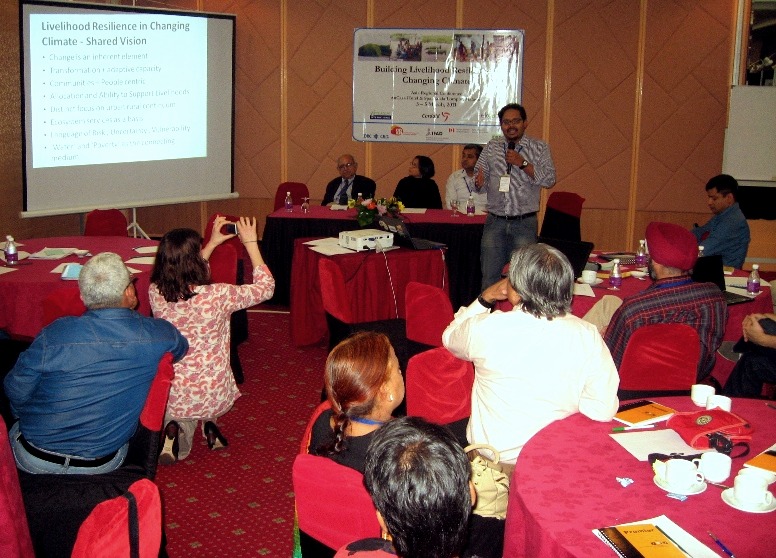
Resilience was discussed and interpreted in a number of ways at the conference. But participants broadly agreed that it is the ability of any individual or community or system to absorb external shocks, bounce back and transform or continue to grow.
Such bouncing back, in some climate related situations, could be to alternatives rather than to the original condition. For example, if poorly built structures are damaged in a disaster or extreme weather condition, the recovery could – and should – be to build back better.
Indeed, the bamboo metaphor is widely used in various fields from business management to self-help counseling. See these interesting links for further insights:
The conference brings together researchers and practitioners from three fields: Disaster Risk Reduction (DRR) and disaster management community; Ecosystem services and conservation community; and the livelihoods and socio-economic development community. Although their work overlap part of the time, they don’t converge too often.
I will blog on different aspects of the conference, trying to connect the dots, and relating the micro to the macro as I often do in my own work communicating development.
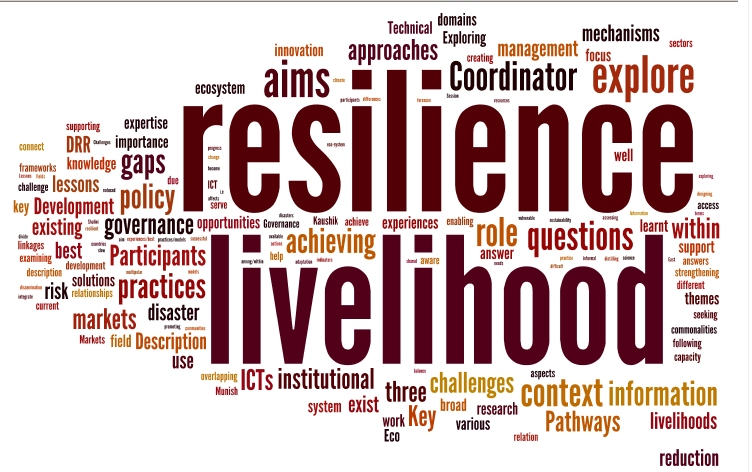
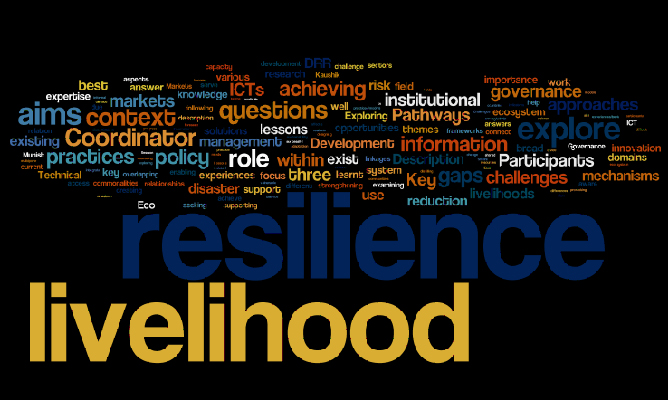
There are many issues, topics and discussions under the broad theme of protecting Asian livelihoods from climate change impacts. For a start, I used Wordle to build a word map, displaying proportionate use of keywords in the conference sessions. The above and below are the word clouds it generated (same words, displayed in different modes).
The conference is organised jointly by Wetlands International-South Asia (WISA), International Development Research Center (IDRC), The Climate and Development Knowledge Network (CDKN), Cordaid and ekgaon technologies of India.
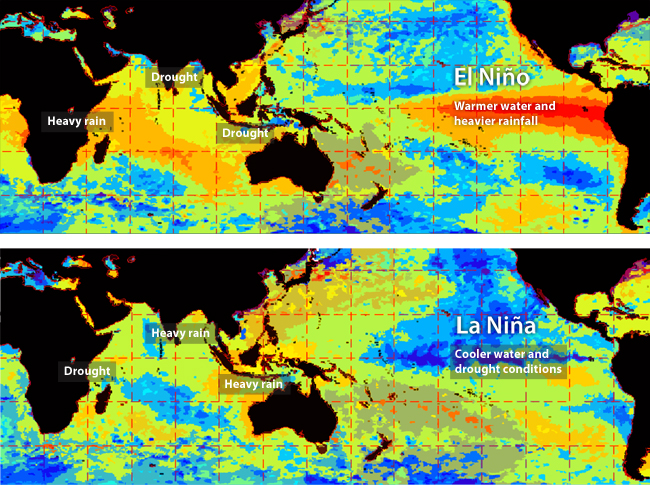
The current spell of heavy rainfall and resulting floods is being blamed on a phenomenon called La Niña. It involves both the ocean and atmosphere.
La Niña occurs when surface temperatures get cooler than normal (by 3 to 5 degrees Centigrade) in the western Pacific Ocean. During a La Niña, the cold water that pools near the coast of South America surges westwards across the mighty Pacific, the largest ocean in the world. This flow causes a greater build up of warmer water along the eastern coast of Australia and in the South East Asia region. The contrast in sea surface temperatures across the Pacific, as well as the contrast in air pressure, produces more rainfall.
La Niña is the Spanish term for “the girl child”. In that literal sense, the current weather extremes might be called the fury of a very formidable young lady! And it’s not the first time she has unleashed such havoc on us. This week in my quiz column, I started off with some questions on freaky weather, and then moved on to other topics.
Other ladies figure in the quiz: from Nobel Prize winning Marie Curie to Harry Potter creator J K Rowling. And we ask about the lady school teacher who died in the Challenger space shuttle disaster in February 1986.
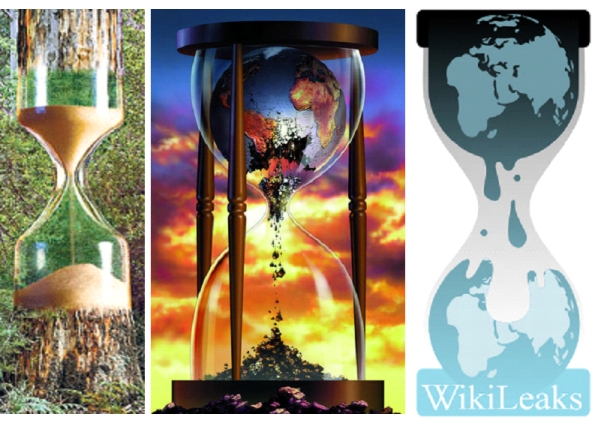
Time is ticking away...but crises also mean opportunities
I like to think and speak in metaphors, especially visual metaphors. Sometimes I coin or design new ones. This illustration is the latest example.
Individual elements in this came from very different sources (thanks to them all). I just mixed them together to make two points during a talk I just gave at the Colombo University.
We live in a crisis-ridden world where we have to cope with multiple emergencies unfolding at the same time, impacting us on different fronts. This illustration captures three of them: crisis in biodiversity, man-made climate change, and the new reality of living in a rapidly WikiLeakable world — what I called the Global Glass House.
We don’t get to choose the timing, severity or duration of any challenge. But we do have some choice over how we respond: we can despair and grumble (blaming the Gods or karma if we believe in those); we can become really alarmist (a la Chicken Little); or we can be measured and smart in how we deal with the seemingly overwhelming situations.
Speaking at the Leaders in Environmental Advocacy Forum (LEAF) on Preserving the Past, Securing the Future on 22 January 2011 at the University of Colombo, I advocated this last option. I also pulled together a number of ideas mentioned on this blog over the past four years.
LEAF was a two-day summit held in Colombo, Sri Lanka, hosted by members of the Elon University’s Periclean Scholar Class of 2011, in partnership with the University of Colombo, the United States Embassy in Colombo, the National Science Foundation of Sri Lanka and Rainforest Rescue International.
In fact, some challenges of living on a warming planet are comparable to coping with a WikiLeakable world: both demand quick adaptation to a new reality. In both cases, governments and society have to change mindset and practices on the go — business as usual is no longer an option. Denialism, or demonising the messenger, won’t take us forward. We need more measured, sometimes even pragmatic responses.
In that process, all-or-nothing is not a viable approach. Waiting for full knowledge and understanding is not feasible either. As I once described it, responding to the planet’s climate and other ecological crisis with partial scientific understanding is akin to many pages of our planet’s ‘operations manual’ being still completely blank — and yet we have to manage the planet to the best of our knowledge, intuition and common sense.
Many of the same principles apply to living in the modern networked info society, where no secrets can be kept that way for too long. The sooner we come to terms with this new reality and adapt, the better.
I’m delighted to see others are addressing these parallels. In my talk, I mentioned a recent essay titled Could climate science become open source? by Brendan Barrett and Sulayman K. Sowe, published earlier this month on the UN University’s Our World 2.0 website.
In their perceptive piece, the authors ask whether climate science would benefit by being more firmly grounded in the principles of openness, perhaps along the lines of the free and open source software communities and open content movements. “The concept of openness behind free and open source software describes a mode of creative knowledge production and sharing in which individuals and communities freely generate and adapt or remix resources (content or software) without licensing restrictions.”
They add: “Proposing a move to a new model of climate science in no way suggests that climate change is not a real and present threat or that we cannot rely on the integrity of our contemporary climate science institutions and scientists. Rather, the argument here is that learning from the way free and open source software projects and communities work may be an important way forward in engendering more effective global, national and local responses to climate change.”
I have always worn multiple ‘hats’, and dabbled in multiple pursuits rather than follow narrow paths of enquiry. I see myself continuing to oscillate between the ‘geeks’ and greens, and where possible, bridging their worlds. It’s really encouraging to see some others straddling the two spheres.
Global Green Awards for Creativity in Sustainability 2010
China’s emergence as a major automobile market has led to high levels of air pollution in the cities. It has also caused an increase in the country’s carbon dioxide emissions that warm the planet.
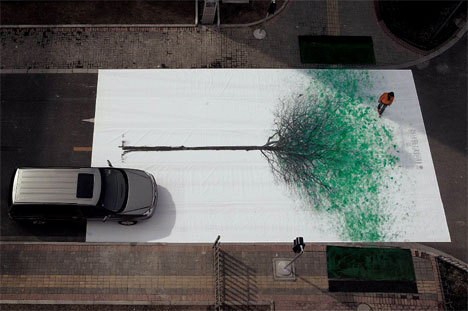
Now, an innovative outdoor campaign, called green pedestrian crossing, is urging Chinese people to walk more and drive less.
This campaign targeted young Chinese people who chose to drive over walking. The campaign involved the creation of an outdoor poster advertisement on pedestrian crossings across 7 thoroughfares in Shanghai.
The Green Awards, presented from the UK, culminated on December 2 with a glittering, ‘green carpet’ event at the Natural History Museum in London. The awards ceremony announced winners for all 16 categories and the 2010 Grand Prix. I was one of the international judges for this year’s awards.
The Green Awards Grand Prix is given to the overall winner which is judged the best amongst all the entries. It is meant to recognise a campaign which, in the opinion of the expert judging panel, best exemplified an outstanding environmental message, and had the greatest capacity to raise public awareness.
Judges were impressed by the creativity shown by the campaign and the simple and effective use of local knowledge. Moreover, the results of the campaign supported the judges’ decision. The campaign reached an estimated 3.9 million people and increased general public awareness about environmental awareness by 86%.
Still from No Pressure film: We do live in The Age of Stupid!Shock therapy is known to work, when handled carefully. We can sometimes shock people out of apathy or indifference, for sure — but the same shock, if overdone, can also numb people or turn them off completely.
That’s certainly the case with a new climate advocacy video film called No Pressure, released on 1 October 2010 by the by the climate mitigation campaign named 10:10.
Written by Richard Curtis and Franny Armstrong (who made the acclaimed 2009 climate documentary, The Age of Stupid) and directed by Dougal Wilson, the film is a tragi-comic attempt to ridicule those who don’t share the same level of concern on global climate change as the climate activists do.
The four-minute film consists of a series of short scenes in which groups of people are asked if they are interested in participating in the 10:10 project to reduce carbon emissions. Those failing to show sufficient enthusiasm for the cause, including two schoolchildren, are gruesomely executed by being blown to pieces.
Well, see for yourself. Caution: this video contains violent scenes that can be offensive to most sensible people:
The normally balanced UK’s Guardian newspaper, which got the online exclusive, introduced the video on 30 September 2010 calling it “attention grabbing” and “pretty edgy.” There were a few others who found artistic or creative merit in the film, which has got high production values — no basement production, this.
But where it fails miserably is in winning any new friends for the climate cause, or at lease to influence people to change their high carbon lifestyles.
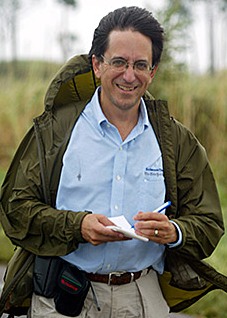
Amdrew RevkinAs Andrew Revkin, who writes the Dot Earth blog for the New York Times,wrote on 1 October: “If the goal had been to convince people that environmental campaigners have lost their minds and to provide red meat (literally) to shock radio hosts and pundits fighting curbs on greenhouse gases, it worked like a charm.”
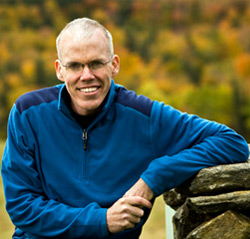
He isn’t alone. Bill McKibben, author, educator and environmentalist — who founded the serious climate group 350.org — wrote on the same day: “The climate skeptics can crow. It’s the kind of stupidity that hurts our side, reinforcing in people’s minds a series of preconceived notions, not the least of which is that we’re out-of-control and out of touch — not to mention off the wall, and also with completely misplaced sense of humor.”
His group, 350.org, issued a statement that emphatically said they had nothing to do with this misplaced British climate extremism. McKibben added, more reflectively: “What makes it so depressing is that it’s the precise opposite of what the people organizing around the world for October 10 are all about. In the first place, they’re as responsible as it’s possible to be: They’ll spend the day putting up windmills and solar panels, laying out bike paths and digging community gardens. And in the second place, they’re doing it because they realize kids are already dying from climate change, and that many many more are at risk as the century winds on. Killing people is, literally, the last thing we want.”
Bill McKibbenNow contrast such concern with the initial reaction from British film maker Franny Armstrong, who wrote a half-hearted, almost defiant apology on the 10:10 UK website, saying: “With climate change becoming increasingly threatening, and decreasingly talked about in the media, we wanted to find a way to bring this critical issue back into the headlines whilst making people laugh. We were therefore delighted when Britain’s leading comedy writer, Richard Curtis – writer of Blackadder, Four Weddings, Notting Hill and many others – agreed to write a short film for the 10:10 campaign. Many people found the resulting film extremely funny, but unfortunately some didn’t and we sincerely apologise to anybody we have offended.”
Adding gross insult to injury, Armstrong signed off saying: “As a result of these concerns we’ve taken it off our website. We won’t be making any attempt to censor or remove other versions currently in circulation on the internet.”
Both the 10:10 UK campaign and its sponsors Sony have been more unequivocal in their apologies in the days that followed. But that’s too little, too late. Enough damage done — climate activists and campaigners worldwide will take months, if not years, to live down this one.
And nothing really goes away on the web — this video will be lurking somewhere for a long time. YouTube currently carries the video in several places, with the warning: “This video or group may contain content that is inappropriate for some users, as flagged by YouTube’s user community.”
Andrew Revkins has posted comments from those who condemned as well as those who found some merit in the offensive climate video. Some of these comments take a dispassionate view, which is to be welcomed.
This incident teaches all of us engaged in environmental communication some important lessons. Environmentalists have over-stated their case before, and every time, that did them (and their causes) far more harm than good. Crying wolf, and ridiculing the non-believers, are never good tactics in winning friends or influencing people.
As Bill McKibben noted: “There’s no question that crap like this (video) will cast a shadow, for a time, over our efforts and everyone else who’s working on global warming. We’re hard at work, as always, but we’re doing it today with a sunk and sad feeling.”
One more thing: even in this age of globalised media, humour doesn’t travel well across cultures and borders. As mainstream corporate media companies have often found out, British humour sometimes doesn’t even cross the Atlantic very well — let alone to other parts of the world. Perhaps this is a key point that this all-British team of film makers and campaigners simply missed.
The world is a bit bigger — and more diverse — than your little island, Ms. Armstrong. By failing to grasp that, and with your crude display of insensitivity, you have really proved the premise of your good climate film.
Who says environment is a ‘safe’ subject for journalists and broadcasters to cover?
Journalist colleagues who work on conflict, security and political topics often have an illusion that environmental reporting is a ‘cosy and comfortable beat’ – one that allows reporters to travel to exotic locations, see cuddly animals, relax in pristine environments and generally take things easy.
That might have been the case some years ago, in another century that’s now receding in our memories. But not any longer: there’s as much conflict, intrigue and complexity in many of today’s environmental topics, and covering them can often be hazardous to the courageous journalists who go after them.
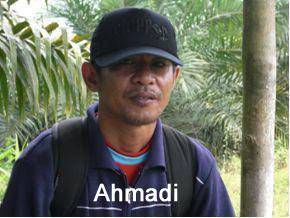
Ahmadi: Beaten up for exposeJust ask Ahmadi, a journalist working for Harian Aceh in Indonesia. Together with a fellow journalist, working for News Investigasi in Medan, he recently investigated a flood that had taken place in the Alapan district in April 2010. During their journey, they met some people cutting up logs. The journalists asked workers who owned these logs and were told that they belonged to the Alapan District Police Station and the Alapan Military Sub-District Command. Hmm…
When confronted with this information, a high ranking military officer reacted quickly and sharply: he wanted the whole story suppressed. In defiance, Harian Aceh published the story on 21 May 2010 — which resulted in Ahmadi being assaulted and threatened with death by the same officer.
“Ahmadi joins the long list of journalists who have been targeted for shedding light on deforestation, which is responsible for at least 18 per cent of the world’s greenhouse gas emissions,” says Reporters Without Borders (RSF), the international watchdog on media freedom.
It says attacks on journalists and bloggers who try to cover any kind of environmental damage are growing steadily all over the world. Among them, those who investigate industrial pollution or the destruction of forests are particularly at risk.
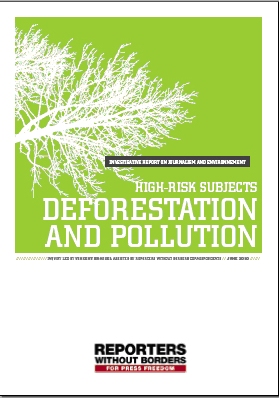
No longer a cosy beat...This week, on the eve of World Environment Day (5 June), RSF released a new report titled Deforestation and pollution: High-risk subjects. It makes grim reading for all of us who are committed to journalism as if the planet mattered.
It follows and echoes their call last year: “We must defend journalists who expose attacks on the environment”.
The new report, the second of its kind within just a few months from RSF, was prepared with the help of its worldwide network of correspondents. They gathered information about incidents in Indonesia, Argentina, El Salvador, Gabon, India, Azerbaijan, China and Morocco. Behind each of these threats and attacks, there were big corporations, criminal gangs or government officials who had been corrupted by money from mining or logging.
Asia features prominently in the report, which condemns the responsibility of the Vietnamese and Chinese governments in serious press freedom violations that deprive the public of crucial information about cases of pollution or deforestation.
The report describes, for example, the way the government in Hanoi has tried to suppress any debate about the environmental impact of bauxite mines being operated by a Chinese company. A field investigation in Argentina established that journalists are under pressure from both supporters and opponents of a mining project.
Mining companies (Aluminium Corp of China, China Metallurgical Group and the Canadian companies Yamana Gold and Pacific Rim), oil companies (Shell, Addax and Synopec), wood pulp companies (Sinar Mas and Riau Andalan Pulp and Paper) and two French multinationals (Bollor and Areva) are all identified in this report as having a direct or indirect role in cases of intimidation or censorship.
This is the second report that RSF has published on this subject. In September 2009, a report titled “The dangers for journalists who expose environmental issues.“, looked at 15 cases of journalists and bloggers who had been killed, attacked, jailed, threatened or censored for covering environmental problems in Russia, Cambodia, Bulgaria and Brazil.
RSF this week reiterated the appeal it launched during last December’s Copenhagen Summit: The media are needed to gather information and disseminate it to the public. Where climate change was concerned, it reminded everyone one, it was the media who helped to establish credible, independent diagnoses of the state of our planet. Their analyses continue to play a crucial role in helping decision-makers to adopt policies and rules that will lead to the desired changes.
On this blog, we have consistently highlighted the need for safeguarding journalists who pursue environmental stories that threaten vested interests within and across borders. For example:
In April 2007, we asked: Can journalists save the planet? Yes, they can be front-runners in the world’s attempts to save species, habitats and entire ecosystems. But only if the rest of society protects and stands by them. When our planetary house is on fire, shooting the messenger isn’t going to save anyone.
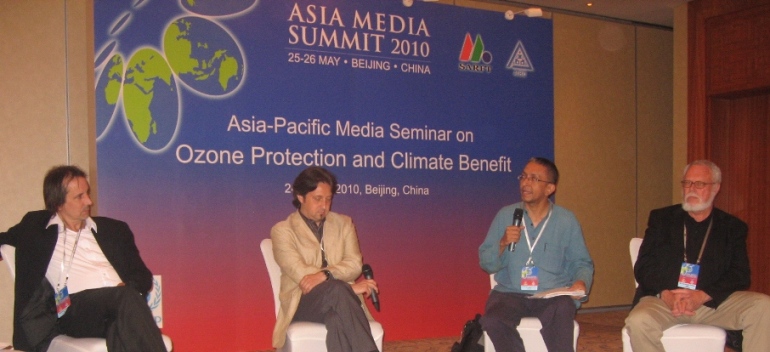
L to R: Sam Labudde (EIA); Eric Soulier (Canal France International); Nalaka Gunawardene (speaking); and Durwood Zaelke (IGSD)
Every year, a couple of weeks before Christmas, a big Climate Circus takes place. The venue city keeps changing, but the process is always the same: it attracts thousands of people – from government officials and scientists to activists and journalists – who huddle in various corners, chat endlessly and gripe often during two chaotic weeks. Then they disperse, rather unhappy with the process…only to return to more of the same a year later.
This is how I see the annual Conference of Parties (COP) of the UN Climate Convention, or UNFCCC. Their last big ‘circus’ was in Copenhagen, Denmark — when the world held its breath for a breakthrough in measures to reduce greenhouse gas emissions that warm up the planet. But, as with many previous conferences, Copenhagen over-promised and under-delivered.
The next COP is to take place in Cancún, Mexico, in December 2010. We can expect more of the same.
I’m not always this cynical. I’m certainly not a climate skeptic or climate change denialist. But I came to this conclusion after covering climate change stories for over 20 years, and having seen the kind of distraction the annual Climate Circus can produce on the media coverage and fellow journalists.
My contention: COPs were intended for treaty-signing governments to come together, bicker among themselves and make slow, painful and incremental progress on what needs to be done to address the massive problems of global climate change. While the core of these conferences remains just that, over the years they have gathered so much else — side events that now completely outweigh the political conference, and often overshadow it. I’m not convinced that this is where the real climate stories are, for discerning journalists.
I was on the last panel for the day, which looked at the next “hot” ozone and climate related stories. We were asked to give our views on: what are the great stories on the road to COP16 in Mexico at the end of the year?
Forget Cancun, I said. We already know how little it’s going to change the status quo. Why bother with that promises to be a non-event? Must we be this concerned with non-stories in our media coverage? In fact, I suggested: we should give the entire UNFCCC processes a couple of years of benign neglect. The real climate stories are not in the unmanageable chaos that the annual Climate Circuses have become. They are out there in the real world.
In the real world where frontline states and communities are already bearing the brunt of extreme weather…where green energy is making rapid advances…where communities and economies are trying to figure out how to live with climate change impacts even as they reduce their greenhouse gas emissions.
There are plenty of climate stories out there, covering the full range of journalistic interests: human interest, human enterprise, innovation, scientific research, community resilience and others. The challenge to journalists and other climate communicators is to go out there, unearth the untold stories, and bring them out in whatever media, forum or other platform.
I have nothing against climate COPs per se, and hope they can be restored to their original purpose of climate negotiations and working out acceptable, practical ways forward. (And this is certainly not a case of sour grapes: I’ve turned down all-expenses-paid invitations to COPs more than once.)
But we need to be concerned about the Climate Circus Effect on media, activist and educator groups, who seem to dissipate a good deal of their limited energies and resources in turning up at these mega-events. Copenhagen is said to have attracted over 17,000 persons (over 3,000 among them accredited journalists). How much of fruitful interaction and sharing can happen in such a setting? And when all the major news networks and wire services are covering the key negotiations and activities in considerable detail, what more can individual journalists capture and report to their home audiences?
Living as we do on a warming planet, we are challenged on many fronts to question old habits, and change our business-as-usual. The media pack has been running after the Climate Circus for over a dozen years. We need to pause, take stock and ask ourselves: is this the best way to cover the climate story?
And while at it, here’s something else for the UN, conveners of the annual Climate Circus. On World Environment Day 2008, whose theme was ‘CO2: Kick the Habit’, I asked the UN to kick its own CO2 habit. I suggested: “Adopt and strictly observe for a year or two a moratorium on all large UN gatherings (no matter what they are called – Summits, conferences, symposia, meetings, etc.) that involve more than 500 persons. In this day and age of advanced telecommunications, it is possible to consult widely without always bringing people physically together….Practising what you preach has a strong moral persuasive power — even if it goes against addictive habits formed for over 60 years of the UN’s history.”
PS: A global, comprehensive and legally-binding agreement on climate change is unlikely to be delivered at this year’s (Cancun) conference as well, the outgoing head of the UNFCCC, Yvo de Boer, was reported as saying on 27 May, just a few days after our Beijing seminar. See what I mean?
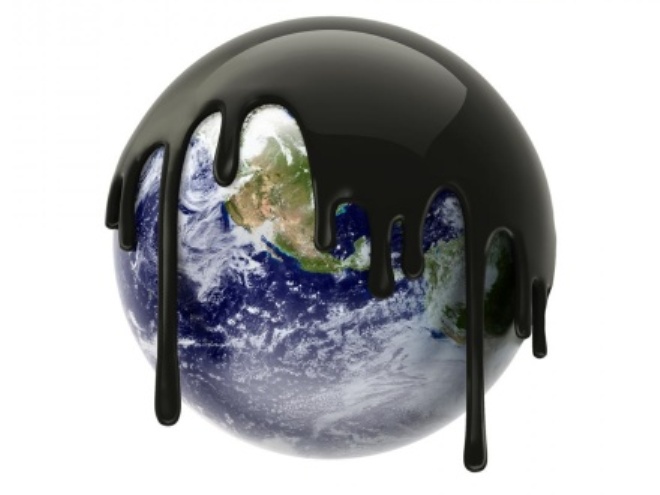
A monstrous oil spill is gushing as much as 2,500,000 gallons of crude a day into the Gulf of Mexico.
This disaster is expected to be catastrophic for the land and people in the gulf. The oil has already reached land, contaminating wildlife sanctuaries. Authorities are so concerned about the impacts of more oil reaching land that they are prefer to set the gulf on fire, burning as much of the oil as possible.
Meanwhile, the fossil fuel industry is raking in windfall profits. BP, which operated the sunken rig, more than doubled its first quarter profits in 2010 to $5.65 billion.
I’ve just signed an urgent petition at Avaaz.org urging U.S. law-makers to overturn plans to expand offshore drilling. As the latest massive oil spill shows, offshore drilling isn’t safe or clean. The world needs clean energy investment to tackle climate, not expansion of dangerous and dirty energy sources.
Addressed to President Obama and members of Congress, it reads, simply: “We urge you to permanently call off plans to open up more of the US coastline to dangerous offshore drilling. Instead, invest in a clean and safe energy future.”
As Avvaz.org notes, “Before the spill, U.S. President Obama and Congressional leaders were planning to ramp up offshore drilling. Now, with the spill, the politics have shifted — and an opportunity has opened for the world’s biggest historical climate polluter to shift away from oil and towards climate-safe energy sources. At a moment like this, when leaders are making up their minds, the world’s voices can help tip the balance.”
Let’s hope it works – but the world is so addicted to its oil, and the petro dollars are so powerful – don’t hold your breath on this…




 Open Minds!