New media anarchy is good for you!

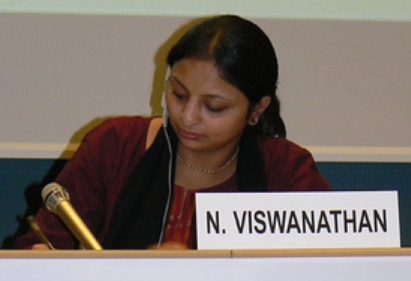
neha-viswanathan.jpg

“You people are too well mannered! I’ve never been to a conference where people are so properly dressed and so polite to each other!”

With these words, Neha Viswanathan made sure she had everyone’s attention. But it was not just a gimmick — she was contrasting the relatively more orderly, organised world of mainstream media (MSM) with the decidedly more anarchic world of new media — including blogs, wikis, YouTube and Second Life.

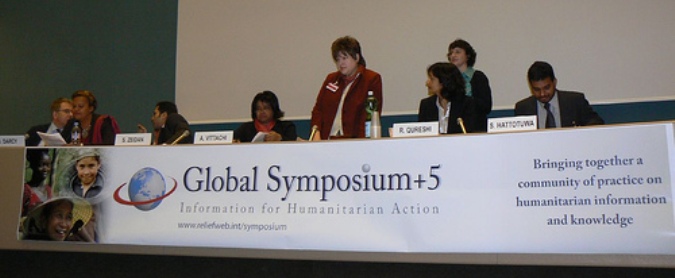
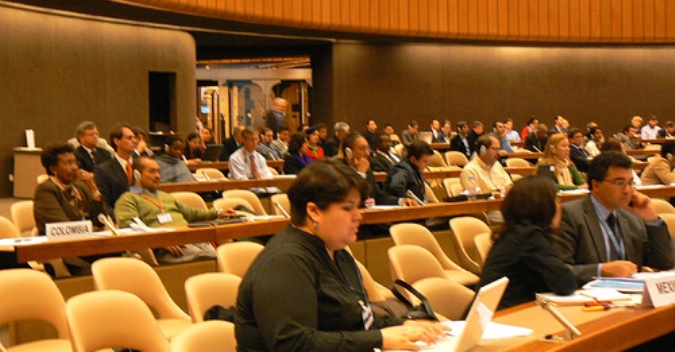
Neha, South Asia Editor of Global Voices, was speaking on a panel on ‘new media’ during the Global Symposium+5 on ‘Information for Humanitarian Action’ in Geneva this week (22 – 26 Oct 2007).

The panel topic itself showed the rapid change taking place in the humanitarian sector. As the panel premise said: “Within minutes of a disaster or conflict, the first images are seen on YouTube rather than CNN, and probably to a larger audience. YouTube, Flickr and blogging are bringing wars, disasters and their humanitarian consequences to the attention of the public, government and aid agencies more efficiently than ever. It’s now possible to keep watch on a Darfur village through satellite imagery, or take a virtual tour of a refugee camp.”

The panel was to discuss whether citizen journalism and new collaborative/ networking technologies are improving humanitarian response, and review how the humanitarian community is faring in this new environment.

My own views on this are found in another blog post: New media tsunami hits humanitarian sector – rescue operations now on!

Neha’s take was slightly different. She started reminding everyone that the new media activists were unruly and not always polite. The blogosphere is very much a contested and contentious space where arguments rage on. Not everything is moderate, balanced or ‘evidence-based’ (to use a new favourite phrase of the humanitarian community).

But in times of crisis or emergency – whether disasters or war – new media activists are increasingly the first responders. The anarchic nature actually provides them with an advantage: they are distributed, self-organising and motivated. There is no central newsroom or coordination point telling them what to do. In typical Nike style, they just do it.

As an example, she described World Wide Help, whose introduction reads: “Using the web to point help in the direction where it’s most needed”.

This blog was started by several founders and members of the SEA EAT (South East Asian Earthquake And Tsunami) blog, wiki and database, all of which gained worldwide attention at the time of the Indian Ocean earthquake and tsunami on 26 December 2004. The group, now calling themselves The World Wide Help Group, has since remobilised to aid in other relief efforts.

Read the whole story of the SEA EAT Blog: A Candle in My Window by Peter Griffin, one of its co-founders

As Sir Arthur C Clarke has also noted, the 2004 tsunami marked a turning point in how citizen journalists and other new media activists respond to emergencies. Since then, the power of new media has been unleashed on many public interest issues and humanitarian causes. As an example, Neha cited the online campaign against street sexual harassment in India.

In Neha’s view, new media can collate authentic testimonials of those directly affected by disasters or other crises, and keep the public attention (and thereby, political interest) on emergencies beyond the first few days.

Her advice to humanitarian aid agencies: keep looking at the new media, especially blogs, to find out what people at ground zero are saying about relief and recovery work.

“Bloggers are not objective – they talk openly, and express themselves freely,” she told the largely prim and proper Geneva audience, where some participants had referred to the meeting as ‘this august gathering’!

Finally, in situations where MSM (the formerly big media!) are shut down, restrained or intimidated into not carrying out their watchdog role, it’s the new media that fills the voice. Neha described the pro-democracy struggles in Nepal in 2005 – 2006 as an example where the people power struggles continued to be reported and commented on after the autocratic king clamped down on all print and broadcast media.

Read my August 2007 blog post: The Road from Citizen Kane to Citizen Journalist

Message to aid workers: Go mobile — or get lost!

banner.jpg

“MY NAME is Mohammed Sokor, writing to you from Dagahaley refugee camp in Dadaab. Dear Sir, there is an alarming issue here. People are given too few kilograms of food. You must help.”

This short, urgent message of a single individual has already joined the global humanitarian lore. It was sent by SMS (a.k.a. mobile texting) from the sender’s own mobile phone to the mobiles of two United Nations officials, in London and Nairobi. Sokor found these numbers by surfing at an internet café at the north Kenyan camp.

The Economist used this example to illustrate how the information dynamics are changing in humanitarian crises around the world. In an article on 26 July 2007, titled ‘Flood, famine and mobile phones’, it noted:
The age-old scourge of famine in the Horn of Africa had found a 21st-century response; and a familiar flow of authority, from rich donor to grateful recipient, had been reversed. It was also a sign that technology need not create a ‘digital divide’: it can work wonders in some of the world’s remotest, most wretched places.”

Elsewhere in the article, it added: “Disaster relief is basically a giant logistical operation. Today’s emergency responders can no more dispense with mobile phones or electronically transmitted spreadsheets than a global courier company can. But unlike most couriers, aid donors operate amid chaos, with rapidly changing constraints (surges of people, outbreaks of disease, attacks by warlords). Mobile phones increase the flow of information, and the speed at which it can be processed, in a world where information used to be confused or absent. The chaos remains, but coping with it gets easier.

image-from-wikimedia.jpg
Image courtesy WikiMedia

All available indicators suggest that the future of humanitarian assistance is going to be largely dependent on mobile communications. Despite this reality, old habits die hard. I sat through an entire presentation on ‘Innovation to Improve Humanitarian Action’ at the Global Symposium+5 on ‘Information for Humanitarian Action’ in Geneva this week — and not once did I hear mobile phones being mentioned. A group of 15 – 20 people had deliberated for 2 days to come up with their vision of ‘the potential of emerging technologies and approaches used in the field and globally to strengthen information sharing, coordination and decision-making’ in humanitarian work.

It might be that aid workers are all frustrated computer geeks…because all their talk was about collaborative and networking software, Geographic Information Systems (GIS), the use of really high resolution (read: oh-so-sexy) satellite imagery, and the latest analytical tools — all requiring high levels of skill and personal computers with loads of processing power.

But no mobile phones! This was too much to let pass, so I raised the question: did you guys even consider this near ubiquitous, mass scale technology and its applications in crisis and disaster situations? And how do you engage the digitally empowered, better informed disaster survivors and crisis-affected communities?

I also recalled the example of Aceh tsunami survivors keeping each other informed about the latest arrivals of relief supplies – all through their mobile phones (as cited by the head of MERCY Malaysia on the previous day).

It turned out that they did discuss mobiles — well, sort of. Amidst all the gee-whiz talk about high tech gadgets, I received a short answer: widespread as mobile phones now are, ‘these systems are not fully integrated or compatible with other information platforms’ — whatever that means! The group’s spokespersons also pointed out that since mobile services are all operated by commercial (telecom) service providers, using their networks involves lots of ‘negotiations’. (I would have thought it’s the same with those who operate earth-watching or communications satellites.)

The message I heard was: mobile phones are probably too down-market, low-tech and entirely too common for the great humanitarian aid worker to consider them as part of their expensive information management systems. For sure, everybody uses them to stay in touch in the field, but what use beyond that?

What uses, indeed. If today’s aid workers ignore the mobile phone revolution sweeping Africa, Asia Pacific and, to a lesser extent, Latin America, they risk marginalising their own selves. The choice seems to be: go fully mobile, or get lost.

Fortunately, the panel discussion that followed — on ‘Envisioning the Future’ — partly redressed this imbalance. The panel, comprising telecom industry, citizen media and civil society representatives, responded to the question: what will our humanitarian future look like and what role will information play in supporting it?

panel-3-on-envisioning-the-future.jpg

Leading the ‘defence’ of mobiles was Rima Qureshi, head of Ericsson Response, part of the global mobile phone manufacturer’s social responsibility initiatives. She reminded us there were now 3.4 billion (3,400 million) mobile phones in the world — and it was growing at 6 new mobile connections every second. By the time she ended her 8-minute talk, she said, some 3,000 new mobiles would have been connected for the first time.

This represents a huge opportunity, she said, to put information into everyone’s hands whenever and wherever they need it. And mobiles are all about two-way communication.

The new generation of mobile phones now coming out are not locked into a single telecom network, and have built-in global positioning (GPS) capability. This means the phone’s location can be pinpointed precisely anywhere on the planet — which can be invaluable in searching for missing persons in the aftermath of a disaster.

Wearing her Ericsson prophet’s hat, Rima said: “Everything we can do on a personal computer will soon become possible on a mobile. Mass availability of mobile phones, able to connect to the global Internet, will represent a big moment for human communication.”

And not just Ericsson, but many other mobile phone makers and network operators are rolling out new products and services. The new mobiles are easier to use, more versatile and durable, and come with longer-lasting or renewable sources of power. Wind-up phone chargers have been on the market for some years, and some new mobile phones come with a hand-cranking charging device that makes them entirely independent of mains electricity. With all this, the instruments keep getting cheaper too.

And if aid workers ignore these and other aspects of mobile realities, they shouldn’t be in their business!

1743641460_63092b452a.jpg

Rima described another Ericsson initiative called Communication for All. It’s trying to harness the power of shared network, across commercial telecom operators and networks (but with some development funding from the World Bank) to deliver coverage to rural areas that aren’t as yet covered fully. The rolling out of coverage would have profound implications for disaster managers and aid workers.

As James Darcy, Director of humanitarian aid policy at the UK’s Overseas Development Institute, noted from the chair, the future of humanitarian communication is already here — but the sector needs to have more imagination in applying already available technologies for new and better uses.

My colleague Sanjana Hattotuwa, ICT researcher and activist from Sri Lanka, made the point that 3.4 billion mobiles raise new ethical considerations. For example, while it is now technologically possible to track the movement of every mobile phone – and therefore, in theory, each unit’s owner – this knowledge can be abused in the wrong hands. (I’ll write a separate blog post on Sanjana’s other remarks.)

Not everyone in the audience was convinced about the future being mobile. Soon enough, the predictable naysayer popped up: saying only 2.4 per cent of people in Sub-Saharan Africa as yet owned mobile phones, and Internet access was limited to only one per cent. Blah, blah, blah! (I was half expecting someone to blurt out the now completely obsolete – but sadly, not fully buried – development myth that there are more phones in New York city than in the whole of sub-Saharan Africa. That didn’t happen.)

Funny thing was, we were discussing all this at the Palais des Nations, the European headquarters of the UN, which is just literally across the street from the headquarters of the International Telecommunication Union (ITU), the authoritative monitor of telecom and ICT industry data and trends! It seemed that the gulf between some humanitarian workers and the telecom industry was much bigger than that.

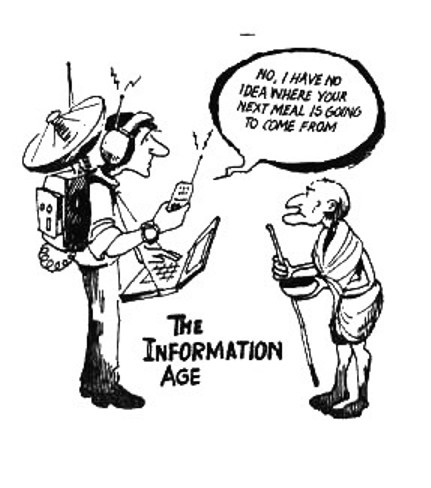
Of course, being connected – to mobile, satellite and every other available information network – is only the first step. We can only hope humanitarian workers don’t end up in this situation, captured in one of my all-time favourite ICT cartoons (courtesy Down to Earth magazine):

copy-of-all-inf-no-solutions.jpg

Read about Sri Lanka’s pathfinding action research by LIRNEasia and others: Last Mile Hazard Information Dissemination Project

All Geneva photos courtesy UN-OCHA Flickr on Global Symposium+5

A million video cameras to change the world!

Something remarkable is happening with online public video sharing platforms: progressive non-profit groups worldwide are seizing their power to do good.

YouTube started off more like the people’s version of funniest home videos. But it’s no longer confined to that category. Activist and social groups are increasingly uploading their videos. As broadband Internet rolls out around the world, more people are actually able to watch these videos online.

In response, YouTube, owned by search giant Google, is creating a special section for nonprofits to air their videos and link them to its Google Checkout online payment system to receive funds directly.

“Nonprofits understand that online video isn’t just a way to broadcast public service announcements on a shrunken TV set,” Reuters quoted Steve Grove, head of news and politics at YouTube, as saying. “It’s a way to get people to do more than just absorb your message but to engage with their user generated content as well.”

Pure Digital, maker of the Flip video camera, has said it plans to give away a million video cameras to non-profit organizations around the world to capture images and moments in places traditional media outlets might not be able to reach.

“Video has power and media has power but the challenge is that the media is limited to telling stories that are controlled by a very small number of people,” Jonathan Kaplan, chief executive of Pure Digital, told Reuters. “This program along with YouTube and other sites will expand the media universe for learning what’s really going on in the world,” he said.

Visit FlipVideo website on support for non-profit groups

Reuters quotes the recent example of the impact of clips of the Myanmar army’s confrontations with local protesters which were posted on YouTube and other Web sites. Some of the clips made their way to mainstream news media, which were blocked out of entering or covering events in Burma.

See an example of a YouTube video on what’s happening in Burma:

Our friends at Witness, an activist group founded by the musician Peter Gabriel in 1992, has long specialised in raising awareness of such previously unseen events through video. Sam Gregory, programme director at Witness, says online distribution has made it easier to put videos in front of the right people such as decision makers and others with a personal connection to the cause.

“It’s not necessarily about the size of the audience it’s about placing targeted video and turning ‘watching’ into action,” said Gregory.

Read the Reuters story on 19 Oct 2007: Nonprofits turn to YouTube to raise awareness, funds

My blog post on 1 Oct 2007: Shoot on sight: Rights Alert on Burma

My blog post on 30 Sep 2007: Kenji Nagai: Filming to the last moment

TVE Asia Pacific News story March 2007: TVEAP films now on YouTube

What’s happening with online video has a parallel in how activist groups seized the potential of the hand-held video camera. The handicam was invented in 1985 by Sony. Intended originally for entertainment and domestic documentation purposes only (ranging from family vacations and weddings), it did not take long to find new uses for this revolutionary technology.

The Handicam Revolution in media began when a video camera captured police beating Rodney King on a Los Angeles highway. The shocking amateur footage was broadcast on TV around the world. The acquittal of the police officers after their first trial sparked outrage, and riots erupted in a 20 block section of Los Angeles, leaving 54 people dead and over 2,000 injured.

Ever since Rodney King, broadcasters have been using amateur video to provide images of events that their own camera people have not captured. And human rights activists have started relying on the power of video images to capture the attention of the broadcasters to expose acts of human rights abuse and violation.

Ram Bahadur Tamang: The face of Film South Asia

ram-bahadur-tamang.jpg ram-bahadur-tamang.jpg

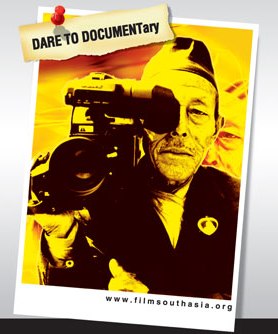
For ten years, this ordinary Nepali man’s photo has been a rallying call for documentary film-makers across South Asia, home to one fifth of humanity.

He has become the symbol, and the logo, of Film South Asia (FSA), a regional film festival organised every other year in Kathmandu since 1997. FSA, whose latest edition rolls out in the Nepali capital this week (11 – 14 October 2007) is the leading and most enduring film festival that brings together South Asian film-makers and film-lovers. It is a low-budget, high-energy festival organised by the non-profit Himal Association.

Having been associated with FSA from the beginning (I was on the first festival’s jury, and have hosted a couple of travelling festivals since), I was curious about who this old man was. On a visit to Kathmandu last month, I asked FSA Chairman and documentary champion Kanak Mani Dixit about it.

It turns out that the FSA logo is derived from this photo, taken of an ordinary Nepali called Ram Bahadur Tamang. Photocredit goes to Cory R Adams.

Courtesy Himal Southasian

Ram Bahadur belonged to the Tamang people, who are believed to have migrated to Nepal from Tibet. Today, the Tamangs reside mainly in the high hills north of Kathmandu.

Perhaps inspired by my query, Kanak has written up the story behind the photo/logo in his column On the Way Up in the latest issue of Himal Southasian which he edits.

He says: “The Tamang from Byabar served the Rana palaces as guards and porters. Ram Bahadur was one such. One day, he was caught by a photographer holding an early-model Sony video camera. He had a Sirdi Sai Baba badge on his left lapel. The image of Ram Bahadur is now the logo of the Film South Asia documentary film festival. He looks out over the world through his camera and his other, free, eye. The trophy given to the best film at the end of each FSA is known as the Ram Bahadur Trophy.”

Not much more is known about old Ram Bahadur. He had moved on shortly after this picture was taken. We don’t know, for example, if he ever actually used the Sony camera, or was just playing with what, at the time, seemed a high-tech curiosity. This was, after all, the early 1990s when video cameras were not quite ubiquitous.

Read Kanak Mani Dixit on Who’s Ram Bahadur Tamang in Himal South Asian October 2007

Read my July 2007 post: Himal Southasian – 20 years of celebrating South Asian diversity

Crossing the other Digital Divide: Challenge to conservation community

Digital Divide refers to the gap between those who have regular, easy access to modern information and communication technologies (ICTs) and those who don’t. In the past decade, the IT industry and development community have launched various initiatives to bridge this divide. The One Laptop Per Child project is among the better known examples.

As digital technologies and media gain momentum and wider coverage than ever before, another kind of digital divide has emerged. This week in Kathmandu, during the Fourth Asian Conservation Forum, some of us have been talking about this new divide — between the Digital Natives and Digital Immigrants.

This latter divide is mainly a product of age, not socio-economics. Market research and sociological studies now confirm that today’s younger people – raised on a diet of mobile phones, video games and mp3 (music) players – have radically different ways of accessing, receiving and coping with information.

Recognising this new Digital Divide is vital for communication and advocacy work of conservation groups, such as IUCN – The World Conservation Union, conveners of the Kathmandu forum.

For nearly 60 years, IUCN has been an effective platform for knowledge-based advocacy. Using scientific evidence and reasoning, it has influenced conservation policies, laws and practices at country and global levels. The world would be a worse place to live in if not for this sustained advocacy work by thousands of experts and activists who were mobilised by IUCN.

Much of that work has been accomplished through the classical advocacy tools: scientific papers, books, conferences and, in recent years, ‘policy dialogues’ — meetings where experts and activists would sit down and talk things through with those who make policy in governments and industry.

IUCN continues to pursue all these methods, with creditable impact. IUCN’s Red List of Threatened Species, whose latest edition is being released today (12 September 2007), is among the best known examples of how the Union’s work informs and inspires urgent action for saving the world’s animals and plants driven to the edge by human activity.

To remain similarly effective in the coming years, IUCN — and the rest of the conservation community — need to evolve and adapt to changing realities in human society. One such reality is the proliferation of ICTs in the past two decades.

The International Telecommunications Union (ITU) announced recently that the world’s telephone connections had passed four billion. Largely thanks to the explosion of mobile phones in the majority world, the total number of telephones (fixed and mobile) had quadrupled in the past decade.

While exact figures are hard to come by, it is estimated that around 1.17 billion people (almost 1 in 6 persons) have access to the Internet, even though varying levels of quality.

These are the more widely quoted figures, but the media mix keeps diversifying even as the size of the overall ‘ICT pie’ keeps increasing. For example, the 1990s saw a channel explosion in both FM radio and television across much of Africa, Asia Pacific and Latin America, hugely increasing viewers’ choice and enhancing the outreach of broadcasting. The popularity of video games (and now, online games) has spawned trans-boundary subcultures that were inconceivable even a decade ago.

It is this bewilderingly media-enriched world that IUCN’s members and experts are trying to engage, hoping to persuade everyone — from governments and industry to communities and individuals — to live and work as if the planet mattered.

In Kathmandu this week, I argued that scientific merit and rational (and often very articulate) reasoning alone won’t win them enough new converts to achieve significant changes in lifestyles, attitudes and practices. To be heard and heeded in the real world outside the charmed development and conservation circles, we need to employ a multitude of platforms, media and ICT tools. And we have to talk in the language of popular culture.

We have come a long way since the 1980s, with the new ICTs evolving parallel to our own understanding of sustainability.

When we were involved in processes leading up to the Earth Summit in Rio de Janeiro, back in 1992, most of us were still using fax and snailmail to exchange information. Email was confined to academic circles and the web was not even conceived.

By the time Johannesburg Summit was held a decade later, email had come into wide use and static websites were being used to disseminate information and opinions. E-commerce and music file sharing were gaining momentum.

Just five years on, the rapidly evolving web 2.0 offers us more tools and platforms to not just engage in one-way dissemination, but to truly communicate with a two-way flow. Wikis allow participatory document drafting. Web logs or blogs enable faster, easier expression and discussion. YouTube and other platforms have suddenly made sharing of moving images much simpler (assuming we have sufficient bandwidth).

In fact, connectivity is improving in many parts of the world, though there still are many gaps, frustrations and cost issues to be resolved. Young people, under 25 years, are leading the charge in entering and ‘colonising’ the new media. Social networking platforms such as MySpace and FaceBook are only the tip of this cyber iceberg. And virtual worlds — such as Second Life, with over 8 million online members — are moving in from the periphery to occupy a clear niche in our new digital world.

800px-web_20_mapsvg.png

Every indication is that these trends will continue. IUCN and other conservationists, with their rigorous scientific analysis expressed in technical papers, print publications and the occasional op ed article in a broadsheet newspaper, have to navigate in this whirlpool — and it’s not easy. But their choice is between engagement and marginalisation. The planet cannot afford the latter.

I’m not suggesting that conservation scientists and organisations must drop their traditional advocacy methods and rush to embrace the new ICT tools. But they need to survey the new media landscape with an open mind and identify opportunities to join the myriad global conversations.

A good part of that is what intellectuals might see as chatter, or tabloid culture. It’s precisely this mass tabloid audience that needs to be engaged for conservation.

There are inspiring examples of how other sections of the development spectrum are seizing new media opportunities:

* Some humanitarian groups now use Google Earth online satellite maps for their information management and advocacy work, for example in Darfur, Sudan, and the Central African Republic.

* In an attempt to name and shame offenders, human rights activists are using YouTube to post incriminating video evidence of human rights abuses worldwide. The influential Foreign Affairs journal recently called this the YouTube Effect.

Fortunately, at least a few Asian conservation leaders already appreciate this enormous new media potential. In Kathmandu, Surendra Shrestha, UNEP’s regional director for Asia Pacific, echoed my views.

“My young kids spend several hours each weekend in virtual worlds. We need to get in there and engage them with our content,” he said. “To do that, we have to get inside their minds, and speak their language.”

Shrestha mentioned how UNEP in Asia is attempting this with ICT-based projects for youth, such as e-generation which, according to him, has involved half a million young people.

Such initiatives are beginning to happen, thanks to a few conservationists who are pragmatic enough to exploit the inevitable. But much more needs to be done to make conservation ‘cool’ and hip for Asia’s youthful population, half of them under 35, and many of them Digital Natives.

For sustainability measures to have a chance of success, these upwardly mobile, spend-happy youth have to be reached, touched and persuaded. If it takes tabloid tactics to achieve this, so be it.

And given Asia’s growing economic clout and ecological impact – with China and India leading the way – the fate of the planet will be decided by what is done, or not done, in our region.

While they debate the finer points of conservation strategies and activities in Kathmandu, Bangkok and other cities across our massive region, Asia’s conservation community must quickly cross the new Digital Divide that currently separates them from Digital Natives.

Declaration of interest: I was part of IUCN Sri Lanka Secretariat (1992-1994), where I started its communication division, and have been a member of IUCN Commission on Education and Communication since 1991.

Read my April 2007 post: Do ICTs make a difference?
Internet People: Can you spot who everyone is?

This is an amusing and clever video I’ve just come across on YouTube: Internet People. As its creators say “it’s an animated tribute to the internet people of the world, wherever you may be.”

It celebrates those ordinary people who found expression — and sometimes, fame — on YouTube before political campaign managers and corporate spin doctors realised its potential.

Animated by Dan Meth, with music by Dan Meth and Micah Frank, Internet People captures and celebrates our shared Internet experiences over the last half-decade with cartoon caricatures that are somehow funnier than the original footage.

“I dare you to watch it just once—or to get all the references after even three viewings,” says animator Meth.

Dan Meth is about to have his own cartoon series – the Meth Minute 39 – on Channel Federator. So watch out!

The Road from Citizen Kane to Citizen Journalist

From Citizen Kane to Citizen Journalist.

That’s the original title given to an essay that I co-wrote with Sir Arthur C Clarke nearly two years ago, at the invitation of the Indian news magazine Outlook.

The editors of Outlook changed it to Arise, Citizen Journalist! — which was fine, though perhaps not as poignant.

Of course, our original title would make sense only if you know what Citizen Kane means. That’s the name of the famous 1941 movie directed by Orson Welles, based on the life and career of American newspaper publisher Charles Foster Kane. The Wikipedia describes Kane as ‘a man whose career in the publishing world was born of idealistic social service, but gradually evolved into a ruthless pursuit of power and ego at any cost.’

Many consider Citizen Kane to be one of the finest movies ever made — some rank it as the best ever.

Image courtesy Wikipedia

In the essay, written within months of the Asian Tsunami of December 2004, we looked at the rise and rise of citizen journalists — taking both a historical perspective and a futuristic scenarios.

On the road thus far, we wrote: “Historically, organised and commercialised mass media have existed only in the past five centuries, since the first newspapers — as we know them — emerged in Europe. Before the printing press was invented, all news was local and there were few gatekeepers controlling its flow. Having evolved highly centralised systems of media for half a millennium, we are now returning to a second era of mass media — in the true sense of that term. Blogs, wikis and citizen journalism are all signs of things to come.

After exploring the corporatisation of the mass media, and its implications for free flow of information and opinions, we ask the question: can the citizen journalist fill the many voids in today’s mainstream media?

The essay quotes John Naughton, a noted British chronicler of the new media, who has watched and commented on the rise of blogging and its impact on the rest of the media. We also refer to researches Shayne Bowman and Chris Willis who have defined citizen journalism as the act of citizens “playing an active role in the process of collecting, reporting, analysing and disseminating news and information”

We raise the all-important question: “Will citizen journalism survive and thrive in the harsh marketplace? The answer to that question lies in our hands—let us not underestimate the power of the discerning media consumer to set new trends (and not forget how mass indifference kills many innovations).

The essay suggests that we should not write off the mainstream media — it has survived and adapted to many changes in both technology and the marketplace.

But our conclusion is definitive: Yet one thing is clear: the age of passive media consumption is fast drawing to an end. There will be no turning back on the road from Citizen Kane to citizen journalist.”

Read the full essay in Outlook magazine’s 10th anniversary issue, 17 October 2005

Read my friend Shahidul Alam on ‘Publishing from the Streets: Citizen Journalism’

Shahidul Alam on citizen journalism on MediaHelpingMedia website

Web 2.0 – The Machine is Us/ing Us!

Technology that drives the web is changing fast. Dozens of free or very low-cost interactive Web tools have emerged in recent years that enhance the ways we create and publish information and the ways we collaborate and share resources – text, images, audio and video.

This evolution of the Web is commonly known as Web 2.0. This term was first coined by the American media company O’Rieliy Media in 2003.

This blog you are reading is part of that web 2.0 evolution. So is YouTube!

Read more about web 2.0 on Wikipedia.

Here’s a cool video that I just came across on YouTube, which uses web 2.0 to show us a few things the new tools enable us to do:

My colleague Manori Wijesekera recently made a great presentation on how the development community can take advantage of web 2.0 tools in creating information products and in communicating their work to different audiences. She was speaking at TVE Asia Pacific’s regional workshop in Khao Lak, Thailand (2 – 6 July 2007), under the Saving the Planet project.

I’ll be summing up her key points in the next few days.

Joey R B Lozano: The legacy continues…at Silverdocs

I met Joey R B Lozano only once, but he left a deep impression.

A small-made man with passionate zeal and tons of energy, he was every inch an activist-journalist-campaigner. We had invited him to a regional workshop of factual video producing and distributing partners from across Asia that we held in Singapore in November 2002.

We hadn’t worked with Joey earlier. He came recommended by our international partner Witness, which uses video-based advocacy and activism for promoting and safeguarding human rights worldwide.

Joey R B Lozano Joey R B Lozano Joey R B Lozano

Joey used his personal video camera to assert indigenous land rights, and to investigate corruption and environmental degradation in his native Philippines. Joey was an independent human rights activist and also one of the country’s leading investigative reporters.

He freelanced for the Philippine Daily Inquirer, covering Indigenous peoples’ rights and the environment, considered the two most dangerous beats in the Philippines. But years earlier, he had moved out of the capital Manila, and committed his life and career to stories and issues at the grassroots that many of his city-based colleagues had no time or patience in covering on an on-going basis.

Trained as a print journalist, Joey mastered new media and technologies whose potential he quickly realised. He moved into television and video media with ease, and later became an active blogger.

Joey’s TV investigations began in 1986, when he helped ABC’s 20/20 to uncover the “Tasaday hoax”, a highly successful fraud to pass off local tribespeople as a newly discovered Stone Age culture.

He soon embarked on his own investigations and started digging into illegal logging, gold mining and land-grabbing. In turn, his exposes quickly earned him repeated assassination and abduction attempts, in a country that is one of the more dangerous places to practice journalism.

When he came to Singapore, Joey had recently ‘starred’ in a major Canadian documentary titled Seeing is Believing: Human Rights, Handicams and The News, which looked at how committed, passionate individuals were using new communication technologies to change the world.

participants-at-tveap-partner-workshop-singapore-nov-2002.jpg

Photo of Singapore TVEAP workshop participants: Joey Lozano is 6th from left on the frontmost row

Follow Seeing is Believing storyboard on the film’s website

We screened the film, made by Katerina Cizek and Peter Wintonick, and heard first hand from Joey on what his struggles entailed. The film followed Joey as he delivers a new “Witness” donated video camera to Nakamata, a coalition of Indigenous groups in Central Bukidnon. Together, Nakamata and Joey begin documenting a dangerous land claims struggle, and it doesn’t take long for tragedy to unfold in front of the camera.

Watching the film and then listening to Joey — and his Witness colleague Sam Gregory — describe the on-going struggle, was one highlight of our week-long workshop. Some of us saw in Joey the activist-campaigner that we wanted to be, but were too scared or too polite to really become.

Not everyone shared that view. The cynicism — sometimes bordering on disdain — of a fellow Filipino from Metro Manila was palpable. No wonder Joey moved away from the city.

We at TVE Asia Pacific were extremely keen to distribute Seeing is Believing, for it held such a powerful and relevant message for our region, but it was not to be. Our enquiries showed that like most documentaries, it was tied up in too many copyrights restrictions and commercial distribution deals.

Following the Singapore workshop, I did keep a watchful eye on what Joey Lozano was up to. The film’s website provided occasional updates, and sometimes blog posts from Joey himself.

Our paths never crossed again. Almost three years after our single encounter came the news that Joey had passed away. It wasn’t the assorted goons who hated his guts that finally got him. His own body turned against him.

His tribute on the film’s website started as follows:

Joey Lozano defied the odds. For three decades, he survived dangerous missions to defend human rights using his video camera, in the Philippines, a country that ranks high, year after year, for most journalists killed. Joey went into hiding numerous times, and he dodged two assassination attempts. Once, bullets whizzed past his ear as he made his escape on motorbike.
But Joey couldn’t beat the odds of cancer. He died in his sleep on September 16, 2005 – at home and surrounded by his family.

Joey R B Lozano - image courtesy Seeing is Believing

The spirit and legacy of Joey R B Lozano live on. He inspired a large number of journalists and activists to stand up for what is right and just — and to be smart about it in using modern information and communication technologies, or ICTs.

Joey and other Witness activists were pioneers in different parts of the world who turned handicams away from weddings and birthday parties to capture less cheerful sights and sounds the world must see — and then act on. They were at it years before mobile phone cameras, YouTube and user-generated content in the mainstream media.

And now, Witness has established an award at the Silverdocs film festival. The WITNESS Award in Memory of Joey R.B. Lozano will be awarded to the qualifying SILVERDOCS filmmaker of a feature-length film who has produced a well-crafted and compelling documentary about a human rights violation or social justice issue. The winning filmmaker will also have a thoughtful, creative, and feasible outreach plan to use their film as a tool to raise awareness of the human rights or social justice issue explored in the film with a goal to bring about change.

The inaugural award was announced on June 17 — and has been won by “The Devil Came on Horseback” by Annie Sundberg and Ricki Stern.

Joey was a Witness partner and board member. He co-produced many films and collaborated on others that helped raise awareness about threats to indigenous people’s rights in the Philippines from corporations, and the complicity of the government in the abuses. Witness was founded in 1991 by musician peter Gabriel and the Lawyer’s Committee for Human Rights to put new technologies into the hands of local activists around the world.

Joey R B Lozano with his handycam

Read International Wildlife May 1999: Why Joey Lozano Is A Marked Man – investigative reporter works for the environment

Read about and watch Rule of the Gun in Sugarland

Radio Sagarmatha wins global award – now that’s real people’s radio!

On 23 May 2007, I wrote about Radio Sagarmatha (RS) of Nepal, South Asia’s first ever public radio station that completed 10 years on that day.

I called it Kathmandu’s beacon of hope. The pioneering radio station, entirely owned and operated by the journalists’ collective Nepal Forum of Environmental Journalists (NEFEJ), has stood by the people of Kathmandu valley — its listeners — through an eventful, sometimes turbulent decade.

And now, more recognition has come — this time in the form of an international award.

Last evening (June 14) in London’s Porchester Hall, the One World Broadcasting Trust (OWBT) presented its Special Award to Radio Sagarmatha.

I join Radio Sagarmatha’s friends and admirers worldwide in congratulating them on this latest honour.

RA Station manager, Mohan Bista, who accepted the award on behalf of his team, said: “We would like to dedicate this award to the Nepali people who fought for freedom of expression and democracy in the country, and thank them for their support through the good and bad times. We welcome the challenge and responsibility of the future.”

Announcing the selection, OWBT said:
“Based in the heart of the Kathmandu Valley, Radio Sagarmatha has irreversibly changed the landscape of broadcasting in the country. Originally built from water pipes and tested by staff driving around the streets of Kathmandu on motorbikes clutching radios, this bold venture gave momentum to the pro-democracy movement, which eventually led to the restoration of parliamentary democracy in April 2006.”

Earlier, Lord Young of Norwood Green, Chairman of OWBT, had said in a letter sent to Radio Sagarmatha: “The Trustees received a large number of nominations from as far apart as Guatemala, Zambia…. and it was inevitably a very difficult choice for them, but Radio Sagarmatha stood out because of its long-standing reputation as one of the first independent public-interest radio stations in South Asia, and the continued efforts to bring credible information to the audiences in an engaging and interactive way. The Trustees were unanimous in their choice.”

OWBT

OWBT’s official press release announcing the award said:
When Radio Sagarmatha launched in May 1997 – after five years of lobbying – it was a milestone not just for Nepal but for the whole of South Asia, marking the end of the government’s radio monopoly. The station blazed a trail for broadcasting in the country, and in its wake hundreds of commercial FM and community-based stations were set up.

When the King’s regime banned all independent broadcasters from carrying news in April 2005, the station continued its daily output. Seven months later, police raided the station, seizing all technical equipment and arresting five staff. But within days, public pressure led the Supreme Court of Nepal to issue an order to the government allowing Radio Sagarmatha to go live again.

RS employs 40 staff and 29 freelancers, and has recently gained government approval to double its transmitter capacity from 500 to 1,000 watts. RS has established a network of eight community radio stations across the country and offers technical support and in-house training for newcomers to Nepal’s radio sector. The station receives sponsorship from local organisations including Eco-Himal, as well as international agencies. It also runs a Friends of Radio Sagarmatha scheme which has so far raised over $10,000.

The One World Media Awards is one of the foremost Awards events in the UK encouraging excellence in media coverage that supports a greater understanding of the vital issues of international development. The awards recognise the unique role of journalists and film makers in bridging the divide between different societies, and communicating the breadth of social, political and cultural experiences across the globe. The 11 award categories cover television, radio, new media and print journalism.

Radio Sagarmatha is well and truly people’s radio. It’s not a government-controlled, donor-propped charade like Sri Lanka’s so-called community radio, about which I wrote earlier this month.

Full list of OWBT award winners 2007

One World Media Awards jury panels for 2007