Burmese television: Meet Asia’s model public broadcaster!

Photo courtesy Associated Press

In the wake of Cyclone Nargis that wreaked havoc in Burma, the world has once again realised the brutality and ruthlessness of the military regime that runs the country.

And as the United Nations and aid agencies struggle with the incredibly uncaring Burmese bureaucracy to get much needed emergency relief for the affected Burmese people, the media outside Burma are having great difficulty accessing authentic information and images.

Despite the massive disaster and resulting tragedy, Burma remains closed to foreign journalists, especially the visual media. No doubt the memories of the monk-led pro-democracy protests of late 2007 are still fresh in the minds of the ruling junta and their propagandists. The few courageous foreign reporters who managed to get in at the time ran enormous personal risks, and Japanese photojournalist Kenji Nagai was shot dead by a Burmese soldier while filming demonstrations.

Unable to report from the multiple scenes of disaster, and lacking a wide choice of reliable local sources willing to go on the record, international news agencies and broadcasters have been forced to quote the government-owned Burmese television station, MRTV.

Global news leaders like Al Jazeera, BBC and CNN have all used MRTV visuals to illustrate their news and current affairs reportage. A recent example from Al Jazeera, posted on 8 May 2008:

The image monopoly by MRTV wouldn’t have mattered so much if they at least provided an accurate account of the unfolding events in its own country. But that seems far too much to expect of this mouthpiece of the Rangoon regime. In Burma’s darkest hour in recent memory, MRTV would much rather peddle the official propaganda – never mind the millions made homeless by the recent disaster.

Here’s an insight from the Inter Press Service, the majority world’s own news agency, reporting from their Asia Pacific headquarters in Bangkok, Thailand:

BURMA: Cyclone Nargis Exposes Junta’s Anti-People Attitude
By Larry Jagan, IPS

Worse, there is evidence emerging that the military authorities had ample warning of a storm brewing in the Bay of Bengal but chose to ignore, or even suppress, it.

The Indian Meteorological Department (IMD) which keeps a close track of geo-climatic events in the Bay of Bengal and releases warnings not only to provinces on the Indian east coast but also to vulnerable littoral countries said it warned Burmese authorities of Cyclone Nargis’ formation and possible approach as early as on Apr. 26.

“We continuously updated authorities in Myanmar (as Burma is officially called) and on Apr. 30 we even provided them a details of the likely route, speed and locations of landfall,’’ IMD director B.P. Yadav told IPS correspondent in New Delhi, Ranjit Devraj.

Burma’s meteorology department did post a warning on its official website on Apr. 27 but no effort was made to disseminate information to the people, much less to carry out evacuations along the coastline or from the islands on the Irrawaddy Delta.

By the time state-run media, which has been continuously spewing propaganda and exhorting the public to vote ‘yes’ to Saturday’s constitution referendum, issued its first cyclone alert on Friday afternoon it was too late for the hapless residents of Rangoon.

courtesy Reuters

Elsewhere in the report, IPS says:

Pictures of soldiers removing fallen trees and clearing roads in Rangoon on the state-run television have further infuriated many in the city. “This is pure propaganda and it’s far from the truth,” e-mailed a Burmese journalist, asking not to be identified for fear of the consequences. “Why do foreign broadcasters show them too –Burmese government propaganda is a disgrace enough to journalism,” he fumed.

“I saw some soldiers getting onto a truck yesterday,” said a 50-year-old resident. “They had no sweat on their shirts, despite what was shown on TV!”

“My wife saw three truckloads of soldiers parked in front of a fallen tree, none of them got down to remove it,” he added.

And here is what Dinyar Godrej has to say on the website of New Internationalist, another pro-South, liberal media outlet. In a post titled ‘Seeing but not believing’, he says:

“Burma is shut off from foreign journalists (unless they are invited in by the military regime to cover specific showpiece events). Western news channels have had to rely on state run television for their moving images.

“So while the death toll is now officially 22,000 (unofficially up to 50,000), with 40,000 people missing and a million homeless; and while the regime is coming in for bitter criticism for its foot-dragging over opening up to international aid and the utter incompetence of its own relief effort so far (which has reached only a tiny fraction of the people affected), we are watching on our television screens soldiers handing over food parcels. We can see nothing of the grief or rage of the people going hungry and thirsty (many water sources are too contaminated to use). They do not talk on camera. Instead they sit obediently in the state TV images, taking what’s given to them. And we watch them, while listening to the numbers and being told of the heightening crisis.”

Appalling as these revelations are, they don’t surprise us. Indeed, MRTV is not alone in this kind of shameless abuse and prostitution of the airwaves, a common property resource. A vast majority of the so-called ‘public’ broadcasters in Asia behave in exactly the same callous manner. This is why I don’t use the term ‘public broadcaster’ to describe these government propaganda channels – because, whatever lofty ideals their founding documents might have, most of them are not serving the public interest any more (if they ever did).

As I commented in Feb 2008: “In developing Asia, which lacks sufficient checks and balances to ensure independence of state broadcasters, the only thing public about such channels is that they are often a drain on public money collected through taxes. Their service and loyalties are entirely to whichever political party, coalition or military dictator in government. When the divide between governments and the public interest is growing, most ‘public’ channels find themselves on the wrong side. No wonder, then, that discerning views have abandoned them.”

Read Feb 2008 post: Why do development Rip van Winkles prefer ‘Aunties’ without eyeballs?

I don’t hold a grudge against the hapless staff of MRTV, who simply must remain their Masters’ Voice at all times to stay alive. Those working for government channels in countries with greater levels of democratic freedom can’t take refuge in this excuse. They must be held accountable for their continuing propagandising and the disgusting pollution of the airwaves.

And the incredibly naive and sycophantic UN agencies – especially UNESCO – also share the blame for their feeble yet persistent defence of the so-called public broadcasters. Years ago, I stopped attending meetings discussing public service broadcasting (PSB) in Asia, which these agencies equate with what the government channels are doing. I see yet another of these exercises in futility being lined up as part of the Asia Media Summit 2008 coming up in a few days in Kuala Lumpor.

As I wrote in February, if these development agencies are seriously interested in broadcasting that serves the public interest, they must engage the privately-owned, commercially operated TV channels, which are the market leaders in much of Asia.

Except, that is, in tightly controlled, closed societies like Burma, where government channels are the only terrestrial TV available for the local people.

Images courtesy AP and Reuters, as published by The New York Times online

Who is afraid of Citizen Journalists? Thoughts on World Press Freedom Day

Today, May 3, is World Press Freedom Day. Proclaimed by the UN General Assembly in 1993, the day is celebrated each year on May 3 — the anniversary of the Declaration of Windhoek, a statement of free press principles put together by African newspaper journalists in 1991.

I’m holed up in a hotel in Singapore this whole weekend, attending the annual Board meeting of Panos South Asia, which works to promote greater public discussion and debate on development issues through the media. Our Board is drawn from Bangladesh, India, Nepal, Pakistan and Sri Lanka and includes leading journalists, publishers and social activists.

I’ve been busy preparing for and attending the intensive Board meeting that I’ve not had the time to do an original blog post on this important day. So like any resourceful journalist, I’m doing the second best thing – ‘recycling’ some material that I was recently associated with in producing.

First, here’s an extract from a chapter that I invited Sri Lankan ICT activist Sanjana Hattotuwa to write for Communicating Disasters: An Asia Pacific Resource Book that I edited last year. Sanjana traces the growing role played by digitally empowered citizens while disasters unfold as well as after disasters have struck. He then turns attention to the wider and more generic challenges faced by citizen journalists everywhere, especially in countries where democracy is under siege:

Who’s Afraid of Citizen Journalists?

But is it all good and positive? Put another way, merely because we now have access to a hundred times more content on a disaster than before does not mean that we get any closer to understanding it or responding to it.

Information overload is a real problem, as is the subjectivity of citizens, who only capture what they feel is important and often ignore aspects to a disaster beyond their own comfort zone and prejudices. There is still no widely accepted standard for citizen journalists, though organizations such as the Centre for Citizen Media are actively working towards such standards .

There are other challenges associated with citizen journalism, especially in a context of violent conflict. This author receives vicious hate mail, suffers public insults, is branded a ‘terrorist’ and even receives the occasional death threat – all because of the content he promotes on the citizen journalism websites he edits.

Not all citizens, even when they can do so and have access to digital devices, record disasters or human rights abuses – especially when their own security could be compromised for having done so. Governments can also clamp down hard on citizen journalism. The French Constitutional Council approved a law in early 2007 that criminalizes the filming or broadcasting of acts of violence by people other than professional journalists. The law could lead to the imprisonment of eyewitnesses who film acts of police violence, or operators of Web sites publishing the images. Sri Lanka unofficially banned a pro-Tamil nationalist website in 2007 and regularly cuts off mobile phone and Internet services in the North and East of the country.

Scared by the potential for embarrassment, political debacles and popular uprisings, countries such as Egypt, Iran, Cuba, North Korea and China vigorously censor and monitor content on blogs and exchanges through SMS, prompting Julien Pain, head of the Internet freedom desk at Reporters Without Borders (RSF) to note: “… all authoritarian regimes are now working to censor the Web, even countries in sub-Saharan Africa. The Ethiopian regime of Prime Minister Meles Zenawi has blocked openly critical Web sites and blogs since May 2006, and President Robert Mugabe of Zimbabwe is considering a law allowing security forces to intercept online messages without reference to the courts. One of the first moves by Thailand’s military rulers after their September (2006) coup was to censor news Web sites, even foreign ones, that criticized the takeover.”

Read Sanjana’s full chapter in Communicating Disasters book, placed online at TVEAP website

* * * * * *

When Citizens Turn on Journalists

The second extract is from my own recent essay under the above title, which was published by the Asia Media website managed by the University of California Los Angeles (UCLA). In this piece, written only a few weeks ago, I comment on a disturbing new threat to media freedom in my native Sri Lanka: misguided citizen vigilantes suspecting and attacking professional journalists engaging in their legitimate news and/or image gathering work in public places. When accredited journalists are affected by this paranoia, I point out how much more difficult it is for citizen journalists who lack the institutionalised media behind them.

Public interest blogging in Sri Lanka has been growing slowly but steadily since the Indian Ocean tsunami of December 2004, which marked a turning point for citizen journalism. According to researcher and new media activist Sanjana Hattotuwa, citizen journalists are increasingly playing a major role in meaningfully reporting deaths, the humanitarian fallout and hidden social costs of violent conflict that are often glossed over or sensationalised by the mainstream media.

Hattotuwa acknowledges, however, that the ready availability of information and communication technologies (ICTs) does not guarantee public-spirited citizen journalism.

“In Sri Lanka, the significant deterioration of democracy in 2006-2007 has resulted in a country where anxiety and fear overwhelm a sense of civic duty to bear witness to so much of what is wrong. No amount of mobile phones and PCs is going to magically erase this deep rooted fear of harm for speaking one’s mind out,” says Hattotuwa.

This makes the courage and persistence of the few citizen journalists even more remarkable. Unlike mainstream journalists, they lack official accreditation, trade unions and pressure groups to safeguard their interests. The state does not recognize bloggers as journalists; despite their growing influence online, most local news websites don’t enjoy any formal status either.

For now, the citizen journalist in Sri Lanka is very much a loner — and very vulnerable.

Read my full op ed essay on AsiaMedia website

Read my blog post for World Press Freedom Day 2007:
Press freedom in the digital age: Seeing beyond our noses and tummies

August 2007: The Road from Citizen Kane to Citizen Journalist

The other side of Reality TV: When Cicadas kill innocent people…

I have nothing against reality television. It’s a TV programming format that, according to Wikipedia, presents purportedly unscripted dramatic or humorous situations, documents actual events, and features ordinary people instead of professional actors.

In fact, I’ve been telling my friends who are factual film-makers that we can learn a thing or two from the recent successes of some reality TV shows.

But everything has its sane limits — and evidently these were exceeded in the recent controversy involving a British TV production company that stands accused of starting a ‘flu epidemic that left four people from a tribe of isolated Peruvian Indians dead and others seriously ill.

Matt Currington (in photo above, on the right), a London-based documentary maker, has been blamed for triggering a “mini-epidemic” in the village of 250 people which led to the deaths of three children and one adult of the Matsigenka people, who live in the isolated Amazonian Cumerjali area of south-eastern Peru.

The 38-year-old was employed by Cicada Films as researcher when he travelled to the area with a guide last year to scout for locations for the World’s Lost Tribes series, which airs on the Discovery Channel.

Here are some extracts from the story that appeared in The Guardian newspaper in the UK on 27 March 2008, written by its environment correspondent John Vidal:

The regional Indian rights organisation Fenama, government officials and a US anthropologist working in the region said in statements seen by the Guardian that a two-person crew working for London-based Cicada Films had visited groups of isolated Indian communities despite being warned not to. Fenama said the film team travelled far upriver and provoked an epidemic. It accused them of threatening the lives of Indians and called for Cicada Films to be barred from entering the area again.

It is understood the company was scouting for a location to set a TV show for Mark Anstice and Olly Steeds, in which the two British presenters would live with a remote tribe, in exchange for gifts. The company has already filmed episodes in New Guinea.

According to the Peruvian government’s protected areas department, Cicada was given a permit to visit only the community of Yomybato. It expressly prohibited visits to uncontacted or recently contacted Indians. “The Cicada team entered [remote headwaters] which are part of the strictly protected zone,” it said.


Read the full story: British reality TV crew accused as flu kills four in isolated Peruvian tribe

In case you think this is some left-wing or liberal conspiracy, read also The Times London story: TV researcher brought fatal flu to Amazon tribe.

The American anthropologist, Glenn Shepard, who met the film team on location, said he had urged them not to make the trip to the Cumerjali settlements, “where people were vulnerable to western illnesses”. “Reality tv seeks ever more dangerous, remote and exotic locales and communities,” he said.

Stephen Corey of the international tribal rights organization, Survival International, agreed. “There has been a whole rash of bizarre and extreme programmes on tribal rights. The key issue here is sensitivity which is not often a priority for television companies,” he said.

Survival International news: British TV company accused of bringing ‘epidemic’ to isolated Indians

British TV company deny allegations about Peru visit

Image from Survival International Image from Survival International

According to Survival International, Cicada Films previously caused controversy with a documentary about an expedition to visit Indians in Ecuador, which allegedly provoked an attack from uncontacted Waorani Indians.

But Cicada is certainly not alone when it comes to exploiting marginalised people in the global South in the course of film-making. And reality TV is not the only format of TV film making that often oversteps the ethical boundaries in search of a ‘good story’.

As I have been saying for sometime now, documentary film-makers and TV news gathering crews are equally guilty of many excesses, lapses and gross abuses all perpetrated in the name of media freedom.
Aug 2007 blog: Wanted – Ethical sourcing of international TV News

Nor is this sinister trend entirely new. I opened a September 2007 blog post with this bizarre request: “Can you help us to film a child’s leg being broken?” This was made by a visiting Canadian TV crew in the 1970s to my friend Darryl D’Monte, one of the most senior journalists in India and former editor of the Times of India.

This was in connection with a brutal practice that was believed to exist in India, so that forcefully maimed children could be employed as beggars. When Darryl was outraged, the film crew had shrugged off saying: “It’s going to happen anyway”.

December 2007: “Hands up who’s poor, speaks English – and looks good on TV!”

Film-makers and TV journalists roam the planet exercising their license to protect and promote the people’s right to know, and in the public interest. But this privileged position is grossly abused when they allow the end to justify their highly questionable means.

Commenting on TV’s latest crime against voiceless people, India’s Down to Earth magazine (30 April 2008 issue) says:

“These forays of reality tv perpetuate an imagery conceived by a 19th century alliance of anthropologers and photographers, that of tribals in their “innocent” state. It’s another matter these images were taken after the tribal groups were ravaged by colonialism.

“Today in the era of digital images when computer games mimic real wars, it might be hard for even the most naive eye to believe what it sees. But tv casts an enormous sway over audience perception and digitization has, in fact, aided it. We know of the images, not the circumstances in which they were taken. We believe them though they might be contrived. That’s why reality tv is dangerous.”

Read Down to Earth leader: Television has new stars

Don’t say a word: Men, women and Bruno Bozzetto

I just wrote a blog post titled Children of Heaven: Appreciating the sound of silence. Reviewing the 1997 movie by Majid Majidi, I remarked about his strategic use of silences in his soundtrack – we must never underestimate its power in the right place.

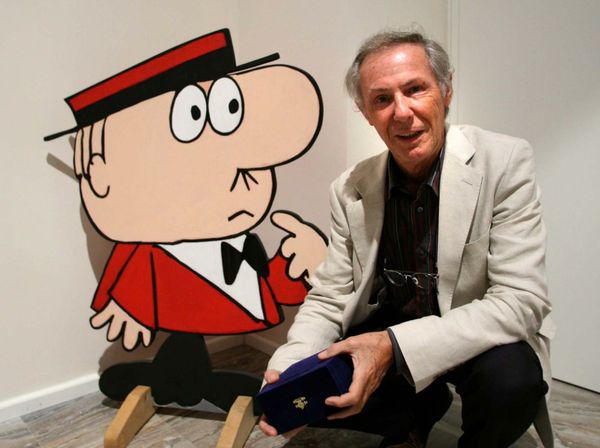
Other creators of moving images do their magic with a good sound track – but sometimes without using a word of dialog. Here’s a clever example I’ve found on YouTube – it is by Italy’s leading animator, Bruno Bozzetto (photos below, courtesy Bruno Bozzetto website).

Bruno Bozzetto

Titled Femminile & Maschile (Feminine and Masculine), this 2-D animation was made in 2004. I can’t find a synopsis online, but one website introduced it simply as follows: Some situations that show the difference of behaviour between men and women in the everyday life.

Anyone with a sense of humour can appreciate this piece – and I hope that includes die-hard feminists…

Here’s the intro from Wikipedia:
Bruno Bozzetto (born March 3, 1938 in Milan, Italy) is an Italian cartoon animator, creator of many short pieces, mainly of a political or satirical nature. He created his first animated short “Tapum! the weapons’ story” in 1958 at the age of 20. His most famous character, a hapless little man named “Signor Rossi” (Mr. Rossi), has been featured in many animated shorts as well as starring in three feature films: “Mr. Rossi Looks for Happiness” (1976), “Mr. Rossi’s Dreams” (1977), and “Mr. Rossi’s Vacation” (1977). Read the rest of his profile on Wikipedia

Earlier this week, to mark Earth Day on 22 April 2008, I took part in a half hour, live interview with Sri Lanka’s highest rated, most popular channel, Sirasa TV. I wanted to relate the global to not just the local but also to the individual and family level. To discuss how our lifestyle choices and consumer decisions affect that planet, I used a series of brilliant cartoon animations that Bruno Bozzetto had done some years ago for WWF.

Again, without having his characters utter a single word, Bozzetto gives out profound messages through images and musical sound track. This is why I keep saying that when it comes to the sheer economy of words, we writers just can’t beat cartoonists.

Sorry, I can’t locate these anywhere online (YouTube lists dozens of his other creations, but not this series — which I can’t even find on his own website.) It’s time for someone to revive this series, for their message is even more relevant for today’s climate-challenged world…

Bruno Bozzetto entry on Internet Movie Database
Visit the official website of Bruno Bozzetto
Watch other Bruno Bozzetto short animations online

Women on the Frontline: Reporting from the battlefront at…home!

“Violence against women threatens the lives of more young women than cancer, malaria or war. It affects one in three women worldwide. It leaves women mentally scarred for life — and it is usually inflicted by a family member.”

With these words, Annie Lennox, the British singer and social activist, presents a new global series of investigative television documentaries called Women on the Frontline that begins on the global satellite TV channel BBC World today, 18 April 2008.

The seven half-hour films shine a light on violence against women and girls in different parts of the world – East and West, North and South. The series takes the front to homes, villages and cities of our world where a largely unreported war against females is being waged.

Read my Feb 2008 blog post: Half the sky, most of the suffering…

The films cover Nepal, where thousands of women are trafficked each year; Turkey, where killing in the name of honour continues; Morocco, where women political activists who have survived torture and imprisonment testify before a government truth and reconciliation commission; the DRC, where women bear the brunt of a 10-year war in the eastern provinces; Colombia, where women have been tortured in the shadow of a guerilla war; Mauritania, where women who have been raped may go to prison; and Austria, where, under a new law, perpetrators of domestic violence are forced to leave home.

Here’s the line up of depressing reports in this series, produced by Geneva-based dev tv and London-based One Planet Pictures – both international partners of TVE Asia Pacific.

Nepal: A Narrow Escape
Turkey: Killing in the Name of Honour
Morocco: Never Again
Democratic Republic of Congo: Find a Word for It
Austria: Showing the Red Card
Mauritania: No film name known yet
Colombia: Justice in the Region of Death

Check dev tv website for broadcast times on BBC World

On the Frontline… is a ‘vehicle’ for independent producers to tell compelling stories about the people who uphold civil society where it is most at threat. The strand started with the 2006 pilot series Doctors on the Frontline, a profile of Medecins Sans Frontieres (MSF) field doctors made by Dev TV film-makers.

Since then, the series has covered villages battling desertification and land degradation, nurses and para-medics on humanitarian missions in hot spots of the world, and children living with social and environmental disintegration.

On the Frontline has gone behind the lines with rebels and filmed among violent street gangs but this time we’ve taken the frontline mostly into the home, where even after 20 years in production, I’m still shocked to see how many obstacles lie between women and equality, and the violence they must still endure,” said Robert Lamb, Executive Director of the series.

A number of UN agencies, including UNFPA and UNIFEM, donor countries such as Austria, non-governmental organizations and other partners provided information and support for the latest series of Women on the Frontline.

Soon after its initial run on BBC World, the series will be distributed in the Asia Pacific region by TVE Asia Pacific.

Read official brochure of Women on the Frontline TV series

March 2008 blog post: Unseen women, unheard voices

Crude: The incredible journey of oil (humanity’s substance addiction)

My colleague Manori Wijesekera returned last month from Tokyo, having participated in Earth Vision – the 16th Earth Vision Global Environmental Film Festival. She represented TVE Asia Pacific as director of one of its finalist films.

The grand prize of the festival was awarded to a stunning science documentary on the story of oil, produced by the Australian Broadcasting Corporation (ABC). Here’s the basic information:

Crude: the Incredible Journey of Oil
The world’s oil fields are deposits of phytoplankton on the ocean floor from the Jurassic period. Will our mass consumption of oil in the last 150 years thrust us back climatically to the warm primeval age when oil fields were formed?
(2007/Australia/90min/Director:Richard Smith)

See the full list of awards presented at Earth Vision 2008

Crude is one of several films that have come out recently exploring the many facets of oil and our civilisation’s dependence (addiction) on it. In March 2007, I wrote about Addicted to Oil, a documentary presented by the New York Times columnist Thomas L Friedman.

David Suzuki, environmentalist, author and long-standing presenter of the natural history series The Nature of Things has called this “a thoughtful, surprising and really important film”.

This is what Manori reported about Crude:

Produced and directed by Richard Smith, this 90 min journey sweeps through the ages: from the birth of oil deep in the dinosaur-inhabited past, to its ascendancy as the indispensable ingredient of modern life.

As Smith states, “Oil is perhaps the single most important commodity shaping the economy, politics and environment of the modern world, and yet most people have only vague notions of where it comes from. I wanted to take the audience back into the ancient oceans in which oil was formed and reveal how intimately the creation of a major oil deposit is connected to the long-term regulation of the planet’s climate”.

“I saw the film as a sort of essential primer for people to begin to make sense of both the coming oil and climate crises. I make no apologies for such apparent certainty that we will face these two dilemmas. From my understanding of the science and the facts, these are the logical conclusions to the planet carrying on with a business-as-usual, or indeed a business-at-any-cost approach. The worst effects of both are probably avoidable, but only if people understand why there is an urgent need to act.”

Crude was first broadcast on ABC TV in May 2007 and is now being distributed worldwide. It has already won two awards at the 2007 Jackson Hole Wildlife Film Festival: the Best Earth Sciences Film award and the Special Jury Recognition Award.

Watch Crude: The incredible journey of oil at ABC’s interactive website

Read production details and short profiles of the film-makers

Krishnendu Bose, Manori Wijesekera and Richard Smith at Earth Vision 2008

Photo: Finalist film directors Krishnendu Bose, Manori Wijesekera and Richard Smith at Earth Vision 2008 in Tokyo

All images of Crude courtesy ABC

Internet Society interviews the web’s inspiation, Arthur C Clarke

In his 1964 short story, “Dial F for Frankenstein”, the late Arthur C Clarke speculated the world’s inter-connected telephone system becoming a conscious entity that then takes over the world. Years later, in 1989, this inspired the British computer scientist Tim Berners-Lee to invent the World Wide Web, a system of interlinked hypertext documents accessed via the Internet.

When Berners-Lee acknowledged his inspiration in media interviews, Sir Arthur exclaimed: “Oh dear, what have I done?”

But in later years, Sir Arthur took pride in being described as the inspiration for the web, which came on top of his much more widely acclaimed recognition of being the inventor of the communication satellite.

It was entirely appropriate, then, that most tributes to Sir Arthur would appear online. The news of his death, on 19 March 2008 in Colombo, Sri Lanka, went round the world at the speed of light thanks largely to the web. This triggered a virtual explosion of tributes, comments and eulogies from ordinary people – ranging from science fiction readers and movie buffs to computer geeks and space enthusiasts.

Among the thousands paying tribute to the grandmaster of science fiction was the Internet Society, a non-profit organisation founded in 1992 to provide leadership in Internet related standards, education, and policy. They called Sir Arthur “a visionary of science and technology, whose ideas and legacy can be seen woven through many modern communication technologies, including the Internet itself”.

As a tribute to Sir Arthur, the Internet Society has placed online, rather belatedly, an interview filmed with Sir Arthur at his Colombo home in 2002. The interview, conducted by Alan Greenberg and George Sadowsky, then Trustees of the Internet Society, is presented in four parts.

In this wide-ranging interview, a very relaxed Sir Arthur talks about the history of 20th century communications and his own role in shaping the events in the past 60 years. Here, in one place, are the reflections and extrapolations of the man who always connected the present with the future. He also touches on the future of space exploration, and the urgent need to develop clean energy sources for a world addicted to oil.

Part 1 of 4 (8 mins 51 secs):

Part 2 of 4 (9 mins 30 secs):

Part 3 of 4 (7 mins 11 secs):

Part 4 of 4 (6 mins 26 secs):

Comment: Although it’s the Internet Society, no less, they seem to be rather limited in their ability to promote these videos placed on the public video exchange platform, YouTube. These remain virtually hidden away, with a single tag (movie) which obscures them from online searches. In nearly three weeks since they were placed online (24 March 2008), these have been viewed by just a few hundred people. In contrast, other tributes and archival material of Sir Arthur are attracting thousands of views and a growing number of comments on the same YouTube.

Arthur C Clarke: The Dangerous Dreamer of Colombo

Image by Reuters, courtesy Down to Earth

Arthur C Clarke: The Dangerous Dreamer of Colombo.

That’s the title I gave to an 800-word obituary/tribute on Sir Arthur C Clarke that I wrote for India’s leading science and environment fortnightly, Down to Earth.

In this essay, I took a quick look at Sir Arthur’s legendary dream power. While there are no independent dream ratings as in television broadcasting, I always felt that he had one of the most active and imaginative dream machines east of Suez (millions of his satisfied readers might agree). When I turn up at his office two mornings a week, he would often relate a fantastic dream he’d just had — a few of these eventually found their way into his stories or even non-fiction writing.

I pegged this tribute on one of my favourite quotes by another British writer, T E Lawrence: “All men dream, but not equally…the dreamers of the day are dangerous men, for they may act their dream with open eyes, to make it possible.”

The tribute has just been published, in the latest issue of Down to Earth datelined 15 April 2008. But the sub editors have chosen a less vivid title, which is of course their prerogative.

This essay was written during the weekend of March 22-23, within hours of Sir Arthur’s funeral. Pradip Saha, the magazine’s editor, contacted me soon after Sir Arthur’s demise and asked if I could do 800 words in 48 hours. He knew I’d worked closely with the late author, and years ago, I had done a Clarke interview for Down to Earth.

Talk about catching me at a busy moment. At the time, as Sir Arthur’s spokesman, I was coping with a deluge of media requests and queries from all over the world (and a few from other worlds – just kidding). But my own newsroom experience had trained me to keep a cool head and remain focused amidst turbulence. So I agreed, and wrote this on 23 March 2008 while still recovering from the sheer exhaustion of a 4-day media-marathon (mediathon?).

This is how I start off the essay:

“In his 1992 book How the World Was One, Sir Arthur C Clarke described a dream he once had: one day, CNN founder (and then owner) Ted Turner is offered the post of the President of the world, but he turns it down politely—because he didn’t want to give up power.

“The trouble with Clarke’s dreams was that many kept coming true, often faster than his own vivid imagination envisaged. Like Albert Einstein, Clarke believed that imagination was more important than knowledge—he called himself an extrapolator, one who expanded from current knowledge to what was scientifically plausible.”

Read my Down to Earth tribute to Arthur C Clarke: The Dangerous Dreamer of Colombo

Arthur C Clarke tribute: Science’s critical cheerleader

scidevnet-logo.jpg scidevnet-logo.jpg

My guest editorial on the late Sir Arthur C Clarke has just been published by the London-based Science and Development Network, SciDev.Net:

Arthur C Clarke: Science’s critical cheerleader

In this, I briefly comment on Sir Arthur’s accomplishments in popular science communication and his life-long crusade against pseudo-science — two important facets of the multi-faceted author, science populariser and underwater explorer who died on 19 March 2008.

Excerpts:

“Clarke’s forte was not only extrapolating about humanity’s technological abilities, but also exploring the nexus between science and society. With his death, science has lost an articulate and passionate promoter who challenged scientists to play a greater role in public policy and demanded that political leaders should take science seriously.

“But he was never an uncritical cheerleader for science, and that will be part of his enduring legacy. In an essay in Science, he cautioned, ‘For more than a century science and its occasionally ugly sister technology have been the chief driving forces shaping our world. They decide the kinds of futures that are possible. Human wisdom must decide which are desirable.'”

In my essay, I talk about how Sir Arthur readily took on a formidable array of anti-science beliefs and superstitious practices, from creationism and scientology to astrology and fire-walking. In these endeavours he joined other campaigners against pseudoscience, including scientists Carl Sagan and Stephen Jay Gould and the magician James Randi.

“For a while, Clarke even made a modest living as a professional sceptical enquirer. Beginning with Arthur C Clarke’s Mysterious World (1980), he hosted three television series that probed – and sometimes exposed – numerous mysteries, superstitions and the paranormal.

“Even when Clarke didn’t find full explanations, he invariably demonstrated the value of keeping an open mind and asking the right questions. And instead of ignoring or dismissing popular obsessions, he tried engaging their proponents in rational discussion. That was characteristic of Clarke, a genial moderator who always sought to build bridges — whether between scientists and the public, or across the “two cultures” divide between the arts and the sciences.”

In all, Sir Arthur hosted three TV series over 15 years:
Arthur C Clarke’s Mysterious World (1980)
Arthur C Clarke’s World of Strange Powers (1985)
Arthur C Clarke’s Mysterious Universe (1994)

These series had numerous re-runs for years on Discovery and other TV channels all over the world. They are still available on DVD. While some of the content is now dated by more information or insights emerging since their production, the series still inspires critical thinking – not to mention TV emulations that come out with many more frills than was possible in the 1980s.

Watch the opening of the first series, where Sir Arthur offered his own classification of mysteries (9 mins 21 secs):

Sir Arthur filmed all his pieces to camera from different, scenic locations in his adopted home in Sri Lanka. Few Sri Lankans realised at the time that this generated millions of dollars worth of free promotion for the country as a tourist destination.

In fact, I end my editorial by looking at Arthur C Clarke the public intellectual in Sri Lanka, where he lived since 1956. I look at how he won some battles with rational arguments while lost others (e.g. Sri Lankan obsession with astrology). This is clearly a subject I will return to in greater depth and analysis in the coming months.

In the modest cough department, I am immensely proud of how I sign off on this editorial:
Arthur C. Clarke mentored Sri Lankan journalist Nalaka Gunawardene and they worked together for 20 years.

SciDev.Net – the Science and Development Network – is a not-for-profit organisation dedicated to providing reliable and authoritative information about science and technology for the developing world. Through http://www.scidev.net, it gives policymakers, researchers, the media and civil society information and a platform to explore how science and technology can reduce poverty, improve health and raise standards of living around the world. SciDev.Net is co-sponsored by the leading journals Nature and Science.

TVE Asia Pacific says Thank You to Sir Arthur C Clarke

In his 1992 book How the World Was One, Sir Arthur C Clarke described a dream: one day in the near future, CNN founder (and then owner) Ted Turner is offered the post of World President, but he politely turns it down – because he didn’t want to give up power!

Just three years later, the then Secretary General of the UN suggested that CNN should be the 16th member of the Security Council. Sir Arthur was fond of quoting this, and once famously told Turner: “You owe me 10 per cent of your income”.

These references – illustrating the power of globalised satellite television – are recalled in TVE Asia Pacific‘s official tribute to Sir Arthur C Clarke, who passed away on March 19 aged 90.

“With the death of Sir Arthur C Clarke, TVE Asia Pacific has lost a long-standing friend and supporter,” the tribute says.

It adds: “Since our establishment in 1996, Television for Education Asia Pacific – to use our full name – has been engaged in pursuing Sir Arthur’s vision of using the potential of moving images to inform and educate the public. Our founders chose to focus on covering development and social issues, with emphasis on the Asia Pacific region – home to half of humanity and where Sir Arthur spent the last half century of his life.”

Although he never held a formal position at TVEAP, Sir Arthur was an informal adviser and mentor to the regional media organisation whose work across Asia Pacific is only possible thanks to the comsat that invented and the web that he inspired.

By the time TVEAP was created in the mid 1990s, the satellite TV revolution was well underway in the Asia Pacific region, and the internet revolution was just taking off. In informal discussions, Sir Arthur advised us to always keep our eyes open on what’s coming up. In the ICT sector, he cautioned, being too closely wedded to one technology or system could lead to rapid obsolescence.

The tribute mentions Sir Arthur’s specific support for the Children of Tsunami media project, and the Communicating Disasters publication.

We also talk about Sir Arthur’s concerns about using information and communication technologies (ICTs) to benefit the poor and other disadvantaged groups – a process that he aptly described as ‘geek to meek’.

We end by recalling how TVEAP recorded and uploaded to YouTube Sir Arthur’s last public video address – his 90th birthday reflections in December 2007.

Read TVEAP’s tribute to Sir Arthur C Clarke, 1917-2008

sir-arthur-clarke-reflecting-on-90-orbits.jpg