Remembering Saneeya Hussain

20 April 2007: It’s exactly two years ago that Saneeya Hussain left us.

Saneeya was a journalist who took a special interest in environment and human rights issues. All her working life, she campaigned tirelessly for a cleaner, safer and more equitable society for everyone — not just in her native Pakistan, but everywhere.

Ironically, it was the urban nightmare that we have collectively created that finally snatched her away at the prime of her career. She was 51.

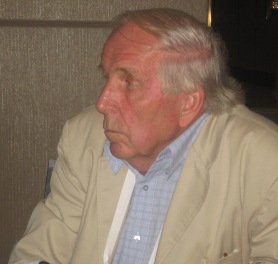
saneeya-hussain.jpg

I first met Saneeya when we both worked for the same global organisation – IUCN, The World Conservation Union. She headed IUCN Pakistan’s Communication Division while I started a similar division for IUCN in Sri Lanka in the early 1990s. In fact, the trails she and her team had blazed in Pakistan was a model and inspiration for us.

In 1998, Saneeya moved to Cape Town in South Africa to work with the World Commission on Dams, an independent group of experts that had a tough mandate: consult widely to resolve the controversial issues associated with large dams. When the Commission held its South Asia consultations in Colombo, Sri Lanka, Saneeya approached us at TVE Asia Pacific to handle all the media relations.

It was while working in Cape Town that Saneeya met Luis Ferraz, a Brazilian geographer, whom she married later.
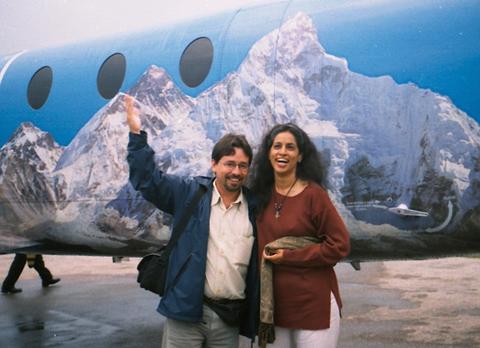
saneeya-and-luis-taking-an-everest-flight.jpg

In 2002, Saneeya became the Executive Director of Panos South Asia, a regional media organisation with its headquarters in Kathmandu, Nepal. As a Board member of Panos, I worked closely with Saneeya in a number of projects and activities.

Although everyone at Panos and in Kathmandu liked her, Saneeya’s stay there was cut short by what her successor at Panos, A S Panneerselvan, called her Siamese twin: asthma.

It was asthma that forced Saneeya to leave Nepal – and the Panos director’s job – as she just couldn’t cope with Kathmandu’s polluted air. As a fellow asthmatic, I fully empathised with her. She moved to Sao Paulo, where she set up what was to be her final home.

What happened in April 2005 has been written and discussed widely by Saneeya’s far-flung network of friends in the past two years. I can only reproduce the last few paras of a tribute I wrote in May 2005, which was privately circulated at the time:

When Saneeya suffered an acute attack of asthma in Sao Paulo on April 7, her husband Luis rushed her to hospital in his car. It was rush hour at 6.30 in the evening, and it took him 20 minutes to drive to the hospital only 2 kilometres away. Saneeya — who had walked to the car — stopped breathing five minutes into the journey. Luis drove as fast as the traffic would allow him, but as it turned out, not nearly fast enough.

Her brain suffered too much damage due to oxygen deprivation, and she never recovered.

As Luis was to remark later, it was not asthma but the traffic that killed Saneeya.

Similar tragic scenarios unfold on South Asia’s mean streets every day. Heart and stroke patients fail to reach help in time. Ambulences and fire engines, with their sirens blaring, only manage to proceed at a snail’s pace. It’s not uncommon for expectant mothers in labour to give birth on their way to hospitals. Then there is the slow, insidious poisoning that goes on 24/7.

So let us be forewarned. If the air pollution doesn’t get us, the traffic jams will. And if we survive both, our road accidents will wait for us. It’s only a matter of time.

Not one but several serial killers are out there.

And we unleashed them all.

beena-sarwar-left-and-saneeya-hussain-photo-courtesy-b-sarwar.jpg

Our mutual friend Beena Sarwar (in the photo above, with Saneeya) has made a 14-minute documentary called Celebrating Saneeya. It was screened at the 5th Karachi International Film Festival in December 2005.

See also my essay ‘Grappling with Asia’s Tsunami of the Air’ (December 2006).

All photos from Saneeya Yahoo Group that links her friends around the world.

The return of the ‘Donnish young man’

Some of my friends who read this blog think I’m fond of name dropping. It’s just that I keep meeting some really interesting and accomplished people as I travel around the world in the course of my work.

Each such encounter enriches me. I write about some of these here to share that joy and inspiration.

Remember I wrote about Robyn Williams , the doyen of science broadcasting in Australia, and his analogy of science journalists and whales?

Well, Robyn and I are among the few participants at the Fifth World Conference of Science Journalists here in Melbourne who were also at the first such conference, some 15 years ago. That was held in Tokyo, Japan, in the Fall of 1992.
Jim Cornell, president of the International Science Writers Association (IWSA) is another.

nalaka-gunawardene-and-robyn-williams-of-abc.jpg

In Tokyo, Jim Cornell invited me to join a panel discussion on science journalism in the developing countries. I was 26 at the time, and was on my first visit to Japan. All these years later, I can’t recall everything I said. But I remember how I quoted Karan Singh, a former minister of population in India, to the effect that in many poor countries where survival was a daily struggle, ‘Development is the best contraceptive’.

Robyn Williams picked this up in an account of the conference he wrote up in UNESCO Sources, the monthly magazine published by the UN’s science agency. He described me as ‘a donnish young man from Sri Lanka’!

I’ve been trying to live this down ever since.

From whales to bacteria: the adaptable science journalist

What happens when a few hundred witty, metaphor-happy journalists are let loose for a week?

They come up with all sorts of new ways to describe themselves!

First it was Australian science broadcaster Robyn Williams who compared science journalists with whales.

He suggested this analogy during the opening of the 5th World Conference of Science Journalists in Melbourne earlier this week.

Heading in the micro end of the animal kingdom, a leading South African science journalist thinks some of her kind are like extremophile bacteria: hardy enough to survive in very harsh environments.

Christina Scott was referring to the tough working conditions of many journalists – including those covering science – working in the developing countries.

She and I were part of a plenary session today on Reporting science in emerging economies which started off the final day of sessions at the conference. Others on the panel were T V Padma (India), Jia Hepeng (China), Talent Ng’andwe (Zambia) and Luisa Massarani (Brazil). All of us are associated with the Science and Development Network (SciDev.Net) in one way or another – as correspondents, regional coordinators, or in my case as a Trustee.

The session surveyed the technological, cultural, political and economic factors that stand in the way of good science journalism in developing regions of the world. We presented our experiences and perspectives on the status of our profession – and hopes for the future.

Yes, we recognised the many odds we are working against. But on the whole it was a message of resilience, adaptability and survival.

I ended my own remarks saying: Life finds a way in the harshest of environments. So does science journalism. In conditions far from ideal, science journalism happens. Not just on and off, but on a regular basis.

We are good at what I call ‘wonderful improvisation’.

SciDev.Net coverage of the Fifth World Conference of Science Journalists

Collective blog of SciDev.Net team at the conference

Personal blog of Talent Ng’andwe

Nature
blog post on our session can be read here

Beware of ‘Vatican condoms’ – and global warming

See also my 19 July 2007 post: Three Amigos: Funny Condoms on a serious mission

You never know where the next piece of helpful advice can come from.

Here at the Fifth World Conference of Science Journalists, currently underway in Melbourne, we were told to be careful in using Vatican condoms: they have holes in them!

It’s a joke, of course, but the implications of increasing human numbers is no laughing matter. And neither is global warming and resulting climate change — one major topic of discussion at the conference.

Professor Roger V Short, FRS, from the University of Melbourne made a passionate plea for controlling our numbers: “We are the global warmers. And we hold the key to containing and reducing it.”

He was speaking at session on ‘Life and death in 2020: how will science respond?’

Human population has increased at an unprecedented rate. When he was born, the world had a total of 2 billion people, the elderly academic said. Now, the estimate is around 6.7 billion.

By 2050, according to the United Nations, it is set to reach 9 billion. And that with all efforts at family planning.

The United States and Australia are the biggest emitters of greenhouse gases that cause global warming. Yet, Australia is the only developed country that is encouraging its people to increase the birthrate.

Are we out of our minds, Professor Short wondered.

The message was loud and clear: unless we seriously contain our numbers, we — and our planet — are doomed.

Prof Short recalled how he’d spent a inspiring week with Thailand’s Senator Michai Viravaidya – known as ‘Mr Condom’ in Thailand for his unashamed and long-standing promoting of condom use — to both reduce population growth and to contain the spread of HIV.

john-rennie2.jpg roger-v-short.jpg

Wide use of condoms, and globally adopting a one-child-per-family policy, can give us a chance to arrest run-away global warming, Prof Short suggested.

The world is urgently in need of many more Mr Condoms, it seems.

To illustrate his point, Prof Short took out a T-Shirt saying ‘Stop Global Warming: Use Condoms!‘ and presented it to John Rennie, editor of the Scientific American, who was chairing the session.

The good sport that Rennie was, he immediately donned it.

Read what Christine Scott said about HIV and South Africa during the same session

See also my 19 July 2007 post: Three Amigos: Funny Condoms on a serious mission

Banned in the USA, Al Jazeera now online at YouTube

“The world’s first English language news channel to have its headquarters in the Middle East; covering the world, bridging cultures and setting the news agenda.”

That’s the marketing line of Al Jazeera International (AJI), launched on 15 November 2006.

It’s been slowly building up an audience, which it now claims to be around 90 million households.

But not in the United States of America: it was shut out of most American homes because cable companies have refused to carry their signal.

Elsewhere, commerce – not politics – was at play: some cable operators and hotels, already locked into various deals with the established global news channels of BBC World and CNN International, weren’t easily carrying AJI either.

Undeterred, AJI started this week to post some of their content on YouTube.

al-jazeera.jpg

Well, things are getting more interesting now!

When AJI started less than six months ago, I wrote an op ed published on Both Media Helping Media (UK) and MediaChannel.org (USA). I argued that to make a real difference, AJI needs to not only analyse and present the news differently, but also gather news more ethically in the developing countries of the global South.

BBC World and CNN International have an appalling track record of doing this. “They epitomise a disturbing belief in international news and current affairs journalism: the end justifies the means.”

I added: If products of child labour and blood diamonds are no longer internationally acceptable, neither should the world tolerate moving images whose origins are ethically suspect.”

I ended my essay: We will be watching. And not just what’s shown on AJI, but how those pictures get there.”>

Well, it’s now become easier to follow AJI. I still keep an open mind about their English channel, even if it shows every sign of aping the BBC and CNN. Already we need to look hard to find a real difference.

Let’s give them one year to prove if they mean what they say — or not.

Read my full essay on Media Helping Media, with some reader comments

Read the version that appeared on MediaChannel.org

50? In South African terms, you’re probably dead!

“How many of you are over 50?” asked Christina Scott, South African journalist and broadcaster.

Half a dozen hands went up.

“Come on, now – be honest,” Christina urged. One more hand joined.

“In South African terms, chances are that you’re already dead,” she declared.

Christina was talking about stark realities of living and dying in today’s South Africa, which is one of the highest HIV infection rates in the world.

We were at a session on ‘Life and Death in 2020: How will science respond?’ during the Fifth World Conference of Science Journalists, currently underway in Melbourne.

christina-scott.jpg Christina Scott - image courtesy IPS

Christina then asked how many in her audience were aged between 30 and 35. This time, four hands shot up.

“If you were in South Africa, you’re probably infected with HIV, and don’t know it yet — and go around giving it to others,” she told them.

After getting her audience shocked and hooked, Christina talked about how HIV is cutting across social hierarchies and colour barriers in her country.

Many intervention strategies to contain HIV have been based on the premise that when people know more, they are more likely to change risky behaviour. “We now see that greater wealth or higher levels of access to information alone do not change people’s behaviour. In fact, the middle classes lull themselves into thinking that HIV is a poor people’s disease, when it’s not,” she said.

In other words, it’s not a linear process and is much nuanced.

Christina was doubtful if Internet, PCs and online communications could make much headway in reaching out a majority of South Africans. It’s not just a lack of connectivity and computers, but a more basic absence of electricity in many areas.

To her, old fashioned radio was still the most cost-effective way to reach more people quickly.

One new ICT that has taken sub-Saharan African by storm is mobile phones. “They are everywhere, and people are using them for all sorts of things — including sexual transactions.”

She was cautiously optimistic about prospects for combating HIV. “AIDS is like a war: it’s very nasty, and causes a lot of damage. But as in war, it also spurs innovation and responses,” she said.

An AIDS vaccine is not the answer, as the virus keeps mutating and in any case distributing the vaccine to all those who need it will be a huge challenge.

Her personal wish: her daughter of 15 to get through college without contracting HIV.

Note: Christina works as Africa consultant for the Science and Development Network.

Science journalists and whales: much in common?

Science journalists have been called many names, some more memorable than others.

Speaking at the inauguration of the 5th World Conference of Science Journalists, Robyn Williams — the doyen of science broadcasting in Australia — suggested a new analogy: they are like whales in many ways.

To paraphrase his witty opening remarks, whales and science journalists have some things in common (my comments in brackets):

They both respond to lots of free drinks and eats.

In fact, they like to drink vast amounts (though not necessarily the same liquids!).

There is evidence to suggest they are both intelligent species.

They are both endangered too – there are some nasty people out to get them.

Both are free spirits – don’t like being trapped or hounded.

And they are known for occasional mass strandings – in the case of science journalists, it first happened in Tokyo (which choice whales might not approve!), followed by Budapest, Sao Paulo, Montreal and now – Melbourne.

These are the cities that have hosted World Conferences of Science Journalists, beginning in 1992.

It’s an event that happens approxiatemly every three years — or as soon as the next host can line up the massive logistics involved in receiving, feeding and keeping the several hundreds whales – sorry, science journalists – happy.

Robyn Williams, image courtesy ABC

Robyn is not just a very entertaining broadcaster, but has has written more than 10 books — one of them a novel, 2007: A True Story Waiting to Happen.

By coincidence, the story involves whales – one of his favourite species – and its action starts in April 2007!

Here’s the blurb promoting the book, first published in 2001:

It is the year 2007. The weather is now wreaking turmoil on the planet. Hurricanes, cyclones, tsunamis, floods, fires, droughts and diseases are sweeping the world with increasing frequency and severity. The poor countries are worst hit, but even the rich ones are no longer immune from major disruption. Big business is worried.

In April 2007, the animals take matters into their own hands. An enormous pod of whales sinks a whale-killing submarine. Massive flocks of pelicans close airports around the world. Huge herds of cattle bring freeways everywhere to a halt, burying cars under mountains of steaming dung.

Desperate to find a solution to the global chaos, the President of the United States calls on the world’s top scientists to explain what it happening and how to stop it. One man, his daughter and her dog hold the key, but before things can get better, they have to get a great deal worse.

Hmmm. Robyn is known and admired for many talents, but perhaps the world hasn’t yet appreciated his powers of prescience.

Having blazed new trails in taking science to the public, Robyn now presents The Science Show on ABC radio.

Related links:

The Science Show story on whale DNA

Robyn Williams interview on ‘scientific whaling’

And now, Al Jazeera get on You Tube

YouTube seems to be everywhere!

Last week in Sydney and this week in Melbourne, journalists and media researchers can’t talk enough about You Tube — though not everyone is equally enthusiastic about the online video sharing platform.

This just in, from MediaChannel.org:

Al Jazeera English goes You Tube

The Doha-based broadcaster Al Jazeera (English) will launch a YouTube branded Channel, the company said today. YouTube users worldwide will have the ability to comment on Al Jazeera English clips, rate them, recommend them to friends and post their own video responses to communicate with other viewers.

Content will include segments from shows such as ‘Frost over the World’, ‘Everywoman’, ‘Inside Iraq’, ‘Inside Story’, ‘Listening Post’, ‘Riz Khan’, ‘One-on-One’, ‘The Fabulous Picture Show’, ‘Witness’ and ‘48′. Al Jazeera English is also planning to release some exclusive web-only programming, starting with ‘Poltical Bytes’, a global conversation hosted by UN correspondent Mark Seddon which will ask the YouTube community to carry on the conversation and add video contributions. The broadcaster said it will provide new content to the site by adding at least 10-15 new clips each week.

Nigel Parsons, Managing Director of Al Jazeera English said: “We believe that YouTube is a perfect platform to reach out to our audience and to give wide and easy access to new viewers around the world. We have significantly built on our distribution since launch and now reach well in access of 90 million cable and satellite households worldwide. With YouTube’s community of millions of online users this is set to dramatically increase.”

SOS: Save Our Spectrum for media freedom

I’m strongly committed to promoting media freedom, but have never been the placard-carrying, slogan-shouting type. Street activism is necessary — but not sufficient.

I’ve been more interested in studying trends and conditions, trying to anticipate what the next big threats, challenges and opportunities are, and how best we can respond to them.

For years, I’ve been writing and talking about the need for proper spectrum management as a pre-condition for media freedom and media pluralism. Last week, I once again spoke about these core issues at OUR Media 6 Conference in Sydney.

I’ve just adapted my Sydney panel remarks into an op ed essay, just published by the UK-anchored media website, Media Helping Media.

Here are the first few paras:

On May 3, the annual World Press Freedom Day will once again be observed worldwide, focusing public attention on a multitude of threats to freedom of expression through the mass media.

But amidst the extremely relevant and necessary slogans, we are unlikely to hear this one: Hands off our spectrum!

Yet saving our spectrum is critical for ensuring media freedom.

The electro-magnetic spectrum has been called the ‘invisible wealth of nations’ — conventional broadcasting relies on the fair, equitable and sound management of this common property resource.

And as economic and cultural practices move more and more into the digital realm, the spectrum’s value is only set to increase.

But few people -– even within the media profession and industry -– appreciate our dependence on this finite resource. Out of sight does seem to push it out of most people’s minds.

Therein lurks a danger: what we don’t see and value can be quietly taken away, without many of us realizing it.

Read full article and leave your comments

Added on April 18: MediaChannel.org anchored in the US has also just re-published the article. Read their version here

Added on April 19: Free Press.Net has also reproduced the article.

Added on April 20: FreePress.Net in the US reproduces the essay

Added on April 21: Bytes4All South Asian ICT wevsite reproduces my essay

Added on April 21: Reclaim the Media website also publishes the article
Thanks to everyone who considered it worth amplifying to their audiences — we need to spread the word! – Nalaka

Money is not an issue: ‘No budget’ films have their own festival

After over a decade working in television and film, most of that time commissioning new content from independent producers or creating content ourselves, I have yet to come across a film-maker who had enough budget.

We’re are all used to getting by with less than ideal budgets.

Some more than others, though: there are low budget films, and then there are ‘no budget’ films.

A few idealists among us still believe money is not an issue in cultural expression.

They now have their own festival, unashamedly for just that kind of films: No Budget VideoFilmfestival, Heilbronn / Weimar & Tour 2007
No budget video film festival

Their self-intro reads:

In 2007 the „Geld spielt keine Rolle“ (“money is not an issue””it’s only money”) VideoFilmfestival will start a series of events during an independent art-, film- and musicfestival in Heilbronn. From the 8th to 10th of June 2007 it will be in Heilbronn, and thereafter will be ample opportunity to screen the films in Weimar (at the Lichthaus Kino in summer 2007), Magdeburg, London and other cities. The previous festival was carried by the faculty of media of the Bauhaus- University Weimar and took place in Weimar in May 2006.

Filmmakers characterized by creativity and idealism get the opportunity to present their films to a wide audience.
For the audience this promises good films which possibly fall through the cracks of commerce.

Remember: deadline for entries is 1 May 2007.

The festival is being organised by a group of German film enthusiasists calling themselves the film sharing community.

Under the topic GELD SPIELT KEINE ROLLE (Money is no issue) the film sharing community wants to provide a platform for productions of moderate means achieving remarkable outputs and meaningful films on a shoestring.

May their tribe increase!