I have written about disaster early warnings on many occasions during the past decade (see 2014 example). I have likened it to running a relay race. In a relay, several runners have to carry the baton and the last runner needs to complete the course. Likewise, in disaster early warnings, several entities – ranging from scientific to administrative ones – need to be involved and the message needs to be identified, clarified and disseminated fast.
Good communications form the life blood of this kind of ‘relay’. Warnings require rapid evaluation of disaster situation, quick decision making upon assessing the risks involved, followed by rapid dissemination of the decision made. Disaster warning is both a science and an art: those involved have to work with imperfect information, many variables and yet use their best judgement. Mistakes can and do happen at times, leading to occasional false alarms.
In the aftermath of the heavy monsoonal rains in late May 2017, southern Sri Lanka experienced the worst floods in 14 years. The floods and landslides affected 15 districts (out of 25), killed at least 208 and left a further 78 people missing. As of 3 June 2017, some 698,289 people were affected, 2,093 houses completely destroyed, and 11,056 houses were partially damaged.
Did the Department of Meteorology and Disaster Management Centre (DMC) fail to give adequate warnings of the impending hydro-meteorological hazard? There has been much public discussion about this. Lankadeepa daily newspaper asked me for a comment, which they published in their issue of 7 June 2017.
I was asked to focus on the use of ICTs in delivering disaster early warnings.
We as a nation collectively uttered these words as we raised our heads after the Indian Ocean tsunami of December 2004. That mega-disaster, which caught our government unawares and society unprepared, devastated many coastal areas, killing around 40,000 and displacing over a million people.
Even a 30 minute early warning could have saved many of those lost lives, by simply asking them to run inland, away from the waves. But there was no such warning.
Badly shaken by that experience, the then government reformed disaster related laws and institutions. Until then, dealing with disaster response was lumped under social services. The new system created a dedicated ministry for disaster management, with emphasis on disaster risk reduction (DRR).
Living amidst multiple hazards is unavoidable, but preparedness can vastly reduce impacts when disasters do occur. That is DRR in a nutshell.
But in immature democracies like ours, we must never say never again. Our political parties and politicians lack the will and commitment required to meet these long-term objectives. Our governance systems are not fully capable of keeping ourselves safe from Nature’s wrath.
Disaster resilience is not a technocratic quick fix but the composite outcome of a myriad actions. Good governance is the vital ‘lubricant’ that makes everything come together and work well. Without governance, we risk slipping back into business as usual, continuing our apathy, greed and short-termism.
This big picture level reality could well be why disaster response has been patchy and uncoordinated in both May 2016 and last week.
Fundamental issues
As the flood waters recede in affected parts of Sri Lanka, familiar questions are being asked again. Did the government’s disaster management machinery fail to warn the communities at risk? Or were the hazard warnings issued but poorly communicated? And once disaster occurred, could the relief response have been better handled? Are we making enough use of technological tools?
Finger pointing won’t get us very far, even though public anger is justified where governmental lapses are evident. We need to move beyond the blame game to identify core issues and then address them.
In my view, two high level issues are climate resilience and improved governance.
DRR is easier said than done in the best of times, and in recent years human-made climate change has made it much harder. Global warming is disrupting familiar weather patterns and causing more frequent and intense weather. What used to be weather extremes occurring once in 25 or 50 years in the past now happens every few years.
Climate imperatives
The UN’s climate panel (IPCC) says that global average temperatures could rise by somewhere between 2 degree and 6 degrees Centigrade by 2100. This would trigger many disruptions, including erratic monsoons, the seasonal oceanic winds that deliver most of our annual rains.
That is more than two thirds of the total number of 646,500 people affected by floods and landslides in the South, as counted on June 1. But slowly-unfolding droughts never get the kind of press that floods inspire.
One thing is clear: disaster management can succeed today only if climate realities are factored in. And coping with climate change’s now inevitable impacts, a process known as climate adaptation, requires technical knowledge combined with proper governance of both natural resources and human systems.
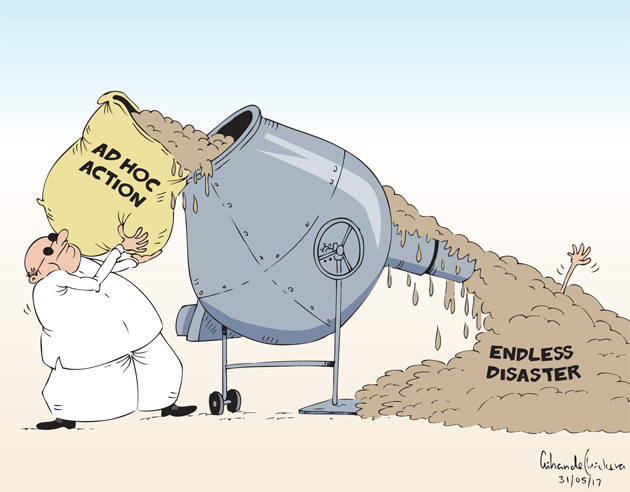
Sri Lanka: Not only oscillating between droughts and floods, but now also having both disasters at the same time. Cartoon by Gihan de Chickera
Adapt or Perish
Sri Lanka joined the UN Framework Convention on Climate Change (UNFCCC) in 1992. But 25 years on, climate considerations are not fully factored into our development planning and public investments. State agencies in charge of roads, railways, irrigation works and utilities don’t appear to realise the need to ‘insure’ their installations and operations from climate impacts.
Climate adaptation is not something that the disaster ministry and DMC alone can accomplish. It needs to be a common factor that runs across the entire government, from agriculture and health to power and transport. It needs to be the bedrock of DRR.
We need aware and empowered local communities matched by efficient local government bodies. This combination has worked well, for example, in the Philippines, now hailed as a global leader in DRR.
Managing disaster early warnings is both a science and an art. When done well, it literally saves lives — but only if the word quickly reaches all those at risk, and they know how to react.
We have come a long way since the devastating Boxing Day tsunami of December 2004 caught Indian Ocean countries by surprise. Many of the over 230,000 people killed that day could have been saved by timely coastal evacuations.
Early warnings work best when adequate technological capability is combined with streamlined decision-making, multiple dissemination systems and well prepared communities.
Rapid onset disasters — such as tsunamis and flash floods — allow only a tight window from detection to impact, typically 15 to 90 minutes. When it comes to tsunamis, it is a real race against time. Effective tsunami warnings require very rapid evaluation of undersea earthquakes and resulting sea level changes, followed by equally rapid dissemination of that assessment.
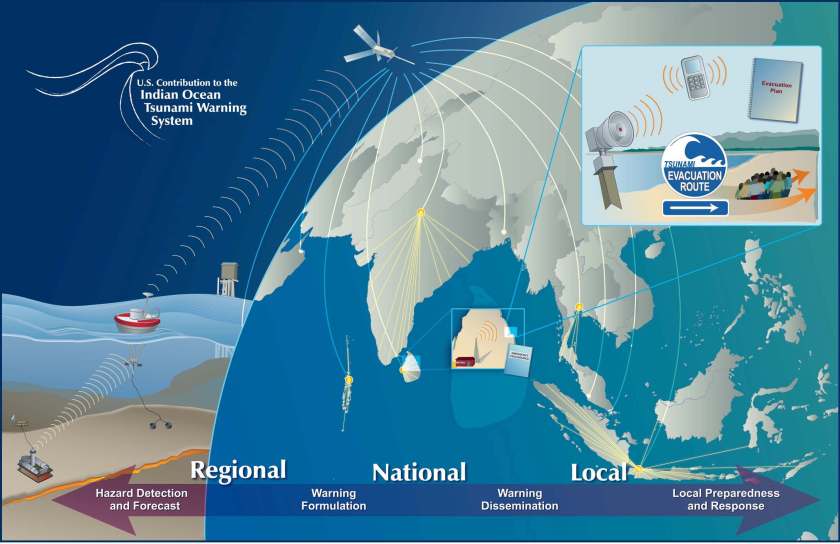
Following the 2004 disaster, the Indian Ocean Tsunami Warning and Mitigation System (IOTWS) was set up in 2005 under UNESCO’s Intergovernmental Oceanographic Commission. It is a regional collaboration that brings together three regional tsunami service providers – scientific facilities operated by the governments of Australia, India and Indonesia — and over a dozen national tsunami centres. The latter are state agencies designated by governments to handle in-country warnings and other mitigation activities.
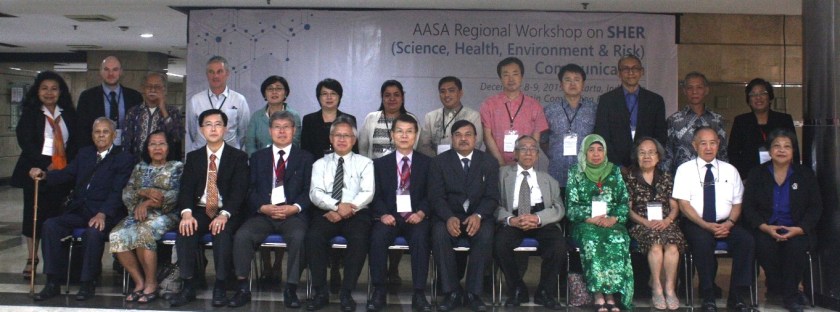
Participants of SHER (Science, Health, Environment & Risk) Communication – Role of S&T Communication in Disaster Management and Community Preparedness held in Jakarta, Indonesia, on 8-9 Dec 2015
It was organised by the Association of Academies and Societies of Sciences in Asia (AASSA) in collaboration with the Indonesian Academy of Sciences (AIPI), Korean Academy of Science and Technology (KAST) and the Agency for Assessment and Application of Technology (BPPT) in Indonesia.
The workshop brought together around 25 participants, most of them scientists researching or engaged in publication communication of science, technology and health related topics. I was one of two journalists in that gathering, having been nominated by the National Academy of Sciences of Sri Lanka (NAASL).
I drew on over 25 years of journalistic and science communication experience, during which time I have worked with disaster managers and researchers, and also co-edited a book, Communicating Disasters: An Asian Regional Handbook (2007).
Nalaka Gunawardene speaking at Science, Health, Environment & Risk Communication Asian regional workshop held in Jakarta, Indonesia, 8-9 Dec 2015
The challenge in disaster early warnings is to make the best possible decisions quickly using imperfect information. With lives and livelihoods at stake, there is much pressure to get it right. But one can’t be timely and perfectly accurate at the same time.
We have come a long way since the devastating Boxing Day tsunami of December 2004 caught Indian Ocean countries by surprise. Many of the over 230,000 people killed that day could have been saved by timely coastal evacuations.
The good news is that advances in science and communications technology, greater international cooperation, and revamped national systems have vastly improved tsunami early warnings during the past decade. However, some critical gaps and challenges remain.
The Indian Ocean Tsunami Warning and Mitigation System (IOTWS) was set up in 2005 under UNESCO’s Intergovernmental Oceanographic Commission. Over USD 400 million has been invested in state of the art equipment for rapid detection and assessment. However, the system’s overall effectiveness is limited by poor local infrastructure and lack of preparedness. Some countries also lack efficient decision-making for issuing national level warnings based on regionally provided rapid assessments.
Warnings must reach communities at risk early enough for action. False warnings can cause major economic losses and reduce compliance with future evacuation orders. Only governments can balance these factors. It is important that there be clearer protocols within governments to consider the best available information and make the necessary decisions quickly.
Now, the proliferation of information and communication technologies (ICTs) is making this delicate balance even more difficult. To remain effective in the always-connected and chattering Global Village, disaster managers have to rethink their engagement strategies.
Controlled release of information is no longer an option for governments. In the age of 24/7 news channels and social media, many people will learn of breaking disasters independently of official sources. Some social media users will also express their views instantly – and not always accurately.
How can this multiplicity of information sources and peddlers be harnessed in the best public interest? What are the policy options for governments, and responsibilities for technical experts? How to nurture public trust, the ‘lubricant’ that helps move the wheels of law and order – as well as public safety – in the right direction?
As a case study, I looked at what happened on 11 April 2012, when an 8.6-magnitude quake occurred beneath the ocean floor southwest of Banda Aceh, Indonesia. Several Asian countries issued quick warnings and some also ordered coastal evacuations. For example, Thai authorities shut down the Phuket International Airport, while Chennai port in southern India was closed for a few hours. In Sri Lanka, panic and chaos ensued.
In the end, the quake did not generate a tsunami (not all such quakes do) – but it highlighted weaknesses in the covering the ‘last mile’ in disseminating early warnings clearly and efficiently.
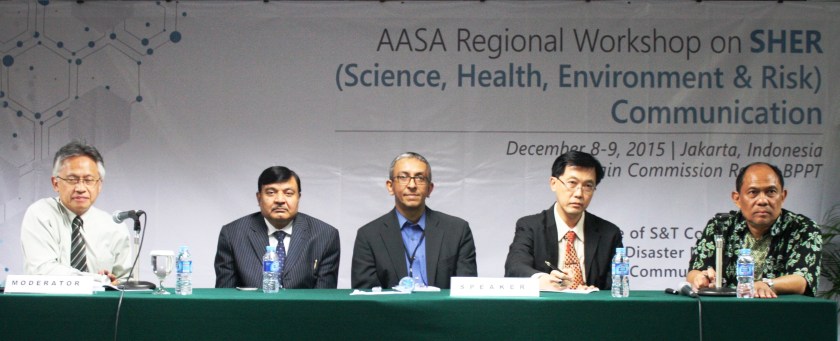
Speakers on ‘ICT Applications for Disaster Prevention and Treatment’ in Jakarta, Indonesia, 8-9 Dec 2015
I concluded: Unless governments communicate in a timely and authoritative manner during crises, that vacuum will be filled by multiple voices. Some of these may be speculative, or mischievously false, causing confusion and panic.





 Open Minds!