The BBC as a Fossil Fool?

The BBC is running a Climate Season once again. Like many arms of the media, they have jumped the climate change bandwagon.

And that’s a good thing.

BBC World’s blurb reads:
As part of BBC World’s extensive coverage of one of the key challenges facing humanity, the Climate Watch season throughout April will feature a host of special documentaries and factual programmes plus news and
business reports from its global correspondents.

This is only to be applauded. But it wasn’t too ago that the BBC – with other sections of the mainstream media – was still insisting on “balancing” its coverage of climate change.

Even a couple of years ago, the BBC appeared to be incapable of running an item on the subject without inviting a skeptic to comment on it.

Of course, the BBC is entitled to change its mind like everyone else. (As a certain Boutros Boutros-Gali once famously remarked, only fools don’t change their mind.)

George Monbiot wrote a column in The Guardian (UK) on 27 April 2004 commenting on this. It was titled: “Beware the Fossil Fools: The Dismissal of Climate Change by Journalistic Nincompoops is a Danger to us All”.

Here’s an extract from that article, published less than 1,000 days ago:

Picture a situation in which most of the media, despite the overwhelming weight of medical opinion, refused to accept that there was a connection between smoking and lung cancer. Imagine that every time new evidence emerged, they asked someone with no medical qualifications to write a piece dismissing the evidence and claiming that there was no consensus on the issue.

Imagine that the BBC, in the interests of “debate”, wheeled out one of the tiny number of scientists who says that smoking and cancer aren’t linked, or that giving up isn’t worth the trouble, every time the issue of cancer was raised.

Imagine that, as a result, next to nothing was done about the problem, to the delight of the tobacco industry and the detriment of millions of smokers. We would surely describe the newspapers and the BBC as grossly irresponsible.

Now stop imagining it, and take a look at what’s happening. The issue is not smoking, but climate change. The scientific consensus is just as robust, the misreporting just as widespread, the consequences even graver.

Monbiot ended the article by asking:

But isn’t it time that the BBC stopped behaving like the public relations arm of the fossil fuel lobby?

How times have changed! But hey, better late than never…

Related:

Monbiot.com
World’s richest environmental prize goes to the BBC

Fossil fuels and fossil fools in India

‘‘People in India, unlike the West, don’t understand the seriousness of climate change….They think global warming is a fantasy. Indians are using fossil fuel like never before. We have constructed oven-like buildings and spend enormous energy cooling them.’’

I came across these words by the well known Indian environmental film-maker Mike Pandey in an article in NewIndPress that surveyed how Indian documentary film-makers are rising to the challenge of communicating climate change.

The article, ‘Meltdown on Film’ published on 15 March 2007 highlights the formidable task of raising awareness in India, now one of the fastest growing economies in the world, consuming larger volumes of fossil fuels every year.

Mike knows what he’s talking about: his film Global Warming went largely unnoticed when it was released in India three years ago.

And he is one of India’s top notch film makers on environment, wildlife and natural history. He has won three Panda Awards — also known as the ‘Green Oscar’ — at the Wildscreen Film Festival held every other year in Bristol, UK — and considered to be the most important festival of its kind in the world. (Modest cough: I was on the jury of Wildscreen 2000, when we gave Mike one of his three Green Oscars.)

Viewer apathy is not the only problem that India’s environmental film-makers have to contend with. Here’s an extract from the article:

Like any environmentalist, our documentary filmmakers are “concerned” about issues like global warming. But the lacklustre reactions of research agencies (who ‘‘support” the cause but don’t really come forward to fund documentaries), zero interest from broadcasters who, according to one filmmaker, prefer ‘‘sexy environmental stories’’, together with viewer apathy, are the reasons why the few impressive documentary films on climate change vanish after a few screenings at festivals. Take the Public Service Broadcast Trust’s (PSBT) Open Frame, for instance, the annual documentary film festival held in Delhi. Or the roving environmental and wildlife film festival CMS Vatavaran, where open discussions are held after every screening. Barely a couple of films are chosen by the public broadcaster Doordarshan after they are screened at these two festivals, which is why most of the documentaries don’t ever reach the masses.

‘‘Public interest stories and documentaries are the last thing broadcasters want to show,’’ quips Pandey. ‘‘People like me are lucky to have found space on DD. Value-based programmes are nudged out so easily by broadcasters these days.”

The article continues:

A few years ago, when Mike Pandey returned to his favourite spot in Austria to capture a snowcap for one of his films, he was shocked to see it had melted. He says, ‘‘I had seen the ice cap the previous year. I had to go deeper into the area to get my shots. It’s common in Austria to see ice caps vanishing. You see blossoms and splendid crops in many areas.’’ After Earth Matters, which is being shown on Doordarshan, Pandey is coming up with a series of six films on global warming, which will talk about ‘‘using alternative energy for the future.’’

Whenever out for shoots at Lakshwadeep, Kochi and Gujarat, Mike has been noticing ‘‘visible changes’’ in ‘‘ocean ferocity’’ and where the sea neighbours the land. ‘‘The water has come in a bit more into the land over the years,’’ he observes.

‘‘You don’t have to be a scientist to notice these changes; you can see it all happening now. Unfortunately, people living along the Indian coastline will be the first ones to face any kind of major impact,’’ he adds.

On my visit to Hyderabad last week, I was told that there are now close to 50 TV channels that cover news and current affairs on a 24/7 basis (in English and other Indian languages). Yet this kind of news hardly seems to make the headlines….it’s probably moving too slowly.

Mike Pandey and other environmental film-makers have their work cut out for them.

“If (Indian cricketer) Sachin Tendulkar or (Bollywood star) Shah Rukh Khan loses his cell phone, the news will reach every nook and corner of the country, but the fact that iodine is essential for the human body is still not known widely,” Mike told India’s Frontline news magazine in 2004. Read full article: Nature’s film-maker in Frontline of 18-31 Dec 2004

Read TVE Asia Pacific website feature on Mike Pandey’s 2003 film on the whale shark in India

Long live MediaChannel.org!

I have never peddled a fund raising appeal through my blog…until now.

Earlier today, I received my daily email from MediaChannel.org, a website that critiques the media — ‘As the media watch the world, we watch the media’

According to their website: MediaChannel is concerned with the political, cultural and social impacts of the media, large and small. MediaChannel exists to provide information and diverse perspectives and inspire debate, collaboration, action and citizen engagement.

And like many of us who mix media and social activism, they are facing a crisis. Today’s email said:

After seven years and a new website redesign, MediaChannel.org may have to cease operations because of a financial emergency. As most of you have already noticed, we have started to run advertising on the website in an effort to deal with our funding challenge.

To put it bluntly, the future of MediaChannel is in question. Please consider making a tax deductible donation online through PayPal or send a check made out to: The Global Center, 575 8th Avenue, Suite 2200, New York, New York, 10018.

MediaChannel is headed by Danny Schechter, the Emmy-award winning TV journalist and film-maker.

I met Danny in the Fall of 1995, when I spent a few weeks in New York on a fellowship to study the United Nations. Danny was one of the more colourful people we met (besides lots of men in suits from the UN, only a few of whom I can now recall by name). Danny introduced himself as a (TV) ‘network refugee’ — and gave a workshop on television journalism in defence of the public interest and human rights that had a lasting influence on myself.

Besides running MediaChannel.org, Danny writes the well-informed, incisive NewsDissector blog

Since then, we’ve been in contact occasionally. And here’s my declaration of interest: MediaChannel.org has published my media related op ed essays, though I never get paid and never expect any payment.

As Walter Cronkite says: “MediaChannel is undoubtedly worth taking part in. So many leading groups and individuals around the whole world have come together.”

And MediaChannel.org is undoubtedly worth supporting.

Read my last op ed on MediaChannel:
Ethical news-gathering: Al Jazeer’s biggest challenge

Digits4Change: Do ICTs make a difference?

When it comes to bridging the Digital Divide, there’s so much hype, rhetoric and confusion. For many in the UN system, it’s just another development issue to be bandied about at endless meetings and conferences, and to be reflected upon from 30,000 feet above the ground where they find themselves most of the time.

Yet, at the ground level, individuals and communities are adapting various ICTs to meet their practical needs and solve real world problems. I sometimes feel that whatever bridging of the Digital Divide will happen in spite of, and not because of, the UN agencies and other development players debating issues to exhaustion.

In 2005-2006, we at TVE Asia Pacific documented some of these efforts in different parts of Asia. We looked at a variety of technologies solving a range of problems. This became Digits4Change.

digits4change.jpg

Here’s our series intrdocution:

There are more poor people in the Asia Pacific than in all other regions combined. At the same time, some Asian countries have achieved the most advanced economies in the world. Their prosperity is partly due to how they have developed or adopted information and communication technologies — or ICTs.

How can the developing countries of Asia use these digital tools to help generate wealth, create more jobs and improve living conditions of people? Governments, private sector, civil society and researchers have been trying out various approaches for years. The World Summit on the Information Society (WSIS) in 2003 – 2005 took stock of what has been accomplished, and what remains to be done.

TVE Asia Pacific – a regional leader in using audio-visual media to cover development issues – embarked on documenting examples where ICTs have made a change in people’s lives in the world’s largest region. We investigated stories on distance learning, business process outsourcing, tele-health and rural connectivity.

The result is a new video series: Digits4Change.

Watch Digits4Change stories on TVEAP’s channel on YouTube

Read my views on the newly launched UN Global Alliance on ICTs for Development , published on SciDev.Net

Cricket on TV: Fatal attraction?

Productivity in South Asia can’t be all that high these days. A good part of our 1.5 billion combined population stays up late into the night, watching live TV broadcasts of cricket matches of the ICC World Cup.

Because the championship is hosted in the West Indies, time differences mean that each match would begin in the evening and continue into the early hours of our mornings.

Lots of people turn up at work with bleary eyes.

But that’s nothing compared to the many tears shed, sighs heaved and fists raised when South Asia’s cricket playing nations — Bangladesh, India, Pakistan and Sri Lanka – lose a match.

The two cricket giants and rivals – India and Pakistan – both had shocking exits in the first round itself. This inspired much anguish, despair and anger. It also wrecked business plans of many South Asian TV networks, which had paid millions of dollars for the rights to broadcast World Cup cricket matches. Now they fear they cannot recover their investment.

Flying from Colombo to Hyderabad for an academic meeting, I read the latest (2 April 2007) issue of the Indian newsmagazine Outlook, which offered a good analysis of what went wrong for India in the World Cup. It’s one among many, many post mortems in the media.

Outlook Editor Vinod Mehta, one of India’s seniormost and outspoken journalists, writes a short piece in this issue, headlined ‘Fatal Attractions’.

In his typical style, he starts:
I told-you-so journalism can be both exasperating and juvenile. Thus, I get no pleasure in reminding you that four weeks before our determined fifteen left for the Caribbean, I had lamented: “Am I the only one turned off by Indian cricket? I’d much rather relax watching an old film than see our boys wield the willow. The occasional fluke victory is all we can hope for. The team looks pedestrian and, frequently, pathetic.

Then he gets more serious, saying we must ask ourselves if the media and the marketers are doing us a favour by injecting such hyper-nationalism ‘as they collectively raise unrealistic hopes of India’s conquests’.

He concludes:

“The martial music, the thumping of chests, the shouts of “India, India”, the painting of the national colours on faces, the patriotic exhortations of politicos suggests that the Cup is already in the bag; the winning is just a formality. When we experience not just defeat but a sound thrashing, the Indian cricket fan, who has been duped by slick promos and to some extent his own credulity, finds reality intolerable. If, instead, expectations were kept at a reasonable level we would not undergo such a tremendous feeling of being let down. We could cope with the disappointment.

“No other team in the World Cup, not even the Aussies and the Proteas, play under so much pressure, most of it induced by greedy advertisers hoping to exploit the passion for the game. I believe this exploitation has gone on long enough. The market must stop playing with the emotions of a nation. Meanwhile, we should remember we have just lost a game of cricket. We are not finished as a nation.”

Read the full commentary in Outlook Online

Arthur Clarke looking for signs of life in Colombo…

I have finally found my legitimate claim for being unique: I don’t follow cricket.

Yes, you heard me right. Despite being born and raised in Sri Lanka, and still being based there about half of my time, I have never been a great fan of cricket. I must be the only one in my office who gets a decent night’s sleep these days. Practically everyone stays up till the wee hours of the morning watching live TV broadcasts of the ICC World Cup cricket matches taking place literally on the other side of the globe: the West Indies.

There’s now a very close nexus between television and cricket. Live broadcasts beam instantly into our living rooms the action on a cricket field anywhere on the planet. In fact, thanks to the zoom-ins, slow-motion instant replays and other techniques, those who watch a cricket match on the small screen can share the action even better than the few thousand who witness it physically at the stadium. (And the screens are no longer very small: across cricket-crazy South Asia, sales have soared for plasma screens of increasingly large – if not mostrous – sizes.)

The man who made all this possible is slightly bemused — but not one bit affected — by all this frenzy. Sir Arthur C Clarke, science fiction author, futurist and inventor of the communications satellite, sits in his living room, pondering the near and far future of humanity that he helped transform into a Global Village.

That’s the only other person in the whole of Colombo that I know who isn’t infected by the current World Cup fever. (See my other post today for views of a rare Indian who doesn’t follow cricket and instead prefers to watch old movies.)

Writing a foreword to the UNDP’s Human Development Report in 2003, Sir Arthur noted: “Today, television rules how Sri Lankans work, dine and socialise. And when an important cricket match is being broadcast live, I have to look hard to find any signs of life on the streets of Colombo.”

We might opt out of following the cricket, making ourselves rather dull conversationalists these days, but if we dare to utter even a word against this de facto religion of South Asians, dire consequences are sure to follow.

A decade ago, Sir Arthur had a first hand experience to prove this. In a wide-ranging media interview, he told a visiting Reuters correspondent that he shared some people’s skepticism that cricket was the slowest form of animal life, because it takes so long. (A Test match can take as many as five full days, and still end without a clear result!).

Having mis-heard Sir Arthur, the Reuters man filed his story saying Arthur C Clarke calls cricket the `lowest form of life’.

That was enough to stir up a mini storm. It couldn’t have come at a worse time — Sri Lanka had just won the 1996 cricket World Cup and the country was still euphoric. For weeks, Sir Arthur had to cope with irate Sri Lankan cricket fans — as he told a visiting American journalist from The Philadelphia Inquirer, ‘I had a lot of explaining to do’.

Moral of the story:
1. Be always careful when talking to journalists.
2. Keep your criticism of cricket strictly to yourself.

Human Development Report Foreword by Sir Arthur C. Clarke: Communications for Goodness’ Sake

Read my later post: Arthur Clarke’s climate friendly advice: Don’t commute; communicate!

Ratomate’s best cup of tea

In another post earlier today, I quoted a doctor turned film-maker in India saying people affected by HIV are dying more from the social stigma attached to the disease than by the disease itself.

Social stigma is a wide-spread problem that confronts people living with HIV in all parts of the world.

But occasionally, we hear some good news: how community has overcome its prejudices and accepted those infected with HIV with affection and care. Usually, it happens after going through the knee-jerk reactions.

It would be very worthwhile for some research to be done on how and when community attitude changes: what are the triggers? what is the tipping point?

Five years ago, we had first hand experience of this through a film that we at TVE Asia Pacific commissioned under our Truth Talking documentary series.

The film, titled Love for a Longer Life (26 mins, 2002) was directed by leading Nepali documentary film-maker Dhurba Basnet.
dhurba-basnet.jpg

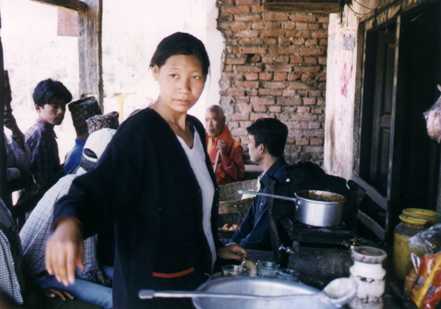
The best cup of tea in the Ratomate village, in central Nepal, is made by a woman called Laxmi Lama. She works in a tea shop owned by her father. “People tell me my father does not know how to make good tea,” she says. “They want me to make tea. The men like their tea strong. When I give my customers strong tea they say one cup is enough for the whole day.”

This is nothing unusual – except that Laxmi is living with HIV. A few years ago, no one in her village would have come near her, let along clamour for a cup of tea she makes.

Born into a very poor family, Laxmi was sold off to a Bombay brothel at the age of 14, and worked as a commercial sex worker for nearly three years before returning to Nepal. She married a man from her village and had settled down to a peaceful routine when a health worker tested her blood and found her positive for HIV. That changed everything dramatically: her husband fled, never to return, and everybody shunned her. The pregnant woman sought refuge in her parents’ house.

That was the fate of most Nepalis living with HIV – abandoned by friends, ostracised by community and left to their own devices. But thanks to the perseverance of a few courageous people – many HIV positive themselves – community attitudes have changed slowly, and have come almost full circle: being reassured that HIV does not spread through casual physical contact, they have accepted her back into their fold.

lakshmi-lama.JPG The moment of truth is when she makes Ratomate’s favourite cups of tea with her bare hands, and men and women flock to taste it. Such a major transformation of community attitudes captured in such a simple, elegant sequence.

Laxmi’s neighbour Kumari Shrestha sums it all up: “We have to give her love. If we do that, she will live longer.”

It would be wonderful if we can discern how and when this change happens. So that it can be induced in thousands of other villages and communites where persons living with HIV are currently battling the virus within, and stigma without.

View a clip from the film here.
Order the film from TVEAP e-shop

The Nature of David Suzuki

One of my highlights in the recent week I spent in Washington DC, attending the DC Environmental Film Festival, was listening to a talk by the Canadian naturalist and television personality David Suzuki.

In a 90-minute presentation at the Smithsonian Natural History Museum, Suzuki talked about his childhood, early influences, academic career and public life. He kept his packed audience – over 600 people – spell-bound, entertained and inspired. It reminded me of the first time I listened to this charismatic geneticist: in the summer of 1991, on my first visit to his home city of Vancouver.

If anything, he had got better with age but, I was happy to note, hasn’t mellowed. He still has the same passion that has made him not just a highly successful science communicator, but an ardent activist for the environmental cause and the rights of indigenous people, or First Nations.

David Suzuki

Introducing their well-known host, Canadian Broadcasting Corporation (CBC) says:
“Dr. Suzuki is an award-winning scientist, environmentalist and broadcaster. His television appearances, explaining the complexities of the natural sciences in a compelling, easily understood way, have consistently received high acclaim for over 30 years. He is the only network television science host who was actually a practising scientist.”

In his Smithsonian talk, Suzuki reminded us that his show – The Nature of Things with David Suzuki – is the only regular science programme that is broadcast on prime-time TV in North America on a mainstream public access channel. This might partly explain, he suggested, why Canadians are better informed about science and environmental issues that affect their daily lives. (In contrast, programmes like Nova go out on niche channels.)

The Museum of Broadcasting has this to say about the programme:
“One of the longest-running television shows in Canadian history, The Nature of Things has aired continuously since 6 November 1960. An hour-long general science program, the show began as a half-hour series–an attempt, as the first press release phrased it, ‘to put weekly science shows back on North American television schedules.’

Suzuki has been presenting the show without a break since 1979, and it is now branded by his name. When The Nature of Things with David Suzuki turned 30 years in l990, Suzuki wrote in The Toronto Star that in the gimmicky world of television-land, where only the new is exciting, “the longevity of a TV series is just like the persistence of a plant or animal species — it reflects the survival of the fittest.”

CBC’s official webpage for the show

Read a brief history of The Nature of Things

CBC profile of David Suzuki, and selected extracts and interview clips