Race to Save the Sky…by 2010

This is the opening segment of an Asian film that we at TVE Asia Pacific produced in 2006 for the UN Environment Programme (UNEP).

Called Return of the Ozone Layer: Are We There Yet? (30 mins, 2006), it tells the story of how the Asia Pacific – home to half of humanity – holds the key to saving the ozone layer…from man-made chemicals eating it up.

We presented it as a race…against time, and against many odds. Here’s how it opens.

You wouldn’t notice it even if you look carefully…but the Asia Pacific is running an important race.

It’s a race to phase out a group of chemicals used in industry, agriculture or consumer products.

When released to the atmosphere, these chemicals damage the Earth’s protective ozone layer. This ‘ozone shield’ protects all life from the Sun’s harmful ultraviolet rays.

These chemicals are used in refrigerators, air conditioners, fire fighting equipment, farming and a range of other products and processes.

The industrialised countries have already stopped producing these chemicals. This happened thanks to an international environmental treaty called the ‘Montreal Protocol on Substances that Deplete the Ozone Layer’. It was adopted in 1987 in response to the thinning of the ozone layer – or the ‘Ozone Hole’ –discovered two years earlier.

The Montreal Protocol sets time-bound, measurable targets for managing nearly 100 different chemicals.

These are closely tied to economic activity, public health and safety. Therefore, developing countries and economies in transition were given more time to reduce consumption — with the same goal of eventually phasing them out.

20 years on, the Montreal Protocol’s implementation has produced tremendous benefits to our health and environment.

But it’s a bit too early to celebrate.

Many challenges remain.

Developing countries now have to show they are making good use of the extra time and resources given to them.

It is the Asia Pacific that now produces and consumes most of the world’s Ozone Depleting Substances – or ODS. .

All production and use of CFCs in developing countries must stop in 2010.

But it’s easier said than done. The region has tens of thousands of small scale industries and farms that still use ozone damaging chemicals.

To accomplish the remaining phase-out targets, all
of them need to be engaged.

In this film, we look at key challenges the Asia Pacific region faces on the road to 2010. Meeting these challenges would ensure timely compliance of phase-out targets.

Clearly, governments alone cannot win this race. Millions of ordinary citizens have to join in.

Millions like the five we feature in this film.

Making this 30-minute documentary was a challenge. For a start, we had to grapple with complex scientific, economic and political issues and present them in a non-technical, accessible manner. We knew the average viewer was not interested in the intricacies of inter-governmental negotiations or atmospheric chemical reactions.

Talking about the ozone layer – which is out of sight, lying a few kilometers above the Earth’s surface – is never easy. It’s harder to get people to pay attention that sustained action is needed to remove man-made threats to the ozone layer.

Our challenge was to tell the story in a simple, engaging way — and UNEP wanted it to be different from many ozone layer documentaries already made. That’s when we decided to focus on five ordinary Asians who were doing their bit to save the ozone layer.

As our opening narration put it:

Five ordinary people, living and working in the Asia Pacific – the world’s largest and most diverse region.

Their actions will impact the future of life on our planet.

And there are millions more like them.

This is their story.

Watch the entire film (in several parts) on TVEAP’s YouTube channel.


September 2007 blog post: Ozzy Ozone: The Little molecule on a big mission
Little voices from the waves: Maldives too young to die!

maldives-too-young-to-die-say-school-children-nov-1989.jpg

My post last week on the Maldives on the frontline of climate change reminds me that I have been covering this story for the better part of 20 years. I have just located this photo from the depths of my personal image collection.

I first visited the Maldives in 1988, which was within months of the Indian Ocean archipelago nation suffering from a massive storm surge in 1987. Although the damage was minimal, the experience was a forceful reminder of how vulnerable the Maldives can be to even a small rise in sea levels – this is what prompted the low lying nation to take up the issue internationally.

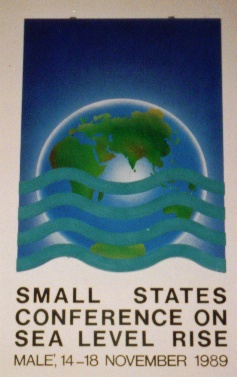
In November 1989, the Maldives hosted the first ever small states conference on sea level rise, held at the Kurumba island resort.

It was also one of the earliest international gatherings on this issue, which was to gain public interest and momentum in the years that followed. Among the participants were delegates from practically all the small states in different parts of the world (defined as those with less than 1 million population), and scientists from disciplines such as oceanography, climatology, meteorology and geology.

This was one of the first international scientific events that I covered as an eager young science journalist. I was then a roving South Asian correspondent for Asia Technology, a popular monthly on Asian science and technology published from Hong Kong (which, alas, folded up in 1991) – there’s nothing online as it was in the pre-web era!

The conference had technical sessions where experts debated scenarios and implications, and a political segment where delegations made their official statements. In the end, they issued the Malé Declaration on Global Warming and Sea Level Rise, which urged for inter-governmental action on the issue.

small-states-conference-on-sea-level-rise-logo.jpg small-states-conference-on-sea-level-rise-logo.jpg

Some 18 years later, I’m still eager but not so young – and I’ve covered more than my share of international environmental conferences to know that they can’t save the world. At least not on their own.

But many serve a useful function in rallying around concerned parties, helping them to agree on advocacy positions. Progress at inter-governmental level can be painfully slow and incremental. Sustaining public and media interest is one way to keep pressure on the endlessly bickering governments.

Following the November 1989 conference, small island states played a key role in negotiations that led to the UN Framework Convention on Climate Change adopted in 1992. This is the precursor to Kyoto, Bali and other processes that are now very much in the news.

The Maldivian hosts knew that scientists and officials alone could not send out a powerful message to the world on what climate change means to low lying islands of the world – many of them no more than a few feet above sea level.

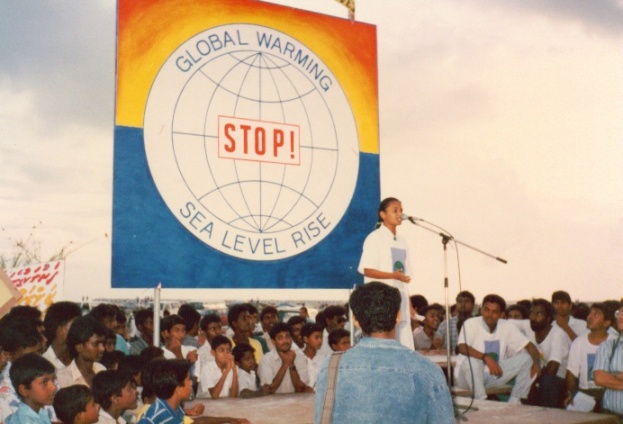
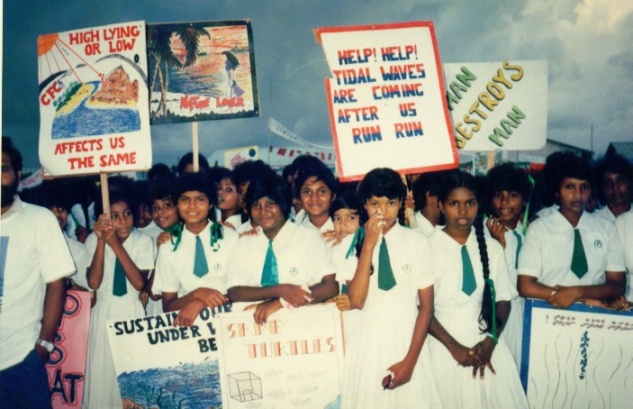
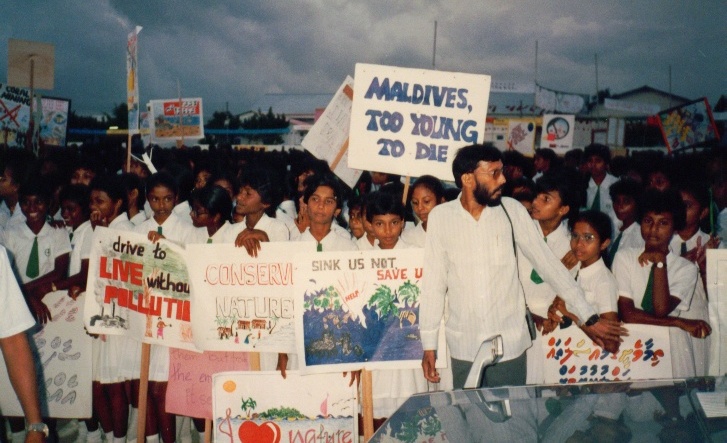
So on the last day evening, we were all taken to the Maldivian capital of Male, where we saw a demonstration and meeting held by the school children and ordinary people. To me, at least, this was the most striking moment of the whole week.

Leading up to this, I had been listening to competent experts and concerned officials talk about impacts, scenarios and mitigation measures for several days. Based on my notes and interviews, I filed several stories that captured highlights.

But unless I go back to my personal archives and look up those stories, I can no longer remember what I wrote. My lingering memories of this event are in these images, showing school children telling delegates – and the world – what it means to be living on the front lines of climate change impact.

listen-to-our-voice-from-the-waves-maldives-nov-1989.jpg

maldivian-school-children-worried-about-sea-level-rise-nov-1989.jpg

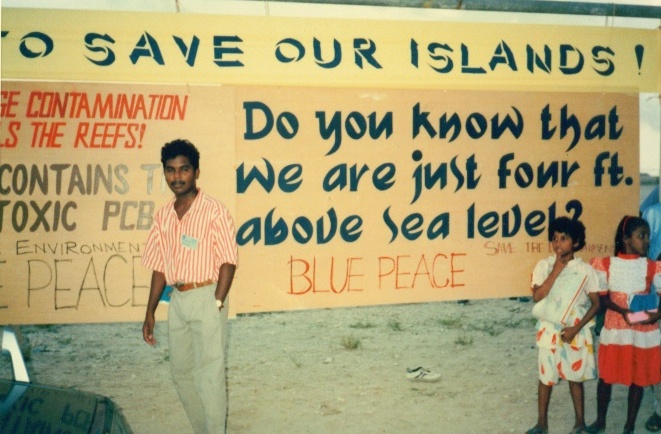
Then newly formed Maldivian environmental organisation Bluepeace was also part of the demonstration:

bluepeace-calls-for-global-attention.jpg

I worked for several years as a science and technology reporter. I was trained to gather, process and present facts and, preferably, expert opinion. But over the years I have realised that while hard facts and expert opinions are necessary, these tell only one part of complex stories we cover.

We need to bring in the human face of our stories — how ordinary children, women and men feel about issues and how they react to situations. This is why I now argue that we should not allow the human face of climate change to be lost in our well-meaning technical and economic discussions about climate change mitigation and adaptation.

We can cover carbon neutrality, zero emissions and common but differentiated responsibilities for all we like, but if we don’t pause to listen to these little voices from the waves – from the frontlines that are already feeling the heat – we will miss the bigger picture of what climate change is all about.

Dec 2007: Road to Bali – Beware of ‘Bad Weather Friends’

Photos by Nalaka Gunawardene, Male island, November 1989

Return to Paradise: Maldives on the frontline of climate change

Related blog post: 6 Jan 2008: Little voices from the waves: Maldives too young to die

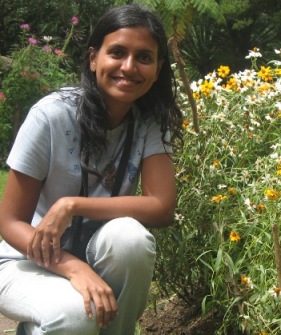
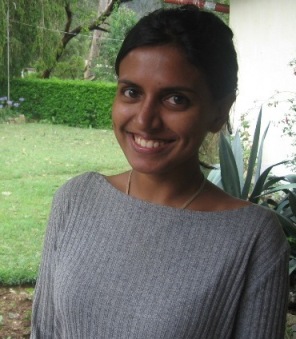
Mariyam Niuma - photo by TVEAP

All of us at TVE Asia Pacific are missing Mariyam Niuma.

This bubbly, happy-go-lucky intern returns to her native Maldives this week after working with us for over a year as a programme assistant. She plans to spend more time with her family, and explore work opportunities in the Indian Ocean archipelago nation of 370,000 people.

Niuma, in her early 20s, applied for a staff position in late 2006. Among other things, she came with skill and dexterity in graphic design, web research and English proficiency — always useful for a regional communication organisation like ourselves.

“I want to learn as much as I can how a non-profit organisation works,” she told as at the recruitment interview. She had plans of taking the knowledge and skills back to her home atoll, hoping to make life better for her people.

I hope she found what she was looking for. We found in her an energetic young person with good attitude – one who could be challenged to work on tough (and sometimes tedious) tasks on a regular basis.

“The last year has been a very challenging and fulfilling year for me, and being at TVEAP helped a lot,” she wrote in an email on her last day at work. “I will miss you all and being a part of you and will always remember the good times and everything I have learnt here both professionally and personally.”

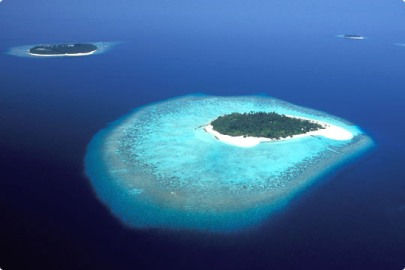
Some months into her internship, Niuma gave us a presentation on her home country, home atoll and life at home. To many outsiders, Maldives evokes images of palm-fringed sandy beaches, shallow seas of an exquisitely azure blue, high end resorts, crystal clear blue waters for diving…and plenty of sunshine all the year round. (Image shows Kurumba resort, Maldives.)

Well, all that’s true as widely advertised. But Maldives is a whole lot more – a history going back to at least 1,500 BC, distinctive island culture, and a nation that is struggling to reconcile tradition with modernity. Divehi, the Maldivian language, contributed the word “atoll” (a ring-shaped coral reef) to the English language.

The former British protectorate, which became independent in 1965 and a republic in 1968, has a pro-democracy movement sustained over the past few years. If such political turbulences create a sense of uncertainty in the minds of Maldivians about their future, it’s only one source of concern.

They also have to worry about whether their nation would have a collective future. That’s because of climate change that scientists now confirm are underway, aggravated by human action.

Most of the 1,200 islands in the Maldives are no more than 1m (3 feet) above sea level. Even a modest rise in sea levels could inundate these lands. Within 100 years the Maldives could become uninhabitable.

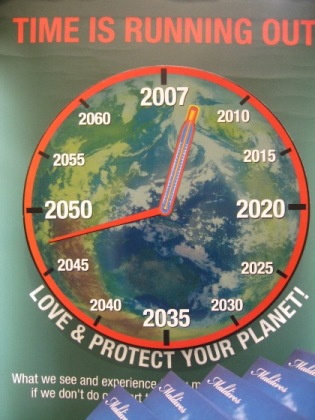
Time is indeed running out for Niuma and her country — as this poster produced by The Body Shop reminds us.

Time is running out...and not just for the Maldives

In 1987 and 1991 storm surges flooded a large number of islands, including one-third of the capital where one-quarter of the country’s population lives. Unusually high waves forced the international airport to be closed, causing great damage to tourism and constraining emergency relief operations. On 26 December 2004, the Asian tsunami battered the Maldives, forcing the evacuation of 13 of its 200 inhabited islands. These incidents indicate how vulnerable the islands are to wave action.

Maldives was among the first countries in the world to raise climate change as a serious issue at the United Nations. President Maumoon Abdul Gayoom raised the alarm back in 1987, when most people had not even realised the problem and scientific evidence was just beginning to come in.

The Maldives did more than raise the issue. The country played a lead role in rallying around other small island states worldwide that would be among the first to be impacted when sea levels rise due to thermal expansion and melting of polar ice.

In November 1989, the Maldives hosted the first ever small states conference on sea level rise, which was one of the first international scientific events that I covered as an eager young science journalist.

The conference issued the Malé Declaration on Global Warming and Sea Level Rise, which urged for inter-governmental action on the issue. The small island states played a key role in negotiations that led to the UN Framework Convention on Climate Change adopted in 1992. This is the precursor to Kyoto, Bali and other processes that are now very much in the news.

Just a few weeks ago, in mid November 2007, the Maldives once again hosted representatives from small island states to discuss climate change. Eighteen years after the original meeting, the subject is no longer a fringe concern; it’s now on everybody’s agenda.

Maldives from the air: tiny specs in the ocean
The meeting urged the the human dimension of global climate change to be included in the agenda of UN Climate Change Summit in Bali (December 2007), and sought the international community’s commitment “to protect people, planet and prosperity by taking urgent action to stabilize the global climate change”.

This time, the Male’ Declaration on the Human Dimension of Global Climate Change called for the UN High Commissioner for Human Rights to assess the human rights implications of climate change and “to conduct a study into the effects of climate change on the full enjoyment of human rights”. It requested the UN Human Rights Council to convene in March 2009 a debate on human rights and climate change.

I wasn’t at the November 2007 Male meeting, but was glad that the meeting stressed the need for adding a human face to the complex, nuanced challenge of climate change. This resonates very much with my own experience.

Read my April 2007 blog post: Wanted – human face of climate change

Mariyam Niuma takes me a bit closer to the realities of what climate change means to communities living on the frontline. Unlike Niuma, who is web savvy and connected with the wider world, many are blissfully unaware of the problem.

Our challenge is to bring their voices, stories and aspirations to the global news agenda and the myriad discussions now underway searching for solutions.

I hope someday we can work with Niuma again — perhaps amplifying her story in moving images.

Nov 2007 blog post: True people power needed to fight climate change

Related blog post: 6 Jan 2008: Little voices from the waves: Maldives too young to die

Photos of Mariyam Niuma courtesy Manori Wijesekera of TVEAP

After the Tsunami: Going the Long Last Mile in Sri Lanka

hazlnfo-video-j-a-malani-hambantota.jpg

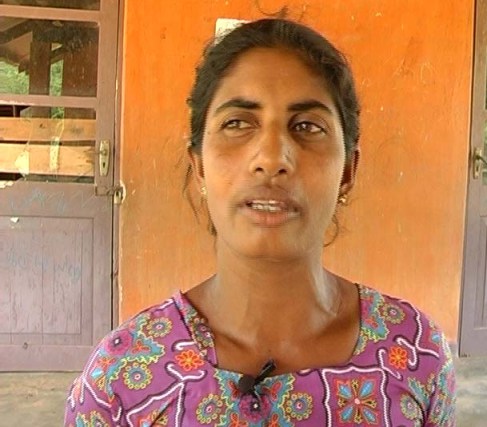
This is J A Malani. She’s an ordinary Sri Lankan woman living in Hambantota, on the island’s southern coast. Several hundred people in her town perished when the Indian Ocean Tsunami arrived on 26 December 2004 without any public warning. When the waves finally stopped their hammering, close to 40,000 people were dead or missing in the biggest disaster the island nation experienced.

Survivor Malani and her neighbours – lucky to be alive – are naturally apprehensive about when the next disaster might arrive, in what form and from where.

And this time around, too, they worry whether there would be anyone to warn them about it.

There just might be. Since the big tsunami three years ago, several Sri Lankan telecom operators, civil society organisations, IT companies and researchers have come together to test out a community-based hazard warning system — one that would prevent the repetition of the nasty surprise Malani’s community experienced not too long ago.

‘Evaluating Last Mile Hazard Information Dissemination Project’ (HazInfo project for short) was an action research project by LIRNEasia to find out how communication technology and training can be used to safeguard grassroots communities from disasters. It involved Sarvodaya, Sri Lanka’s largest development organisation, and several other partners, and was supported by International Development Research Center (IDRC) of Canada.

The project studied which information and communications technologies (ICTs) and community mobilisation methods could work effectively in disseminating information on hazards faced by coastal communities. The exercise was not confined to tsunamis alone; other rapid onset disasters such as cyclones and floods were also covered.

In its first phase, the project worked in 32 chosen coastal villages (all impacted by the tsunami) and mobilised local communities from muslim, Sinhala and Tamil backgrounds. Malini’s community was among those participating in this field testing of an approach that Sarvodaya hopes to roll out progressively to all 15,000 villages they work in.

That initial engagement by itself was reassuring to Malani. “This has helped us to get rid of fear and hesitation in our minds,” she said in a television interview recorded some weeks ago. “Now we know what we should do when a disaster strikes.”

That peace of mind is priceless to any human being, and that knowledge is liberating – particularly to one who has survived a major disaster that came from nowhere.

Malani is one of several beneficiaries featured in a 12-minute film TVE Asia Pacific recently produced. Several other participants from different coastal locations expressed similar views — and hopes that next time around, they will not be taken unawares.

The Long Last Mile can be viewed on YouTube in two parts:

The Long Last Mile, part 1 of 2:

The Long Last Mile, part 2 of 2:

LIRNEasia researchers analysed how each ICT tool or combination was integrated into communities to deliver timely warnings to those designated as first responders. The factors needed for efficient functioning of the hazard information hub were also studied. Read detailed findings and analysis here.

The HazInfo project grew out of a participatory concept paper that LIRNEasia developed in the aftermath of the 2004 tsunami. It noted that a national early warning system was a ‘pure public good’, and the responsibility of its supply would normally fall on the government. However, the paper acknowledged that, due to lack of capacity, “it is unlikely that the last mile of such a system will be provided by the local government or private firms operating in the marketplace”.

I have written a whole chapter on this project, titled Bridging the Long Last Mile, in Communicating Disasters: An Asia Pacific Resource Book (co-edited by Nalaka Gunawardene and Frederick Noronha). Read that chapter here:

bridging-the-long-last-mile-final-text-formated.pdf

Tsunami Stories: How a film saved lives in Kosgoda, southern Sri Lanka

With the third anniversary of the Asian Tsunami drawing close, we are reliving memories of the mega-disaster that hit many parts of coastal Asia on 26 December 2004.

On 10 October 2007, I wrote the story of Tilly Smith, the 11-year-old English school girl whose geography knowledge helped save hundreds of lives on the Maikhao Beach in Thailand that day.

Here’s another story, which was related by Thyagee de Zoysa, a young Sri Lankan woman who until recently was working as Project Officer of CEE Sri Lanka, a non-profit educational charity that I am associated with.

In January 2007, Thyagee spoke at the European launch of TVE Asia Pacific’s latest environmental television series, The Greenbelt Reports</em>, held in Athens, Greece. There she made a passionate appeal for education and awareness to be put into action.

She drew from her personal experience, having survived the Indian Ocean Tsunami in her native village of Kosgoda in southern Sri Lanka. These are her exact words:

“I, myself, am particularly willing to participate in this project, as I was at my home on the 26th of December 2004, with my parents, until we heard a young man crying ‘Run to the temple, run to the hill, the sea is coming’. We ran — and it saved our lives.
“The young man told me later that he knew that the sea was going to come with full power because of a film that he had seen. A film, which was about a meteorite impact with earth and how a tsunami happens after that. He knew that, if there comes a day when the sea goes back towards the horizon, it then comes back again to take your life.

“It does not matter in what way you create awareness on the environment, be it books, films or the Internet. What matters is that you do it and make somebody understand the possible actions to take up. Believe me, I am grateful to this young man for saving my life and that of my family…”

Neither Thyagee nor the young life-saver could recall the name of the film, but it doesn’t matter. The film left a bit of knowledge in the young man’s mind which surfaced instantly just when it was needed. That helped save lives.

Alas, there were very few Sri Lankans – young or old – who had any idea about tsunamis prior to that fateful Boxing Day 2004.

Writing a foreword to Communicating Disasters: An Asia Pacific Resource Book (co-edited by Nalaka Gunawardene and Frederick Noronha), Sir Arthur C Clarke refers to another rare exception: a retired sailor living in the coastal village of Galbokka recognised the tell-tale signs of the on-coming tsunami and rushed the entire community to safety.

The challenge we still face is to build everybody’s awareness on multiple hazards and what to do when hazards turn into disasters.

“Hands up who is poor, speaks English – and looks good on TV!”

“Hands up who is poor, speaks English – and looks good on TV!”

With that title, I opened my panel remarks to the 8th Annual Symposium on Poverty Research in Sri Lanka on the morning of 30 November 2007.

Sri Lanka’s Centre for Poverty Analysis (CEPA) had invited me to speak during a session on ‘Taking it off the page: Alternative mediums of communication to influence change’. The theme of the overall symposium was ‘Communicating research and influencing change’.

Part of my talk was on challenges in using moving images to communicate development related research. The other part was on how most sections of the mainstream media covers stories of the poor — or those living at the bottom of the income pyramid.

I noted that as Asia’s billions strive for a better today and better tomorrow, there are millions of stories at the bottom of the pyramid. But most mainstream media manage to miss these stories due to their ignorance, or arrogance, or both.

But reporting from the bottom of the pyramid need not be all about doom, gloom and alarm. In fact, so much is happening there that a well informed story-teller won’t have much time to spend on negativity (while acknowledging a great deal of suffering that remains).

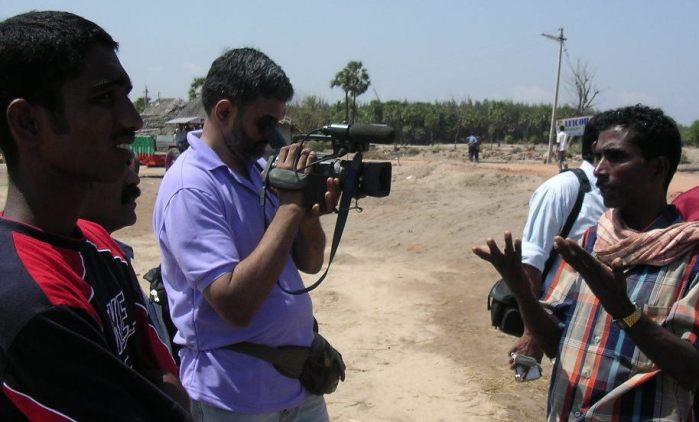
interviewing-tsunami-survivor-in-tamil-nadu-india.jpg

In my remarks, I emphasised that to discover these stories and tell them with empathy and accuracy, we as story-tellers need to recognise a few basic realities:
• The poor are not another species to be treated as if they were endangered! They are living and loving human beings as complex and nuanced as anyone in this room.
• Nor are the poor a ‘sub-human species’ with a simpler set of needs and aspirations. They have as many primary, secondary and tertiary needs – just like anyone else!
• When it comes to information, they have not only survival and practical information needs (which many development projects try to provide), but also what I call ‘information wants’ – cultural and social information – which many development projects completely ignore.
• The poor have opinions too — and are often more articulate and expressive when someone cares to listen and capture these.

So telling media stories from the Bottom of Pyramid needs the knowledge base, socio-cultural understanding and ethical framework in which to gather and process these stories. We at TVE Asia Pacific don’t claim to have got everything right, here are our basic rules of engagement:
• We treat the rich, middle class and poor alike – extending the same courtesy and respect (including obtaining personal clearances for interviews).
• We caption everyone on-screen by name and location, irrespective of their social and economic status.
• We film people – for interviews or generic footage – only with informed consent.
• Wherever possible, we take our the finished TV products back to where they were filmed and share with those who told us their stories. (We are not alone in this: I have written blog posts about Earthcare Films of India and the Brock Initiative of the UK who are also doing this.)

Our industry of broadcast TV is not always known for its class-less treatment of every human being with respect and dignity. In fact, the poor often become ‘Canon-fodder’ for camera crews looking for dramatic images of human suffering.

from-mediachannelorg.jpg from-mediachannelorg.jpg

The globalised media continue to use stereotyped images of the global South – captured mostly by northern photographers and camera crews. As my friend Shahidul Alam, founder of Drik Picture Library in Bangladesh, says: “Invariably, films about the plight of people in developing countries show how desperate and helpless they are…. Wide angle black and white shots, grainy, high contrast images characterise the typical third world helpless victim.”

This explained my title: “Hands up who is poor, speaks English and looks good on TV!” It’s a caricature of how some camera crews go looking for that convenient sound-bite with some doom-and-gloom visuals to match.

But it’s not just the northern media who sensationalise and oversimplify life at the bottom of the pyramid in the South. Many of our own media outlets, rooted in the cities and obsessed with middle class life styles, are also good (or bad) in this game!

And the media are not alone. When development agencies and ‘pro-poor’ activists presume – in their middle class arrogance – that the poor only need survival or sustenance related information, the latter is immediately reduced to sub-human status.

Nov 2005 op ed: Communication rights and communication wrongs


Nov 2006 op ed: Ethical news gathering: Al Jazeera’s biggest challenge

Aug 2007 blog post: Wanted: Ethical sourcing of international TV News

Moving images moving research…beyond academic circles!

Although I’ve dabbled in some media research at times, I don’t think of myself as a researcher. So when Sri Lanka’s Centre for Poverty Analysis (CEPA) invited me to speak at their 8th Annual Symposium on Poverty Research in Sri Lanka, I spoke on what I know a little bit about — communicating research using the audio-visual media.

My panel remarks, delivered on the morning of 30 November 2007, were on ‘alternative mediums of communication to influence change’. I opened with the provocative title “Hands up who is poor, speaks English – and looks good on TV!” (see separate blog post on media related aspects of my talk).

These days, so much of research in physical, biological and social sciences is justified in the name of poverty reduction. Yes, studying and understanding development problems is the essential first step of solving them. But without properly communicating this research, the results won’t help the poor — or anyone else.

We at TVE Asia Pacific are committed to covering Asia’s development issues using TV, video and web. Our small challenge is to capture the many and varied facets of how Asians are working for a better today and better tomorrow. Reducing and eventually eliminating poverty is a significant part of that process.

As Asia’s billions strive for better lives, there are millions of stories at the bottom of the income pyramid. But most mainstream media manage to miss these stories due to their ignorance, or arrogance, or both.

For us, one key source of information and analysis is researchers – people who study trends and conditions, and keep reflecting on how and why. Their knowledge and insights are invaluable for us to tell stories from and about the bottom of the pyramid.

filming-living-labs-in-uttar-pradesh-india.jpg

As I told the researchers in my audience: “Part of our challenge is to know what you are studying — and then figure out the public interest and human interest angles of your work. As communicating research to those outside the scientific or research communities is more an art than a science.”

I cited three recent examples where we had produced engaging TV/video content to communicate research directly relevant or related to the poor.

Digits4Change
was our attempt to understand and document how information and communication technologies (ICTs) are changing the way Asians live, work and play. We covered technologies such as Internet, computers, mobile phones and satellite communications applied in education, healthcare and rural business development. The knowledge base for this 2006 series came from IDRC’s Pan Asia programme which supports action research that addresses specific problems.

Also in 2006, we produced The Greenbelt Reports to take a close look at the environmental lessons of the Indian Ocean tsunami. We visited a dozen locations in India, Indonesia, Sri Lanka and Thailand to find out how community and conservation interests can be balanced in relation to coral reefs, mangroves and sand dunes. In telling these stories, we worked with researchers from global agencies like IUCN the World Conservation Union and UNEP as well as national organisations like the M S Swaminathan Research Foundation in India.

The Greenbelt Reports

Living Labs is our most recent series, released in March 2007. Filmed in 9 countries in Africa, Asia, Europe and Latin America, it looked at how researchers are addressing different aspects of a major challenge in agriculture: how to grow more food with less water. We worked with a global action research project called the CGIAR Challenge Programme on Water and Food, which gave us exclusive access to their on-going field work and emerging findings in nine major river basins of the developing world.

living-labs-by-tveap.jpg

In telling these and other stories, we work within a certain framework we have defined for ourselves. Among its salient points:
• We don’t set out trying to communicate messages; we just want to tell good stories and development communication is a by-product.
• We look for under-reported/ignored development issues, or a less covered angle in a widely reported story.
• We don’t just talk to technical experts but to many other individuals involved or affected – women, men and children from all walks of life.
• We seek and accommodate different points of view, not allowing single-issue activists or one source to dominate/monopolise a story.
• Our finished products are informed by science but never immersed in science – we always keep in mind that our audience is non-specialsits.

All our stories cover real people dealing with real world issues and challenges. And since Asia has more people living in poverty than anywhere else in the world, most of the time our stories concern what’s happening at the bottom of the pyramid – or what can directly impact people living there.

And without exception, all these TV series and individuals films are available free of any license fees for broadcast, civil society and educational use. They are also available for online viewing at TVE Asia Pacific’s channel on YouTube.

Communicating research through moving images is not easy. Packing years of hard work into a few mins of engaging visuals and narration involves ruthless condensation which sometimes leaves some researcher egos bruised. When covering the work of large research organisations, we’ve also had deal with internal politics and hierarchies: for example, what to do when a junior researcher is more authentic and articulate than her supervisor?

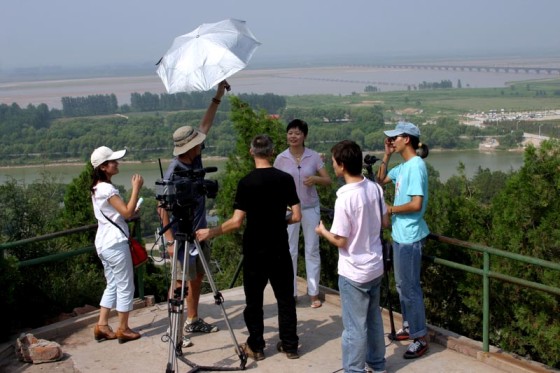
Producing Living Labs based on filming in 9 countries on 3 continents in just 5 months during 2006 was a challenge in both logistics and political negotiations. As editor-in-chief, I had to balance the public accessibility of our end product with researchers’ keenness to pack their stories with facts and figures.

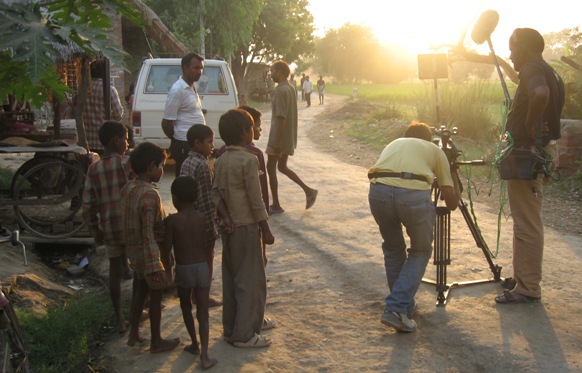
living-labs-being-filmed-in-yellow-river-basin-china.jpg

We didn’t please everyone. One senior researcher told us that his multi-faceted, multi-year nad multi-million dollar was like an elephant — and we’d only glimpsed just one part of that big creature!

That’s just the point: we can never cover the whole elephant in a media product intended for non-specialists. So we choose which part of the elephant is most interesting and present it in a way that will make viewers realise — and hopefully, appreciate — that there’s a lot more that’s worth finding out.

Moving image products often act only as ‘teasers’ — communicating highlights of research, and directing those interested to online or offline sources that offer more information.

Because they act as a/v versions of executive summaries, these ‘teasers’ by themselves are a powerful way of reaching out those who are unlikely to look up the details: that includes many policy makers, government officials and business people.

Winston Churchill used to ask his staff to give him everything ‘on one page’. These days, he might have asked for everything to be summed up in a five minute video — as we often do.

The Al and Pachy Show: Climate Change gains public momentum

Compared to former US Vice President and climate campaigner Al Gore, the name Rajendra K Pachauri might not be as widely recognised. In fact, I wonder how many Americans can even pronounce the name correctly.

But Dr Pachauri is a scientific heavyweight himself, and is the other half of this year’s Nobel Peace Prize. He chairs the UN’s Inter-governmental Panel on Climate Change (IPCC), which was announced as joint and equal winner.

He may be less glamorous than Gore, but Pachauri is just as ardent an advocate for the world to seriously tackle global warming. It was Pachauri’s dedicated work ethic and “ability to build and inspire a team” that helped the IPCC to win the world’s most coveted prize.

Read Rajendra Pachauri’s first reaction to the Nobel Peace Prize announcement

In a profile of the Indian engineer turned scientist-diplomat, The Christian Science Monitor noted: “If Gore is the frontman of the crusade against global warming, then Pachauri runs the engine room.”

Like Gore, Pachauri is a global-warming pioneer. Since the late 1980s, the former industrial engineer has sought to use science to convince skeptics and CEOs of the need of reducing mankind’s atmospheric imprint. Now, he warns that if the problem is not addressed, developing nations will bear the brunt of the crisis, suffering for a situation they did not create because they have not the resources to mitigate it.

In their profile, The Christian Science Monitor quoted Tulsi Tanti, a friend and founder of Suzlon, Asia’s largest manufacturer of wind turbines, as saying: “He has been one of the pioneers and voices of reason in the field, not just calling attention to an environment in peril but creating solutions by bridging the gap between academia, business, policymakers, and the public.”

Read full profile from The Christian Science Monitor of 15 October 2007

I first met and interviewed Dr Pachauri in October 1990, during the Second World Climate Conference in Geneva. That was one of the first international scientific conferences that I covered as a journalist, and Pachauri was kind enough to grant me a long interview. We spoke less of climate and more about energy security and innovative energy solutions. At that time he was head of India’s Tata Energy Research Institute, which was later renamed as The Energy and Resources Institute, still abbreviated as TERI.

Our paths have occasionally crossed since, in different parts of the world, and Dr Pachauri has always remained accessible and articulate. I last met him in Rome in the fall of 2003, during the annual GreenAccord Media Forum on Protecting Nature organised by the Italian organisation GreenAccord.

Read Dr Rajendra Pachuri’s speech at GreenAccord 2003 meeting.

Pachauri was his characteristic modest when reacting to the news of the Nobel Prize. ”I was not expecting any awards for my efforts. I feel privileged to share it with Al Gore. I am only a symbolic recipient but it is the organisation which has been awarded,” he said.

He added: ”With this award to the committee, the issue of climate change will come to the fore. It places a larger responsibility on me and I will ensure that more will be done.”

In a phone call soon after the announcement, he reportedly told Al Gore: “This is Pachy. I am so delighted and so privileged to have the IPCC share with you. I will be your follower and you will be my leader.”

The IPCC set up in 1988 comprises 3,000 atmospheric scientists, oceanographers, ice specialists, economists and other experts and is the world’s top scientific authority on global warming and its impact.

Wikipedia on the IPCC and its track record

Wikipedia on Rajendra K Pachuri

Journalists join the Global Race to the Arctic!

Image from Wikipedia

Everybody seems to be heading to the Arctic these days.

With global warming triggering a thawing of the massive ice caps that have covered the North Pole for millennia, bordering countries are trying to stake claims on land masses, open seas and suspected oil and other mineral reserves.

The results of global warming are seen first and strongest in the polar regions. The Arctic sea ice has shrunk at an average annual rate of about 70,000 square kilometres per year since 1979.

There’s suddenly a new race to the North Pole, not so much to reach it first – as happened in the early part of the 20th century – but to grab a piece of real estate.

And now, science journalists can join the race.

The World Federation of Science Journalists (WFSJ) has just announced a competition offering science journalists the chance to win three week-long trips aboard the Canadian research icebreaker Amundsen. It is being organised in collaboration with the Canada Foundation for Innovation and the International Polar Year Circumpolar Flaw Lead Project.

Winners will fly to Inuvik (Canada), and hop aboard a Twin Otter aircraft to the famous icebreaker. There, they will receive first hand experience of global warming where it is unfolding the fastest, says a circular from WFSJ.

To enter, professional journalists are invited to send their CV, coordinates, key pages of passport and a one-page essay on why they should be selected.

World Federation of Science Journalists
28, rue Caron, suite 200, Gatineau (Québec) Canada J8Y 1Y7
Email: info@wfsj.org
Tel.: +819 770-0776
Fax: +819 595 2458
www.wfsj.org

Applications must be received before 5 November 2007.

Geography lesson that saved many lives: The story of Tilly Smith and Asian Tsunami of 2004

ISDR image

Today, 10 October, is the International Day for Disaster Reduction. The theme this year is “Disaster Risk Reduction Begins at School”.

This year’s campaign, spearheaded by UN International Strategy for Disaster Risk Reduction aims “to inform and mobilize Governments, communities and individuals to ensure that disaster risk reduction is fully integrated into school curricula in high risk countries and that school buildings are built or retrofitted to withstand natural hazards.”

Buried beneath this development jargon that UN agencies are so fond of is something very important: sensitising the next generation about living with hazards can help make our societies better able to cope with disasters when they do happen.

And you never know when an informed and alert school kid could save the day — and many lives.

A good example came from Thailand when the Indian Ocean Tsunami arrived without any public warning on 26 December 2004.

ISDR BBC

Tilly Smith, an eleven-year-old British schoolgirl, was on holiday on Maikhao Beach in Thailand with her family when the tsunami hit. Just a few weeks earlier, she had studied tsunamis in school — and immediately recognized the signs of the receding sea as a sign of an impending disaster. She warned her parents, which led to all the hotel guests being rapidly moved from the beach.

This simple, timely action by a single schoolgirl saved the life of dozens of people. Tilly’s story highlights the critical importance of basic education in preventing the tragic impacts of natural disasters.

Watch her story on YouTube:

This 5 min video, produced by UN/ISDR in 2005, is available in English, French and Spanish. Watch the English version on their website, which is now hidden under all that bureaucratic babble:
Higher resolution WMV file – more suited for broadband Internet connections
Lower resolution WMV file – will play better on narrowband Internet connections

According to the Wikipedia, Tilly’s family have declined requests to be interviewed by commercial and national broadcasters, but Tilly has appeared at the United Nations in November 2005, meeting Bill Clinton the UN Special Envoy for Tsunami Relief, and at the first year anniversary in Phuket, as part of the campaign to highlight the importance of education.

In December 2005, Tilly was named “Child of the Year” by the French magazine Mon Quotidien. On the First Anniversary of the Official Tsunami Commemorations at Khao Lak, Thailand on December 26, 2005, she was given the honour of closing the ceremony with a speech to thousands of spectators which read in part:

National Geographic online: Tsunami Family saved by school girl’s geography lesson

BBC Online: Award for tsunami warning pupil