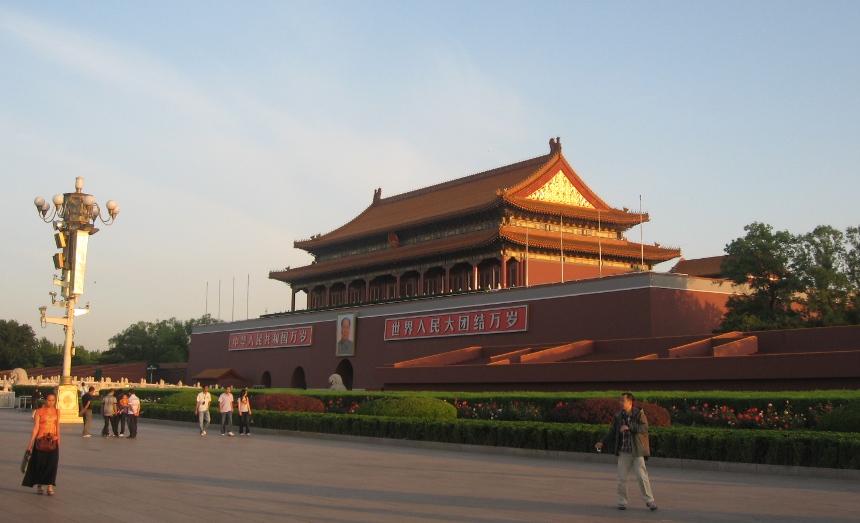
Tiananmen literally means Gate of Heavenly Peace...hmmm
I spent several hours at the Tian’anmen Square in Beijing, China, this week, while attending a media conference. I was returning to this landmark, now a key tourist attraction in modernised and assertive China, after nearly a decade. And much has changed…
Measuring 880 metres by 500 metres, and covering a total area of 440,000 square metres, the Tiananmen Square is the largest city square in the world. But mere superlatives don’t impress me. It’s what goes on behind the claims, labels and stereotypes that interest me.
I’ve been to the square on a couple of previous Beijing visits. The first was in October 1996, during my very first visit to China. I was also taken in a group tour on a later visit. If I remember right, my last sighting of the Square was in 2002 – just before I acquired my first digital camera. (That makes a difference, because Before Digital, my analog photographs on travel were sparingly taken…and my own memory is not a very reliable storage medium.)
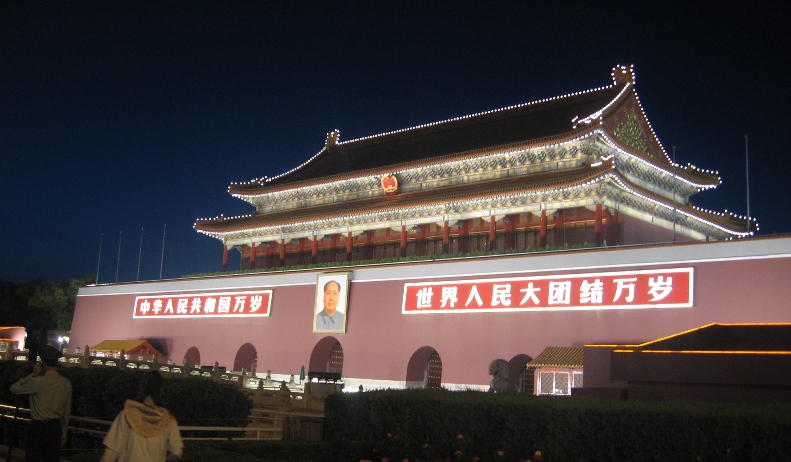
Day or night, he keeps vigil over Tiananmen Square...and 1.3 billion people
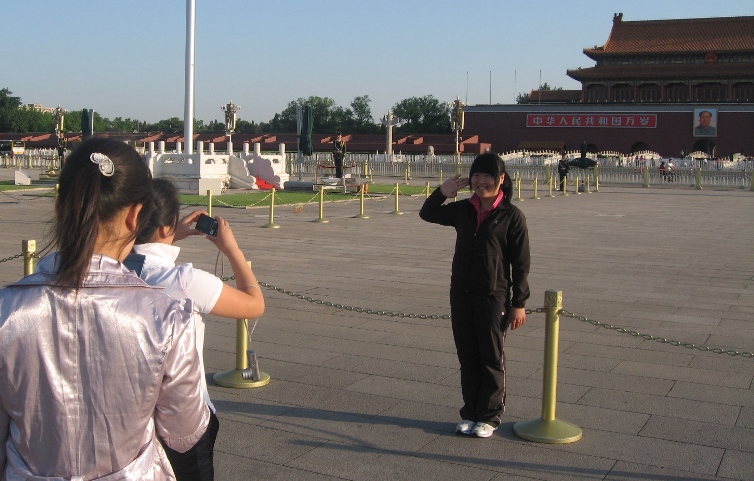
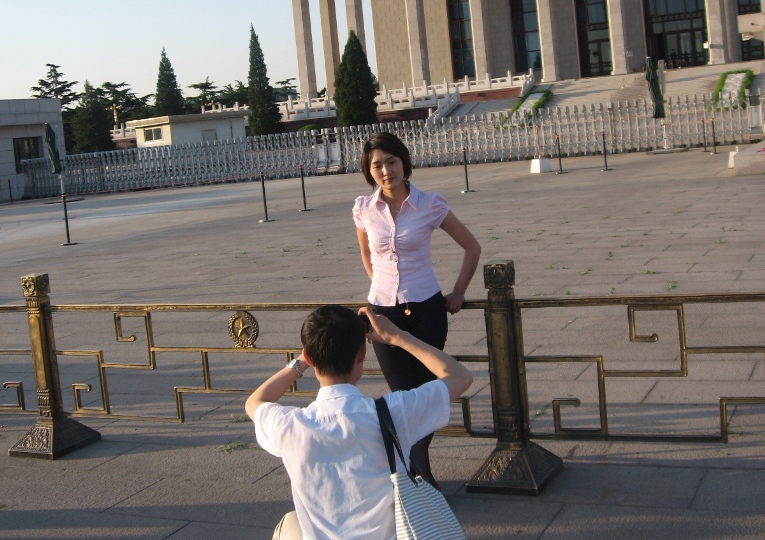
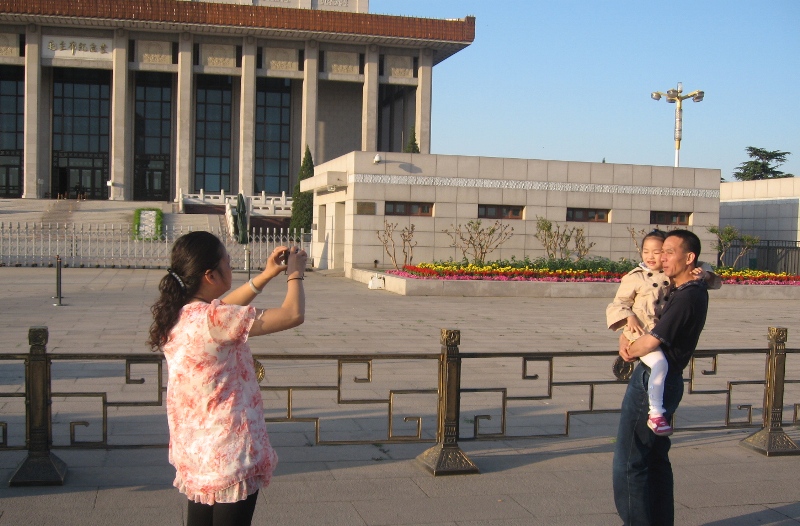
This time, I was armed with my digital camera and ample digital memory — and, it seemed, so were most other visitors! There were the obviously foreign tourists (including the loud and uninformed Americans), but it seemed most people thronging to the square were Chinese…many from out of town. For some, a visit to this centre of power is a rare occasion to be cherished and recorded.
I was impressed by just how many people were clicking away, using either digital cameras or mobile phone cameras. I shouldn’t be surprised by this, for China is the country with the largest number of mobile phones in use: by March 2010, there were some 780 million mobile subscribers, accounting for 58.5 per cent of all people in China.
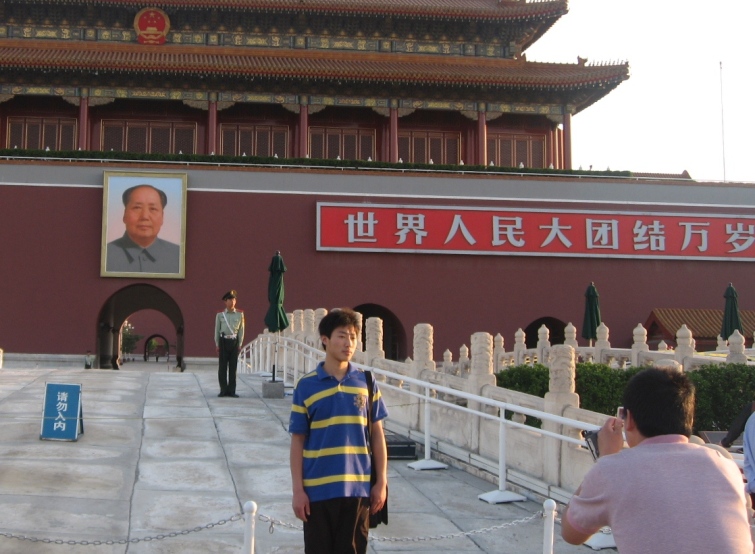
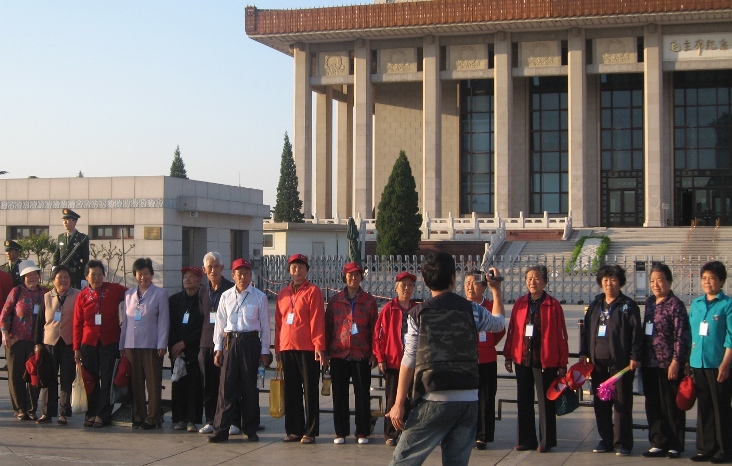
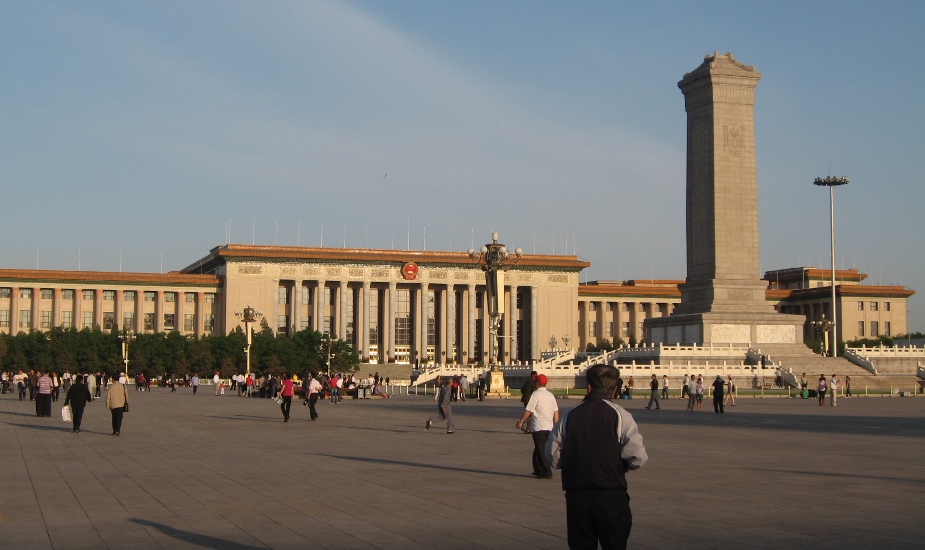
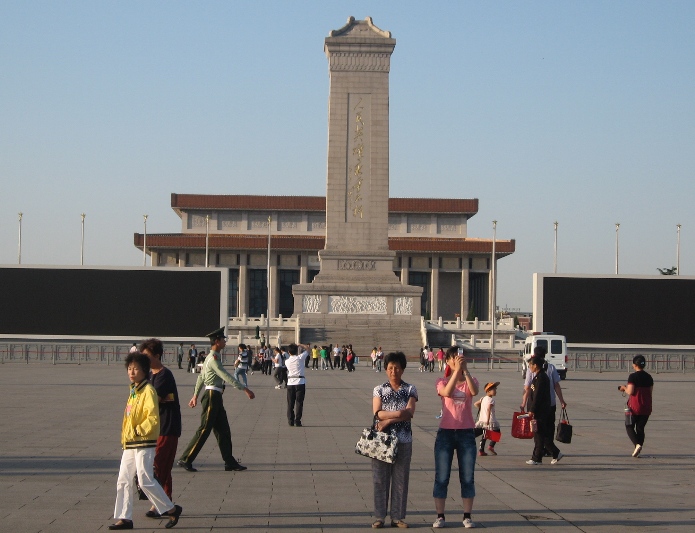
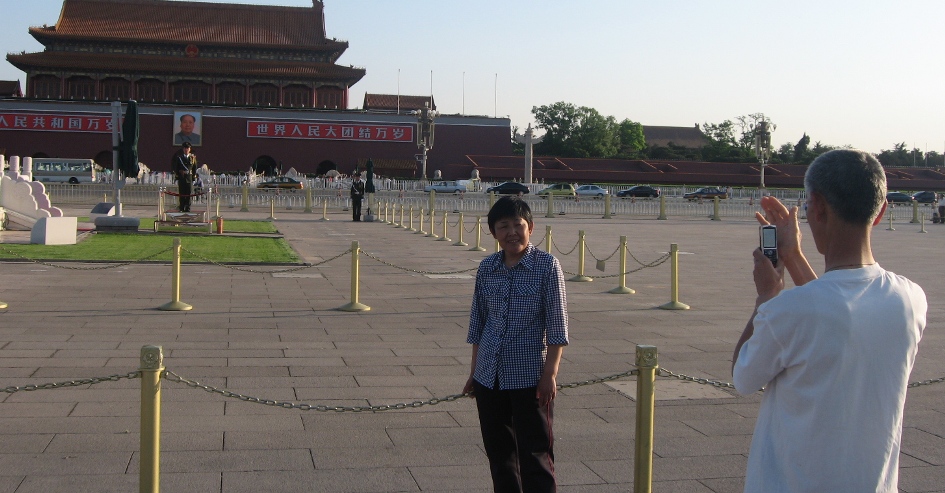
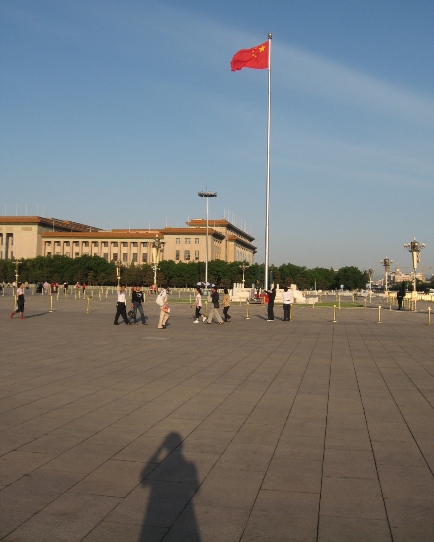
Keen to capture different scenes under varying kinds of daylight and night lights, I made three visits to the Square – including one at 5.30 in the morning to catch daybreak at the Gate of Heavenly Peace (literal meaning of Tiananmen). So here’s a sampling of my several dozen photos – this selection has a bias on people shooting each other, digitally speaking (a far cry from the kind of shooting that took place here 20 years ago).
Look serious, man - he's watching!Now bring out your best smiles, all!People milling about with Great Hall of the People in the backgroundClicking away at Monument to the People's Heroes
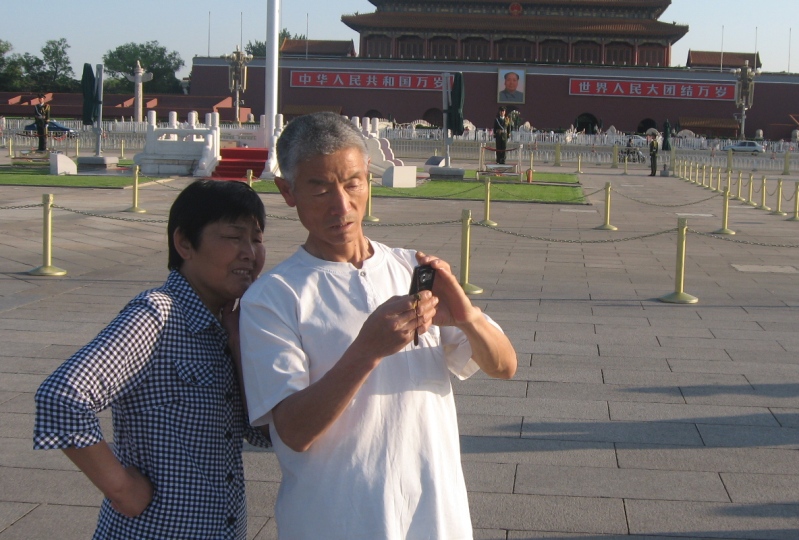
One of the most striking moments I captured was of this elderly couple, very dignified and sprightly in their outlook, as they were taking a stroll on the square early morning and capturing memories on their mobile phone. They are old enough to have known another reality, but this was now and here…
This Square, and we, have seen and heard much in our time...Did we get it alright?
I also noticed how the younger visitors were clearly at ease with digital technologies, just like their fellow Digital Natives elsewhere in the world. There is also a discernible easing up (not only among unknown people in public places, but also noticeable among older and younger Chinese friends I have): maybe it’s the exuberance of youth, but the NextGen Chinese don’t seem to be as somber and serious as their parents.
Or perhaps the younger people in China today just have more things to smile about?
Would Chairman Mao approve this pose, eh?Heaven is in the eye of the beholder...Digital Natives capturing memories for the Next Gen
It was a rushed visit of four nights and three days, so all my impressions are fleeting. They don’t begin to do justice to the nuanced complexity that is modern China. But they tell me one thing: even in a land with a proud history of over 5,000 years, ten years can still make a difference.
Bye for now: I take only photos, and leave only shadows behind...
Note: All photos were taken touristically for my own memory and personal archives, with no other intention.
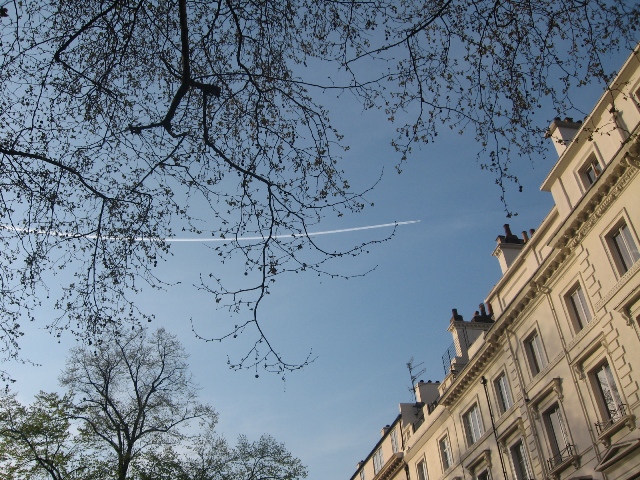
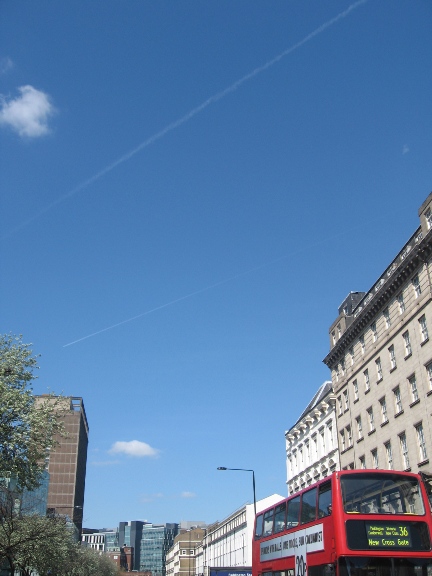
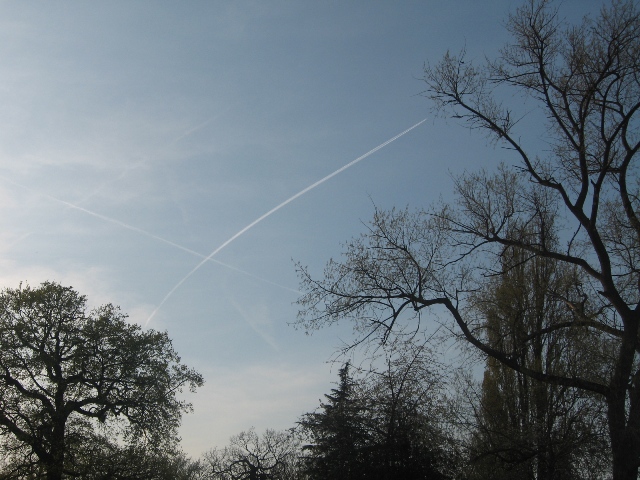
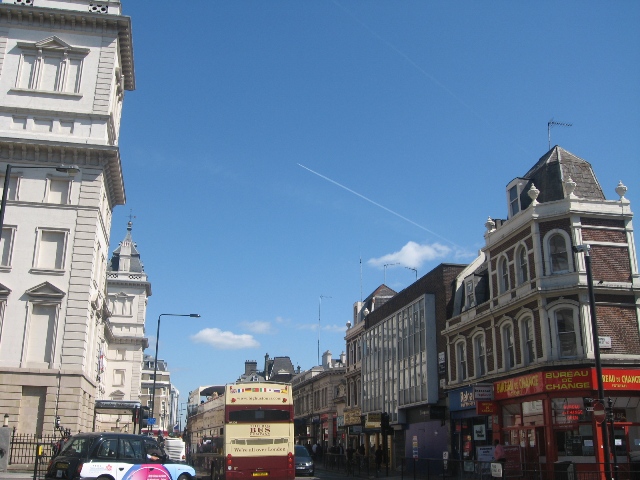
With the British air space being reopened last night for flying after six days, the skies over London roared back to life today, 21 April 2010. It was the first full day of flight operations since the airborne ash from Eyjaffjalljokull (a glacial volcano in Iceland) triggered the first ever shut down of air space over Britain – and later several other countries in western Europe.
Stranded with tens of thousands of other air travellers in London, I’ve been watching the situation unfold and following the debate between airlines, British Met Office and the aviation regulator (which ordered the shut down on safety grounds on April 16).
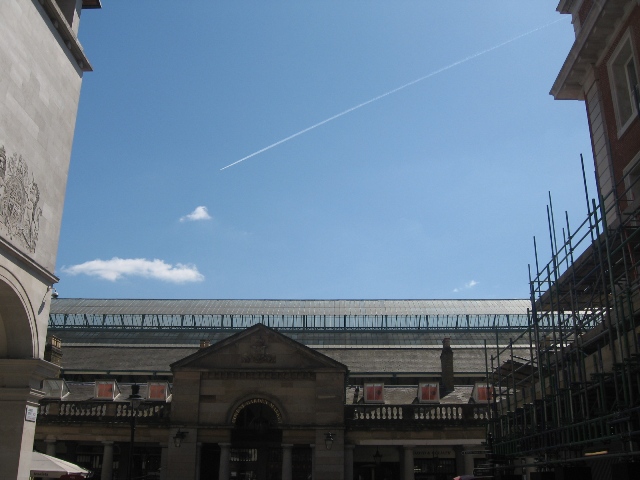
London (and much of Britain) rolled out near-perfect Spring weather in the past few days — clear blue skies and warm, sunny days. But one thing was conspicuously missing: no aeroplanes flying overhead, and no vapour trails drawing temporary lines in the sky.
Vapour trails mark the return of flights to London skies, 21 April 2010Contrails (“condensation trails”) or vapour trails are artificial ‘clouds’ made by condensed water from the exhaust of aircraft engines. As the hot exhaust gases cool in the surrounding air, they sometimes (but not always) produce a ‘cloud’ of microscopic water droplets.
Today, the planes and their vapour trails were back in abundance. It looked almost as if the trails were the airline industry’s way of sticking their tongue out at the aviation regulator, who is now under immense public and media pressure over its conduct in this incident.
The Evening Standard today ran its front page photo of Andrew Haines, head of the British Civil Aviation Authority whose decision is estimated to have caused losses totalling over one billion Pounds to travel industry and others dependent on air travel services. Their headline: “The man who shut the skies: Aviation chief accused of flights ban blunder”
That debate will rage on for many days to come. Meanwhile, I’m hoping I can fly back home, belatedly yet soon. While waiting to hear that news, I walked around Central London today clicking images of life on the ground and vapour trails across the lovely blue skies. Here are a few — taken in Leicester Square, Convent Garden, Paddington and Hyde Park.
Vapour trails over Hyde Park London, 21 April 2010London skies over Paddington, 21 April 2010London skies over Convent Garden, 21 April 2010
A few days ago, commenting on cartoons on climate change, I wrote: “So how do we capture climate change’s multiplicity in visual forms? Photographers go for the evidence and authenticity. Film makers work on both current impacts and future scenarios…”
Now here comes a chance for photographers everywhere to bear witness to the climate crisis slowly unfolding all around us.
As the website says, “Hot Shots is…designed to create a visual record of these personal impressions by and for people around the world. The focus is not only on spectacular events, but also on climate change from people’s own, personal perspective.”
From Reza Deghati, the renowned Iranian-French photojournalist (who works under the name Reza) comes another story – this time from Afghanistan, where the above photo was taken in 1990.
Reza recalls how the photo was taken: “In 1990, the United Nations asked me to put aside my cameras in order to run a humanitarian program in an Afghanistan recently freed from Russian occupation. I had to open a route for wheat shipments needed to feed the population in the Northern Provinces. Eleven years of war against the Soviet Army had devastated the country. Fields lay fallow, roads were impassable, mined or destroyed, and buildings like hospitals and schools were nothing but ruins. I could have given away the wheat. Instead, I decided to barter it for work so as to avoid one of the unfortunate consequences of some humanitarian programs that foster dependence rather than offer new ways to live. Throughout the Province, a new army took shape. This time, men did not carry rifles but shovels.”
“I remember seeing a young Afghan boy coming out of school one day, holding a plant in his hand. He had been watering it carefully. A shoot had sprouted out. I took a picture of him, and asked: ‘What are you going to do with this plant?’ His answer….’I am going to make a tree with it’.
Reza Deghati, photo by Ali KhalighLooking back, Reza thinks this may have provided part of the inspiration for setting up Aina, a third-generation humanitarian association that he founded in 2001 in Taliban-free Afghanistan.
Aina now works in Afghanistan, “contributing to the emergence of civil society through actions in the area of education (particularly focusing on women and children), information and communication.” It promotes independent media development and cultural expression as a foundation of democracy.
Reflecting further on the power of images, Reza says on Aina website: “In the early 80s, I discovered wars and the harshest moments of the world as a young photojournalist. I could not just stay there as a mere witness. I was led into thinking over conflicts, repressions, exodus and their burden of known pain, answers as well. As canon roars fade, urgency requires tangible reconstruction. An army of shovel-carrying men starts marching, determined to erase any remaining sign of ruin. Others take care of suffering bodies. Yet, there is an invisible destruction, only known to wounded dignities, that can ruin physical rebuilding efforts in a country and keep it from recovering.
“Those who are not given any intellectual and cultural weapons will go back to their unique reference. The culture of war fosters war. That is how Aina was founded. A third-generation association, Aina has been working on independent media development and culture, everywhere freedom of speech has remained a fragile value. It provides logistical support, state-of-the art technology access and local media and cultural actor training.”
Reza adds, optimistrically: “Today, Aina is like that plant. I hope that it will become a tree of culture, peace and freedom in Afghanistan…”
Where the island of Sri Lanka was concerned, it was the first solar eclipse of the broadband internet era — and that showed.
The last solar eclipse seen in Sri Lanka was two generations ago, on 20 June 1955. That was almost pre-historic in mass media terms. The newly independent Ceylon had a single, state-owned radio station and a handful of newspapers. There was no television, and the internet was not even conceived.
Yet, paradoxically, the media’s influence over the 8 million people then living on the island seem to have been greater at the time. As astronomer Dr Kavan Ratnatunga recalled: “A quack physician cum astrologer, recommended that women wanting to become fair and lovely should drink a decoction of which the main ingredient was “Vada Kaha” (Sweet Flag or Acorus Calamus) at the time of the total eclipse, preferably unseen by others. Many who took his advice ended up in hospital.”
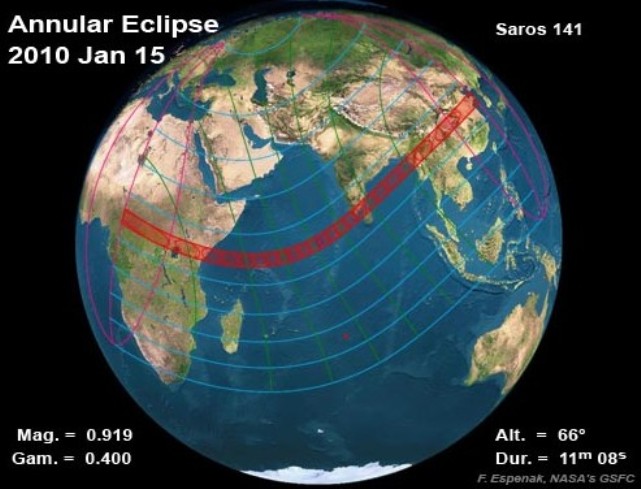
Solar eclipse on 15 Jan 2010 seen in Anuradhapura, north-central Sri Lanka - photos by ReutersIn contrast, in 21st Century Sri Lanka, the January 15 eclipse was not much of a news story. I don’t claim to have done a systematic analysis, but my impressions are drawn from scanning the major newspaper websites in English and Sinhala, and surfing the dozen or more terrestrial (free-to-air, not cable) TV channels that were on the air during the three hours or so of the eclipse. (Sorry: I missed out radio, and I’m not proficient in Tamil.)
Broadcast television was my biggest disappointment. Solar eclipses are a visual spectacular, and literally heaven-sent for live television. Yet, not a single Lankan TV channel carried a live broadcast of the event, either from northern Sri Lanka where it was best seen (in its annular form, with ‘ring of fire’ effect), or from elsewhere on the island as a partial eclipse.
It seemed as if the Colombo-based media were completely preoccupied with the intense build-up to the presidential election scheduled for 26 January 2010 — a case of politics eclipsing the solar eclipse?
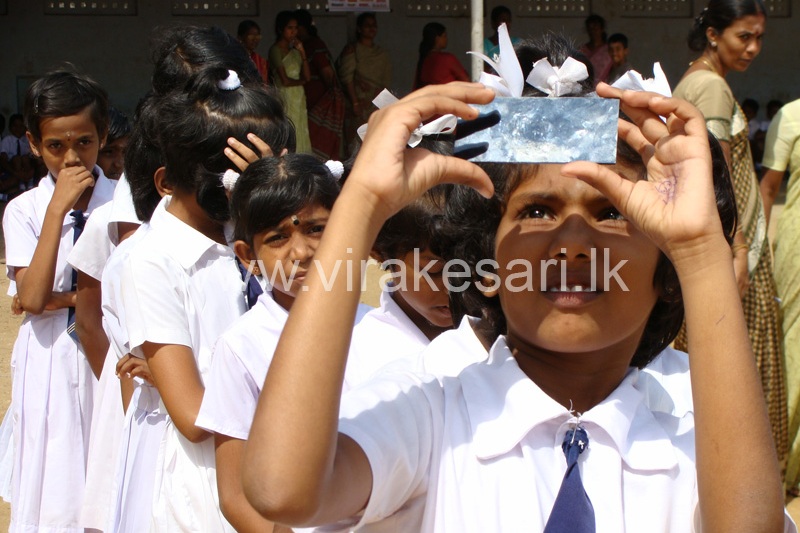
Jaffna school children view the solar eclipse - Photo courtesy Virakesari
But there were a couple of honourable exceptions – and thank heavens for that! One was the leading Tamil daily Virakesari, which sponsored an expedition to Jaffna, in northern Sri Lanka, by a group of professional and amateur astronomers from SkyLk.com. According to one member of this expedition, Thilina Heenatigala, this newspaper provided the widest and most uptodate coverage of the annular eclipse from Jaffna.
SkyLk.com collaborated with the Hindu College in Jaffna, whose playground was converted into an open air observation camp. Thilina says over 2,000 people – including school children and adults – had converged to witness the event. A large screen was set up on to which the live image from a telescope was projected.
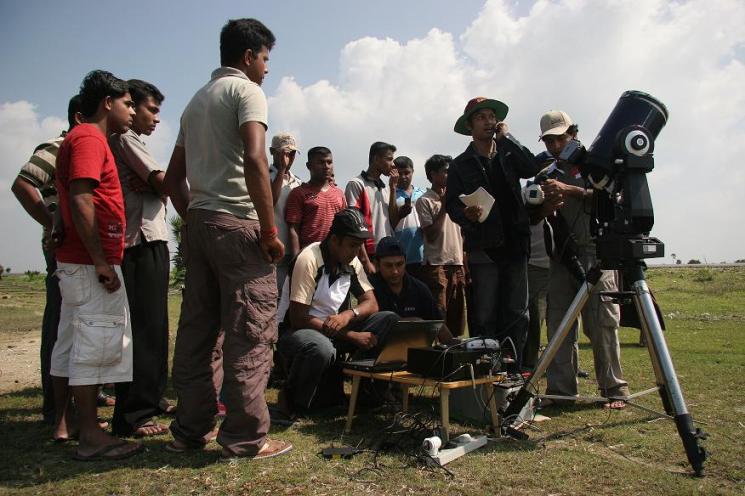
Not far from there, a group of engineering students and teachers from the University of Moratuwa was doing a more scientific observation. Later that day, team leader Dr Rohan Munasinghe reported in an email: “We have recorded the solar eclipse from Kayts (lat 9d,37m N, Long 79d,58 E), the biggest island off Jaffna Sri Lanka. We have timestamped the video with GPS (Garmin 18) accuracy.”
University of Moratuwa team observing the clipse - photo courtesy Dr Rohan Munasinghe
Elsewhere across the island of Sri Lanka, there was plenty of interest among the people from all walks of life — as seen from the thousands who stepped out during mid-day to take a peek at the celestial phenomenon. Not all of them followed the safety precautions to prevent eye damage, disseminating which the media had done a good job in the preceding days.
Clearly, this high level of public interest was not reflected in how the rest of Lankan mainstream media covered the eclipse. But if the mainstream media’s gaze was firmly fixed on the gathering election storm on the ground, the new media created opportunities for others to step into that void. Citizen scientists joined hands with citizen journalists to capture and share the eclipse with each other — and the world. These unpaid enthusiasts used commonly available digital tools and online platforms for this purpose.
Some of them uploaded dozens of photos for public viewing on image sharing sites like Flickr. A good example is what Shehal Joseph and Romayne Anthony did. There were many others.
SkyLk.com group was more ambitious: they actually webcast the eclipse live online from their public observation camp at Hindu College grounds. Stuck in Colombo with its sub-optimal viewing conditions for this eclipse, this was the best chance for people like myself to catch the annular part of the phenomenon.
“We were struggling with bandwidth limitations most of the time,” Thilina Heenatigala says. “We used a Dialog HSPA modem to connect to the web, and line speeds kept fluctuating. We were not the only ones uploading still photos or video to the web from different locations in northern Sri Lanka — and apparently all of us were slowing down each other.”
Being the tech-savvy planner he is, Thilina had alerted Dialog telecom company about the likely peaking of bandwidth demand. But he is not sure if any temporary enhancing was done, even though Dialog currently claims to be the ‘first and best’ to offer telecom coverage in the north. Certainly, the live eclipse webcast was not of uniform quality — it’s a small miracle it happened at all: until a few months ago, this was part of the theatre of war in northern Sri Lanka.
In fact, SkyLk.com had used the web to build up public awareness and interest using video trailers on YouTube. Here is one of several simulations they had up from December, thus one for Anuradhapura, Sri Lanka (simulation):
In the end, however, SkyLk.com became a victim of its own success. The live webcast was followed by hundreds, and then thousands of online visitors from different parts of the world. This apparently overshot the usual allocations provided by the offshore hosting company (in the US), which suspended the account. Right now SkyLk.com website is not accessible (as at 16 January 2010, 15:00 UTC/GMT).
Within hours of the eclipse, several individuals and groups also uploaded highlights of their eclipse videos on to the YouTube. Here are the most striking ones I came across in a quick search:
Solar Eclipse 2010 Sri Lanka Scientific Record – by University of Moratuwa
Scientific recording of the annular solar eclipse on 15 January 2010 was carried out from the Island Kayts (Lat +09d 37m North and Long +79d 58m East) of Sri Lanka.
Orion Video’s coverage from Nallur, Jaffna:
Not in the same league as the above two videos, this was Nishan Perera’s personal observations from Ratnapura, south-western Sri Lanka:
It’s too early to draw firm conclusions from this random evidence, but in all likelihood, we passed thresholds in both citizen journalism and citizen science with this eclipse. Clearly, the mainstream media’s monopoly/domination over reporting of such an event has been shattered: their indifference will no longer stand in the way of information and images being disseminated.
Perhaps just as important, it is no longer possible for a couple of self-appointed ‘public astronomers’ to dominate the public information channels on an occasion like this, mostly for shameless self-promotion. As Dr Kavan Ratnatunga, President of the Sri Lanka Astronomical Association, noted in an article: “I am amazed as to how many who have never even seen a Solar Eclipse, will gladly talk about it to an equally ignorant journalist, resulting in some totally misleading and sometimes hilarious information being published in both the English and Sinhala media. In a nation which believes in pseudo astrology, I am sure it is just a matter of time before quacks start using it to predict influence on local events and politics. However, there is absolutely no influence on any person by any of these celestial events.”
At the end of the day, however, astronomy aficionados are emphatic that no amount of media coverage can really substitute the experience of being there and experiencing it ourselves. As Kavan says: “A solar Eclipse is event which must be experience and observed. No video can do justice to that experience. It can also become addictive. In the modern age when the Internet and TV can bring events to your home, one may wonder why some Eclipse chasers travel round the world to see an Eclipse of the Sun.”
The next solar eclipse visible from Sri Lanka will be on 26 December 2019. I wonder what kind of media and ICT landscape would cover that event…
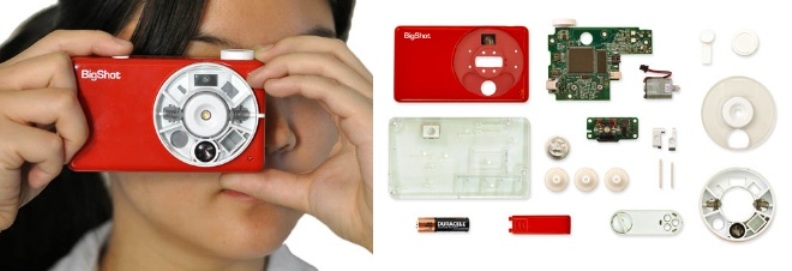
BigShot: Inspiration with every click?“Build a better mousetrap, and the world will beat a path to your door.” This remark is attributed to one of my favourite essayists and philosophers, Ralph Waldo Emerson.
That was probably true for the 19th century in which he lived and died, but it takes a bit more than a mousetrap to generate a buzz these days. But simple and elegant inventions are still the best. BigShot is one of these.
It’s still in testing stage, but already being hailed as “a camera that could improve the way children learn about science and one another”.
BigShot is an innovation by Indian-born Shree K. Nayar, now the T. C. Chang Professor of Computer Science at Columbia University in New York, USA.
As his university’s newspaper reports: “He came up with a prototype as sleek as an iPod and as tactile as a Lego set: the Bigshot digital camera. It comes as a kit, allowing children as young as eight to assemble a device as sophisticated as the kind grown-ups use—complete with a flash and standard, 3-D and panoramic lenses—only cooler. Its color palette is inspired by M&Ms, a hand crank provides power even when there are no batteries and a transparent back panel shows the camera’s inner workings.”
With the BigShot, Nayar wants to not only empower children and encourage their creative vision, but also get them excited about science. Each building block of the camera is designed to teach a basic concept of physics: why light bends when it passes through a transparent object, how mechanical energy is converted into electrical energy, how a gear train works.
Watch Professor Shree Nayar talk about the purpose and development of the Bigshot camera project.
Nayar would like to roll out the camera, now in prototype form, along the lines of the One Laptop Per Child campaign: For each one sold at the full price of around $100, several would be donated to underprivileged schools in the United States and abroad. He will soon begin looking for a partner—a company or nonprofit—to help put Bigshot into production.
Life inspires innovation...Wired magazine wrote in a recent review: “(It) is a super-simple digicam from the Computer Vision Lab at Columbia University. It comes in parts, ready to be assembled (by kids, but I can’t wait to get my hands on one), and teaches you along the way how these things work. It’s not quite the transparent view you get from making an old analog camera, where you can see how everything works, but it’s as close as you can get from a machine that uses circuit boards.”
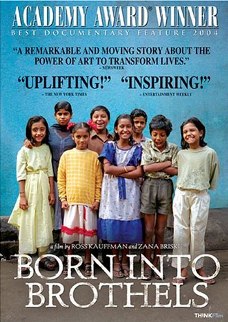
Interestingly, the initial inspiration for BigShot came from a documentary: Born into Brothels (85 mins, 2004), a film about the children of prostitutes in Sonagachi, Kolkata’s red light district. The widely acclaimed film, written and directed by Zana Briski and Ross Kauffman, won a string of accolades including the Academy Award for Documentary Feature made in 2004.
I saw that film during the AIDS Film Festival I helped organise in Bangkok in July 2004. In this film, the film maker, British photographer Zana Briski, gave 35 mm film cameras to eight children and watched as those cameras transformed their lives.
“The film reaffirmed something I’ve believed for a long time, which is that the camera, as a piece of technology, has a very special place in society,” says Nayar. “It allows us to express ourselves and to communicate with each other in a very powerful way.”
Watch an overview of Born into Brothels, featuring the film makers:
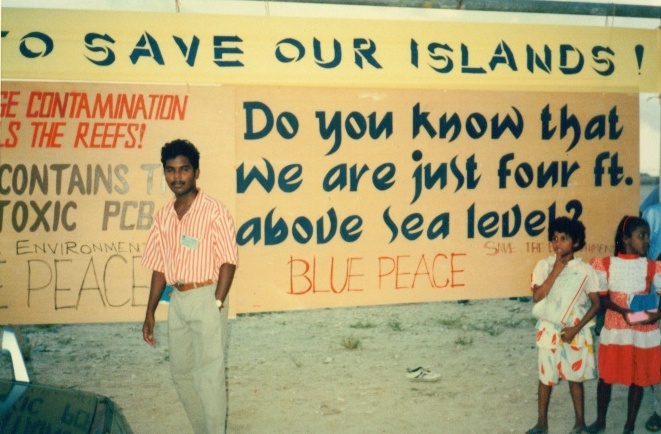
Bluepeace was vocal, even at 2 months. Photo by Nalaka Gunawardene: Male, November 1989
I’m not a professional photographer, but as a journalist I often carry a camera and take photos of what interests me. So I’m very glad to have captured that historic bill board as a journalist covering the conference. Bluepeace still uses it in their records, always with acknowledgement.
Ali Rilwan, Bluepeace co-founder whom I photographed as a young man, says: “Twenty years later, we need not ask the same question, as the world is well-aware of the dangers Maldives faces. However, we face the urgent need to talk and work with the rest of the world to find solutions.”
Now, Bluepeace is actively using photographs as part of their climate advocacy.
Images from the frontlines of climate impact...
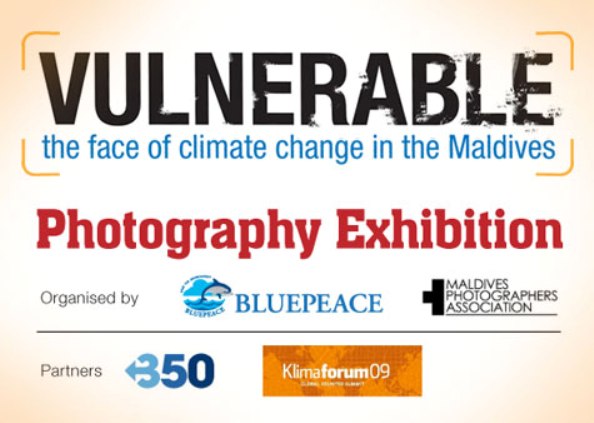
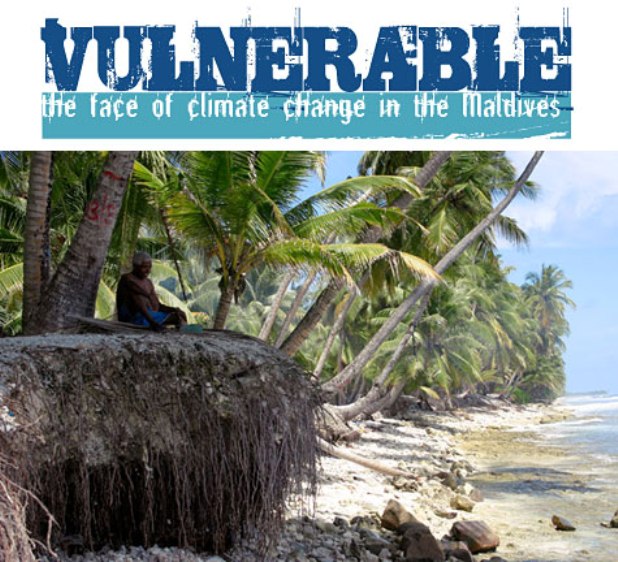
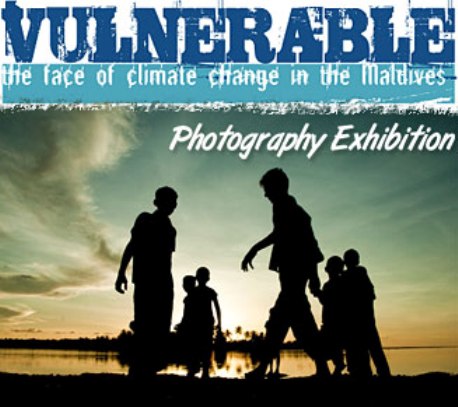
VULNERABLE is a photo exhibition organised by Bluepeace. To celebrate the 20th anniversary of Bluepeace, and to join the global environmental movement bringing attention to the dangers of climate change in the run up to United Nations Conference on Climate Change (COP15), Bluepeace presents VULNERABLE, which showcases the face of climate change in the Maldives. The exhibition documents the vulnerability of the fragile coral islands of the Maldives to climate change, through pictures from talented Maldivian photographers. It depicts a nation under threat, as it tries to safeguard an age-old culture and lifestyle that could be erased with rising seas and climate change.
VULNERABLE was launched online on October 24, the International Day of Climate Action organised by 350.org, which calls for a reduction of global carbon emissions below 350 parts per million.
In the coming weeks and months the exhibition will move to different locations in the Maldives and other countries, including Copenhagen in December 2009, where it will be hosted by Klimaforum09, an alternate climate summit with participation from global environmental movements and civil society organisations.
I can’t wait to see the exhibit in a physical display, which is more powerful than viewing it online. For now, here are some glimpses…
One man vs. the mighty Red Army - photo by Jeff Widener for Associated Press
This is of the most famous photos of modern times. The official caption, given by Associated Press, reads: “An anti-government protester stands in front of artillery tanks in Beijing’s Tiananmen Square on June 5, 1989, at the height of the pro-democracy protests.”
It’s a moment deeply etched in the consciousness of our media-saturated world. The solitary, unarmed man was standing up against not just a brute of a tank, but the might of the entire Chinese Red Army, which had just cracked down ruthlessly on pro-democracy student protests.
It was on the morning of June 5 that the Tank Man appeared from nowhere. A line of 18 tanks were pulling out of Tiananmen Square and driving east along the Avenue of Eternal Peace. The previous day, the square had been cleared of students and much blood had been spilled. The streets were now empty except for soldiers.
Suddenly a man in a white shirt and black trousers, with a shopping bag in each hand, steps out on to the road and stands waiting as the tanks approach. The lead vehicle halts, assessing its options.
It moves right to go around him. The man waves the shopping bag in his right hand then dances a few steps to the left to block the tank again. The tank swerves back left to avoid him. The man waves the bag again and stepps to the right. Then both stop. The tank even turned off its engine.
Then more things happened.
Watch a video montage of this breathtaking standoff, captured by western journalists filming from a safe distance:
Watch first few minutes of the 2006 PBS documentary on the Tank Man incident and aftermath:
Twenty years on, the identify of the Tank Man remains a mystery. There are conflicting reports on who he was, and what happened to him after that single, defining act of defiance. Practically all we know is that he wasn’t run down by the tanks, and was instead arrested a few minutes later by the Chinese authorities. Naturally, there are few official comments on the incident or the Tank Man.
But during those few minutes, when individual soldiers hesitated and refrained from running him over, the Unknown Rebel secured his worldwide fame. He probably wasn’t doing it for any notion of posterity – in all likelihood, he was horrified bystander who’d seen the carnage in the preceding days and felt, as we do from time to time, that enough was enough.
And unlike most of us, he decided to risk his life to register his protest. In April 1998, Time magazine included the “Unknown Rebel” in its feature entitled Time 100: The Most Important People of the Century.
Charlie Cole, a Newsweek photographer who captured the moment, says: “Personally I think the government most likely executed him. It would have been in the government’s interest to produce him to silence the outcry from most of the world. But, they never could. People were executed at that time for far less than what he did.”
In early June 2009, a fifth photographer shared his own image of the incident – disclosing photos that had never before been circulated. Associated Press reporter Terril Jones revealed a photo he took showing the Tank Man from ground level, a different angle than all of the other known photos. (Tank Man is the second from left, in the background.) Jones initially didn’t realise what he had captured until a month later when printing his photos from that momentous week.
As we celebrate the memory of the Tank Man – and his defiance of brutal, oppressive use of state power to crush dissent – we must also salute the courage and resourcefulness of photojournalists and TV reporters who risked their own lives to capture this moment for posterity. Tank Man became iconic only because his act was frozen in time by those bearing witness. All too often, states – from Burma to Zimbabwe, and others in between – ensure that there is no one to bear such witness when they unleash the full force of police, armies and weapons on their own people.
There can be no doubt that Tank Man was not the first of his kind, nor would he be the last. Other ordinary men and women have found uncommon courage to stand up against injustice and state brutality wielded in the name of national security, law and order or anti-terrorist crackdown. But in the absence of witnesses – whether professional journalists or citizen journalists – the rest of the world will never know.
As I have explained elsewhere: “I’m strongly committed to promoting media freedom, but have never been the placard-carrying, slogan-shouting type. Street activism is necessary — but not sufficient. I’ve been more interested in studying trends and conditions, trying to anticipate what the next big threats, challenges and opportunities are, and how best we can respond to them.”
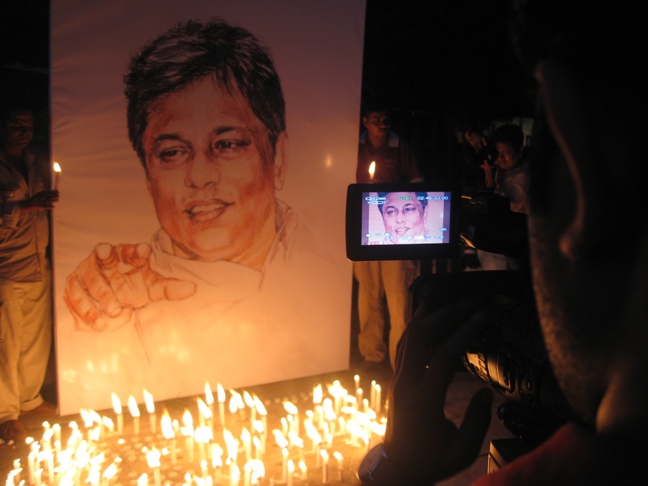
So I went to the vigil more for Lasantha the person and less for any organised effort. The invitation I received by SMS and email from several sources asked us to gather outside Colombo’s Vihara Maha Devi (formerly Victoria) Park at 5.15 pm. It was going to be a ‘joint civil society protest’ against Lasantha’s killing and the erosion of media freedom, democracy and human rights.
It turned out to be a well-intended but poorly-planned event lacking in vision and dynamism, perhaps a bit like our (very) civil society entities themselves. The couple of hundred people who joined it came mainly from Colombo’s high society, the ones who faithfully lapped up every word that Lasantha churned out week after week for nearly 15 years. Ironically, Lasantha and his newspaper were only loosely associated with this kind of (very) civil society – fellow companions on a shared journey, but not necessarily agreeing on priorities or strategies.
I remembered the battered face of an old lady who sat through the entire funeral service – and then left quietly, without even lining up with the rest of the crowd to take one last look at Lasantha as he lay amidst flowers. I remembered the handful of men and women dressed in bright coloured clothes – standing out amidst the sea of white or black clad people – who I later found out came from the Kotahena area and were part of Lasantha’s home town church.
Lighting candles was good. Keeping the flame alive is harder...
No one had sent SMS or emails asking them to turn up. Some of them might not have been readers of English newspapers, which circulate among a numerically small but socially and economically influential section of Lankan society. They came because they felt the fallen man had stood up and spoken out for them.
In comparison, the candlelight vigil was decidedly upmarket. Nothing wrong in that, for the chattering class is very much part of our society and have the same rights to dissent and protest. In some countries, the upper middle class even provides vision, articulation and leadership to mass struggles. Ours, sadly, is more characterised by part-time activists who move more in the cocktail circuits grumbling about everything yet doing precious little to change the status quo. Indeed, some of them in their day jobs benefit personally from the prevailing corruption and nepotism, no matter which political party is in office.
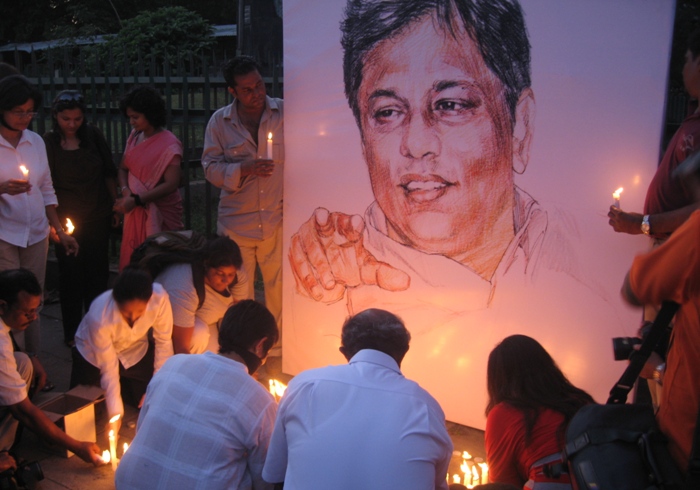
The vigil’s organisers – it wasn’t clear who exactly they were – had painstakingly got the material ready: a large painting of Lasantha, black cloth bands and, of course, candles. But they hadn’t given enough thought to the location. We initially gathered and spent over half an hour on a stretch of road (Green Path) where only motorists passed by, but absolutely no pedestrians. Then someone thought of moving to the nearby roundabout which was a more visible, strategic location.
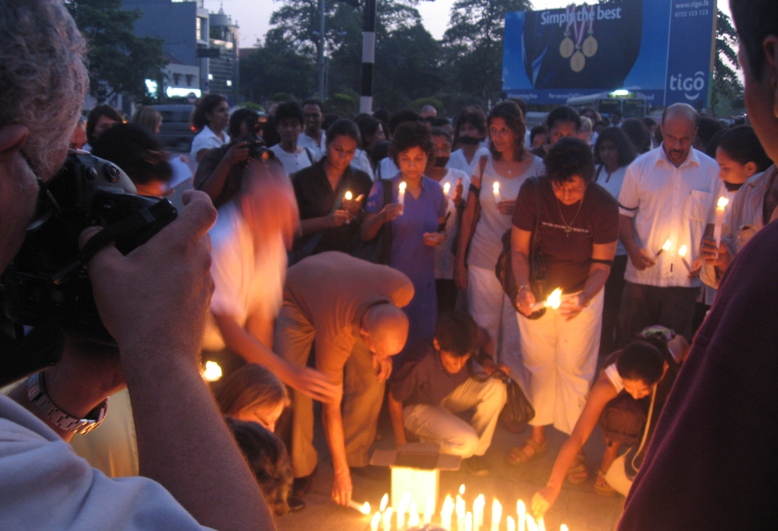
Not perfect, but better. By then, dusk was beginning to fall. We moved unhurriedly, chatting among ourselves, and slowly converged on a wide pavement. There, one by one, we started planting our candles on the ground in front of Lasantha’s picture. It was a moving moment captured in many still cameras and a handful of video cameras.
There we lingered for another hour or more, chatting with each other — and not necessarily about the lofty or somber matters. I was glad to catch up with several friends or associates active in artistic, journalistic or intellectual circles. I saw everybody else doing the same.
One of them, a human rights activist now turned peacenik, asked me many eager questions about blogging. A columnist for an English daily, he isn’t active online and his organisation is notably inept when it comes to mobilising the web for their cause. In his early 50s, he evidently hasn’t crossed what I call the Other Digital Divide. And he typifies the face of our organised civil society – a motley collection of do-gooders who are liberal, mostly secular, passionate yet largely ineffective in their advocacy for reform and change. They just can’t mobilise people power.
Candles burn out, but the image captured will live for longer...
Admittedly, it’s a quantum leap from the one-way street in op ed pages of mainstream print newspapers to the far less orderly, sometimes near-anarchic and often unpredictable world of the blogosphere. This might explain why a majority of Lankan civil society groups stay within their comfort zone and don’t engage the world of web 2.0
On the other hand, the younger, digitally-empowered activists who engage the web with technical savvy and passion are often too impatient or inexperienced (or both) with the necessarily tedious processes of institutional development – such as legal registration, financial management and putting in place mechanisms for the very ideals they advocate in governments and corporations: proper governance and accountability.
Fortunately, this offline/online divide is blurring, even if only slowly. Groups like Beyond Borders, which originated and found their feet in the new media world, are becoming more institutionalised. If they sustain themselves (and don’t lose their sharp edge), they can bridge the online world with the offline realities and needs.
Meanwhile, as some doggedly persistent citizen journalists and new media activists have shown in the days following Lasantha’s killing, it is now possible to stir up public discussion and debate on issues of rights, freedoms and democracy using dynamic websites, blogs, online video and other tools of web 2.0. See, for example, this reflection by the Editor of Groundviews.
Whether they are active online or offline, committed activists in Sri Lanka have their work cut out for them. If the candlelight vigil for Lasantha is an indication, far more work needs to be done in strategy, unity, networking and technology choices. The old order needs to pause, reflect and change their ways. If they can’t or won’t, at a minimum they must get out of the way. (Remember what happened to those dinosaur species that were vegetarian and harmless? They too went the way of T rex…)
Earlier on in the evening, as we were heading to the roundabout with burning candles in our hands, the wind suddenly picked up. Many of us struggled to keep the flame burning, sometimes shielding it with one palm. It wasn’t quite easy to do this while walking forward, watching our step. Amidst all this, we lost sense of where we were heading. We just followed those immediately in front of us, unsure who – if anyone – was leading. Not smart or strategic.
As I drove home, I realised how symbolic that candle-in-the-wind moment had been. Keeping the flames of truth, justice and fairness alive is hard enough. It becomes that much harder when winds of tribalism threaten to snuff it out. And in the thickening darkness, how do we make sure we are headed in the right direction?
The night is young and storm clouds are still gathering. We have miles to go before we can sleep.
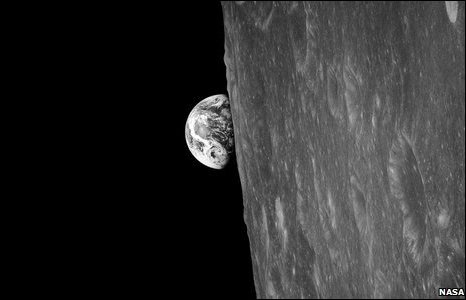
Earthrise: Apollo 8's enduring legacy (image courtesy NASA)
I can never have enough of this photo — the first ever snapshot of Earth.
This photo of “Earthrise” over the lunar horizon was taken by the Apollo 8 crew on Christmas eve 1968, showing Earth for the first time as it appears from deep space. It forever changed how humans look at – and feel about – their home planet.
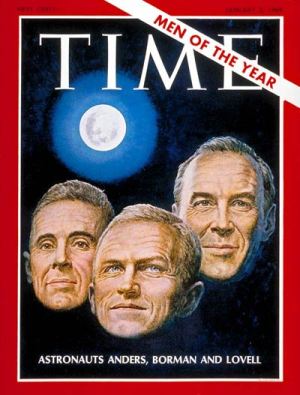
And here’s the best part: this image was captured by accident! In all the meticulous planning for the Apollo 8 mission, no one had anticipated or thought about it. All attention was on the Moon itself, which humans would be viewing at such close range for the first time. None of the astronauts on board Apollo 8 – Mission Commander Frank Borman, Command Module Pilot James Lovell and Lunar Module Pilot William Anders – were ready for the opportunity to witness their own Earthrise.
And if they had stuck to the mission plan, and not acted spontaneously, this image might never have been captured at the time it was.
Earth's photographers frozen in TIME... As Apollo historian and film-maker Dr Christopher Riley recalled on the 40th anniversary of this remarkable event a few days ago:
For the first three orbits, preoccupied by the Moon and their latest TV broadcast, the spacecraft was not orientated to give them a chance to see the Earth. But as Apollo 8 nosed its way back from the far side of the Moon for the fourth time, one of the crew spotted the view by chance from a window, his reaction captured by the on board tape recorder.
“Oh, my God! Look at that picture over there!” he exclaimed. “Isn’t that something…”
After a quick joke about the fact that it was not in their flight plan to photograph it, the crew abandoned protocol and scrambled to get a snap of the occasion with their stills camera.
The Hasselblad only had a black and white film magazine in, resulting in the image (below) – the first photograph of Earthrise taken by a human as he watched it happen.
The first Earthrise ever photographed; a colour photograph followed minutes later
But this first historic picture is rarely reproduced. Not content with this first monochromatic image, the astronauts rushed to find a colour film, and Bill Anders managed to snap two more frames which became the choice of photo editors for the rest of history.
Apollo 8 was an important prelude to actually landing on the Moon (which took place in July 1969). It achieved many firsts — including the first manned launch from NASA’s new Moonport, first manned mission to leave the earth’s gravitational field and reenter the earth’s atmosphere at tremendous speeds, first pictures taken by humans of the Earth from deep space, and first live TV coverage of the lunar surface. A Christmas Eve reading from the book of Genesis from Apollo 8 was heard by an estimated 2 billion people, the biggest TV audience in history.
Some might consider Apollo 8 as no more than a technological rehearsal to the eventual landing on the Moon, by astronauts of Apollo 11, but the images of Earthrise have had far-reaching implications. The rise of the global environmental movement in the 1970s was partly inspired by this new perspective of our planet. In his Oscar-award winning film An Inconvenient Truth, Al Gore acknowledges this as he sets the stage with a series of images of Earth in space, helping us to appreciate the beauty and fragility of our planet in distress.
In an op ed essay to mark the 40th anniversary, Oliver Morton wrote in the New York Timeson 24 December 2008: “The photograph of that earthrise by the astronaut Bill Anders forms part of the Apollo program’s enduring legacy — eclipsing, in many memories, any discoveries about the Moon or renewed sense of national pride. It and other pictures looking back at the Earth provided a new perspective on the thing that all humanity shares. As Robert Poole documents in his history, ‘Earthrise: How Man First Saw the Earth‘, that perspective had deep cultural effects, notably in the emotional resonance it offered the growing environmental movement. Seen from the Moon, the Earth seemed so small, so isolated, so terribly fragile.”
He goes on to argue that the planet is not as fragile or vulnerable as some suggest. But he ends with these words: ““Earthrise” showed us where we are, what we can do and what we share. It showed us who we are, together; the people of a tough, long-lasting world, shot through with the light of a continuous creation.”
The lessons of Earthrise images have been on other people’s minds as the anniversary passed. On his informative blog Dot Earth, New York Times reporter Andrew C. Revkin recently asked his readers to share what the Earthrise images meant to them. He has received a wide range of comments from people as diverse as former astronauts, scientists, school teachers and children.
Watch Jim Lovell & Apollo 8: Christmas Eve Heard Round the World – WGN (Chicago)’s producer Pam Grimes takes a look back at the 1968 Apollo mission through the eyes of astronaut Jim Lovell:
And here is how NASA Television looked back at their historic mission, 40 years later. In this video Astronauts Frank Borman, James Lovell and Bill Anders recount man’s first voyage around the moon:
One final comment: The world is grateful to NASA, America’s space agency, for adopting from the early days of space exploration a far-sighted, public spirited policy that all its space images are made available free of copyrights to anyone, anywhere on the planet. This is what enables me to use space images on my blog – and keeps tens of thousands of such images in the public domain. Space agencies of other countries, also funded by tax-payer money, have been far less generous when it comes to sharing copyrights. The Heavens may be free, but some images of it are not.
Read my October 2007 blog post: No copyright on this planet – thank Heavens (and NASA) for that!










 Open Minds!
