Communicating Disasters in digitally empowered Asia: A tale of two books

I have just spent a hectic week in Kuala Lumpur, and am just coming up for fresh air. That explains why this blog was silent for a few days.

I was at the Third Global Knowledge Conference (GK3) held in the Malaysian capital from 11 to 13 December 2007. With several related events preceding the main conference, my week was completely full.

GK3 was a global platform for all those engaged in using ICTs (information and communication technologies) for meeting the real world’s needs and solving its problems — to reduce poverty, increase incomes, create safer communities, create sustainable societies and support youth enterprise, etc. (Read my impressions of GK3 in this blog post.)

The week’s assorted events saw two separate video films produced by TVE Asia Pacific being screened as integral components of two sessions. These were The Long Last Mile (on community-based warning of rapid onset disasters) and Teleuse@BOP (on telephone use patterns among low income groups in five emerging Asian economies).

That wasn’t surprising because we produce and distribute films that capture Asia’s quest for improving lives through sustainable development. But unusually for myself, I also had two books coming out during the week — one that I had edited, and another that carried a chapter I had written.

communicating-disasters-an-asia-pacific-resource-book-by-tveap-and-undp.jpg

The first was Communicating Disasters: An Asia Pacific Resource Book, which I co-edited with Indian journalist Frederick Noronha. It was the culmination of a year-long process that began with an Asian brainstorming meeting on Communicating Disasters that TVEAP convened in December 2006 in Bangkok. That meeting, attended by three dozen participants drawn from media and disaster management sectors, identified the need for a handbook that can strengthen cooperation of these two communities before, during and after disasters.

The book, comprising 19 chapters contributed by 21 authors, has a foreword written by Sir Arthur C Clarke, inventor of the communication satellite. Pulling together these contributions from the specialist authored scattered across the globe was no easy task for co-editor Fred and myself.

The book’s blurb reads as follows:

“Where there is no camera, there is no humanitarian intervention,” said Bernard Kouchner, co-founder of Medecins Sans Frontieres who later became the Foreign Minister of France. Disaster managers and relief agencies acknowledge the mass media’s key role at times of distress. Yet, the relationship between media practitioners and those managing disasters can often be stressful, difficult and fraught with misunderstandings. Communicating about disasters sometimes ends up as communication disasters.

How can these mishaps be minimised, so that the power of conventional and new media can be harnessed to create more disaster resilient communities? What value addition can the new information and communication technologies (ICTs) bring in? In this book, media and development professionals from across the Asia Pacific share their views based on decades of experience in covering or managing a variety of disasters – cyclones, droughts, earthquakes, floods, landslides and tsunamis.

This book is aimed at journalists, disaster managers and civil society groups who want to use information and communication to create safer societies and communities.

The other book that came out in KL was Digital Review of Asia Pacific, 2007-2008 edition. It was launched during a workshop on Emerging Knowledge Opportunities (The Progress of ICT in Asia-Pacific and Other Parts of the World) on 12 December 2007.

The completely updated edition of the Digital Review of Asia Pacific contains authoritative reports on how 31 economies are using ICT in business, government and civil society written by senior authors who live and work in the region.

I have written the Sri Lanka chapter for the book, continuing a tradition I started back in 2003 with the first edition of the book. I was only sorry that I missed the session during GK3 where the book was launched — because I was moderating another session exactly at the same time in another room. But I was glad to join at least part of the post-launch reception and to meet with some fellow authors who were attending GK3.

Both books are multi-author books, and both have been in the making for a year or longer. It was quite a challenge to get 20 other contributors to come up with their chapters for Communicating Disasters. They were genuinely interested and supportive, but everyone being so busy, it took time and effort to pull together all the strands.

I was not the only common author in these books. My colleague and one-time co-author Chanuka Wattegama (now with LIRNEasia) has written two distinctive chapters on ICTs and disaster communication for the two books.

Many years ago, my friend (now international expert on terrorism and widely published academic author) Rohan Gunaratna told me that writing a book was like waging a small war. I don’t normally use military metaphors, because I deplore all things military, but I can’t resist extending Rohan’s analogy to say that compiling a multi-author book is a bit like waging a mini-war with a coalition of the willing!

Arthur C Clarke 90th Birthday reflections released on YouTube!

We have just uploaded on to TVEAP Films channel on YouTube a new short video, capturing the 90th birthday reflections of Sir Arthur C Clarke.

The world’s best known writer of science fiction, Sir Arthur C Clarke turns 90 on 16 December 2007. Scientific, literary and media communities around the world plan to mark this event.

In this 9 minute video, the visionary writer, explorer and science populariser looks back at his illustrious career spanning nearly 70 years and notes: “Growing up in the 1920s and 1930s, I never expected to see so much happen in the span of a few decades.”

He offers a quick assessment of two sectors where he has left his mark: space travel and communications technology. Ever the optimist, he believes that the best is yet to come in both areas.

“I still can’t quite believe that we’ve just marked the 50th anniversary of the Space Age,” Sir Arthur says. “We’ve accomplished a great deal in that time, but the ‘Golden Age of Space’ is only just beginning.”

Noting that good communications are necessary, but not sufficient, for human progress, he makes a strong plea for tolerance and compassion to achieve greater understanding between peoples and nations. To him, true globalization would require overcoming “our tribal divisions and begin to think and act as if we were one family”.

In the video, which we recorded in Colombo in the first week of December, Sir Arthur mentions three personal wishes – proof of life outside the Earth, clean energy to overcome global warming, and peace in Sri Lanka, his adopted country.

He ends the message indicating his preferred legacy: “I want to be remembered most as a writer – one who entertained readers, and, hopefully, stretched their imagination as well.”

In a technical paper written in 1945, Clarke was the first to propose the idea of communications satellites, which have today become a global industry supporting broadcast and telecommunications needs. One of his short stories inspired the World Wide Web, while another was later expanded to make the movie 2001: A Space Odyssey, which he co-wrote with director Stanley Kubrick. He has lived in Sri Lanka since 1956.

The video was filmed by Video Image (Private) Limited, in collaboration with the non-profit educational media foundation TVE Asia Pacific (TVEAP) — both of which donated their services to this effort.

Read the full text of Sir Arthur’s birthday reflections on TVEAP website

Good communications necessary, but not sufficient, says Arthur C Clarke

Arthur C Clarke’s 90th birthday reflections on TVEAP’s YouTube channel

GlobalVision at 20: Insiders turned outsiders keep kicking


GlobalVision, the path-breaking media company anchored in New York with a truly global outlook and a strong commitment to social justice, completed 20 years this week.

It was launched in November 1987 out of one room in Soho (New York) as a mission-driven company with little money but a big idea: to improve news coverage of the world through an “inside-out” approach that would offer voices not usually heard on the air in the US.

The founders were Danny Schechter, who became, in his words, a “network refugee” from ABC News 20/20 and Rory O’Connor, then with CBS News 48 Hours.

As the company introduction says:

“The whole world is watching… From Baghdad to Beijing, from Madrid to Manhattan, information is moving at the speed of light. Media and communications technology are transforming our lives — and those of our six billion neighbors. But in the emerging global village, whose stories get told — and who gets to tell them?

“At Globalvision, we believe in telling stories from the inside out. That means working with other cultures — not at them –and helping people to tell their own stories in their own way, to a world that’s getting smaller every day.”

In an industry saturated with media companies known more for their style than substance, Global Vision has not only blazed new trails, but used moving images in ways that moved people towards social change, political reform and – just as importantly – constantly question and challenge conventional wisdom and traditional authority.

They have also never hesitated to challenge the fellow journalists and corporate media on their servility, acquiescence and willing suspension of journalistic norms in the United States, especially under the current Bush administration.

They have won numerous awards and professional recognition for its pioneering international newsmagazine South Africa Now, which first broke through censorship to smuggle footage out of what was once the land of apartheid — and later chronicled Nelson Mandela’s transition from prisoner to President.

The company followed up with another award winning series, Rights & Wrongs: Human Rights Television with Charlayne Hundter-Gault, which aired for four years in sixty-two countries around the world.

Danny and Rory have also directed and produced more than thirty hard-hitting documentaries, many involving controversial issues and investigations — some for the PBS “Frontline” series” and others for television systems worldwide. Current films deal with subjects such as America’s child farm workers, bridging the global digital divide, flawed media coverage of the War in Iraq, and the ongoing debt crisis that threatens the global economic system.

I met Danny in person only once – in the Fall of 1995, when I spent a few weeks in New York on a fellowship to study the United Nations. Danny was one of the more colourful people we met (besides lots of men in suits from the UN, only a few of whom I can now recall by name). Danny introduced himself as a (TV) ‘network refugee’ — and gave a workshop on television journalism in defence of the public interest and human rights that had a lasting influence on myself.

Ever since, I have followed his books, incisive NewsDissector blog and Global Vision output with much interest.

So here’s wishing Danny, Rory and team at GlobalVision many more years of kicking ass!

MediaChannel.org: Global Vision marks 20th anniversary

Read Danny Schechter on: The Days of Our Dominion: Global Vision celebrations 20 years in the trenches

Rory O’Connor’s tribute to the late Anita Roddick, a long-standing supporter of Global Vision

Road to Bali: Beware of ‘Bad weather friends’!

unfcccnew-c.jpg

All the environmental roads — well, actually flights — seem to lead to Bali in the coming days.

The Indonesian ‘Island of the Gods’, famed as a tourist resort, will play host to the 13th United Nations Climate Change Conference from 3 to 14 December 2007.

The Conference, hosted by the Government of Indonesia, brings together representatives of over 180 countries together with observers from inter-governmental and non-governmental organizations, and the media. The two week period includes the sessions of the Conference of the Parties to the UN Framework Convention on Climate Change (UNFCCC), its subsidiary bodies as well as the Meeting of the Parties of the Kyoto Protocol.

The Bali meeting will be a turning point in the global response to climate change, an issue which has moved above and beyond being a simple ‘green’ concern to one with economic, security and social implications. The annual meeting returns to Asia after five years, since New Delhi, India, hosted the 8th meeting in November 2002.

In the build up to Bali, a new report released on 19 November 2007 says that without immediate action, global warming is set to reverse decades of social and economic progress across Asia, home to over 60 per cent of the world’s population.

Up in Smoke? Asia and the Pacific – with a foreword by Dr Rajendra K Pachauri, Chairman of the Nobel prize-winning Inter-governmental Panel on Climate Change (IPCC) – is the most extensive and concluding chapter of a unique, four-year long exercise by the Up in Smoke coalition, an alliance of the UK’s major environment and development groups.

The report shows “how the human drama of climate change will largely be played out in Asia, where almost two thirds of the world’s population live, effectively on the front line of climate change.”

When our friends at the International Institute for Environment and Development (IIED) in London sent me the press release about the report last week, something caught my eye. Among the several accompanying quotes was this one concerning the media:

“In many Asian countries climate change stories don’t make it into the media, so the public are left out of the debate. The challenge for decision-makers and the media is to stimulate interest in their work and translate the complex issues into stories that capture the public’s imagination. Climate change above all requires the engagement of everyone in creating the changes required.”

This sweeping statement is attributed to Rod Harbinson, Head of Environment, Panos London.

I know Panos London well, and am surprised to read an official remark of this nature emerging from that organisation which, until recently, has tried to relate to the majority world media as a friend and supporter. In fact, the first time I had one of my own pieces internationally syndicated was by Panos Features, back in 1989.

Come to think of it, the second article I wrote for Panos Features concerned how the low-lying, Indian Ocean island nation of Maldives was preparing for adverse impacts of climate change. That was years before the web, so there’s no link I can provide.

As a development writer and journalist who has covered global climate change among other issues for two decades, I have problems with Mr Harbinson’s remark.
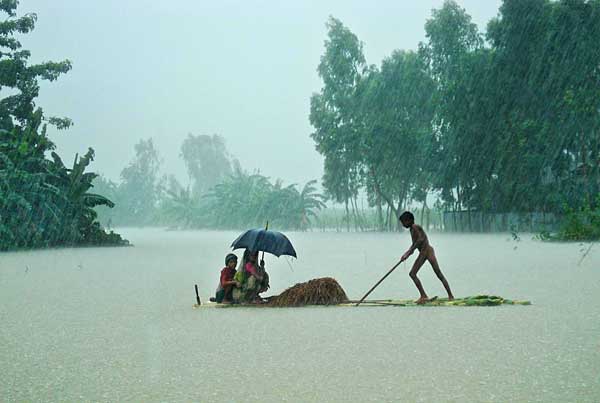
Drik/Majorityworld
Photo: A family looks for shelter using a raft made of banana trees during the last Monsoon: 31 July 2007: Gaibandha, Bangladesh © Quddus Alam/DrikNews Linked from Shahidul News

I’m in full agreement on the need to ‘translate the complex issues into stories that capture the public’s imagination’. There is also no argument that climate change requires the engagement of everyone.

But I would be very interested to know on what statistical or analytical basis he says “in many Asian countries climate change stories don’t make it into the media, so the public are left out of the debate’.

Asia, as Mr Harbinson should surely know, is not just China, India and Indonesia. It is large and highly diverse region, containing five sub-regions as defined by the UN. It is home to nearly two thirds of humanity, who live in over three dozen independent states or dependent territories.

Living in Asia and trying to work at regional level, I know how difficult it is to make any generalisations about this rich and constantly changing assortment of economies, cultures and societies branded as Asia (which, taken together with the small island nations of the South Pacific, is known as the Asia Pacific). In fact, it’s wise not to speak about Asia as a whole, for there is little in common, say, between Japan and Laos, or between China and Maldives.

The Asian media are as diverse as the region, and have been undergoing rapid change in recent years. Unshackled from the state’s crushing grip in most countries, the broadcast media (radio, TV) have proliferated and emerged as the primary source of information for a majority of Asians. New media – web, mobile devices and multimedia combinations – are now changing the way many Asia’s communicate and access information.

I have always been curious how Panos London, perched at its cosy home in London’s White Lion Street, assesses what goes on in the majority world. In this case, how much of Asia does Mr Harbinson know and is really familiar with? How many Asian media outlets has he or Panos monitored, assessed and sampled before coming to this sweeping and damning conclusion about the lack of climate change stories in the Asian media?

And how many of these outlets are radio and TV, and in languages other than English? I would really like to know.

If Panos London believes in evidence-based analysis, then it owes us in Asia an explanation as to on what basis its head of environment makes such statements about an entire continent, whose media output is predominantly in Asian languages, not English. And whose principal media are broadcast, not print.

And what constitutes a climate story? Tracking the endless array of inter-governmental babble in the name of working out some compromised partial solution to the major problem? Or reporting on campaigns to clean up polluting industries or sectors (such as transport) that generate most of the greenhouse gases? Or focusing on how humble communities in remote corners of the world are finding how their lifestyles and livelihoods are suddenly threatened by something they hardly understand?

To me, it’s all of the above — and a lot more. Climate change is akin to a prism through which many, many development issues and topics can be analysed. Just as HIV/AIDs long ago ceased to be a simple medical or health story, climate change has moved well beyond being an environmental story.

The more angles, perspectives and topics that are covered in the media, the better. And all of it need not be in that staid, cautiously balanced style of The Guardian or BBC that Panos London must be more familiar with.

Panos London, in its statement of beliefs, says ‘Freedom of information and media pluralism are essential attributes of sustainable development’. Surely, then, they realise that media pluralism includes speaking in a multitude of tongues, and analysing from many different perspectives — as happens in the Asian media 24/7, if Mr Harbinson and his colleagues care to spend more time in the region and keep their eyes and ears open.

But instead, they seem more like a group of well-meaning people with a solution in search of a problem. For the past many months, Panos London has been crying wolf about the allegedly poor coverage of climate issues in the majority world media.

That was the main thrust of a report they published in late 2005, titled Whatever the weather – media attitudes to reporting climate change.

According to Panos London website that I have accessed today, “…the survey found that there is little knowledge among journalists about these important choices and they are rarely discussed. The dramatic impacts of extreme weather events, for example, rarely feature in relation to climate change and the topic remains low on editors’ story sheets.”

The survey was based on ‘interviews conducted with journalists and media professionals in Honduras, Jamaica, Sri Lanka and Zambia’ and claimed to ‘give insights into the attitudes of journalists and the status of the media in these countries.’

Well, I was one of those majority world journalists covered by the survey — and I had major reservations about how they used my responses. Being cautious, I had used email (and not the phone) to respond to their survey questions – I therefore have a complete record of everything I said. When the draft report was shared on my request, I found some of my responses being distorted or taken out of context. I had to protest very strongly before some accuracy was restored. I later regretted having agreed to be part of this dubious survey.

It was flawed in many ways. The questionnaire was very poorly conceived and structured. I actually declined to answer some questions which were worded in such a way as to elicit just the kind of response that Panos London wanted — to make a case that journalists in the majority world are so incompetent that they need help.

A glaring omission in the final report was that it carried no list of journalists interviewed. I had to ask several times before I could even find out how many others participated in the survey (apparently some three dozen). But my requests for a list of other survey respondents were repeatedly declined by Panos London, who said it was privileged information. They later took the position that European data protection laws did not allow them to disclose this information!

In an email sent to Rod Harbinson on 22 Feb 2006, I said: “I would argue that Panos London had pre-conceived notions that it wanted to present in this report, and used superficial and largely unprofessional interview surveys with a few scattered journalists as a rubber-stamping exercise to publish what it wanted to say anyway. This is further borne out by the fact that some of my more outspoken responses have been completely ignored.”

I have seen or heard nothing since to change the above view. And the contents of Whatever the weather – media attitudes to reporting climate change are consistent with what Rod Harbinson says in the IIED press release that prompted me to make this comment.

Yes, climate change is the Big Issue of our times that needs everyone to rally around and search for ‘common but differentiated’ solutions and responses. But no issue or global threat is too big to warrant the willing suspension of time-honoured journalistic or academic values of honesty, integrity and balance. Issuing lop-sided ‘survey reports’ and making sweeping negative statements do not help the cause of improving public discussion and debate on climate change.

The road to Bali and beyond is going to be an arduous journey. On that treacherous road, we in the majority world need to beware of ‘bad weather friends’ who come bearing bad surveys and self-serving offers of ‘help’.

— Nalaka Gunawardene

Note: In the spirit of communication for development and media pluralism, I invite Panos London to respond to the above critique, and offer to publish their response in full.

I remain a critical cheer-leader of the global Panos family, and serve on the Board of Panos South Asia, an entirely independent entity that has excellent relations with Panos London. Like all families, we don’t always agree – and that’s part of media pluralism!

Related blog posts:

Nov 2007: True ‘People Power’ needed to fight climate change
Nov 2007: Beyond press release journalism: Digging up an environmental business story
Oct 2007: The Al and Pachy Show: Climate Change gains public momentum

Aug 2007: Arthur Clarke’s climate friendly advice: Don’t commute; communicate!
June 2007: Sex and the warming planet: A tip for climate reporters
April 2007: Can journalists save the planet?
April 2007: Beware of Vatican Condoms and global warming
April 2007: Pacific ‘Voices from the Waves’ on climate change
April 2007: Wanted – human face of climate change!

Al Jazeera English is one: Getting better at imitating its rival BBC World!

al-jazeera.jpg

Al Jazeera English (AJE), the world’s newest global news and current affairs channel, completed one year on the air on 15 November 2007.

This in itself is a commendable accomplishment, and we extend heart-felt first birthday greetings to the channel that entered the highly competitive arena of global newscasting offering to ‘balance the information flow from South to North, providing accurate, impartial and objective news for a global audience from a grass roots level, giving voice to different perspectives from under-reported regions around the world.

AJE wanted to revolutionise English language TV in the same way Al Jazeera turned Arabic TV world upside down, ending the monopoly of the airwaves by state broadcasters.

First, the good news. AJE has done well on some fronts, adding to the diversity in international news and current affairs television, and enriching the often endangered media pluralism in a world that is, ironically, having more broadcast channels than ever before in history. It has brought to us stories ignored by other news outlets, while offering us somewhat different takes on widely covered stories.

In a self-congratulatory note and video clip posted this week on YouTube, the channel says: “A year ago Al Jazeera English was launched, marking the start of a new era in international journalism. In the last 12 months we have brought a fresh perspective to world events and shed light on many of the world’s little reported stories.”

Here are some of the highlights compiled by AJE.

In another post on its own website, AJE offers a selection of exclusive video stories from its correspondents to show how it ‘continues to set the news agenda’.

We also salute AJE for withstanding the unofficial yet widespread ‘block out’ of its distribution by North American cable operators, depriving most viewers in the US and Canada the opportunity of watching it on their TV screens. In a nifty move, the channel started placing some of its more consequential content on YouTube, making it available to anyone, anywhere with a sufficiently high speed Internet connection.

Image courtesy Al Jazeera

And now, on to the not-so-good news…

If AJE in its first year somewhat stood apart from the other two global newscasters – BBC World and CNN International – that was occasional and superficial, and not quite consistent or substantial. In fact, the only thing that AJE has consistently done is to under-deliver on its own lofty promise of doing things differently.

As I wrote in a blog post in August 2007: “I’m looking long and hard for the difference that they (AJE) so emphatically promised. Instead, I find them a paler version of BBC World, at times trying oh-so-hard to be just like the BBC!”

Of course, AJE – or any other broadcaster, for that matter – is fully entitled to set a trend or follow a model already set by another channel, even that of a rival. But to so blatantly imitate the BBC while all the time claiming to be different is simply not credible.

And credibility is the most important virtue for a news and current affairs media operation. Earn and sustain it and the world will be on their side. Lose it, and they will be the laughing stock on the air.

I’m not suggesting that has happened yet. But as I cautioned in an op ed written days after AJE started broadcasting in November 2006, “unless it’s very careful and thoughtful, AJE runs the risk of falling into the same cultural and commercial traps that its two rivals are completely mired in.”

Here’s a simple test. If viewers were to watch AJE, BBC World and CNN International without logos and any other tell-tale branding, how many would be able to tell the channels apart?

To me, CNN is in a league of its own for a variety of positive and negative reasons. Their offering is technically and professionally superior, even if I have objections to some of their editorial choices and analysis.

However, it’s harder to discern differences between the often befuddled BBC World and its enthusiastic imitator, Al Jazeera English. Perhaps it’s no coincidence that the latter has a significant number of former BBC reporters and presenters, many of who have been poached. While that again is a choice for AJE’s management, they must realise that we the viewers in the global South do not want a global channel rooted in our part of the world to dress up in the BBC’s increasingly discredited clothes.

And then there is the whole question of ethical sourcing of content — an important consideration which most global, regional and national TV channels continue to ignore. Many roaming news journalists’ key operating guideline seems to be: get the story ahead of rivals, no matter what — or who gets hurt in that process.

That business as usual must end. As I have argued in this blog and elsewhere: “If products of child labour and blood diamonds are no longer internationally acceptable, neither should the world tolerate moving images whose origins are ethically suspect.”

Aug 2007 blog post: Wanted: Ethical sourcing of international TV news

Nov 2005 op ed on SciDev.Net: Communication rights and communication wrongs, by Nalaka Gunawardene

In August 2007, I critiqued some Sri Lanka related stories appearing on AJE’s People & Power strand, pointing out some ethically questionable practices in how their reporter got the story, possibly placing some of her sources and interviewees at personal risk. To her credit, the reporter Juliana Ruhfus engaged me in this blog, explaining her side. Read the full exchange here.

But there are other key areas where AJE needs to very carefully guard its image and credibility. In the past year, the world’s assorted development and humanitarian agencies have realised that it’s ‘cool’ to be seen on Al Jazeera than on BBC and CNN. Some of their propagandists (sorry, public information officers) had beaten a path to AJE offices in London, Doha and Kuala Lumpur, seeking to cut various deals to get coverage.

Yes, the development and humanitarian communities certainly have worthwhile messages and issues to communicate, many of which need urgent, wide dissemination. Tragically, what most agencies seek is self-promotion and ego-massaging, not issue based discussion. It is precisely this alarming trend of paying media outlets to carry agency propaganda that I have labelled ‘cheque-book development’.

Aug 2007: ‘Cheque-book Development’ – paying public media to deliver development agency logos

It’s no secret that BBC World has shamelessly allowed its airwaves to be sold for cash by assorted ‘touts’ claiming to have privileged access to the once-respected broadcaster. In the past year, some of these touts have extended their tentacles to AJE. We don’t yet know if these are entirely pro bono acts of goodwill by AJE, or if money has exchanged hands somewhere along the line.

If the latter has happened, we ardently hope that someone within AJE would blow the whistle in their own collective self interest. Or perhaps AJE wants to be too much like BBC World in every respect — including the corruption part?

Meanwhile, the real challenge to Al Jazeera remains exactly what I said one year ago: to usher in real change, it needs to transform not just how television news is presented and analysed, but also how it is gathered.

Despite having a code of ethics for its conduct, the well-meaning, south-cheering channel has yet to rise to that part of the challenge. Let’s hope that in its second year, Al Jazeera English would spend less time imitating its rivals, and more time in living up to its own promise.

Personal note: Some readers have asked why I continue to hold AJE to higher standards in a world where media ethics are being observed in the breach all the time. It’s simply because I still see AJE as the best hope for the majority world to tell its own stories in its own myriad voices and accents. I desperately want AJE to succeed on all fronts, not just in audience ratings, signal coverage and market penetration. For that, it must fast find its identity and stop defining itself by its rivals.

Journalists and scientists seeking Green Accord

Can journalists save the planet?

This was the question I raised in a blog post written in April 2007. Arguing that environmental journalists alone cannot adequately address the multitude of complex environmental challenges faced today, I wrote: “We urgently need more good journalism that covers sustainable development as an integral part of mainstream human affairs.”

For the past five years, an Italian non-profit cultural association named Greenaccord has been attempting just this. In the (northern hemisphere) Fall of each year, they invite and host 50 – 60 journalists and scientists from all over the world to discuss how the media can be an integral part of society’s response to today’s environmental crises. In fact, they believe the media must play a path-finder role in our search for solutions.

During this week, I have been attending the V Greenaccord International Media Forum on the Protection of Nature, held from 7 to 11 Novmeber 2007 at the historic Villa Mondragone in Frascati, some 20km south east of Rome.

It has been a time to meet old friends again and to make new ones. I have been part four of the five Greenaccord media forums since the first one was held in Rapolane Terme, in the Tuscany valley in northern Italy in 2002.

Greenaccord is the only regular (annual) meeting that I know of where practising journalists and media gatekeepers come together from all regions of the world to discuss the state of the planet and state of their profession.

Each year, we have some ‘regulars’ returning while new participants join the growing network. As some old hands noted this week, it is evolving into an extended family.

That family consists mainly of print and broadcast media journalists from Africa, Asia, Europe, Latin America and the Caribbean. Many are engaged in ‘deadline journalism’ of news and current affairs, while a few of us, like myself, have moved on to more reflective and analytical kind of journalism. We also have a few researchers, activists and public information officers among us, enriching our discussions with a diversity of perspectives.

To engage this group of participants over three and a half days, Greenaccord invites a dozen or so scientific or industry experts from different regions of the world and different disciplines. This year’s theme, ‘Capitalising on the Environment’, was explored by business leaders, fair trade activists, economists and a number of technical experts specialising in fields such as clean energy, clean technology and organic farming.

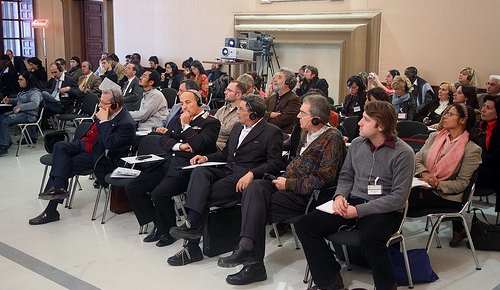
greenaccord-v-forum-in-progress-nov-2007.jpg

As with all meetings, some speakers were far more interesting than others. And some sessions were blessed with competent chairpersons who kept overenthusiastic speakers in check and allowed meaningful discussion and debate to happen.

Sitting through such meetings is a bit like gem mining. One has to sift through a lot of gravel to find a rare precious gem. When that happens, it’s well worth the hassle.

Well, I’ve had my share of gravel moments (zzzzzzzzzzzzzzzzz!) and precious moments (Eureka!) this week. I’ll write separate blog posts on some of the latter. They are indeed worth sharing.

The real stars (or gems if you like) in this whole exercise are the participants themselves. We come from such diverse backgrounds – the sessions are supported by simultaneous interpretation in English, Spanish and Italian, with an occasional remark in French – that we enrich each other by simply being there.

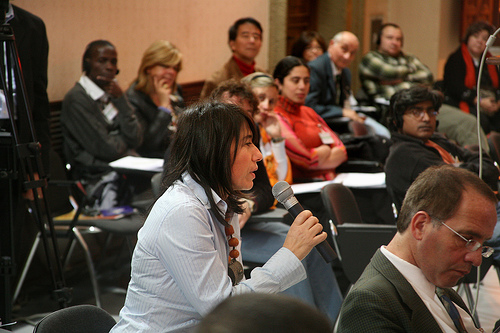
emanuela-gasbarroni-from-tve-med-intervenes.jpg

Some of us can barely contain our passion for what we do, and keep making comments or asking questions at every available opportunity. Others are more quiet during sessions but expressive during the many hours of networking and socialising over fine Italian wine, coffee and gastronomical treats. All these are part of Greenaccord’s cultural diversity that we contribute to, and then celebrate.

Even if we don’t take ourselves too seriously, we do discuss sobering issues. On the one hand, the planet is in peril, largely thanks to human bungling over generations. On the other, mass media itself is in crisis in many countries — under siege from oppressive governments, grappling with limitations of money and skills, and facing competition from new media platforms grabbing audiences and revenue.

For example, a colleague from Cameroon found the government closing down his privately owned FM radio station just a couple of days before he left for Rome. Others had worrying tales to share about official censorship, physical violence unleashed on media organisations and journalists, and the tension between media owners’ interests and the public interest.

We expressed solidarity and support for all Greenaccord colleagues currently experiencing difficulties of various kinds. The spirit of camaraderie in this network is strong – and keeps growing.

So is all this networking and meeting hopping a distraction from real work, which each one of us have to perform at our desks, or in our studios, on an individual basis? I don’t think so. Far from being a drag on my time, I find gatherings like Greenaccord inspiring and energising. They also remind me that I’m not alone in the daily struggle and drudgery of deadlines, government bureaucracies, funding crises and a never-ending race to keep up with new media technologies.

A planet in peril and a media in crisis need more platforms like this to connect and support many more of our kind who weren’t in Rome this week. Greenaccord isn’t perfect (we’re working on it), but it has lit more than a few candles against the looming darkness.

– Nalaka Gunawardene, Frascati, Rome: 10 November 2007

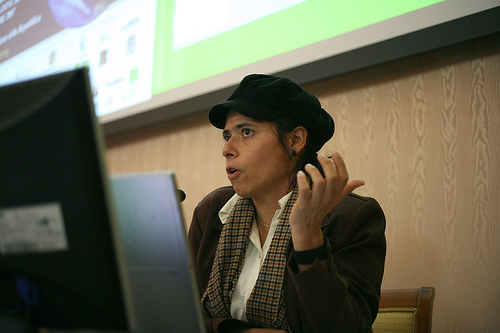
zilia-castrillon-speaking-at-greenaccord-v-nov-2007.jpg


Meeting photos courtesy Adrian Gilardoni’s Flickr account

New media anarchy is good for you!

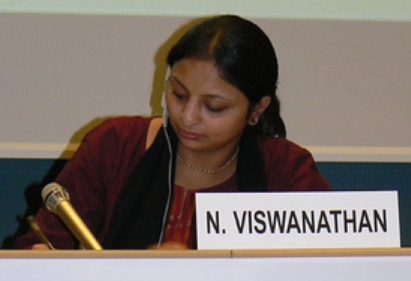
neha-viswanathan.jpg

“You people are too well mannered! I’ve never been to a conference where people are so properly dressed and so polite to each other!”

With these words, Neha Viswanathan made sure she had everyone’s attention. But it was not just a gimmick — she was contrasting the relatively more orderly, organised world of mainstream media (MSM) with the decidedly more anarchic world of new media — including blogs, wikis, YouTube and Second Life.

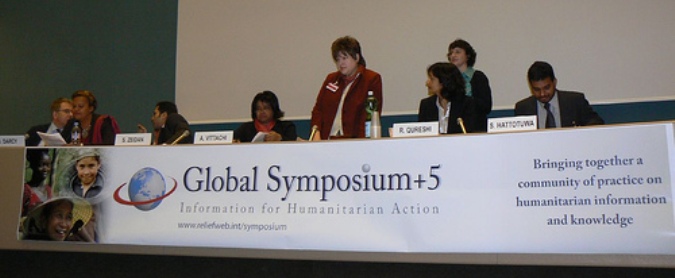
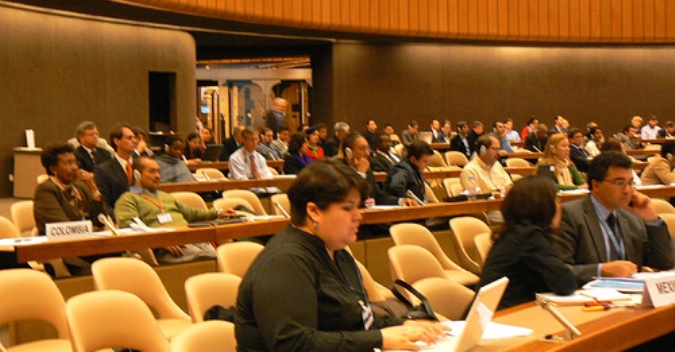
Neha, South Asia Editor of Global Voices, was speaking on a panel on ‘new media’ during the Global Symposium+5 on ‘Information for Humanitarian Action’ in Geneva this week (22 – 26 Oct 2007).

The panel topic itself showed the rapid change taking place in the humanitarian sector. As the panel premise said: “Within minutes of a disaster or conflict, the first images are seen on YouTube rather than CNN, and probably to a larger audience. YouTube, Flickr and blogging are bringing wars, disasters and their humanitarian consequences to the attention of the public, government and aid agencies more efficiently than ever. It’s now possible to keep watch on a Darfur village through satellite imagery, or take a virtual tour of a refugee camp.”

The panel was to discuss whether citizen journalism and new collaborative/ networking technologies are improving humanitarian response, and review how the humanitarian community is faring in this new environment.

My own views on this are found in another blog post: New media tsunami hits humanitarian sector – rescue operations now on!

Neha’s take was slightly different. She started reminding everyone that the new media activists were unruly and not always polite. The blogosphere is very much a contested and contentious space where arguments rage on. Not everything is moderate, balanced or ‘evidence-based’ (to use a new favourite phrase of the humanitarian community).

But in times of crisis or emergency – whether disasters or war – new media activists are increasingly the first responders. The anarchic nature actually provides them with an advantage: they are distributed, self-organising and motivated. There is no central newsroom or coordination point telling them what to do. In typical Nike style, they just do it.

As an example, she described World Wide Help, whose introduction reads: “Using the web to point help in the direction where it’s most needed”.

This blog was started by several founders and members of the SEA EAT (South East Asian Earthquake And Tsunami) blog, wiki and database, all of which gained worldwide attention at the time of the Indian Ocean earthquake and tsunami on 26 December 2004. The group, now calling themselves The World Wide Help Group, has since remobilised to aid in other relief efforts.

Read the whole story of the SEA EAT Blog: A Candle in My Window by Peter Griffin, one of its co-founders

As Sir Arthur C Clarke has also noted, the 2004 tsunami marked a turning point in how citizen journalists and other new media activists respond to emergencies. Since then, the power of new media has been unleashed on many public interest issues and humanitarian causes. As an example, Neha cited the online campaign against street sexual harassment in India.

In Neha’s view, new media can collate authentic testimonials of those directly affected by disasters or other crises, and keep the public attention (and thereby, political interest) on emergencies beyond the first few days.

Her advice to humanitarian aid agencies: keep looking at the new media, especially blogs, to find out what people at ground zero are saying about relief and recovery work.

“Bloggers are not objective – they talk openly, and express themselves freely,” she told the largely prim and proper Geneva audience, where some participants had referred to the meeting as ‘this august gathering’!

Finally, in situations where MSM (the formerly big media!) are shut down, restrained or intimidated into not carrying out their watchdog role, it’s the new media that fills the voice. Neha described the pro-democracy struggles in Nepal in 2005 – 2006 as an example where the people power struggles continued to be reported and commented on after the autocratic king clamped down on all print and broadcast media.

Read my August 2007 blog post: The Road from Citizen Kane to Citizen Journalist

New media tsunami hits global humanitarian sector; rescue operations now on…

banner.jpg

Geneva, 25 October 2007 (MovingNews): The global humanitarian sector has been hit by a ‘new media’ tsunami, causing widespread damage and massive confusion in Geneva.

Giant waves — carrying blogs, wikis, YouTube and other new media products — have simultaneously swept over several aid capitals of the world, including London, New York and Tokyo.

United Nations and many other international relief organisations are among the worst affected. These aid agencies, usually among the first to arrive at the scene of major disasters or crises, found their information and communication capacities severely depleted.

“This is entirely a man-made calamity, and we just didn’t see it coming,” the UN spokesperson in Geneva said in a brief message released using the old-fashioned Morse code. “Our risk registers, log frame analyses and satellite technologies gave us no advance warning.”

Eye witness reports said some agencies were completely marooned on old media islands, saddled with very large numbers of completely unreadable documents going back to decades.

First casualties included assorted spin doctors carrying out propaganda for UN agencies. One perished while trying to sanitise the Wikipedia entry about his agency head.

Meanwhile, several dozen injured or badly bruised public information officers have been treated at a language clinic. Some will undergo trauma counselling.

“We have never been exposed to this level of open and two-way communication,” a survivor from UN OCHA said. “We were so used to always being in control, always telling others what to do and how to do it. I still don’t know what hit us!”

In a major show of solidarity, the world’s computer, telecommunications and media industries are rushing emergency teams to provide relief and recovery support.

“For decades, the UN, red cross and other aid agencies have responded to many and varied emergencies. In their hour of need, we have decided to come to their help,” a joint tele-com-media industry statement said.

Other survivors are being given first aid in simple, jargon-free public speaking. Those who respond well will be treated with basic courses in participatory communication methods.

The emergency coordinators have ordered that any spin doctors found alive be quarantined to prevent the spread of the fatal infection known as MDG.

As the recover process continues, ICT activists plan to conduct more advanced exercises — such as how to produce PowerPoint presentations with less than 20 words per slide.

“But we have to take things one step at a time,” a relief worker said. “These people have just had their entire frame of reference collapse all around them. They are in deep shock and disbelief. It will be a gradual process.”

It has now been established that a few alert officials had anticipated the new media tsunami well ahead of its dramatic arrival. But their warnings were ignored, as it now turns out, to everyone’s peril.

In Washington DC, the United States has just designated veteran broadcasters Walter Cronkite , Bill Moyers and Oprah Winfrey as their New Media Tsunami Relief Ambassadors. In the coming weeks, they will tour the decimated UN, red cross and other humanitarian aid agencies, taking stock of the global disaster and sharing their collective wisdom on telling the truth to the public simply and well.

You, dear reader, are now invited to continue building this unfolding scenario:

How soon and how well will the humanitarian sector raise its head from the new media tsunami?

Will they learn lessons from this disaster, or might they soon return to business as usual?

What would happen to the massive outpouring of goodwill, voluntary help and aid?

Message to aid workers: Go mobile — or get lost!

banner.jpg

“MY NAME is Mohammed Sokor, writing to you from Dagahaley refugee camp in Dadaab. Dear Sir, there is an alarming issue here. People are given too few kilograms of food. You must help.”

This short, urgent message of a single individual has already joined the global humanitarian lore. It was sent by SMS (a.k.a. mobile texting) from the sender’s own mobile phone to the mobiles of two United Nations officials, in London and Nairobi. Sokor found these numbers by surfing at an internet café at the north Kenyan camp.

The Economist used this example to illustrate how the information dynamics are changing in humanitarian crises around the world. In an article on 26 July 2007, titled ‘Flood, famine and mobile phones’, it noted:
The age-old scourge of famine in the Horn of Africa had found a 21st-century response; and a familiar flow of authority, from rich donor to grateful recipient, had been reversed. It was also a sign that technology need not create a ‘digital divide’: it can work wonders in some of the world’s remotest, most wretched places.”

Elsewhere in the article, it added: “Disaster relief is basically a giant logistical operation. Today’s emergency responders can no more dispense with mobile phones or electronically transmitted spreadsheets than a global courier company can. But unlike most couriers, aid donors operate amid chaos, with rapidly changing constraints (surges of people, outbreaks of disease, attacks by warlords). Mobile phones increase the flow of information, and the speed at which it can be processed, in a world where information used to be confused or absent. The chaos remains, but coping with it gets easier.

image-from-wikimedia.jpg
Image courtesy WikiMedia

All available indicators suggest that the future of humanitarian assistance is going to be largely dependent on mobile communications. Despite this reality, old habits die hard. I sat through an entire presentation on ‘Innovation to Improve Humanitarian Action’ at the Global Symposium+5 on ‘Information for Humanitarian Action’ in Geneva this week — and not once did I hear mobile phones being mentioned. A group of 15 – 20 people had deliberated for 2 days to come up with their vision of ‘the potential of emerging technologies and approaches used in the field and globally to strengthen information sharing, coordination and decision-making’ in humanitarian work.

It might be that aid workers are all frustrated computer geeks…because all their talk was about collaborative and networking software, Geographic Information Systems (GIS), the use of really high resolution (read: oh-so-sexy) satellite imagery, and the latest analytical tools — all requiring high levels of skill and personal computers with loads of processing power.

But no mobile phones! This was too much to let pass, so I raised the question: did you guys even consider this near ubiquitous, mass scale technology and its applications in crisis and disaster situations? And how do you engage the digitally empowered, better informed disaster survivors and crisis-affected communities?

I also recalled the example of Aceh tsunami survivors keeping each other informed about the latest arrivals of relief supplies – all through their mobile phones (as cited by the head of MERCY Malaysia on the previous day).

It turned out that they did discuss mobiles — well, sort of. Amidst all the gee-whiz talk about high tech gadgets, I received a short answer: widespread as mobile phones now are, ‘these systems are not fully integrated or compatible with other information platforms’ — whatever that means! The group’s spokespersons also pointed out that since mobile services are all operated by commercial (telecom) service providers, using their networks involves lots of ‘negotiations’. (I would have thought it’s the same with those who operate earth-watching or communications satellites.)

The message I heard was: mobile phones are probably too down-market, low-tech and entirely too common for the great humanitarian aid worker to consider them as part of their expensive information management systems. For sure, everybody uses them to stay in touch in the field, but what use beyond that?

What uses, indeed. If today’s aid workers ignore the mobile phone revolution sweeping Africa, Asia Pacific and, to a lesser extent, Latin America, they risk marginalising their own selves. The choice seems to be: go fully mobile, or get lost.

Fortunately, the panel discussion that followed — on ‘Envisioning the Future’ — partly redressed this imbalance. The panel, comprising telecom industry, citizen media and civil society representatives, responded to the question: what will our humanitarian future look like and what role will information play in supporting it?

panel-3-on-envisioning-the-future.jpg

Leading the ‘defence’ of mobiles was Rima Qureshi, head of Ericsson Response, part of the global mobile phone manufacturer’s social responsibility initiatives. She reminded us there were now 3.4 billion (3,400 million) mobile phones in the world — and it was growing at 6 new mobile connections every second. By the time she ended her 8-minute talk, she said, some 3,000 new mobiles would have been connected for the first time.

This represents a huge opportunity, she said, to put information into everyone’s hands whenever and wherever they need it. And mobiles are all about two-way communication.

The new generation of mobile phones now coming out are not locked into a single telecom network, and have built-in global positioning (GPS) capability. This means the phone’s location can be pinpointed precisely anywhere on the planet — which can be invaluable in searching for missing persons in the aftermath of a disaster.

Wearing her Ericsson prophet’s hat, Rima said: “Everything we can do on a personal computer will soon become possible on a mobile. Mass availability of mobile phones, able to connect to the global Internet, will represent a big moment for human communication.”

And not just Ericsson, but many other mobile phone makers and network operators are rolling out new products and services. The new mobiles are easier to use, more versatile and durable, and come with longer-lasting or renewable sources of power. Wind-up phone chargers have been on the market for some years, and some new mobile phones come with a hand-cranking charging device that makes them entirely independent of mains electricity. With all this, the instruments keep getting cheaper too.

And if aid workers ignore these and other aspects of mobile realities, they shouldn’t be in their business!

1743641460_63092b452a.jpg

Rima described another Ericsson initiative called Communication for All. It’s trying to harness the power of shared network, across commercial telecom operators and networks (but with some development funding from the World Bank) to deliver coverage to rural areas that aren’t as yet covered fully. The rolling out of coverage would have profound implications for disaster managers and aid workers.

As James Darcy, Director of humanitarian aid policy at the UK’s Overseas Development Institute, noted from the chair, the future of humanitarian communication is already here — but the sector needs to have more imagination in applying already available technologies for new and better uses.

My colleague Sanjana Hattotuwa, ICT researcher and activist from Sri Lanka, made the point that 3.4 billion mobiles raise new ethical considerations. For example, while it is now technologically possible to track the movement of every mobile phone – and therefore, in theory, each unit’s owner – this knowledge can be abused in the wrong hands. (I’ll write a separate blog post on Sanjana’s other remarks.)

Not everyone in the audience was convinced about the future being mobile. Soon enough, the predictable naysayer popped up: saying only 2.4 per cent of people in Sub-Saharan Africa as yet owned mobile phones, and Internet access was limited to only one per cent. Blah, blah, blah! (I was half expecting someone to blurt out the now completely obsolete – but sadly, not fully buried – development myth that there are more phones in New York city than in the whole of sub-Saharan Africa. That didn’t happen.)

Funny thing was, we were discussing all this at the Palais des Nations, the European headquarters of the UN, which is just literally across the street from the headquarters of the International Telecommunication Union (ITU), the authoritative monitor of telecom and ICT industry data and trends! It seemed that the gulf between some humanitarian workers and the telecom industry was much bigger than that.

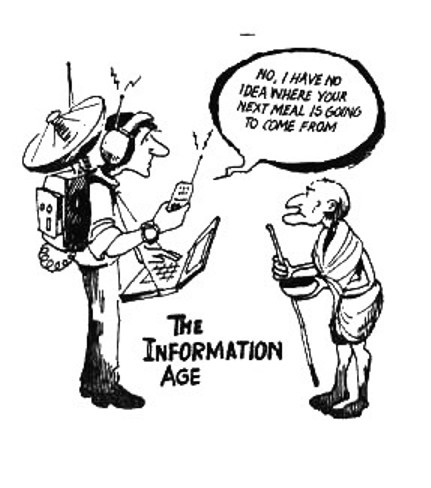
Of course, being connected – to mobile, satellite and every other available information network – is only the first step. We can only hope humanitarian workers don’t end up in this situation, captured in one of my all-time favourite ICT cartoons (courtesy Down to Earth magazine):

copy-of-all-inf-no-solutions.jpg

Read about Sri Lanka’s pathfinding action research by LIRNEasia and others: Last Mile Hazard Information Dissemination Project

All Geneva photos courtesy UN-OCHA Flickr on Global Symposium+5

A million video cameras to change the world!

Something remarkable is happening with online public video sharing platforms: progressive non-profit groups worldwide are seizing their power to do good.

YouTube started off more like the people’s version of funniest home videos. But it’s no longer confined to that category. Activist and social groups are increasingly uploading their videos. As broadband Internet rolls out around the world, more people are actually able to watch these videos online.

In response, YouTube, owned by search giant Google, is creating a special section for nonprofits to air their videos and link them to its Google Checkout online payment system to receive funds directly.

“Nonprofits understand that online video isn’t just a way to broadcast public service announcements on a shrunken TV set,” Reuters quoted Steve Grove, head of news and politics at YouTube, as saying. “It’s a way to get people to do more than just absorb your message but to engage with their user generated content as well.”

Pure Digital, maker of the Flip video camera, has said it plans to give away a million video cameras to non-profit organizations around the world to capture images and moments in places traditional media outlets might not be able to reach.

“Video has power and media has power but the challenge is that the media is limited to telling stories that are controlled by a very small number of people,” Jonathan Kaplan, chief executive of Pure Digital, told Reuters. “This program along with YouTube and other sites will expand the media universe for learning what’s really going on in the world,” he said.

Visit FlipVideo website on support for non-profit groups

Reuters quotes the recent example of the impact of clips of the Myanmar army’s confrontations with local protesters which were posted on YouTube and other Web sites. Some of the clips made their way to mainstream news media, which were blocked out of entering or covering events in Burma.

See an example of a YouTube video on what’s happening in Burma:

Our friends at Witness, an activist group founded by the musician Peter Gabriel in 1992, has long specialised in raising awareness of such previously unseen events through video. Sam Gregory, programme director at Witness, says online distribution has made it easier to put videos in front of the right people such as decision makers and others with a personal connection to the cause.

“It’s not necessarily about the size of the audience it’s about placing targeted video and turning ‘watching’ into action,” said Gregory.

Read the Reuters story on 19 Oct 2007: Nonprofits turn to YouTube to raise awareness, funds

My blog post on 1 Oct 2007: Shoot on sight: Rights Alert on Burma

My blog post on 30 Sep 2007: Kenji Nagai: Filming to the last moment

TVE Asia Pacific News story March 2007: TVEAP films now on YouTube

What’s happening with online video has a parallel in how activist groups seized the potential of the hand-held video camera. The handicam was invented in 1985 by Sony. Intended originally for entertainment and domestic documentation purposes only (ranging from family vacations and weddings), it did not take long to find new uses for this revolutionary technology.

The Handicam Revolution in media began when a video camera captured police beating Rodney King on a Los Angeles highway. The shocking amateur footage was broadcast on TV around the world. The acquittal of the police officers after their first trial sparked outrage, and riots erupted in a 20 block section of Los Angeles, leaving 54 people dead and over 2,000 injured.

Ever since Rodney King, broadcasters have been using amateur video to provide images of events that their own camera people have not captured. And human rights activists have started relying on the power of video images to capture the attention of the broadcasters to expose acts of human rights abuse and violation.