MDG: A message from our spin doctors?

References to the Millennium Development Goals (MDGs) are popping out of every UN document, speech and communication product these days. Each agency and official seem to be keen to outdo all others in living and swearing by this new ‘development mantra’ of our times.

MDGs are an international blueprint for human development, with eight major goals to be achieved by 2015. These goals are the means of implementing the Millennium Declaration — to which 189 governments committed at the UN Millennium Summit held in 2000.

But important as they are, the MDGs are only a means to an end, even if an extremely worthwhile one. If we lose sight of that, we risk allowing the MDG ‘dog’ to wag the development ‘dog’.

Alfonso Gumucio Dagron

Speaking at OUR Media 6 conference in Sydney this week, Alfonso Gumucio-Dagron, Managing Director – Programmes of the Communication for Social Change Consortium, cautioned about development agencies engaging in too much spin or public relations, and too little real communication.

Alfonso, a widely experienced and highly respected practitioner and thinker in development communication, lamented how institutional publicity is taking a much higher priority than communication as a social process that gives a voice to the communities and players involved.

Ah, finally a dev-com heavyweight echoes what I’ve been saying for some time! At every UN and media platform I could access in the past couple of years, I’ve stressed that catalysing wide ranging public discussion and debate on the MDGs’ core issues is far more important than simply enhancing ‘brand recognition’ for MDGs themselves. (That’s useful too, but as part of a wider process.)

On the eve of the MDG+5 Summit at UN Headquarters in September 2005, I wrote in an editorial published by SciDev.Net:

Today’s MDG promoters need to revisit some of the more successful development efforts of the past few decades — such as promoting universal human rights, eradicating smallpox, popularising oral rehydration salts, and wiping out Southern debt — and study the role good communication played in each.

Those in the UN system, in particular, have to find more creative ways of getting the MDG message across. In my view, MDG ‘branding’ is not what is important; it is the core set of issues that MDGs embody that need mass attention and aggressive promotion.

We should also invoke the memory of past visionary leaders who navigated the treacherous inter-governmental minefields to talk truth to power. One was James Grant, former executive director of the UN children’s agency, turned UNICEF into a formidable global brand.

One of Grant’s enduring remarks concerned the silent emergency of several thousand children (and adults) dying everyday from preventable diarrhoeal diseases. It was, he pointed out repeatedly, as if several jumbo jets full of children were crashing everyday — and nobody took any notice.

That metaphor might lack political correctness in the post-11 September era. But the message was loud and clear. Grants’ one time deputy at UNICEF, Tarzie Vittachi, was another master at summing up complex development issues in memorable ways. When he was head of information at the UN population agency, the former newspaper editor used to remind everyone: ‘Governments don’t have babies; people do.’

Read my full editorial in SciDev.Net in September 2005: Simpler words are needed to get MDG message across

Related links:

MDGs: Mind the development gap, Asia Pacific told

The Communication Initiative: Strategic Thinkin: Mind the Communication Gap

Let’s resolve analog anomalies before going fully digital…

At the last minute, I was invited to join a forum on Community use of digital spectrum at OUR Media 6 Conference here in Sydney.

I agreed because I have written and spoken for years about how we in developing Asia are blissfully ignorant about the gross misuse and abuse of our electro-magnetic spectrum by its custodians – our governments.

I was the odd one out on this panel, as all others were from Australia -– I don’t even live in a country that has set a timeframe for transition from analog to digital spectrum in broadcasting.

Only a few countries in Asia have as yet announced a timeframe for this -– Japan, Korea and Malaysia among them. Some have not even thought of this issue – they are dealing with more basic concerns in broadcast regulation and policy formulation. Yet I found this discussion instructive: sooner or later, all countries will have to go through this transition. It certainly helps to know the issues you are debating and grappling with.

Cartoon Stock

An extract from my remarks:

We should address fundamental reforms in broadcast policy, law and regulation before embarking on the high-cost, tedious and slow process of moving the entire production and distribution process to digital. We who haven’t derived and shared the full benefits of analog broadcasting must get our fundamentals right before going digital.

And therein lies the challenge for all of us who want to safeguard media freedom and promote the freedom of expression and cultural production. In my view, many activists in our region are not paying enough attention to how the electro-magnetic spectrum has been mismanaged and abused by various governments. Activist attention has been held by the more tangible, physical threats to media freedom: issues such as censorship, media ownership and political economy of the media.

All these are worthwhile and necessary — but not sufficient on their own.

During discussion, I also made the points:

The spectrum has been called the ‘invisible wealth of nations’. As economic and cultural practices move more and more into the digital realm, we’re going to increasingly feel the value of this common property resource. All our gains in the physical world would be undermined if we find the spectrum has been irretrievably allocated to a handful of privileged users ignoring the public interest. We need to wake up to this reality.

Perhaps it’s just as well we in developing Asia don’t have tight timeframes to switch from analog to digital spectrum use. We’ve got a good deal of cleaning up and streamlining to do in the analog realm.

This window will be open only for a few years. If we don’t act, we run the risk of making an equal mess in the digital spectrum, only far worse.

In terms of action, I suggest three simple yet important steps:

For us in the developing countries – or emerging economies – in Asia, I suggest three actions:
• Look forward to the transition from analog to digital spectrum
• Look sideways to see how we’re currently doing in the analog domain
• Look back to reflect on the mistakes we’ve made along the way (and learn)

Read the cleaned up text of my panel remarks plus responses
om6-forum-on-digital-spectrum-nalaka-remarks.pdf

Wikipedia on Open Spectrum

Moving images moving heart first, mind next

“Film is a lousy medium to communicate information. It works best at the emotional level.”

Bruce Moir, one of Australia’s seniormost film professionals made this remark soon after I had presented TVE Asia Pacific’s Children of Tsunami experience to OUR Media 6 conference in Sydney last afternoon.

After more than 35 years in documentary and feature film production for both cinematic and broadcast industries, in different parts of the English speaking world, Bruce knows a thing or two about moving people with moving images.

I was delighted and privileged to have Bruce join my presentation. He’d come at my invitation to the conference happening in his city.

“We’ve got to remember that film appeals to people’s hearts more than their minds,” Bruce explained. “The way to people’s heads is through their hearts, from the chest upwards — and not the other way round.”

I hope this was an ‘Aha!’ moment to at least some in our audience. I’ve personally heard Bruce say this before, but it bears repetition – because many film professionals tend to overlook this. Especially those who are trying to ‘communicate messages’.

Even a few weeks ago, I quoted him in a review as saying: “Our fundamental job is to tell a story – one that holds an audience’s interest and moves their heart, regardless of language, cultural context or subject….I have always believed that film achieves its optimal impact by aiming to ‘get at the audience’s head via their heart’ rather than the other way around.”

Bruce Moir

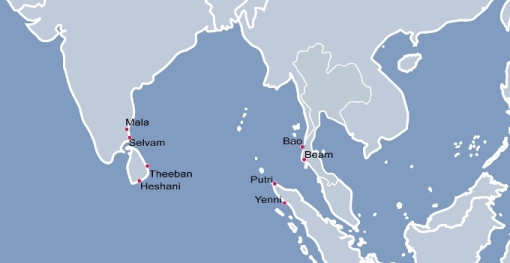
Without Bruce’s involvement, Children of Tsunami would have turned out to be very different. He was our Supervising Producer for the entire effort, advising and guiding our national film production teams tracking the progress of Tsunami survivor families in India, Indonesia, Sri Lanka and Thailand for one year afer the Asian Tsunami.

As Bruce recalled, the four teams came with different backgrounds, skill levels and film-making traditions of their own – ranging from television news and current affairs to development film-making, the type usually commissioned by UN agencies. Bringing them to be ‘on the same page’ was no easy task.

Film-makers are not particularly known for their patience or people-skills. Many I know have a ‘just-get-on-with-it-never-mind-the-niceties’ attitude. Bruce is one of the most patient persons I know: he would spend days and weeks relating to our production teams – usually by email or phone – gently nudging them in certain directions.

For sure, there’s no one right way to make a film. But there are some tried and tested principles in good story telling, which is what Bruce excels in. And which he willingly shares with others.

The year-long, 4-country and 8-location Children of Tsunami project was the biggest logistical operation TVE Asia Pacific has mounted in its 11 years of existence. (We’re in no great hurry to top that one!). Our production teams – operating from Bangkok, Colombo, Ubud (Indonesia) and Chennai – related to our regional production team based in two cities: Colombo, where TVEAP office is currently anchored, and Sydney, where Bruce lives.

We only came together face to face just once, in Bangkok, early on in the process. That meeting agreed on styles and formats, and also helped build the human relationships.

The rest of the time it was all through communications technologies. As you can imagine, lots of tapes moved around, as did many Gigabytes of video over the web. (DHL should have become a sponsor – they had lots of business from us!)

children-of-tsunami-locations.jpg

As I explained in my talk, Children of Tsunami was not just a film project. We published a monthly video report online on each of the eight families we were tracking, plus maintained a dedicated website with growing volumes of text, images and links. The monthly videos were edited and post-produced in the countries of filming, by our production teams themselves. It was distributed film-making, even if everyone worked to a common format.

With all that frenzy now behind us, the products of Children of Tsunami continue to be distributed, showcased and discussed at film festivals and conferences like OUR Media.

As I said yesterday to my predominantly academic audience: we’ve got a story telling and journalistic practice, and we now need a theory for it.

Related links:

Children of Tsunami: Documenting Asia’s longest year

Children of Tsunami revisited two years later

What’s in a name: My media, your media or OUR Media?

We’ve just finished the first day of OUR Media 6 conference in Sydney. A great deal was presented and discussed by over 150 participants from more than 30 countries. It will take a while to navigate through this mass of information, perspectives and opinions.

One thing we talked about was how to describe the kind of media that is emerging or consolidating in many countries outside the formal power structures and corporate/governmental controls.

Several names are being tossed up:
Community media?
Alternative media?
Tactical media?
Citizen media?
Social movement media?
People’s media?

Whatever label we apply, these media face formidable challenges. John D.H. Downing, Professor of International Communication and Founding Director, Global Media Research Center Southern Illinois University, USA, started off the conference with a wide-ranging, insightful discussion of the key challenges.

His talk was full of ‘nuggets’ of practical wisdom, the kind that some academics never seem to produce or peddle:

Small is not always beautiful.

Community is not necessarily lovely.

Aha! I’m glad these statements were said upfront, because there’s a tendency to romanticise both at gatherings like this.

We’re off to a good start. Watch this space.

A foot in both graves? OURMedia, here I come!

I’ve just arrived in Sydney, Australia, to participate in, and speak at, OURMedia/NUESTROSMedios 6 Conference, 9-13 April 2007.

There are over 130 presentations planned over the 5 days from representatives from over 85 international and Australian organizations and over 35 countries. I’ll be talking about ‘Communicating Under Duress: The Children of Tsunami experience’ on April 10 afternoon.

ourmedia-vi-banner.jpg

According to the conference website:

OURMedia / NUESTROS Medios is an international network and forum founded in 2001 by a group of engaged academics interested in advancing the democratic potential of community, alternative and ‘citizens’ media. Recognising that the intellectual and policy frameworks for citizens’ media are often out of touch with the on-the-ground reality, the purpose of OURMedia is to connect scholars, practitioners, activists and policy-makers towards defined outcomes. OURMedia is now a network of over 500 people from 50 countries and has generated an extensive body of practical and theoretical knowledge primarily in English and Spanish. It constitues a unique space of dialogue between academics and practitioners, advocates and artists working in community, alternative and citizens’ media.

Past OURMedia conferences have been organized in the United States (2001), Spain (2002), Colombia (2003), Brazil (2004) and India (2005). These conferences have consisted of scholarly and academic presentations, media activism initiatives, policy workshops, community cultural development roundtable debates, new media labs, research-led forums and engagements by local media producers.

I’m not an academic, although in my media and communication work I often work with researchers and academics, always asking them to say things in simpler words. I speak and write in very practical, pragmatic terms — not in academese. I sometimes wonder how it goes down with academic colleagues who typically utter four jargon terms out of every ten. But somehow, I must be doing a few things right because I often get invited back!

Which reminds me what John Naughton, British columnist on new media and academic said about the double-life of a journalist-cum-academic (or the other way round):

When I was an undergraduate I became heavily involved in student politics and in the process got to know some newspaper editors who asked me to write articles for them. So I did — and to my astonishment they sent money in return. Figuring that this was a great racket I continued to do it. One of my famous fellow-countrymen, Conor Cruise O’Brien has also been an academic and a journalist all his life. He describes it as “having a foot in both graves”. I try and keep the two sides of my life separate. My journalistic mates think I must be a good academic on the grounds that I’m not much of a journalist, while my academic colleagues think I must be a good journalist (on the grounds that…). They’re both wrong.

John wrote A Brief History of the Future: The origins of the Internet. He writes a weekly column about the Internet in the business section of The Observer newspaper in the UK.

Wanted – Human face of climate change!

Now that scientists have spoken, loud and clear, things are beginning to happen on climate change — and not a moment too soon.

Venture capitalists, policy wonks, technology geeks, security analysts and social activists are all joining the conversation — thanks largely to the media’s increased coverage of the issue.

The threat of climate change is being taken seriously. The past few weeks have seen evidence of this. For example:

The latest report from the Inter-governmental Panel on Climate Change, released on April 6, said greenhouse gas emissions are at least partly responsible for the warmer climate, which will pose a host of environmental and health challenges, ranging from more diseases to floods and droughts.

– In March 2007, an international panel of scientists presented the United Nations with a sweeping, detailed plan to combat climate change, warning that failure would produce a turbulent 21st century of weather extremes, spreading drought and disease, expanding oceans and displacing coastal populations.

And for the first time ever, the U.N. Security Council will discuss potential threats to international security from climate change.

These conversations will be richer and more meaningful if the ordinary people — who are most at direct risk from climate change’s multiple impacts — were heard in the corridors of power, money and deal-making.

We in the media must see beyond the important scientific projections, policy debates and UN talks — we must look for the human faces, voices and dimensions of climate change.

That’s the point I made in a recent essay published on TVE Asia Pacific website a few weeks ago. Here’s an extract:

A healthy mix of rational thinking and emotional appeal will stand a better chance of moving people to kick their addition to oil.

Allowing real people to tell their own personal experiences can also be very effective. I realised this five years ago, when we commissioned the first-ever documentary on climate change and the South Pacific, made by a native Pacific islander. Voices from the Waves, directed and produced by Bernadette Masianini of Fiji, was narrated by two teenagers growing up on two islands, each facing an uncertain future.

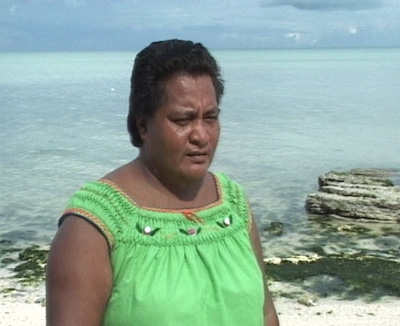
At one point we meet Mrs Saipolua, an ordinary woman who lives on the island of Kiribati, where no place is higher than a few feet above the sea. She is distressed having had to move her home twice in a past decade due to the receding shoreline.
For Kiribati’s 82,000 inhabitants, climate change is not theory; it’s already lashing on their beaches.

“Our house used to be in that spot,” Mrs Saipolua points to a place that’s now permanently submerged. “This is where we relocated to the second time.”

mrs-saipolua.jpg

She points to several tombstones that are on the verge of being washed away. “Even the final resting places of our loved ones are not spared…..The sea action had cracked the gravestones.”

I’ve covered climate change for years as a science writer. But it was Mrs Saipolua who made me realise the impact climate change is having on millions of ordinary people who have never heard that term.

Related links:

Pacific ‘Voices from the Waves’ on climate change

Read the full essay, Changing Climate and Moving Images on TVEAP website

Watch a video clip from Voices from the Waves on TVEAP’s YouTube Channel:

Video and DVD copies of Voices from the Waves can be ordered from TVE Asia Pacific’s online e-shop.

UN Climate Change Impact Report: Poor Will Suffer Most

Fossil fuels and fossil fools in India

‘‘People in India, unlike the West, don’t understand the seriousness of climate change….They think global warming is a fantasy. Indians are using fossil fuel like never before. We have constructed oven-like buildings and spend enormous energy cooling them.’’

I came across these words by the well known Indian environmental film-maker Mike Pandey in an article in NewIndPress that surveyed how Indian documentary film-makers are rising to the challenge of communicating climate change.

The article, ‘Meltdown on Film’ published on 15 March 2007 highlights the formidable task of raising awareness in India, now one of the fastest growing economies in the world, consuming larger volumes of fossil fuels every year.

Mike knows what he’s talking about: his film Global Warming went largely unnoticed when it was released in India three years ago.

And he is one of India’s top notch film makers on environment, wildlife and natural history. He has won three Panda Awards — also known as the ‘Green Oscar’ — at the Wildscreen Film Festival held every other year in Bristol, UK — and considered to be the most important festival of its kind in the world. (Modest cough: I was on the jury of Wildscreen 2000, when we gave Mike one of his three Green Oscars.)

Viewer apathy is not the only problem that India’s environmental film-makers have to contend with. Here’s an extract from the article:

Like any environmentalist, our documentary filmmakers are “concerned” about issues like global warming. But the lacklustre reactions of research agencies (who ‘‘support” the cause but don’t really come forward to fund documentaries), zero interest from broadcasters who, according to one filmmaker, prefer ‘‘sexy environmental stories’’, together with viewer apathy, are the reasons why the few impressive documentary films on climate change vanish after a few screenings at festivals. Take the Public Service Broadcast Trust’s (PSBT) Open Frame, for instance, the annual documentary film festival held in Delhi. Or the roving environmental and wildlife film festival CMS Vatavaran, where open discussions are held after every screening. Barely a couple of films are chosen by the public broadcaster Doordarshan after they are screened at these two festivals, which is why most of the documentaries don’t ever reach the masses.

‘‘Public interest stories and documentaries are the last thing broadcasters want to show,’’ quips Pandey. ‘‘People like me are lucky to have found space on DD. Value-based programmes are nudged out so easily by broadcasters these days.”

The article continues:

A few years ago, when Mike Pandey returned to his favourite spot in Austria to capture a snowcap for one of his films, he was shocked to see it had melted. He says, ‘‘I had seen the ice cap the previous year. I had to go deeper into the area to get my shots. It’s common in Austria to see ice caps vanishing. You see blossoms and splendid crops in many areas.’’ After Earth Matters, which is being shown on Doordarshan, Pandey is coming up with a series of six films on global warming, which will talk about ‘‘using alternative energy for the future.’’

Whenever out for shoots at Lakshwadeep, Kochi and Gujarat, Mike has been noticing ‘‘visible changes’’ in ‘‘ocean ferocity’’ and where the sea neighbours the land. ‘‘The water has come in a bit more into the land over the years,’’ he observes.

‘‘You don’t have to be a scientist to notice these changes; you can see it all happening now. Unfortunately, people living along the Indian coastline will be the first ones to face any kind of major impact,’’ he adds.

On my visit to Hyderabad last week, I was told that there are now close to 50 TV channels that cover news and current affairs on a 24/7 basis (in English and other Indian languages). Yet this kind of news hardly seems to make the headlines….it’s probably moving too slowly.

Mike Pandey and other environmental film-makers have their work cut out for them.

“If (Indian cricketer) Sachin Tendulkar or (Bollywood star) Shah Rukh Khan loses his cell phone, the news will reach every nook and corner of the country, but the fact that iodine is essential for the human body is still not known widely,” Mike told India’s Frontline news magazine in 2004. Read full article: Nature’s film-maker in Frontline of 18-31 Dec 2004

Read TVE Asia Pacific website feature on Mike Pandey’s 2003 film on the whale shark in India

Long live MediaChannel.org!

I have never peddled a fund raising appeal through my blog…until now.

Earlier today, I received my daily email from MediaChannel.org, a website that critiques the media — ‘As the media watch the world, we watch the media’

According to their website: MediaChannel is concerned with the political, cultural and social impacts of the media, large and small. MediaChannel exists to provide information and diverse perspectives and inspire debate, collaboration, action and citizen engagement.

And like many of us who mix media and social activism, they are facing a crisis. Today’s email said:

After seven years and a new website redesign, MediaChannel.org may have to cease operations because of a financial emergency. As most of you have already noticed, we have started to run advertising on the website in an effort to deal with our funding challenge.

To put it bluntly, the future of MediaChannel is in question. Please consider making a tax deductible donation online through PayPal or send a check made out to: The Global Center, 575 8th Avenue, Suite 2200, New York, New York, 10018.

MediaChannel is headed by Danny Schechter, the Emmy-award winning TV journalist and film-maker.

I met Danny in the Fall of 1995, when I spent a few weeks in New York on a fellowship to study the United Nations. Danny was one of the more colourful people we met (besides lots of men in suits from the UN, only a few of whom I can now recall by name). Danny introduced himself as a (TV) ‘network refugee’ — and gave a workshop on television journalism in defence of the public interest and human rights that had a lasting influence on myself.

Besides running MediaChannel.org, Danny writes the well-informed, incisive NewsDissector blog

Since then, we’ve been in contact occasionally. And here’s my declaration of interest: MediaChannel.org has published my media related op ed essays, though I never get paid and never expect any payment.

As Walter Cronkite says: “MediaChannel is undoubtedly worth taking part in. So many leading groups and individuals around the whole world have come together.”

And MediaChannel.org is undoubtedly worth supporting.

Read my last op ed on MediaChannel:
Ethical news-gathering: Al Jazeer’s biggest challenge