‘Embedded’ or aloof: Media’s choice in covering emergencies

banner.jpg

In many disaster and conflict hot spots of the world, journalists and relief aid providers work closely together. There are times when journalists play good Samaritan and aid workers dabble as reporters. In the difficult field conditions of emergencies, this is understood and accepted.

But should journalists become ’embedded’ in humanitarian operations? If so, how impartial or independent would their coverage be?

This issue kept coming up during the Global Symposium+5 on ‘Information for Humanitarian Action’ in Geneva this week (22 – 26 Oct 2007). The majority aid officials and handful of journalists present didn’t always agree.

UN agencies and other humanitarian organisations increasingly recognise the power of media, especially broadcast television, to raise public awareness on emergencies. This, in turn, influences political commitments, aid donations and relief operations themselves.

But how close can the media get to aid agencies before they lose their sense of perspective and independent analysis? If journalists becoming embedded with the military in conflicts is frowned upon, what about media’s de facto embedding with humanitarian missions?

There was no consensus on the issue, but a few of us stressed on the need for independent media — independent of governments, aid agencies and other vested interests — to take stock of crisis situations and report, reflect and analyse on what they find.

The presence of nosy reporters might be an occasional irritant to some aid agencies, especially if they have things to hush up, but at the big picture level it can serve everyone’s interest — especially those of affected groups.

Alain Modoux, a former red cross official who went on to become an assistant director general of UNESCO, reminded us how governments often stand in the way of free flow of information on emergency situations. The reasons for such suppression vary: some don’t want to admit failures on their watch, and others fear public discussion and debate, especially at international level, on what is happening in their own country.

Governments can — and often do — bring pressure upon aid agencies to fall in line (or risk being thrown out). In such situations, it’s only the independent media that can take stock of rapidly changing situations and highlight the unmet needs and any disparities in the emergency response.

Then there is the media’s traditional watchdog role. The humanitarian sector is now the world’s largest unregulated industry – billions of dollars flow through the sector every year, most of it public funds (direct donations or taxes collected by governments). Yes, the aid agencies all audit their accounts and the UN has stringent regulations on how they can spend money. But there’s nothing like a bit of media scrutiny to keep everybody clean and honest…

Follow the money! This is what journalists are taught and trained to do – and with good reason. In emergency situations following the money often brings up instances of waste, corruption and mismanagement that aid agencies would rather not talk about.
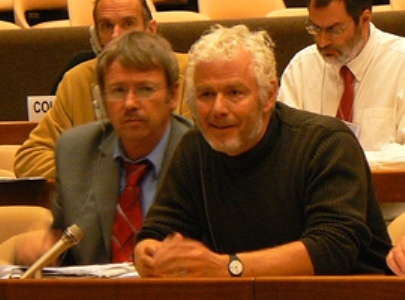
edward-giradet.jpg

Swiss journalist Edward Girardet (photo, above), who specialises in in media, humanitarian aid and conflict issues, has been making this point for a long time.

As he has written: “Humanitarianism should not ‘belong’ to any one group. What the international aid industry urgently needs is more hard-nosed and independent reporting.”

That is unlikely to happen when individual journalists are too cosy with aid workers or their bosses.

Ed was at the Geneva Symposium this week, once again making a case for a viable media watchdog capable of reporting the real causes behind humanitarian predicaments, including how the international community responds.

Read my June 2007 blog post quoting Ed Girardet: Can the media tame the alms bazaar?

In one intervention, I suggested that the media can become the ‘conscience’ of the humanitarian industry – to ensure transparency and accountability of resources, decisions and conduct.

Partnerships between media and aid workers is fine, as long as the media remain somewhat aloof and detached.

And it’s not the global media who can or will stay with the stories as recovery takes months or years. We all saw in the aftermath of the Indian Ocean Tsunami how quickly the global media’s news interest went down.

In the long term, empowering the local journalists to ask the right questions and go in search of answers.

Read this blog post reproduced in Asia Media Forum


Read this blog post adapted in MediaHelpingMedia

Journalists join the Global Race to the Arctic!

Image from Wikipedia

Everybody seems to be heading to the Arctic these days.

With global warming triggering a thawing of the massive ice caps that have covered the North Pole for millennia, bordering countries are trying to stake claims on land masses, open seas and suspected oil and other mineral reserves.

The results of global warming are seen first and strongest in the polar regions. The Arctic sea ice has shrunk at an average annual rate of about 70,000 square kilometres per year since 1979.

There’s suddenly a new race to the North Pole, not so much to reach it first – as happened in the early part of the 20th century – but to grab a piece of real estate.

And now, science journalists can join the race.

The World Federation of Science Journalists (WFSJ) has just announced a competition offering science journalists the chance to win three week-long trips aboard the Canadian research icebreaker Amundsen. It is being organised in collaboration with the Canada Foundation for Innovation and the International Polar Year Circumpolar Flaw Lead Project.

Winners will fly to Inuvik (Canada), and hop aboard a Twin Otter aircraft to the famous icebreaker. There, they will receive first hand experience of global warming where it is unfolding the fastest, says a circular from WFSJ.

To enter, professional journalists are invited to send their CV, coordinates, key pages of passport and a one-page essay on why they should be selected.

World Federation of Science Journalists
28, rue Caron, suite 200, Gatineau (Québec) Canada J8Y 1Y7
Email: info@wfsj.org
Tel.: +819 770-0776
Fax: +819 595 2458
www.wfsj.org

Applications must be received before 5 November 2007.

Katie Couric: Faithfully her Master’s voice?

This is an interesting video, uploaded last month on to YouTube by media activists.

In September 2007, Katie Couric, anchorwoman of CBS Evening News reported live from Baghdad. But instead of using that opportunity to ask tough questions and dig for the truth, Couric asked soft questions and repeated a number of false Bush talking points.

As activists point out, the media’s failure to ask tough questions helped America get embroiled in Iraq in the first place.

It’s hard to believe that Couric currently occupies the slot that was long adorned by the likes of Walter Cronkite, anchorman for The CBS Evening News for 19 years (1962 – 1981). During the heyday of CBS News in the 1970s and 1980s, he was often cited in viewer opinion polls as “the most trusted man in America”, because of his professional experience and avuncular demeanor.

From Wikipedia

Media watchers cannot help comparing how Cronkite covered an earlier, equally controversial conflict that left America bruised and bleeding: the Vietnam War. Following Cronkite’s editorial report during the Tet Offensive that the Vietnam War was unwinnable, President Lyndon Johnson is reported to have said, “If I’ve lost Walter Cronkite, I’ve lost Middle America.”

How times have changed. Couric is the media lap-dog that every government and military would wish to have — her recent reportage from Iraq would probably be held up by some of them as ‘an example to every journalist covering a war’.

Incidentally, Cronkite provides the voiceover introduction to Couric’s CBS Evening News, which began on 5 September 2006.

And that’s the way it is.

YouTube video courtesy Moveon.org – Democracy in Action

Anita Roddick: “There was nothing like this dame”

Image courtesy Media is a Plural website

Citizen journalist, film-maker and media critic Rory O’Connor has written a moving tribute to extraordinary activist and entrepreneur Anita Roddick, whose premature death on 12 September 2007 has left her many admirers in shock and grief.

He recalls how colleague and fellow media-activist Danny Schechter and he first met Anita at a gathering of progressive business executives called the Social Ventures Network. Their shared background, vision and ideals soon turned them into friends and co-conspirators.

Rory recalls how their company Global Vision embarked on a new human rights-oriented TV newsmagazine in the mid 1990s: “Anita and her husband Gordon were key players in that series – ‘Rights & Wrongs: Human Rights Television’ – coming to fruition. They contributed their energy and enthusiasm, their ideas and information, their contacts and creativity (and oh yes, their capital!) and without all of it, the series would never have been born. But with their help, the award winning newsmagazine was broadcast weekly for four years, on more than 150 public television stations in the USA, as well as on channels and networks in sixty-one other countries. It remains the only regularly scheduled television program in history devoted exclusively to coverage of human rights.

Rory echoes my own point about how Anita was a communicator par excellence, driven more by intuition and inspiration than any textbookish theories:
“Although Anita wasn’t a media activist per se, she intuitively understood how media could be used for activism, and she did so shamelessly and in a cheerfully relentless manner. Whether she was supporting social and environmental causes through window displays, convincing American Express to pay her to appear in an ad promoting the Body Shop and its causes, working with Globalvision on its commercial and non-profit programming (or later writing books, blogging, running an activist website, contributing to the success of Mother Jones magazine, or working closely with — and donating millions to — media-savvy organizations such as Amnesty International,) Anita intrinsically ‘got’ the importance of characters and stories to selling anything—from cold cream to ideas and values – and she employed them cleverly and constantly in support of her principles.”

Watch Anita’s one minute on climate change for Friends of the Earth:

Watch QuantumShift.tv’s thoughtful tribute to Anita Roddick, better presented than the fleeting coverage of mainstream news channels:

Read the full tribute on Media is a Plural website.

Read my own tribute to Anita Roddick: We shall always remember you!

Read Danny Schechter on News Dissector website

Crossing the other Digital Divide: Challenge to conservation community

Digital Divide refers to the gap between those who have regular, easy access to modern information and communication technologies (ICTs) and those who don’t. In the past decade, the IT industry and development community have launched various initiatives to bridge this divide. The One Laptop Per Child project is among the better known examples.

As digital technologies and media gain momentum and wider coverage than ever before, another kind of digital divide has emerged. This week in Kathmandu, during the Fourth Asian Conservation Forum, some of us have been talking about this new divide — between the Digital Natives and Digital Immigrants.

This latter divide is mainly a product of age, not socio-economics. Market research and sociological studies now confirm that today’s younger people – raised on a diet of mobile phones, video games and mp3 (music) players – have radically different ways of accessing, receiving and coping with information.

Recognising this new Digital Divide is vital for communication and advocacy work of conservation groups, such as IUCN – The World Conservation Union, conveners of the Kathmandu forum.

For nearly 60 years, IUCN has been an effective platform for knowledge-based advocacy. Using scientific evidence and reasoning, it has influenced conservation policies, laws and practices at country and global levels. The world would be a worse place to live in if not for this sustained advocacy work by thousands of experts and activists who were mobilised by IUCN.

Much of that work has been accomplished through the classical advocacy tools: scientific papers, books, conferences and, in recent years, ‘policy dialogues’ — meetings where experts and activists would sit down and talk things through with those who make policy in governments and industry.

IUCN continues to pursue all these methods, with creditable impact. IUCN’s Red List of Threatened Species, whose latest edition is being released today (12 September 2007), is among the best known examples of how the Union’s work informs and inspires urgent action for saving the world’s animals and plants driven to the edge by human activity.

To remain similarly effective in the coming years, IUCN — and the rest of the conservation community — need to evolve and adapt to changing realities in human society. One such reality is the proliferation of ICTs in the past two decades.

The International Telecommunications Union (ITU) announced recently that the world’s telephone connections had passed four billion. Largely thanks to the explosion of mobile phones in the majority world, the total number of telephones (fixed and mobile) had quadrupled in the past decade.

While exact figures are hard to come by, it is estimated that around 1.17 billion people (almost 1 in 6 persons) have access to the Internet, even though varying levels of quality.

These are the more widely quoted figures, but the media mix keeps diversifying even as the size of the overall ‘ICT pie’ keeps increasing. For example, the 1990s saw a channel explosion in both FM radio and television across much of Africa, Asia Pacific and Latin America, hugely increasing viewers’ choice and enhancing the outreach of broadcasting. The popularity of video games (and now, online games) has spawned trans-boundary subcultures that were inconceivable even a decade ago.

It is this bewilderingly media-enriched world that IUCN’s members and experts are trying to engage, hoping to persuade everyone — from governments and industry to communities and individuals — to live and work as if the planet mattered.

In Kathmandu this week, I argued that scientific merit and rational (and often very articulate) reasoning alone won’t win them enough new converts to achieve significant changes in lifestyles, attitudes and practices. To be heard and heeded in the real world outside the charmed development and conservation circles, we need to employ a multitude of platforms, media and ICT tools. And we have to talk in the language of popular culture.

We have come a long way since the 1980s, with the new ICTs evolving parallel to our own understanding of sustainability.

When we were involved in processes leading up to the Earth Summit in Rio de Janeiro, back in 1992, most of us were still using fax and snailmail to exchange information. Email was confined to academic circles and the web was not even conceived.

By the time Johannesburg Summit was held a decade later, email had come into wide use and static websites were being used to disseminate information and opinions. E-commerce and music file sharing were gaining momentum.

Just five years on, the rapidly evolving web 2.0 offers us more tools and platforms to not just engage in one-way dissemination, but to truly communicate with a two-way flow. Wikis allow participatory document drafting. Web logs or blogs enable faster, easier expression and discussion. YouTube and other platforms have suddenly made sharing of moving images much simpler (assuming we have sufficient bandwidth).

In fact, connectivity is improving in many parts of the world, though there still are many gaps, frustrations and cost issues to be resolved. Young people, under 25 years, are leading the charge in entering and ‘colonising’ the new media. Social networking platforms such as MySpace and FaceBook are only the tip of this cyber iceberg. And virtual worlds — such as Second Life, with over 8 million online members — are moving in from the periphery to occupy a clear niche in our new digital world.

800px-web_20_mapsvg.png

Every indication is that these trends will continue. IUCN and other conservationists, with their rigorous scientific analysis expressed in technical papers, print publications and the occasional op ed article in a broadsheet newspaper, have to navigate in this whirlpool — and it’s not easy. But their choice is between engagement and marginalisation. The planet cannot afford the latter.

I’m not suggesting that conservation scientists and organisations must drop their traditional advocacy methods and rush to embrace the new ICT tools. But they need to survey the new media landscape with an open mind and identify opportunities to join the myriad global conversations.

A good part of that is what intellectuals might see as chatter, or tabloid culture. It’s precisely this mass tabloid audience that needs to be engaged for conservation.

There are inspiring examples of how other sections of the development spectrum are seizing new media opportunities:

* Some humanitarian groups now use Google Earth online satellite maps for their information management and advocacy work, for example in Darfur, Sudan, and the Central African Republic.

* In an attempt to name and shame offenders, human rights activists are using YouTube to post incriminating video evidence of human rights abuses worldwide. The influential Foreign Affairs journal recently called this the YouTube Effect.

Fortunately, at least a few Asian conservation leaders already appreciate this enormous new media potential. In Kathmandu, Surendra Shrestha, UNEP’s regional director for Asia Pacific, echoed my views.

“My young kids spend several hours each weekend in virtual worlds. We need to get in there and engage them with our content,” he said. “To do that, we have to get inside their minds, and speak their language.”

Shrestha mentioned how UNEP in Asia is attempting this with ICT-based projects for youth, such as e-generation which, according to him, has involved half a million young people.

Such initiatives are beginning to happen, thanks to a few conservationists who are pragmatic enough to exploit the inevitable. But much more needs to be done to make conservation ‘cool’ and hip for Asia’s youthful population, half of them under 35, and many of them Digital Natives.

For sustainability measures to have a chance of success, these upwardly mobile, spend-happy youth have to be reached, touched and persuaded. If it takes tabloid tactics to achieve this, so be it.

And given Asia’s growing economic clout and ecological impact – with China and India leading the way – the fate of the planet will be decided by what is done, or not done, in our region.

While they debate the finer points of conservation strategies and activities in Kathmandu, Bangkok and other cities across our massive region, Asia’s conservation community must quickly cross the new Digital Divide that currently separates them from Digital Natives.

Declaration of interest: I was part of IUCN Sri Lanka Secretariat (1992-1994), where I started its communication division, and have been a member of IUCN Commission on Education and Communication since 1991.

Read my April 2007 post: Do ICTs make a difference?

War Made Easy: Exposing the Spin Doctors of Death

As we mark the sixth anniversary of 9/11 terrorist attack on the World Trade Center in New York, attention is focused more and more on the role the media played in the days and months that followed.

The war in Iraq was justified as a retaliation against 9/11. The Pentagon marched on to the cheer-leading of American media, which barely asked the basic questions, let along challenge the military-political logic.

A new documentary probes how this shameless acquiescence took place in full public glare. WAR MADE EASY: How Presidents & Pundits Keep Spinning Us to Death, narrated by Sean Penn, features Normon Solomon, on whose 2005 book the film is largely based.

Here’s the trailer for the film:

And its synopsis:

War Made Easy reaches into the Orwellian memory hole to expose a 50-year pattern of government deception and media spin that has dragged the United States into one war after another from Vietnam to Iraq. Narrated by actor and activist Sean Penn, the film exhumes remarkable archival footage of official distortion and exaggeration from LBJ to George W. Bush, revealing in stunning detail how the American news media have uncritically disseminated the pro-war messages of successive presidential administrations.

War Made Easy gives special attention to parallels between the Vietnam war and the war in Iraq. Guided by media critic Norman Solomon’s meticulous research and tough-minded analysis, the film presents disturbing examples of propaganda and media complicity from the present alongside rare footage of political leaders and leading journalists from the past, including Lyndon Johnson, Richard Nixon, Defense Secretary Robert McNamara, dissident Senator Wayne Morse, and news correspondents Walter Cronkite and Morley Safer.

Norman Solomon’s work has been praised by the Los Angeles Times as “brutally persuasive” and essential “for those who would like greater context with their bitter morning coffee.” This film now offers a chance to see that context on the screen.

Approx. 72 minutes
English subtitles
Directed & Written by: Loretta Alper & Jeremy Earp
Produced by: Loretta Alper
Co-produced & Edited by: Andrew Killoy
Executive Producers: Jeremy Earp & Sut Jhally
Associate Producer: Jason Young
Sound: Peter Acker, Armadillo Media Group
Motion Graphics: Andrew Killoy & Sweet & Fizzy
Additional Music: John Van Eps & Leigh Philips
Narrated by: Sean Penn
Based on the book by Norman Solomon

Image courtesy War Made Easy website

I haven’t yet seen this film, but it’s certainly one I want to catch soon. Not the least because I live and work in a war-ravaged country – Sri Lanka – where the politicians and generals have engaged in their own (increasingly sophisticated) acts of spin doctoring. Most alarmingly, large sections of the Sri Lankan media find absolutely nothing wrong to play along, all in the name of patriotism….

Sounds familiar?

Read the full transcript of War Made Easy

“Can you help us to film a child’s leg being broken?”

“Can you help us to film a child’s leg being broken?”

This question, posed by a visiting Canadian TV crew in the 1970s, startled my good friend Darryl D’Monte, one of the most senior journalists in India and former editor of the Times of India.

Darryl was having a chat with the crew, giving them some insights on the extent of poverty in his home city of Bombay, since renamed as Mumbai. It is routine for visiting journalists to have such chats with their local counterparts to get context and advice.

It was when the conversation turned to beggars, that this western TV crew asked if they could film the intentional breaking of a poor child’s leg — a brutal practice that was believed to exist so that maimed children could be employed as beggars. A disabled child would evoke more sympathy, and consequently, more alms.

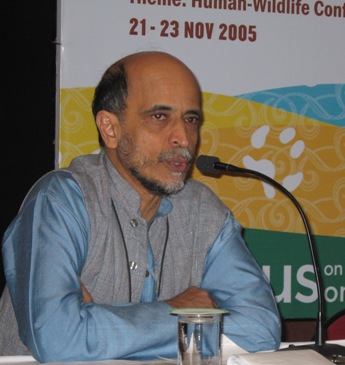
darryl-dmonte-speaking-at-ifej-2005-congress.jpg

The articulate Darryl must have expressed his exasperation in strong terms. But even he couldn’t have anticipated the response.

“It’s going to happen anyway,” was how the film crew rationalised their bizarre request.

So why not be there, capture it on film, and get a great story out of it — which can be packaged as the brutal side of India’s poverty! This must have been the crew’s line of reasoning. Maybe their editors had exerted pressure to come back with something out of the ordinary.

I quoted this incident in my essay, Ethical newsgathering challenge for Al Jazeera International, published in November 2006. It was a plea for the newest entrant to international TV newsgathering to play by a different, and more ethical, set of rules.

These and worse practices are certainly not confined to India, or to TV crews originating from any single country. And sadly, these have not been abandoned after the 1970s. In fact, the emergence of 24/7 satellite news channels since the 1980s has inspired much more competition in the TV newsgathering industry, creating an alarming race to the bottom.

Such journalists’ only operating guideline seems to be: get the story, no matter what — or who gets hurt in that process.

In filming wildlife documentaries, film-makers sometimes have to make a choice: do they interfere in the processes of Nature, such as a predator setting on a hapless prey? There is an unwritten rule that things must be allowed to happen, with humans only capturing actuality on film.

But when it comes to filming wild life of our species in our cities and villages, the ethical dilemmas are not so easily resolved. This is why all journalists and film-makers, especially those in newsgathering, need a strong ethical framework for their work.

Journalists represent the public’s right to know, which is extremely important. Media coverage and exposes can trigger much needed aid, reform or public outcry on certain issues. But that is not a justification for getting the story by any means.

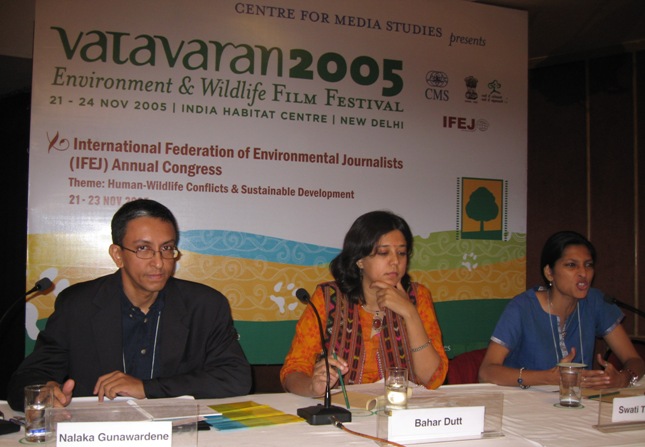
Darryl D’Monte shared the above story at panel discussion on ‘Does TV do a better job on environmental reporting?’ which I chaired during the annual congress of the International Federation of Environmental Journalists (IFEJ), held in New Delhi, India, in November 2005. That year it was part of the Vatavaran 2005, the national environmental film festival of India.

panel-discussion-at-ifej-2005-congress-new-delhi.jpg

I was reminded of this story because the 4th CMS Vatavaran film festival is round the corner: it will be in New Delhi from 12 to 16 September 2007. I won’t be there in person; my colleague Manori Wijesekera is representing TVEAP this time.

TVE Asia Pacific News: Environmental film-makers call for ethical framework

Read official report of IFEJ Congress in 2005

Related blog posts:

Al Jazeera: Looking hard for the promised difference

Wanted: Ethical sourcing of international TV news

Cheque-book Development: Paying public media to deliver development agency logos

The Step-children of Tsunami: Overlooked and forgotten

india-malas-family-lost-their-home-jobs.jpg

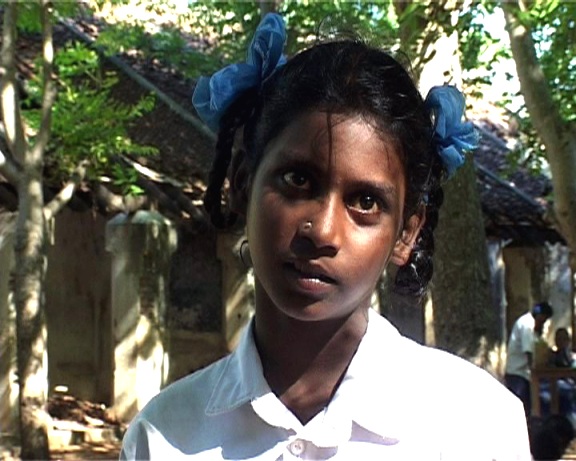
Meet Mala. She lives in in Kottaikkadu village in Kancheepuram District in India’s southern Tamil Nadu state.

She was 11 years old when, in December 2004, the Asian Tsunami crashed into village without warning. This made her very poor family desperate and destitute.

The disaster didn’t kill anyone in her village, but caused considerable property damage. In her case, the waves that rolled in spared their small hut, but her fisherman father was nearly drowned: he survived with some injuries.

But the family’s fishing boat and gear were gone. That was a mighty blow.

After the waves had retreated, they returned to their house and started rebuilding their lives. They thought the world’s generosity in responding to the Asian Tsunami will somehow bring some help.

They were wrong.

When the Tsunami triggered massive aid donations, all affected countries pledged to distribute it in a fair, equitable and transparent manner. But as the aid trickled down layers of government and charities, various biases and distortions crept in.

What happened in Mala’s village was an example. We came across the situation when tracking Mala’s family for a whole year (2005) after the Tsunami, documenting their long road to recovery as part of our Children of Tsunami media project.

We tracked two affected families each in India, Indonesia, Sri Lanka and Thailand, filming their progress — or the lack of it — every month and producing video reports that were uploaded to a dedicated website.

Follow Mala’s story through monthly video reports on our website

The most striking example of aid disparity came from India. Even months after the disaster, Mala’s family — or anyone else in her village — received absolutely no relief or recovery assistance.

Officially, it was because ‘no one was killed’ in her village. But everybody in Kottaikkadu village knew the real reason: in the Indian social hierarchy, they occupy the lowest level, known as ‘Dalits’.

Apparently, that was why both government agencies and charities stayed clear of the village.

Our India production team, led by senior journalist and film-maker Satya Sivaraman (with video camera in the photo, below), investigated further. They compared Kottaikadu with its adjoining village of Alambara. Both had suffered similar damage during the Tsunami: people lost their boats and nets, but there were no deaths.

Image from Children of Tsunami website

Yet the people of Alambara – who belong to a supposedly higher caste of fishermen — received food items, boats and fishing nets from various outside sources.

In fact, they felt quite sorry for their neighbours in Kottaikkadu. “On the day of the tsunami we ran over 15 kilometers,” said Kuppuraj, a resident of Alambara. “Kottaikadu villagers, who live just 600 meters away…ran with us — but nobody has helped them to recover.”

There was another incident that showed up the caste-based discrimination, which my colleague Manori Wijesekera, production manager of Children of Tsunami, has just reminded me.

In March 2005, our India film crew found Mala’s father seriously ill with a lung infection (triggered by his near-drowning during the Tsunami) and his family so helpless that they were unable to even seek medical attention.

So the crew put their filming gear aside, and became good Samaritans: they rushed the sick man to a nearby government-run hospital. But once there, doctors refused to admit or treat him — all due to the patient’s supposedly low caste!

It was only when Satya and crew threatened to film the entire sorry episode, and have it broadcast on television later that day, that medical attention was finally provided. Discarding their production plans, our crew stayed with Mala’s family at the hospital through the night and next day to ensure the doctors gave her father the correct medical attention. The family believes that the production team saved her father’s life that day.

Read more about what happened at Children of Tsunami website

Watch the March 2005 video report that covered the hospitalisation incident

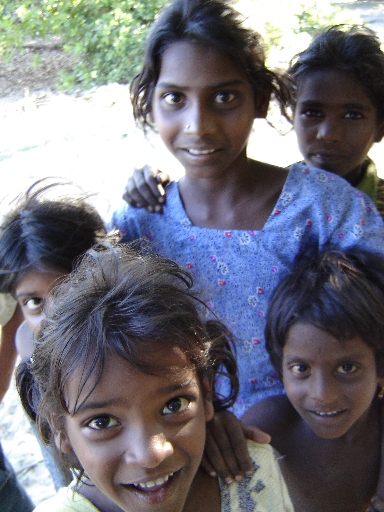
mala-with-her-neighbours.jpg

While their father was recovering, Mala’s mother toiled as a labourer to keep the home fires burning. Mala has one younger sister and two younger brothers.

Children of Tsunami: Rebuilding the Future was TVE Asia Pacific’s response to largely superficial media coverage of the Indian Ocean Tsunami of December 2004. It tracked on TV, video and web the personal recovery stories of eight affected families in India, Indonesia, Sri Lanka and Thailand for a year after the disaster. Its many media products — distributed on broadcast, narrowcast and online platforms -– inspired public discussion on aid management and optimum rehabilitation choices.

As we discovered along the way, some of the affected could be better described as Step-children of Tsunami.

In one of my early blog posts, I paid a tribute to the most extreme example of such a child, Thillainayagam Theeban.

The Tsunami has become yesterday’s news, but there are thousands of affected children, women and men who are still living on the edge of survival.

Related links:

Children of Tsunami: Documenting Asia’s longest year

Children of Tsunami revisited two years later

All images courtesy Children of Tsunami media project, TVE Asia Pacific

Remembering Diana, the world’s first Princess of Television

Today, 31 August 2007, is the tenth anniversary of Princess Diana’s tragic death in a road accident in Paris.

A decade on, I can still remember exactly where and how I first heard the news. This experience is widely shared: to many in my generation — born in the 1960s and raised through 1970s and 1980s (just like Diana was) — this was an unforgettable moment. Perhaps just like the assassination of John F Kennedy was to a previous generation.

The analogy between Di and JFK goes further. Both had charismatic personalities that appealed far beyond their home country. Both epitomised the vibrancy of youth and the potential for change in the institutions they joined (Diana the British Royal family, and JFK the American government). Both lives were snuffed out before they could fulfill that promise, but they left enduring legacies — and thriving cottage industries of conspiracy theories (‘Who killed JFK?’ has now been joined by ‘Who killed Diana?’).

Here’s another similarity: JFK and Diana were both iconic images of the era of television.

If JFK turned up just in time to charm the first generation of American TV viewers, Diana’s arrival on world stage coincided neatly with the worldwide roll out of satellite television, especially the all-news channels. And thanks to the advances in global broadcasting, Diana commanded a far bigger global audience than JFK did (though the comparisons must end there).

I would like to remember Diana as the first Princess of Television of our media-rich age.

Looking back, we can see how satellite television started and evolved almost in parallel to Diana’s own life. Diana had just celebrated her first birthday, when the world’s first trans-Atlantic satellite television signal was relayed from Europe to the Telstar satellite over North America on 23 July 1962. (By coincidence, JFK was to have participated in the event, but could not owing to a technical delay.)

Over the next two decades, as Diana grew up and matured into a young lady who would soon capture the world’s imagination, satellite TV’s technology, outreach and mass following evolved to cover more channels, territories and eyeballs.

A turning point came when the US entrepreneur Ted Turner took a daring step for that time by launching the Cable News Network (CNN), the world’s first 24 hour news channel. CNN went on the air on 1 June 1980 amidst many skeptics asking: who would possibly want to watch news all the time?

Who indeed! Until then, conventional wisdom had confined news to a regular evening slot, anchored by larger-than-life newscasters. The routine was broken only when there was some earth-shattering development.

Turner’s CNN, ridiculed in the early days as the ‘chicken noodle network’, changed all that, and paved the way for dozens of 24/7 news channels.

As it turned out, CNN arrived just in time. The engagement between Diana and Charles, the Prince of Wales, was announced a few months later, in February 1981.

Their Royal Wedding on 29 July 1981 was watched by a combined television audience of over 750 million worldwide. That broke records as the highest audience for a live broadcast, surpassing the Apollo XI Moon landing a dozen years earlier (seen by an estimated 500 million).

The rest is recent history. Television newsgatherers could never have enough of Diana — apparently their audiences kept asking for more. That may be a debatable point, but Diana was quick to learn the art of exploiting the inevitable: when she realised it was a stark fact of life, she started using it to her personal advantage.

Diana used television as much as television used Diana. Her famous BBC Panorama interview with Martin Bashir was one among many instances when she lived her personal life under the glare of public television (photo below).

Image from BBC Image courtesy BBC

But Diana’s clever use of television was not just for advancing her personal agenda. When she became a big time charity supporter in the 1990s, she used the power of moving images to demystify and humanise global issues from caring for people living with HIV/AIDS to banishing the scourge of landmines. These ensured that Diana became the People’s Princess in the last years of her life.

Image courtesy Daily Telegraph

Early on in her marriage to Charles, a leading newsman told Diana: when you married him, we came as part of the package deal. If she was initially stressed by that revelation, she later made the best use of that inevitable trapping of her celebrity.

And when she died young and tragically, on 31 August 1997, her premature departure became the biggest news story of the year.

The BBC (domestic) announces Princess Diana’s death:

BBC World TV announces Diana’s death in Paris:

Diana’s funeral on 6 September 1997 had a larger global satellite TV audience than did her wedding. Of course, by then there were more people and more television sets on this planet.

Elton John sings a special version of ‘Candle in the Wind’ at Princess Diana’s funeral:

So we salute the legacy of the world’s first Princess of Television. One who moved our hearts with moving images of her personal life and those of the worthy causes she championed. One who showed how moving images can move people.

PS: There was a time when the unforgettable television moments were gone after their broadcasts (unless recorded on tape). But now we have YouTube, where the world’s visual memory lives on. All news and current affairs coverage I have linked to in this post were found on YouTube by simply searching for Princess Diana. There is much more where these came from.

Read BBC Online’s timeline of the life of Princess Diana

Al Jazeera International: Looking hard for the promised difference

Image courtesy Al Jazeera

This is how Al Jazeera International (AJI), which started broadcasting on 15 November 2006, promoted itself.

In its own words, the 24/7 English language channel set out to ‘balance the information flow from (global) South to North, providing accurate, impartial and objective news for a global audience from a grass roots level, giving voice to different perspectives from under-reported regions around the world.’

Noble ideals, indeed — and we fervently hope they succeed. That’s what I said in my op ed, Ethical Newsgathering: Biggest Challenge for Al Jazeera, published online within days of the new channel going on the air.

I said: “In recent years, the self righteous arrogance and the not-so-subtle biases of BBC and CNN have become increasingly intolerable. But unless it’s very careful and thoughtful, AJI runs the risk of falling into the same cultural and commercial traps that its two older rivals are mired in.

“CNN can’t get out of its US-centric analysis even in its international broadcasts. And the BBC news team is like a hopelessly mixed up teenager: one moment they are deeply British or at least western European; the next moment they are more passionate about Africa than Africans themselves.

“Desperately seeking legitimacy and acceptance, these global channels have sometimes traded in their journalistic integrity for privileged access, exclusives or -– dare we say it? -– to be embedded.”

I admit that I haven’t been watching enough of AJI to come to any firm conclusions. One reason: the new channel is still not widely available in some countries that I visit and spend time in.

But going by what is on their YouTube channel, where some 1,300 video segments have been placed so far (as at 29 August 2007), I have a rough idea of AJI’s first few months of coverage.

I’m looking long and hard for the difference that they so emphatically promised. Instead, I find them a paler version of BBC World, at times trying oh-so-hard to be just like the BBC!

Take, for example, the coverage they have recently done on the bloody and protracted civil war in Sri Lanka. Being where I live and work, I take a particular interest in this topic.

In a 2-part edition of AJI’s People & Power programme, Juliana Ruhfus investigates the impact of Sri Lanka’s civil war.

People & Power: How the East was Won: Part 1 of 2

People & Power: How the East was Won: Part 2 of 2

I don’t have a problem with AJI’s analysis in this documentary, which tries hard to be balanced and fair in what I know is a very difficult subject to cover, with intolerant hardliners on both sides of the conflict.

But I have several issues with how it has been put together – the norms and ethics of their newsgathering.

* A white blond woman, so evidently a parachute journalist, is reporting and presenting the story. Why isn’t an Asian telling this story?

* She is repeatedly mispronouncing all the local names. Just like the BBC does as a matter of routine.

* She gestures, interviews and talks exactly like those know-all reporters from the BBC. At times I detect a faint condescension in her voice, but that may be my imagination.

* For part of the coverage, the intrepid AJI reporter becomes embedded with the Sri Lankan armed forces, and interviews civilians under the watchful eye of military men. This is hardly a credible way of eliciting any honest responses!

* More importantly, she shows little regard for the personal safety of some people she interviews. At one point, she asks three muslim men if the Eastern Province of Sri Lanka is now any safer than before it was ‘liberated’ by the government forces. The men are clearly uncomfortable with this question. Honest answers can cost them dearly. But why should she care? She persists, showing close-ups of these individuals.

* Even when she interviews people who had explicitly asked for concealment of their identity, she leaves tell-tale signs for those identities to be easily guessed. A woman whose teen-aged son has been coerced into joining a paramilitary group is filmed in silhouette — not a good enough cover. Real voices have not been altered through a synthesizer.

These and other observations blur the difference between BBC and AJI in my mind. With a few notable exceptions, most BBC reporters don’t care one bit about the hapless, distressed people whom they interview. All they want is to get a ‘good story’ with dramatic visuals.

AJI is desperately trying to outdo the BBC in all the latter’s wrong aspects. Otherwise why should Juliana Ruhfus try so hard to get a damning comment from an interviewee evidently ill-at-ease of being ambushed by this western woman?

I still want to have an open mind about AJI’s promised difference, and keep hoping that it will emerge sooner rather than later. But this kind of newsgathering and film-making don’t augur well.

If this is the ethical standard of journalism that AJI aspires to, we who had high hopes of their becoming a real alternative to the dominant two are going to be disappointed.

Read my earlier post: Wanted: Ethical sourcing of international TV News

Watch Al Jazeera on YouTube

AJI AJI