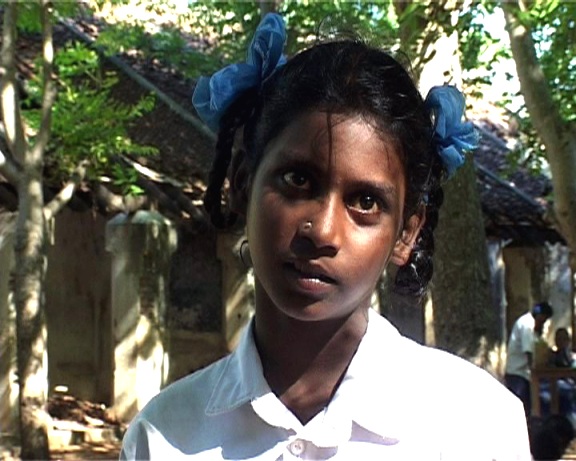
The Step-children of Tsunami: Overlooked and forgotten

india-malas-family-lost-their-home-jobs.jpg

Meet Mala. She lives in in Kottaikkadu village in Kancheepuram District in India’s southern Tamil Nadu state.

She was 11 years old when, in December 2004, the Asian Tsunami crashed into village without warning. This made her very poor family desperate and destitute.

The disaster didn’t kill anyone in her village, but caused considerable property damage. In her case, the waves that rolled in spared their small hut, but her fisherman father was nearly drowned: he survived with some injuries.

But the family’s fishing boat and gear were gone. That was a mighty blow.

After the waves had retreated, they returned to their house and started rebuilding their lives. They thought the world’s generosity in responding to the Asian Tsunami will somehow bring some help.

They were wrong.

When the Tsunami triggered massive aid donations, all affected countries pledged to distribute it in a fair, equitable and transparent manner. But as the aid trickled down layers of government and charities, various biases and distortions crept in.

What happened in Mala’s village was an example. We came across the situation when tracking Mala’s family for a whole year (2005) after the Tsunami, documenting their long road to recovery as part of our Children of Tsunami media project.

We tracked two affected families each in India, Indonesia, Sri Lanka and Thailand, filming their progress — or the lack of it — every month and producing video reports that were uploaded to a dedicated website.

Follow Mala’s story through monthly video reports on our website

The most striking example of aid disparity came from India. Even months after the disaster, Mala’s family — or anyone else in her village — received absolutely no relief or recovery assistance.

Officially, it was because ‘no one was killed’ in her village. But everybody in Kottaikkadu village knew the real reason: in the Indian social hierarchy, they occupy the lowest level, known as ‘Dalits’.

Apparently, that was why both government agencies and charities stayed clear of the village.

Our India production team, led by senior journalist and film-maker Satya Sivaraman (with video camera in the photo, below), investigated further. They compared Kottaikadu with its adjoining village of Alambara. Both had suffered similar damage during the Tsunami: people lost their boats and nets, but there were no deaths.

Image from Children of Tsunami website

Yet the people of Alambara – who belong to a supposedly higher caste of fishermen — received food items, boats and fishing nets from various outside sources.

In fact, they felt quite sorry for their neighbours in Kottaikkadu. “On the day of the tsunami we ran over 15 kilometers,” said Kuppuraj, a resident of Alambara. “Kottaikadu villagers, who live just 600 meters away…ran with us — but nobody has helped them to recover.”

There was another incident that showed up the caste-based discrimination, which my colleague Manori Wijesekera, production manager of Children of Tsunami, has just reminded me.

In March 2005, our India film crew found Mala’s father seriously ill with a lung infection (triggered by his near-drowning during the Tsunami) and his family so helpless that they were unable to even seek medical attention.

So the crew put their filming gear aside, and became good Samaritans: they rushed the sick man to a nearby government-run hospital. But once there, doctors refused to admit or treat him — all due to the patient’s supposedly low caste!

It was only when Satya and crew threatened to film the entire sorry episode, and have it broadcast on television later that day, that medical attention was finally provided. Discarding their production plans, our crew stayed with Mala’s family at the hospital through the night and next day to ensure the doctors gave her father the correct medical attention. The family believes that the production team saved her father’s life that day.

Read more about what happened at Children of Tsunami website

Watch the March 2005 video report that covered the hospitalisation incident
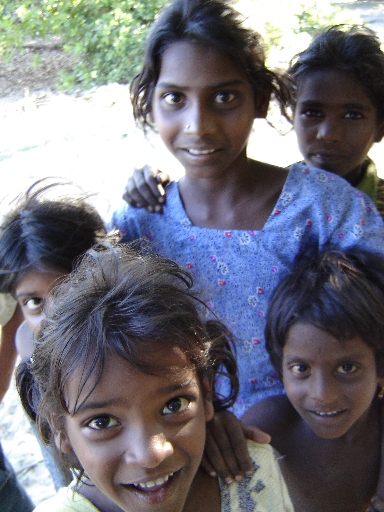
mala-with-her-neighbours.jpg

While their father was recovering, Mala’s mother toiled as a labourer to keep the home fires burning. Mala has one younger sister and two younger brothers.

Children of Tsunami: Rebuilding the Future was TVE Asia Pacific’s response to largely superficial media coverage of the Indian Ocean Tsunami of December 2004. It tracked on TV, video and web the personal recovery stories of eight affected families in India, Indonesia, Sri Lanka and Thailand for a year after the disaster. Its many media products — distributed on broadcast, narrowcast and online platforms -– inspired public discussion on aid management and optimum rehabilitation choices.

As we discovered along the way, some of the affected could be better described as Step-children of Tsunami.

In one of my early blog posts, I paid a tribute to the most extreme example of such a child, Thillainayagam Theeban.

The Tsunami has become yesterday’s news, but there are thousands of affected children, women and men who are still living on the edge of survival.

Related links:

Children of Tsunami: Documenting Asia’s longest year

Children of Tsunami revisited two years later

All images courtesy Children of Tsunami media project, TVE Asia Pacific

People Power: Going beyond elections and revolutions

“At the bottom of all the tributes paid to democracy is the little man, walking into the little booth, with a little pencil, making a little cross on a little bit of paper.”

That’s how Sir Winston Churchill summed up democracy at work. Elections – at national and local levels – give ordinary people the chance to decide who would run their affairs for the next few years. At least in theory.

In the modern world, however, elections alone cannot ensure that people’s wishes prevail. Better models of engagement are needed…and are being developed across the globe.

Historically, people responded to bad governance by rejecting governments at elections, and occasionally by overthrowing corrupt and despotic regimes through mass agitation. In the past decade, this “people power” has toppled rulers in the Philippines, Nepal and Ukraine among others, and sent a strong signal to autocratic governments elsewhere.

Yet such people power has its own limits: in country after country where one political party – or indeed political system – was replaced with another through popular vote or revolt, people have been disappointed or dismayed at how quickly the new brooms lose their bristles. The solution must, therefore, lie in not just participating in elections or revolutions, but in constantly engaging governments and keeping the pressure on them to govern well – or else.

So what is to be done, as Lenin famously asked? One challenge is to find new approaches to promoting good governance.

from-people-power-documentary.jpg
Photo: An election awareness public rally in Rajastan, India (late 2003)

An example is Social Accountability practices – individuals or civil society groups getting together to demand accountability from different levels of government. This represents a significantly higher level of citizen engagement than merely changing governments at elections or taking to the streets.

It involves the careful gathering of data, their systematic analysis and knowledge-based engagement and negotiation with elected and other public officials. Crucial to this process is accessing and using critical information – about budgets, expenditures, excesses, corruption, performance, etc.

The new breed of citizen voice is about using information in a way that lead to positive change in government and society. People use knowledge as a pivotal tool to improve governance, better use of common property resources, and management of public funds collected through taxation or borrowed from international finance institutions.

The media can play multiple roles in such social accountability processes. At a basic level, media’s coverage of these processes adds momentum to citizen movements. At a higher level, some citizen groups are use media as an information tool or campaigning platform or both, optimising each other’s strengths.

Here’s an example from my own experience. In 2004, TVE Asia Pacific produced a half-hour international TV documentary titled People Power that profiled four Social Accountability projects in Africa (Malawi), Asia (India), Europe (Ireland) and Latin American (Brazil).

First broadcast on BBC World in February 2004, it has since been widely distributed to broadcast, civil society and educational users in the global South. It is still available from TVEAP on DVD and VHS video.

Hernando de Soto

We interviewed the Peruvian economist Hernando de Soto (photo, above) of the Institute for Liberty and Democracy in Lima, Peru, who said: “Supposedly in a democracy, if the majority of people are poor, then they set the criteria of what is right. Yet all those mechanisms that allow [society] to decide where the money goes — and that it is appropriately allocated — are not in place throughout the Third World. We take turns electing authoritarian governments. The country, therefore, is left to the [whims] of big-time interests, and whoever funded the elections or parties. We have no right of review or oversight. We have no way for the people’s voice to be heard — except for eight hours on election day.”

When the India story was being filmed, in late 2003, by coincidence several states were holding elections for the state legislatures. Our crew followed the election process in the northern Indian state of Rajastan to see how a citizen group was forcing social accountability for all standing for election.

Mazdoor Kisan Shakti Sangathan (MKSS) invited the people of Beawar, Rajastan, to a public meeting where the affidavits on the local candidates were made available to everyone. This process of social accountability and transparency extends beyond the political process to the village level where the MKSS has successfully lobbied for the right to information legislation to overcome the systemic corruption in the political and bureaucratic organisations.

from-people-power.jpg

MKSS’s struggles has led to laws to ensure people’s right to information across India.

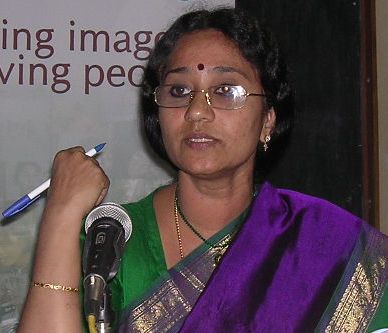
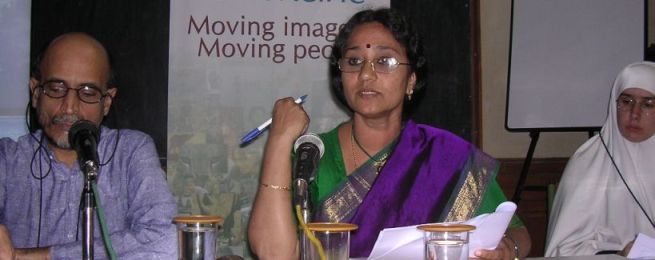
“India is the largest functioning democracy in the world and it has significant strengths (but) it also has weaknesses,” says Dr Bela Bhatix (photographed wearing red saree), Associate Fellow of the Centre for the Study of Developing Societies, interviewed on our film. “Among the strengths is that we have been able to sustain our democracy…It’s no small matter to have regular elections and we usually have something like 60 per cent turnout — around 600 million people, or twice the size of America. But at the same time there are some very important weaknesses of our democracy which we really need to think about.”
dr-bela-bhatix-from-people-power.jpg

Social activist Aruna Roy, coordinator of MKSS (photographed below), says: “In 1996, the MKSS sat in a 40-day sit-in at Beawar and we were demanding the right to access records of the Panchayat, the smallest elected body in India. We involved the entire city and made it a people’s campaign. We involved people from all over India, and the national campaign for people’s right to information was born.”
aruna-roy.jpg

Watch India story from People Power on TVEAP’s YouTube channel:

All photos captured from People Power documentary, courtesy TVE Asia Pacific.

Read TVEAP website feature, People Power beyond elections and revolutions by Nalaka Gunawardene

India and Pakistan: Still struggling to grow up at 60!

See 23 March 2008 related story: Arthur C Clarke – Of Nukes and Impotent Nations (commentary on nuclear arms race in South Asia)

Today, 15 August 2007, India marked its 60th anniversary of political independence from the British. Pakistan, which was created by the British partitioning of India at the time of independence, marked their 60th birthday yesterday.

So here’s wishing the Indo-Pak combine a meaningful 60th.

For human beings, 60 is a landmark age. In some cultures, it marks the beginning of senior citizen stage. Wisdom, maturity and exemplary conduct are assumed and expected of those reaching 60.

When it comes to nation states, however, things don’t quite work that way. India and Pakistan at 60 are a good example.

Yes, they have made significant advances on many fronts in the past six decades. But before that progress can be celebrated, we have to take note of the political and socio-economic turmoil that these two nations — harbouring close to 1.5 billion human beings between them — find themselves in.

Those tensions are exacerbated by the bitter nuclear arms race between these two still-impoverished nations.

When it comes to geopolitics of nuclear weapons, India and Pakistan behave worse than two sill school boys. This is how my friends at Himal Southasian magazine summed it up brilliantly:

india-pakistan-nuclear-rivalry-as-seen-by-himal-magazine.jpg

And here’s another Himal cartoon which punctures the juvenile male obsession with weapons of mass destruction:

Image courtesy Himal Southasian

So let’s hope that the 60-year-olds will finally begin to act their age at least now!

Earthcare Outreach: taking moving images to the grassroots

On 19 July 2007, I wrote about the need for natural history and environment film-makers to take their films back to the locations and communities where they filmed.

I cited the specific example of the Brock Initiative, started by ex BBC Natural History producer Richard Brock, which is supporting projects in several countries in Africa and Asia.

In today’s mail, I received the DVD of Tiger – the death chronicles, the latest documentary by the award-winning Indian film-maker Krishnendu Bose. I’m going to watch and write about it separately, but this reminded me of the outreach work he and his company, Earthcare Films, have been doing for years.

After working for a dozen years with factual film-makers from across Asia, my experience is that not many are really interested in any outreach besides a high profile broadcast. For sure, broadcasts help draw attention to a film and its creator/s. But as we have discussed in recent blog posts, broadcast television is not an ideal platform to get a discussion going on issues and concerns. In fact, many film makers are finding it harder to get their serious films broadcast at times with better audience ratings.

Still, surprisingly few film-makers have time or patience for serious narrowcast outreach. Yes, it is a time consuming, tedious process. The logistics can be demanding and expensive. And there is not much glamour (or ‘arty and intellectual feel’) in going to a small town or remote village and playing back your film to a few dozen people living on the edge of survival.

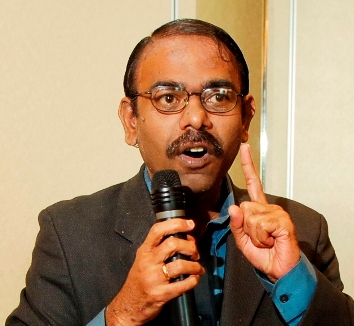
Image courtesy Earthcare Films website

But as exceptional film-makers like Krishnendu (in photo above, taken from Earthcare Films website) know well, it can be an enormously enriching and satisfying experience for a film-maker. People like him watch the audience while they watch the film.

Films are a greatly underused communication form. Serious communication usually is at most limited to awareness building,” says Earthcare Films website in its section on outreach.

That’s why EarthCare Outreach wants to explore beyond. “Films could be tools for social change and empowerment. Participatory film-making by sharing skills and capacities could take the ‘use’ of films to a different level. Not that it has not been tried and practised, but we want to take it forward and try and push the boundaries.

Krishnendu and colleagues have set up the EarthCare Outreach Trust specifically for this purpose. The objective is “to create ownership and stake in the process and the product of a documentary film of the people whose lives we document. In the process we strive to empower young people and rural communities to make them stakeholders in decision-making and in planning for natural resource management.”

For the past several years, Earthcare Outreach has been active on these fronts, organising mobile film screenings or traveling film festivals in rural and urban areas in different parts of India. The website talks about how they have held community and citizenry exchanges between selected locations, evolving film-making skill-share across these groups.

Read more about Earthcare Outreach activities.

Contact Earthcare Films for more information and involvement

On a personal note, I’m trying to recall when I first met Krishnendu. It must be at least a decade ago — I had seen some of his work before I met the man behind them. We were together as guests of the Earth Vision Tokyo Global Environmental Film Festival in 2001 — where his film, Harvesting Hunger, (image below shows it being filmed) won a special jury award.

Image courtesy Earthcare Films

Faecal Attraction: There’s no such thing as a convenient flush…

Out of sight is out of mind.

That’s how it works for most of us. Especially when the subject is what we do in the privacy of our toilets and then just flush away.

But there is no such thing as a Convenient Flush — it’s all linked to how waste, including sewage, is disposed of. Or not.

And what goes around, even out of our sight, comes around — turning up in the least expected ways! Like faecal matter in our drinking water.

A new film produced by the New Delhi-based research and advocacy organisation Centre for Science and Environment (CSE) probes the link between sewage disposal and river water pollution in India — specifically, the River Yamuna, part of the massive Indo-Gangetic river system.

The film by Pradip Saha is titled Faecal Attraction: Political Economy of Defecation. It is accompanied CSE’s latest publication Sewage Canal: How to Clean the Yamuna.

The book and the film expose the political economy of defecation, where the rich are subsidised to defecate in convenience and the poor pay for pollution with their ill health because of dirty water.

It begins by asking two simple questions: Where does your water come from? What do you do with your shit?

Watch the answers – some amusing, others absurd – in this 3-min trailer on YouTube:

Backed by scientific data, CSE shows how India’s 14 major rivers, as well as 55 minor and many small rivers have all been reduced to sewers. They receive millions of litres of sewage, industrial residue and agricultural waste from the cities and towns through which they flow.

Delhi and Agra together account for 90 per cent of the pollution in the River Yamuna, a major tributary of the Ganges. Yamuna is one of the most polluted rivers in the world, especially around New Delhi, the capital of India, which dumps about 57% of its waste into the river.

When Yamuna flows by Delhi, the city extracts gallons of fresh water for drinking and irrigation. What is given in return to the river is only excreta – sewage, and industrial and agricultural waste. This sewage is (supposed to be) collected, transported, and assembled for treatment (cleaning), and then flown back to the river. In reality, what goes back is far from clean… The irony is that the city has 40 per cent of the entire sewage treatment infrastructure in the country with only five per cent of the country’s population! And still, Yamuna is unclean.

Cartoon courtesy CSE India

Though numerous attempts have been made to clean it, the efforts have proven to be futile. Although the government of India has spent nearly $500 million to clean up the river, the river continues to be polluted with garbage while most sewage treatment facilities are underfunded or malfunctioning.

“As these rivers die a slow death, the sole blame for their pathetic condition lies with human beings who have always treated these water bodies as their personal dumping zones,” says CSE.

Anil Agarwal, founder director of CSE, believed that a “society is known by the water it keeps”. “The health of a river…reflects the very health of the human society, its ability to live harmoniously with its environment,”, he said.

In that sense, things are very seriously wrong with not just the Yamuna, but river systems across India.

Read CSE Director Sunita Narain’s presentation on the River Yamuna pollution and clean up options

Read CSE Press release on river pollution

A Silent Emergency: More television sets than toilets!

Read a later blog post: Faecal Attraction: There’s no such thing as a convenient flush…

It was September 2004. My daughter Dhara, eight years at the time (or ‘eight plus’ as she insisted on saying), had a complaint.

The toilets in her school were not clean enough. She was finding it squeamish to use them. So she was doing her best to avoid going to the loo: she’d drink less, and try to ‘hold back’ until she could rush home.

Like many sheltered middle class kids, she was still coming to terms with the wider world outside her home. And she attends a well endowed private school where, I am told, toilets are cleaned regularly by janitors engaged by the school.

Now we cut to eleven-year-old Susheela, a girl growing up in neighbouring India. I’ve never met her in person, but this sentence summed up her tragic story:
“I was always first in the class. I am very much interested in studies. I want to become a lawyer. But my mother stopped me from going to school after Class V as the middle school I was attending, 5 km from my house, had no toilet. Can someone help me?”

This was the opening of an article on water and sanitation written by Indian journalist Dr Asha Krishnakumar and published in the news magazine Frontline (part of The Hindu group) at the end of 2003. It was titled: A Silent Emergency.

dr-asha-krishnakumar.jpg Image courtesy WSSCC

It was several months later that I actually read Asha’s article. By coincidence, my daughter was having her own ‘toilet issue’ at the time — and the contrast was striking.

Asha’s article continued:
Susheela’s anguish is shared by a large number of girls in India who drop out of school for what sounds like an absurd reason: want of a toilet in school. “Sanitation is closely linked to female literacy in India,” says a United Nations Children’s Fund (UNICEF) study. According to V. Balakrishnan, convener of the Tamil Nadu Primary Schools Improvement Campaign, the lack of proper toilet facilities in schools has a definite and significant bearing on the drop-out rate of girls, particularly around the time they reach Class VIII. In 2000, barely 10 per cent of Tamil Nadu’s 40,000 government schools had usable toilets; the figure is much lower for the country as a whole.

I’d been covering development issues in the media for over 15 years, but this stark reality had not occurred to me. In some developing countries, girls face a greater struggle in enrolling in school and staying on. There are cultural, social and economic factors working against educating girls.

And as Asha’s article revealed, there are other, less known factors adding to this burden.

I shouldn’t have been surprised. Indian census data had revealed in 2001 that, some parts of the country had more television sets than toilets.

Asha’s was one of three dozen excellent media articles on water and sanitation that I read that month as a judge in an international award scheme to recognise the best media reporting on the issue. Organised by the Water Supply and Sanitation Collaborative Council (WSSCC), it was meant to to encourage broader media coverage of water supply, sanitation and hygiene (WASH) issues in the developing world.

The initiative, first launched in 2002, is open to journalists from developing countries, who write or broadcast original investigative reports on WASH issues. The Collaborative Council seeks to use the WASH Media Awards as part of the broader goals of fostering sustainable relations with journalists in developing nations, and increasing media coverage of WASH issues.

WASH has recently announced the next media awards, covering print and broadcast media coverage from 1 July 2007 to 30 April 2008. This time around, it also involves the Stockholm International Water Institute (SIWI).

Winning entries will be presented at the World Water Week in Stockholm , Sweden in August 2008. Deadline for the submission of entries is on or before May 15, 2008. Read the announcement

In 2004, the recipient of the first WASH Media Award was Nadia El-Awady from Egypt for her outstanding article “The Nile and its People”. It illustrated the impacts of industrial pollution, sewage and solid waste management on people’s health and dignity along the River Nile.

We evaluated a large number of high quality entries and decided to give special recognition and Certificates of Appreciation to several other journalists. Asha was one of them.

A few months later, it was my privilege to meet Asha in person at a workshop on media and sustainable development that TVE Asia Pacific organised as part of the Education for a Sustainable Future conference in Ahmedabad, India, in January 2005. The photo shows Asha addressing our workshop while Darryl D’Monte, fellow judge in WASH media awards looks on.

l-to-r-darryl-dmonte-asha-krishnakumar-and-nadia-el-awady.jpg

By another coincidence, the lady on the right is Nadia El-Awady who was overall winner of the WASH media award. At the time she was the Health and Science Page Editor of IslamOnline.net. She has since been promoted.

Either the world is smaller than we think, or our networks are larger than we imagine.

But I will always be grateful to Asha for opening my eyes on a silent emergency. One that I have since explained to my daughter. She no longer complains.

Read the WASH press release on 2004 media award winners

Read the publication on WASH Media Awards 2004

Read WASH media guide on The Biggest Scandal of the last 50 Years

Photos by Janaka Sri Jayalath, TVE Asia Pacific

Channel South Asia? Yes and No!

I wrote a few days ago about Ujala TV, a fledgling and entirely private, modest effort to operate a satellite TV channel carrying education and information for South Asian audiences — a quarter of the world’s total population.

This reminds me of discussions that have been around for years about setting up a South Asian TV network.

It’s one of those good ideas too dangerous to be mentioned frequently in public — in case our South Asian governments actually take it up! And that, as all South Asians know, will be the death of another good idea.

Two years ago, Himal Southasian, the only publication that truly thinks and acts at South Asian level (even if they spell it as one word: Southasian!) ran an interesting analysis on the prospects for a South Asian channel. It was written by Indian journalist Aman Malik.

The article’s premise was this:
Isn’t it time for a regional television network that ‘thinks Southasian’ and broadcasts via satellite and cable throughout the region? While Latin America’s incipient Telesur and West Asia’s energetic Al Jazeera might provide models, it is clear that we will have to go our own way.

Read Channel Southasia by Aman Malik in Himal Southasian, Nov – Dec 2005

Himal Southasian Cartoon courtesy Himal Southasian

It looked at the experience of Al Jazeera Arabic channel in the Middle East (launched in 1996), and the more recent initiative of Telesur, the pan Latin American television network founded by the Chavez administration of Venezuela in 2005.

Aman’s article was based on this premise:
“Regionalism in Southasia, which got a boost with the official sanction of the establishment of SAARC two decades ago, has been an increasingly important theme for civil society in each of the region’s countries. Over time, such groups have felt the need for print and electronic media that cover the region as a whole; the overwhelming presence of western satellite news has made analysts call for native channels. The spread of Indian channels, in particular the satellite footprints of Hindi and English broadcasts emanating from India, has again led people in other countries to call for a satellite channel that is uniquely Southasian, without allegiance to any national sensibility.”

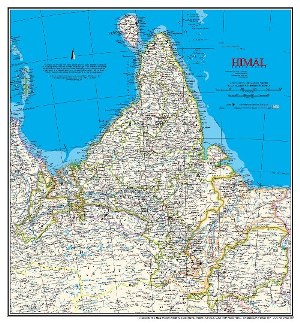
Map courtesy www.safeer.info copy-of-southasian-map-by-himal.jpg

He also analysed the prevailing media mix accurately when he wrote:
Coverage of the Southasian neighbourhood is hampered by the fact that no television channels, beyond the few big Indian channels, keep correspondents (or even stringers) in the neighbouring countries. As a result, the news that is used is filtered through the medium of Western wire services and television channels. A region the size of the Subcontinent generates an enormous volume of news, but you would not know that ‘there is a region out there’ if you watched television in any of the countries of Southasia. The Indian channels that are able do so send camera units parachuting into nearby countries – if there is a bombing spree in Dhaka, for instance, a state of emergency in Kathmandu, or a tsunami disaster in Colombo. But they themselves have neither the wherewithal nor the interest to stay with a story to do follow-up.”

He then summed up the divided opinion on the timing for such a channel:
“Some believe that now is the perfect time for a Southasian channel; they tend to be the idealists who hanker for ‘soft borders’, Southasian camaraderie, peace and the prosperity that comes from peace. There are others who believe that the time is not right for such a channel; they tend to be the realists who point out, first, that the audiences are currently not present for a channel that tries to be all things to all audiences across seven nation states. They also point to the enormous costs of running a satellite channel in Southasia. Such an investment would be unlikely to be backed by bankers and investors – at least, not until the movement for Southasian regionalism evolves into a revolution.”

Among the key issues such a venture will have to address is language. There is no one South Asian language spoken and understood by all people — between Hindu and Urdu, a few hundred million may be covered but it still leaves out a sizeable number who don’t understand these. English, for the time being, is the language that cuts across political borders, even if it has its own cultural barriers: only a numerical minority speaks English, even if they are among the more influential in societies.

Other challenges for a Channel South Asia include:
* Given the enormous diversity among South Asian peoples, societies and economies, how would audience be defined for such a channel (no channel can be all things to all people).
* How to rise above the interests and perspective of a single country
* How to recruit and nurture staff who can think beyond and above their own nationalities
* Where in geographical terms can such a broadcaster be anchored, and yet stay beyond the crushing bureaucracy and political pressures of the physical location?
* Where to find the investors with deep enough pockets yet honourable enough not to meddle with the editorial aspects of such an operation

I agree fully with Aman when he writes:
The governments of Southasia clearly cannot be expected to back a Southasian television channel — neither by themselves, nor due to their lack of trust in each other. Such a channel would be an expensive project, from the hardware and satellite hook-ups, to region-wide networks of correspondence and marketing reach. But if not the government, then who would have the required cash to promote it? While a sense of regionalism may be developing, it is still incipient as far as the marketplace is concerned; investors are hardly going to come up at this time with the multimillion dollars that the project would need.

I, for one, am relieved that South Asian governments are unlikely to come together in such a venture – we’ve suffered long enough and hard enough with our state-owned, government-controlled, ruling party mouthpieces (both radio and TV) that pollute our airwaves (a public commons) every day and night. Euphemistically called ‘national television’, these conduits of governmental propaganda have progressively lost audience share — and influence — since private channels started operating in the early 1990s. They are today reduced to vanity channels for vane politicians and bureaucrats. The mass audience has long ago abandoned them.

I’d rather take chances with a South Asian Murdoch, than with our unaccountable, selfish governments.

Read the full article on Channel Southasia in Himal Southasian, Nov-Dec 2005
Enriching South Asian airwaves: Ujala TV is one year old – and counting

Satellites and South Asia: An overview by David Page and William Crawley published in Himal South Asian magazone, August 2000

Arthur C Clarke on ‘Satellites and Saris – 25 years later’ in Frontline Magazine, 28 April – 11 May 2001

Broadcasters united by Tsunami, but now divided again

In the broadcast industry, everybody knows each other — but then each one minds his or her own turf.

The United Nations, humanitarian agencies and advocacy groups have all tried to get media to co-operate more with each other, but these have remained largely token efforts.

Let’s face it: the broadcast media is fiercely competitive. TV networks and channels compete with each other in a given country or region. With channel proliferation there are more offerings chasing the same eyeballs.

But extraordinary situations bring out spontaneous collaboration in extraordinary ways. One such trigger is disasters.

Last December, speaking at a regional brainstorming on Communicating Disasters that TVE Asia Pacific organised with the UNDP, veteran Indian journalist A S Panneerselvan related a heart warming story of Indian broadcasters coming together on one such occasion.

The first hours and days after the Tsunami saw the highly competitive Indian news media organizations sharing each other’s information, visual and contacts in the true spirit of cooperation.

“Generally, the Indian news market is highly competitive with 18 TV news channels. They’re not willing to share visuals or co-operate. But something extraordinary happened soon after the Tsunami news broke. For the first time, none of the channels was insisting on exclusivity. They were simply downloading each other’s images, without even bothering about the rights or other issues.

“This was indeed rare. We know how many contracts have to be signed even for broadcasting 10 seconds of a cricket match. The kind of cross-flow of information after the Tsunami was amazing. All channel rivalries were momentarily forgotten.

“The only problem was with the international relief agencies, who are extremely hierarchy conscious. They were not easily available to the news media, and often they spoke only to influential Western news agencies such as Reuters and BBC.”

Panneer is now executive director of Panos South Asia. He was formerly the managing editor of Sun TV and bureau chief for Outlook magazine in India.

Read the full report of the Bangkok meeting on TVE Asia Pacific website

Bill Moyers & Ammu Joseph: Journalists are beachcombers…

I had an ‘aha!’ moment last week during the session on ‘Reporting the world through a gender lens’ at Asia Media Summit 2007 in Kuala Lumpur, Malaysia.

Ammu Joseph, the passionate and articulate Indian journalist and women’s rights activist, was speaking on gender sensitivity in disaster related coverage in South Asian media. She always speaks drawing on her rich and varied experiences, and offers refreshing perspectives on oft-discussed topics.

At one point, she quoted one of my journalism heroes, Bill Moyers, as saying:
“We journalists are simply beachcombers on the shores of other people’s knowledge, other people’s experience, and other people’s wisdom. We tell their stories.”

How very true!

Bill MoyersAmmu Joseph

I researched where Bill Moyers said this, and it turns out it was part of his speech accepting Harvard Medical School’s Global Environment Citizen Award in December 2004. Read the full speech, which is highly inspiring.

Reading further, I came across another Bill Moyers gem:
“One challenge we journalists face – how to tell such a story without coming across as Cassandras, without turning off the people we most want to understand what’s happening, who must act on what they read and hear.”

That is more relevant today than when he first said it: with climate change becoming the latest worldwide scare, it is indeed a huge challenge for us to report, analyse and explore issues without crying wolf.

But crying wolf is what characterised a good part of the session on reporting climate change during the Asia Media Summit. It had some good speakers, who knew what they were talking about, but was very poorly moderated by a man who had no idea what he was taking on.

That’s when I so wished we could clone a few more Bill Moyers — this planet is seriously in need of more like him!

And we need more like Ammu Joseph to tell us jouralism and broadcasting are not just industries or professions; that they involve and require more. Here’s her short profile:

Ammu Joseph is an independent journalist and author based in Bangalore, and writing primarily on issues relating to gender, human development and the media. Her publications include five books: Whose News? The Media and Women’s Issues (Sage, 1994 and 2006 — revised edition, co-authored/edited with Kalpana Sharma), Women in Journalism: Making News (Konark, 2000 and Penguin India, 2005 — revised edition), Terror, Counter-Terror: Women Speak Out (Kali for Women, 2003, co-authored/edited with Kalpana Sharma), Storylines: Conversations with Women Writers, and Just Between Us: Women Speak about their Writing (Women’s World India/Asmita, 2003, co-authored/edited with Vasanth Kannabiran, Ritu Menon, Gouri Salvi and Volga).

Read Ammu Joseph detailed profile

Read some of Ammu Joseph’s recent writing on India Together

Saved by the ‘soaps’ – Asia Media Summit picks up momentum

Asia Media Summit 2007’s first day — which started with old media mandarins dismissing new media — ended on a good note, thanks to an interesting, focused session on soap operas and reality TV shows.

Is reality TV a transient fad? With media convergence and lowered barriers to mass media, what new forms and formats of programming and delivery will emerge? These were some questions posed to three panelists drawn from the India, South Africa and the UK.

The most interesting presentation, for me, came from India: Yvonne MacPherson, Project Director of BBC World Service Trust (India) — the BBC’s charitable arm — spoke about their work in India using entertainment TV formats to communicate socially relevant messages.

She shared highlights of BBC-WST’s experiences in using the long-format drama serials and reality based dramas on Indian television.

These are part of what BBC-WST website calls ‘one of the world’s biggest mass media projects to achieve HIV and AIDS awareness and prevention’.

HIV positive detective Jasoos Vijay - courtesy BBC WST Jasoos Vijay transformed Indian attitudes about HIV Haath se Haath Milaa music video wins top India TV awards

First broadcast in July 2002, ‘Jasoos Vijay’ (which means Detective Vijay) is a long-running detective serial on India television. It features Vijay — who is living with HIV — and has messaging about HIV and AIDS awareness and prevention woven in to the plot and dialogue. It not only provided basic facts and figures, but also debunked popular misconceptions about HIV.

After four years on the air, the series entered the Top Ten among Indian TV programmes in August 2006. According the industry-wide TAM audience figures, it then drew a weekly audience reach of almost 16 million viewers.

The series is filmed entirely on location. It is made in Hindi and dubbed into seven other languages. The detective serial is broadcast on peak viewing time on Sunday evening on India’s Doordarshan National channel.

“Long format drama series is the best way to attract a countrywide mass audience,” MacPherson said. “Reality show format, on the other hand, better suits urban and semi-urban audiences.”

In the latter category is BBC-WST’s celebrity and reality programme on HIV awareness, ‘Haath se Haath Milaa’, which means ‘Let’s Join Hands’. It is aimed at younger viewers in urban areas.

Both series were delivered in partnership with India’s national broadcaster, Doordarshan and the Indian National Aids Control Organisation (NACO). Whatever services that were mentioned in the programmes — whether on voluntary HIV testing or anti retroviral drugs — the creators ensured that it was already available through the official healthcare system.

Key to the success of these media initiatives was substantial volumes of research and pre-testing, MacPherson said.

Studies have highlighted how television plays such a significant role in the lifestyle and family choices in India.

She disclosed that BBC-WST is now planning to apply the same entertainment format to another social issue in India: the wide-spread practice of aborting girls after the sex of an unborn child is found out from tests.

“There have been various TV advertisements appealing viewers to love girls, but that doesn’t seem to work — because they don’t address why girls and women are devalued in society.”

Vasanthi Rao, Director of India’s Centre for Media Studies (CMS), was less enthusiastic about reality shows on Indian television. “They don’t really capture reality. It’s more a moderated reality.”

She asked about the kind of budgets that BBC-WST worked with in India, a question that Yvonne MacPherson chose to ignore. This was interesting by itself, given how BBC-WST is increasingly seen as competing for scarce development communication funds with national and local organisations in the very developing countries that it seeks to serve.

In recent years, the BBC-WST has raised millions of pounds and dollars worth grants which come from overseas aid budgets of the UK government and from charitable foundations such as the Bill and Melinda Gates Foundation. Notwithstanding the high degree of professionalism and creativity the Trust has brought into all its media projects in India and elsewhere, questions need to be asked on its cost-benefits ratio — and whether it distorts the market for others.

Jacky Sutton, a communications advisor with Unesco in Afghanistan, noted how soap operas can complement the media’s news agenda. “Media is not all about confronting politicians or exposing corruption. It is also about giving people the right information and more choices in their daily lives.”

She noted how UN-sponsored development films on worthy issues are just that – worthy. “They are not particularly interesting — I have made a few myself!”. She agreed that entertainment formats are the most suitable to engage the mass audience.

Dali Mpofu, Group CEO of South African Broadcasting Corporation, offered very sound advice to the so-called public service broadcasters or PSBs (a misnomer that I no longer believe in). In his own words: “The biggest mistake that PSBs is to compete with the (commercial) mainstream, trying to be more like them. Instead, we should do very well what we are mandated to do. It is the duty of PSBs to push the envelope.”

He described how SABC has taken risks: some paid off, others didn’t. That’s all part of the game.

If only other ‘public’ broadcasters of the world were as enterprising.