Communicating Disasters: Lessons From Titanic to Asian Tsunami by Arthur C Clarke

What do the RMS Titanic, which sank on her maiden voyage in April 1912, and the Asian Tsunami of December 2004 have in common?

Both were maritime disasters and, when they happened, both shook the world as few others did before or since.

And now, Sir Arthur C Clarke has linked the two tragedies that happened 92 years apart: he says they both illustrate how communications failures can compound the impact of a disaster.

Writing a foreword to Communicating Disasters: An Asia Pacific Resource Book (co-edited by myself and Frederick Noronha, and just released), the inventor of the communications satellite revisits the two disasters that left deep impressions in his mind.

communicating-disasters-an-asia-pacific-resource-book-by-tveap-and-undp.jpg sir-arthur-clarke-by-shahidul-alam.jpg

Arthur C Clarke was born five years after the sinking of the ‘unsinkable’ RMS Titanic while on her maiden voyage. His home town Minehead, in Somerset, was not more than a couple of hundred kilometres from Southampton, from where the Titanic set off, he says, adding: “All my life, I have been intrigued by the Titanic disaster.”

He is particularly interested in what happened to the Titanic’s distress call after she hit the iceberg at 11.40 pm on the night of 14 April 1912. “A series of unfortunate factors compounded the disaster. The most ironic among them was that the wireless operator on the Californian, located closest to the Titanic, had shut down for the day just 30 minutes before the first distress call was sent out. Had the Californian been listening, it could have responded hours before the Carpathia, the eventual rescue vessel.”

The Titanic disaster prompted the shipping community to introduce a 24-hour radio watch on all ships at sea. It also consolidated the role of maritime radio in distress signalling and rescue operations.

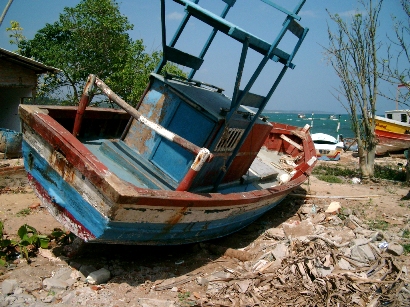
But, as fate would have it, the absence of a timely warning once again characterised the second disaster to touch Sir Arthur’s life. Arriving 10 days after his 87th birthday, the Asian Tsunami of December 2004 left a massive trail of destruction in his adopted country Sri Lanka and several other countries bordering the Indian Ocean.

He reflects:
“Astonishingly, a full century after the invention of radio, the Tsunami arrived without any public warning. The disaster’s death toll could have been drastically reduced if its occurrence — already known to scientists — was disseminated quickly and effectively to millions of coastal dwellers living on its predictable path. Even a half hour’s notice would have allowed people to run away from the coast, and in many affected locations there was just enough time to get to safety. But alas, that didn’t happen — and tens of thousands perished.

“It was appalling that our sophisticated local and global communications systems completely failed us that fateful day. The communications satellites that I invented, and the global Internet that one of my stories inspired, could have spread the warning, with the hundreds of radio and television channels across coastal Asia amplifying it.

“It is now known that the failures were human, not technological. To ensure better results next time, we need to achieve an optimum mix of technology, management systems and community preparedness — not just for tsunamis, but for many other hazards that we live with. We have to remember that delivering credible early warnings to those who are most at risk is both an art and a science.”
copy-of-tsunamis-legacy-in-southern-sri-lanka.jpg

In his foreword, Sir Arthur sees the Asian Tsunami as a turning point for citizen journalism – ordinary people armed with digital tools bearing witness to unfolding events and then sharing it with others. He writes: “On 26 December 2004, many holiday-makers on affected beaches were armed with video cameras, and it was their ‘amateur’ images that later showed us the full force and fury of the unfolding disaster. Because it was distributed over a large area and occurred during peak holiday season, the Asian Tsunami was probably the most widely filmed disaster in history.”

This was not the first disaster that ‘citizen journalists’ covered, says Sir Arthur, but it marked a turning point in the growing phenomenon enabled by information and communications technologies (ICTs). “The post-Tsunami coverage showed that the professional and amateur divide had now blurred; there is a clear (and complementary) role that each can play.”

ICTs can do much in good times and bad, but as Sir Arthur recalls, the Tsunami also reminded us how disasters can make our information society vulnerable. “When electricity and telephone services — both fixed and mobile – went down in the worst affected areas, a century old technology came to the rescue: amateur radio enthusiasts restored the first communication links with the outside world, sometimes using the Morse Code to economise the power of car batteries.”

He quotes the President of the Radio Society of Sri Lanka as saying, “When all else is dead, short wave is alive.”

Sir Arthur’s perceptive foreword is a sobering counterpoint to the post-tsunami frenzy that we witnessed in the Indian Ocean rim countries. Yes, lacking a tsunami warning system – such as the one Pacific Ocean countries have – is a big gap that needed to be filled. But governments and development donors have rushed into setting up high tech, high cost early warning systems without due consideration for social, cultural and political realities of the intended beneficiary countries.

As we saw with some subsequent undersea quakes – such as the one off the resort town of Pangandaran, Java, on 17 July 2006, and the one off off Bengkulu, Sumatra, on 12 September 2007 – we have yet to achieve the right mix of technology, management systems and community preparedness in most coastal countries in Asia.

Governments, donors and UN agencies would do well do heed the wise words of Sir Arthur Clarke, who concludes his Foreword with these words:

“Communicating disasters — before, during and after they happen — is fraught with many challenges. Today’s ICT tools enable us to be smart and strategic in gathering and disseminating information. But there is no silver bullet that can fix everything. We must never forget how even high tech (and high cost) solutions can fail at critical moments. We can, however, contain these risks by addressing the cultural, sociological and human dimensions — aspects that this book explores in some depth and detail, from the perspective of both media professionals and disaster managers.

“The lessons of history are clear: if we are not careful, we can easily lull ourselves into the same kind of false confidence that doomed the Titanic.”

Read the full text of “Communicating Disasters: A Century of Lessons”, By Sir Arthur C Clarke
communicating-disasters-a-century-of-lessons-by-arthur-c-clarke.pdf
Or download foreword as contained in the printed book

After the Tsunami: Going the Long Last Mile in Sri Lanka

hazlnfo-video-j-a-malani-hambantota.jpg

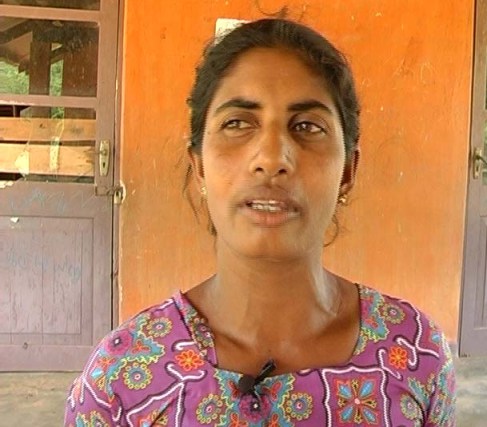
This is J A Malani. She’s an ordinary Sri Lankan woman living in Hambantota, on the island’s southern coast. Several hundred people in her town perished when the Indian Ocean Tsunami arrived on 26 December 2004 without any public warning. When the waves finally stopped their hammering, close to 40,000 people were dead or missing in the biggest disaster the island nation experienced.

Survivor Malani and her neighbours – lucky to be alive – are naturally apprehensive about when the next disaster might arrive, in what form and from where.

And this time around, too, they worry whether there would be anyone to warn them about it.

There just might be. Since the big tsunami three years ago, several Sri Lankan telecom operators, civil society organisations, IT companies and researchers have come together to test out a community-based hazard warning system — one that would prevent the repetition of the nasty surprise Malani’s community experienced not too long ago.

‘Evaluating Last Mile Hazard Information Dissemination Project’ (HazInfo project for short) was an action research project by LIRNEasia to find out how communication technology and training can be used to safeguard grassroots communities from disasters. It involved Sarvodaya, Sri Lanka’s largest development organisation, and several other partners, and was supported by International Development Research Center (IDRC) of Canada.

The project studied which information and communications technologies (ICTs) and community mobilisation methods could work effectively in disseminating information on hazards faced by coastal communities. The exercise was not confined to tsunamis alone; other rapid onset disasters such as cyclones and floods were also covered.

In its first phase, the project worked in 32 chosen coastal villages (all impacted by the tsunami) and mobilised local communities from muslim, Sinhala and Tamil backgrounds. Malini’s community was among those participating in this field testing of an approach that Sarvodaya hopes to roll out progressively to all 15,000 villages they work in.

That initial engagement by itself was reassuring to Malani. “This has helped us to get rid of fear and hesitation in our minds,” she said in a television interview recorded some weeks ago. “Now we know what we should do when a disaster strikes.”

That peace of mind is priceless to any human being, and that knowledge is liberating – particularly to one who has survived a major disaster that came from nowhere.

Malani is one of several beneficiaries featured in a 12-minute film TVE Asia Pacific recently produced. Several other participants from different coastal locations expressed similar views — and hopes that next time around, they will not be taken unawares.

The Long Last Mile can be viewed on YouTube in two parts:

The Long Last Mile, part 1 of 2:

The Long Last Mile, part 2 of 2:

LIRNEasia researchers analysed how each ICT tool or combination was integrated into communities to deliver timely warnings to those designated as first responders. The factors needed for efficient functioning of the hazard information hub were also studied. Read detailed findings and analysis here.

The HazInfo project grew out of a participatory concept paper that LIRNEasia developed in the aftermath of the 2004 tsunami. It noted that a national early warning system was a ‘pure public good’, and the responsibility of its supply would normally fall on the government. However, the paper acknowledged that, due to lack of capacity, “it is unlikely that the last mile of such a system will be provided by the local government or private firms operating in the marketplace”.

I have written a whole chapter on this project, titled Bridging the Long Last Mile, in Communicating Disasters: An Asia Pacific Resource Book (co-edited by Nalaka Gunawardene and Frederick Noronha). Read that chapter here:

bridging-the-long-last-mile-final-text-formated.pdf

Tsunami Stories: How a film saved lives in Kosgoda, southern Sri Lanka

With the third anniversary of the Asian Tsunami drawing close, we are reliving memories of the mega-disaster that hit many parts of coastal Asia on 26 December 2004.

On 10 October 2007, I wrote the story of Tilly Smith, the 11-year-old English school girl whose geography knowledge helped save hundreds of lives on the Maikhao Beach in Thailand that day.

Here’s another story, which was related by Thyagee de Zoysa, a young Sri Lankan woman who until recently was working as Project Officer of CEE Sri Lanka, a non-profit educational charity that I am associated with.

In January 2007, Thyagee spoke at the European launch of TVE Asia Pacific’s latest environmental television series, The Greenbelt Reports</em>, held in Athens, Greece. There she made a passionate appeal for education and awareness to be put into action.

She drew from her personal experience, having survived the Indian Ocean Tsunami in her native village of Kosgoda in southern Sri Lanka. These are her exact words:

“I, myself, am particularly willing to participate in this project, as I was at my home on the 26th of December 2004, with my parents, until we heard a young man crying ‘Run to the temple, run to the hill, the sea is coming’. We ran — and it saved our lives.

“The young man told me later that he knew that the sea was going to come with full power because of a film that he had seen. A film, which was about a meteorite impact with earth and how a tsunami happens after that. He knew that, if there comes a day when the sea goes back towards the horizon, it then comes back again to take your life.

“It does not matter in what way you create awareness on the environment, be it books, films or the Internet. What matters is that you do it and make somebody understand the possible actions to take up. Believe me, I am grateful to this young man for saving my life and that of my family…”

Neither Thyagee nor the young life-saver could recall the name of the film, but it doesn’t matter. The film left a bit of knowledge in the young man’s mind which surfaced instantly just when it was needed. That helped save lives.

Alas, there were very few Sri Lankans – young or old – who had any idea about tsunamis prior to that fateful Boxing Day 2004.

Writing a foreword to Communicating Disasters: An Asia Pacific Resource Book (co-edited by Nalaka Gunawardene and Frederick Noronha), Sir Arthur C Clarke refers to another rare exception: a retired sailor living in the coastal village of Galbokka recognised the tell-tale signs of the on-coming tsunami and rushed the entire community to safety.

The challenge we still face is to build everybody’s awareness on multiple hazards and what to do when hazards turn into disasters.

Communicating Disasters in digitally empowered Asia: A tale of two books

I have just spent a hectic week in Kuala Lumpur, and am just coming up for fresh air. That explains why this blog was silent for a few days.

I was at the Third Global Knowledge Conference (GK3) held in the Malaysian capital from 11 to 13 December 2007. With several related events preceding the main conference, my week was completely full.

GK3 was a global platform for all those engaged in using ICTs (information and communication technologies) for meeting the real world’s needs and solving its problems — to reduce poverty, increase incomes, create safer communities, create sustainable societies and support youth enterprise, etc. (Read my impressions of GK3 in this blog post.)

The week’s assorted events saw two separate video films produced by TVE Asia Pacific being screened as integral components of two sessions. These were The Long Last Mile (on community-based warning of rapid onset disasters) and Teleuse@BOP (on telephone use patterns among low income groups in five emerging Asian economies).

That wasn’t surprising because we produce and distribute films that capture Asia’s quest for improving lives through sustainable development. But unusually for myself, I also had two books coming out during the week — one that I had edited, and another that carried a chapter I had written.

communicating-disasters-an-asia-pacific-resource-book-by-tveap-and-undp.jpg

The first was Communicating Disasters: An Asia Pacific Resource Book, which I co-edited with Indian journalist Frederick Noronha. It was the culmination of a year-long process that began with an Asian brainstorming meeting on Communicating Disasters that TVEAP convened in December 2006 in Bangkok. That meeting, attended by three dozen participants drawn from media and disaster management sectors, identified the need for a handbook that can strengthen cooperation of these two communities before, during and after disasters.

The book, comprising 19 chapters contributed by 21 authors, has a foreword written by Sir Arthur C Clarke, inventor of the communication satellite. Pulling together these contributions from the specialist authored scattered across the globe was no easy task for co-editor Fred and myself.

The book’s blurb reads as follows:

“Where there is no camera, there is no humanitarian intervention,” said Bernard Kouchner, co-founder of Medecins Sans Frontieres who later became the Foreign Minister of France. Disaster managers and relief agencies acknowledge the mass media’s key role at times of distress. Yet, the relationship between media practitioners and those managing disasters can often be stressful, difficult and fraught with misunderstandings. Communicating about disasters sometimes ends up as communication disasters.

How can these mishaps be minimised, so that the power of conventional and new media can be harnessed to create more disaster resilient communities? What value addition can the new information and communication technologies (ICTs) bring in? In this book, media and development professionals from across the Asia Pacific share their views based on decades of experience in covering or managing a variety of disasters – cyclones, droughts, earthquakes, floods, landslides and tsunamis.

This book is aimed at journalists, disaster managers and civil society groups who want to use information and communication to create safer societies and communities.

The other book that came out in KL was Digital Review of Asia Pacific, 2007-2008 edition. It was launched during a workshop on Emerging Knowledge Opportunities (The Progress of ICT in Asia-Pacific and Other Parts of the World) on 12 December 2007.

The completely updated edition of the Digital Review of Asia Pacific contains authoritative reports on how 31 economies are using ICT in business, government and civil society written by senior authors who live and work in the region.

I have written the Sri Lanka chapter for the book, continuing a tradition I started back in 2003 with the first edition of the book. I was only sorry that I missed the session during GK3 where the book was launched — because I was moderating another session exactly at the same time in another room. But I was glad to join at least part of the post-launch reception and to meet with some fellow authors who were attending GK3.

Both books are multi-author books, and both have been in the making for a year or longer. It was quite a challenge to get 20 other contributors to come up with their chapters for Communicating Disasters. They were genuinely interested and supportive, but everyone being so busy, it took time and effort to pull together all the strands.

I was not the only common author in these books. My colleague and one-time co-author Chanuka Wattegama (now with LIRNEasia) has written two distinctive chapters on ICTs and disaster communication for the two books.

Many years ago, my friend (now international expert on terrorism and widely published academic author) Rohan Gunaratna told me that writing a book was like waging a small war. I don’t normally use military metaphors, because I deplore all things military, but I can’t resist extending Rohan’s analogy to say that compiling a multi-author book is a bit like waging a mini-war with a coalition of the willing!

Al Jazeera English is one: Getting better at imitating its rival BBC World!

al-jazeera.jpg

Al Jazeera English (AJE), the world’s newest global news and current affairs channel, completed one year on the air on 15 November 2007.

This in itself is a commendable accomplishment, and we extend heart-felt first birthday greetings to the channel that entered the highly competitive arena of global newscasting offering to ‘balance the information flow from South to North, providing accurate, impartial and objective news for a global audience from a grass roots level, giving voice to different perspectives from under-reported regions around the world.

AJE wanted to revolutionise English language TV in the same way Al Jazeera turned Arabic TV world upside down, ending the monopoly of the airwaves by state broadcasters.

First, the good news. AJE has done well on some fronts, adding to the diversity in international news and current affairs television, and enriching the often endangered media pluralism in a world that is, ironically, having more broadcast channels than ever before in history. It has brought to us stories ignored by other news outlets, while offering us somewhat different takes on widely covered stories.

In a self-congratulatory note and video clip posted this week on YouTube, the channel says: “A year ago Al Jazeera English was launched, marking the start of a new era in international journalism. In the last 12 months we have brought a fresh perspective to world events and shed light on many of the world’s little reported stories.”

Here are some of the highlights compiled by AJE.

In another post on its own website, AJE offers a selection of exclusive video stories from its correspondents to show how it ‘continues to set the news agenda’.

We also salute AJE for withstanding the unofficial yet widespread ‘block out’ of its distribution by North American cable operators, depriving most viewers in the US and Canada the opportunity of watching it on their TV screens. In a nifty move, the channel started placing some of its more consequential content on YouTube, making it available to anyone, anywhere with a sufficiently high speed Internet connection.

Image courtesy Al Jazeera

And now, on to the not-so-good news…

If AJE in its first year somewhat stood apart from the other two global newscasters – BBC World and CNN International – that was occasional and superficial, and not quite consistent or substantial. In fact, the only thing that AJE has consistently done is to under-deliver on its own lofty promise of doing things differently.

As I wrote in a blog post in August 2007: “I’m looking long and hard for the difference that they (AJE) so emphatically promised. Instead, I find them a paler version of BBC World, at times trying oh-so-hard to be just like the BBC!”

Of course, AJE – or any other broadcaster, for that matter – is fully entitled to set a trend or follow a model already set by another channel, even that of a rival. But to so blatantly imitate the BBC while all the time claiming to be different is simply not credible.

And credibility is the most important virtue for a news and current affairs media operation. Earn and sustain it and the world will be on their side. Lose it, and they will be the laughing stock on the air.

I’m not suggesting that has happened yet. But as I cautioned in an op ed written days after AJE started broadcasting in November 2006, “unless it’s very careful and thoughtful, AJE runs the risk of falling into the same cultural and commercial traps that its two rivals are completely mired in.”

Here’s a simple test. If viewers were to watch AJE, BBC World and CNN International without logos and any other tell-tale branding, how many would be able to tell the channels apart?

To me, CNN is in a league of its own for a variety of positive and negative reasons. Their offering is technically and professionally superior, even if I have objections to some of their editorial choices and analysis.

However, it’s harder to discern differences between the often befuddled BBC World and its enthusiastic imitator, Al Jazeera English. Perhaps it’s no coincidence that the latter has a significant number of former BBC reporters and presenters, many of who have been poached. While that again is a choice for AJE’s management, they must realise that we the viewers in the global South do not want a global channel rooted in our part of the world to dress up in the BBC’s increasingly discredited clothes.

And then there is the whole question of ethical sourcing of content — an important consideration which most global, regional and national TV channels continue to ignore. Many roaming news journalists’ key operating guideline seems to be: get the story ahead of rivals, no matter what — or who gets hurt in that process.

That business as usual must end. As I have argued in this blog and elsewhere: “If products of child labour and blood diamonds are no longer internationally acceptable, neither should the world tolerate moving images whose origins are ethically suspect.”

Aug 2007 blog post: Wanted: Ethical sourcing of international TV news

Nov 2005 op ed on SciDev.Net: Communication rights and communication wrongs, by Nalaka Gunawardene

In August 2007, I critiqued some Sri Lanka related stories appearing on AJE’s People & Power strand, pointing out some ethically questionable practices in how their reporter got the story, possibly placing some of her sources and interviewees at personal risk. To her credit, the reporter Juliana Ruhfus engaged me in this blog, explaining her side. Read the full exchange here.

But there are other key areas where AJE needs to very carefully guard its image and credibility. In the past year, the world’s assorted development and humanitarian agencies have realised that it’s ‘cool’ to be seen on Al Jazeera than on BBC and CNN. Some of their propagandists (sorry, public information officers) had beaten a path to AJE offices in London, Doha and Kuala Lumpur, seeking to cut various deals to get coverage.

Yes, the development and humanitarian communities certainly have worthwhile messages and issues to communicate, many of which need urgent, wide dissemination. Tragically, what most agencies seek is self-promotion and ego-massaging, not issue based discussion. It is precisely this alarming trend of paying media outlets to carry agency propaganda that I have labelled ‘cheque-book development’.

Aug 2007: ‘Cheque-book Development’ – paying public media to deliver development agency logos

It’s no secret that BBC World has shamelessly allowed its airwaves to be sold for cash by assorted ‘touts’ claiming to have privileged access to the once-respected broadcaster. In the past year, some of these touts have extended their tentacles to AJE. We don’t yet know if these are entirely pro bono acts of goodwill by AJE, or if money has exchanged hands somewhere along the line.

If the latter has happened, we ardently hope that someone within AJE would blow the whistle in their own collective self interest. Or perhaps AJE wants to be too much like BBC World in every respect — including the corruption part?

Meanwhile, the real challenge to Al Jazeera remains exactly what I said one year ago: to usher in real change, it needs to transform not just how television news is presented and analysed, but also how it is gathered.

Despite having a code of ethics for its conduct, the well-meaning, south-cheering channel has yet to rise to that part of the challenge. Let’s hope that in its second year, Al Jazeera English would spend less time imitating its rivals, and more time in living up to its own promise.

Personal note: Some readers have asked why I continue to hold AJE to higher standards in a world where media ethics are being observed in the breach all the time. It’s simply because I still see AJE as the best hope for the majority world to tell its own stories in its own myriad voices and accents. I desperately want AJE to succeed on all fronts, not just in audience ratings, signal coverage and market penetration. For that, it must fast find its identity and stop defining itself by its rivals.

New media anarchy is good for you!

neha-viswanathan.jpg

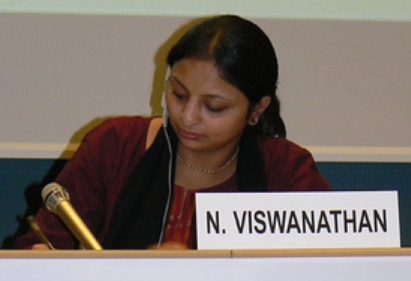
“You people are too well mannered! I’ve never been to a conference where people are so properly dressed and so polite to each other!”

With these words, Neha Viswanathan made sure she had everyone’s attention. But it was not just a gimmick — she was contrasting the relatively more orderly, organised world of mainstream media (MSM) with the decidedly more anarchic world of new media — including blogs, wikis, YouTube and Second Life.

Neha, South Asia Editor of Global Voices, was speaking on a panel on ‘new media’ during the Global Symposium+5 on ‘Information for Humanitarian Action’ in Geneva this week (22 – 26 Oct 2007).

The panel topic itself showed the rapid change taking place in the humanitarian sector. As the panel premise said: “Within minutes of a disaster or conflict, the first images are seen on YouTube rather than CNN, and probably to a larger audience. YouTube, Flickr and blogging are bringing wars, disasters and their humanitarian consequences to the attention of the public, government and aid agencies more efficiently than ever. It’s now possible to keep watch on a Darfur village through satellite imagery, or take a virtual tour of a refugee camp.”

The panel was to discuss whether citizen journalism and new collaborative/ networking technologies are improving humanitarian response, and review how the humanitarian community is faring in this new environment.

My own views on this are found in another blog post: New media tsunami hits humanitarian sector – rescue operations now on!

Neha’s take was slightly different. She started reminding everyone that the new media activists were unruly and not always polite. The blogosphere is very much a contested and contentious space where arguments rage on. Not everything is moderate, balanced or ‘evidence-based’ (to use a new favourite phrase of the humanitarian community).

But in times of crisis or emergency – whether disasters or war – new media activists are increasingly the first responders. The anarchic nature actually provides them with an advantage: they are distributed, self-organising and motivated. There is no central newsroom or coordination point telling them what to do. In typical Nike style, they just do it.

As an example, she described World Wide Help, whose introduction reads: “Using the web to point help in the direction where it’s most needed”.

This blog was started by several founders and members of the SEA EAT (South East Asian Earthquake And Tsunami) blog, wiki and database, all of which gained worldwide attention at the time of the Indian Ocean earthquake and tsunami on 26 December 2004. The group, now calling themselves The World Wide Help Group, has since remobilised to aid in other relief efforts.

Read the whole story of the SEA EAT Blog: A Candle in My Window by Peter Griffin, one of its co-founders

As Sir Arthur C Clarke has also noted, the 2004 tsunami marked a turning point in how citizen journalists and other new media activists respond to emergencies. Since then, the power of new media has been unleashed on many public interest issues and humanitarian causes. As an example, Neha cited the online campaign against street sexual harassment in India.

In Neha’s view, new media can collate authentic testimonials of those directly affected by disasters or other crises, and keep the public attention (and thereby, political interest) on emergencies beyond the first few days.

Her advice to humanitarian aid agencies: keep looking at the new media, especially blogs, to find out what people at ground zero are saying about relief and recovery work.

“Bloggers are not objective – they talk openly, and express themselves freely,” she told the largely prim and proper Geneva audience, where some participants had referred to the meeting as ‘this august gathering’!

Finally, in situations where MSM (the formerly big media!) are shut down, restrained or intimidated into not carrying out their watchdog role, it’s the new media that fills the voice. Neha described the pro-democracy struggles in Nepal in 2005 – 2006 as an example where the people power struggles continued to be reported and commented on after the autocratic king clamped down on all print and broadcast media.

Read my August 2007 blog post: The Road from Citizen Kane to Citizen Journalist

New media tsunami hits global humanitarian sector; rescue operations now on…

banner.jpg

Geneva, 25 October 2007 (MovingNews): The global humanitarian sector has been hit by a ‘new media’ tsunami, causing widespread damage and massive confusion in Geneva.

Giant waves — carrying blogs, wikis, YouTube and other new media products — have simultaneously swept over several aid capitals of the world, including London, New York and Tokyo.

United Nations and many other international relief organisations are among the worst affected. These aid agencies, usually among the first to arrive at the scene of major disasters or crises, found their information and communication capacities severely depleted.

“This is entirely a man-made calamity, and we just didn’t see it coming,” the UN spokesperson in Geneva said in a brief message released using the old-fashioned Morse code. “Our risk registers, log frame analyses and satellite technologies gave us no advance warning.”

Eye witness reports said some agencies were completely marooned on old media islands, saddled with very large numbers of completely unreadable documents going back to decades.

First casualties included assorted spin doctors carrying out propaganda for UN agencies. One perished while trying to sanitise the Wikipedia entry about his agency head.

Meanwhile, several dozen injured or badly bruised public information officers have been treated at a language clinic. Some will undergo trauma counselling.

“We have never been exposed to this level of open and two-way communication,” a survivor from UN OCHA said. “We were so used to always being in control, always telling others what to do and how to do it. I still don’t know what hit us!”

In a major show of solidarity, the world’s computer, telecommunications and media industries are rushing emergency teams to provide relief and recovery support.

“For decades, the UN, red cross and other aid agencies have responded to many and varied emergencies. In their hour of need, we have decided to come to their help,” a joint tele-com-media industry statement said.

Other survivors are being given first aid in simple, jargon-free public speaking. Those who respond well will be treated with basic courses in participatory communication methods.

The emergency coordinators have ordered that any spin doctors found alive be quarantined to prevent the spread of the fatal infection known as MDG.

As the recover process continues, ICT activists plan to conduct more advanced exercises — such as how to produce PowerPoint presentations with less than 20 words per slide.

“But we have to take things one step at a time,” a relief worker said. “These people have just had their entire frame of reference collapse all around them. They are in deep shock and disbelief. It will be a gradual process.”

It has now been established that a few alert officials had anticipated the new media tsunami well ahead of its dramatic arrival. But their warnings were ignored, as it now turns out, to everyone’s peril.

In Washington DC, the United States has just designated veteran broadcasters Walter Cronkite , Bill Moyers and Oprah Winfrey as their New Media Tsunami Relief Ambassadors. In the coming weeks, they will tour the decimated UN, red cross and other humanitarian aid agencies, taking stock of the global disaster and sharing their collective wisdom on telling the truth to the public simply and well.

You, dear reader, are now invited to continue building this unfolding scenario:

How soon and how well will the humanitarian sector raise its head from the new media tsunami?

Will they learn lessons from this disaster, or might they soon return to business as usual?

What would happen to the massive outpouring of goodwill, voluntary help and aid?

Message to aid workers: Go mobile — or get lost!

banner.jpg

“MY NAME is Mohammed Sokor, writing to you from Dagahaley refugee camp in Dadaab. Dear Sir, there is an alarming issue here. People are given too few kilograms of food. You must help.”

This short, urgent message of a single individual has already joined the global humanitarian lore. It was sent by SMS (a.k.a. mobile texting) from the sender’s own mobile phone to the mobiles of two United Nations officials, in London and Nairobi. Sokor found these numbers by surfing at an internet café at the north Kenyan camp.

The Economist used this example to illustrate how the information dynamics are changing in humanitarian crises around the world. In an article on 26 July 2007, titled ‘Flood, famine and mobile phones’, it noted:
The age-old scourge of famine in the Horn of Africa had found a 21st-century response; and a familiar flow of authority, from rich donor to grateful recipient, had been reversed. It was also a sign that technology need not create a ‘digital divide’: it can work wonders in some of the world’s remotest, most wretched places.”

Elsewhere in the article, it added: “Disaster relief is basically a giant logistical operation. Today’s emergency responders can no more dispense with mobile phones or electronically transmitted spreadsheets than a global courier company can. But unlike most couriers, aid donors operate amid chaos, with rapidly changing constraints (surges of people, outbreaks of disease, attacks by warlords). Mobile phones increase the flow of information, and the speed at which it can be processed, in a world where information used to be confused or absent. The chaos remains, but coping with it gets easier.

image-from-wikimedia.jpg
Image courtesy WikiMedia

All available indicators suggest that the future of humanitarian assistance is going to be largely dependent on mobile communications. Despite this reality, old habits die hard. I sat through an entire presentation on ‘Innovation to Improve Humanitarian Action’ at the Global Symposium+5 on ‘Information for Humanitarian Action’ in Geneva this week — and not once did I hear mobile phones being mentioned. A group of 15 – 20 people had deliberated for 2 days to come up with their vision of ‘the potential of emerging technologies and approaches used in the field and globally to strengthen information sharing, coordination and decision-making’ in humanitarian work.

It might be that aid workers are all frustrated computer geeks…because all their talk was about collaborative and networking software, Geographic Information Systems (GIS), the use of really high resolution (read: oh-so-sexy) satellite imagery, and the latest analytical tools — all requiring high levels of skill and personal computers with loads of processing power.

But no mobile phones! This was too much to let pass, so I raised the question: did you guys even consider this near ubiquitous, mass scale technology and its applications in crisis and disaster situations? And how do you engage the digitally empowered, better informed disaster survivors and crisis-affected communities?

I also recalled the example of Aceh tsunami survivors keeping each other informed about the latest arrivals of relief supplies – all through their mobile phones (as cited by the head of MERCY Malaysia on the previous day).

It turned out that they did discuss mobiles — well, sort of. Amidst all the gee-whiz talk about high tech gadgets, I received a short answer: widespread as mobile phones now are, ‘these systems are not fully integrated or compatible with other information platforms’ — whatever that means! The group’s spokespersons also pointed out that since mobile services are all operated by commercial (telecom) service providers, using their networks involves lots of ‘negotiations’. (I would have thought it’s the same with those who operate earth-watching or communications satellites.)

The message I heard was: mobile phones are probably too down-market, low-tech and entirely too common for the great humanitarian aid worker to consider them as part of their expensive information management systems. For sure, everybody uses them to stay in touch in the field, but what use beyond that?

What uses, indeed. If today’s aid workers ignore the mobile phone revolution sweeping Africa, Asia Pacific and, to a lesser extent, Latin America, they risk marginalising their own selves. The choice seems to be: go fully mobile, or get lost.

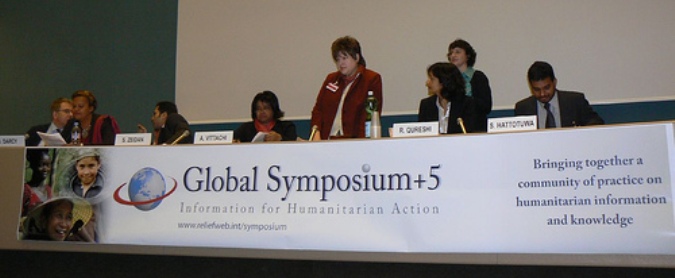
Fortunately, the panel discussion that followed — on ‘Envisioning the Future’ — partly redressed this imbalance. The panel, comprising telecom industry, citizen media and civil society representatives, responded to the question: what will our humanitarian future look like and what role will information play in supporting it?

panel-3-on-envisioning-the-future.jpg

Leading the ‘defence’ of mobiles was Rima Qureshi, head of Ericsson Response, part of the global mobile phone manufacturer’s social responsibility initiatives. She reminded us there were now 3.4 billion (3,400 million) mobile phones in the world — and it was growing at 6 new mobile connections every second. By the time she ended her 8-minute talk, she said, some 3,000 new mobiles would have been connected for the first time.

This represents a huge opportunity, she said, to put information into everyone’s hands whenever and wherever they need it. And mobiles are all about two-way communication.

The new generation of mobile phones now coming out are not locked into a single telecom network, and have built-in global positioning (GPS) capability. This means the phone’s location can be pinpointed precisely anywhere on the planet — which can be invaluable in searching for missing persons in the aftermath of a disaster.

Wearing her Ericsson prophet’s hat, Rima said: “Everything we can do on a personal computer will soon become possible on a mobile. Mass availability of mobile phones, able to connect to the global Internet, will represent a big moment for human communication.”

And not just Ericsson, but many other mobile phone makers and network operators are rolling out new products and services. The new mobiles are easier to use, more versatile and durable, and come with longer-lasting or renewable sources of power. Wind-up phone chargers have been on the market for some years, and some new mobile phones come with a hand-cranking charging device that makes them entirely independent of mains electricity. With all this, the instruments keep getting cheaper too.

And if aid workers ignore these and other aspects of mobile realities, they shouldn’t be in their business!

1743641460_63092b452a.jpg

Rima described another Ericsson initiative called Communication for All. It’s trying to harness the power of shared network, across commercial telecom operators and networks (but with some development funding from the World Bank) to deliver coverage to rural areas that aren’t as yet covered fully. The rolling out of coverage would have profound implications for disaster managers and aid workers.

As James Darcy, Director of humanitarian aid policy at the UK’s Overseas Development Institute, noted from the chair, the future of humanitarian communication is already here — but the sector needs to have more imagination in applying already available technologies for new and better uses.

My colleague Sanjana Hattotuwa, ICT researcher and activist from Sri Lanka, made the point that 3.4 billion mobiles raise new ethical considerations. For example, while it is now technologically possible to track the movement of every mobile phone – and therefore, in theory, each unit’s owner – this knowledge can be abused in the wrong hands. (I’ll write a separate blog post on Sanjana’s other remarks.)

Not everyone in the audience was convinced about the future being mobile. Soon enough, the predictable naysayer popped up: saying only 2.4 per cent of people in Sub-Saharan Africa as yet owned mobile phones, and Internet access was limited to only one per cent. Blah, blah, blah! (I was half expecting someone to blurt out the now completely obsolete – but sadly, not fully buried – development myth that there are more phones in New York city than in the whole of sub-Saharan Africa. That didn’t happen.)

Funny thing was, we were discussing all this at the Palais des Nations, the European headquarters of the UN, which is just literally across the street from the headquarters of the International Telecommunication Union (ITU), the authoritative monitor of telecom and ICT industry data and trends! It seemed that the gulf between some humanitarian workers and the telecom industry was much bigger than that.

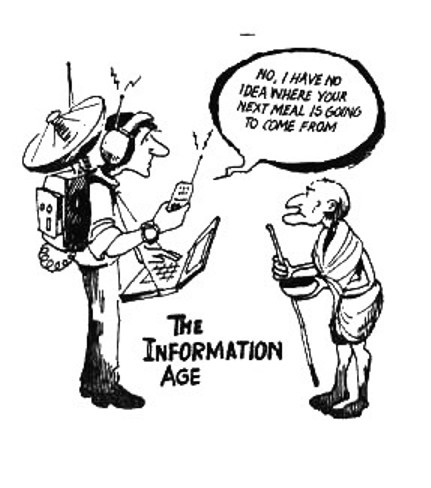
Of course, being connected – to mobile, satellite and every other available information network – is only the first step. We can only hope humanitarian workers don’t end up in this situation, captured in one of my all-time favourite ICT cartoons (courtesy Down to Earth magazine):

copy-of-all-inf-no-solutions.jpg

Read about Sri Lanka’s pathfinding action research by LIRNEasia and others: Last Mile Hazard Information Dissemination Project

All Geneva photos courtesy UN-OCHA Flickr on Global Symposium+5

Share (information) if you really care: Challenge to humanitarian community

banner.jpg

Why can’t we humanitarian workers talk to each other in the field?

Why must we, instead, badger and harass people affected by a disaster or war, asking them for the same information over and over again?

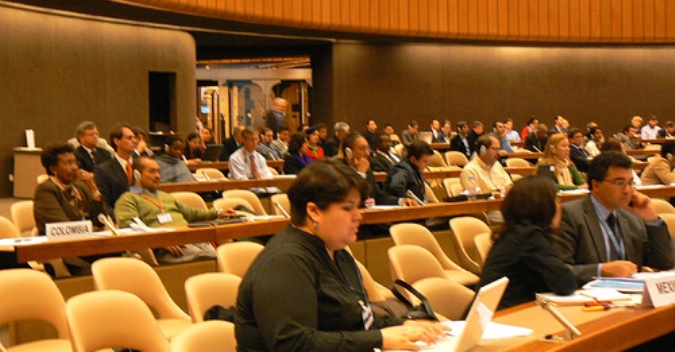
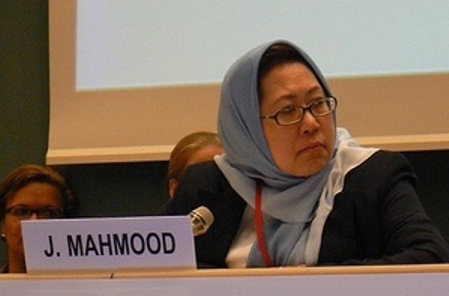
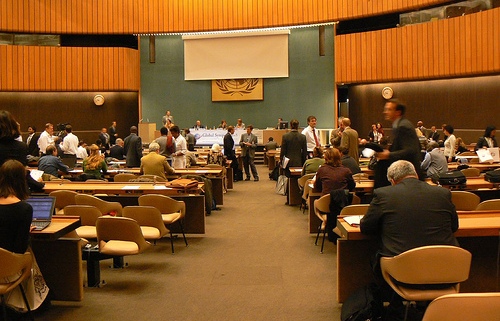
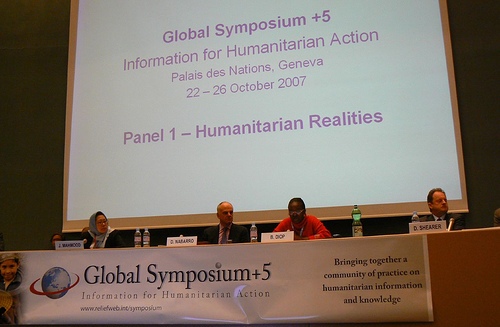
With these simple yet important questions, Dr Jemilah Mahmood, President of MERCY Malaysia, started off the first panel discussion on humanitarian realities at the Global Symposium+5 on ‘Information for Humanitarian Action’ organised by the United Nations Office for the Coordination of Humanitarian Affairs (UN-OCHA). The meeting, held in Geneva from 22 – 26 October 2007 at the Palais des Nations, has brought together over 200 persons involved or interested in information and communication aspects of humanitarian work.

I was nearly dozing off on a surfeit of humanitarian jargon and acronyms when Jemilah started her reality check. The medical doctor turned humanitarian leader spoke from her heart, and spoke such common sense that sometimes seemed to elude the self-important UN types.

Jemilah argued that there was a greater need for community based information gathering and communication, rather than just data mining that often takes place in crisis or emergency situations.

“Communication with affected communities needs to be a genuinely two-way process,” she said, echoing the discussions at my own working group on ‘Communicating with affected communities in crisis’.

dr-jemilah-mahmood-mercy-malaysia.jpg

She talked of people in Aceh, Indonesia, and elsewhere who survived the tsunami — and then faced a barrage of questions and questionnaires from an endless stream of aid workers, many of who asked the same questions again and again! Why couldn’t the first group/s who surveyed survivors not have shared the information they gathered, she wondered.

“I sometimes see how humanitarian agencies are fighting with each other to keep field information to themselves,” she revealed.

There is also a need for humanitarian workers to be more sensitive to and respectful of affected people’s culture and social norms. For example, it is inappropriate to go to predominantly muslim communities and ask about their sexual habits or probe incidents of rape — even though gathering such information would be relevant in some situations. “The humanitarian workers need to find the right ways to tackle these and other challenges,” she said.

Sometimes well meaning aid workers inadvertently overstep their boundaries. In the aftermath of the Pakistan earthquake of October 2005, community meetings were scheduled at times when the people had to break their day-time fasting.

Today’s crisis affected people are becoming better informed and more empowered. Jemilah recalled how mobile phones are increasingly spreading news and information among crisis affected people on the arrival of new food or medicinal stocks. Once in Aceh, the news of vaccine stock arrival spread within hours through mobile texting or SMS, prompting thousands of people to turn up asking for this service.

The humanitarian community needs to combine technology, common sense and human considerations to deliver better services and benefits, she argued. “Technology alone won’t do this for us, but it offers us useful tools,” she said.

She added: “There are huge opportunities to use modern communication technologies to plan better, reduce disaster risks and have a well coordinated response in times of disasters.”

In short, we need locally relevant, low-cost solutions to improve information gathering, information sharing and communication all around, she argued.

1729202869_7825dbdc5b.jpg

MERCY Malaysia is an internationally recognised medical and humanitarian relief organisation. “MERCY Malaysia is not just a response organisation,” says its president Dr Jemilah Mahmood. This realisation came during the Afghanistan crisis (in October, 2001), when members decided it would be more prudent to look towards providing Total Disaster Risk Management (TDRM) to ensure that affected communities become more resilient after a disaster.

Since its inception, MERCY Malaysia has served hundreds of thousands of victims of natural and complex humanitarian disasters from Kosova, Indonesia, India, Turkey, Cambodia, Afghanistan, Sri Lanka, Iraq, Iran and Sudan. Hundreds of volunteers, both from the medical and non-medical field, have been trained and deployed to these areas. Dr. Jemilah Mahmood herself has led most of these missions at home and abroad, in particular to Kosova, Indonesia, Cambodia, Afghanistan, Iraq and most recently to Palestine.

Read The Star newspaper (Malaysia) article on MERCY Malaysia on 12 October 2007

panel-1-humanitarian-realities.jpg

All Geneva photos courtesy UN-OCHA Flickr on Global Symposium+5

The many lives of PI: Crisis communication and spin doctors

banner.jpg

Where does public information (PI) work end and public communication (PC) work begin?

And how can we separate public information work, which is mostly institutional propaganda, from public communication of issues and knowledge directly relevant to saving lives or improving them?

This is the question that we often grappled with this week in Geneva, during the Global Symposium+5 on ‘Information for Humanitarian Action’ organised by the United Nations Office for the Coordination of Humanitarian Affairs (UN-OCHA). The meeting, held from 22 – 26 October 2007 at the Palais des Nations, brought together over 200 persons involved or interested in information and communication aspects of humanitarian work. I was part of working group on ‘Communicating with affected communities in crisis’.

I raised the importance of separating PI from PC from the very beginning of our discussions. PI and public relations (PR) both have their place, I said, but it was not in the same league as communicating issues and knowledge.

Members of my working group – drawn from humanitarian organisations, UN agencies and the media – broadly agreed with this view. But many couldn’t help sliding back to their own agency’s PI/PR agendas during our discussions!

This is no accident. In this age of spin and soundbites, many development and humanitarian agencies are under pressure to raise their individual profiles in the public eye. In trying to do so, they give far higher priority – and resources – to PI/PR than to engaging in issue-based communication, or, to use one of their own favourite phrases, ‘evidence based advocacy’.

For public communication to assume its rightful place in the development process and humanitarian intervention, all key players will need to be more restrained with their PI/PR agenda. But looking around the massive UN complex in Geneva, where a dozen UN agencies are competing with each other for the public’s and media’s attention, I can’t quite see this happening soon.

I touch on this in an essay in August 2007 titled Cheque-book development corrupting the media. Here’s an extract:

As development organisations compete more intensely for external funding, they are increasingly adopting desperate strategies to gain higher media visibility for their names, logos and bosses.

“Communication officers in some leading development and humanitarian organisations have been reduced to publicists. When certain UN agency chiefs tour disaster or conflict zones, their spin doctors precede or follow them. Some top honchos now travel with their own ’embedded journalists’ – all at agency expense.

“In this publicity frenzy, these agencies’ communication products are less and less on the issues they stand for or reforms they passionately advocate. Instead, the printed material, online offerings and video films have become ‘logo delivery mechanisms’.

So the first step would be to deliver less logos and more real information.

Read my other relevant blog posts:

August 2007: Cheque-book Development: Paying public media to deliver development agency logos

April 2007: Say MDG and smile, will ya?

April 2007: MDG: A message from our spin doctors?