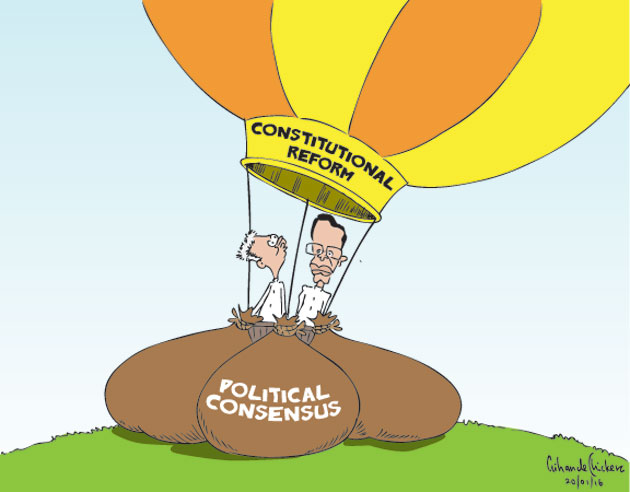
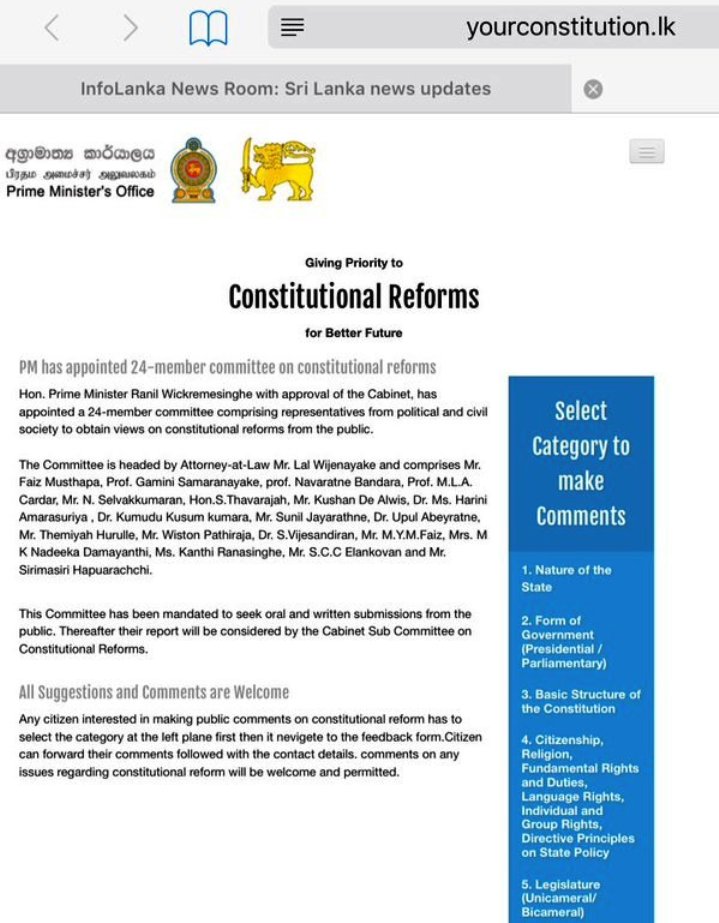
“Sri Lanka wants to make a new Constitution in a radically different way. It is poised to become the first developing country in the world to ‘crowd-source’ ideas for making the highest law of the land.
“That is all well and good – as long as the due process is followed, and that process has intellectual rigour, transparency and integrity. Therein lies the big challenge.”
So opens my latest op-ed essay, just published by Groundviews.org
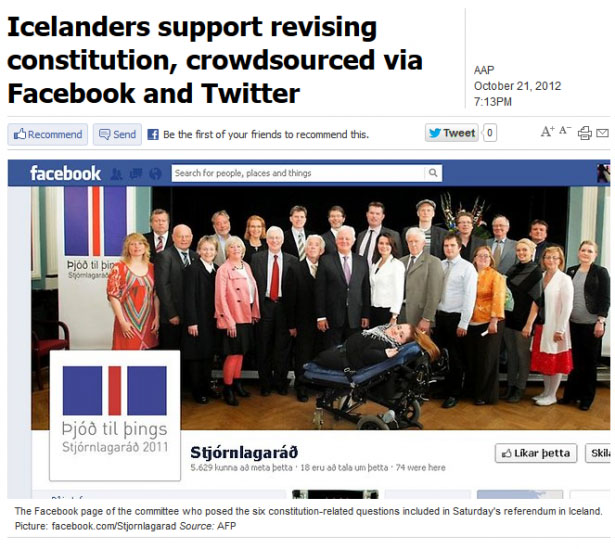
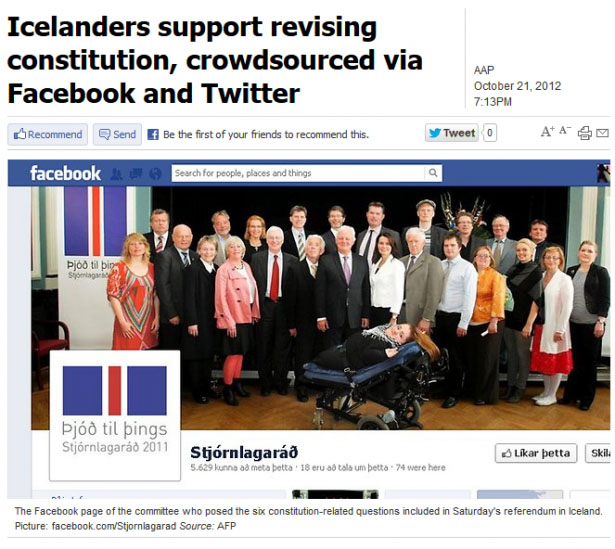
In it, I describe the experience of Iceland which was the world’s first country to ‘crowd-source’ a new Constitution. From 2011 to 2013, the European nation of 330,000 people engaged in an exercise of direct democracy to come up with a modern Constitution to replace the existing one adopted in 1944. That involved many public hearings as well as using social media and other communications platforms to gather public inputs and to ensure public scrutiny.
Facebook was used as part of a public consultation strategy to draft Iceland’s new Constitution in 2011-13
This is the path that Sri Lanka has now chosen: open and participatory Constitution making. To be sure, tropical Sri Lanka is vastly different. Its population of 21 million is 60 times larger than Iceland’s. But the Arctic nation’s generic lessons are well worth studying – both for inspiration and precaution.
I point out: “In doing so, it is important to ensure that public consultative process is not limited to the web and social media. Instead of dominating, technologies should only enable maximum participation.”
“The bottom-line: gathering public proposals is commendable, but not an end by itself. The government needs to adopt a systematic method to study, categorize and distil the essence of what is suggested. And that must happen across English, Sinhala and Tamil languages.”
Sri Lanka’s new government has committed to drafting a new Constitution to replace the current one adopted in 1978.
According to the Cabinet spokesperson, “for the first time [in Sri Lanka], a Constitution is going to be framed with the consultation of people.” Though the country has adopted Constitutions twice after independence — in 1972 and 1978 — public participation was negligible on both occasions.
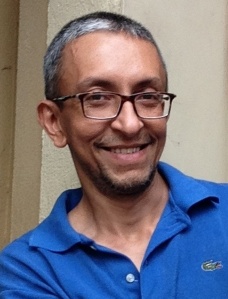
Nalaka Gunawardene in a serious pose
This is well and good, but it is still not clear what consultation mechanisms would be used, and how genuinely consultative the process is going to be. Our politicians and officials lack imagination and courage to try out new methods of public participation in governance. For example, they barely use the potential of new information and communications technologies (ICTs).
In an interview with Prasad Nirosha Bandara of Ravaya independent broadsheet newspaper, published on 20 December 2015, I make an earnest case for the new Constitution drafting process to be more open, more participatory and more consultative by using all available methods – tried and tested old-fashioned ones, as well as new potential opened up by the spread of the web, mobile phones and social media.
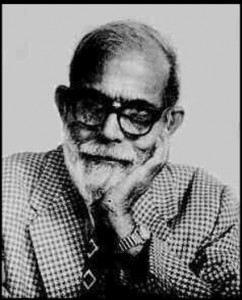
I also draw attention to a historically important memorandum was sent by the Ceylon Rationalist Association on 25 September 1970 to Dr Colvin R De Silva, then Minister of Constitutional Affairs, who was heading the group tasked with drafting what eventually became the country’s first Republican Constitution of 1972. Written by the Association’s Founder President Dr Abraham Thomas Kovoor, it captured the broad, idealistic vision that members of that voluntary group of free thinkers had advocated since its inception in 1960. Among other principles, it advocated – in point 6 – that “the best protection for freedom of conscience is a Secular State”.
I located the memo two years ago and published it online on Groundviews.org so that it becomes widely available. In this interview, I urge the new Constitution drafters of 2016 not to make the same mistakes that Colvin R de Silva did in 1972 by ignoring these ideas of public intellectuals.
 Open Minds!