Skip Williamson's Facebook profile photoWow, isn’t the Facebook a great place to connect people, ideas and creativity? I never thought much about it, but maybe I ought to spend more time there…
Yesterday, I published a semi-serious essay called WikiLeaks, Swiss Banks and Alien invasions, which was about an obscure short story by Arthur C Clarke describing an unlikely alien invasion of the Earth. For once, the invaders used brain and cunning rather than fire power, and against this onslaught, our planet’s rulers had no defence…
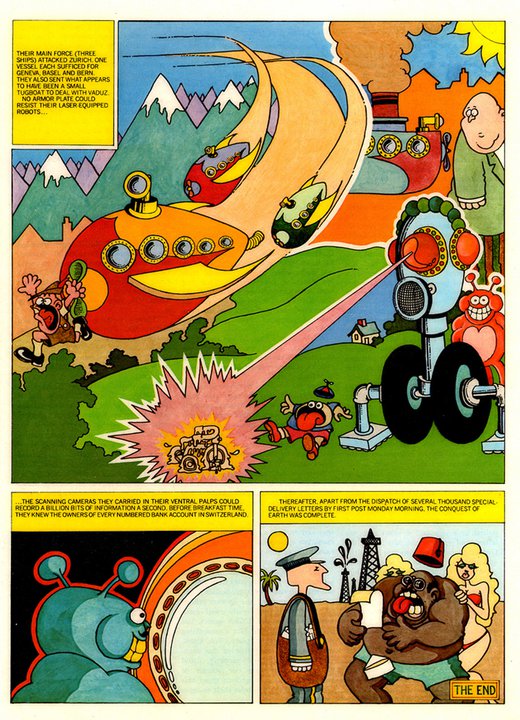
I mentioned how PLAYBOY Magazine had used that story as the basis for a psychedelic comic strip illustrated by the American underground cartoonist Skip Williamson. At the time of writing, I had not been able to locate the comic strip that was published in their issue of May 1972. I wondered: “…it’s either behind a pay-wall, or lies somewhere with little or no indexing by search engines.”
Turns out to be the latter. In less than 24 hours, there was a response from Skip Williamson himself saying the artwork is on his Facebook page, http://www.facebook.com/skip.williamson.
Many thanks to Skip Williamson for posting the link…and while at it, for all his brilliantly cheeky and subversive creations over the years! I hope he doesn’t mind my reproducing the comic strip (all of 2 pages) below:
When the Twerms Came - Comic Strip - Page 1 of 2When the Twerms Came - Comic Strip page 2 of 2
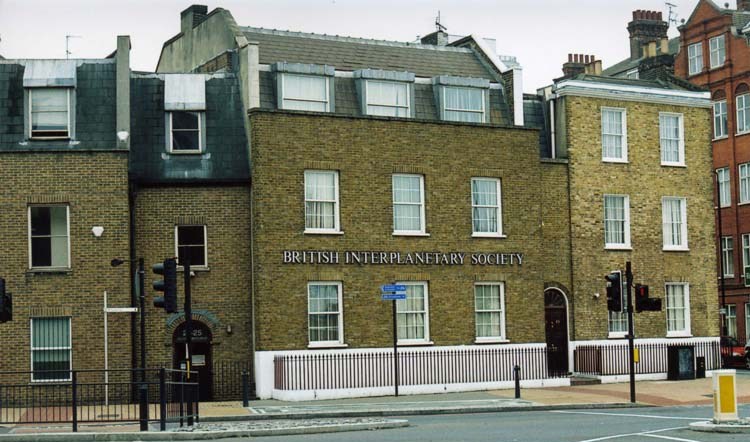
Humanity’s journey to the stars began here…Photo by Greg Fewer
I seem to have a knack for visiting the UK just when Nature decides to remind the hapless islanders who is really in charge. Last April it was the Icelandic volcano Eyjaffjalljokull coughing up. Last week it was sub-zero temperatures and freezing winds coming all the way, with love, from Siberia…
But London’s spirits are not so easily dampened by ash or snow (but they all groaned when their bid for FIFA World Cup 2018 lost to Russia’s). A highlight of my week’s stay was a visit to the British Interplanetary Society (BIS) headquarters on South Lambeth Road.
BIS, founded in 1933 by Phil E Cleator, is the oldest organisation in the world whose aim is exclusively to support and promote astronautics and space exploration. It was originally set up not only to promote and raise the public profile of astronautics, but also to undertake practical experiments in rocketry. But the pioneering British ‘space cadets’ soon discovered that Britain’s the Explosives Act of 1875 prevented any private testing of liquid-fuel rockets.
Undaunted, they continued with their thought experiments, discussions and public advocacy. Perhaps it was just as well that they didn’t get into the messy (and potentially hazardous) business of rocketry. For over 75 years, they have been preparing humanity’s engagement with the realm and challenges of space. Unlike its American and German counterparts, the BIS never became absorbed into the rocket or space industries that developed after the Space Age began in 1957.
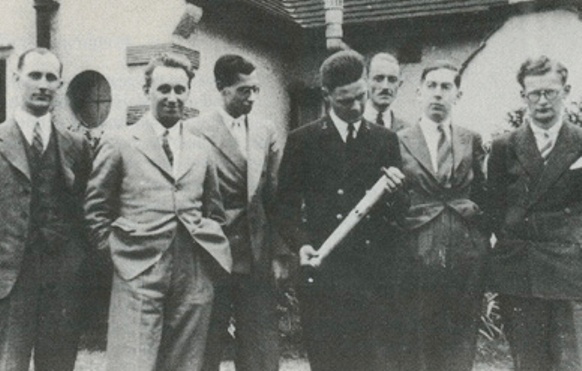
Arthur C. Clarke (far right) and other members of the British Interplanetary Society had a visit from rocket pioneer Robert Truax (holding the rocket model) in 1938
I have always admired the BIS for their pioneering role in popularising space travel, and having ha the audacity to dream of it and in public too. So I was delighted to be invited to the BIS annual Christmas get-together on the evening of December 1. This year, they celebrated the life and times of their founder member and two-time chairman, Arthur C Clarke.
Mark Stewart, the energetic librarian and archivist at BIS, heard I was visiting London and invited me to join their members-only event. Mark is currently looking after one of the finest collections on astronautics on this side of the Atlantic. Some records and documents at the BIS Library go back to the 1930s.
It was good to finally visit ‘ground zero’ of where it all began — nothing less than humanity’s long (and eventual) journey to the stars, hatched by a group of starry-eyed youth as an entirely private, citizen initiative. It took another 20 years — and considerable battering of London by Germany’s V2 rockets — for the British government to take it seriously.
I spent the afternoon chatting with Mark and Colin Philip, a BIS Fellow. Joining us later was Mark’s teenage son Alex, a next-gen space cadet already volunteering at the society. They gave me the guided tour — only a few months ago, I heard, a certain N. Armstrong had been similarly shown around. The society is certainly proud of its history and Sir Arthur’s photos, books, papers and posters are prominently displayed.
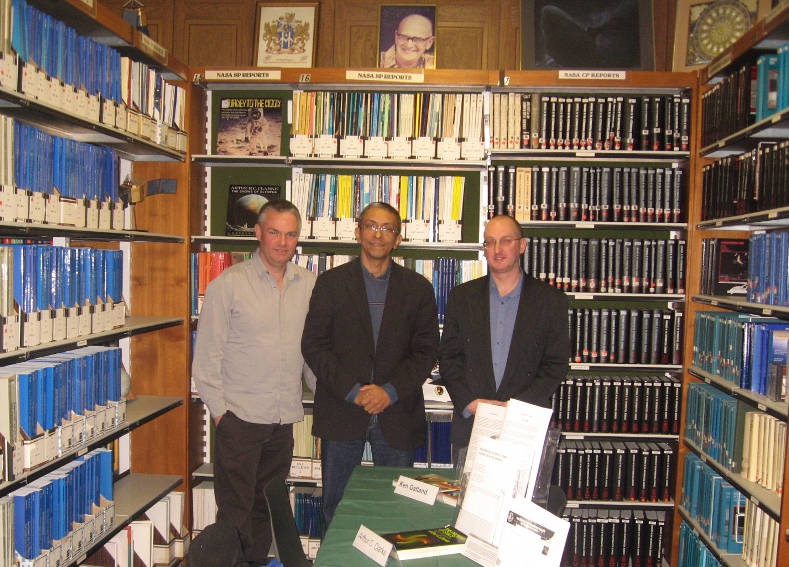
L to R – Colin Philip, Naaka Gunawardene, Mark Stewart, BIS Library 1 Dec 2010
The evening gathering was attended by 40 – 50 members, who were treated to an illustrated talk by Mat Irvine, British TV personality who has worked on many science and science fiction shows over the years, gave an illustrated talk about his friend Arthur. (Confession: I was so engrossed in his talk that I forgot to take any photos of him making it!)
I was familiar with much of the ground that Mat covered, but there were occasional revelations. For example, I didn’t know that circa 1995, Mat and (Sir Arthur’s brother) Fred Clarke had worked with the Isle of Man Post Office to issue some stamps bearing Sir Arthur’s visage and other iconic images associated with him, e.g. the monolith from 2001, comsats, etc. Alas, the plans didn’t work out, but Mat still has the designs and is hopeful that the British Post Office might consider it for the author’s birth centenary in 2017. Of course, some lobbying will be needed…but there’s plenty of time for that.
Like all non-profits these days, the BIS is struggling financially. It also faces the challenge of recruiting younger members – the average age of the Christmas gathering seemed to be 55 or 60. They have fascinating stories to tell (among them: the inside story how Apollo 13 was saved), but forward transmission requires more new blood.
The Council, I heard, is working on repositioning the society for the Facebook generation, and I wish them every success. ‘Imagination to reality’ is their motto, and they have seen a good deal of day-dreaming of the pioneering space cadets come true.
Nalala Gunawardene (L) with Mark Stewart at BIS Library
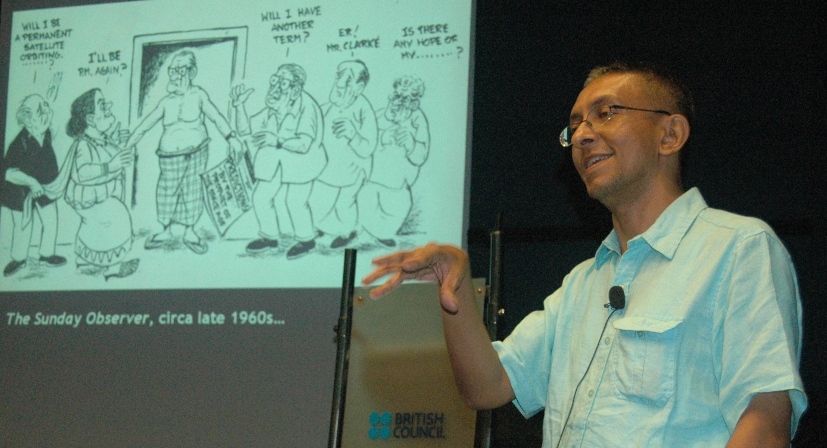
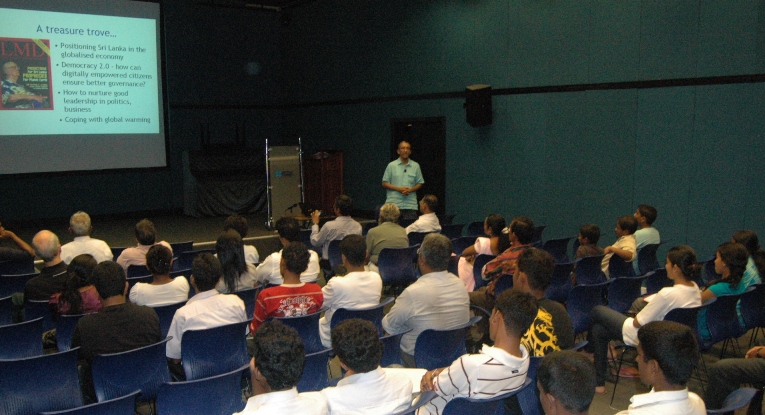
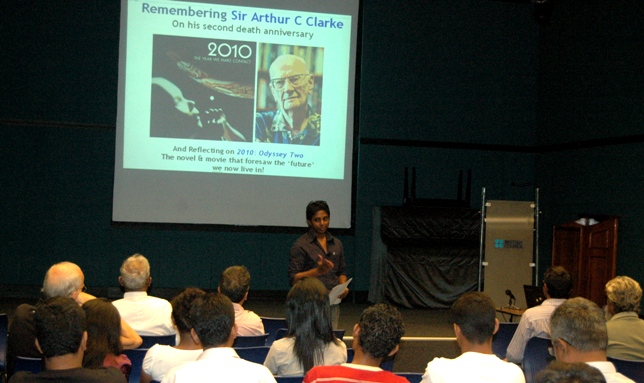
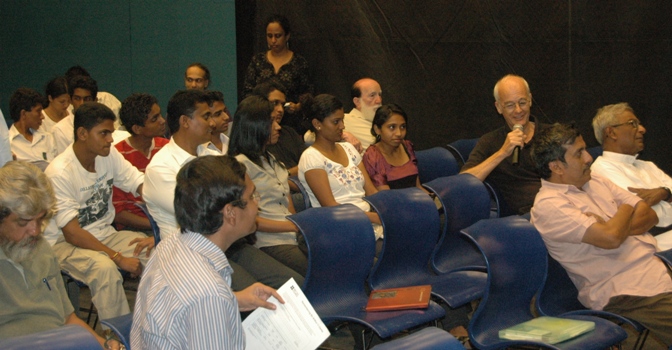
I gave an illustrated talk titled ‘Sir Arthur C Clarke: Man Who Lived in the Future’. We had an eager audience of 65 – 70 persons. Here are some photos from the occasion – a more detailed blog post will follow.
Nalaka Gunawardene giving Sir Arthur C Clarke memorial talk (photos above & below), 17 Marc 2010, British Councl Colombo
Thilina Heeatigala, General Secretary of SLAA, introducing the programmeMichael Snowden asking a question
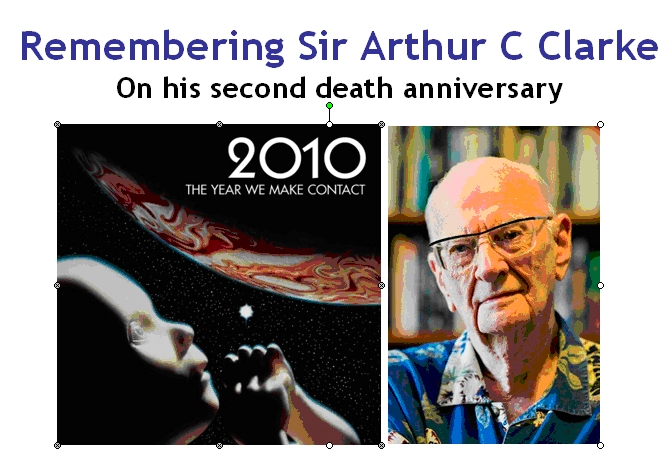
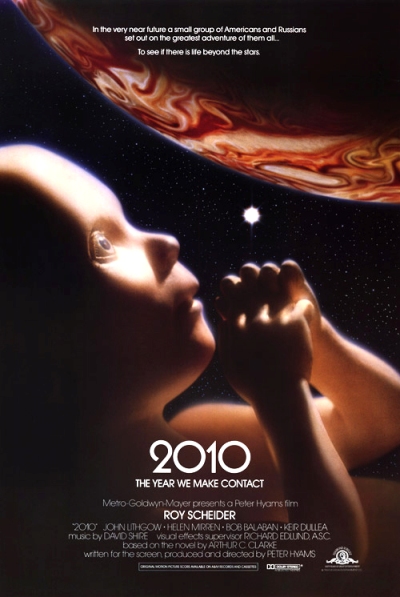
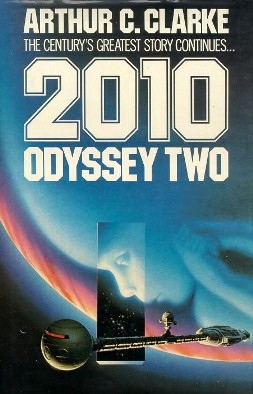
The talk will be followed by the screening of feature film 2010: The Year We Make Contact(116 mins, 1984). Directed by Peter Hyams on a screenplay co-written by Peter Hyams and Arthur C Clarke, the film starred Roy Scheider, John Lithgow, Helen Mirren and Keir Dullea. This is the movie adaptation of the best selling science fiction novel 2010: Odyssey Two that Arthur C Clarke wrote in 1982.
When I was in my early teens (back in the early 1980s), I developed a great interest in radio. Not just in listening to radio broadcasts, which I did regularly while growing up in a country that had no television, but also in building a radio that could both receive and transmit signals.
My school teacher father, who encouraged me in many of my diverse pursuits, bought transistors, condensers and other ‘building blocks’ for a basic radio set. With the help of an amateur radio handbook, and through trial and error, he and I actually built a functional transmitter. It was exhilarating to listen to local and shortwave broadcasts on a home-made radio set, but even more exciting to be able to transmit rudimentary signals.
Even as a kid, I was not contented in being a passive recipient of information; I wanted to give out as much as I received…
That particular fancy didn’t last long: I soon moved on to other challenges, and never persisted with being a serious amateur radio enthusiast (or ‘radio ham’), but it left a lasting impression. A few years later, after leaving high school, I became a regular freelancer at the local radio station. By age 23, I was hosting my own weekly show on national radio, and my association with the radio medium would last for much of my 20s.
The humble low tech that saved the day...My interest in amateur radio lay dormant — until five years ago, when I read reports about how radio hams helped revive emergency communications in the immediate aftermath of the Indian Ocean Tsunami.
The decades old practice was hailed as the ‘low tech’ miracle that literally helped save lives. Where electricity and telephone services — both fixed and mobile — had been knocked down, radio hams restored the first communication links. They were at the forefront of relief efforts, for example, in the Andaman and Nicobar Islands in India, and in Hambantota in southern Sri Lanka.
This intrigued Sir Arthur C Clarke, inventor of the communications satellite and long time resident of Sri Lanka. Shortly afterwards, he wrote in Wired magazine: “We might never know how many lives they saved and how many minds they put at ease, but we owe a debt to Marconi’s faithful followers.”
If Sir Arthur were alive, he would have been dismayed to find what has happened since. Notwithstanding their celebrated role after the tsunami, radio hams have been sidelined in Sri Lanka. Their very hobby is being frowned upon by the state on the grounds of…national security.
Looking back, it seems like the public-spirited radio hams were given their 15 minutes of fame and then soundly ignored. Worse, the short-lived prominence may have attracted new bureaucratic hurdles.
“As the applause died away, everything was forgotten,” I quote Victor Goonetilleke, one time President and current Secretary of the Radio Society of Sri Lanka, which networks amateur radio practitioners in the country.
One reason for this bureaucratic fear and negativity, I argue, may be simple ignorance of what amateur radio really is — reflecting the disturbingly low levels of media literacy in Sri Lanka.
Read the full essay, and join the conversation on Groundviews, or on this blog.
We apologise for the delayed arrival of the future?
The year 2010 has finally arrived, but as they often say in the imagination business, the future isn’t what it used to be.
Actually, any number of futures can be anticipated — but only one of them becomes real. Which one does depends on an infinite number of actions (and inactions)…
2010 holds a special significance for science fiction and movie buffs because both a well known novel and a movie have been set in that year by the grandmaster of near-future imagination, Arthur C Clarke.
The story is about seven Russians and three Americans who embark on a joint space mission to Jupiter to figure out what happened to the previous Jupiter mission nine years earlier. They start off as acquaintances and end up as friends – the author hoped that would help improve understanding between the US and the USSR.
The book was dedicated to celebrated cosmonaut Alexei Leonov and Andrei Sakharov, physicist, Nobel laureate and humanist, whose outspoken views led to his internal exile in Gorky until 1986.
In fact, the spacecraft in 2010 is named Alexei Leonov. As Sir Arthur recalled a dozen years later: “I had just sent the manuscript of 2010 to my editors when I visited Russia for a most memorable and enjoyable visit. In between toasts at Leonov’s apartment, I revealed that most of the action in my novel was taking place on board the Cosmonaut Alexei Leonov. A delighted Leonov quipped: ‘Then it must be a good ship.'”
The novel was adapted as a movie by Peter Hyams and released in 1984. Its promotional title was2010: The Year We Make Contact! (although this never appears in the film itself.) Unlike 2001: A Space Odyssey, the novel and the screenplay were not written simultaneously, and there are significant differences between the two. According to the Wikipedia, the film was only a moderate success, disappointing many critics as well as viewers.
If nothing else, the book and movie of 2010 remind us how difficult it is to write near-future stories — most of them are completely overtaken by reality.
Several elements in 2010 have become anachronistic in the years following their original release. The most striking is the end of the Cold War and the disintegration of the once mighty Soviet Union (which ceased to exist in 1991).
As Sir Arthur said in an interview in May 2005: “I’ve been more interested in the medium to long-term prospects for humanity, rather than in near-term developments. Politics and economics are so unpredictable that it’s practically impossible to make geopolitical forecasts with any degree of certainty.”
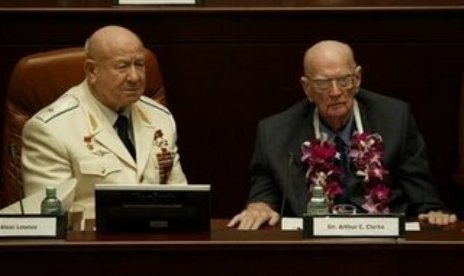
Alexei Leonov (left) and Arthur C Clarke at their last encounter in Colombo, 16 Dec 2007Interestingly, he had peppered the novel with names of various Soviet dissidents, including physicists Andrei Sakharov and Yuri Orlov, human-rights activists Mykola Rudenko and Anatoly Marchenko, Russian Orthodox activist Gleb Yakunin, among others. That was the author’s not-so-subtle jibe at the Soviet Union, despite the fact that he was both admired and respected in the country that pioneered humanity’s entry into space.
At first, this had somehow gone unnoticed by the Soviet censors. The Russian language youth magazine Tekhnika Molodezhy began serialising 2010: Odyssey Two. Halfway through the story, the serialisation was abruptly stopped. The Central Committee then summoned Cosmonaut Leonov to ask why in the novel the crew of the spaceship Alexei Leonov consisted of Soviet dissidents. (Clearly, that was another regime that couldn’t discern between fictional and real worlds — and tried, in vain, to rule over both.)
That’s when Leonov, Hero of the Soviet Union and one of its most decorated citizens, told off the Central Committee: “You aren’t worth the nail on Arthur C. Clarke’s little finger.” This was revealed years later in Two Sides of the Moon: Our Story of the Cold War Space Race, co-authored by Alexei Leonov and American astronaut David Scott (Simon and Schuster, 2004).
As Sir Arthur – a long standing friend of Leonov – remarked in a review of their book, Leonov was “perhaps the only man in the USSR who could have got away with that kind of remark”.
Well, that 2010 is finally here — even though Sakharov and Clarke never lived to see it, Leonov is very much with us. We are not yet heading to Jupiter, but at least the Cold War is now history…
Who can predict what surprises await us as the real 2010 unfolds?




 Open Minds!