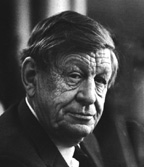
I remember Auden: We must love one another or die…

W H Auden (1907 - 1973)
It begins in a bar, and ends with a prayer. It was written in another century by a poet on the opposite side of the planet on the day the deadliest war in history broke out.

Almost 70 years later, at the end of my own 30-year-long war, I have been reading and re-reading September 1, 1939. I’m trying to make sense of what is happening around me. The near hysterical mass euphoria on one side, and bewildered dejection on the other.

I was just six when the poet W H Auden died, and only 13 when this bloody, protracted war started. As I wrote in an essay published on the day after the war ended, I have lived all my adult years with this war providing a constantly grim, sometimes highly disruptive backdrop.

I survived the war in its various phases, including uneasy lulls when guns were temporarily silent. I watched most of my own friends join the exodus of genes and talent from a land where they saw no hope or future. I chose to stay on, but questioned the wisdom of it each time a major atrocity took place. I went through six jobs and one marriage, and raised a child who would soon be the same age as I was when the war started.

Are we at the end of the long, dark tunnel? Is the promised land of peace and prosperity now at hand? Have we seen the last of multi-barrel guns, grenade launchers, helicopter gunships, claymore mines and the deadly suicide bombers? Or will national security and anti-terrorism continue to dictate what we can or cannot do as citizens in a free, democratic and finally peaceful country?

I honestly don’t know. Probably it’s too early to tell. But I’m uneasy with celebrations when so much healing and rebuilding need to be done. I’m worried about continuing the simplistic division of people into patriots and traitors. As I wrote earlier this week, this perception of Us and Them is our first landmine on the long road to peace. I don’t know why we as a people continue to insist on everything being in black and white. What happened to the myriad shades of grey?

For some months now, I’ve been turning to classical and modern poems for solace and comfort. When prose fails, verse must take over. Auden himself disliked this poem, but few words in English move me as his line: “We must love one another or die.”

So here it is, the full and original words of September 1, 1939 – for whatever resonance it may offer us across the gulf of seven decades straddling two centuries:

September 1, 1939

I sit in one of the dives
On Fifty-second Street
Uncertain and afraid
As the clever hopes expire
Of a low dishonest decade:
Waves of anger and fear
Circulate over the bright
And darkened lands of the earth,
Obsessing our private lives;
The unmentionable odour of death
Offends the September night.

Accurate scholarship can
Unearth the whole offence
From Luther until now
That has driven a culture mad,
Find what occurred at Linz,
What huge imago made
A psychopathic god:
I and the public know
What all schoolchildren learn,
Those to whom evil is done
Do evil in return.

Exiled Thucydides knew
All that a speech can say
About Democracy,
And what dictators do,
The elderly rubbish they talk
To an apathetic grave;
Analysed all in his book,
The enlightenment driven away,
The habit-forming pain,
Mismanagement and grief:
We must suffer them all again.

Into this neutral air
Where blind skyscrapers use
Their full height to proclaim
The strength of Collective Man,
Each language pours its vain
Competitive excuse:
But who can live for long
In an euphoric dream;
Out of the mirror they stare,
Imperialism’s face
And the international wrong.

Faces along the bar
Cling to their average day:
The lights must never go out,
The music must always play,
All the conventions conspire
To make this fort assume
The furniture of home;
Lest we should see where we are,
Lost in a haunted wood,
Children afraid of the night
Who have never been happy or good.

The windiest militant trash
Important Persons shout
Is not so crude as our wish:
What mad Nijinsky wrote
About Diaghilev
Is true of the normal heart;
For the error bred in the bone
Of each woman and each man
Craves what it cannot have,
Not universal love
But to be loved alone.

From the conservative dark
Into the ethical life
The dense commuters come,
Repeating their morning vow;
“I will be true to the wife,
I’ll concentrate more on my work,”
And helpless governors wake
To resume their compulsory game:
Who can release them now,
Who can reach the deaf,
Who can speak for the dumb?

All I have is a voice
To undo the folded lie,
The romantic lie in the brain
Of the sensual man-in-the-street
And the lie of Authority
Whose buildings grope the sky:
There is no such thing as the State
And no one exists alone;
Hunger allows no choice
To the citizen or the police;
We must love one another or die.

Defenceless under the night
Our world in stupor lies;
Yet, dotted everywhere,
Ironic points of light
Flash out wherever the Just
Exchange their messages:
May I, composed like them
Of Eros and of dust,
Beleaguered by the same
Negation and despair,
Show an affirming flame.

– W. H. Auden
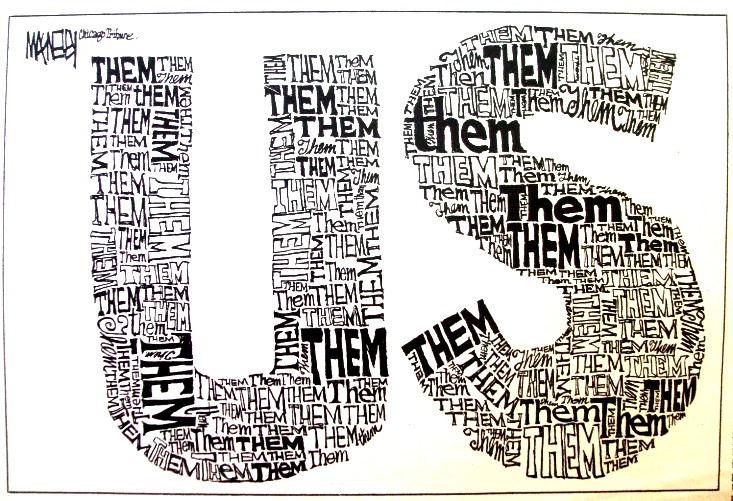
Us and Them: Sri Lanka’s first landmine on the road to peace…

Cartoon by Jeff MacNelly, Chicago Tribune

In our troubled times, cartoonists often provide more than mere caricature and entertainment. War and peace are no laughing matters, and neither is the profound advice some cartoons offer us. As a product of our image-saturated, popular culture driven world, I derive part of my insights from cartoonist-philosophers whose economy of words is unbeatable.

I haven’t discovered exactly what provoked the American cartoonist Jeff MacNelly (1947 – 2000) to draw this brilliantly perceptive cartoon in May 1992. But the three-time Pulitzer prize winning editorial cartoonist of the Chicago Tribune (and creator of popular comic strip Shoe) has captured a sentiment that has characterised so many tensions and suspicions in his land and mine: us and them.

It’s at the root of so much conflict and grief, be it between Islam and the West, or Israel and Palestine, or Sinhalese and Tamils in Sri Lanka. Its entirely a matter of perception, largely a creation of our insecure and insular minds. Yet we argue, wage war and kill each other for the sake of this strong tribal perception.

In an op ed essay published on Sri Lankan citizen journalism website Groundviews today, titled Memories of War, Dreams of Peace, I asked:

“Can we as a nation finally stop glorifying the war and its weapons, and return to our cultural heritage of ahimsa? How do we turn the current opportunity for peace into something tangible and lasting, so that we don’t allow political violence and war ever again? Do we have what it takes to go beyond chest thumping and finger pointing, and begin to care and share? Would we eventually be able to liberate our minds from our deep-rooted tribalism that sees everything through the prism of us and them?”

Indeed, one of the first – and hardest – challenges as we try to unify Sri Lankans and rebuild our war-ravaged country is to get over this division.

Read the full essay: Memories of War, Dreams of Peace

Pete Seeger turns 90 on World Press Freedom Day: Thank you for the protest music!

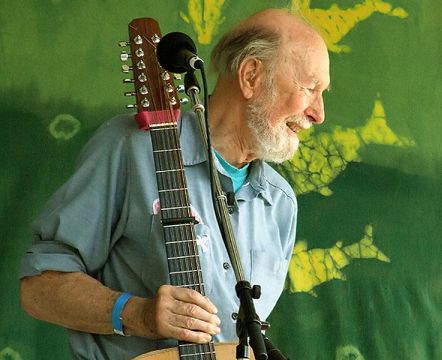
Pete Seeger: Still singing protest at 90...

Today, 3 May, is once again World Press Freedom Day. It is recognised by the UN, and observed by media professionals and media activists worldwide to ‘draw attention to the role of independent news and information in society, and how it is under attack’.

By happy coincidence, today also marks the 90th birthday of Pete Seeger, American folk singer and a pioneer of protest music. Since media freedom is inseparable from the democratic rights to dissent and protest, I will devote this blog post to salute Pete and his many decades of music for worthy causes — ranging from the American civil rights movement and opposing the Vietnam war to saving the environment and nuclear disarmament.

I won’t go over the basic biographical or career information, which is easily found online. Wikipedia has a good entry, and PBS shows a career timeline which has covered some of the most momentous events of the past century. There are approximately 200 songs (music and lyrics) that Pete wrote or with which he is associated – including “Guantanamera,” “Where Have All The Flowers Gone,” “If I Had A Hammer,” “Turn Turn Turn,” “Wimoweh,” “We Shall Overcome”.

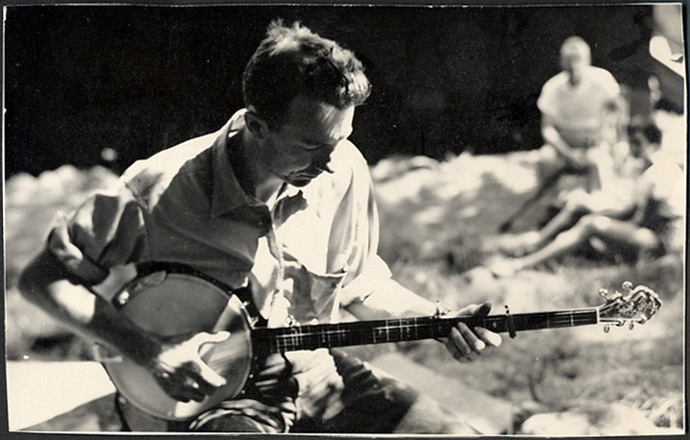
Pete is a hero for at least three generations of music lovers and freedom lovers around the world who believe in human rights, human dignity and democratic freedoms. Armed with nothing more than his banjo and melodious voice, and driven by the courage of his conviction, this small, gentle man has stood up to mighty leaders, generals and officials.

Never underestimate the power of one determined man...
Pete is celebrated as much for his artistic and cultural achievements as for standing resolutely for his political beliefs and for lending his voice and music in support of causes be believed in. In 1955, he was called before the now infamous House Un-American Activities Committee, but refused to name personal and political associations on the grounds that this would violate his First Amendment rights. He said: “”I am not going to answer any questions as to my association, my philosophical or religious beliefs or my political beliefs, or how I voted in any election, or any of these private affairs. I think these are very improper questions for any American to be asked, especially under such compulsion as this.”

This defiance resulted in sustained harassment, persecution and professional isolation. As his recent PBS biography noted, “Standing strong for deeply-held beliefs, Seeger went from the top of the pop charts to the top of the blacklist and was banned from American commercial television for more than 17 years. This determined singer/songwriter made his voice heard and encouraged the people of the world to sing out along with him.”

‘If you love your country, you’ll find ways to somehow to speak out, to do what you think is right,” Pete says in this powerful documentary looking back at over half a century of activist singing and music.


Watch opening segment of PBS AMERICAN MASTERS series: Pete Seeger: The Power of Song, directed by Jim Brown and first aired in February 2008

Watch more PBS interviews with Pete Seeger and some of his archived performances from yesteryear

Having pleaded under the First Amendment during the communist witch days of the 1950s, Pete repeatedly paid tribute to the far-sighted American pioneers who introduced the First Amendment guaranteeing the freedom of speech.

“As some judge said, if there is any fixed star in our firmament, that is the First Amendment,” he says in a talk-cum-performance at the Ford Hall Forum. In this audio-only piece, he talks the privilege of living under the First Amendment. He recalls his experience being questioned by the House Unamerican Activities Committee, encounters with censorship, and his relationship with fellow singer Woody Guthrie. It runs for nearly an hour, but is worth every second.

For someone like Pete Seeger who sang alongside Dr Martin Luther King, Jr., and other civil rights movement leaders and activists, it must have been deeply moving to be able to sing at the concert to mark President Barack Obama’s inauguration on 20 January 2009 at the Lincoln Memorial.

Watch Bruce Springsteen sing along with Pete Seeger on Woody Guthrie’s “This Land Is Your Land”. As he often does, Pete invites the euphoric audience to sing along!

One of my favourite Pete Seeger songs is “Turn! Turn! Turn! (to Everything There is a Season)”, often abbreviated to “Turn! Turn! Turn!”. It’s a song adapted entirely from the the Book of Ecclesiastes in the Bible (with the exception of the last line) and composed to music by Pete Seeger in 1959. Seeger waited until 1962 to record it,

Pete Seeger tells how he came to write “Turn Turn Turn.”

I have always believed that we have to get creative and resourceful when the basic freedoms of conscience and freedom of expression are under siege from despotic rulers and fanatical extremists. When we are not allowed to express in factual prose, we must turn to creative prose. And when prose fails, we still have verse, lyrics, satire and drama — the possibilities are only limited by our imagination. This is why I celebrate activist artistes like Pete Seeger, and invoke the memory of activist-poets like Adrian Mitchell and Ken Saro-wiwa. When the barbarians are at our gates and we feel surrounded by the unrelenting forces of hatred, intolerance and tribalism, they remind us that Another World is Possible — but we have to believe in it, stay the course and find ways to sing, dance and laugh our way out of gloom.

And here’s Pete singing another one of my personal favourites, a song that powered the civil rights movement and has since inspired and sustained struggles for social justice around the world: We Shall Overcome.


New York Times editorial appreciation on 5 May 2009: Still Singing

To Whom It May Concern, a.k.a. Tell Me Lies: In memory of Adrian Mitchell (1932-2008)

I was run over by the truth one day.
Ever since the accident I’ve walked this way
So stick my legs in plaster
Tell me lies about Vietnam…

With these lines opened the bitterly sarcastic reaction to the televised horrors of the Vietnam War by British poet, playwright and performer Adrian Mitchell.

He first read his best-known poem, called To Whom It May Concern (also known as Tell Me Lies), to thousands of anti-war protesters who flocked into London’s Trafalgar Square on the afternoon of Easter Monday 1964. As Mitchell delivered his lines from the pavement above in front of the National Gallery, angry demonstrators in the square below scuffled with police.

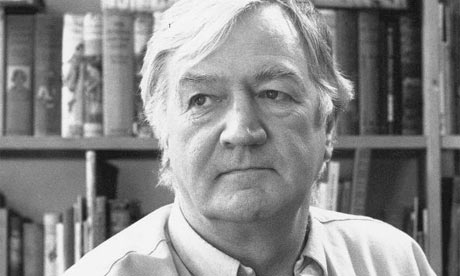
Adrian Mitchell (1932 - 2008)
Mitchell, who died on 20 December 2008 aged 76, occasionally updated the poem to take into account the subsequent wars and resulting tragedies in places as far apart as Iraq, Burma, Afghanistan and Israel/Palestine.

“It is about Vietnam, But it is still relevant,” Mitchell said in 2001. “It’s about sitting faithfully in England while thousands of miles away terrible atrocities are being committed in our name.”

As Michael Kustow wrote in an obituary in The Guardian: “Mitchell’s original plays and stage adaptations, performed on mainstream national stages and fringe venues, on boats and in nature, add up to a musical, epic and comic form of theatre, a poet’s drama worthy of Aristophanes and Lorca. Across the spectrum of his prolific output, through wars, oppressions and deceptive victories, he remained a beacon of hope in darkening times. He was a natural pacifist, a playful, deeply serious peacemonger and an instinctive democrat.”

The one time journalist and television critic was fired by The Sunday Times (UK) for reviewing Peter Watkins’ 1965 anti-nuclear TV film The War Game. Its depiction of the impact of Soviet nuclear attack on Britain had caused such dismay within the BBC and British government that the public broadcaster cancelled its scheduled transmission on 6 August 1966 (the 21 anniversary of the Hiroshima attack). It was finally broadcast in 1985, with the corporation stating that “the effect of the film has been judged by the BBC to be too horrifying for the medium of broadcasting”.

But Auntie Beeb and the rest of the Establishment couldn’t stop Mitchell, whose satirical poems continued to demolish myths emanating from the propaganda mills of the military-industrial complex and their allies in the mainstream media.

As Kustow recalled: “To Whom It May Concern, a riveting poem against bombs and cenotaphs and the Vietnam war, with which he stirred a capacity audience in Mike Horovitz’s pioneering Poetry Olympics at the Albert Hall in 1965, has lasted through the too many wars since: a durable counting-rhyme to a rhythm and blues beat.”

Watch Adrian Mitchell recite/sing his poem in 1965 (black and white film):

As Jan Woolf wrote in another tribute: “To watch Adrian Mitchell…prepare his body for a performance of To Whom It May Concern – chin cupped in hand, eyes focused, back tense, ‘I got run over by the truth one day…’ – was to see a great poet steadying himself with all the focus and tension of a warrior. When those blue suede shoes got moving, the poem came alive. He breathed it, lived it, became it. It was as if he were dancing with language to get at the truth.”

Woolf recalls that Mitchell’s reading of Tell Me Lies at a City Hall benefit just before the 2003 invasion of Iraq was electrifying. “Of course, he couldn’t stop that war, but he performed as if he could.”

Watch Mitchell read what he called the 21st-century remix of his protest poem ‘To Whom It May Concern (Tell me lies about Vietnam)’.

The 21st century re-mix ends with these words:

“You put your bombers in, you put your conscience out
You take the human being, and you twist it all about
So scrub my skin with women
So chain my tongue with whisky
Stuff my nose with garlic
Coat my eyes with butter
Fill my ears with silver
Stick my legs in plaster
Tell me lies about –
Iraq
Burma
Afghanistan
BAE Systems
Israel
Iran

Tell me lies Mr Bush
Tell me lies Mr Blairbrowncameron

Tell me lies about Vietnam

For some strange reason that has nothing to do with Adrian Mitchell’s recent departure, these words and the whole poem keep turning in my mind over and over again.

Nobel Peace Prize: A ‘Loud speaker’ for quiet peace-makers of our troubled world…

Can five unknown Norwegians achieve the worthy goal that has eluded so many leaders and activists – peace within and among nations of our world?

Well, if the individuals happen to be selectors of the world’s most prestigious prize – the Nobel Peace Prize – they stand a better chance than most people. The Norwegian Nobel Committee, appointed by the country’s parliament for six-year terms, may not be very well known beyond their country but their annual selection reverberates around the world and has changed the course of history in the past century.

But Professor Geir Lundestad, Director of the Norwegian Nobel Institute, says the Nobel Peace Prize cannot claim to have achieved peace on its own.

“It’s the laureates who work tirelessly and sometimes at great personal risk to pursue peace and harmony in their societies or throughout the world,” he told the international advisory council meeting of Fredskorpset, the Norwegian peace corp, held in Oslo on 4 – 5 September 2008. “With the Nobel Peace Prize, we try to recognise, honour and support the most deserving among them.”

Where high profile laureates are concerned, the prize becomes an additional accolade in their already well known credentials. But for those who are less known in the international media or outside their home countries, being awarded the Nobel Peace Prize is akin to being handed over a ‘loud speaker’ — it helps to amplify their causes, struggles and voices, he said.

In today’s media-saturated information society, the value of such an amplifier cannot be overestimated, says Lundestad, who also serves as Secretary to the Nobel Peace Prize selection committee. It allows laureates to rise above the cacophony and babble of the Global Village.

Geir Lundestad, Director, Norwegian Nobel Institute (photo from NRK)

Every year in October, Lundestad makes one of the most eagerly awaited announcements to the world media: the winner of that year’s Nobel Peace Prize. He would typically give a 45 minute advance warning to the laureate – this is the famous ‘call from Oslo’ (and ‘call from Stockholm’ for laureates of other Nobel prizes).

Lundestad, who has held his position since 1990, has had interesting experiences in making this call. For example, the 1995 prize was equally divided between the Pugwash Conferences on Science and World Affairs and Englishman Joseph Rotblat, its founding secretary general, for their efforts to diminish the part played by nuclear arms in international politics. But when he received the call, Rotblat had insisted that it was some sort of mistake; the media had hyped the prospect of then British prime minister John Major winning the prize for his work on Northern Ireland peace process. He went for a long walk and wasn’t home when the world’s media beat a path to his door a short while later.

Such early warning to the laureate does not always happen, especially if the media keeps a vigil at the favourite contender’s home or office. When Al Gore and the UN-IPCC were jointly awarded the 2007 prize, Lundestad rang the New Delhi office of IPCC chairman Dr Rajendra Pachauri shortly before the decision was announced in Oslo. Pretending to be a Norwegian journalist, he asked Pachauri’s secretary whether any media representatives were present. Being told yes, he just hung up.

The Nobel Peace Prize has been awarded to 95 individuals and 20 organizations since it was established in 1901. During this time, the Norwegian Nobel Committee has tried to honour the will of Swedish engineer, chemist and inventor Alfred Nobel. Where the peace prize was concerned, he wrote that it should go “to the person who shall have done the most or the best work for fraternity between nations, for the abolition of standing armies and for the holding and promotion of peace congresses”.

To decide who has done the most to promote peace is a highly political matter, and scarcely a matter of cool scholarly judgement, said Prof Lundestad, who is also one of Norway’s best known historians. He described the thorough selection process and the various checks and balances in place so that the prize does not become, even indirectly, an instrument of Norwegian foreign policy.

Notwithstanding these, the peace prize does not have a perfect record in whom it has selected as well as those it has failed to honour. The most glaring omission of all, he said, was Mahatma Gandhi.

Gandhi was nominated five times – in 1937, 1938, 1939, 1947 and, finally, a few days before he was assassinated in January 1948. The rules of the prize at the time allowed posthumous presentation, but the then committee decided not to (although UN secretary general Dag Hammarskjöld did receive the 1961 prize posthumously after he died in a plane crash). Gandhi’s omission has been publicly regretted by later members of the Nobel Committee; when the Dalai Lama was awarded the Peace Prize in 1989, the chairman of the committee said that this was “in part a tribute to the memory of Mahatma Gandhi”.
Read Nobel website’s essay: Mahatma Gandhi: The Missing Laureate

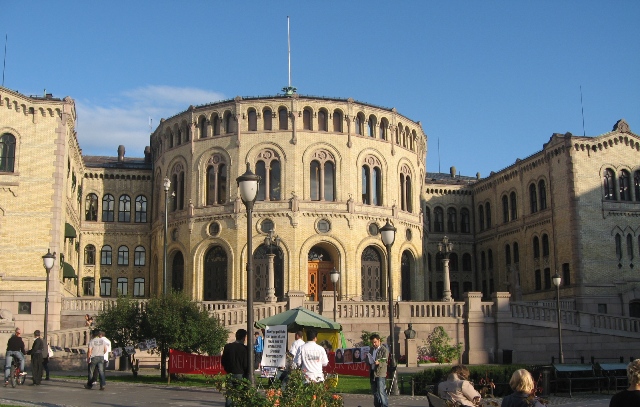
Norwegian Parliament that appoints Nobel Peace Prize Committee

The prize does not have a very good track record in gender balance either. Only 12 of the 95 individual winners are women. Heroines of Peace: profiles of women winners (up to 1997)

And a few laureates may not have deserved to be so honoured – but Lundestad won’t name any for now (he likes his job and wants to keep it). Perhaps one day, after retirement, he might write a book where this particular insight could be shared.

Controversy has been a regular feature of the prize – both over its selections and exclusions. This is only to be expected when thousands of nominations are received every year, and given the high level political message the selection sends out to the world.

Despite its flaws, there is little argument that the Nobel Peace Prize is the most prestigious of all awards and prizes in the world. At Swedish Krona 10 million, or a little over 1.5 million US Dollars, it isn’t the most lavish prize – but much richer prizes lack the brand recognition this one has achieved over the decades. And it is the best known among over 100 peace prizes in the world.

In recent years, the committee has steadily expanded the scope of the prize to recognise the nexus between peace, human security and environmental degradation (Wangaari Mathaai in 2004; Al Gore and IPCC in 2007) and the link between poverty and peace (Mohammud Yunus, 2006).

The most important question, to many historians and scholars of peace, is the political and social impact of the Nobel Peace Prize. Lundestad is being too modest when he says that it’s the laureates, not the prize itself, that has achieved progress in various spheres ranging from nuclear disarmament and humanitarian intervention to safeguarding human rights and poverty reduction.

“We may have contributed — and that is quite enough,” he says. “We don’t claim to have ended the Cold War, or apartheid in South Africa.”

But the prize’s influence and catalytic effect are indisputable. When the 1983 prize was given to Polish trade union leader Lech Walesa, it triggered a whole series of events that eventually led to the crumbling of the Iron Curtain, collapse of the Berlin Wall and the eventual disintegration of the once mighty Soviet Union. The process culminated when Mikhail Gorbachev became the 1990 laureate.
Read Nobel Peace Prize: Revelations from the Soviet Past

In another example, over the years there have been four South African laureates – Albert Lutuli (1960), Bishop Desmond Tutu (1984), Nelson Mandela and F W de Klerk (sharing 1993 prize). Lundestad says: “But we would never claim that the prize was a major factor in ending apartheid in South Africa. The prize was part of the wider international support that built up and sustained pressure on the white minority government. In some respects, the 1960 prize to Lutuli may have been the most significant – for it triggered a process that culminated in the early 1990s.”

He acknowledges, however, that in hot spots like Burma, East Timor and South Africa, the Nobel Peace Prize has enhanced the profile of key political activists and helped maintain the international community’s and media’s interest in these long drawn struggles.

And as Lundestad and the Nobel Peace Prize Committee of five unknown Norwegians know all too well, there is much unfinished business in our troubled and quarrelsome world seeking an elusive peace.

Read Geir Lundestad’s 2001 essay on the first century of the Nobel Peace Prize.
Read his 1999 essay ‘Reflections on the Nobel Peace Prize’

Watch a 2005 interview by University of California television, where host Harry Kreisler talks with Geir Lundestad. They discuss the Nobel Peace Prize, its history, impact and the controversy surrounding some of the awardees (December 2005):