The Road from Citizen Kane to Citizen Journalist

From Citizen Kane to Citizen Journalist.

That’s the original title given to an essay that I co-wrote with Sir Arthur C Clarke nearly two years ago, at the invitation of the Indian news magazine Outlook.

The editors of Outlook changed it to Arise, Citizen Journalist! — which was fine, though perhaps not as poignant.

Of course, our original title would make sense only if you know what Citizen Kane means. That’s the name of the famous 1941 movie directed by Orson Welles, based on the life and career of American newspaper publisher Charles Foster Kane. The Wikipedia describes Kane as ‘a man whose career in the publishing world was born of idealistic social service, but gradually evolved into a ruthless pursuit of power and ego at any cost.’

Many consider Citizen Kane to be one of the finest movies ever made — some rank it as the best ever.

Image courtesy Wikipedia

In the essay, written within months of the Asian Tsunami of December 2004, we looked at the rise and rise of citizen journalists — taking both a historical perspective and a futuristic scenarios.

On the road thus far, we wrote: “Historically, organised and commercialised mass media have existed only in the past five centuries, since the first newspapers — as we know them — emerged in Europe. Before the printing press was invented, all news was local and there were few gatekeepers controlling its flow. Having evolved highly centralised systems of media for half a millennium, we are now returning to a second era of mass media — in the true sense of that term. Blogs, wikis and citizen journalism are all signs of things to come.

After exploring the corporatisation of the mass media, and its implications for free flow of information and opinions, we ask the question: can the citizen journalist fill the many voids in today’s mainstream media?

The essay quotes John Naughton, a noted British chronicler of the new media, who has watched and commented on the rise of blogging and its impact on the rest of the media. We also refer to researches Shayne Bowman and Chris Willis who have defined citizen journalism as the act of citizens “playing an active role in the process of collecting, reporting, analysing and disseminating news and information”

We raise the all-important question: “Will citizen journalism survive and thrive in the harsh marketplace? The answer to that question lies in our hands—let us not underestimate the power of the discerning media consumer to set new trends (and not forget how mass indifference kills many innovations).

The essay suggests that we should not write off the mainstream media — it has survived and adapted to many changes in both technology and the marketplace.

But our conclusion is definitive: Yet one thing is clear: the age of passive media consumption is fast drawing to an end. There will be no turning back on the road from Citizen Kane to citizen journalist.”

Read the full essay in Outlook magazine’s 10th anniversary issue, 17 October 2005

Read my friend Shahidul Alam on ‘Publishing from the Streets: Citizen Journalism’

Shahidul Alam on citizen journalism on MediaHelpingMedia website

Joey R B Lozano: The legacy continues…at Silverdocs

I met Joey R B Lozano only once, but he left a deep impression.

A small-made man with passionate zeal and tons of energy, he was every inch an activist-journalist-campaigner. We had invited him to a regional workshop of factual video producing and distributing partners from across Asia that we held in Singapore in November 2002.

We hadn’t worked with Joey earlier. He came recommended by our international partner Witness, which uses video-based advocacy and activism for promoting and safeguarding human rights worldwide.

Joey R B Lozano Joey R B Lozano Joey R B Lozano

Joey used his personal video camera to assert indigenous land rights, and to investigate corruption and environmental degradation in his native Philippines. Joey was an independent human rights activist and also one of the country’s leading investigative reporters.

He freelanced for the Philippine Daily Inquirer, covering Indigenous peoples’ rights and the environment, considered the two most dangerous beats in the Philippines. But years earlier, he had moved out of the capital Manila, and committed his life and career to stories and issues at the grassroots that many of his city-based colleagues had no time or patience in covering on an on-going basis.

Trained as a print journalist, Joey mastered new media and technologies whose potential he quickly realised. He moved into television and video media with ease, and later became an active blogger.

Joey’s TV investigations began in 1986, when he helped ABC’s 20/20 to uncover the “Tasaday hoax”, a highly successful fraud to pass off local tribespeople as a newly discovered Stone Age culture.

He soon embarked on his own investigations and started digging into illegal logging, gold mining and land-grabbing. In turn, his exposes quickly earned him repeated assassination and abduction attempts, in a country that is one of the more dangerous places to practice journalism.

When he came to Singapore, Joey had recently ‘starred’ in a major Canadian documentary titled Seeing is Believing: Human Rights, Handicams and The News, which looked at how committed, passionate individuals were using new communication technologies to change the world.
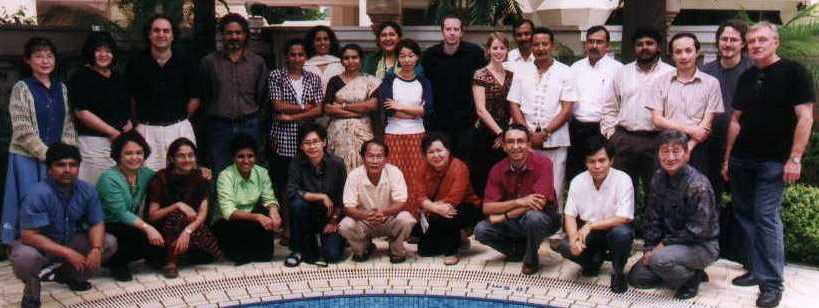
participants-at-tveap-partner-workshop-singapore-nov-2002.jpg

Photo of Singapore TVEAP workshop participants: Joey Lozano is 6th from left on the frontmost row

Follow Seeing is Believing storyboard on the film’s website

We screened the film, made by Katerina Cizek and Peter Wintonick, and heard first hand from Joey on what his struggles entailed. The film followed Joey as he delivers a new “Witness” donated video camera to Nakamata, a coalition of Indigenous groups in Central Bukidnon. Together, Nakamata and Joey begin documenting a dangerous land claims struggle, and it doesn’t take long for tragedy to unfold in front of the camera.

Watching the film and then listening to Joey — and his Witness colleague Sam Gregory — describe the on-going struggle, was one highlight of our week-long workshop. Some of us saw in Joey the activist-campaigner that we wanted to be, but were too scared or too polite to really become.

Not everyone shared that view. The cynicism — sometimes bordering on disdain — of a fellow Filipino from Metro Manila was palpable. No wonder Joey moved away from the city.

We at TVE Asia Pacific were extremely keen to distribute Seeing is Believing, for it held such a powerful and relevant message for our region, but it was not to be. Our enquiries showed that like most documentaries, it was tied up in too many copyrights restrictions and commercial distribution deals.

Following the Singapore workshop, I did keep a watchful eye on what Joey Lozano was up to. The film’s website provided occasional updates, and sometimes blog posts from Joey himself.

Our paths never crossed again. Almost three years after our single encounter came the news that Joey had passed away. It wasn’t the assorted goons who hated his guts that finally got him. His own body turned against him.

His tribute on the film’s website started as follows:

Joey Lozano defied the odds. For three decades, he survived dangerous missions to defend human rights using his video camera, in the Philippines, a country that ranks high, year after year, for most journalists killed. Joey went into hiding numerous times, and he dodged two assassination attempts. Once, bullets whizzed past his ear as he made his escape on motorbike.
But Joey couldn’t beat the odds of cancer. He died in his sleep on September 16, 2005 – at home and surrounded by his family.

Joey R B Lozano - image courtesy Seeing is Believing

The spirit and legacy of Joey R B Lozano live on. He inspired a large number of journalists and activists to stand up for what is right and just — and to be smart about it in using modern information and communication technologies, or ICTs.

Joey and other Witness activists were pioneers in different parts of the world who turned handicams away from weddings and birthday parties to capture less cheerful sights and sounds the world must see — and then act on. They were at it years before mobile phone cameras, YouTube and user-generated content in the mainstream media.

And now, Witness has established an award at the Silverdocs film festival. The WITNESS Award in Memory of Joey R.B. Lozano will be awarded to the qualifying SILVERDOCS filmmaker of a feature-length film who has produced a well-crafted and compelling documentary about a human rights violation or social justice issue. The winning filmmaker will also have a thoughtful, creative, and feasible outreach plan to use their film as a tool to raise awareness of the human rights or social justice issue explored in the film with a goal to bring about change.

The inaugural award was announced on June 17 — and has been won by “The Devil Came on Horseback” by Annie Sundberg and Ricki Stern.

Joey was a Witness partner and board member. He co-produced many films and collaborated on others that helped raise awareness about threats to indigenous people’s rights in the Philippines from corporations, and the complicity of the government in the abuses. Witness was founded in 1991 by musician peter Gabriel and the Lawyer’s Committee for Human Rights to put new technologies into the hands of local activists around the world.

Joey R B Lozano with his handycam

Read International Wildlife May 1999: Why Joey Lozano Is A Marked Man – investigative reporter works for the environment

Read about and watch Rule of the Gun in Sugarland

Asia Mediasaurus Summit 2007 now on in Kuala Lumpur?

As the Asia Media Summit 2007 started this morning at Hotel Nikko in Kuala Lumpur Malaysia, I had to kick myself hard to make sure it was not a bad dream concocted by my often over-active imagination.

The first plenary session was on ‘Era of participatory media: Rethinking mass media’. It was a response to what many of us had urged the organisers, Asia Pacific Institute for Broadcasting Development (AIBD), to do this time around: take a closer look at how the citizens’ media are evolving and impacting mainstream media.

The session had three speakers — the Director General of Deutsche Welle (DW) of Germany, Director General (international planning) of NHK Japan, and an Editor Emeritus (no less!) from The Toronto Star newspaper in Canada. (The fourth speaker, Director General of Al Jazeera Network, didn’t show up – is it because he no longer holds that job after a recent shake-up of the network’s top management? See: Pro-US coup at Al Jazeera?)

Image courtesy AIBD

The panel was chaired by Jennifer Lewis, who edits Singapore Straits Times Online, Mobile and Print offering — better known by its abbreviation STOMP. She was the only interesting speaker and, tellingly, the only speaker who had any direct experience with the new media or participatory media.

Age has something to do with it, I guess. I’m 41 years old, and I don’t consider myself a digital native. I didn’t grow up with computers and mobile phones like my 11-year-old daughter is now doing. For all my interest in the new media, I remain a digital immigrant trying to find my way in the digital world.

For sure, DW, NHK and The Toronto Star are venerable media institutions that have long served the public interest. No argument there. But why were their chiefs pontificating on the limitations of new media — especially blogs — while there was not a single new media practitioner on the panel (not counting Jennifer, who as moderator didn’t get to share her own experience)?

We sat there hearing from the worthies of the old media that bloggers have limitations of outreach, legitimacy and credibility. They grudgingly acknowledged the existence and some advantages the new media have over their own (old and tired?) media. But all of them failed to say anything new or interesting.

Some, like the emeritus Canadian editor, in fact could not understand why there was no business model in blogs. (Yes, we know it stumps the commercialised media to see so many of us working for no gains or perks of any kind!). He then ventured to make sweeping generalisations about all new media by trying to make a tenuous link between new media platforms and their use by terrorist groups. That was so off the mark that does not warrant a response. The moral is: Elderly editors must stick to what they know best.

During question time, a few audience members tried to point out the complementarity of the old and new media, but by then the tone had already been set: this is going to be yet another gathering of the now rapidly endangered mediasaurus – about whom I have talked about in this previous post.

AMS 2007’s first session showed us well and clear the great divide between the old media and new media. The panel failed miserably and completely to find any bridge across the two. It was doomed from the start because there was no representative of the new media on it.

Asia’s largest gathering of media managers and policy makers has got off to an inauspicious start.

I don’t want to spend three days of my time if this is going to be Asia Mediasaurus Summit.

Source: http://www.indcjournal.com/archives/ariaillg2.jpg

Outsourcing with a heart: Cambodia’s success story

Today, 16 May 2007, was observed worldwide as World Information Society Day – it marks the establishment of the International Telecommunications Union (ITU) in 1865 and used to be called the World Telecommunication Day.

The UN-sponsored day was dedicated this year to making available the benefits of the digital revolution to young people everywhere. As the ITU noted in its media release:

The World Summit on the Information Society (WSIS) recognized the young as the future workforce and the earliest adopters of ICT, and called for their empowerment as key contributors to building an inclusive Information Society. World leaders stated their commitment at the Summit in Tunis to actively engage youth in innovative ICT-based development programmes and widen opportunities for them.

Yesterday I wrote about a TV service in Pasadena, California, outsourcing some of its reporting work to journalists in India.

Outsourcing is a worldwide trend, fuelled by the rolling out of Internet access and encouraged – at least in part – by the lower salaries that equally skilled persons still command in the less developed parts of the world. So much has been written and spoken about outsourcing in the IT industry, which has created multi-million dollar businesses in recipient countries such as India.

The outsourcing industry employs tens of thousands of young women and men in developing countries, especially in Asia, which receive the outsourced work. Most of them are from urban backgrounds with English-speaking ability and reasonable levels of education.

But this business-driven process can also benefit young people who haven’t had such advantages in life.

digits4change.jpg

A story in TVE Asia Pacific’s Digits4Change series illustrates this potential. It came from Cambodia, and we called it Compassionate Data.

digits4change-tv-series-cambodia.jpg

We went to Cambodia in late 2005 to find out how business process outsourcing (BPO) is benefiting one of the poorest countries in the world.

Emerging from decades of conflict, Cambodians are now trying to find their place in the global village. But lacking in English and computer skills, many find their opportunities limited.

Digital Divide Data is a non-profit organisation run like a business. Started in 2001, they outsource data processing work from the west.

As the world goes digital, thousands of old, paper-based documents need to be digitised. These tasks take time, effort and quality control. Digital Divide Data (DDD) provides this value added service.

Among its clients are universities, companies and organisations in North America.

But what’s special about DDD is their staff. They employ young men and women from disadvantaged backgrounds – orphans, those with disabilities, or from very poor, rural backgrounds. A few have been trafficked for the sex trade.

Sith Sophary Nhev, DDD’s then Cambodia manager told us: “Many companies outsource this kind of service to international clients by using educated and skillful people, but DDD use disadvantaged people who have low skill and low education but we still provide like a good service, quality, time turnaround and a competitive price for the clients.”

Young people come to DDD with a basic education and virtually no skills. The company trains them in computers and English. In fact, all staff are required to continue their education. The company provides scholarships – and pays them an above average salary.

In the hard-nosed ICT industry that’s usually driven by financial bottomlines, DDD has demonstrated that it is indeed possible to do well and do good at the same time. They are a social enterprise, a growing trend worldwide.

digits4change-compassionate-data.jpg

[

]

Watch the full story on TVEAP’s YouTube Channel

Digits4Change TV series website

Digital Divide Data website

Press freedom in the digital age: Seeing beyond our noses and tummies

See later post on 3 May 2008: Who is afraid of Citizen Journalists?

On 3 May 2007, we mark another World Press Freedom Day.

This day is meant to ‘raise awareness of the importance of freedom of the press and to remind governments of their duty to respect and uphold the right to freedom of expression enshrined under Article 19 of the Universal Declaration of Human Rights.’

Read more about the Day on the Wikipedia and World Association of Newspapers. (Ah yes, that cartel of governments called UNESCO also puts up a show every year to mark this day, but it’s no better than the mafia bosses coming together to pontificate about the rule of law and justice for all. So let’s completely ignore the irrelevant UN behemoth and its meaningless hot air.)

The essay I wrote two weeks ago about saving our (electro-magnetic) spectrum to safeguard media freedom and media pluralism has been widely reproduced on the web.

That’s precisely the kind of insidious, hidden dangers to media freedom that don’t receive sufficient attention at many events to mark World Press Freedom Day.

I found this out the hard way when the Editors Guild of Sri Lanka invited me to address their observance of the 2001 World Press Freedom Day in Colombo. In the audience were over 250 Sri Lankan journalists and editors, and my topic was global trends and challenges to press freedom.

I decided to talk about ICTs – information and communication technologies – and how they were impacting the profession and industry of journalism. I recalled how technologies like mobile phones and satellite television had completely revolutionised the nature of news gathering and dissemination during the 1990s. The Internet was once again turning the whole media world upside down, I said: sooner rather than later, the impact of these developments would be felt in little Sri Lanka.

I argued that by being well informed and prepared, we could adapt better to the new challenges posed by the Internet, and we will be able to seize the many opportunities the new medium offers to consolidate press freedom. I mentioned some examples from the Asia Pacific and elsewhere how social activists, indigenous people and political groups – including separatist organisations – are using the power of the Internet to disseminate information and opinions at a low cost to a worldwide audience, and how states and their censors were increasingly unable to control such flows across political borders.

Unfortunately, a section of the audience felt very strongly that I was talking ‘pie in the sky’ when journalists in Sri Lanka were grappling with much more urgent issues of survival – such as low salaries, poor working conditions, and threats of physical harm or even death in the line of duty.

I was told — firmly — not to talk about computers and Internet when some media organisations did not even provide sufficient seating or (book) library facilities for their journalists. “Internet is good for pampered western journalists. We have survival issues,” one ardent critic said.

Now, it’s far more interesting to talk to a room full of disagreeing people. I took these comments in that spirit.

In the ensuing discussion, I readily agreed that all immediate factors mentioned by my detractors were indeed major concerns. My point, simply, was that we could not afford to ignore the bigger trends and processes that shape our industry and redefine how we reach our audiences.

Cartoon courtesy WAN

Just as terrestrial television broadcasters had to adjust and reorient themselves when faced with challenges from satellite television in the 1990s, the entire media sector – print and broadcast – has to come to terms with the Internet and World Wide Web.

I added: It doesn’t do any good to bury our head in the sand and wish it to go away. The much better option, as Sir Arthur Clarke has suggested, is ‘cautious engagement of the new media, so that we can exploit the inevitable’

Exploiting the inevitable is precisely the pragmatic approach we need. The globalisation of economics, media and information is taking place regardless of our individual opinions and reactions. By positioning ourselves for cautious engagement and to take advantage of tools and opportunities ushered in by the digital age, we can promote both media freedom and media pluralism.

Three years later, I expanded these ideas into a semi-academic paper (that is, as academic as I can ever get!) presented to the Annual Conference of the Asian Media Information and Communication Centre (AMIC) held in Bangkok, Thailand, in July 2004. I titled it: Media Pluralism in the Digital Age: Seize the Moment

It was later published in AMIC’s quarterly journal, Media Asia. Here’s how I ended my paper:

Newer ICTs can strengthen the outreach, quality and inclusiveness of the mass media. The true potential of this change can only be tapped when all stake-holders of the media play their part. A particular challenge to the ICT4D community is advocating the policy and legislative reform agenda that will enable this process.

There is an interesting post script to my experience with the Sri Lankan media on World Press Freedom Day 2001 quoted at the beginning.

During the past three years, more journalists, producers and their gatekeepers have begun using the Internet as a tool, information resource or alternative medium for expression. The initial apprehensions that some professionals harboured about this new medium have been replaced with growing enthusiasm and a recognition of its utility.

The vindication of my initially disputed seminar remarks came sooner than I expected. My most vehement critic that day was a fire-breathing young reporter then working for a Sinhala newspaper. Less than a year later, this avowed sceptic of the Internet launched his own website to disseminate news and commentary on social, political and economic issues that he felt he could not freely cover in the mainstream print outlets. The fact that his initiative did not last more than a few issues is another matter; clearly, he has been converted.

He would be happy to hear that I have been among regular visitors to his website.

Related: Media Freedom Internet Cookbook

Media Helping Media website

And now, Al Jazeera get on You Tube

YouTube seems to be everywhere!

Last week in Sydney and this week in Melbourne, journalists and media researchers can’t talk enough about You Tube — though not everyone is equally enthusiastic about the online video sharing platform.

This just in, from MediaChannel.org:

Al Jazeera English goes You Tube

The Doha-based broadcaster Al Jazeera (English) will launch a YouTube branded Channel, the company said today. YouTube users worldwide will have the ability to comment on Al Jazeera English clips, rate them, recommend them to friends and post their own video responses to communicate with other viewers.

Content will include segments from shows such as ‘Frost over the World’, ‘Everywoman’, ‘Inside Iraq’, ‘Inside Story’, ‘Listening Post’, ‘Riz Khan’, ‘One-on-One’, ‘The Fabulous Picture Show’, ‘Witness’ and ‘48′. Al Jazeera English is also planning to release some exclusive web-only programming, starting with ‘Poltical Bytes’, a global conversation hosted by UN correspondent Mark Seddon which will ask the YouTube community to carry on the conversation and add video contributions. The broadcaster said it will provide new content to the site by adding at least 10-15 new clips each week.

Nigel Parsons, Managing Director of Al Jazeera English said: “We believe that YouTube is a perfect platform to reach out to our audience and to give wide and easy access to new viewers around the world. We have significantly built on our distribution since launch and now reach well in access of 90 million cable and satellite households worldwide. With YouTube’s community of millions of online users this is set to dramatically increase.”

SOS: Save Our Spectrum for media freedom

I’m strongly committed to promoting media freedom, but have never been the placard-carrying, slogan-shouting type. Street activism is necessary — but not sufficient.

I’ve been more interested in studying trends and conditions, trying to anticipate what the next big threats, challenges and opportunities are, and how best we can respond to them.

For years, I’ve been writing and talking about the need for proper spectrum management as a pre-condition for media freedom and media pluralism. Last week, I once again spoke about these core issues at OUR Media 6 Conference in Sydney.

I’ve just adapted my Sydney panel remarks into an op ed essay, just published by the UK-anchored media website, Media Helping Media.

Here are the first few paras:

On May 3, the annual World Press Freedom Day will once again be observed worldwide, focusing public attention on a multitude of threats to freedom of expression through the mass media.

But amidst the extremely relevant and necessary slogans, we are unlikely to hear this one: Hands off our spectrum!

Yet saving our spectrum is critical for ensuring media freedom.

The electro-magnetic spectrum has been called the ‘invisible wealth of nations’ — conventional broadcasting relies on the fair, equitable and sound management of this common property resource.

And as economic and cultural practices move more and more into the digital realm, the spectrum’s value is only set to increase.

But few people -– even within the media profession and industry -– appreciate our dependence on this finite resource. Out of sight does seem to push it out of most people’s minds.

Therein lurks a danger: what we don’t see and value can be quietly taken away, without many of us realizing it.

Read full article and leave your comments

Added on April 18: MediaChannel.org anchored in the US has also just re-published the article. Read their version here

Added on April 19: Free Press.Net has also reproduced the article.

Added on April 20: FreePress.Net in the US reproduces the essay

Added on April 21: Bytes4All South Asian ICT wevsite reproduces my essay

Added on April 21: Reclaim the Media website also publishes the article
Thanks to everyone who considered it worth amplifying to their audiences — we need to spread the word! – Nalaka

Money is not an issue: ‘No budget’ films have their own festival

After over a decade working in television and film, most of that time commissioning new content from independent producers or creating content ourselves, I have yet to come across a film-maker who had enough budget.

We’re are all used to getting by with less than ideal budgets.

Some more than others, though: there are low budget films, and then there are ‘no budget’ films.

A few idealists among us still believe money is not an issue in cultural expression.

They now have their own festival, unashamedly for just that kind of films: No Budget VideoFilmfestival, Heilbronn / Weimar & Tour 2007
No budget video film festival

Their self-intro reads:

In 2007 the „Geld spielt keine Rolle“ (“money is not an issue””it’s only money”) VideoFilmfestival will start a series of events during an independent art-, film- and musicfestival in Heilbronn. From the 8th to 10th of June 2007 it will be in Heilbronn, and thereafter will be ample opportunity to screen the films in Weimar (at the Lichthaus Kino in summer 2007), Magdeburg, London and other cities. The previous festival was carried by the faculty of media of the Bauhaus- University Weimar and took place in Weimar in May 2006.

Filmmakers characterized by creativity and idealism get the opportunity to present their films to a wide audience.
For the audience this promises good films which possibly fall through the cracks of commerce.

Remember: deadline for entries is 1 May 2007.

The festival is being organised by a group of German film enthusiasists calling themselves the film sharing community.

Under the topic GELD SPIELT KEINE ROLLE (Money is no issue) the film sharing community wants to provide a platform for productions of moderate means achieving remarkable outputs and meaningful films on a shoestring.

May their tribe increase!

Michael Crichton, Mediasaurus and end of broadcasting

I just wrote a post on digital pioneer and futurist Mark Pesce’s views on the end of broadcasting and the mass media as we know it.

Television broadcasting is probably a dinosaur facing extinction, but let’s remember a bit of pre-history here: dinosaurs didn’t die off in an instant. No time lord zapped them with some mighty extincter machine. Their decline and eventual extinction was, it is believed, a slow and gradual process.

So it will be with broadcasting. Even if their distribution and revenue models are now undermined and will soon be obsolete, conventional broadcasting (as we know it) will continue to operate and try to compete, at least for a few years. And in the less developed countries with emerging economies, that process will take longer.

Which means we still have to engage TV broadcasters even as their Empires of Eyeball slowly crumble.

And let’s not write off those Empires just yet. I still remember an article in the early days of Wired magazine: appearing in Sep-Oct 1993 issue, it was titled Mediasaurus , and written by the well known science fiction author (and medical doctor) Michael Crichton (of Jurassic Park and ER fame).

Michael Crichton, courtesy Michael Crichton website

He started the article as:
I am the author of a novel about dinosaurs, a novel about US-Japanese trade relations, and a forthcoming novel about sexual harassment – what some people have called my dinosaur trilogy. But I want to focus on another dinosaur, one that may be on the road to extinction. I am referring to the American media. And I use the term extinction literally. To my mind, it is likely that what we now understand as the mass media will be gone within ten years. Vanished, without a trace.

And he ended:
So I hope that this era of polarized, junk-food journalism will soon come to an end. For too long the media have accepted the immortal advice of Yogi Berra, who said: “When you come to a fork in the road, take it.” But business as usual no longer serves the audience. And although technology will soon precipitate enormous changes in the media, we face a more immediate problem: a period of major social change. We are going to need a sensitive, informed, and responsive media to accomplish those changes. And that’s the way it is.

I just re-read the full article, and Crichton’s analysis is even more valid today than when it was written over a dozen years ago. But it’s also true that the broadcast industry – and conventional media as a whole – have changed and adapted.

No doubt that Mediasaurus still has an expiry date, but it’s not easy trying to guess exactly when the last of their kind drops dead.

Read the full article on Wired Online

Mark Pesce: In the company of a hypermind

Oops – I didn’t immediately realise that I was sharing a panel with a digerati – a highly accomplished pioneer and visionary of the digital world. And did he get us to think outside the idiot box!

His name is Mark Pesce. He is one of the early pioneers in Virtual Reality.
The co-inventor of VRML, he is the author of five books and numerous papers on the future of technology. Now based on Sydney, Australia, he is a writer, researcher and teacher.

Mark Pesce, courtesy Wikipedia

During the OUR Media 6 panel discussing how to safeguard community interests in the era of digital broadcasting, he was emphatic that broadcasting as we know it is doomed.

“The mass mind is not going to last. The sooner broadcasters recognise this, the better,” he said.

The broadcast model of one-way, point-to-multipoint, passive distribution of content is endangered by the digital revolution. The age of hyperdistribution has already dawned, and that is going to wipe out conventional distribution models sooner than later.

Hyperdistribution is audience-driven distribution of films and television programmes. The economics of production and distribution of media have changed radically – can film-makers adapt to the new rules? This is the question that Mark posed in talk given at the Sydney International Film Festival in Jube 2006 – listen to audio recording of his talk.

The near future of content distribution is in Internet-enabled, user-driven and often mobile devices. Already, two billion people – almost a third of humanity – walks around with mobile phones. These will provide new pathways to peddle new types of content to more audiences than ever before.

The film-making and TV-producing communities need to wake up to these new realities, Mark said.

His blog, Hyperpeople, is full of fascinating insights and extrapolations. Here’s one short extract:
Television producers are about to learn the same lessons that film studios and the recording industry learned before them: what the audience wants, it gets. Take your clips off of YouTube, and watch as someone else – quite illegally – creates another hyperdistribution system for them. Attack that system, and watch as it fades into invisibility. Those attacks will force it to evolve into ever-more-undetectable forms. That’s the lesson of music-sharing site Napster, and the lesson of torrent-sharing site Supernova. When you attack the hyperdistribution system, you always make the problem worse.

In May 2005, he wrote in an article titled Piracy is good? How Battlestar Galactica killed broadcast TV:
Television broadcasters owe their existence to the absence of substantially effective competition. When you’re dealing with real-world materials that are in naturally short supply – whether diamonds, oil, or broadcasting spectrum — a cartel can maintain and enforce its oligopoly. But when you’re working with media, which exist today as digital ephemera, bits that can be copied and reproduced endlessly at nearly zero cost, broadcast oligopolies are susceptible to a form of “digital arbitrage,” which can hollow-out their empires in an afternoon. Hyperdistribution techniques are more efficient than broadcast networks for television program distribution.

Read my other post on the OUR Media Forum on the community use of digital spectrum

Mark Pesce website

Mark Pesce blog, Hyperpeople