Sharing archives: Will broadcasters (finally) put planet before profit?

I have long wondered if both radio and TV broadcasters store their archival material in black holes – into which everything disappears and nothing ever comes out. And certainly, nothing is shared with anyone else.

In a widely reproduced and commented op ed essay written for SciDev.Net in November 2008, titled Planet before profit for climate change films, I noted:
“It isn’t just climate-related films that are locked up with copyright restrictions. Every year, hundreds of television programmes or video films — many supported by public, corporate or philanthropic funds — are made on a variety of development and conservation topics.

“These are typically aired once, twice or at best a few times and then relegated to a shelf somewhere. A few may be released on DVD or adapted for online use. But the majority goes into archival ‘black holes’, from where they might never emerge again. Yet most of these films have a long shelf life and could serve multiple secondary uses outside the broadcast industry.”

Escape from the Southern 'black hole'?
Well, it seems things are changing, albeit very slowly. Last month, we welcomed the announcement from Al Jazeera sharing their news footage online through a Creative Commons license — the first time that video footage produced by a news broadcaster is released for commercial and non-commercial use.

Now comes the news that Australia’s public broadcaster ABC is releasing selected content from its vast archives for non-commercial use by others. And we must thank Charles Darwin for that.

On 12 February 2009, to celebrate Charles Darwin’s 200th birthday, ABC started releasing some archival materials, all based loosely around the theme of evolution and mutation. This Australian first was achieved through ABC’s collaborative media site, Pool.

In an imaginatively named effort called Gene Pool, ABC started off with a recording from its archives of genetics professor Steve Jones talking about Darwin’s life and work.

The next offering to Gene Pool would be a clip from ABC’s Monday Conference in 1971 featuring Stanford entomologist Paul Ehrlich talking about climate change (yes, it’s from 38 years ago!).

These materials are being released under the Creative Commons 3.0 licence allowing people to reuse or remix them in any way they like — as long as it’s for non-commercial use.

On Gene Pool website, ABC said: “You can also create your own work exploring the themes of evolution and mutation in lateral ways, and share them back into the Gene Pool.”

A framework for sharing...
As Creative Commons Australia explained: “This means that people can tweak, twist and remix the files to create their own creative interpretation of the themes of evolution and mutation, and share these results with the rest of the world. The idea is to build a whole community up around the project, remixing and reusing the ABC archival material in new and previously unthought of ways. This all culminates in a public exhibition of Gene Pool pieces at Melbourne’s RMIT on November 24th – the 150th anniversary of the publication of Darwin’s book The Origin of Species.”

They added: “Just imagine what gems might be hidden away in ABC filing cabinets, waiting to be discovered and put to good use by the population that payed for them in the first place.”

That’s precisely what I’ve been saying for a long time – the taxpayer-funded broadcasters like BBC, NHK or ABC (and their equivalents in other countries) have no moral right to lock away their archives on legal or technical grounds. And to think that some of the content thus held up could actually help us in winning history’s eternal race between education and catastrophe!

Nothing escapes this one...for now
Nothing escapes from this one...for now
The BBC – hailed as a model public broadcaster worldwide – is among the worst offenders on this count. It holds one of the largest archives on environment, natural history and wildlife filmed all over the planet for several decades, yet it stubbornly refuses to share this material with anyone, even when it’s only for strict non-commercial, educational use. Read one example in my July 2007 blog post, The Lawyers who locked up the Butterfly Tree.

This myopic selfishness is contrasted (and put to shame) by exceptional film-makers like Richard Brock (who worked with BBC Natural History Unit for 35 years before leaving it unhappy over its rights management) who have decided to open up their personal video archives for non-commercial use especially in the majority world where such material is in short supply.

We can only hope that ABC’s move would build up pressure on the stubborn old Auntie BBC to finally relent. In fact, this might be a chance for all those public broadcasters – many of them now ‘Aunties without eyeballs’ – to redeem themselves at last, ending decades of copyrights tyranny. (And if that puts their inhouse lawyers out of a job, they can join greedy bankers now lining up for public forgiveness!)

ABC says about its tentative steps to the world of open archives: “It’s a small offering to start but there’ll be a lot more to come. We’re working madly behind the scenes getting clearance to release more more more.”

Watch this space…and keep an eye on that Gene Pool!
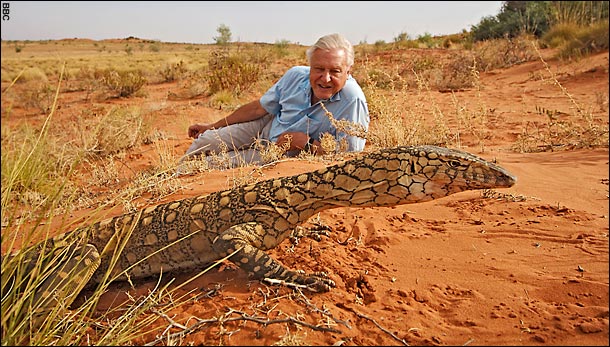
The quest for next David Attenborough continues…

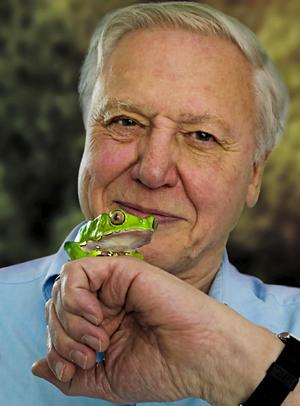
Human Ambassador to the natural world...David Attenborough

I spent most of today at the Wildscreen film festival being held at the British Council Colombo. Naturalist and broadcaster Sir David Attenborough featured prominently in two films screened: Can We Save Planet Earth? (2006) and Life in Cold Blood: Armoured Giants (2008).

For me, it was more than a fascinating journey to far corners of our endangered planet in the company of the world’s best known broadcaster, and Britain’s most trusted public figure. I recalled how in this very venue, as an eager teenager growing up in the simpler, pre-web days of the 1980s, I watched his pioneering series Life on Earth (1979) and The Living Planet (1984). These path-breaking series redefined how natural history documentaries were made, and inspired a whole new generation of film-makers and nature lovers. A quarter century later, I’m still hooked.

Over the last 25 years, Attenborough has established himself as the world’s leading natural history programme maker with more landmark series: The Trials of Life (1990), The Private Life of Plants (1995), The Life of Birds (1998), The Life of Mammals (2002) and Life in the Undergrowth (2005). The final chapter in the ‘Life’ series is Life in Cold Blood (2008).

As fellow broadcaster Jeremy Paxman noted in a Time magazine tribute to Attenborough: “Life After Death is almost the only natural-history series yet to be made by Attenborough. In a career that has taken him to every corner of the world, he has explored life in all its richness — from mammals and birds to plants and reptiles. No living person has done more to make the people of Planet Earth aware of the world around them.”

Close encounters?
Close encounters?
But as I wrote in May 2007, “like all creatures big and small in the great Circle of Life that Sir David has so avidly told us about, he too is mortal. At 81, it’s time for the world to look for the next David Attenborough.”

In his Time tribute, Paxman noted that what distinguishes Attenborough is “that boundless, schoolboyish enthusiasm, the infectious joy of discovering the infinite variety of life”. Yet as the popular song goes, dragons live forever, but not so little boys – so the quest for the next Attenborough has quietly preoccupied the minds of many practising or following the world of natural history and environmental film making.

I’m not obsessed with this question (and I wish Sir David many more years of life on Earth and life on the airwaves), but I today popped it to Jeremy Bristow, a producer of environmental programmes at BBC Television, at the end of his fascinating master class on The role of films in Environmental Conservation. Jeremy’s most recent project has been two films hard-hitting films on Climate Change with Sir David Attenborough for BBC1 and the Discovery Channel.

The bad news is that despite searching far and wide – even some competitions – the David Attenborough has yet to be discovered.

“There are many talented, passionate natural history film makers and some of them also have good screen presence — but none to match Sir David,” said Jeremy Bristow. “I know many in the natural history film world have kept their eyes open for a potential successor.”

Perhaps Sir David is a unique product of his time and circumstances, Jeremy speculated. Certainly, there weren’t too many getting into this business in the early days of television broadcasting. The first major programme series to feature Sir David was BBC’s Zooquest, which ran from 1954 to 1963. And then, one thing led to another…and more than 50 years later, he’s still in the business.

To me, it’s the voice – authoritative without at all being pompous or pontificating – that gives Sir David enduring and endearing appeal. Time called it ‘the voice of the environment’.

Now is the time when that voice of reason, moderation and passion is needed more than ever. A time when the natural world is under siege from human-induced accelerated climate change even as the world of science takes daily beatings from assorted fundamentalist forces.

At 82, Sir David still remains not just our most versatile ambassador to the natural world, but also one of the best spokespersons for the rigors of science and intellectual curiosity.

Here’s a recent example of Sir David – taking us on a quick, animated guide to evolution of life on Earth, in a 2009 documentary called Charles Darwin and the Tree of Life to mark 150 years since Charles Darwin published his famous Origin of the Species:

IUCN at 60 finally crosses the ‘Other Digital Divide’…

iucn.org
iucn.org
This news just came in, from IUCN – International Union for Conservation of Nature:
“Gland, Switzerland, 29 January 2009 (IUCN) – The world’s oldest and largest environmental organization is launching a new opinion page on its website, starting today with an article on President Obama written by IUCN’s President, Mr. Ashok Khosla.”

The press release quoted Julia Marton-Lefèvre, Director General of IUCN as saying: “Because we are a science-based organization and because we are also a membership organization, we tend to avoid controversies. While we, as an organization, will maintain our scientific rigor and strict neutrality in defending nature conservation, we wanted to provide our experts and members a space to freely express themselves, get feedback from a wide audience and generate informed debates around the big issues of our time.”

Intrigued, I quickly looked up the new Opinion page, and found this welcome note from Mario Laguë, its Head of Global Communications: “IUCN is an organization that built its enviable reputation on science and on the contributions of all its members. This combination of the need for both accuracy and democratic legitimacy can at times slow down our capacity to react to current events or to express opinions that are not ‘official positions’. While it is clear that the views expressed on this page are not necessarily those of IUCN, we expect them to be in accordance with its vision of ‘a just world that values and conserves nature’.

This isn't quite what IUCN would approve, but still an interesting idea...
Not quite what IUCN would approve, but still an interesting idea...
This is what I would call cautious engagement, but it’s certainly a welcome move. The first contribution to the Opinions page is an article by Dr Ashok Khosla, President of IUCN, titled ‘A new President for the United States: We have a dream’. In his characteristic analytical and perceptive style, Ashok sums up the promise the new US administration holds for pursuing the conservation agenda worldwide.

The opinions page allows comments by readers — moderated, and limited to 300 characters per comment, just enough to make a point briefly. Two days after the Khosla essay was posted online, it had attracted four comments…or at least that many were approved by people at IUCN headquarters who review comments.

Beyond these specifics, the launch of an interactive opinions page marks a new era for IUCN which brings together over 1,000 governments, state agencies and non-governmental organisations committed to preserving life on Earth. It signifies that the alliance as a whole is finally crossing what I have called the ‘Other Digital Divide’ — the one that separates the Digital Natives and Digital Immigrants.

I’m delighted to see IUCN belatedly crossing this divide, which I’ve been advocating for some time. In September 2007, participating in IUCN’s Fourth Asian Conservation Forum in Kathmandu, Nepal, I argued that scientific merit and rational (and often very articulate) reasoning alone won’t win them enough new converts to achieve significant changes in lifestyles, attitudes and practices needed to change business as usual.

I said: “To be heard and heeded in the real world outside the charmed development and conservation circles, we need to employ a multitude of platforms, media and ICT tools.”

I added: “IUCN and other conservationists, with their rigorous scientific analysis expressed in technical papers, print publications and the occasional op ed article in broadsheet newspapers, have to navigate in this whirlpool (of new media) — and it’s not easy. But their choice is between engagement and marginalisation. The planet cannot afford the latter.

“I’m not suggesting that conservation scientists and organisations must drop their traditional advocacy methods and rush to embrace the new ICT tools. But they need to survey the new media landscape with an open mind and identify opportunities to join the myriad global conversations.”

It takes time to turn around a large ship like IUCN, but they have been trying. For example, in September 2008, days before its World Conservation Congress in Barcelona, Spain, IUCN launched its own YouTube channel to share its videos online. Four months later, viewing numbers for the three dozen short videos posted are still in double digits, but a start has been made.

So it’s good to have the grand old lady of global conservation enter the endlessly chatty, cacophonic world of web 2.0. Let’s hope she won’t remain too aloof or elite (what I call the ‘broadsheet newspaper mentality’ when much of the world has gone tabloid or ‘compact’), or try to be too prim and proper in expressing her own views. The conversations online tend to evolve fast, and can sometimes be rough, spontaneous or unpredictable. Excessive moderating can leave out the passion and rhetoric that drive some discussions – sanitising is not recommended except to avoid libel and slander. These attributes can be very disconcerting to well-established organisations that have so far carefully managed their corporate communications. Engaging new media requires losing a good part of that control.

But as our friends in Gland have now recognised, it’s no longer a choice – but an imperative.

September 2007 blog post: Crossing the Other Digital Divide – Challenge to Conservation Community

August 2008 blog post: Wanted: Development 2.0 to catch up with web 2.0!

Climate Neros: Films chained, unchained…

down-to-earth

“Twenty centuries ago, Emperor Nero fiddled while Rome burned. Today, some media companies are squabbling over copyrights while the planet is warming.”

These words, which I first uttered during an Asian workshop on moving images and changing climate in Tokyo in early October 2008, have resonated with many journalists, producers and activists concerned about climate change.

The latest outlet to carry my views is Down to Earth, the fortnightly magazine on science and environment published from New Delhi, India. They have included a condensed version of my remarks in their issue for 15 December 2008, under the heading: Films chained, unchained

It’s part of a special issue to mark the 14th Conference of Parties to the United Nations Framework Convention on Climate Change (UNFCCC) and the fourth meeting of Parties to the Kyoto Protocol, being held in the Polish city of Poznan from 1 to 12 December 2008.

In fact, Down to Earth editor Pradip Saha was part of our Tokyo workshop which called for climate change to be recognised as a copyright free zone.

When Down to Earth editors first mooted the idea of carrying my views, they suggested a catchy headline: Climate’s Niros. I rather liked that…but that didn’t survive their copyediting. Ah, well…

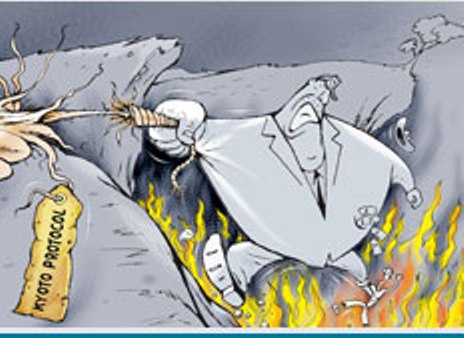
Last chance for Kyoto Protocol? Courtesy Down to Earth
Last chance for Kyoto Protocol?
In its preamble to the special climate change issue, Down to Earth editors say:
“Eleven years after the Kyoto Protocol was signed — only to be consigned to irrelevance over the subsequent decade — nations are meeting in Poland to negotiate post-2012 action.

“The realities of climate change are clearer than ever, and the cost of action is mounting. Rich countries, historically responsible for climate change, are proposing new mechanisms to share the burden. Leading developing countries such as India and China need to negotiate hard as well and make a big push for renewables…” Read full story

On 5 November 2008, SciDev.Net published my op ed essay:
Planet before profit for climate films

On 7 November 2008, Asia Media Forum published a longer version of this essay:
Climate Change or (c)limate (c)hange: Guarding copyrights on a warming planet

These have been linked to, or commented upon, by various blogs and websites. Interestingly, the big time TV/video production companies and broadcasters have been keeping quiet in this debate.

Perhaps they are too busy counting their money accruing from license fees?

Climate change and copyrights: What intellectual property on a dead planet?

Twenty centuries ago, Emperor Nero fiddled while Rome burned. Today, some media companies are squabbling over copyrights while the planet is warming.

This is the main thrust of my latest op ed essay, just published by the Science and Development Network (SciDev.Net) anchored in London, UK. It’s titled: Planet before profit for climate change films.

I have adapted for this commentary some of my ideas initially expressed on this blog – especially the post on 12 Oct 2008: Climate in Crisis and planet in peril – but we’re squabbling over copyrights!

Broadcasting on a warming planet

In writing this essay, I’ve also drawn on the excellent discussions we had last month during the Asia Pacific workshop on Changing Climate and Moving Images in Tokyo.

I’m challenging broadcasters to put their money where their mouth is.

Here’s an excerpt:

“Broadcast mandarins routinely support global struggles against poverty, HIV, corruption and climate change by offering free airtime to carry public interest messages. But few let go of their own products on these very subjects for non-broadcast uses.

“Making climate change a ‘copyright free zone’ for media products would increase the resource materials available to thousands of educators, social activists and trainers struggling to communicate this complex topic to audiences across the world. Moving images would make their task easier.

“The climate crisis challenges everyone to adopt extraordinary measures. Broadcasters and film-makers need to balance their financial interests with planetary survival.

“What use is intellectual property on a dead planet?”

Read my full essay on SciDev.Net: Planet before profit for climate change films.

In September 2006, speaking at the United Nations headquarters (photo below), I called for poverty to be recognised as a copyright free zone. The idea was to have broadcasters and other electronic publishers release copyrights on TV, video and online content relating to poverty and development issues -– at least until (MDG target year of) 2015.

The TV broadcast and film communities have reacted to this proposal with disdain or indifference, but I keep badgering on. If poverty didn’t motivate broadcasters to change business as usual, I hope, the planetary threat posed by climate change would.

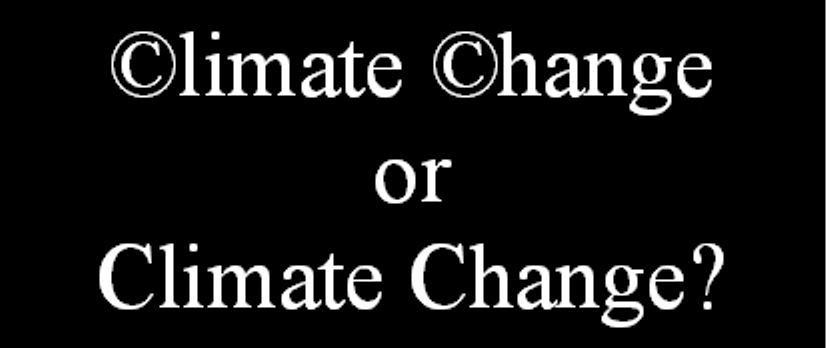
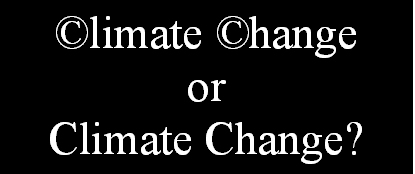
©limate ©hange or climate change? Copyrights on a warming planet

This is the real question!

OK, this is hot off my imaginative mind. I was writing an op ed essay today and turning phrases over in my mind when I came up with this…which neatly sums up what I’ve been saying for a while: confronted with the climate crisis, broadcasters and film-makers need to adopt a more liberal approach to copyrights on their creations.

For discussions on this, see my earlier blog posts:

15 Oct 2008: Standing on Al Gore’s Shoulders: Moving images in the climate debate

13 Oct 2008: ‘Climate Challenge’ marks turning point in Vietnam’s climate concerns

12 Oct 2008: India’s climate change NIMBYsm and middle class apathy

12 Oct 2008: Climate in Crisis and planet in peril – but we’re squabbling over copyrights!

See also these news items appearing on TVE Asia Pacific website:

6 Oct 2008:
Make climate change a ‘copyright free zone’: Asia Pacific TV and film professionals call

4 Oct 2008:
Climate coverage in media needs rational and emotional approaches

Standing on Al Gore’s Shoulders: Moving images in the climate debate

And the winner is...

Al Gore used to have a reputation as a very smart man who was very stiff and aloof especially in his public speaking.

I didn’t notice this the only time I listened to him in person, at an environmental journalists conference at MIT in Boston, Massachusetts, in the Fall of 1995. Perhaps because he was speaking to a group of over 200 journalists, Gore was especially charming. He delivered a well prepared speech passionately, and then took a dozen questions.

I still remember one incident during question time. A Bangladeshi participant lined up to ask him something and started addressing him as ‘Mr President’. Gore smilingly interjected: ‘Not yet!’. The journalist, not the least shaken by his slip of the tongue, said: ‘Well, I hope you will be one day!’.

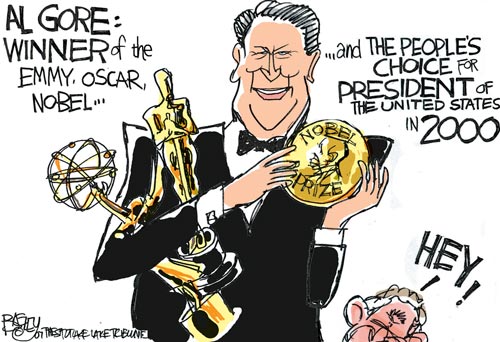
Well, that day came…and it was not to be. Gore won the popular vote in the 2000 presidential election but lost the presidency in a bizarre series of events that had the rest of the world gasping.

All that sounds so long ago, now that Gore has emerged as the world’s best known climate crusader. There are many who feel that he is more effective in his current role than as a politician.

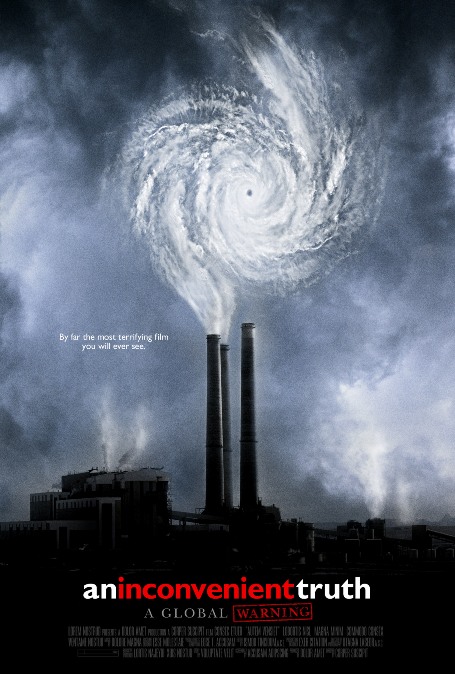
His 2006 film, An Inconvenient Truth, helped move the climate change debate forward in a decisive manner.

Whatever we might think about the film’s artistic and technical merits, I’m glad it has settled one question: can a single film make a difference in tipping public opinion about a matter of global importance?

The answer, where climate change is concerned, is a resounding yes!

For sure, the film arrived at a time when the climate change debate had been going on for nearly two decades. Scientific evidence was mounting for human responsibility for accelerated changes in our climate. Political and business leaders, in denial for years, were finally beginning to take note — perhaps sensing votes or dollars.

Official film poster
Coming in at the time it did — in the Summer of 2006 –- Al Gore’s film tipped the public opinion to agree that climate change was for real and responses were urgently needed.

“It is now clear that we face a deepening global climate crisis that requires us to act boldly, quickly and wisely,” says the former US Vice President introducing his film.

An Inconvenient Truth focuses on Al Gore and his travels in support of his efforts to educate the public about the severity of the climate crisis. Gore says, “I’ve been trying to tell this story for a long time and I feel as if I’ve failed to get the message across.”

The film closely follows a Keynote presentation (dubbed “the slide show”) that Gore presented throughout the world. It intersperses Gore’s exploration of data and predictions regarding climate change and its potential for disaster with Gore’s life story.

An Inconvenient Truth is not a particularly stunning or dramatic documentary. Some have called it a ‘dramatised PowerPoint presentation’ (although Gore actually uses Apple’s Keynote presentation software). There aren’t cuddly animals, deadly chemicals, forest infernos or gory animal hunts that make environmental films appeal to a mass audience.

In fact, it hangs together — and sustains for nearly an hour and a half — due to the sheer star power of Al Gore. And when we take a closer look, we see how hard Gore and his team at Participant Productions have tried to engage audiences.

The film, made on a budget of around US$1 million (modest by Hollywood standards) went on to earn US$49 million at the box office worldwide. As at late 2008, it ranks as the fourth-highest-grossing documentary film in the United States, after Fahrenheit 9/11, March of the Penguins and Sicko.

I first saw An Inconvenient Truth at a cinema in Virginia, USA, while it was still on its initial theatrical release in the Fall of 2006. I reviewed it in early 2007, and recently returned to discussing the film during a presentation I made to our Asia Pacific regional workshop on changing climate and moving images, held in Tokyo in early October 2008.

My thrust was: now that Al Gore and his film have helped turn the climate debate, how can we continue to use moving images in search of solutions? In other words, how do we stand on the shoulders of Al Gore?

Another excellent film on climate change
The Great Warming: Another excellent film on climate change

I looked back at Gore’s film and another excellent Canadian film that came out the same year, The Great Warming. Discussing their merits, I noted how both films appeal as much to our emotions as they do to our rational intellect. “Facts, figures and analysis alone cannot engage a diverse, sometimes sceptical or indifferent audience. That’s why they try a different approach: appealing to the emotions.”

Here are some excerpts from my remarks:

We often see environmental documentaries failing to engage audiences because they pack too much information, or worse, preach too heavily and directly. Some film-makers feel strongly that they must ‘inform and educate’ their viewers at all costs.

To engage people, both are needed
It’s story telling that works best with moving images –- and what better stories to tell than the personalised ones of real people dealing with real world problems and challenges?

With ‘moving images, moving people’ as our slogan, we at TVE Asia Pacific believe in the power of well-made films to reach out to people’s hearts and minds.

Our experience shows that moving images can indeed move people, but only when:
• They are used in the right context;
• They form part of a bigger effort or campaign;
• Audio-visual’s strengths are maximised; and
• Audio-visuals limitations are properly recognised.

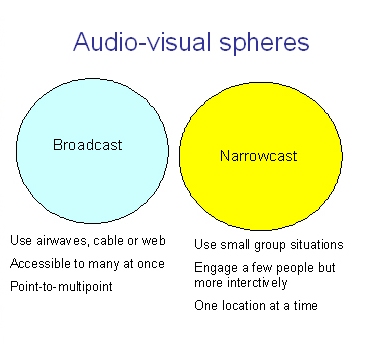
It’s the combination of broadcast and narrowcast spheres that has a better chance of changing people’s attitudes and, ultimately, their behaviour.

Read the full presentation here:
standing-on-al-gores-shoulders-nalaka-gunawardene-speech-in-tokyo-4-oct-20081

‘Climate Challenge’ marks turning point in Vietnam’s climate concerns

Seeking local solutions for a global problem
Climate Challenge TV series: Seeking local solutions for a global problem

Many media reports and documentaries on climate change tend to be scary. Even the most balanced and scientifically informed ones caution us about dire scenarios that can rapidly change the world as we know it.

But it’s not all doom and gloom. Like every crisis, climate change too presents humanity with formidable challenges that can become opportunities to do things differently — and better.

Climate Challenge is a rare TV series that adopts this positive attitude. The 6-part series co-produced by One Planet Pictures in the UK and dev.tv in Switzerland, links the global climate crisis with location action for both mitigation (trying to reduce further aggravation) and adaptation (learning to cope with impacts).

It also makes the point: in the fight against global warming, developed and developing countries must work hand-in-hand to find viable solutions for all.

The film-makers of Climate Challenge focus on some of the most promising approaches to turning down the global thermostat. Climate Challenge goes in search for solutions that won’t put a break on economic growth.

The series had its original run on BBC World News in April – May 2007. Shortly afterwards, TVE Asia Pacific (TVEAP) started distributing it to TV channels, educational institutions and civil society groups across the Asia Pacific region. It has been one of the more popular items on our catalogue of international TV films on sustainable development and social justice.

Our deal with Asia Pacific broadcasters is a barter arrangement. TVEAP clears copyrights for developing countries in our region (more than 30 countries or territories) and offers films free of license fee that normally prevent many southern broadcasters from using this content.

We offer a new set of titles every two months to our broadcast partners – now numbering over 40 channels. They select and order what interests them, and often pay for the cost of copying on to professional tape and dispatch by courier.

When they receive the tapes, accompanied by time-coded scripts, many TV stations version the films into their local language/s using sub-titles or voice-dubbing. They do this at their expense, and then assign a good time slot for airing the films once or several times. They are free to re-run the films as often as they want. The only expectation is that they give us feedback on the broadcasts, so that we can report to the copyright owners once a year.

This arrangement works well, and bilateral relationships have developed between TVEAP’s distribution team and programme managers or acquisition staff at individual TV stations across Asia. Everything happens remotely — through an online ordering system and by email. It’s rarely that we at TVEAP get to meet and talk with our broadcast colleagues in person.

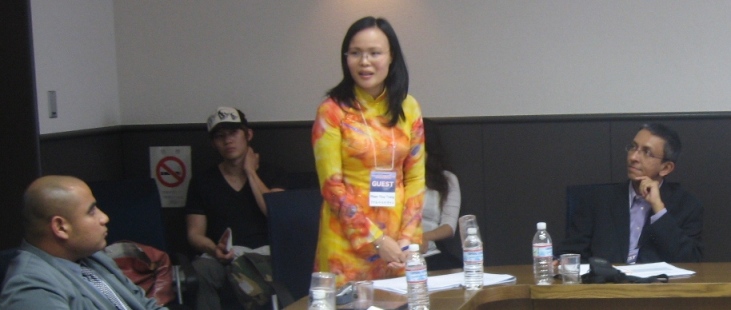
Pham Thuy Trang speaks in Tokyo

I was delighted, therefore, to meet one of our long-standing broadcast colleagues in Tokyo earlier this month when we ran a regional workshop on changing climate and moving images. Pham Thuy Trang, a reporter with news and current affairs department of Vietnam Television (VTV), was one of the participants. She turned out to be an ardent fan of our films.

She told the Tokyo workshop how the Climate Challenge series marked a turning point in Vietnam’s public discussion and understanding of climate change issues.

In mid 2007, VTV was one of many Asian broadcasters who ordered Climate Challenge. Having versioned it into Vietnamese, VTV broadcast the full series in December 2007 to coincide with the 13th UN climate change conference in Bali, Indonesia.

“This was the first time the issue received indepth coverage on TV,” Trang said. This was particularly significant because a 2007 survey had revealed low levels of interest in climate issues by the media in Vietnam.

Vietnam has a 3,000km long coastline
“In fact, the World Bank has identified Vietnam, with its 3,000 km long coastline, as among the countries most vulnerable to climate change impact. Our media has been reporting some developments – such as increased coastal erosion – as purely local incidents without making the climate link,” she noted.

The series, originally broadcast in the foreign documentaries slot, was noticed by the VTV senior management who then arranged for its repeat broadcast in the long-established environmental slot. The latter slot, well established for a decade, commands a bigger audience.

“Our Director General was impressed by our receiving such a good series on an important global issue,” Trang recalled. She added: “We need more films like this – that explain the problem and help us to search for solutions.”

Trang kept on thanking TVEAP for Climate Challenge and other films that bring international environment and development concerns to millions of Vietnamese television viewers. I said we share the credit with generous producers like One Planet Pictures and dev.tv, who let go of the rights to their creations for the global South.

If only more producers of TV content on climate and other development issues think and act as they do. That was also the call we made at the end of our workshop: recognise climate change as a copyright free zone.


Related blog post: Climate in crisis and planet in peril – but we’re squabbling over copyrights!

India’s climate change NIMBYsm and middle class apathy

Pradip Saha in Tokyo

The global climate is indeed changing, but not everyone is equally affected by it – or bothered about it either. Take, for example, the majority of India’s 300 million+ middle class, which is roughly the size of the entire population of the United States.

According to environmental activist and independent film-maker Pradip Saha, it’s not a question of ignorance, but apathy.

“Our educated middle classes understand what’s happening, but they are also big contributors to the problem – with their frenzy to burn oil and coal. They look for any excuses for not acting on this issue,” Pradip said during a recent regional workshop in Tokyo, Japan.

The Asia Pacific workshop on ‘Changing Climate and Moving Images’, held in Tama New Town, Tokyo, was organised by TVE Japan in collaboration with TVE Asia Pacific and supported by Japan Fund for Global Environment.

Pradip, associate director of the Centre for Science and Environment – a leading research and advocacy organisation – has been tracking climate change issues for two decades. He sees this Big Issue in three ways: science of climate change, politics of climate change and feelings of climate change.

To fully understand how the complex Indian society perceives and responds to the climate crisis, all three dimensions need to be studied, he says. And particular attention must be paid to the plight of those who are already experiencing changes in their local climate.

From the Himalayan mountains to the small islands in the Bay of Bengal, millions of Indians are living and coping with climate change. “Large sections of our poor feel it, and are among the worse impacted.”

Many such affected people may never have heard of climate change. They are bewildered by rapid changes in rainfall, river flows, sunshine and other natural phenomena.

Pradip drew an example from the Sundarban delta region in the Bay of Bengal. With 10,000 square kilometres of estuarine mangrove forest and 102 islands, it is the world’s largest delta. Here, some islands are slowly being eroded and submerged by rising sea levels. Three small islands have already gone underwater. Others are experiencing problems of salt water intrusion, posing major difficulties for the local people.

Sundarban delta as seen from space

Analysis of surface data near Sagar island in the Sundarbans reveals a temperature increase of 0.9 degree celsius per year. Experts are of the opinion that this is one of the first regions bearing the brunt of climate change.

But the islanders – like most other poor people in India – don’t have enough or any voice to express their concerns to the policy makers, civil society groups and captains of industry. For these members of the middle class, the Sundarbans mean just one thing: the Royal Bengal Tiger.

And most of them probably have never heard of Sagar island. They might just shrug it off, saying: It’s Not In My Backyard (NIMBY).

During the past few months, Pradip has been filming on these islands trying to capture the unfolding human and environmental crisis. He was inspired by an investigative story that appeared in early 2008 in the Down to Earth science and environmental magazine where he is managing editor.

Pradip screened the 64-minute long film, aptly titled Mean Sea Level, at our workshop. The few of us thus became the first outsiders to see the film which I found both deeply moving and very ironic. With minimal narration, he allows the local people to tell their own story. There’s only one expert who quickly explains just what is going on in this particularly weather-prone part of the world.

Confronted with middle class apathy and indifference, activists and journalists like Pradip Saha face an uphill task. “Knowledge is not turning into action because those who know (about climate change causes and responses) are also the biggest culprits,” he says.

To make matters worse, government policies are not formulated with adequate public consultations. Sections of central and state governments in India have also started responding to individual effects of climate change without understanding the bigger picture. Such piecemeal solutions can do more harm than good.

Then there is India’s obsession with motor cars – a topic on which Pradip has already made a short film.

Pradip’s views on climate change activism in India resonates with those of the Filipino academic-activist Walden Bello. Speaking at the Greenaccord international media forum in Rome in November 2007, he called for a mass movement at the grassroots across the developing countries of the global South to deal with climate change – the biggest environmental threat faced by the planet today.

As I quoted him saying, such a movement might be unpopular not only with the Southern elite but also with sections of the urban-based middle class sectors that have been the main beneficiaries of the high-growth economic strategy that has been pursued since the early 1990s.

Read my April 2007 post: Fossil Fools in India

Climate in Crisis and planet in peril – but we’re squabbling over copyrights!

Climate in Crisis - a global documentary

On my recent visit to Tokyo for a regional workshop on changing climate and moving images, I watched a number of excellent documentary films on the subject. One of them was Crude: The Incredible Journey of Oil, the excellent Australian film that I wrote about in March.

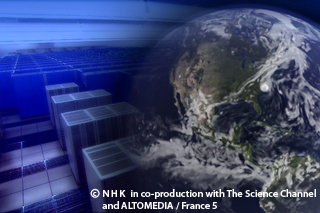
Another was Climate in Crisis, an outstanding global documentary in two parts (2 x 52 mins) co-produced in 2006 by Japan’s public broadcaster NHK together with The Science Channel and ALTOMEDIA/France 5.

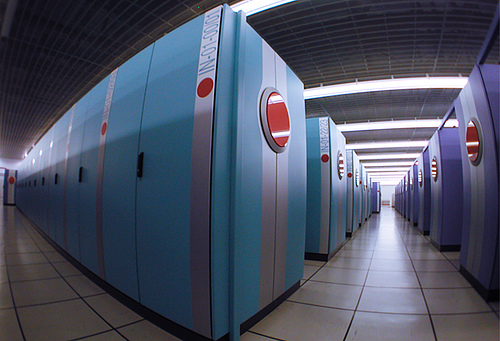
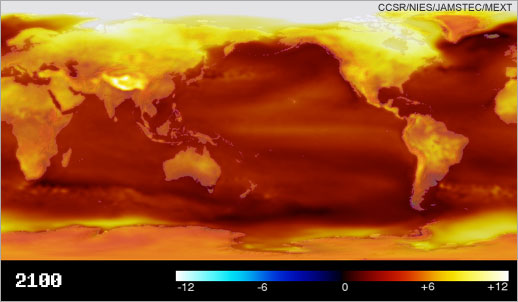
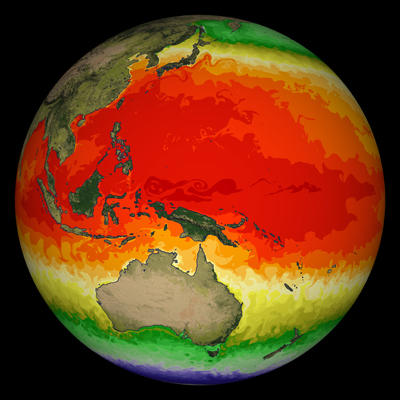
Directed by Fujikawa Masahiro, the film draws heavily on the Earth Simulator — one of the world’s most powerful supercomputers — which Japanese scientists used to project the climatic disasters in next 100 years. The system was developed in 1997 for running global climate models to evaluate the effects of global warming and problems in solid earth geophysics. It has been able to run holistic simulations of global climate in both the atmosphere and the oceans — down to a resolution of 10 km.

NEC Earth Simulator in Japan

The results, captured in this documentary, are truly mind-boggling. Atmospheric temperatures may rise by as much as 4.2 degrees Celsius, more hurricanes may attack and deserts may spread from Africa to southern Europe, and half of the Amazon rainforest may be gone. Climate in Crisis shows a severe projection on environmental destruction based on rigorous scientific data and considers whether humankind can avoid this.

This film, made in the same year as Al Gore’s Oscar-winning film An Inconvenient Truth, has won several awards including the Earth Vision Award at the 15th Earth Vision Tokyo Global Environmental Film Festival.

I was curious why this excellent film – in my view, better made than Al Gore’s one – hasn’t been more widely seen, talked about and distributed. To be honest, I’d not even heard of this one until my Japan visit — and I try to keep myself informed on what’s new in my field of endeavour.

The reasons soon became apparent: copyright restrictions! The co-producers are keeping the rights so tight that only the highest bidders will be allowed to acquire it on a license fee.

This is a standard broadcast industry practice that didn’t surprise me. But I was taken aback by how jealously the rights are guarded. All other films that were part of our event, including high budget commercial productions like Crude, were screened to the public at the Parthenon in Tama New Town in Tokyo.

Not so with Climate in Crisis, which we – the overseas participants to the workshop – had to watch at a theatre inside NHK’s Tokyo headquarters. No public screening was possible. As we later heard, NHK itself was willing to allow a public screening (after all, it draws a good part of its income from the Japanese public), but their international co-producing partners, especially the Science Channel, would simply not agree to it. Wow.

Twenty centuries ago, emperor Nero fiddled while Rome burned. Today, some people are squabbling over copyrights while the whole planet is in peril.

Earth in 2100 - as seen by Earth Simulator

Our workshop participants came from solid backgrounds in broadcasting or independent film-making, and we are not naive activists asking hard-nosed broadcasters to let go of their precious rights which generates vital income. But we would have expected them to allow films such as Climate in Crisis to circulate a bit more freely in everybody’s interest.

This reminded me of correspondence I had last year with the Canadian producers of another outstanding climate film titled The Great Warming. The initial discussions with its director were promising, but when the distribution people started talking about ‘revenue optimising’, our negotiations stalled.

It also reminded me of similar experiences of other environment and natural history film makers, such as South Africa’s Neil Curry. He had a long struggle with the BBC to clear the non-broadcast use rights of his own film that he wanted to take back to the locations in Botswana where it was filmed.

Many broadcast and production companies in the west don’t realise that TV broadcasters in developing Asia operate on a very different basis. Talking about broadcast ‘pre-sales’ or ‘commissions’ loses meaning when many stations are operating on tiny budgets — or in some cases, no budgets — for factual content. Many are struggling to survive in tough, emerging economies.

Is this our future?
Is this our future?

TVE Asia Pacific operates a regional film distribution service that brings environment and development films within reach of such broadcasters. We operate without getting mired in license fees or royalties.

Our 2-day workshop called for climate change to be recognised as a ‘copyright free zone’. This would enable audio-visual media content on the subject to move freely across borders and to be used widely for broadcast and narrowcast purposes.

Here’s the full reference from our statement of concern:

“Prevailing copyright regimes prevent the sharing and wider use of outstanding TV programmes and video films on climate and development issues. We are deeply concerned that even content developed partly or wholly with public funding (government grants, donor funds or lottery funds) remain unfairly locked into excessive copyright restrictions. Sometimes film-makers and producers themselves are willing but unable to allow their creations to be used for non-commercial purposes by educational, civil society and advocacy groups. We appreciate the media industry’s legitimate needs for intellectual property management and returns on investment. At the same time, the climate crisis challenges us to adopt extraordinary measures, one of which can and should be recognising climate change as a ‘copyright free zone’. Such agreement would encourage media organisations and independent producers to share content across borders, and with entities outside the media industry engaged in climate education, advocacy and activism.”

Here’s the simple question I raised during the workshop, which is worth being posed to all those who hesitate to even discuss this issue:

Can anyone manage their intellectual property rights on a dead planet?

This is the real question!