Sir Arthur C Clarke’s funeral was held on March 22 afternoon in a manner that he would have approved: no decorations, no gun salute or any other governmental involvement, no religious rites of any kind, and no funeral orations.
Both his families – the Clarkes and Ekanayakes – were present, as were hundreds of his friends, fans and Sri Lankans from all walks of life. The local and international media bore silent witness. The Sri Lankan police and army soldiers stood by, in silent salute.
Everything went according to plan, and there was no commotion or chaos. Even the weather was cooperative: it seemed as if friends in high places ensured that afternoon thunderstorms that have characterised most of March in Colombo didn’t happen.
Tamara Ekanayake, the second daughter of Hector and Valerie Ekanayake – Sir Arthur’s adopted Sri Lankan family – made a single, short and passionate speech.
She said:
“You gave your time, your undivided attention and most importantly love to those around you so readily.
We thank you for the times you listened; we thank you for the times you laughed; we thank you for more than you could imagine.”
She added:
“As family, we feel so privileged that you left your mark on us. Your footprint will never fade, if anything it will only magnify what we do.”
Tamara also revealed what Sir Arthur had wanted on his tombstone: Here lies Arthur C Clarke
He never grew up
But didn’t stop growing.
As wished by Sir Arthur, the funeral was short, secular and devoid of any pomposity that so often characterises Sri Lankan funerals. It was all over in a few minutes.
Sir Arthur’s final odyssey also united all of Sri Lanka’s radio and TV channels, who observed one minute’s silence from 3.30 to 3.31 pm on March 22, even as the author’s burial was underway. Although this unity lasted for all of 60 seconds, it was no mean feat, as the cacophony of over 16 terrestrial channels and more than two dozen FM radio channels almost never speak in one voice (which is to be celebrated as media pluralism). The request for this minute came from the Sri Lankan government whose offer of a state funeral was earlier politely declined by the late author’s family (as he wished no involvement by either British or Sri Lankan governments).
As Sir Arthur’s spokesman, I also want to thank all our friends in the media – journalists, producers and photojournalists from national and international media – for their interest, cooperation and solidarity in the past few days. Yes, they chased me like a pack of newshounds day and night, but it was all in the line of duty. And I hope they were happy with how I did mine – being always available, willing and forthcoming with information, voice cuts, TV soundbyes and image access.
‘This is Arthur Clarke, saying goodbye from Colombo….’
This was the characteristic signing off Sir Arthur C Clarke used whenever he made a video greeting to an international meeting on some important issue somewhere on the planet.
From disarmament and new communications technologies to space exploration and conservation, he would offer the uniquely Clarkian take on the subject – in his witty, insightful and funny style.
I have worked with and for him for half my life – 21 years – as part of his personal office in Colombo, Sri Lanka (not to be confused with the government-run Arthur C Clarke Institute which he had nothing to do with). In that time, I helped film a significant number of video greetings to gatherings of the world’s movers and shakers.
Some of these were assemblies of sombre men and women in suits at the United Nations, Davos or Pentagon. Sir Arthur would deliberately poke fun at the pomposity and self-importance of these types, in a way that they could still laugh – even at their expense.
Other events were less formal, but no less important: glittering gatherings of Hollywood or Silicon Valley professionals – some of who have more ‘soft power’ worldwide than military generals or secretary generals. Again, he would challenge the boundaries of imagination of these professionals whose mega-billion industries were built largely on imagination.
In all these and more, Sir Arthur demonstrated another quality: the great economy of words. He hardly spoke for longer than ten minutes, or 600 seconds. The Grandmaster of the Soundbyte that he was, he knew just how to pack the right mix of power, fun and sense of wonder into each second.
Confined to a wheelchair in Sri Lanka – the country he adopted – in later years due to Post Polio, Sir Arthur used either satellite links or the web to connect to many important scientific, literary and entertainment gatherings in far corners of the planet.
When Sir Arthur said his Final Goodbye from Colombo in the early hours of 19 March 2008 at Colombo’s Apollo Hospital, there was no global witness. He was in the company of just five people – comprising family and staff.
Aptly, however, the news of his demise went right around the world at the speed of light thanks to the comsat and web. In less than an hour, the whole world knew.
And now its the world’s turn to say Goodbye to its most trusted ‘Man in the Future’. The world remembers, salutes and celebrates his genius, humanity and imagination.
For once, there was no specific invitation from anywhere. But for several weeks running up to his birthday, we had seen considerable media and fan interest on how he feels like completing 90 orbits around the Sun.
So in the last days of November 2007, I suggested to Sir Arthur that we should film a short video message – openly addressed to the whole world, sharing his reflections on turning 90. He liked the idea, and as has been the custom in recent years, asked me to draw up his speaking points.
I spent several days going through dozens of his essays and speeches, both published and unpublished. When I had a draft, we worked long and hard on it to get everything just right. I saw how he could still ‘Clarkise’ any piece of writing, which showed no sign of wear and tear for the 90 orbits.
This was a ‘no-budget’ production. Sir Arthur’s personal photographer Rohan de Silva had done many video greetings using a home video camera, but he and I agreed that this should be done more professionally. I mentioned the idea to our friends at Video Image (Private) Limited, the country’s top production company who had filmed with Sir Arthur for so many global TV channels and international clients. They immediately agreed to do it – for free.
We didn’t have a tele-prompter, but realised the importance of Sir Arthur looking straight at his audience. So in just a couple of days, Brian Ratnasekera of Video Image improvised a working unit.
I directed the shoot with Video Image crew on 5 December at Sir Arthur’s home. Allowing several breaks for him to catch his breath, our filming took the better part of that morning.
The filming got off to a bumpy start. First the improvised tele-prompter had some teething problems, but these were quickly sorted. Then, in a very rare moment of disagreement, Sir Arthur said he wanted to be filmed wearing his Nehru jacket (which he affectionately called ‘My Doctor No suit’).
We had already donned him in a colourful bush shirt and crew and I felt that this was the right attire for a message that was intensely personal and somewhat wistful. The shirt with large prints was far more characteristic of Arthur C Clarke than any formal suit. At that moment, I was the shoot’s director and not his long-standing spokesperson who would be more agreeable with his views and wishes.
A few tense moments passed. Then one of Sir Arthur’s valets had a brainwave. Why not use the casual NASA jacket that Sir Arthur often wore when he felt the air conditioning was getting a bit too cold?
That saved our shoot. He compromised, trading Nehru for NASA. Within seconds, he was back to his normal cheerful self. When the shoot got underway, he was at ease, speaking right to the camera and looking straight at millions of unknown viewers who would watch it for years to come.
Reading our text scrolling gently upward on the tele-prompter, he missed out just one word out of nearly 900. We only needed to do a single re-take. That was impressive for a man who’d recently had cataract operations in both eyes.
In the end, I knew we had a great piece – one where he looked back at a most remarkable career of our time, and looked forward to what lies in store for humanity.
After surveying what has, by all measures, been a highly remarkable life and the astounding rate of technological development he has witnessed, Sir Arthur listed three ‘Big Wishes’ that he wanted to see happen – ideally in his life time (alas, that was not to be).
Finally, he offered some personal views on posterity – a subject on which he’d been ambivalent at times.
This is perhaps the most consequential of his birthday reflections. In his own words: “I’m sometimes asked how I would like to be remembered. I’ve had a diverse career as a writer, underwater explorer, space promoter and science populariser. Of all these, I want to be remembered most as a writer – one who entertained readers, and, hopefully, stretched their imagination as well.”
He ended the message by quoting another English writer — who, coincidentally, also spent most of his life in the East — Rudyard Kipling: “If I have given you delight
by aught that I have done.
Let me lie quiet in that night
which shall be yours anon;
And for the little, little span
the dead are borne in mind,
seek not to question other than,
the books I leave behind.”
That’s also how he ended his 9-minute birthday video – but upon reflection, it seems to me that he used that to bid a fond farewell to his millions of fans and readers worldwide. Perhaps his famous crystal ball told him something…
He signed off: This is Arthur Clarke, saying Thank You and Goodbye from Colombo!
And this is Nalaka Gunawardene, saying Thank You and Goodbye to Sir Arthur. It was the greatest privilege of my life to have worked with you.
What do the RMS Titanic, which sank on her maiden voyage in April 1912, and the Asian Tsunami of December 2004 have in common?
Both were maritime disasters and, when they happened, both shook the world as few others did before or since.
And now, Sir Arthur C Clarke has linked the two tragedies that happened 92 years apart: he says they both illustrate how communications failures can compound the impact of a disaster.
Writing a foreword to Communicating Disasters: An Asia Pacific Resource Book (co-edited by myself and Frederick Noronha, and just released), the inventor of the communications satellite revisits the two disasters that left deep impressions in his mind.
Arthur C Clarke was born five years after the sinking of the ‘unsinkable’ RMS Titanic while on her maiden voyage. His home town Minehead, in Somerset, was not more than a couple of hundred kilometres from Southampton, from where the Titanic set off, he says, adding: “All my life, I have been intrigued by the Titanic disaster.”
He is particularly interested in what happened to the Titanic’s distress call after she hit the iceberg at 11.40 pm on the night of 14 April 1912. “A series of unfortunate factors compounded the disaster. The most ironic among them was that the wireless operator on the Californian, located closest to the Titanic, had shut down for the day just 30 minutes before the first distress call was sent out. Had the Californian been listening, it could have responded hours before the Carpathia, the eventual rescue vessel.”
The Titanic disaster prompted the shipping community to introduce a 24-hour radio watch on all ships at sea. It also consolidated the role of maritime radio in distress signalling and rescue operations.
But, as fate would have it, the absence of a timely warning once again characterised the second disaster to touch Sir Arthur’s life. Arriving 10 days after his 87th birthday, the Asian Tsunami of December 2004 left a massive trail of destruction in his adopted country Sri Lanka and several other countries bordering the Indian Ocean.
He reflects: “Astonishingly, a full century after the invention of radio, the Tsunami arrived without any public warning. The disaster’s death toll could have been drastically reduced if its occurrence — already known to scientists — was disseminated quickly and effectively to millions of coastal dwellers living on its predictable path. Even a half hour’s notice would have allowed people to run away from the coast, and in many affected locations there was just enough time to get to safety. But alas, that didn’t happen — and tens of thousands perished.
“It was appalling that our sophisticated local and global communications systems completely failed us that fateful day. The communications satellites that I invented, and the global Internet that one of my stories inspired, could have spread the warning, with the hundreds of radio and television channels across coastal Asia amplifying it.
“It is now known that the failures were human, not technological. To ensure better results next time, we need to achieve an optimum mix of technology, management systems and community preparedness — not just for tsunamis, but for many other hazards that we live with. We have to remember that delivering credible early warnings to those who are most at risk is both an art and a science.”
In his foreword, Sir Arthur sees the Asian Tsunami as a turning point for citizen journalism – ordinary people armed with digital tools bearing witness to unfolding events and then sharing it with others. He writes: “On 26 December 2004, many holiday-makers on affected beaches were armed with video cameras, and it was their ‘amateur’ images that later showed us the full force and fury of the unfolding disaster. Because it was distributed over a large area and occurred during peak holiday season, the Asian Tsunami was probably the most widely filmed disaster in history.”
This was not the first disaster that ‘citizen journalists’ covered, says Sir Arthur, but it marked a turning point in the growing phenomenon enabled by information and communications technologies (ICTs). “The post-Tsunami coverage showed that the professional and amateur divide had now blurred; there is a clear (and complementary) role that each can play.”
ICTs can do much in good times and bad, but as Sir Arthur recalls, the Tsunami also reminded us how disasters can make our information society vulnerable. “When electricity and telephone services — both fixed and mobile – went down in the worst affected areas, a century old technology came to the rescue: amateur radio enthusiasts restored the first communication links with the outside world, sometimes using the Morse Code to economise the power of car batteries.”
He quotes the President of the Radio Society of Sri Lanka as saying, “When all else is dead, short wave is alive.”
Sir Arthur’s perceptive foreword is a sobering counterpoint to the post-tsunami frenzy that we witnessed in the Indian Ocean rim countries. Yes, lacking a tsunami warning system – such as the one Pacific Ocean countries have – is a big gap that needed to be filled. But governments and development donors have rushed into setting up high tech, high cost early warning systems without due consideration for social, cultural and political realities of the intended beneficiary countries.
Governments, donors and UN agencies would do well do heed the wise words of Sir Arthur Clarke, who concludes his Foreword with these words:
“Communicating disasters — before, during and after they happen — is fraught with many challenges. Today’s ICT tools enable us to be smart and strategic in gathering and disseminating information. But there is no silver bullet that can fix everything. We must never forget how even high tech (and high cost) solutions can fail at critical moments. We can, however, contain these risks by addressing the cultural, sociological and human dimensions — aspects that this book explores in some depth and detail, from the perspective of both media professionals and disaster managers.
“The lessons of history are clear: if we are not careful, we can easily lull ourselves into the same kind of false confidence that doomed the Titanic.”
With the third anniversary of the Asian Tsunami drawing close, we are reliving memories of the mega-disaster that hit many parts of coastal Asia on 26 December 2004.
Here’s another story, which was related by Thyagee de Zoysa, a young Sri Lankan woman who until recently was working as Project Officer of CEE Sri Lanka, a non-profit educational charity that I am associated with.
In January 2007, Thyagee spoke at the European launch of TVE Asia Pacific’s latest environmental television series, The Greenbelt Reports</em>, held in Athens, Greece. There she made a passionate appeal for education and awareness to be put into action.
She drew from her personal experience, having survived the Indian Ocean Tsunami in her native village of Kosgoda in southern Sri Lanka. These are her exact words:
“I, myself, am particularly willing to participate in this project, as I was at my home on the 26th of December 2004, with my parents, until we heard a young man crying ‘Run to the temple, run to the hill, the sea is coming’. We ran — and it saved our lives.
“The young man told me later that he knew that the sea was going to come with full power because of a film that he had seen. A film, which was about a meteorite impact with earth and how a tsunami happens after that. He knew that, if there comes a day when the sea goes back towards the horizon, it then comes back again to take your life.
“It does not matter in what way you create awareness on the environment, be it books, films or the Internet. What matters is that you do it and make somebody understand the possible actions to take up. Believe me, I am grateful to this young man for saving my life and that of my family…”
Neither Thyagee nor the young life-saver could recall the name of the film, but it doesn’t matter. The film left a bit of knowledge in the young man’s mind which surfaced instantly just when it was needed. That helped save lives.
Alas, there were very few Sri Lankans – young or old – who had any idea about tsunamis prior to that fateful Boxing Day 2004.
The world’s best known writer of science fiction, Sir Arthur C Clarke turns 90 on 16 December 2007. Scientific, literary and media communities around the world plan to mark this event.
In this 9 minute video, the visionary writer, explorer and science populariser looks back at his illustrious career spanning nearly 70 years and notes: “Growing up in the 1920s and 1930s, I never expected to see so much happen in the span of a few decades.”
He offers a quick assessment of two sectors where he has left his mark: space travel and communications technology. Ever the optimist, he believes that the best is yet to come in both areas.
“I still can’t quite believe that we’ve just marked the 50th anniversary of the Space Age,” Sir Arthur says. “We’ve accomplished a great deal in that time, but the ‘Golden Age of Space’ is only just beginning.”
Noting that good communications are necessary, but not sufficient, for human progress, he makes a strong plea for tolerance and compassion to achieve greater understanding between peoples and nations. To him, true globalization would require overcoming “our tribal divisions and begin to think and act as if we were one family”.
In the video, which we recorded in Colombo in the first week of December, Sir Arthur mentions three personal wishes – proof of life outside the Earth, clean energy to overcome global warming, and peace in Sri Lanka, his adopted country.
He ends the message indicating his preferred legacy: “I want to be remembered most as a writer – one who entertained readers, and, hopefully, stretched their imagination as well.”
In a technical paper written in 1945, Clarke was the first to propose the idea of communications satellites, which have today become a global industry supporting broadcast and telecommunications needs. One of his short stories inspired the World Wide Web, while another was later expanded to make the movie 2001: A Space Odyssey, which he co-wrote with director Stanley Kubrick. He has lived in Sri Lanka since 1956.
The Space Age was ushered in by the launch of a 83.6km metallic ball, named Sputnik 1, on 4 October 1957. When it happened exactly half a century ago, the course of history was changed forever.
‘Sputnik’ is Russian for travelling companion or satellite.
Here’s how a newsreel of Universal International News, screened at cinemas across the US, reported the development:
As one comment, posted by fromthesidelines said on YouTube:
“This was one of the last weekly newsreels seen in movie theaters across the country (thanks to television)- this excerpt, from October of ’57, shows how much of an impact Russia’s “Sputnik” had on space and world affairs. Note that animated “simulations” were used, as Universal did NOT have access to any of the actual footage of “Sputnik” itself!”
“Although I had been writing and speaking about space travel for years, I still have vivid memories of exactly when I heard the news. I was in Barcelona for the 8th International Astronautical Congress. We had already retired to our hotel rooms after a busy day of presentations by the time the news broke. I was awakened by reporters seeking an authoritative comment on the Soviet achievement. Our theories and speculations had suddenly become reality!
“For the next few days, the Barcelona Congress became the scene of much animated discussion about what the United States could do to regain some of its scientific prestige. While manned spaceflight and Moon landings were widely speculated about, many still harboured doubts about an American lead in space. One delegate, noticing that there were 23 American and five Soviet papers at the Congress, remarked that while the Americans talked a lot about spaceflight, the Russians just went ahead and did it!”
And here is how Arthur C Clarke sums up the accomplishments of the first 50 years of space exploration:
“On the whole, I think we have had remarkable accomplishments during the first 50 years of the Space Age. Some of us might have preferred things to happen in a different style or time frame, but when our dreams and aspirations are adjusted for reality, there is much we can look back on with satisfaction. (For example, in 1959 I took a bet that men would be landing on the Moon by June 1969, and lost only very narrowly.) And in the heady days of Apollo, we seemed to be on the verge of exploring the planets through manned missions. I could be forgiven for failing to anticipate all the distractions of the 1970s that wrecked our optimistic projections — though I did caution that the Solar System could be lost in the paddy fields of Vietnam. (It almost was.)”
That’s the original title given to an essay that I co-wrote with Sir Arthur C Clarke nearly two years ago, at the invitation of the Indian news magazineOutlook.
The editors of Outlook changed it to Arise, Citizen Journalist! — which was fine, though perhaps not as poignant.
Of course, our original title would make sense only if you know what Citizen Kane means. That’s the name of the famous 1941 movie directed by Orson Welles, based on the life and career of American newspaper publisher Charles Foster Kane. The Wikipedia describes Kane as ‘a man whose career in the publishing world was born of idealistic social service, but gradually evolved into a ruthless pursuit of power and ego at any cost.’
Many consider Citizen Kane to be one of the finest movies ever made — some rank it as the best ever.
In the essay, written within months of the Asian Tsunami of December 2004, we looked at the rise and rise of citizen journalists — taking both a historical perspective and a futuristic scenarios.
On the road thus far, we wrote: “Historically, organised and commercialised mass media have existed only in the past five centuries, since the first newspapers — as we know them — emerged in Europe. Before the printing press was invented, all news was local and there were few gatekeepers controlling its flow. Having evolved highly centralised systems of media for half a millennium, we are now returning to a second era of mass media — in the true sense of that term. Blogs, wikis and citizen journalism are all signs of things to come.”
After exploring the corporatisation of the mass media, and its implications for free flow of information and opinions, we ask the question: can the citizen journalist fill the many voids in today’s mainstream media?
The essay quotes John Naughton, a noted British chronicler of the new media, who has watched and commented on the rise of blogging and its impact on the rest of the media. We also refer to researches Shayne Bowman and Chris Willis who have defined citizen journalism as the act of citizens “playing an active role in the process of collecting, reporting, analysing and disseminating news and information”
We raise the all-important question: “Will citizen journalism survive and thrive in the harsh marketplace? The answer to that question lies in our hands—let us not underestimate the power of the discerning media consumer to set new trends (and not forget how mass indifference kills many innovations).”
The essay suggests that we should not write off the mainstream media — it has survived and adapted to many changes in both technology and the marketplace.
But our conclusion is definitive: “Yet one thing is clear: the age of passive media consumption is fast drawing to an end. There will be no turning back on the road from Citizen Kane to citizen journalist.”
This week I’m working from home, as I nurse a cold that came from nowhere and knocked me down.
I have to take plenty of rest as my body battles the virus. So I alternate between bed and desk, keeping up with at least some of my work.
And that’s not as difficult as it once was, thanks to my home ADSL connection. (For sure, its day-time speeds make it more like ‘fraudband’ and not the broadband that it’s marketed as, but hey, at least I’m connected to the world.)
Well, that’s old hat — probably older than myself. But that assumes a new significance with the current concerns about climate change and how we may adapt our lifestyles to be more climate friendly, i.e. emit less carbon dioxide and other gases that trap the sun’s heat and warm up the planet.
“In 1973, when OPEC started to multiply oil prices, I rashly predicted: ‘The age of cheap power is over – the age of free power is still 50 years ahead.’
Three decades on, there are promising signs that we may soon get close to that ideal. There is a real possibility that the most important event of the early 21st century will be the advent of unlimited amounts of clean energy. Does it really matter whether hydrogen or nuclear fusion or another technology will finally liberate us from our current addiction to fossil fuels? Meanwhile, other technologies enable us to adjust our work and lifestyles. For example, mobile phones and the Internet have already cut down a lot of unnecessary travel – and this is only the beginning. We should revive a slogan I coined in the 1960s: ‘Don’t commute – communicate!’”
Self evident as this might seem, it’s not a point that is appreciated widely enough.
On 30 October 2006, the UK government published a 579-page report on the economics of climate change by Sir Nicholas Stern, a former chief economist at the World Bank. Despite the massive size, scope and authority of the report, the Stern Report had no reference to the role that the ICT sector could play in helping to reduce energy demand, mitigate CO2 emissions and help to save the planet.
Fortunately, others are taking note. Among them is the European Telecommunications Network Operators’ Association (ETNO), which issued a report — incidentally, in the same month as the Stern Report — titled Saving the climate @ the speed of light: ICT for CO2 reductions.
It was a joint publication with the World Wide Fund for Nature, WWF. Its introduction read: “A wider usage of ICT-based solutions can play an important role in reducing CO2 emissions. This joint WWF-ETNO road map proposes a concrete way forward for a better consideration and inclusion of ICT’s in EU and national strategies to combat climate change.”
Sir Arthur Clarke photo by Shahidul Alam, taken in January 2007
PS: I must admit that my carbon emission savings by working from home are pretty modest. I live about a kilometre from my office, so my personal commuting to and from work does not entail much of fossil fuel burning. On a good day, I can walk to work…
Armed with the tattered book, I joined night sky observation sessions of the Young Astronomers’ Association. That was more than 20 years ago.
Hormones-on-legs that we all were at the time, we were interested in heavenly bodies at both ends of a telescope. But we couldn’t have had a better guide to the celestial wonders than Patrick Moore.
The same Patrick Moore reached a milestone in the history of broadcasting this month: he has hosted the same show on television for 50 long years, more than anyone else on any subject anywhere on this planet.
The show is The Sky at Night, which started on BBC Television in April 1957.
The Space Age had not even begun, and television broadcasting was still in its formative days, when a much younger Patrick Moore presented the first Sky at Night in April 1957. But as if on cue, the Soviet Union launched Sputnik One just six months later, triggering the Space Race. Thus Patrick Moore has been our able, dependable and colourful guide to the most fascinating journey in the history of humankind – our species finally venturing beyond its ‘cradle’, the Earth.
But as another populariser of space and astronomy, Sir Arthur Clarke, notes: “Sky at Night has not been just a gee-whiz show of rockets, satellites and other expensive toys deployed by rich nations trying to outsmart each other. At its most basic, it’s a show about exploring that great laboratory within easy access to anyone, anywhere on the planet: the night sky.”
Sir Arthur adds in a special tribute to his long-standing friend:
“By the time the Space Age dawned, Patrick was well on his way to becoming the best known public astronomer in the world. TheSky at Night only consolidated a reputation that was well earned through endless nights of star-gazing, and many hours of relentlessly typing an astonishing volume of books, papers and popular science articles.”
In the 50th anniversary programme, broadcast this month, Patrick Moore traveled back in time to see the first recording of The Sky at Night . He talked to his earlier self about astronomy back in 1957, and discussed how things have changed in half a century. He then time traveled to 2057 where the ‘virtual’ Patrick, saved in the BBC computer, is celebrating 100 years of making The Sky at Night and talks to Dr Brian May about the discovery of life on Mars.
Thank you, Sir Patrick, for being our affable guide to the night sky and space travel for half a century. We hope you don’t consider retirement anytime soon.


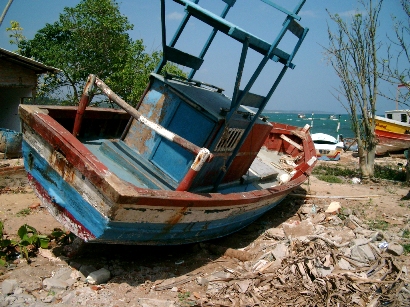
 “I, myself, am particularly willing to participate in this project, as I was at my home on the 26th of December 2004, with my parents, until we heard a young man crying ‘Run to the temple, run to the hill, the sea is coming’. We ran — and it saved our lives.


 Open Minds!