Playing Shahrazad; Telling Stories to Save Ourselves…and the Planet

I’ve been silent on this blog for over 20 days. I like to think that was for a good cause.

Well, I was frightfully busy organising and running a small Asian regional workshop in Khao Lak, Thailand – it was part of TVE Asia Pacific’s Saving the Planet project.

Saving the Planet is telling real life stories to save our planet in peril. It was inspired by the Arabian Nights.

Remember how the clever and beautiful Shahrazad saved herself and other women in her kingdom from the murderous King Shahriyar? Once betrayed by a wife, the wicked ruler had embarked on a killing spree where he would wed a virgin bride everyday, and have her beheaded the day after the wedding. All girls and women in his kingdom were threatened.

That is, until, beautiful and clever Sharrazard volunteered to be the next bride. Facing an assured death, she starts telling the king engaging stories that holds him spell-bound. Her story, or stories, since many tales are interwoven and imbedded into the first, lasts for 1001 consecutive nights.

This story-telling captivated the king’s attention and held his patience with its fantastic and mysterious tales, its vivid descriptions and breath-taking heroism. Shahrazad’s story-telling is in itself a heroic and life-saving device, which finally forced the king to spare the wise and courageous girl’s life. Apparently he gave up his killing ways after that experience (if only some of our modern day rulers were so easily reformed!).

Image courtesy Rose TheatreImage courtesy Middleeast UK.comImage courtesy Middleeastuk.com

Read more about Arabian Nights

Story telling is more an art than a science. Shahrazad used it to save her life, and lives of all other women in her kingdom. Mythical as it may be, we can draw a few lessons from the Arabian Nights on what kind of stories to tell — with visible effects.

Good journalism is all about telling stories — real life stories about what happens to real world men, women and children. Mixing journalistic skills with development stories as we do, Saving the Planet is an attempt to tell a few good stories from the Asia Pacific — about individuals and organisations who are engaged in education for sustainable development, or ESD.

As we introduce the project on its dedicated website:
Confronted with a range of environment and development problems, the world is looking for bright ideas to sustain life on the planet. Education at all levels can shape the world of tomorrow, equipping individuals and societies with the skills, perspectives, knowledge and values to live and work in a sustainable manner. Education for Sustainable Development (ESD) is a vision of education that seeks to balance human and economic well-being with cultural traditions and respect for the earth’s natural resources.

copy-of-saving-the-planet-logo.jpg dd8.gif

Saving the Planet started with an open competition – we asked people to nominate projects or activities in developing countries of Asia that are communicating or educating their communities on any aspect of sustainable development. Not just ‘green’ issues (e.g. recycling, conservation) or scarey issues like climate change and ozone depletion, but also ‘brown’ issues (e.g. sanitation, cleaner production) and what I call ‘black and white issues’ – human rights and social justice.

We received dozens of nominations, which we turned over to a regional selection panel. Their final selection was announced in mid May 2007 – see my blog post on the winners.

Read more about the winning stories on Saving the Planet website

The idea is for us to go out and film each of these winning projects for an Asian regional TV series. But ahead of that, we brought to Khao Lak, Thailand, two representatives of each project/organisation for a week-long workshop, 2 to 6 July 2007.

That workshop sought to strengthen the communication skills and capacity of the six organisations. Not just in moving images, which we dabble in, but in new media and older media as well. In short, how to use media and other communication tools to reach out to different audiences and, hopefully, influence them in positive ways that help them — and the planet.

This is why Saving the Planet is also story telling for survival – and here we are talking about the survival of not just one individual, but of all life on the planet. And instead of one evil king, our story tellers are confronted with a multitude of threats to our survival, many of them of our own making.

The analogy with the Arabian Nights is not as far-fetched as it might seem. The success of the Arabian Nights stories over many other forgotten folk tales may be due to their blend of popular themes: heroic and romantic adventures are littered with mystery, old wisdom and exciting struggles between good and evil. Almost all tales have three main elements or notions. Firstly, if there is a problem, there is a solution. Secondly, endurance can enable a crisis to reach a resolution. And finally, fantastic elements help the protagonists to maintain their endurance.

So one thing we kept probing and discussing was how to package serious (and often perceived as ‘boring’) development messages in ways that engage and entertain groups or communities we are trying to reach.

I’ll write more about the workshop when I have a chance. The official report of the workshop will go up on TVEAP and Saving the Planet websites within a few weeks.

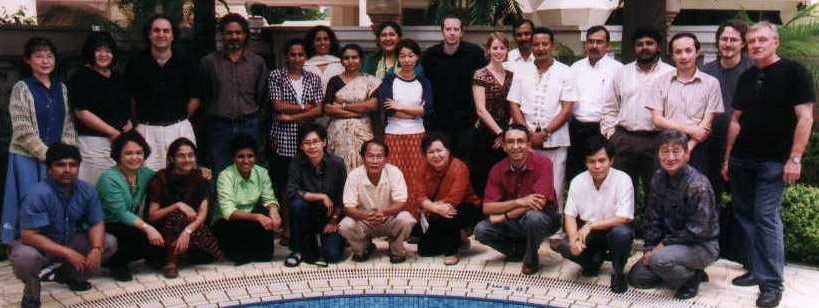
For now, here’s the photo of our participants, together with the resource team and my colleagues from TVE Asia Pacific.

participants-and-resource-team-of-saving-the-planet-workshop-in-khao-lak-july-2007.jpg

Saving the Planet is implemented by TVE Asia Pacific in collaboration with the Asia/Pacific Cultural Centre for UNESCO (ACCU),Tokyo, Japan, within the framework of ACCU-UNESCO Asia-Pacific Programme under the UNESCO/Japan Funds-in-Trust for the Promotion of Education for Sustainable Development.

Joey R B Lozano: The legacy continues…at Silverdocs

I met Joey R B Lozano only once, but he left a deep impression.

A small-made man with passionate zeal and tons of energy, he was every inch an activist-journalist-campaigner. We had invited him to a regional workshop of factual video producing and distributing partners from across Asia that we held in Singapore in November 2002.

We hadn’t worked with Joey earlier. He came recommended by our international partner Witness, which uses video-based advocacy and activism for promoting and safeguarding human rights worldwide.

Joey R B Lozano Joey R B Lozano Joey R B Lozano

Joey used his personal video camera to assert indigenous land rights, and to investigate corruption and environmental degradation in his native Philippines. Joey was an independent human rights activist and also one of the country’s leading investigative reporters.

He freelanced for the Philippine Daily Inquirer, covering Indigenous peoples’ rights and the environment, considered the two most dangerous beats in the Philippines. But years earlier, he had moved out of the capital Manila, and committed his life and career to stories and issues at the grassroots that many of his city-based colleagues had no time or patience in covering on an on-going basis.

Trained as a print journalist, Joey mastered new media and technologies whose potential he quickly realised. He moved into television and video media with ease, and later became an active blogger.

Joey’s TV investigations began in 1986, when he helped ABC’s 20/20 to uncover the “Tasaday hoax”, a highly successful fraud to pass off local tribespeople as a newly discovered Stone Age culture.

He soon embarked on his own investigations and started digging into illegal logging, gold mining and land-grabbing. In turn, his exposes quickly earned him repeated assassination and abduction attempts, in a country that is one of the more dangerous places to practice journalism.

When he came to Singapore, Joey had recently ‘starred’ in a major Canadian documentary titled Seeing is Believing: Human Rights, Handicams and The News, which looked at how committed, passionate individuals were using new communication technologies to change the world.

participants-at-tveap-partner-workshop-singapore-nov-2002.jpg

Photo of Singapore TVEAP workshop participants: Joey Lozano is 6th from left on the frontmost row

Follow Seeing is Believing storyboard on the film’s website

We screened the film, made by Katerina Cizek and Peter Wintonick, and heard first hand from Joey on what his struggles entailed. The film followed Joey as he delivers a new “Witness” donated video camera to Nakamata, a coalition of Indigenous groups in Central Bukidnon. Together, Nakamata and Joey begin documenting a dangerous land claims struggle, and it doesn’t take long for tragedy to unfold in front of the camera.

Watching the film and then listening to Joey — and his Witness colleague Sam Gregory — describe the on-going struggle, was one highlight of our week-long workshop. Some of us saw in Joey the activist-campaigner that we wanted to be, but were too scared or too polite to really become.

Not everyone shared that view. The cynicism — sometimes bordering on disdain — of a fellow Filipino from Metro Manila was palpable. No wonder Joey moved away from the city.

We at TVE Asia Pacific were extremely keen to distribute Seeing is Believing, for it held such a powerful and relevant message for our region, but it was not to be. Our enquiries showed that like most documentaries, it was tied up in too many copyrights restrictions and commercial distribution deals.

Following the Singapore workshop, I did keep a watchful eye on what Joey Lozano was up to. The film’s website provided occasional updates, and sometimes blog posts from Joey himself.

Our paths never crossed again. Almost three years after our single encounter came the news that Joey had passed away. It wasn’t the assorted goons who hated his guts that finally got him. His own body turned against him.

His tribute on the film’s website started as follows:

Joey Lozano defied the odds. For three decades, he survived dangerous missions to defend human rights using his video camera, in the Philippines, a country that ranks high, year after year, for most journalists killed. Joey went into hiding numerous times, and he dodged two assassination attempts. Once, bullets whizzed past his ear as he made his escape on motorbike.
But Joey couldn’t beat the odds of cancer. He died in his sleep on September 16, 2005 – at home and surrounded by his family.

Joey R B Lozano - image courtesy Seeing is Believing

The spirit and legacy of Joey R B Lozano live on. He inspired a large number of journalists and activists to stand up for what is right and just — and to be smart about it in using modern information and communication technologies, or ICTs.

Joey and other Witness activists were pioneers in different parts of the world who turned handicams away from weddings and birthday parties to capture less cheerful sights and sounds the world must see — and then act on. They were at it years before mobile phone cameras, YouTube and user-generated content in the mainstream media.

And now, Witness has established an award at the Silverdocs film festival. The WITNESS Award in Memory of Joey R.B. Lozano will be awarded to the qualifying SILVERDOCS filmmaker of a feature-length film who has produced a well-crafted and compelling documentary about a human rights violation or social justice issue. The winning filmmaker will also have a thoughtful, creative, and feasible outreach plan to use their film as a tool to raise awareness of the human rights or social justice issue explored in the film with a goal to bring about change.

The inaugural award was announced on June 17 — and has been won by “The Devil Came on Horseback” by Annie Sundberg and Ricki Stern.

Joey was a Witness partner and board member. He co-produced many films and collaborated on others that helped raise awareness about threats to indigenous people’s rights in the Philippines from corporations, and the complicity of the government in the abuses. Witness was founded in 1991 by musician peter Gabriel and the Lawyer’s Committee for Human Rights to put new technologies into the hands of local activists around the world.

Joey R B Lozano with his handycam

Read International Wildlife May 1999: Why Joey Lozano Is A Marked Man – investigative reporter works for the environment

Read about and watch Rule of the Gun in Sugarland

Baby 81: The Asian Tsunami’s big ‘non-story’

When many journalists chase the same unfolding story, it’s common for them to acquire the ‘herd mentality’. This ‘media pack’ can sometimes lose sense of direction, perspective — and even the truth.

A good example is the story of a Sri Lankan baby who grabbed world media attention for a few days as a “celebrated” Tsunami orphan.

The four-month-old boy, Abhilash Jeyarajah, was picked up by a neighbor who found him under a pile of garbage soon after giant waves lashed Kalmunai on 26 December 2004. The man handed over the child to the Kalmunai hospital. The parents, who also survived the waves, later found their child.

That should have been the happy ending for that family — but it was not to be.

Newspapers, television and news agencies reported how squabbling broke out among several couples over “Baby 81” — as he was dubbed by hospital authorities in Kalmunai, going by the admission number. As many as nine couples who lost their infants in the tsunami all claimed he was theirs — or so the story was spread by the news-hungry media who had descended on tsunami-hit Sri Lanka in their hundreds.

Photo courtesy Reuters

Even the usually cautious New York Times carried the story, referring to him as a “celebrated orphan”.

The story assumed a momentum of its own. One leading American TV network invited the baby and his parents to visit the US to be their studio guests and tell their ‘story’.

It was only many weeks later that the truth began to emerge.

Police denied nine couples had claimed him as their own. Kalmunai hospital authorities confirmed that only one couple had come forward to claim the baby. The man who handed over the child to hospital told police that he had known the child was that of his neighbors — there was no dispute about the parentage.

“Because it had a miraculous escape, a lot of people showed interest in the child, but they never said they were the parents,” chief inspector W. C. Wijetilleka was quoted as saying. “Only one couple claimed the child. No one else has come forward to make a legal claim.”

“As far as the police and the courts are concerned, only one couple is claiming the child,” inspector Wijetilleka said. “We have reported the facts to court and the judge ordered the hospital to release the child to the parents.”

The story was fuelled by the hospital’s initial reluctance to release the boy until he was well enough. The couple then petitioned the court, which ordered on 12 January 2005 that the baby be given to them. DNA tests, presented to court on 14 February 2005 confirmed their claim as biological parents.


Read Lanka Business Online account of what happened: Baby 81 – the story with nine or more lies

Read Reuters AlertNet guest blogger Glenda Cooper’s recent update on the Baby 81 saga

This non-story was discussed during the Asian regional brainstorming on Communicating Disasters that TVE Asia Pacific and UNDP organised in Bangkok, Thailand, in December 2006.

“The young couple was at the centre of endless media coverage for several weeks,” Asoka Dias, Station Director of MTV/MBC Network, Sri Lanka, told our meeting.

He added: “This created public impression that they also received a great deal of money and other help, which was not the case. They have had to relocate to a new neighbourhood, and are struggling to lead normal lives.”

Read the meeting report of Communicating Disasters

Radio Sagarmatha wins global award – now that’s real people’s radio!

On 23 May 2007, I wrote about Radio Sagarmatha (RS) of Nepal, South Asia’s first ever public radio station that completed 10 years on that day.

I called it Kathmandu’s beacon of hope. The pioneering radio station, entirely owned and operated by the journalists’ collective Nepal Forum of Environmental Journalists (NEFEJ), has stood by the people of Kathmandu valley — its listeners — through an eventful, sometimes turbulent decade.

And now, more recognition has come — this time in the form of an international award.

Last evening (June 14) in London’s Porchester Hall, the One World Broadcasting Trust (OWBT) presented its Special Award to Radio Sagarmatha.

I join Radio Sagarmatha’s friends and admirers worldwide in congratulating them on this latest honour.

RA Station manager, Mohan Bista, who accepted the award on behalf of his team, said: “We would like to dedicate this award to the Nepali people who fought for freedom of expression and democracy in the country, and thank them for their support through the good and bad times. We welcome the challenge and responsibility of the future.”

Announcing the selection, OWBT said:
“Based in the heart of the Kathmandu Valley, Radio Sagarmatha has irreversibly changed the landscape of broadcasting in the country. Originally built from water pipes and tested by staff driving around the streets of Kathmandu on motorbikes clutching radios, this bold venture gave momentum to the pro-democracy movement, which eventually led to the restoration of parliamentary democracy in April 2006.”

Earlier, Lord Young of Norwood Green, Chairman of OWBT, had said in a letter sent to Radio Sagarmatha: “The Trustees received a large number of nominations from as far apart as Guatemala, Zambia…. and it was inevitably a very difficult choice for them, but Radio Sagarmatha stood out because of its long-standing reputation as one of the first independent public-interest radio stations in South Asia, and the continued efforts to bring credible information to the audiences in an engaging and interactive way. The Trustees were unanimous in their choice.”

OWBT

OWBT’s official press release announcing the award said:
When Radio Sagarmatha launched in May 1997 – after five years of lobbying – it was a milestone not just for Nepal but for the whole of South Asia, marking the end of the government’s radio monopoly. The station blazed a trail for broadcasting in the country, and in its wake hundreds of commercial FM and community-based stations were set up.

When the King’s regime banned all independent broadcasters from carrying news in April 2005, the station continued its daily output. Seven months later, police raided the station, seizing all technical equipment and arresting five staff. But within days, public pressure led the Supreme Court of Nepal to issue an order to the government allowing Radio Sagarmatha to go live again.

RS employs 40 staff and 29 freelancers, and has recently gained government approval to double its transmitter capacity from 500 to 1,000 watts. RS has established a network of eight community radio stations across the country and offers technical support and in-house training for newcomers to Nepal’s radio sector. The station receives sponsorship from local organisations including Eco-Himal, as well as international agencies. It also runs a Friends of Radio Sagarmatha scheme which has so far raised over $10,000.

The One World Media Awards is one of the foremost Awards events in the UK encouraging excellence in media coverage that supports a greater understanding of the vital issues of international development. The awards recognise the unique role of journalists and film makers in bridging the divide between different societies, and communicating the breadth of social, political and cultural experiences across the globe. The 11 award categories cover television, radio, new media and print journalism.

Radio Sagarmatha is well and truly people’s radio. It’s not a government-controlled, donor-propped charade like Sri Lanka’s so-called community radio, about which I wrote earlier this month.

Full list of OWBT award winners 2007

One World Media Awards jury panels for 2007

Broadcasters united by Tsunami, but now divided again

In the broadcast industry, everybody knows each other — but then each one minds his or her own turf.

The United Nations, humanitarian agencies and advocacy groups have all tried to get media to co-operate more with each other, but these have remained largely token efforts.

Let’s face it: the broadcast media is fiercely competitive. TV networks and channels compete with each other in a given country or region. With channel proliferation there are more offerings chasing the same eyeballs.

But extraordinary situations bring out spontaneous collaboration in extraordinary ways. One such trigger is disasters.

Last December, speaking at a regional brainstorming on Communicating Disasters that TVE Asia Pacific organised with the UNDP, veteran Indian journalist A S Panneerselvan related a heart warming story of Indian broadcasters coming together on one such occasion.

The first hours and days after the Tsunami saw the highly competitive Indian news media organizations sharing each other’s information, visual and contacts in the true spirit of cooperation.

“Generally, the Indian news market is highly competitive with 18 TV news channels. They’re not willing to share visuals or co-operate. But something extraordinary happened soon after the Tsunami news broke. For the first time, none of the channels was insisting on exclusivity. They were simply downloading each other’s images, without even bothering about the rights or other issues.

“This was indeed rare. We know how many contracts have to be signed even for broadcasting 10 seconds of a cricket match. The kind of cross-flow of information after the Tsunami was amazing. All channel rivalries were momentarily forgotten.

“The only problem was with the international relief agencies, who are extremely hierarchy conscious. They were not easily available to the news media, and often they spoke only to influential Western news agencies such as Reuters and BBC.”

Panneer is now executive director of Panos South Asia. He was formerly the managing editor of Sun TV and bureau chief for Outlook magazine in India.

Read the full report of the Bangkok meeting on TVE Asia Pacific website

Can media tame the global ‘alms bazaar’?

The Asian Tsunami of December 2004 inspired dozens of cartoons in newspapers and websites all over the world. To me, this was one of the most heart rending Tsunami cartoons.

Without a single word, it said so much about the humanitarian sector’s conduct and priorities. It showed how Asia’s massive disaster drained much needed support from other unfolding emergencies in the world.

This week in Geneva – arguably the humanitarian capital of the world – a leading Swiss journalist once again raised the crucial issue: how best can humanitarian agencies respond to multiple crises without everyone ending up in a needless frenzy?

Edward Girardet, who specialises in in media, humanitarian aid and conflict issues, was speaking at a media workshop on tracking climate change that his non-profit organisation, Media21, organised this week in conjunction with the Global Platform on Disaster Risk Reduction in Geneva (5 – 7 June 2007).

The platform, organised by the UN International Strategy for Disaster Reduction (UN-ISDR), brought together several hundred disaster managers, researchers and activists for three days of discussion and debate on key issues and challenges they face.

Ed was outspoken in his critique of the humanitarian sector (which, someone suggested during the week, is the largest unregulated industry in the world).

“Much of the emergency response to the Indian Ocean tsunami in late 2004 was not required, but hundreds of organizations still insisted on being seen, often at the cost of rechanneling humanitarian resources from vital operations elsewhere in the world, bringing some to virtual collapse, notably in Africa.”

Writing an op ed piece in the Christian Science Monitor this week, Ed has expanded on his views. He says:

“What this amounts to is a blatant abuse of public confidence. As one International Committee of the Red Cross representative admitted, if the donating public knew how often personal egos or vested interests call the shots, they might prove less forthcoming in their support.”

Edward Girardet, Swiss journalist

Here is how he ends his essay:

Humanitarianism, however, should not “belong” to any one group. What the international aid industry urgently needs is more hard-nosed and independent reporting.

Current initiatives such as IRIN, the UN’s humanitarian news service, and the World Disaster Report of the International Red Cross are excellent in many ways but widely perceived as beholden to their organizations.

Another question is whether one can expect real criticism of the international aid industry if such ventures are themselves cofunded by governments.

The best solution would be the creation of a viable media watchdog capable of reporting the real causes behind humanitarian predicaments, including how the international community responds.

Most mainstream news organizations are unlikely to cover the global aid business on a consistent basis.

On the other hand, a pooling of media, corporate, and foundation support for a specialized reporting entity could prove to be the answer. Any other approach that does not guarantee complete independence would be a waste of time and money.

Read his full op ed in Christian Science Monitor online (8 June 2007 issue).

Read the full report of TVE Asia Pacific’s Roundable meeting on Communicating Disasters, held in Bangkok, December 2006

Sex and the warming planet: a tip for climate reporters

I had no idea that the nice lady seated next to me was described by her publisher as ‘America’s hottest sex therapist’.

Nor had I linked sex with climate change — though, come to think of it, both have something ‘hot’ in common.

Psychologist, journalist and sex therapist Dr Judy Kuriansky came out with practical advice on how we journalists can cover climate change in more interesting ways. And she made a lot of sense.

“You have to make the climate story appeal to the average reader or viewer,” the Professor of Clinical Psychology at Columbia University Teacher’s College, USA, told us participants at a global media workshop on understanding and reporting climate change in Geneva this week.

In some ways, attracting audience attention is comparable to getting a new date, she suggested.

Dr Judy Kuriansky

“If you want to attract a man or woman’s attention, what do you do? You can go for a walk in the park…and take a child or dog with you. It doesn’t have to be your child or your dog, as long as you have one. That makes it a lot easier for you to start a conversation with an attractive stranger.”

Likewise in covering climate change. Bring out the children or animals. These always help audiences to relate to otherwise dull or dreary stories.

People across cultural and educational divides share a love and concern for children and animals. And how climate change is going to impact our children is something that most sensible adults would pay attention to.

Some communicators are already heeding this advice. The Great Warming, a compelling, Canadian-made documentary released in 2006 and narrated by actors Alanis Morissette and Keanu Reeves, reveals how a changing climate is affecting the lives of people everywhere. Using breathtaking visuals filmed in eight countries on three continents, this production ‘taps into the growing groundswell of public interest in this topic to present an emotional, accurate picture of our children’s planet’.

‘Our children’s planet’ – a simple yet powerful phrase that never fails to move sensible and sensitive people. As I wrote in a recent review, it’s precisely that kind of appeal to our hearts and emotions that many climate change (and indeed, environmental) documentaries lack.

But who else could have linked all this to the art and science of dating? Dr Judy knows a thing or two about this subject, having written The Complete Idiot’s Guide to Dating, now in its 3rd edition.

Dr Judy he was in Geneva representing the NGO Committee on Mental Health, a US-based charity, which ran a session during the Global Platform on Disaster Risk Reduction in Geneva (5 – 7 June 2007).

Her group ran a session on mental health needs of disaster affected people — an aspect largely neglected by the UN and humanitarian organisations that respond to disasters.

Experts warned this week that climate change is set to increase both the intensity and frequency of disasters. This will mean more people than ever will be affected physically, pshychologically, economically and other ways.

Chatting to her later, I discovered Dr Judy and I had more things in common than an interest in, well, climate change.

For one thing, in the aftermath of the Asian Tsunami of December 2004, she had visited Sri Lanka with a team of psychologists to provide much-needed help to survivors to overcome their trauma. Unlike many relief agencies that stayed within the ‘comfort zones’ close to the capital Colombo, her team went all the way to Batticaloa on the east coast, a good 12 hour car journey away.

I also discovered that she and I had both been speakers at the 59th Annual NGO Conference organised by the UN Department of Public Information in New York in September 2006.

And we are both associated with Light Millennium, a non-profit group in New York dedicated to culture and peace. We have a mutual friend in its founder, Bircan Unver.

Here’s a bio note on Dr Judy from one of her websites:

Dr.Kuriansky is a world renowned radio advice host, clinical psychologist and certified sex therapist, popular lecturer, newspaper columnist, TV reporter and commentator and author of many books on relationships. She is a pioneer of radio call-in advice, and more recently of Internet advice. An adjunct professor at the Clinical Psychology Program at Columbia University Teachers College and at the Department of Psychiatry at Columbia Medical Center, she is also visiting professor of Peking University Health Science Center in Beijing. She is a frequent commentator on TV on various news issues, particularly on CNN, and columnist for the New York Daily News, Singapore Straits Times and South China Morning Post.

Lions and community radio: part of Sri Lanka’s mythical lore

Even well-meaning, usually balanced media organisations can occasionally slip, and fall for traps that damage their credibility.

I have always had the highest regard for Inter Press Service (IPS), the news agency of the majority world that presents the Southern voice and perspective. In the early days of my career, I shared an office with IPS bureau in Colombo, and still count many good friends who work or report for IPS from different parts of Asia.

Imagine my dismay and surprise, then, when this news story was carried by IPS earlier today:

MEDIA-SRI LANKA:
Building Ethnic Harmony With Community Radio

KOTHMALE, Jun 4 (IPS) – In this tea-growing hill country, about 150 km from Colombo, a state-run community radio station is creating harmony among the country’s Sinhalese, Tamil and Muslim ethnic groups by broadcasting from the villages and opening up the airwaves to people’s participation.

”People all over Sri Lanka are talking about peace, but this community radio has been doing it from the beginning,” P. Pavitheran, an announcer at the Kothmale Community Radio (KCR) told IPS.

“We don’t have any community divisions here,” added the Tamil broadcaster who also speaks fluent Sinhalese and switches smoothly between the two languages on air. “All my (assisting) staff are Sinhalese, but we’re all working together as a team.”

KCR on FM band was set up by the government-owned Sri Lanka Broadcasting Corporation (SLBC) in 1989 with 3 hours of transmission three days a week. Today, it broadcasts 12.5 hours a day on weekdays and 8 hours on weekends in both Sinhalese and Tamil. It covers a modest 20-km radius that includes 60 villages and 3 rural towns and reaches a population of 200,000. Read the full story here

IPS

This is one of those feel-good stories that news agencies like to publish once in a while, so that it counter the mainly negative stories that they carry as mirrors of society.

But in this instance, IPS has – perhaps inadvertently – peddled a pervasive myth that has been fabricated and distributed by UNESCO for over two decades about there being community radio stations in Sri Lanka.

I have lived and worked in Sri Lanka all my life, and never once come across a community radio station. In fact, this is a rare instance where successive governments for the past 20 years stand united: all have stubbornly refused to license any community radio.

There has never been, and there isn’t, any community radio in Sri Lanka in the sense the rest of the world understands that term. The fully state-owned and government-controlled Sri Lanka Broadcasting Corporation (SLBC) has several rural transmissions which masquerade as community radio, hoodwinking gullible development donors and naive foreign journalists.

As I have written in many places over the years, local communities have no control over content or management of the station. And no political content is allowed in the programming — try criticising the government in office and the jackboot of the Big Bad Babus of SLBC will come down with thunderous effect!

Let me quote from one of my published articles:

“SLBC broadcasts from all corners of the country, including stations located in remote areas. The channel involves local people in programme production, and it maintains a strongly agrarian audience. But listeners have no say in running the stations – these are managed by a tight bureaucracy in the capital Colombo, whose rigid guidelines control content: strictly no politics, and nothing remotely against the government in office.

“But, although touted as such, SLBC is not community radio, which is supposed to promote access, public participation in production and decision-making and listener-financing – where each listener contributes a small amount towards the running of the radio station.”

Read full article in Panos Features: Radio in Sri Lanka suffers as Colombo bosses call the shots

See also: Sri Lankan government’s broadcast stranglehold in UCLA’s AsiaMedia

Despite all this, if someone still insists that there is community radio in Sri Lanka, I can argue that by the same token, lions roam free in Sri Lanka’s remaining jungles. After all, the Sinhalese have a folk lore suggesting they descend from a lion.

Both prospects are equally fantastic. At least there are a couple of lions in the zoo.

Individuals are free to believe in fabrications coming out of that Paris-based myth factory called UNESCO. But responsible news organisations like IPS need to fact-check their stories lest they legitimise these dubious claims that contribute to suppressing genuine media freedom and media pluralism in Sri Lanka.

Bill Moyers & Ammu Joseph: Journalists are beachcombers…

I had an ‘aha!’ moment last week during the session on ‘Reporting the world through a gender lens’ at Asia Media Summit 2007 in Kuala Lumpur, Malaysia.

Ammu Joseph, the passionate and articulate Indian journalist and women’s rights activist, was speaking on gender sensitivity in disaster related coverage in South Asian media. She always speaks drawing on her rich and varied experiences, and offers refreshing perspectives on oft-discussed topics.

At one point, she quoted one of my journalism heroes, Bill Moyers, as saying:
“We journalists are simply beachcombers on the shores of other people’s knowledge, other people’s experience, and other people’s wisdom. We tell their stories.”

How very true!

Bill MoyersAmmu Joseph

I researched where Bill Moyers said this, and it turns out it was part of his speech accepting Harvard Medical School’s Global Environment Citizen Award in December 2004. Read the full speech, which is highly inspiring.

Reading further, I came across another Bill Moyers gem:
“One challenge we journalists face – how to tell such a story without coming across as Cassandras, without turning off the people we most want to understand what’s happening, who must act on what they read and hear.”

That is more relevant today than when he first said it: with climate change becoming the latest worldwide scare, it is indeed a huge challenge for us to report, analyse and explore issues without crying wolf.

But crying wolf is what characterised a good part of the session on reporting climate change during the Asia Media Summit. It had some good speakers, who knew what they were talking about, but was very poorly moderated by a man who had no idea what he was taking on.

That’s when I so wished we could clone a few more Bill Moyers — this planet is seriously in need of more like him!

And we need more like Ammu Joseph to tell us jouralism and broadcasting are not just industries or professions; that they involve and require more. Here’s her short profile:

Ammu Joseph is an independent journalist and author based in Bangalore, and writing primarily on issues relating to gender, human development and the media. Her publications include five books: Whose News? The Media and Women’s Issues (Sage, 1994 and 2006 — revised edition, co-authored/edited with Kalpana Sharma), Women in Journalism: Making News (Konark, 2000 and Penguin India, 2005 — revised edition), Terror, Counter-Terror: Women Speak Out (Kali for Women, 2003, co-authored/edited with Kalpana Sharma), Storylines: Conversations with Women Writers, and Just Between Us: Women Speak about their Writing (Women’s World India/Asmita, 2003, co-authored/edited with Vasanth Kannabiran, Ritu Menon, Gouri Salvi and Volga).

Read Ammu Joseph detailed profile

Read some of Ammu Joseph’s recent writing on India Together

Community Broadcasting: A way forward in Asia

In an earlier post, I wrote about what I presented to the workshop on community broadcasting and ICTs during Asia Media Summit 2007 in Kuala Lumpur, Malaysia, last week.

The workshop on ‘Connecting Communities through Community Broadcasting and ICTs’ gave us a chance to clarify key issues and concerns, and to agree on a common understanding for future action.

On behalf of our workshop, dynamic young Manisha Aryal, broadcast activist from Nepal who currently works for InterNews in Pakistan, presented our recommendations to the Summit plenary.

manisha-aryal-at-asia-media-summit-2007.jpg

Here, for the record, are the recommendations. I don’t hold my breath on this, but it’s good to synthesize a long and hard day’s work — over nine hours of talking! — into a few short paras.

Connecting Communities Though Community Radios and ICT

Recognizing the importance of community media in economic, political and social development, in promoting good governance practices, and in empowering marginalized groups and communities in participating fully in society in urban, rural as well as remote areas; and

Understanding the importance of encouraging community media initiatives that are owned and managed by communities and with material produced predominantly by, for and about communities,

We, the participants at the workshop on Connecting Communities through Community Radios and ICTs at Asia Media Summit 2007:
• Advocate for the recognition of community radio and other community media as a distinct tier of legislation and regulation, alongside public service and commercial broadcasting, thus, contributing to the promotion of “air diversity”
• Advocate for the recognition of community media practitioners as valuable, professionally competent resources who can be involved in both peer training and training of other media professionals
• Organize awareness building and sensitization programs on community radio and other ICTs’ potential in development for legislators and community broadcasters
• Invite community media practitioners and include the topic of community broadcasting prominently in regional and global meetings (for example: a plenary session on community media at AMS 2008, World Electronic Media Forum later this year, etc.)
• Organize training and mentoring sessions for Community Broadcasting practitioners with special recognition of the role of younger generations on how community radio can capitalize on the development in the ICT sector, on new ways of addressing financial and organizational sustainability, etc.
• Include Community Media practitioners in the documentation and sharing of local and indigenous knowledge, as well as other discussions on global themes (for example the discussions on GM, MDGs, etc.)
• Look for ways to ground community media initiatives to initiatives in other sectors (health, agriculture, education, etc.)
• Facilitate partnerships between efforts to promote community broadcasting and efforts to promote newer ICTs among communities such as Community Multimedia Centers, etc.
• Recognize community broadcasting stations as an effective entry point to take ICTs to the grassroots both in rural as well as urban settings.
• Document and disseminate best-practices and learnings in community broadcasting

Photo courtesy Manori Wijesekera, TVEAP