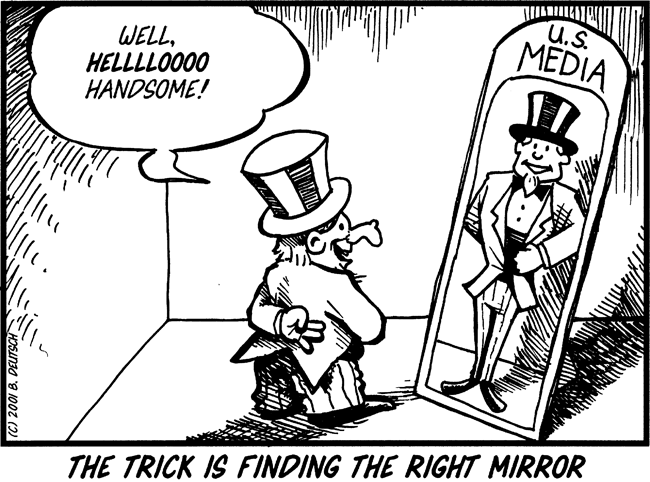
A friend of mine recently shared a wonderful quote by the French poet and film maker Jean Cocteau (1889 – 1963): “Mirrors should reflect a little before throwing back images.”
That ideal could very well serve as an aspiration for the industry I have been part of, in one way or another, for over 20 years: the public media. At the very basic, the media are expected to reflect our society and our times.
The reality is, there are many different kinds of mirrors:
• Some mirrors show us things exactly as they are – we might call them true mirrors.
• There are some ‘funny mirrors’ that distort – showing us as too thin, too fat, or elongated!
• There are concave and convex mirrors used in everyday situations from rear view mirrors in cars to shaving mirrors in bathrooms.
• Then there are a few mirrors that have cracked, which now give out a totally warped reflection.
Of course, the properties and behaviour of these mirrors are determined the laws of physics.
But must the public media behave just like glass mirrors do, throwing back images without some inner reflection?
Journalism as if the planet mattered... Who speaks for the Earth?
Thirty years ago, public astronomer Carl Sagan posed this question in his trail-blazing television series Cosmos: A Personal Voyage. And this is how he answered it:
“Our loyalties are to the species and to the planet. We speak for earth. Our obligation to survive and flourish is owed not just to ourselves, but also to that cosmos ancient and vast from which we spring!”
While we all can – and must – speak for our home planet, journalists covering environmental issues do that everyday as part of their job. And now, the rest of the world can vote for the year’s best efforts in this line of work.
Fifteen winners of the inaugural Earth Journalism Awards were announced this week in Paris. The organisers — Internews, an international NGO that works to empower local media worldwide — have opened the online public voting to find the winner of a 16th prize.
“The Earth Journalism Awards were established to boost climate change coverage in this critical year leading up to Copenhagen, and to highlight the efforts of journalists reporting on this challenging subject around the world,” says James Fahn, Internews’ Global Director of Environmental Program. “We were overwhelmed by the tremendous response we received, and would like to thank the hundreds of journalists who entered their stories for participating.”
Winning stories include: a compelling account from Pakistan of how a small coastal community is responding to the multiple challenges that climate change is already posing them; a multi-media investigation on the use and effects of fire in the Amazon; and a business report from East Africa on how Kenyan companies are missing out on the growing global carbon credits market.
They were chosen through a process involving a globe-spanning, independent jury that involved over 100 media and climate change experts. I was part of that process.
Watch video announcing the Earth Journalism Awards 2009:
Internews is inviting the winners of the Earth Journalism Awards to cover the negotiations at the United Nations Climate Change Conference in Copenhagen, (COP15) December 7-18. There they will receive support from Internews to report on the negotiations to their media organizations back home. They will also attend a high profile awards ceremony, to be co-hosted by Nobel Peace Prize Winner Dr. Rajendra K. Pachauri, at the Danish Radio Hall on December 14, the eve of the final high-level negotiations. Each of the fifteen winners will receive one of the coveted regional or thematic awards as determined by the independent juries.
The Earth Journalism Awards is being implemented by Internews in association with partners that include the Government of Denmark, hosts of the negotiations; The World Bank; MTV International, the leading global broadcaster and youth brand; The Government of Italy, The V. Kann Rasmussen Foundation and the Edgerton Family Fund; Flip Video Spotlight; the Open Society Network, WWF International, The Global Canopy Programme and the Tcktcktck campaign, part of the GCCA, the international alliance of campaigning NGOs that includes Oxfam, WWF, and Greenpeace, Global Forum for Media Development and IMS.
Evolution or revolution?
I was born three years before the Internet (which turned 40 a few weeks ago), and raised entirely on newspapers and radio in a country where broadcast television didn’t arrive until I was 13.
From the time I could read and write, I always wanted to be a media publisher. In that pre-history of the Personal Computer and Internet, my choices were pretty limited: I published a hand-written household newspaper and was its editor, reporter, printer and distributor all rolled into one. But I was obsessive in my work even then, and the newspaper lasted a couple of years in which over two dozen issues were released (all of them now mercifully lost).
My school teacher parents were my first patrons, supplying me with plenty of paper, pencils and ink. But there must have times when they rather wished that I didn’t indulge in my own brand of independent journalism. I loved to criticise and lampoon the ‘management’ in my editorials — even as a kid, I was already critical of the establishment!
Fortunately for me, the ‘management’ left me alone and to my own devices, but most independent editors in history haven’t been so lucky. As the American journalist A.J. Leibling (1904 -1963) once said, “Freedom of the press is guaranteed only to those who own one.” In his time, this was perfectly true.
There was a time, until recently, when press barons and media moguls led, and the rest of society followed. In our topsy-turvy times, however, the reverse is increasingly true.
In theory, at least, anyone can be a global broadcaster and publisher in less than two hours using free tools that can be downloaded and activated in minutes.
David Brewer (photo from http://www.i-m-s.dk)My British media activist friend David Brewer has just published an online guide on how to become a publisher or broadcaster in 100 minutes. (Okay, the non-geeks among us might need a bit longer than that, but still, you can be in business in just a few hours.)
David Brewer’s journalistic and managerial experience spans newspapers, radio, television, and online, and he now runs Media Ideas International Ltd, a media strategy consultancy with clients in Europe, the Balkans, the CIS, the Middle East, Asia, Africa and Central America.
David has worked with what I like to call the A-B-C of global broadcasting. He was the launch managing editor of BBC News Online in 1997, and moved to CNN, as managing editor, to set up CNN.com Europe, Middle East and Africa and CNNArabic.com. He was an editorial consultant for the launch of Al Jazeera English in 2006 and continues to work with Al Jazeera English as a new media consultant.
In his spare time, he runs Media Helping Media , a network and online resource to support media in areas where freedom of expression is under threat.
Dilrukshi Handunnetti: Making wavesMy good friend Dilrukshi Handunnetti, a leading investigative journalist in Sri Lanka, is currently on a Jefferson Fellowship traveling in the United States. She is one of a dozen journalists from the Asia Pacific who have been competitively chosen to participate in this prestigious programme, which in 2009 is focusing on the theme, The Right Climate for Confronting Climate Change?
I finished my latest climate film, Small Islands – Big Impact, only the day before Dilrukshi left for Hawaii, her first stop in the multi-destination, intensive programme. Given her long standing coverage of the Maldivian political affairs as well as Asian/global environmental issues, I gave her a DVD of the film to take along.
I’m delighted to hear that she has been showing Small Islands – Big Impact in various presentations, often producing a…big impact wherever it was shared. It’s always good to have such feedback — here’s an excerpt from an email she has just sent me from Boulder, Colorado:
“I liked presenting your short film and the response it generated. The film generated a discussion on promoting the concept of (climate) adaptation as a human right – just as I felt it would be such a catch phrase here. I also had the (media coverage of) the underwater Cabinet meeting with me. So Maldives got a lot of attention despite not having a Maldivian here.
“Several wanted to know about the actual risk level of the Maldives and the possibility of the islands being submerged. They also asked about purchasing land elsewhere and whether the Maldives had the financial capability to do that. Others wanted to know about depleting fish catch President Nasheed spoke about as this was a common concern to Indonesia, Southern India and Vietnam.
President Nasheed: Stop pointing fingers, extend a helping hand...“Some queried whether President Nasheed was going to Copenhagen to state his case. Two others asked whether lobby groups were behind his thinking. Several found, including American, Chinese and Indian participants, that President Nasheed’s call to end the blame game should be heeded by all. There was collective agreement that others’ behaviour impacted on the likes of President Nasheed and vulnerable communities.
“Interestingly, everyone found his interview a STORY. Something that they would want to report on in their respective media. We continue to discuss the same on our tours and walkathons from venue to venue for various meetings. In fact, I had the American participant asking our resource persons (IPCC types, no less!) whether they were willing to acknowledge the concept of climate refugees directly in relation to the Maldives.
“I think the movie served a great purpose of awakening the minds of many to the threat level faced by some communities on low lying coastal nations – like the pacific Islands and the Maldives. A senior broadcaster from the Tonga Broadcasting Corporation personally thanked me for wanting to highlight their plight as a small island nation.”
You can watch Small Islands – Big Impact online here:
A journalist for over 17 years, Dilrukshi Handunnetti has extensively covered politics, the environment, culture, and history and gender issues. In her current role, she writes the parliamentary column for the newspaper in addition to writing and editing investigative stories carried in her publication. Dilrukshi has also covered the ethnic conflict from a non-military perspective and written extensively on issues of good governance, graft and corruption. Dilrukshi is the recipient of many national journalism awards in Sri Lanka, including: the Young Reporter of the Year 2001, Best Environment Reporter of the year 2002, Best Environment Reporter of the year 2003, Best English Journalist of the Year 2004 (Merit) Award and D B Dhanapala Award for the Best English Journalist of the Year 2005, all presented by the Editors’ Guild of Sri Lanka.
In this extract from our 2005 film Deep Divide, Dilrukshi talks about Sri Lanka’s coastal resource development challenges before and after the 2004 Asian Tsunami:
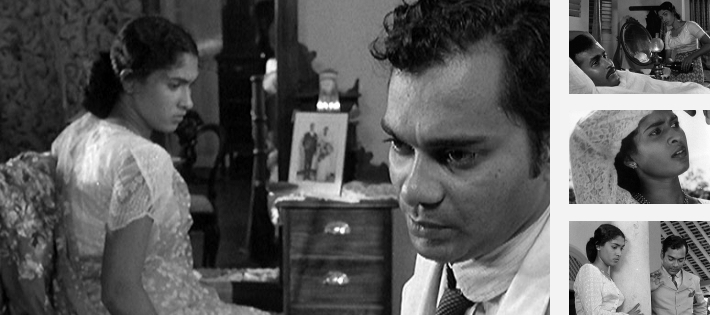
Gamperaliya (1964): A Sri Lankan film classicLast evening, at the gala opening of the European Film Festival in Colombo, I sat two rows in front of a living treasure of the Asian cinema and watched his recently restored 1964 cinematic masterpiece, a cultural treasure in its own right.
The doyen of the Lankan cinema, Lester James Peries, made Gamperaliya (Changes in the Village, 35mm, 108 minutes) based on the Sinhala novel of the same name, written by Martin Wickremasinghe, himself a leading light of Lankan literature during the 20th century.
The movie was groundbreaking in Sinhala cinema, and was shot entirely outside of a studio using one lamp and hand held lights for lighting (at a time when most films were still being made within studios). Although not an immediate commercial success, it was critically and internationally acclaimed, and won the Golden Peacock at the Grand Prix International Film Festival in India and the Golden Head of Palenque in Mexico, both in 1965. It was one of the first Lankan films to be internationally recognised.
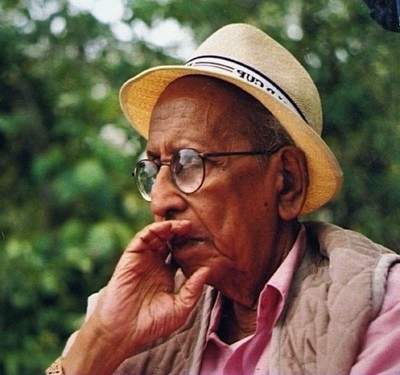
Lester: 20 feature films in a 50-year career...Gamperaliya was the first independent film made in Sri Lanka. There was no film studio involvement, and the film maker and friends invested Lankan Rupees 170,000 to make it (roughly USD 30,000 at the time, although today the same amount of the much weaker Rupee converts to less than USD 1,500).
Critic David Chute wrote: “Gamperaliya launched a revolution, not only in the way films were made but also in content…[director] Peries sought an alternative to the Bollywood-influenced melodramas that dominated commercial cinema…With an elegant narrative style comparable to Satyajit Ray’s Apu Trilogy, [the film’s] aesthetic choices also have a moral dimension.”
Gamperaliya is two years older than myself, and although I’d watched it on television, I had never seen it in a cinema on a large screen with proper sound. It was a real treat. For nearly two hours, I was transported back to two periods of recent history: the newly independent Dominion of Ceylon (not yet renamed Sri Lanka) in the early 1960s when the film was made, and the early 20th century colonial Ceylon where the actual story takes place. To engage in such time travel in the company of the maestro film maker himself was a unique experience.
However, it was sobering to reflect how many who were involved in the creative effort to make Gamperaliya are no longer with us. Among them are screenplay writer Regi Siriwardena, actor Gamini Fonseka and co-producer Anton Wickremasinghe. It was only a few months ago that Tissa Abeysekera, who started his long and colourful association with the Lankan cinema by working as a dialogue writer and assistant director in Gamperaliya, abruptly departed.
Lester, who turned 90 in April 2009, was making a rare public appearance. We were told that this is only the second time he has ventured out since he retired from film-making two years ago. He looked a bit frail, but walked up and down the isle supported by his wife Sumitra Peries, his partner both in life and cinema.
In some ways, cine film is even more prone to the decay of elements than humans. Gamperaliya was almost totally lost. Last evening’s celebrated reunion of the master and his masterpiece was the outcome of a major restoration that involved substantial efforts and investments by concerned cinephiles on both sides of the Atlantic.
Gamperaliya was rescued from the brink of disaster. A few years ago, UNESCO launched a project to collate a World Heritage of cinema and selected another film of Lester’s, Nidhanaya (Treasure, 1972) as a work of art that should be preserved for future generations. But when Lester and UNESCO representatives went to the Sarasavi studio in Dalugama, north of Colombo, where almost all the films made in Lankan cinema are kept, they found that the master Negative (the Mother Copy from which fresh copies could be made) was burnt due to vinegar syndrome – a condition when negatives start deteriorating.
“This was not due to the failure of anybody in Dalugama studio or the National Film Corporation but due to the failure of all governments that came to power since 1956. The late journalist Ajith Samaranayake and many others fought for a film archive but we were not able to persuade any government,” the disappointed film maker was quoted as saying at the time.
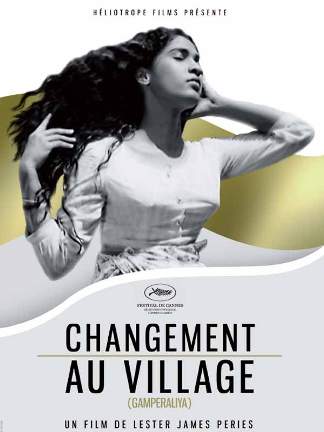
Gamperaliya French poster
This news reached Pierre Rissient, a French national and a guardian of Lankan cinema who is attached to ‘Pathe’ one of the biggest film companies in the world. He urged Lester to help restore the equally important film Gamperaliya, which was also in a state of decay but could still be salvaged.
In one email, Rissient wrote to Lester: “Dear Lester you made a great masterpiece, not only of the cinematography of your country but also universally. It is your duty to make possible this restoration; it is not for your friend Pierre, but for the world.”
So Pierre Rissient pursued this and arranged for it to be carried out at the film restoration unit of the University of California in Los Angeles (UCLA). The UCLA Film and Television Archive is the largest university-based collection of film and television materials in the world,
Some 14 sound reels and 14 picture reels of Gamperaliya, weighing 60 kilos, were couriered to UCLA in May 2007. The film was restored to the visual and audio perfection by Rob Stone and Jere Guldin. The restoration with latest digital sound and visual quality will enable the film to be shown all over the world after 45 years.
In May 2008, the restored Gamperaliya was screened at the Cannes Film Festival under the section ‘Restored Classics’.
At the time, Lester wrote to Pierre Rissient: “It is a tremendous campaign that made it possible for Gamperaliya to survive and your incredible faith in our film that made this miracle possible. We do hope and pray that there is no serious deterioration that will destroy any chances of a glorious restoration. Sumithra and I thank you and are joined by the Sri Lanka film industry for your valiant effort.”
And all of us movie lovers in Sri Lanka and across the world join them in this gratitude, for saving the cultural treasure that is Gamperaliya.
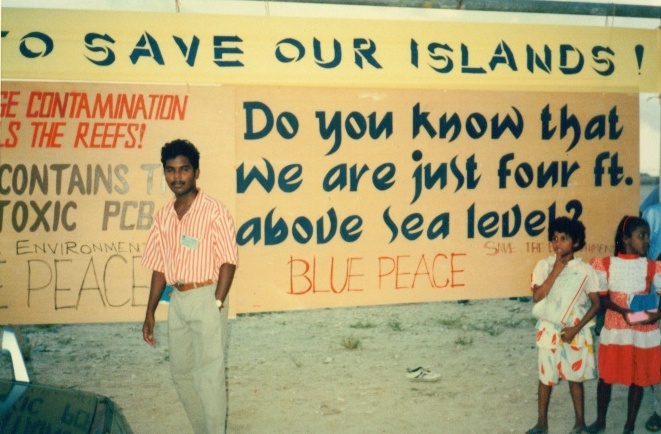
Bluepeace was vocal, even at 2 months. Photo by Nalaka Gunawardene: Male, November 1989
I’m not a professional photographer, but as a journalist I often carry a camera and take photos of what interests me. So I’m very glad to have captured that historic bill board as a journalist covering the conference. Bluepeace still uses it in their records, always with acknowledgement.
Ali Rilwan, Bluepeace co-founder whom I photographed as a young man, says: “Twenty years later, we need not ask the same question, as the world is well-aware of the dangers Maldives faces. However, we face the urgent need to talk and work with the rest of the world to find solutions.”
Now, Bluepeace is actively using photographs as part of their climate advocacy.
Images from the frontlines of climate impact...
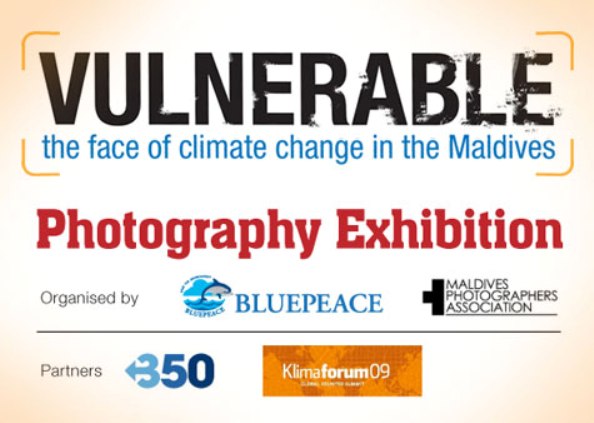
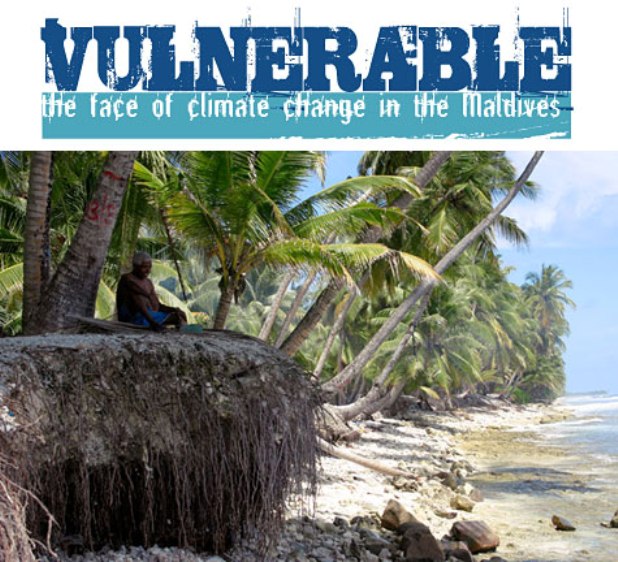
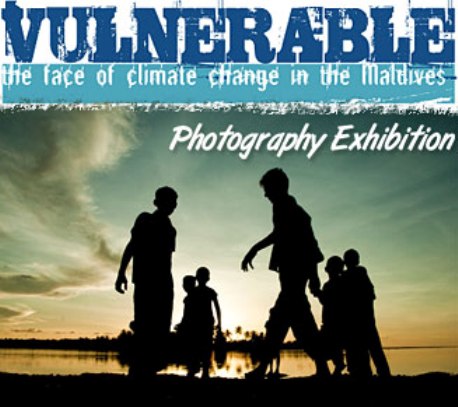
VULNERABLE is a photo exhibition organised by Bluepeace. To celebrate the 20th anniversary of Bluepeace, and to join the global environmental movement bringing attention to the dangers of climate change in the run up to United Nations Conference on Climate Change (COP15), Bluepeace presents VULNERABLE, which showcases the face of climate change in the Maldives. The exhibition documents the vulnerability of the fragile coral islands of the Maldives to climate change, through pictures from talented Maldivian photographers. It depicts a nation under threat, as it tries to safeguard an age-old culture and lifestyle that could be erased with rising seas and climate change.
VULNERABLE was launched online on October 24, the International Day of Climate Action organised by 350.org, which calls for a reduction of global carbon emissions below 350 parts per million.
In the coming weeks and months the exhibition will move to different locations in the Maldives and other countries, including Copenhagen in December 2009, where it will be hosted by Klimaforum09, an alternate climate summit with participation from global environmental movements and civil society organisations.
I can’t wait to see the exhibit in a physical display, which is more powerful than viewing it online. For now, here are some glimpses…
Clip, clip, clip...I’m usually happy and eager to explain my work to anyone who asks. I keep cool when people mix up technicalities related to film and video – after all, I don’t know the finer points in other professions and industries.
One thing I’m a bit tired of hearing is the wide-spread misuse of the term ‘video clip’. I try to keep a straight face when well-meaning people ask me about recent ‘video clips’ I’ve made. The truth is, I don’t make any: I make fully edited films – sometimes long, sometimes short, but always finished (That is, if a film can ever be called ‘finished’. An industry giant once told me that no film is ever finished; it’s only abandoned…)
For example, my latest climate film Small Islands – Big Impact is slightly under 6 minutes, yet it’s a complete product. I spent two months working on actually making it, and almost 20 years covering the story itself.
But the distinction between film and clip is not widely understood. In fact, the digital revolution seems to have added to the confusion.
The Wikipedia says a media clip is a short segment of media either an audio clip or a video clip. In other words, a part of something bigger.
It further explains: “Media clips may be promotional in nature, as with movie clips. For example, to promote upcoming movies, many actors are accompanied by movie clips on their circuits. Additionally, media clips may be raw materials of other productions, such as audio clips used for sound effects.”
Video clips are short clips of video, usually part of a longer piece. Wikipedia adds, however, that this term is “also more loosely used to mean any short video less than the length of a traditional television program.”
That’s part of the confusion. With the spread of broadband Internet , which enabled greater bandwidth to both content creators and users, video clips have become very popular online.
About.com, another widely used online reference, says: “A video clip is a small section of a larger video presentation. A series of video frames are run in succession to produce a short, animated video. This compilation of video frames results in a video clip.”
But that’s not all. While the TV/video industry widely accepts the above definition, the computer industry seems to use ‘video clip’ generically to mean any short video, processed or otherwise. This is how video clip is defined, for example, by YourDictionary.com and PC Magazine’s online encyclopedia.
Snip, snip, snip...?In this era of media convergence, when films an TV programmes are made using non-linear technologies enabled by computers, it’s no wonder that ‘video clip’ means different things to different people.
Wikipedia also talks of an emerging clip culture: “The widespread popularity of video clips, with the aid of new distribution channels, has evolved into clip culture. It is compared to “lean-back” experience of seeing traditional movies, refers to an internet activity of sharing and viewing a short video, mostly less than 15 minutes. The culture began as early as the development of broadband network, but it sees the boom since 2005 when websites for uploading clips are emerging on the market, including Shockinghumor, YouTube, Google Video, MSN Video and Yahoo! Video. These video clips often show moments of significance, humour, oddity, or prodigy performance. Sources for video clips include news, movies, music video and amateur video shot. In addition to the clip recorded by high-quality camcorders, it is becoming common to produce clips with digital camera, webcam, and mobile phone.”
Until recently, I used to get irked when people ask me about ‘video clips’ I make. My stock answer has been: “We only make fully edited, self-contained short films of various durations…partly because less is more these days. We don’t, as a policy, make ‘clips’ which in TV industry terms means semi-edited or unedited extracts that are not self-contained.”
Maybe I should stop being such a purist. After all, as I keep reminding my colleagues, students and anyone else who cares to listen to me, media is a plural!
One thing is for sure. Literacy rates and computer literacy rates have been rising worldwide in recent decades. But when it comes to basic media literacy, our societies still have a long way to go.
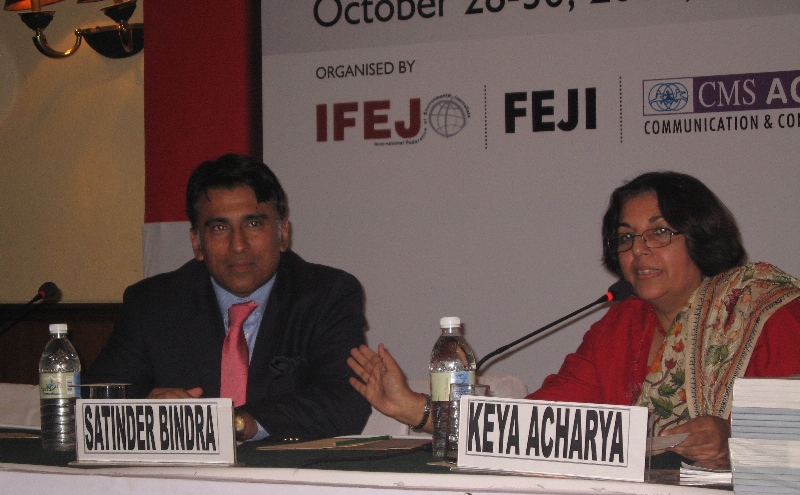
Satinder Bindra (left) and Keya Acharya at IFEJ 2009 Congress Satinder Bindra left active journalism a couple of years ago when he joined the UN Environment Programme (UNEP) as its Director of the Division of Communications and Public Information (DCPI) based at UNEP Headquarters in Nairobi. But thank goodness he still thinks and acts like a journalist.
We have gone beyond the cautionary stage of climate change, and are now acting out ‘Part II’ where we have to focus on what people can do, he said. “Climate change is no longer in doubt, and if anything, the IPCC’s scenarios are turning out to be under-estimates.”
He was referring to the IFEJ congress theme, “Bridging North-South Differences in Reporting Climate Change: Journalists’ role in Reaching an Ambitious Agreement at COP15 in Copenhagen”.
Satinder sounded emphatic when he said: “We have a limited time in which to reach as many people as possible. Environment is the single biggest challenge we face in the world today, and we as journalists have a tremendous responsibility in providing the latest, accurate information to our audiences.”
He added: “There is still a debate among journalists on whether or not we should be advocates for the environment. We should not be scared to push the best science, even if we don’t choose to engage in advocacy journalism.”
Satinder, who was a familiar face on CNN as its South Asia bureau chief until 2007, acknowledged that the media landscape was evolving faster than ever before. “Thanks to the web and mobile media, our distribution modes and business models are changing. YouTube has emerged as a key platform. Viral is the name of the game.”
His message to broadcasters, in particular, was: “You may be rivals in your work, but when it comes to saving the planet, put those differences aside.”
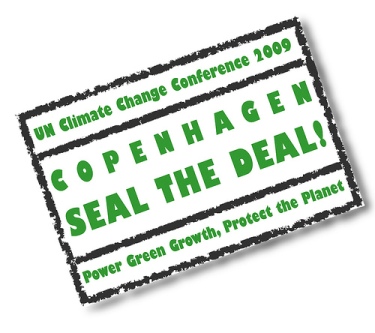
A call to the whole planet...Satinder is spearheading, on behalf of UNEP, the UN-wide Seal the Deal Campaign which aims to galvanize political will and public support for reaching a comprehensive global climate agreement in Copenhagen in December.
To me at least, the most important part of Satinder’s speech was when he said that he was not seeking to promote or position the UNEP or United Nations branding. His open offer to all journalists and broadcasters: “If you need to use the hundreds of UNEP films, or make use of our footage in your own work, go right ahead. We want you to make journalistic products. There’s no need or expectation to have the UN branding!”
Wow! This is such a refreshing change — and a significant departure — from most of his counterparts at the other UN agencies, who still think in very narrow, individual agency terms. They just can’t help boxing the lofty ideals of poverty reduction, disaster management, primary health care and everything else within the agenda setting and brand promotion needs of their own agencies.
“As development organisations compete more intensely for external funding, they are increasingly adopting desperate strategies to gain higher media visibility for their names, logos and bosses.
“Communication officers in some leading development and humanitarian organisations have been reduced to publicists. When certain UN agency chiefs tour disaster or conflict zones, their spin doctors precede or follow them. Some top honchos now travel with their own ‘embedded journalists’ – all at agency expense.
“In this publicity frenzy, these agencies’ communication products are less and less on the issues they stand for or reforms they passionately advocate. Instead, the printed material, online offerings and video films have become ‘logo delivery mechanisms’.”
Let’s sincerely hope that the pragmatic and passionate Satinder Bindra will be able to shake up the communication chiefs and officers of the UN system, and finally get them to see beyond their noses and inflated egos. It’s about time somebody pointed out that vanity does not serve the best interests of international development.

 “The Earth Journalism Awards were established to boost climate change coverage in this critical year leading up to Copenhagen, and to highlight the efforts of journalists reporting on this challenging subject around the world,” says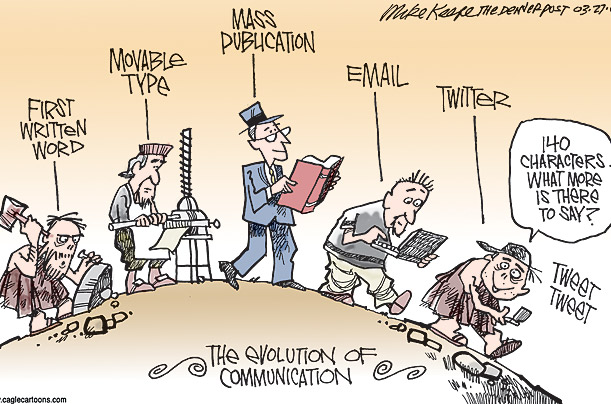



 Open Minds!
