Text of my ‘When Worlds Collide’ column published in Ceylon Today newspaper on 29 August 2014
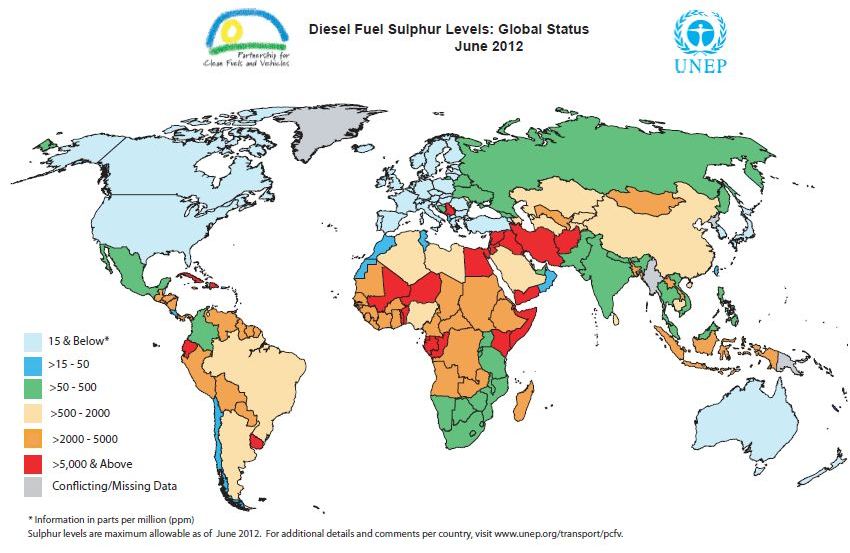
Diesel fuel sulphur status – June 2012, Map by UNEP
Progress is slow and incremental. Those who take all-or-nothing positions often end up with…nothing.
So let’s hail Sri Lanka’s leading petroleum distributor introducing a super diesel with lower levels of sulphur. This is indeed good news. But much more remains to be done.
Until now, Super Diesel marketed by the state-owned Ceylon Petroleum Corporation (CPC) had a sulphur content of 500 ppm (parts per million). From 22 August 2014, its sulphur has come down to 10 ppm.
“CPC is compelled to improve the quality of diesel, since it contributes a lot towards the reduction of harmful diesel exhaust emissions causing environmental pollution and serious health hazards which have been reported to have costly effects both economically and socially on the society at large,” a…
News feature written for Ceylon Today newspaper, 19 Oct 2013
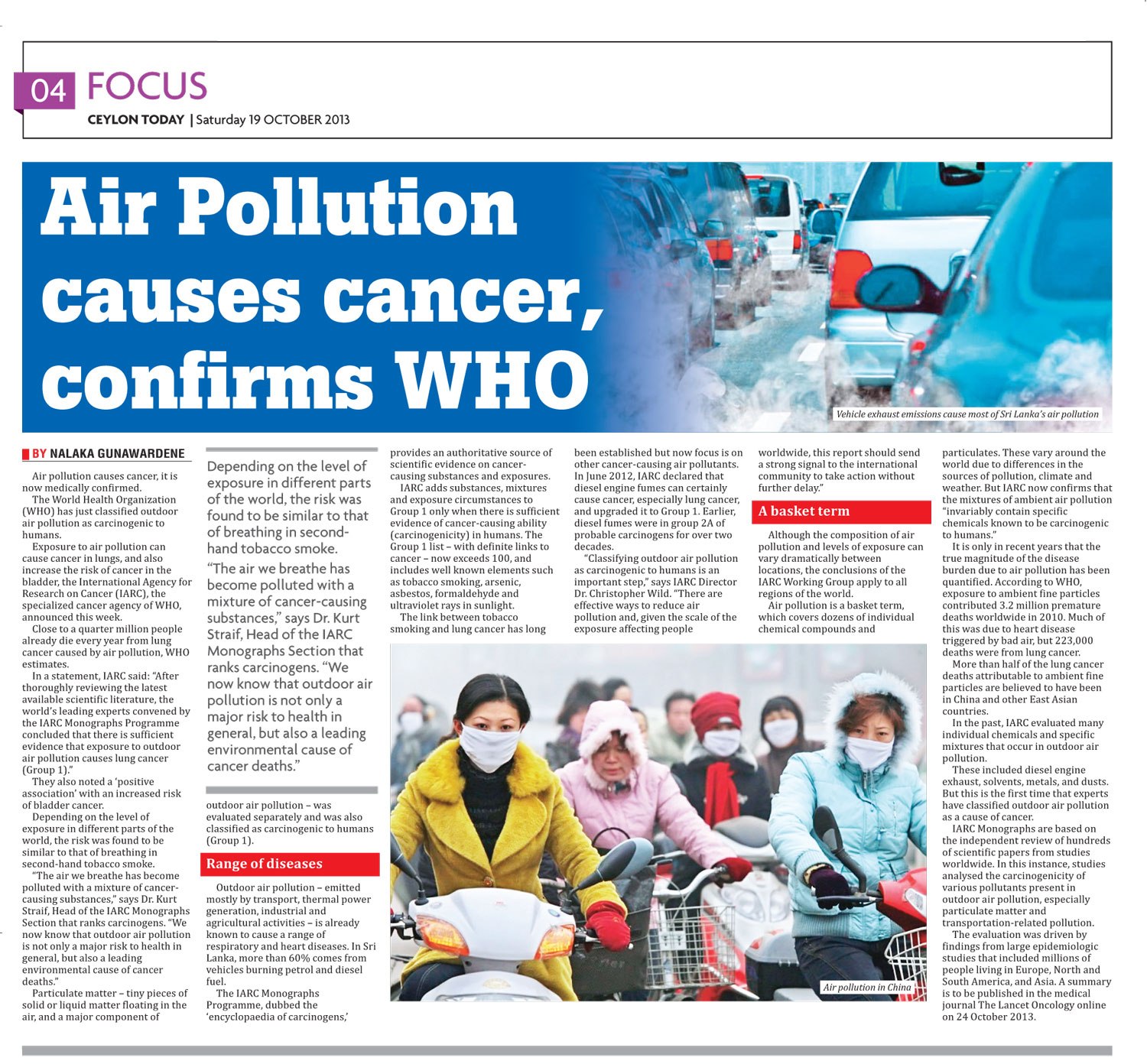
Air Pollution causes cancer, confirms WHO
By Nalaka Gunawardene
Air pollution causes cancer, it is now medically confirmed.
The World Health Organization (WHO) has just classified outdoor air pollution as carcinogenic to humans.
Exposure to air pollution can cause cancer in lungs, and also increase the risk of cancer in the bladder, the International Agency for Research on Cancer (IARC), the specialized cancer agency of WHO, announced this week.
Close to a quarter million people already die every year from lung cancer caused by air pollution, WHO estimates.
In a statement, IARC said: “After thoroughly reviewing the latest available scientific literature, the world’s leading experts convened by the IARC Monographs Programme concluded that there is sufficient evidence that exposure to outdoor air pollution causes lung cancer (Group 1).”
They also noted a “positive association” with an increased risk of bladder cancer.
Depending on the level of exposure in different parts of the world, the risk was found to be similar to that of breathing in second-hand tobacco smoke.
“The air we breathe has become polluted with a mixture of cancer-causing substances,” says Dr Kurt Straif, Head of the IARC Monographs Section that ranks carcinogens. “We now know that outdoor air pollution is not only a major risk to health in general, but also a leading environmental cause of cancer deaths.”
Particulate matter — tiny pieces of solid or liquid matter floating in the air, and a major component of outdoor air pollution– was evaluated separately and was also classified as carcinogenic to humans (Group 1).
Outdoor air pollution – emitted mostly by transport, thermal power generation, industrial and agricultural activities — is already known to cause a range of respiratory and heart diseases. In Sri Lanka, more than 60% comes from vehicles burning petrol and diesel fuel.
The IARC Monographs Programme, dubbed the “encyclopaedia of carcinogens”, provides an authoritative source of scientific evidence on cancer-causing substances and exposures.
IARC adds substances, mixtures and exposure circumstances to Group 1 only when there is sufficient evidence of cancer-causing ability (carcinogenicity) in humans.
The link between tobacco smoking and lung cancer has long been established but now focus is on other cancer-causing air pollutants. In June 2012, IARC declared that diesel engine fumes can certainly cause cancer, especially lung cancer, and upgraded it to Group 1. Earlier, diesel fumes were in group 2A of probable carcinogens for over two decades.
“Classifying outdoor air pollution as carcinogenic to humans is an important step,” says IARC Director Dr Christopher Wild. “There are effective ways to reduce air pollution and, given the scale of the exposure affecting people worldwide, this report should send a strong signal to the international community to take action without further delay.”
Although the composition of air pollution and levels of exposure can vary dramatically between locations, the conclusions of the IARC Working Group apply to all regions of the world.
Air pollution is a basket term, which covers dozens of individual chemical compounds and particulates. These vary around the world due to differences in the sources of pollution, climate and weather. But IARC now confirms that the mixtures of ambient air pollution “invariably contain specific chemicals known to be carcinogenic to humans”.
It is only in recent years that the true magnitude of the disease burden due to air pollution has been quantified. According to WHO, exposure to ambient fine particles contributed 3.2 million premature deaths worldwide in 2010. Much of this was due to heart disease triggered by bad air, but 223 000 deaths were from lung cancer.
More than half of the lung cancer deaths attributable to ambient fine particles are believed to have been in China and other East Asian countries.
In the past, IARC evaluated many individual chemicals and specific mixtures that occur in outdoor air pollution. These included diesel engine exhaust, solvents, metals, and dusts. But this is the first time that experts have classified outdoor air pollution as a cause of cancer.
IARC Monographs are based on the independent review of hundreds of scientific papers from studies worldwide. In this instance, studies analysed the carcinogenicity of various pollutants present in outdoor air pollution, especially particulate matter and transportation-related pollution.
The evaluation was driven by findings from large epidemiological studies that included millions of people living in Europe, North and South America, and Asia. A summary is to be published in the medical journal The Lancet Oncology online on 24 October 2013.
Air Pollution causes cancer, Ceylon Today, 19 Oct 2013
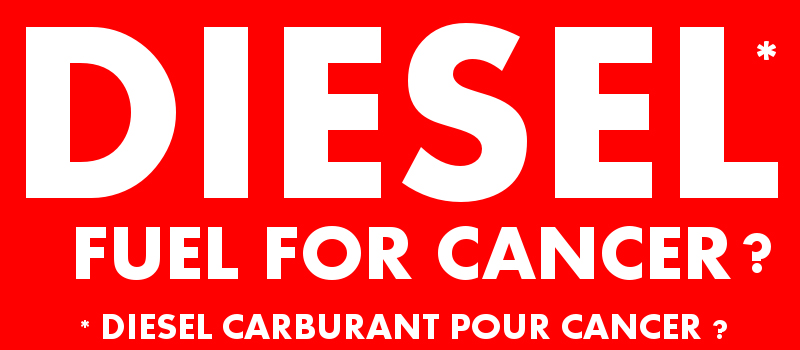
In this week’s Sunday column in Ravaya (22 July 2012, in Sinhala), I discuss the far-reaching public health implications of the World Health Organisation (WHO)’s recent assessment that diesel engine fumes do certainly cause cancer, especially lung cancer, in humans.

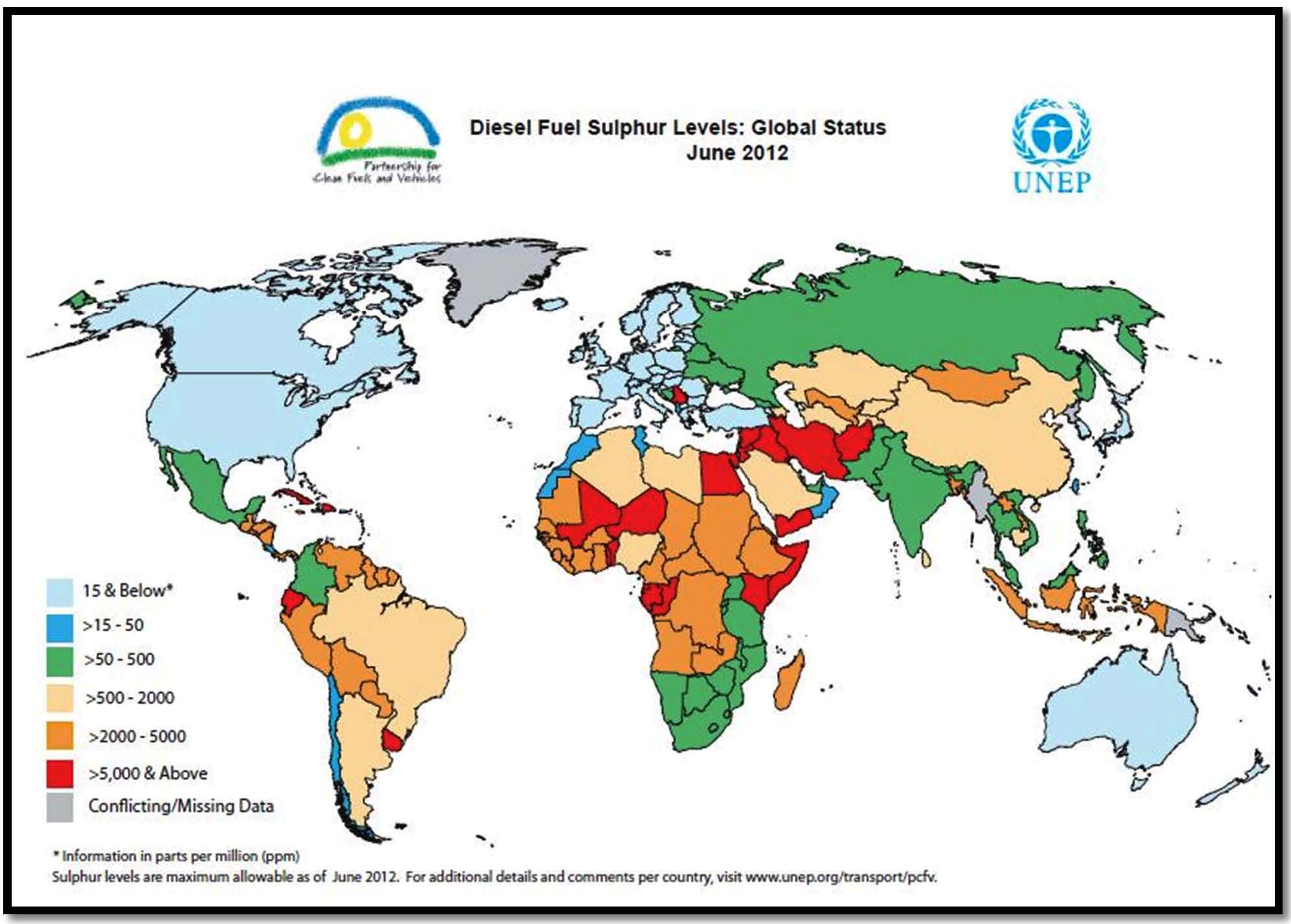 Diesel fuel sulphur status – June 2012, Map by UNEP

 Open Minds!