Arthur C Clarke: The Dangerous Dreamer of Colombo

Image by Reuters, courtesy Down to Earth

Arthur C Clarke: The Dangerous Dreamer of Colombo.

That’s the title I gave to an 800-word obituary/tribute on Sir Arthur C Clarke that I wrote for India’s leading science and environment fortnightly, Down to Earth.

In this essay, I took a quick look at Sir Arthur’s legendary dream power. While there are no independent dream ratings as in television broadcasting, I always felt that he had one of the most active and imaginative dream machines east of Suez (millions of his satisfied readers might agree). When I turn up at his office two mornings a week, he would often relate a fantastic dream he’d just had — a few of these eventually found their way into his stories or even non-fiction writing.

I pegged this tribute on one of my favourite quotes by another British writer, T E Lawrence: “All men dream, but not equally…the dreamers of the day are dangerous men, for they may act their dream with open eyes, to make it possible.”

The tribute has just been published, in the latest issue of Down to Earth datelined 15 April 2008. But the sub editors have chosen a less vivid title, which is of course their prerogative.

This essay was written during the weekend of March 22-23, within hours of Sir Arthur’s funeral. Pradip Saha, the magazine’s editor, contacted me soon after Sir Arthur’s demise and asked if I could do 800 words in 48 hours. He knew I’d worked closely with the late author, and years ago, I had done a Clarke interview for Down to Earth.

Talk about catching me at a busy moment. At the time, as Sir Arthur’s spokesman, I was coping with a deluge of media requests and queries from all over the world (and a few from other worlds – just kidding). But my own newsroom experience had trained me to keep a cool head and remain focused amidst turbulence. So I agreed, and wrote this on 23 March 2008 while still recovering from the sheer exhaustion of a 4-day media-marathon (mediathon?).

This is how I start off the essay:

“In his 1992 book How the World Was One, Sir Arthur C Clarke described a dream he once had: one day, CNN founder (and then owner) Ted Turner is offered the post of the President of the world, but he turns it down politely—because he didn’t want to give up power.

“The trouble with Clarke’s dreams was that many kept coming true, often faster than his own vivid imagination envisaged. Like Albert Einstein, Clarke believed that imagination was more important than knowledge—he called himself an extrapolator, one who expanded from current knowledge to what was scientifically plausible.”

Read my Down to Earth tribute to Arthur C Clarke: The Dangerous Dreamer of Colombo

Listen to our Planet in Distress: Arthur C Clarke’s Last Call

Author and underwater explorer Arthur C Clarke, who died last week aged 90, may not have been a placard-carrying, greener-than-green environmental activist. But in his own unique style, he supported a range of environmental concerns – from the conservation of gorillas, whales and dolphins (among his favourite species) to the search for cleaner energy sources that would enable humanity to kick its addiction to oil.

This interest was sustained to the very end. In his last public speech delivered a month before his demise, he stressed: “There has never been a greater urgency to restore our strained relationship with the Earth.”

The speech was an audio greeting to the global launch of the International Year of Planet Earth (IYPE), held on 12 – 13 February 2008 at UNESCO Headquarters in Paris. Sir Arthur provided the closing remarks for the 2-day meeting attended by diplomats, scientists and youth from all corners of the world.

In that address, which he had recorded from his sick bed in Colombo, Sri Lanka, in early February, Sir Arthur said:
“The International Year of Planet Earth is being observed at a crucial juncture in our relationship with the planet. There are now clear signs that our growing numbers and our many activities are impacting the Earth’s natural systems, causing planetary stress.”

IYPE

He added: “We have had local or regional indicators of this stress for decades, and more recently we have confirmed our unmistakable role in climate change. If we’re looking for the smoking gun, we only need to look in the mirror…”

He outlined his wish for the ambitious IYPE, which is led by geoscientists around the world to raise more awareness and inspire action on understanding how our planet works. “I sincerely hope that the Year of Planet Earth would mark a turning point in how we listen to Earth’s distress call — and how we respond to it with knowledge, understanding and imagination.”

The full text of Sir Arthur’s greeting is found as a pdf on IYPE’s official website, which also offers the actual greeting as an audio file – but only in Apple Quicktime. For those who are not part of that limited universe, I reproduce Sir Arthur’s speaking text in full below.

I had the privilege of once again working on this text with Sir Arthur as I did for many years on various other video/audio greetings and essays. This was originally going to be a video greeting, but we decided to just capture it in audio as Sir Arthur was confined to bed with a back injury since early 2008.

Listen to the audio track on TVEAP’s YouTube channel:

Audio greeting by Sir Arthur C Clarke
to the global launch event of International Year of Planet Earth 2008
UNESCO Headquarters, Paris: 12 – 13 February 2008

Hello! This is Arthur Clarke, speaking from my home in Colombo, Sri Lanka.

I’m very happy to join you on this occasion, when the International Year of Planet Earth is being inaugurated at the UNESCO Headquarters in Paris.

I’m sorry that my health does not permit me to join you in person.
I have fond memories of attending major international conferences at UNESCO over the years. I’ve always cherished my close association with the organisation, especially since I received the UNESCO-Kalinga prize for popularisation of science in 1961 – a date that now seems to belong to the Jurassic era!

The International Year of Planet Earth is being observed at a crucial juncture in our relationship with the planet. There are now clear signs that our growing numbers and our many activities are impacting the Earth’s natural systems, causing planetary stress. We’ve had local or regional indicators of this stress for decades, and more recently we’ve confirmed our unmistakable role in climate change. If we’re looking for the smoking gun, we’ve only got to look in the mirror…

So there has never been a greater urgency to restore our strained relationship with the Earth.

In such a conversation, who speaks for the Earth?

Almost 30 years ago, my late friend astronomer Carl Sagan posed this question in his trail-blazing television series Cosmos. And this is how he answered it:
“Our loyalties are to the species and to the planet. We speak for earth. Our obligation to survive and flourish is owed not just to ourselves, but also to that cosmos ancient and vast from which we spring!”

I sincerely hope that the Year of Planet Earth would mark a turning point in how we listen to Earth’s distress call — and how we respond to it with knowledge, understanding and imagination.

My mind goes back to the International Geophysical Year, which was observed in 1957 – 58. Both the former Soviet Union and the United States launched artificial satellites during that period, thus ushering in the Space Age. Going to space was an important evolutionary step for our species – one that distinguishes our period in history from all the preceding ones. For the first time, we could look back on our home planet from a vantage point in space, and that gave us a totally new perspective.

The beautiful images of Earth from space inspired much public interest that led to the Earth Day and the global environmental movement in the 1970s.

Of course, I’ve suggested that ‘Earth’ is a complete misnomer for our planet when three quarters of it is covered by ocean. But I guess it’s a bit too late now to change the name to planet Ocean!

Fifty years after the IGY and the dawn of the Space Age, do we know enough about how our planet operates?

Thanks to advances in earth sciences and space sciences, we have unravelled many mysteries that baffled scientists for generations. We now monitor the land, atmosphere and ocean from ground-based and space-based platforms. Armies of scientists are pouring over tera-bytes of data routinely gathered by our many sentinels keeping watch over our planet.

We don’t yet fully understand certain phenomena, and there are still gaps in how we process and disseminate scientific knowledge. This is why, for example, the Indian Ocean tsunami of December 2004 arrived without public warnings in Sri Lanka and many other coastal regions. Within minutes of the undersea quake off Sumatra, geologists and oceanographers around the world knew what was happening. But they lacked the means of reaching authorities who could evacuate people to safety.

For this reason, I’m very glad to hear that the Year of Planet Earth is placing equal emphasis on creating new knowledge and its public outreach. Today, more than ever, we need the public understanding and engagement of science. As UNESCO has been advocating for 60 years, public engagement is essential for
science to influence policy and improve lives.

In fact, with our planet under stress, we often have to act before we fully understand some natural processes. That is where we have to combine our best judgement and imagination.

We also need to change the way our resources and energy are used. Our modern civilisation depends on energy, but we can’t allow oil and coal to slowly bake all life on our planet. In my 90th birthday reflections a few weeks ago, I listed three wishes I dearly want to see happen. One of them is to kick our current addiction to oil, and instead adopt clean energy sources. For over a decade, I’ve been monitoring various new energy experiments, which have yet to produce commercial scale results. Climate change has now added a new sense of urgency to this quest.

So we face many challenges as we embark on the International Year of Planet Earth. I hope this year’s many activities will help us to better listen to our home planet, and then to act with knowledge and imagination.

This is Arthur Clarke, wishing you every success in this endeavour.

Earth Day Flag


Listen to the audio file on IYPE website (only with Apple Quicktime)

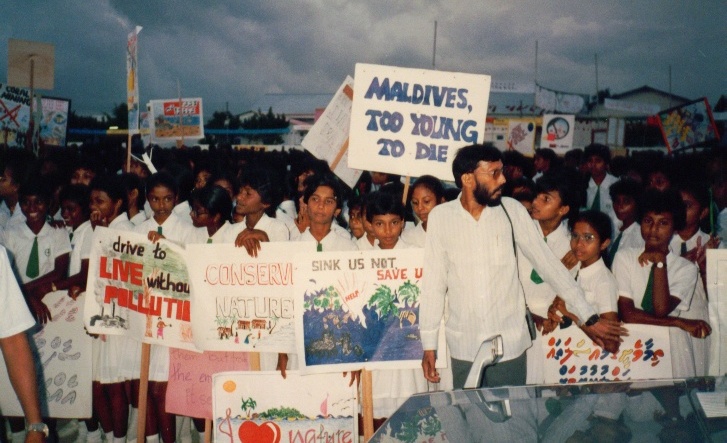
Little voices from the waves: Maldives too young to die!

maldives-too-young-to-die-say-school-children-nov-1989.jpg

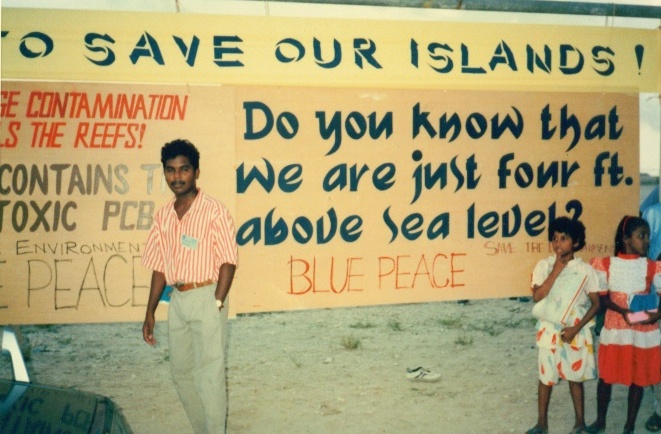
My post last week on the Maldives on the frontline of climate change reminds me that I have been covering this story for the better part of 20 years. I have just located this photo from the depths of my personal image collection.

I first visited the Maldives in 1988, which was within months of the Indian Ocean archipelago nation suffering from a massive storm surge in 1987. Although the damage was minimal, the experience was a forceful reminder of how vulnerable the Maldives can be to even a small rise in sea levels – this is what prompted the low lying nation to take up the issue internationally.

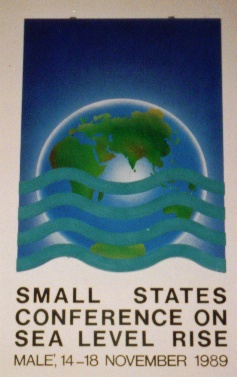
In November 1989, the Maldives hosted the first ever small states conference on sea level rise, held at the Kurumba island resort.

It was also one of the earliest international gatherings on this issue, which was to gain public interest and momentum in the years that followed. Among the participants were delegates from practically all the small states in different parts of the world (defined as those with less than 1 million population), and scientists from disciplines such as oceanography, climatology, meteorology and geology.

This was one of the first international scientific events that I covered as an eager young science journalist. I was then a roving South Asian correspondent for Asia Technology, a popular monthly on Asian science and technology published from Hong Kong (which, alas, folded up in 1991) – there’s nothing online as it was in the pre-web era!

The conference had technical sessions where experts debated scenarios and implications, and a political segment where delegations made their official statements. In the end, they issued the Malé Declaration on Global Warming and Sea Level Rise, which urged for inter-governmental action on the issue.

small-states-conference-on-sea-level-rise-logo.jpg small-states-conference-on-sea-level-rise-logo.jpg

Some 18 years later, I’m still eager but not so young – and I’ve covered more than my share of international environmental conferences to know that they can’t save the world. At least not on their own.

But many serve a useful function in rallying around concerned parties, helping them to agree on advocacy positions. Progress at inter-governmental level can be painfully slow and incremental. Sustaining public and media interest is one way to keep pressure on the endlessly bickering governments.

Following the November 1989 conference, small island states played a key role in negotiations that led to the UN Framework Convention on Climate Change adopted in 1992. This is the precursor to Kyoto, Bali and other processes that are now very much in the news.

The Maldivian hosts knew that scientists and officials alone could not send out a powerful message to the world on what climate change means to low lying islands of the world – many of them no more than a few feet above sea level.

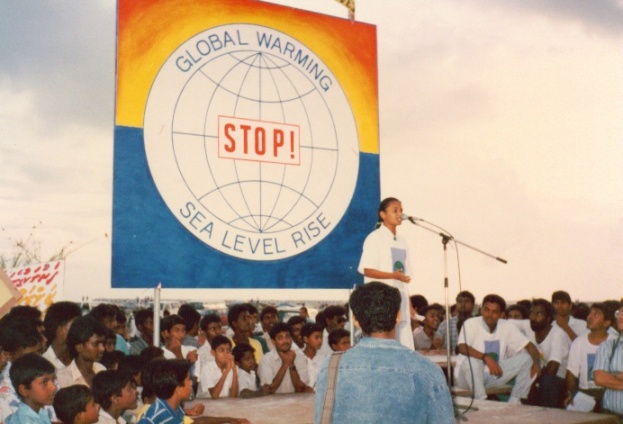
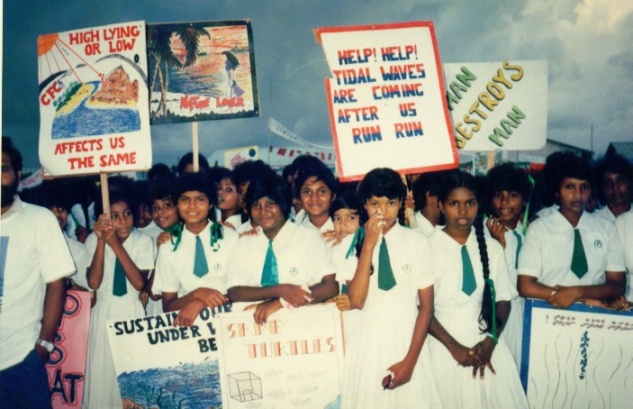
So on the last day evening, we were all taken to the Maldivian capital of Male, where we saw a demonstration and meeting held by the school children and ordinary people. To me, at least, this was the most striking moment of the whole week.

Leading up to this, I had been listening to competent experts and concerned officials talk about impacts, scenarios and mitigation measures for several days. Based on my notes and interviews, I filed several stories that captured highlights.

But unless I go back to my personal archives and look up those stories, I can no longer remember what I wrote. My lingering memories of this event are in these images, showing school children telling delegates – and the world – what it means to be living on the front lines of climate change impact.

listen-to-our-voice-from-the-waves-maldives-nov-1989.jpg

maldivian-school-children-worried-about-sea-level-rise-nov-1989.jpg

Then newly formed Maldivian environmental organisation Bluepeace was also part of the demonstration:

bluepeace-calls-for-global-attention.jpg

I worked for several years as a science and technology reporter. I was trained to gather, process and present facts and, preferably, expert opinion. But over the years I have realised that while hard facts and expert opinions are necessary, these tell only one part of complex stories we cover.

We need to bring in the human face of our stories — how ordinary children, women and men feel about issues and how they react to situations. This is why I now argue that we should not allow the human face of climate change to be lost in our well-meaning technical and economic discussions about climate change mitigation and adaptation.

We can cover carbon neutrality, zero emissions and common but differentiated responsibilities for all we like, but if we don’t pause to listen to these little voices from the waves – from the frontlines that are already feeling the heat – we will miss the bigger picture of what climate change is all about.

Dec 2007: Road to Bali – Beware of ‘Bad Weather Friends’

Photos by Nalaka Gunawardene, Male island, November 1989

Return to Paradise: Maldives on the frontline of climate change

Related blog post: 6 Jan 2008: Little voices from the waves: Maldives too young to die

Mariyam Niuma - photo by TVEAP

All of us at TVE Asia Pacific are missing Mariyam Niuma.

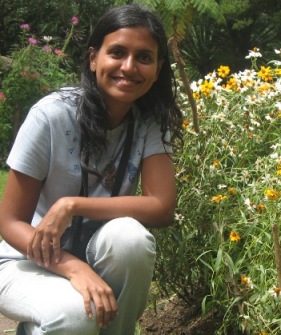
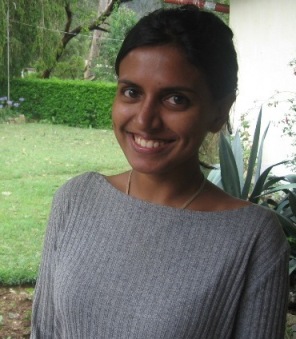
This bubbly, happy-go-lucky intern returns to her native Maldives this week after working with us for over a year as a programme assistant. She plans to spend more time with her family, and explore work opportunities in the Indian Ocean archipelago nation of 370,000 people.

Niuma, in her early 20s, applied for a staff position in late 2006. Among other things, she came with skill and dexterity in graphic design, web research and English proficiency — always useful for a regional communication organisation like ourselves.

“I want to learn as much as I can how a non-profit organisation works,” she told as at the recruitment interview. She had plans of taking the knowledge and skills back to her home atoll, hoping to make life better for her people.

I hope she found what she was looking for. We found in her an energetic young person with good attitude – one who could be challenged to work on tough (and sometimes tedious) tasks on a regular basis.

“The last year has been a very challenging and fulfilling year for me, and being at TVEAP helped a lot,” she wrote in an email on her last day at work. “I will miss you all and being a part of you and will always remember the good times and everything I have learnt here both professionally and personally.”

Some months into her internship, Niuma gave us a presentation on her home country, home atoll and life at home. To many outsiders, Maldives evokes images of palm-fringed sandy beaches, shallow seas of an exquisitely azure blue, high end resorts, crystal clear blue waters for diving…and plenty of sunshine all the year round. (Image shows Kurumba resort, Maldives.)

Well, all that’s true as widely advertised. But Maldives is a whole lot more – a history going back to at least 1,500 BC, distinctive island culture, and a nation that is struggling to reconcile tradition with modernity. Divehi, the Maldivian language, contributed the word “atoll” (a ring-shaped coral reef) to the English language.

The former British protectorate, which became independent in 1965 and a republic in 1968, has a pro-democracy movement sustained over the past few years. If such political turbulences create a sense of uncertainty in the minds of Maldivians about their future, it’s only one source of concern.

They also have to worry about whether their nation would have a collective future. That’s because of climate change that scientists now confirm are underway, aggravated by human action.

Most of the 1,200 islands in the Maldives are no more than 1m (3 feet) above sea level. Even a modest rise in sea levels could inundate these lands. Within 100 years the Maldives could become uninhabitable.

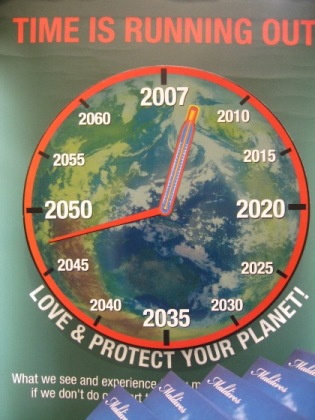
Time is indeed running out for Niuma and her country — as this poster produced by The Body Shop reminds us.

Time is running out...and not just for the Maldives

In 1987 and 1991 storm surges flooded a large number of islands, including one-third of the capital where one-quarter of the country’s population lives. Unusually high waves forced the international airport to be closed, causing great damage to tourism and constraining emergency relief operations. On 26 December 2004, the Asian tsunami battered the Maldives, forcing the evacuation of 13 of its 200 inhabited islands. These incidents indicate how vulnerable the islands are to wave action.

Maldives was among the first countries in the world to raise climate change as a serious issue at the United Nations. President Maumoon Abdul Gayoom raised the alarm back in 1987, when most people had not even realised the problem and scientific evidence was just beginning to come in.

The Maldives did more than raise the issue. The country played a lead role in rallying around other small island states worldwide that would be among the first to be impacted when sea levels rise due to thermal expansion and melting of polar ice.

In November 1989, the Maldives hosted the first ever small states conference on sea level rise, which was one of the first international scientific events that I covered as an eager young science journalist.

The conference issued the Malé Declaration on Global Warming and Sea Level Rise, which urged for inter-governmental action on the issue. The small island states played a key role in negotiations that led to the UN Framework Convention on Climate Change adopted in 1992. This is the precursor to Kyoto, Bali and other processes that are now very much in the news.

Just a few weeks ago, in mid November 2007, the Maldives once again hosted representatives from small island states to discuss climate change. Eighteen years after the original meeting, the subject is no longer a fringe concern; it’s now on everybody’s agenda.

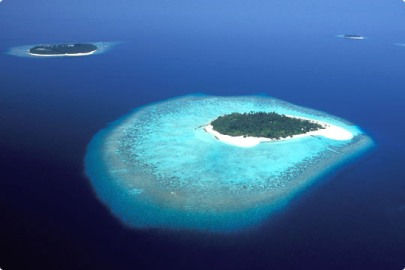
Maldives from the air: tiny specs in the ocean
The meeting urged the the human dimension of global climate change to be included in the agenda of UN Climate Change Summit in Bali (December 2007), and sought the international community’s commitment “to protect people, planet and prosperity by taking urgent action to stabilize the global climate change”.

This time, the Male’ Declaration on the Human Dimension of Global Climate Change called for the UN High Commissioner for Human Rights to assess the human rights implications of climate change and “to conduct a study into the effects of climate change on the full enjoyment of human rights”. It requested the UN Human Rights Council to convene in March 2009 a debate on human rights and climate change.

I wasn’t at the November 2007 Male meeting, but was glad that the meeting stressed the need for adding a human face to the complex, nuanced challenge of climate change. This resonates very much with my own experience.

Read my April 2007 blog post: Wanted – human face of climate change

Mariyam Niuma takes me a bit closer to the realities of what climate change means to communities living on the frontline. Unlike Niuma, who is web savvy and connected with the wider world, many are blissfully unaware of the problem.

Our challenge is to bring their voices, stories and aspirations to the global news agenda and the myriad discussions now underway searching for solutions.

I hope someday we can work with Niuma again — perhaps amplifying her story in moving images.

Nov 2007 blog post: True people power needed to fight climate change

Related blog post: 6 Jan 2008: Little voices from the waves: Maldives too young to die

Photos of Mariyam Niuma courtesy Manori Wijesekera of TVEAP

“Hands up who is poor, speaks English – and looks good on TV!”

“Hands up who is poor, speaks English – and looks good on TV!”

With that title, I opened my panel remarks to the 8th Annual Symposium on Poverty Research in Sri Lanka on the morning of 30 November 2007.

Sri Lanka’s Centre for Poverty Analysis (CEPA) had invited me to speak during a session on ‘Taking it off the page: Alternative mediums of communication to influence change’. The theme of the overall symposium was ‘Communicating research and influencing change’.

Part of my talk was on challenges in using moving images to communicate development related research. The other part was on how most sections of the mainstream media covers stories of the poor — or those living at the bottom of the income pyramid.

I noted that as Asia’s billions strive for a better today and better tomorrow, there are millions of stories at the bottom of the pyramid. But most mainstream media manage to miss these stories due to their ignorance, or arrogance, or both.

But reporting from the bottom of the pyramid need not be all about doom, gloom and alarm. In fact, so much is happening there that a well informed story-teller won’t have much time to spend on negativity (while acknowledging a great deal of suffering that remains).

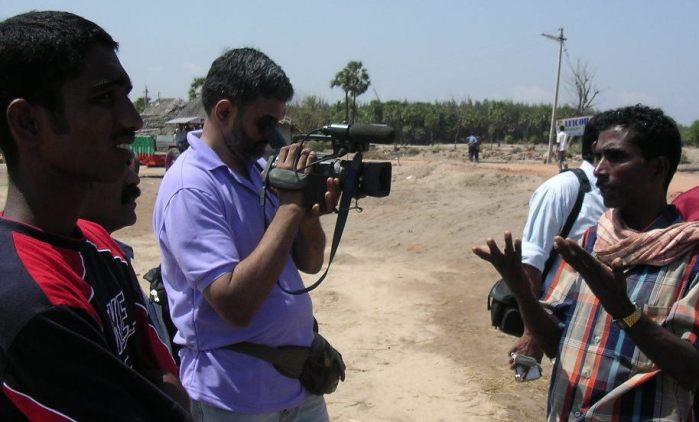
interviewing-tsunami-survivor-in-tamil-nadu-india.jpg

In my remarks, I emphasised that to discover these stories and tell them with empathy and accuracy, we as story-tellers need to recognise a few basic realities:
• The poor are not another species to be treated as if they were endangered! They are living and loving human beings as complex and nuanced as anyone in this room.
• Nor are the poor a ‘sub-human species’ with a simpler set of needs and aspirations. They have as many primary, secondary and tertiary needs – just like anyone else!
• When it comes to information, they have not only survival and practical information needs (which many development projects try to provide), but also what I call ‘information wants’ – cultural and social information – which many development projects completely ignore.
• The poor have opinions too — and are often more articulate and expressive when someone cares to listen and capture these.

So telling media stories from the Bottom of Pyramid needs the knowledge base, socio-cultural understanding and ethical framework in which to gather and process these stories. We at TVE Asia Pacific don’t claim to have got everything right, here are our basic rules of engagement:
• We treat the rich, middle class and poor alike – extending the same courtesy and respect (including obtaining personal clearances for interviews).
• We caption everyone on-screen by name and location, irrespective of their social and economic status.
• We film people – for interviews or generic footage – only with informed consent.
• Wherever possible, we take our the finished TV products back to where they were filmed and share with those who told us their stories. (We are not alone in this: I have written blog posts about Earthcare Films of India and the Brock Initiative of the UK who are also doing this.)

Our industry of broadcast TV is not always known for its class-less treatment of every human being with respect and dignity. In fact, the poor often become ‘Canon-fodder’ for camera crews looking for dramatic images of human suffering.

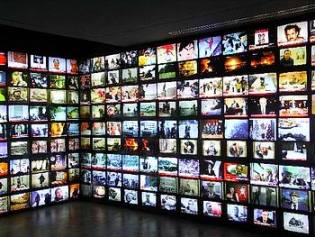
from-mediachannelorg.jpg from-mediachannelorg.jpg

The globalised media continue to use stereotyped images of the global South – captured mostly by northern photographers and camera crews. As my friend Shahidul Alam, founder of Drik Picture Library in Bangladesh, says: “Invariably, films about the plight of people in developing countries show how desperate and helpless they are…. Wide angle black and white shots, grainy, high contrast images characterise the typical third world helpless victim.”

This explained my title: “Hands up who is poor, speaks English and looks good on TV!” It’s a caricature of how some camera crews go looking for that convenient sound-bite with some doom-and-gloom visuals to match.

But it’s not just the northern media who sensationalise and oversimplify life at the bottom of the pyramid in the South. Many of our own media outlets, rooted in the cities and obsessed with middle class life styles, are also good (or bad) in this game!

And the media are not alone. When development agencies and ‘pro-poor’ activists presume – in their middle class arrogance – that the poor only need survival or sustenance related information, the latter is immediately reduced to sub-human status.

Nov 2005 op ed: Communication rights and communication wrongs


Nov 2006 op ed: Ethical news gathering: Al Jazeera’s biggest challenge

Aug 2007 blog post: Wanted: Ethical sourcing of international TV News

Moving images moving research…beyond academic circles!

Although I’ve dabbled in some media research at times, I don’t think of myself as a researcher. So when Sri Lanka’s Centre for Poverty Analysis (CEPA) invited me to speak at their 8th Annual Symposium on Poverty Research in Sri Lanka, I spoke on what I know a little bit about — communicating research using the audio-visual media.

My panel remarks, delivered on the morning of 30 November 2007, were on ‘alternative mediums of communication to influence change’. I opened with the provocative title “Hands up who is poor, speaks English – and looks good on TV!” (see separate blog post on media related aspects of my talk).

These days, so much of research in physical, biological and social sciences is justified in the name of poverty reduction. Yes, studying and understanding development problems is the essential first step of solving them. But without properly communicating this research, the results won’t help the poor — or anyone else.

We at TVE Asia Pacific are committed to covering Asia’s development issues using TV, video and web. Our small challenge is to capture the many and varied facets of how Asians are working for a better today and better tomorrow. Reducing and eventually eliminating poverty is a significant part of that process.

As Asia’s billions strive for better lives, there are millions of stories at the bottom of the income pyramid. But most mainstream media manage to miss these stories due to their ignorance, or arrogance, or both.

For us, one key source of information and analysis is researchers – people who study trends and conditions, and keep reflecting on how and why. Their knowledge and insights are invaluable for us to tell stories from and about the bottom of the pyramid.

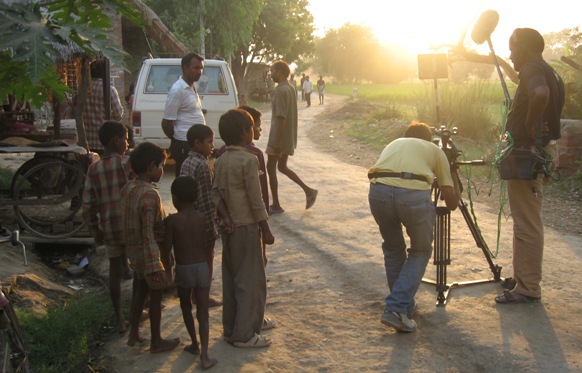
filming-living-labs-in-uttar-pradesh-india.jpg

As I told the researchers in my audience: “Part of our challenge is to know what you are studying — and then figure out the public interest and human interest angles of your work. As communicating research to those outside the scientific or research communities is more an art than a science.”

I cited three recent examples where we had produced engaging TV/video content to communicate research directly relevant or related to the poor.

Digits4Change
was our attempt to understand and document how information and communication technologies (ICTs) are changing the way Asians live, work and play. We covered technologies such as Internet, computers, mobile phones and satellite communications applied in education, healthcare and rural business development. The knowledge base for this 2006 series came from IDRC’s Pan Asia programme which supports action research that addresses specific problems.

Also in 2006, we produced The Greenbelt Reports to take a close look at the environmental lessons of the Indian Ocean tsunami. We visited a dozen locations in India, Indonesia, Sri Lanka and Thailand to find out how community and conservation interests can be balanced in relation to coral reefs, mangroves and sand dunes. In telling these stories, we worked with researchers from global agencies like IUCN the World Conservation Union and UNEP as well as national organisations like the M S Swaminathan Research Foundation in India.

The Greenbelt Reports

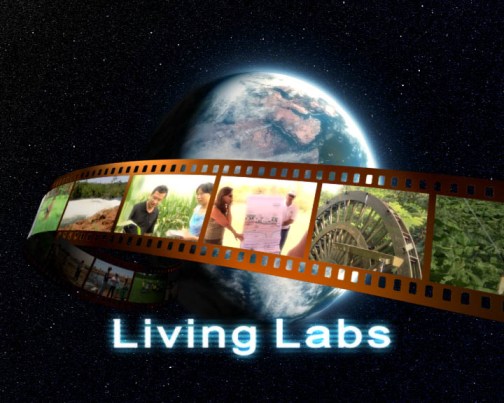
Living Labs is our most recent series, released in March 2007. Filmed in 9 countries in Africa, Asia, Europe and Latin America, it looked at how researchers are addressing different aspects of a major challenge in agriculture: how to grow more food with less water. We worked with a global action research project called the CGIAR Challenge Programme on Water and Food, which gave us exclusive access to their on-going field work and emerging findings in nine major river basins of the developing world.

living-labs-by-tveap.jpg

In telling these and other stories, we work within a certain framework we have defined for ourselves. Among its salient points:
• We don’t set out trying to communicate messages; we just want to tell good stories and development communication is a by-product.
• We look for under-reported/ignored development issues, or a less covered angle in a widely reported story.
• We don’t just talk to technical experts but to many other individuals involved or affected – women, men and children from all walks of life.
• We seek and accommodate different points of view, not allowing single-issue activists or one source to dominate/monopolise a story.
• Our finished products are informed by science but never immersed in science – we always keep in mind that our audience is non-specialsits.

All our stories cover real people dealing with real world issues and challenges. And since Asia has more people living in poverty than anywhere else in the world, most of the time our stories concern what’s happening at the bottom of the pyramid – or what can directly impact people living there.

And without exception, all these TV series and individuals films are available free of any license fees for broadcast, civil society and educational use. They are also available for online viewing at TVE Asia Pacific’s channel on YouTube.

Communicating research through moving images is not easy. Packing years of hard work into a few mins of engaging visuals and narration involves ruthless condensation which sometimes leaves some researcher egos bruised. When covering the work of large research organisations, we’ve also had deal with internal politics and hierarchies: for example, what to do when a junior researcher is more authentic and articulate than her supervisor?

Producing Living Labs based on filming in 9 countries on 3 continents in just 5 months during 2006 was a challenge in both logistics and political negotiations. As editor-in-chief, I had to balance the public accessibility of our end product with researchers’ keenness to pack their stories with facts and figures.

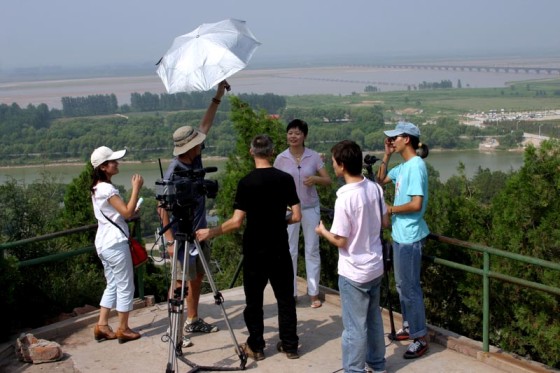
living-labs-being-filmed-in-yellow-river-basin-china.jpg

We didn’t please everyone. One senior researcher told us that his multi-faceted, multi-year nad multi-million dollar was like an elephant — and we’d only glimpsed just one part of that big creature!

That’s just the point: we can never cover the whole elephant in a media product intended for non-specialists. So we choose which part of the elephant is most interesting and present it in a way that will make viewers realise — and hopefully, appreciate — that there’s a lot more that’s worth finding out.

Moving image products often act only as ‘teasers’ — communicating highlights of research, and directing those interested to online or offline sources that offer more information.

Because they act as a/v versions of executive summaries, these ‘teasers’ by themselves are a powerful way of reaching out those who are unlikely to look up the details: that includes many policy makers, government officials and business people.

Winston Churchill used to ask his staff to give him everything ‘on one page’. These days, he might have asked for everything to be summed up in a five minute video — as we often do.

Road to Bali: Beware of ‘Bad weather friends’!

unfcccnew-c.jpg

All the environmental roads — well, actually flights — seem to lead to Bali in the coming days.

The Indonesian ‘Island of the Gods’, famed as a tourist resort, will play host to the 13th United Nations Climate Change Conference from 3 to 14 December 2007.

The Conference, hosted by the Government of Indonesia, brings together representatives of over 180 countries together with observers from inter-governmental and non-governmental organizations, and the media. The two week period includes the sessions of the Conference of the Parties to the UN Framework Convention on Climate Change (UNFCCC), its subsidiary bodies as well as the Meeting of the Parties of the Kyoto Protocol.

The Bali meeting will be a turning point in the global response to climate change, an issue which has moved above and beyond being a simple ‘green’ concern to one with economic, security and social implications. The annual meeting returns to Asia after five years, since New Delhi, India, hosted the 8th meeting in November 2002.

In the build up to Bali, a new report released on 19 November 2007 says that without immediate action, global warming is set to reverse decades of social and economic progress across Asia, home to over 60 per cent of the world’s population.

Up in Smoke? Asia and the Pacific – with a foreword by Dr Rajendra K Pachauri, Chairman of the Nobel prize-winning Inter-governmental Panel on Climate Change (IPCC) – is the most extensive and concluding chapter of a unique, four-year long exercise by the Up in Smoke coalition, an alliance of the UK’s major environment and development groups.

The report shows “how the human drama of climate change will largely be played out in Asia, where almost two thirds of the world’s population live, effectively on the front line of climate change.”

When our friends at the International Institute for Environment and Development (IIED) in London sent me the press release about the report last week, something caught my eye. Among the several accompanying quotes was this one concerning the media:

“In many Asian countries climate change stories don’t make it into the media, so the public are left out of the debate. The challenge for decision-makers and the media is to stimulate interest in their work and translate the complex issues into stories that capture the public’s imagination. Climate change above all requires the engagement of everyone in creating the changes required.”

This sweeping statement is attributed to Rod Harbinson, Head of Environment, Panos London.

I know Panos London well, and am surprised to read an official remark of this nature emerging from that organisation which, until recently, has tried to relate to the majority world media as a friend and supporter. In fact, the first time I had one of my own pieces internationally syndicated was by Panos Features, back in 1989.

Come to think of it, the second article I wrote for Panos Features concerned how the low-lying, Indian Ocean island nation of Maldives was preparing for adverse impacts of climate change. That was years before the web, so there’s no link I can provide.

As a development writer and journalist who has covered global climate change among other issues for two decades, I have problems with Mr Harbinson’s remark.
Drik/Majorityworld
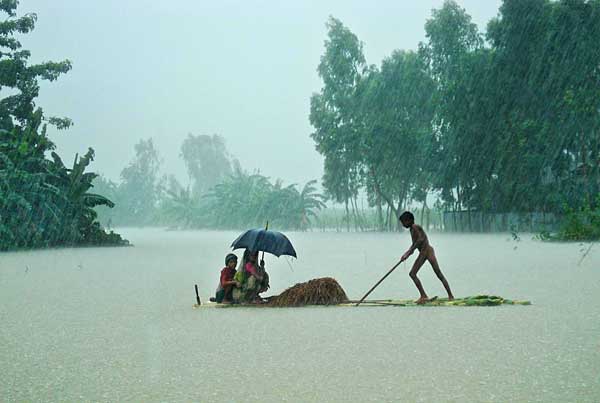
Photo: A family looks for shelter using a raft made of banana trees during the last Monsoon: 31 July 2007: Gaibandha, Bangladesh © Quddus Alam/DrikNews Linked from Shahidul News

I’m in full agreement on the need to ‘translate the complex issues into stories that capture the public’s imagination’. There is also no argument that climate change requires the engagement of everyone.

But I would be very interested to know on what statistical or analytical basis he says “in many Asian countries climate change stories don’t make it into the media, so the public are left out of the debate’.

Asia, as Mr Harbinson should surely know, is not just China, India and Indonesia. It is large and highly diverse region, containing five sub-regions as defined by the UN. It is home to nearly two thirds of humanity, who live in over three dozen independent states or dependent territories.

Living in Asia and trying to work at regional level, I know how difficult it is to make any generalisations about this rich and constantly changing assortment of economies, cultures and societies branded as Asia (which, taken together with the small island nations of the South Pacific, is known as the Asia Pacific). In fact, it’s wise not to speak about Asia as a whole, for there is little in common, say, between Japan and Laos, or between China and Maldives.

The Asian media are as diverse as the region, and have been undergoing rapid change in recent years. Unshackled from the state’s crushing grip in most countries, the broadcast media (radio, TV) have proliferated and emerged as the primary source of information for a majority of Asians. New media – web, mobile devices and multimedia combinations – are now changing the way many Asia’s communicate and access information.

I have always been curious how Panos London, perched at its cosy home in London’s White Lion Street, assesses what goes on in the majority world. In this case, how much of Asia does Mr Harbinson know and is really familiar with? How many Asian media outlets has he or Panos monitored, assessed and sampled before coming to this sweeping and damning conclusion about the lack of climate change stories in the Asian media?

And how many of these outlets are radio and TV, and in languages other than English? I would really like to know.

If Panos London believes in evidence-based analysis, then it owes us in Asia an explanation as to on what basis its head of environment makes such statements about an entire continent, whose media output is predominantly in Asian languages, not English. And whose principal media are broadcast, not print.

And what constitutes a climate story? Tracking the endless array of inter-governmental babble in the name of working out some compromised partial solution to the major problem? Or reporting on campaigns to clean up polluting industries or sectors (such as transport) that generate most of the greenhouse gases? Or focusing on how humble communities in remote corners of the world are finding how their lifestyles and livelihoods are suddenly threatened by something they hardly understand?

To me, it’s all of the above — and a lot more. Climate change is akin to a prism through which many, many development issues and topics can be analysed. Just as HIV/AIDs long ago ceased to be a simple medical or health story, climate change has moved well beyond being an environmental story.

The more angles, perspectives and topics that are covered in the media, the better. And all of it need not be in that staid, cautiously balanced style of The Guardian or BBC that Panos London must be more familiar with.

Panos London, in its statement of beliefs, says ‘Freedom of information and media pluralism are essential attributes of sustainable development’. Surely, then, they realise that media pluralism includes speaking in a multitude of tongues, and analysing from many different perspectives — as happens in the Asian media 24/7, if Mr Harbinson and his colleagues care to spend more time in the region and keep their eyes and ears open.

But instead, they seem more like a group of well-meaning people with a solution in search of a problem. For the past many months, Panos London has been crying wolf about the allegedly poor coverage of climate issues in the majority world media.

That was the main thrust of a report they published in late 2005, titled Whatever the weather – media attitudes to reporting climate change.

According to Panos London website that I have accessed today, “…the survey found that there is little knowledge among journalists about these important choices and they are rarely discussed. The dramatic impacts of extreme weather events, for example, rarely feature in relation to climate change and the topic remains low on editors’ story sheets.”

The survey was based on ‘interviews conducted with journalists and media professionals in Honduras, Jamaica, Sri Lanka and Zambia’ and claimed to ‘give insights into the attitudes of journalists and the status of the media in these countries.’

Well, I was one of those majority world journalists covered by the survey — and I had major reservations about how they used my responses. Being cautious, I had used email (and not the phone) to respond to their survey questions – I therefore have a complete record of everything I said. When the draft report was shared on my request, I found some of my responses being distorted or taken out of context. I had to protest very strongly before some accuracy was restored. I later regretted having agreed to be part of this dubious survey.

It was flawed in many ways. The questionnaire was very poorly conceived and structured. I actually declined to answer some questions which were worded in such a way as to elicit just the kind of response that Panos London wanted — to make a case that journalists in the majority world are so incompetent that they need help.

A glaring omission in the final report was that it carried no list of journalists interviewed. I had to ask several times before I could even find out how many others participated in the survey (apparently some three dozen). But my requests for a list of other survey respondents were repeatedly declined by Panos London, who said it was privileged information. They later took the position that European data protection laws did not allow them to disclose this information!

In an email sent to Rod Harbinson on 22 Feb 2006, I said: “I would argue that Panos London had pre-conceived notions that it wanted to present in this report, and used superficial and largely unprofessional interview surveys with a few scattered journalists as a rubber-stamping exercise to publish what it wanted to say anyway. This is further borne out by the fact that some of my more outspoken responses have been completely ignored.”

I have seen or heard nothing since to change the above view. And the contents of Whatever the weather – media attitudes to reporting climate change are consistent with what Rod Harbinson says in the IIED press release that prompted me to make this comment.

Yes, climate change is the Big Issue of our times that needs everyone to rally around and search for ‘common but differentiated’ solutions and responses. But no issue or global threat is too big to warrant the willing suspension of time-honoured journalistic or academic values of honesty, integrity and balance. Issuing lop-sided ‘survey reports’ and making sweeping negative statements do not help the cause of improving public discussion and debate on climate change.

The road to Bali and beyond is going to be an arduous journey. On that treacherous road, we in the majority world need to beware of ‘bad weather friends’ who come bearing bad surveys and self-serving offers of ‘help’.

— Nalaka Gunawardene

Note: In the spirit of communication for development and media pluralism, I invite Panos London to respond to the above critique, and offer to publish their response in full.

I remain a critical cheer-leader of the global Panos family, and serve on the Board of Panos South Asia, an entirely independent entity that has excellent relations with Panos London. Like all families, we don’t always agree – and that’s part of media pluralism!

Related blog posts:

Nov 2007: True ‘People Power’ needed to fight climate change
Nov 2007: Beyond press release journalism: Digging up an environmental business story
Oct 2007: The Al and Pachy Show: Climate Change gains public momentum

Aug 2007: Arthur Clarke’s climate friendly advice: Don’t commute; communicate!
June 2007: Sex and the warming planet: A tip for climate reporters
April 2007: Can journalists save the planet?
April 2007: Beware of Vatican Condoms and global warming
April 2007: Pacific ‘Voices from the Waves’ on climate change
April 2007: Wanted – human face of climate change!

The Al and Pachy Show: Climate Change gains public momentum

Compared to former US Vice President and climate campaigner Al Gore, the name Rajendra K Pachauri might not be as widely recognised. In fact, I wonder how many Americans can even pronounce the name correctly.

But Dr Pachauri is a scientific heavyweight himself, and is the other half of this year’s Nobel Peace Prize. He chairs the UN’s Inter-governmental Panel on Climate Change (IPCC), which was announced as joint and equal winner.

He may be less glamorous than Gore, but Pachauri is just as ardent an advocate for the world to seriously tackle global warming. It was Pachauri’s dedicated work ethic and “ability to build and inspire a team” that helped the IPCC to win the world’s most coveted prize.

Read Rajendra Pachauri’s first reaction to the Nobel Peace Prize announcement

In a profile of the Indian engineer turned scientist-diplomat, The Christian Science Monitor noted: “If Gore is the frontman of the crusade against global warming, then Pachauri runs the engine room.”

Like Gore, Pachauri is a global-warming pioneer. Since the late 1980s, the former industrial engineer has sought to use science to convince skeptics and CEOs of the need of reducing mankind’s atmospheric imprint. Now, he warns that if the problem is not addressed, developing nations will bear the brunt of the crisis, suffering for a situation they did not create because they have not the resources to mitigate it.

In their profile, The Christian Science Monitor quoted Tulsi Tanti, a friend and founder of Suzlon, Asia’s largest manufacturer of wind turbines, as saying: “He has been one of the pioneers and voices of reason in the field, not just calling attention to an environment in peril but creating solutions by bridging the gap between academia, business, policymakers, and the public.”

Read full profile from The Christian Science Monitor of 15 October 2007

I first met and interviewed Dr Pachauri in October 1990, during the Second World Climate Conference in Geneva. That was one of the first international scientific conferences that I covered as a journalist, and Pachauri was kind enough to grant me a long interview. We spoke less of climate and more about energy security and innovative energy solutions. At that time he was head of India’s Tata Energy Research Institute, which was later renamed as The Energy and Resources Institute, still abbreviated as TERI.

Our paths have occasionally crossed since, in different parts of the world, and Dr Pachauri has always remained accessible and articulate. I last met him in Rome in the fall of 2003, during the annual GreenAccord Media Forum on Protecting Nature organised by the Italian organisation GreenAccord.

Read Dr Rajendra Pachuri’s speech at GreenAccord 2003 meeting.

Pachauri was his characteristic modest when reacting to the news of the Nobel Prize. ”I was not expecting any awards for my efforts. I feel privileged to share it with Al Gore. I am only a symbolic recipient but it is the organisation which has been awarded,” he said.

He added: ”With this award to the committee, the issue of climate change will come to the fore. It places a larger responsibility on me and I will ensure that more will be done.”

In a phone call soon after the announcement, he reportedly told Al Gore: “This is Pachy. I am so delighted and so privileged to have the IPCC share with you. I will be your follower and you will be my leader.”

The IPCC set up in 1988 comprises 3,000 atmospheric scientists, oceanographers, ice specialists, economists and other experts and is the world’s top scientific authority on global warming and its impact.

Wikipedia on the IPCC and its track record

Wikipedia on Rajendra K Pachuri

Journalists join the Global Race to the Arctic!

Image from Wikipedia

Everybody seems to be heading to the Arctic these days.

With global warming triggering a thawing of the massive ice caps that have covered the North Pole for millennia, bordering countries are trying to stake claims on land masses, open seas and suspected oil and other mineral reserves.

The results of global warming are seen first and strongest in the polar regions. The Arctic sea ice has shrunk at an average annual rate of about 70,000 square kilometres per year since 1979.

There’s suddenly a new race to the North Pole, not so much to reach it first – as happened in the early part of the 20th century – but to grab a piece of real estate.

And now, science journalists can join the race.

The World Federation of Science Journalists (WFSJ) has just announced a competition offering science journalists the chance to win three week-long trips aboard the Canadian research icebreaker Amundsen. It is being organised in collaboration with the Canada Foundation for Innovation and the International Polar Year Circumpolar Flaw Lead Project.

Winners will fly to Inuvik (Canada), and hop aboard a Twin Otter aircraft to the famous icebreaker. There, they will receive first hand experience of global warming where it is unfolding the fastest, says a circular from WFSJ.

To enter, professional journalists are invited to send their CV, coordinates, key pages of passport and a one-page essay on why they should be selected.

World Federation of Science Journalists
28, rue Caron, suite 200, Gatineau (Québec) Canada J8Y 1Y7
Email: info@wfsj.org
Tel.: +819 770-0776
Fax: +819 595 2458
www.wfsj.org

Applications must be received before 5 November 2007.

Crossing the other Digital Divide: Challenge to conservation community

Digital Divide refers to the gap between those who have regular, easy access to modern information and communication technologies (ICTs) and those who don’t. In the past decade, the IT industry and development community have launched various initiatives to bridge this divide. The One Laptop Per Child project is among the better known examples.

As digital technologies and media gain momentum and wider coverage than ever before, another kind of digital divide has emerged. This week in Kathmandu, during the Fourth Asian Conservation Forum, some of us have been talking about this new divide — between the Digital Natives and Digital Immigrants.

This latter divide is mainly a product of age, not socio-economics. Market research and sociological studies now confirm that today’s younger people – raised on a diet of mobile phones, video games and mp3 (music) players – have radically different ways of accessing, receiving and coping with information.

Recognising this new Digital Divide is vital for communication and advocacy work of conservation groups, such as IUCN – The World Conservation Union, conveners of the Kathmandu forum.

For nearly 60 years, IUCN has been an effective platform for knowledge-based advocacy. Using scientific evidence and reasoning, it has influenced conservation policies, laws and practices at country and global levels. The world would be a worse place to live in if not for this sustained advocacy work by thousands of experts and activists who were mobilised by IUCN.

Much of that work has been accomplished through the classical advocacy tools: scientific papers, books, conferences and, in recent years, ‘policy dialogues’ — meetings where experts and activists would sit down and talk things through with those who make policy in governments and industry.

IUCN continues to pursue all these methods, with creditable impact. IUCN’s Red List of Threatened Species, whose latest edition is being released today (12 September 2007), is among the best known examples of how the Union’s work informs and inspires urgent action for saving the world’s animals and plants driven to the edge by human activity.

To remain similarly effective in the coming years, IUCN — and the rest of the conservation community — need to evolve and adapt to changing realities in human society. One such reality is the proliferation of ICTs in the past two decades.

The International Telecommunications Union (ITU) announced recently that the world’s telephone connections had passed four billion. Largely thanks to the explosion of mobile phones in the majority world, the total number of telephones (fixed and mobile) had quadrupled in the past decade.

While exact figures are hard to come by, it is estimated that around 1.17 billion people (almost 1 in 6 persons) have access to the Internet, even though varying levels of quality.

These are the more widely quoted figures, but the media mix keeps diversifying even as the size of the overall ‘ICT pie’ keeps increasing. For example, the 1990s saw a channel explosion in both FM radio and television across much of Africa, Asia Pacific and Latin America, hugely increasing viewers’ choice and enhancing the outreach of broadcasting. The popularity of video games (and now, online games) has spawned trans-boundary subcultures that were inconceivable even a decade ago.

It is this bewilderingly media-enriched world that IUCN’s members and experts are trying to engage, hoping to persuade everyone — from governments and industry to communities and individuals — to live and work as if the planet mattered.

In Kathmandu this week, I argued that scientific merit and rational (and often very articulate) reasoning alone won’t win them enough new converts to achieve significant changes in lifestyles, attitudes and practices. To be heard and heeded in the real world outside the charmed development and conservation circles, we need to employ a multitude of platforms, media and ICT tools. And we have to talk in the language of popular culture.

We have come a long way since the 1980s, with the new ICTs evolving parallel to our own understanding of sustainability.

When we were involved in processes leading up to the Earth Summit in Rio de Janeiro, back in 1992, most of us were still using fax and snailmail to exchange information. Email was confined to academic circles and the web was not even conceived.

By the time Johannesburg Summit was held a decade later, email had come into wide use and static websites were being used to disseminate information and opinions. E-commerce and music file sharing were gaining momentum.

Just five years on, the rapidly evolving web 2.0 offers us more tools and platforms to not just engage in one-way dissemination, but to truly communicate with a two-way flow. Wikis allow participatory document drafting. Web logs or blogs enable faster, easier expression and discussion. YouTube and other platforms have suddenly made sharing of moving images much simpler (assuming we have sufficient bandwidth).

In fact, connectivity is improving in many parts of the world, though there still are many gaps, frustrations and cost issues to be resolved. Young people, under 25 years, are leading the charge in entering and ‘colonising’ the new media. Social networking platforms such as MySpace and FaceBook are only the tip of this cyber iceberg. And virtual worlds — such as Second Life, with over 8 million online members — are moving in from the periphery to occupy a clear niche in our new digital world.

800px-web_20_mapsvg.png

Every indication is that these trends will continue. IUCN and other conservationists, with their rigorous scientific analysis expressed in technical papers, print publications and the occasional op ed article in a broadsheet newspaper, have to navigate in this whirlpool — and it’s not easy. But their choice is between engagement and marginalisation. The planet cannot afford the latter.

I’m not suggesting that conservation scientists and organisations must drop their traditional advocacy methods and rush to embrace the new ICT tools. But they need to survey the new media landscape with an open mind and identify opportunities to join the myriad global conversations.

A good part of that is what intellectuals might see as chatter, or tabloid culture. It’s precisely this mass tabloid audience that needs to be engaged for conservation.

There are inspiring examples of how other sections of the development spectrum are seizing new media opportunities:

* Some humanitarian groups now use Google Earth online satellite maps for their information management and advocacy work, for example in Darfur, Sudan, and the Central African Republic.

* In an attempt to name and shame offenders, human rights activists are using YouTube to post incriminating video evidence of human rights abuses worldwide. The influential Foreign Affairs journal recently called this the YouTube Effect.

Fortunately, at least a few Asian conservation leaders already appreciate this enormous new media potential. In Kathmandu, Surendra Shrestha, UNEP’s regional director for Asia Pacific, echoed my views.

“My young kids spend several hours each weekend in virtual worlds. We need to get in there and engage them with our content,” he said. “To do that, we have to get inside their minds, and speak their language.”

Shrestha mentioned how UNEP in Asia is attempting this with ICT-based projects for youth, such as e-generation which, according to him, has involved half a million young people.

Such initiatives are beginning to happen, thanks to a few conservationists who are pragmatic enough to exploit the inevitable. But much more needs to be done to make conservation ‘cool’ and hip for Asia’s youthful population, half of them under 35, and many of them Digital Natives.

For sustainability measures to have a chance of success, these upwardly mobile, spend-happy youth have to be reached, touched and persuaded. If it takes tabloid tactics to achieve this, so be it.

And given Asia’s growing economic clout and ecological impact – with China and India leading the way – the fate of the planet will be decided by what is done, or not done, in our region.

While they debate the finer points of conservation strategies and activities in Kathmandu, Bangkok and other cities across our massive region, Asia’s conservation community must quickly cross the new Digital Divide that currently separates them from Digital Natives.

Declaration of interest: I was part of IUCN Sri Lanka Secretariat (1992-1994), where I started its communication division, and have been a member of IUCN Commission on Education and Communication since 1991.

Read my April 2007 post: Do ICTs make a difference?