Say MDG and smile, will ya?

There we go again!

I have just done another post on Millennium Development Goals (MDGs), pleading that the core issues they promote be given due prominence than simple brand promotion for MDGs and their promoters-cum-custodians (the UN).

For my readers outside the charmed development circles, MDGs are an international blueprint for human development, with eight major goals to be achieved by 2015. These goals are the means of implementing the Millennium Declaration — to which 189 governments committed at the UN Millennium Summit held in 2000.

One way to ensure the governments will keep their promise is to turn media spotlight on them. Journalists and media managers have a key role to play in this process.

With this in mind, our friends at the Asia Pacific Institute for Broadcasting Development (AIBD) have launched the Asia Pacific MDG Media Awards to ‘recognise and honour the best media reporting on the MDGs’. They have the backing of two UN agencies (UNDP and UNESCAP) and the Asian Development Bank. The deadline for applications is 15 April 2007.


See TVE Asia Pacific news item on Asia Pacific MDG Media Awards

All this is well and good — except that the rules of the award scheme are a bit self-limiting. There’s one that I’ve only just noticed: “Reference to the MDGs (whether one or all MDG Goals) in your content is mandatory.”

This places wrong emphasis on MDG branding when it should be on the actual issues. MDGs are not another slogan for spin doctors at UN agencies to play around with for a few years until the next development fad comes along.

MDGs are about human dignity and social justice to the half of humanity that currently lives in poverty, squalor and deprivation. It is these real world people who lose their babies to preventable childhood diseases; drop out of school because they cannot afford to stay on; die needlessly in their millions during pregnancy or childbirth; or go to bed hungry every night.

In that bigger scheme of things, it doesn’t really matter whether justice is delivered through strategies, programmes and projects labelled ABC, XYZ, MDG or something else.

Besides, MDGs are a means to an end. The process is important, but branding is not, on that journey.

Half way along the way — to the agreed target of 2015 — an informed and motivated media can help countries and development players to remain focused.

By all means, reward good journalistic coverage of development and social justice issues underscored by the MDGs. But please, let’s not turn this into another round of simple publicity and self-promotion for UN agencies.

Related:

MDG Asia Pacific website

AIBD documents on Asia Pacific MDG Media Awards

MDG: A message from our spin doctors?

References to the Millennium Development Goals (MDGs) are popping out of every UN document, speech and communication product these days. Each agency and official seem to be keen to outdo all others in living and swearing by this new ‘development mantra’ of our times.

MDGs are an international blueprint for human development, with eight major goals to be achieved by 2015. These goals are the means of implementing the Millennium Declaration — to which 189 governments committed at the UN Millennium Summit held in 2000.

But important as they are, the MDGs are only a means to an end, even if an extremely worthwhile one. If we lose sight of that, we risk allowing the MDG ‘dog’ to wag the development ‘dog’.

Alfonso Gumucio Dagron

Speaking at OUR Media 6 conference in Sydney this week, Alfonso Gumucio-Dagron, Managing Director – Programmes of the Communication for Social Change Consortium, cautioned about development agencies engaging in too much spin or public relations, and too little real communication.

Alfonso, a widely experienced and highly respected practitioner and thinker in development communication, lamented how institutional publicity is taking a much higher priority than communication as a social process that gives a voice to the communities and players involved.

Ah, finally a dev-com heavyweight echoes what I’ve been saying for some time! At every UN and media platform I could access in the past couple of years, I’ve stressed that catalysing wide ranging public discussion and debate on the MDGs’ core issues is far more important than simply enhancing ‘brand recognition’ for MDGs themselves. (That’s useful too, but as part of a wider process.)

On the eve of the MDG+5 Summit at UN Headquarters in September 2005, I wrote in an editorial published by SciDev.Net:

Today’s MDG promoters need to revisit some of the more successful development efforts of the past few decades — such as promoting universal human rights, eradicating smallpox, popularising oral rehydration salts, and wiping out Southern debt — and study the role good communication played in each.

Those in the UN system, in particular, have to find more creative ways of getting the MDG message across. In my view, MDG ‘branding’ is not what is important; it is the core set of issues that MDGs embody that need mass attention and aggressive promotion.

We should also invoke the memory of past visionary leaders who navigated the treacherous inter-governmental minefields to talk truth to power. One was James Grant, former executive director of the UN children’s agency, turned UNICEF into a formidable global brand.

One of Grant’s enduring remarks concerned the silent emergency of several thousand children (and adults) dying everyday from preventable diarrhoeal diseases. It was, he pointed out repeatedly, as if several jumbo jets full of children were crashing everyday — and nobody took any notice.

That metaphor might lack political correctness in the post-11 September era. But the message was loud and clear. Grants’ one time deputy at UNICEF, Tarzie Vittachi, was another master at summing up complex development issues in memorable ways. When he was head of information at the UN population agency, the former newspaper editor used to remind everyone: ‘Governments don’t have babies; people do.’

Read my full editorial in SciDev.Net in September 2005: Simpler words are needed to get MDG message across

Related links:

MDGs: Mind the development gap, Asia Pacific told

The Communication Initiative: Strategic Thinkin: Mind the Communication Gap

Moving images moving heart first, mind next

“Film is a lousy medium to communicate information. It works best at the emotional level.”

Bruce Moir, one of Australia’s seniormost film professionals made this remark soon after I had presented TVE Asia Pacific’s Children of Tsunami experience to OUR Media 6 conference in Sydney last afternoon.

After more than 35 years in documentary and feature film production for both cinematic and broadcast industries, in different parts of the English speaking world, Bruce knows a thing or two about moving people with moving images.

I was delighted and privileged to have Bruce join my presentation. He’d come at my invitation to the conference happening in his city.

“We’ve got to remember that film appeals to people’s hearts more than their minds,” Bruce explained. “The way to people’s heads is through their hearts, from the chest upwards — and not the other way round.”

I hope this was an ‘Aha!’ moment to at least some in our audience. I’ve personally heard Bruce say this before, but it bears repetition – because many film professionals tend to overlook this. Especially those who are trying to ‘communicate messages’.

Even a few weeks ago, I quoted him in a review as saying: “Our fundamental job is to tell a story – one that holds an audience’s interest and moves their heart, regardless of language, cultural context or subject….I have always believed that film achieves its optimal impact by aiming to ‘get at the audience’s head via their heart’ rather than the other way around.”

Bruce Moir

Without Bruce’s involvement, Children of Tsunami would have turned out to be very different. He was our Supervising Producer for the entire effort, advising and guiding our national film production teams tracking the progress of Tsunami survivor families in India, Indonesia, Sri Lanka and Thailand for one year afer the Asian Tsunami.

As Bruce recalled, the four teams came with different backgrounds, skill levels and film-making traditions of their own – ranging from television news and current affairs to development film-making, the type usually commissioned by UN agencies. Bringing them to be ‘on the same page’ was no easy task.

Film-makers are not particularly known for their patience or people-skills. Many I know have a ‘just-get-on-with-it-never-mind-the-niceties’ attitude. Bruce is one of the most patient persons I know: he would spend days and weeks relating to our production teams – usually by email or phone – gently nudging them in certain directions.

For sure, there’s no one right way to make a film. But there are some tried and tested principles in good story telling, which is what Bruce excels in. And which he willingly shares with others.

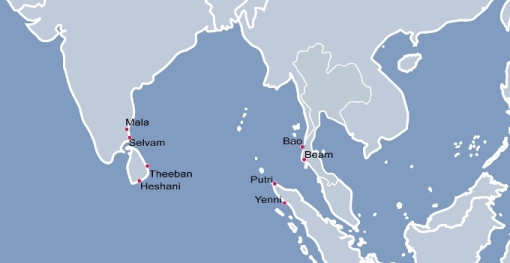
The year-long, 4-country and 8-location Children of Tsunami project was the biggest logistical operation TVE Asia Pacific has mounted in its 11 years of existence. (We’re in no great hurry to top that one!). Our production teams – operating from Bangkok, Colombo, Ubud (Indonesia) and Chennai – related to our regional production team based in two cities: Colombo, where TVEAP office is currently anchored, and Sydney, where Bruce lives.

We only came together face to face just once, in Bangkok, early on in the process. That meeting agreed on styles and formats, and also helped build the human relationships.

The rest of the time it was all through communications technologies. As you can imagine, lots of tapes moved around, as did many Gigabytes of video over the web. (DHL should have become a sponsor – they had lots of business from us!)

children-of-tsunami-locations.jpg

As I explained in my talk, Children of Tsunami was not just a film project. We published a monthly video report online on each of the eight families we were tracking, plus maintained a dedicated website with growing volumes of text, images and links. The monthly videos were edited and post-produced in the countries of filming, by our production teams themselves. It was distributed film-making, even if everyone worked to a common format.

With all that frenzy now behind us, the products of Children of Tsunami continue to be distributed, showcased and discussed at film festivals and conferences like OUR Media.

As I said yesterday to my predominantly academic audience: we’ve got a story telling and journalistic practice, and we now need a theory for it.

Related links:

Children of Tsunami: Documenting Asia’s longest year

Children of Tsunami revisited two years later

Pacific ‘Voices from the Waves’ on climate change

Some of you have asked to share more information on Truth Talking: Voices from the Waves, the half-hour documentary on climate change and its impact on the South Pacific people that we produced in 2002.

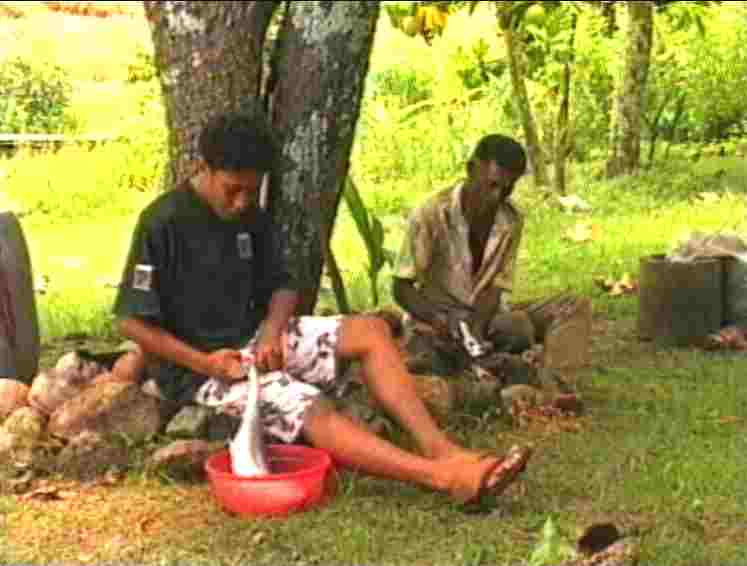
It was the first-ever documentary on climate change and the South Pacific, made by a native Pacific islander (all films till then had been made by visiting foreign film crews). Directed and produced by Bernadette Masianini of Fiji (photo on extreme right below), its story was based on the experience and impressions of two teenagers growing up on two islands, a girl and boy, both facing uncertain futures.

Here’s what I wrote for the Truth Talking book that accompanied the film series.

gutting-fish.jpg fish-trap.jpg ttplogofin.jpg copy-of-berni.jpg

Dilagi loves her village. Her parents and grandparents, and generations before them, were born and raised in this village. Her family has lived here for centuries, but by the time Dilagi has children of her own, her village might no longer exist.

In Fiji, where Dilagi lives, traditions and cultures are rooted in the home; the village is an integral part of a person’s identity. Like most of the eight million people who live in the Pacific island states, Dilagi’s village is located close to the sea. The bounty of the ocean has long sustained the islanders, but now the same waters have begun to threaten their future. Every year, the shoreline seems to move a little inland, and the beach gets a bit smaller. Before the current century ends, according to scientific projections, many low-lying Pacific islands will go under the rising seas either in part or full – and their histories, traditions and unique cultures will be lost forever.

Dilagi is somewhat aware of this perilous future, but can do nothing about it. The changes in global climate that are causing sea levels to rise and triggering severe storms and cyclones are the result of pollution and environmental degradation generated thousands of miles away in the industrialised world. Says Dilagi: “The villagers cannot understand why the waves are coming on to shore. They think these are signs that the end of the world is near.”

The Pacific contains 22 states, made up of thousands of small islands, with a multitude of cultures and traditions. Diverse as they are, they all share Dilagi and her neighbours’ concerns about the future.

Two thousand and five hundred kilometres north-east of Fiji, sitting on the island of Kiribati, Bernard stares at the same ocean that seems to be lashing out at his tiny island nation with increasing force every year. One of the lowest lying islands in the world, no place on Kiribati is higher than four metres (13 feet).

Building sea walls has provided only a temporary respite against the waves. Not even the grave yards or tombstones are spared. Bernard visits Mrs Saipolua’s house, which she has had to move twice to escape from rising seas. In her backyard, the gravestones of ancestors are being constantly battered by the waves. “Even the final resting places of our loved ones are not spared…the sea action had cracked the gravestones,” she says.

“With our islands being so small, the sea is our biggest resource,” says Bernard. “Over the years, the generations have perfected the ways to use the oceans respectfully for our survival. Ironically, it is the very ocean on which we depend that now threatens us.”

All Pacific islands – including Kiribati and Fiji — have their own unique culture and traditions. They may share the world’s largest ocean and sometimes common ethnicity, but no two island cultures are the same. From the way they collect their food to how they celebrate festivals, their traditions revolve around the geography and natural resources of the islands and the sea.

voices-from-the-waves-image1.jpg

In this intricate tapestry weaving islands with humans, everything has a place and purpose. For example, the traditional dances entertain and also record the people’s history. Costumes for these dances are produced from plants unique to the Pacific and decorative garlands are made from the brightly coloured flowers. Extreme weather events and climate anomalies that now threaten the environment of these islands may soon drive many plants and animals into extinction. As Bernard asks, “If changes to the climate affect our environment, how long will these aspects of our culture survive?”

For a majority of Pacific island people, climate change is a very real concern that is already impacting them; it’s not a doomsday scenario sometime in the future. Closely linked as they are to their islands and the sea, they just cannot accept relocation in a far away land as a survival option.

“Everything I need in my life is here on this island — my elders, my parents, my friends,” says Bernard. “I cannot imagine life anywhere else, and I cannot imagine that I might have to go and live in another country if my islands are no longer habitable….”

From across the sea, Dilagi agrees: “Our villagers have lived here for hundreds of years. Their traditions and cultures are rooted in this area. They cannot imagine life anywhere else.”

Order this film on DVD or VHS from TVEAP e-shop

Wanted – Human face of climate change!

Now that scientists have spoken, loud and clear, things are beginning to happen on climate change — and not a moment too soon.

Venture capitalists, policy wonks, technology geeks, security analysts and social activists are all joining the conversation — thanks largely to the media’s increased coverage of the issue.

The threat of climate change is being taken seriously. The past few weeks have seen evidence of this. For example:

The latest report from the Inter-governmental Panel on Climate Change, released on April 6, said greenhouse gas emissions are at least partly responsible for the warmer climate, which will pose a host of environmental and health challenges, ranging from more diseases to floods and droughts.

– In March 2007, an international panel of scientists presented the United Nations with a sweeping, detailed plan to combat climate change, warning that failure would produce a turbulent 21st century of weather extremes, spreading drought and disease, expanding oceans and displacing coastal populations.

And for the first time ever, the U.N. Security Council will discuss potential threats to international security from climate change.

These conversations will be richer and more meaningful if the ordinary people — who are most at direct risk from climate change’s multiple impacts — were heard in the corridors of power, money and deal-making.

We in the media must see beyond the important scientific projections, policy debates and UN talks — we must look for the human faces, voices and dimensions of climate change.

That’s the point I made in a recent essay published on TVE Asia Pacific website a few weeks ago. Here’s an extract:

A healthy mix of rational thinking and emotional appeal will stand a better chance of moving people to kick their addition to oil.

Allowing real people to tell their own personal experiences can also be very effective. I realised this five years ago, when we commissioned the first-ever documentary on climate change and the South Pacific, made by a native Pacific islander. Voices from the Waves, directed and produced by Bernadette Masianini of Fiji, was narrated by two teenagers growing up on two islands, each facing an uncertain future.

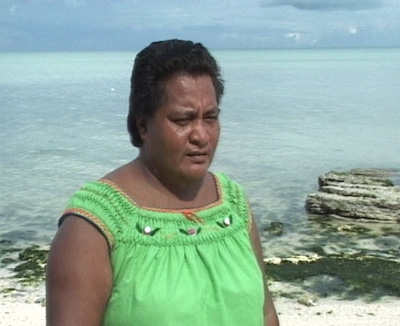
At one point we meet Mrs Saipolua, an ordinary woman who lives on the island of Kiribati, where no place is higher than a few feet above the sea. She is distressed having had to move her home twice in a past decade due to the receding shoreline.
For Kiribati’s 82,000 inhabitants, climate change is not theory; it’s already lashing on their beaches.

“Our house used to be in that spot,” Mrs Saipolua points to a place that’s now permanently submerged. “This is where we relocated to the second time.”

mrs-saipolua.jpg

She points to several tombstones that are on the verge of being washed away. “Even the final resting places of our loved ones are not spared…..The sea action had cracked the gravestones.”

I’ve covered climate change for years as a science writer. But it was Mrs Saipolua who made me realise the impact climate change is having on millions of ordinary people who have never heard that term.

Related links:

Pacific ‘Voices from the Waves’ on climate change

Read the full essay, Changing Climate and Moving Images on TVEAP website

Watch a video clip from Voices from the Waves on TVEAP’s YouTube Channel:

Video and DVD copies of Voices from the Waves can be ordered from TVE Asia Pacific’s online e-shop.

UN Climate Change Impact Report: Poor Will Suffer Most

Anita Roddick, Angkor Wat and ‘development pill’

Dame Anita Roddick would have been proud of her mastery of Khmer.

There she was on a large screen, speaking in fluent Khmer, watched by over a thousand Cambodians women, children and men.

Time: One evening in December 2005
Place: A village temple close to the historic city of Siem Reap, Cambodia

There we were, practically in the shadow of the massive Angkor Wat temple complex, and trying to reach out to rural Cambodians on practical ways to live more sustainable lives.

anita-roddick.jpg cambodian-audience.jpg

The event was an evening of variety entertainment laced with some information and education. Colleagues at Action IEC, our Cambodian partner, knew exactly how to get this mix right. Amidst songs, drama, comedy and live competitions, they screened Hands On video films versioned into Khmer.

As the loudspeakers boomed and (Hands On host) Anita Roddick appeared on screen speaking in a strange tongue, I watched the audience closely. They were spell-bound: especially the children belied a sense of wonder.

But sustaining their attention is a big challenge. That evening’s 4-hr programme was the result of over a dozen Cambodian colleagues planning and working for days. It was part of the public outreach activity for Hands On films that we versioned into Khmer under a 4-country, Asian project called Localising Hands On in Asia.

The young and not-so-young in our audience that evening were there mainly for the fun and games. Rolling out Anita and Hands On was a clever ploy by Kosal, Cedric and other Cambodian colleagues. Call it ‘sugar-coating’ the development pill.

Oh yes, we also had the Khmer versioned programmes broadcast on Cambodia’s most popular TV channel (CTN). That engaged a different kind of audience. A passive broadcast can never really produce the kind of audience engagement we saw that evening.

In our efforts to engage Asia’s eyeballs and minds, we’ve made modest progress by proceeding parallely on broadcast and narrowcast fronts — but there is a great deal of unfinished business.

For details, visit Localising Hands On in Asia website

Added on 11 Sep 2007: Anita Roddick:We shall always remember you

Caught between mines and starvation

Today, April 4, is being observed worldwide as Mine Action Day.

The UN General Assembly declared the International Day for Mine Awareness and Assistance in Mine Action, which was first observed in 2006.

Mine Action says on its website:“Landmines and explosive remnants of war continue to kill or injure as many as 15,000 people a year. The overwhelming majority are civilians who trigger these devices years or even decades after a conflict ends. In some countries, such as Afghanistan, the majority of victims are under the age of 18.

Some progress has been made. Mine action programmes and the anti-personnel mine-ban treaty or “Ottawa Convention,” have contributed to a reduction in the annual number of casualties from an estimated 26,000 10 years ago to between 15,000 and 20,000 today.

But not nearly enough. I remember a short video film I watched during my first visit to Cambodia in mid 1996. After 30 years of civil war, Cambodia was left with a deadly legacy of between 4 and 6 million landmines – nobody knows quite how many. And progress has been slow to detect, deactivate and remove these millions of death-traps lying all around in this one of the poorest countries in Asia.

Our friends at the Women’s Media Centre of Cambodia, a media advocacy group run by women, showed me a campaign video they had made advocating mine action. Used for screenings at key UN meetings in Geneva and New York, it showed the plight of poor Cambodians, especially women and children, who have no choice but to live and work with landmine hazards.

Sorry, a decade later I can’t recall the title of this film. A Google search didn’t bring up any links either. But there was a sequence that I remember well.

In rural Cambodia, some women spoke their mind about the many hazards that surround them, small arms and landmines being just two of them.

What’s our choice here, one woman asked. “Everytime we step out of our homes and go to the fields, we can get blown up by a landmine. Yet if we stay at home, we will starve to death.”

She’s not alone. Millions of people – women, children and men – across the global South face this reality everyday. The men in suits in Geneva and New York, who issue lofty statements on mine action from the safety of their glasshouses, need to be aware of this stark choice.

Note: Women’s Media Centre in Cambodia does some good work. At the time we worked with them, they were running an FM radio station, producing lots of videos, and training Cambodian women to use media to support development and personal advancement.

Changing climate and moving images

Climate change is suddenly popping out of everywhere. Media outlets that couldn’t discern climate from weather not too long ago are covering the politics, technology, economics — and sometimes, science — of climate change.

We have to thank Al Gore and his Oscar-award winning film, An Inconvenient Truth, for helping climate change to reach that tipping point. For sure, it has been building up for years, but it took moving images to really push it up the agenda.

While the political stature of its ‘star’ — and now, the Oscar – takes this film to a league of its own, it’s not the only global documentary about this important topic. In recent years, a number of factual and make-belief films have been made with climate change as their principal theme.

No wonder Hollywood is attracted to this subject – it offers the ultimate planetary disaster, even if it unfolds slowly over decades. That’s not a major constraint in the land of make-belief: in The Day After Tomorrow (2004), director Roland Emmerich just accelerated natural climatic processes to happen within weeks – with dramatic results for his story (and box office).

It may be convenient to take such liberties with the truth in fiction, but delivering factual and credible content involves bigger challenges. That requires balancing facts, opinions and interpretations while engaging today’s easily distracted audiences. The task becomes harder when the subject is as technical as climate change.

I recently wrote a review of two major climate change documentaries, both released last year: An Inconvenient Truth, and The Great Warming.

Read the full review on TVE Asia Pacific website

The ‘Children of Brundtland’, 20 years on

On 30 March 2007, I was part of a South Asian Workshop to pre-test a pilot e-module on Science Journalism. Held at the University of Hyderabad, India, it brought together a small group sharing a passion for science journalism and science communication. It was organised by SciDev.Net with support from UNESCO.

I used my remarks to pay tribute to an important and lasting influence on my own career as a development communicator: Our Common Future, report of the Brundtland Commission that came out exactly 20 years ago. The anniversary was marked by a few organisations like IIED, but I felt it deserved better observance.


Here’s an extract from my remarks:

Within a few months of my entering active journalism, something happened globally that left a deep impression on me -– and as I later found out, on many others like myself in different parts of the world. In March 1987, the World Commission on Environment and Development –- chaired by the then Norwegian Prime Minister Gro Harlem Brundtland -– published its final report. Titled Our Common Future, it was the first of its kind to draw broad links between environmental, social and economic concerns and it made international policy recommendations accordingly. It prompted the UN to convene the Earth Summit in Rio de Janeiro in 1992.

The Report didn’t invent the concept or term sustainable development, but it certainly helped popularise it. The Commission’s work helped the environmental movement to evolve from the tree-hugging, whale-saving, cuddly animal level to a higher and multi-faceted level of environmental management.

And it inspired a generation of young journalists, educators and activists worldwide. I count myself among them –- in that sense, we are all Children of Brundtland.

IIED London takes stock of 20 years after Brundtland Commission Report

More memories of Theeban…

On March 17, I wrote about introducing our Children of Tsunami documentary at the DC Environmental Film Festival, and and how I dedicated the screening to Theeban – the Sri Lankan boy who survived the Asian Tsunami, but was killed in the island nation’s political violence on 3 March 2007.

My personal tribute to Theeban has been widely circulated online. Edited versions have appeared on MediaHelpingMedia (UK) and Asia Media from University of California Los Angeles (USA).

It appears that my tribute has moved many readers. I’ve heard from several by email – encouragingly, all supportive and sympathetic. Among those who wrote was young journalist Chathuri Dissanayake, who worked as a researcher for Video Image, the Sri Lankan production company we (TVE Asia Pacific) engaged to film Theeban’s unfolding story for most of 2005.

With her permission, I want to share her recollections and views:

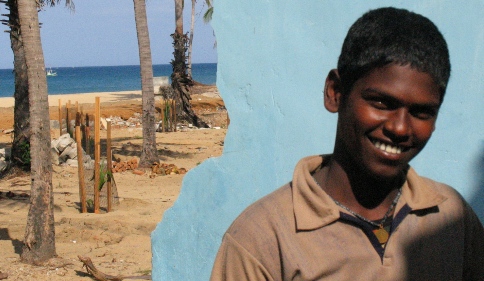
It’s a very nice piece about Theeban. It captures what we had grown to love in the boy. The picture you have of him taken on I think our first visit brings back a lot of memories.

theeban.jpg

When he was abducted (in late 2006), I always thought at least he is alive, now I’m still trying to come to terms with the fact that he is no more. The best memory I have of him is his wide smile. The pictures you have chosen bears ample testimony as to how beautiful that is. Even though he couldn’t communicate with us coz of the language barrier his smile and eyes were so expressive. When I first met him at the camp what struck me most was his unspoilt innocence. I wish I had taken a bit more trouble to help him out after the filming ended.

Theeban gave life to harsh realities of the conflict in the country that I have lived all my life with. Before meeting Theeban and visiting his village, I only knew what media told me of the east but Theeban brought it closer to me. Earlier, when ever I heard of the violence in the north or the east, it was just news to me as it was to many living in the “right side of the country”. But the Children of Tsunami project opened up the other side of the story, and as a young journalist, I gained a lot of experience.

To me, Theeban was real and he represented many youngsters in the area. His scattered dreams and hopes were real and it is a tragedy that help doesn’t reach them. Nothing substantial was done to help him and many others like him to rebuild their lives. Theeban was too young for any sort of vocational training that was available, and he didn’t have the right qualifications. My dilemma of what would happen to Theeban and many like him whose futures were washed away in the Tsunami grew as all the options of vocational training I checked out for Theeban turned out that applicants needed at least (GCE) Ordinary Level. Theeban was forced to leave school and it looked as if it never struck to any authority that someone needs to look after the youths like Theeban.

theeban-photocredit-video-imagetveap.jpg

To me Theeban, like many others was another victim of forces that he had no control over. It was not his fault that a tidal wave destroyed his family but he paid for it dearly, gave up his education and took the responsibilities of the bread winner of the family on to his shoulders. When the Tsunami struck he was still hopeful he wanted to earn money and take care of his brothers. He missed his mother dearly but found a bit of comfort in his grandma. But the violence that sprang up in the area had no mercy on him. Theeban’s story ended in tragedy coz the forces that were against him were too strong for him to fight back. The hope I saw in his eyes still haunts me. But I take comfort in knowing that at least he tried to fight back. No matter what his shy smile and shining eyes will remain with me.

That is how I remember Theban best. A youth who managed to smile and have a hope for the future in spite of the trauma that he went through when many grown up men around him gave up on life.