Patrick Moore: 50 years of Sky at Night on the air

The first ever book on astronomy I owned, a pocket guide to the night sky, was written by an Englishman called Patrick Moore.

Armed with the tattered book, I joined night sky observation sessions of the Young Astronomers’ Association. That was more than 20 years ago.

Hormones-on-legs that we all were at the time, we were interested in heavenly bodies at both ends of a telescope. But we couldn’t have had a better guide to the celestial wonders than Patrick Moore.

The same Patrick Moore reached a milestone in the history of broadcasting this month: he has hosted the same show on television for 50 long years, more than anyone else on any subject anywhere on this planet.

The show is The Sky at Night, which started on BBC Television in April 1957.

Sir Patrick Moore Patrick Moore presenting an early Sky at Night programme

The Space Age had not even begun, and television broadcasting was still in its formative days, when a much younger Patrick Moore presented the first Sky at Night in April 1957. But as if on cue, the Soviet Union launched Sputnik One just six months later, triggering the Space Race. Thus Patrick Moore has been our able, dependable and colourful guide to the most fascinating journey in the history of humankind – our species finally venturing beyond its ‘cradle’, the Earth.

But as another populariser of space and astronomy, Sir Arthur Clarke, notes: “Sky at Night has not been just a gee-whiz show of rockets, satellites and other expensive toys deployed by rich nations trying to outsmart each other. At its most basic, it’s a show about exploring that great laboratory within easy access to anyone, anywhere on the planet: the night sky.”

Sir Arthur adds in a special tribute to his long-standing friend:
“By the time the Space Age dawned, Patrick was well on his way to becoming the best known public astronomer in the world. The Sky at Night only consolidated a reputation that was well earned through endless nights of star-gazing, and many hours of relentlessly typing an astonishing volume of books, papers and popular science articles.”

In the 50th anniversary programme, broadcast this month, Patrick Moore traveled back in time to see the first recording of The Sky at Night . He talked to his earlier self about astronomy back in 1957, and discussed how things have changed in half a century. He then time traveled to 2057 where the ‘virtual’ Patrick, saved in the BBC computer, is celebrating 100 years of making The Sky at Night and talks to Dr Brian May about the discovery of life on Mars.

Sir Patrick Moore

Thank you, Sir Patrick, for being our affable guide to the night sky and space travel for half a century. We hope you don’t consider retirement anytime soon.

Read Patrick Moore’s brief history of The Sky at Night

BBC’s 45th anniversary multimedia tribute

BBC Online interview with Sir Patrick Moore

Sir Arthur Clarke’s tribute to The Sky at Night at 50

Eye balls and leather balls: World Cup cricket final is here!

It’s finally here: Cricket’s Big Day (or Big Night, depending on where we are on the planet).

In the Cricket World Cup final today, defending champions Australia will meet 1996 World Champions Sri Lanka. The final game is to be played at the Kensington Oval in Barbados, in the cricket playing nations of the West Indies.

As I wrote in a post when the current series started, Sir Arthur Clarke will have to look very hard today for any signs of life across Sri Lanka.

The whole nation of 20 million people will have their eyes glued to whatever television screen they can find.

They will be joined by at least a couple of billion other eye balls in the rest of South Asia, where cricket-playing nations of Banglades, India and Pakistan saw their respective teams being eliminated in the World Cup’s seven weeks of build up in the Caribbean.

Talk about moving images moving people.

Not being an ardent cricket fan, I’ve not followed the series with the religious zeal of my many friends and colleagues. But just after filing this blog post, I’m off to see the finals on a giant, open air screen.

As Reuters reported recently, cricket fever has united — at least for now — the otherwise utterly and bitterly divided Sri Lankans. I just want to be part of that moment of unity, and yes, watch some good cricket too.

Tonight’s game will use probably a handful of professional leather balls used in cricket. As cricket fans tune in to live broadcasts worldwide, it’s fair to say that never before have so many eye balls followed the movement of so few leather balls.

May the best handlers of leather balls win.

And no matter who wins, TV broadcasters will be laughing all the way to the bank…

Bill Moyers: How the American media followed Pied Pipers of Pentagon

Bill Moyers has done it again.

The heavyweight of public interest broadcasting in America has turned the spotlight right at his own industry, asking how so many members of his profession could be so easily tamed and led astray by the Pied Pipers of Pentagon.

In Buying the War, a 90-minute documentary that aired on the Public Broadcasting System (PBS) on 25 April 2007, Moyers explores the role of the press in the lead-up to the invasion of Iraq.

Buying the War includes interviews with Dan Rather, formerly of CBS; Tim Russert of MEET THE PRESS; Bob Simon of 60 MINUTES; Walter Isaacson, former president of CNN; and John Walcott, Jonathan Landay and Warren Strobel of Knight Ridder newspapers, which was acquired by The McClatchy Company in 2006.

Image courtesy PBS Bill Moyers

How did the mainstream press get it so wrong? How did the evidence disputing the existence of weapons of mass destruction and the link between Saddam Hussein to 9-11 continue to go largely unreported?

“What the conservative media did was easy to fathom; they had been cheerleaders for the White House from the beginning and were simply continuing to rally the public behind the President — no questions asked. How mainstream journalists suspended skepticism and scrutiny remains an issue of significance that the media has not satisfactorily explored,” says Moyers.

“How the administration marketed the war to the American people has been well covered, but critical questions remain: How and why did the press buy it, and what does it say about the role of journalists in helping the public sort out fact from propaganda?”

The programme opened with the following words of Moyers:

Four years ago this spring the Bush administration took leave of reality and plunged our country into a war so poorly planned it soon turned into a disaster. The story of how high officials misled the country has been told. But they couldn’t have done it on their own; they needed a compliant press, to pass on their propaganda as news and cheer them on.

Since then thousands of people have died, and many are dying to this day. Yet the story of how the media bought what the White House was selling has not been told in depth on television. As the war rages into its fifth year, we look back at those months leading up to the invasion, when our press largely surrendered its independence and skepticism to join with our government in marching to war.

The show has already drawn rave reviews. David Sirota says at WorkingforChange:

I went to journalism school because I thought journalism was about sifting through the B.S. in order to challenge power and hold the Establishment accountable. Bill Moyers and the folks I’ve gotten to know at McClatchy Newspapers who Moyers highlights show that that long tradition still exists. But the fact that they are such rare exceptions to the rule also show that the incentive system in journalism today is to reward not the people who challenge power, but the people who worship it. And though Tim Russert and Peter Beinart and Bill Kristol and Tom Friedman can kick back in Washington with their six figure salaries and tell themselves that they are really Important People, what we have seen is that they are part of a new journalistic culture that is threatening to destroy what once was a truly noble profession and undermine our democracy.”

Read the full transcript of Buying the War online

Watch Buying the War online at PBS website

Read the full review at David Sirota’s blog: When journalism became transcription and reporting disappeared

Mediasaurus — and the rise of bloggers

Earlier this month, I referred to science fiction writer Michael Crichton’s 1993 Wired article titled ‘Mediasaurus’ — in which he talked about how television as we know it (or knew it, at the time) was doomed.

I’ve just come across this cartoon, which I can’t resist sharing.

Cartoonists are the social philosophers of our time. And no one else achieves a better economy of words.

Source: http://www.indcjournal.com/archives/ariaillg2.jpg

Tabloid journalism – and MTV’s Environment News

What can be done to lure more young audiences to care for and discuss about issues of science and technoloy?

This question was put to a panel on ‘Science and television’ that I was on last week at the Fifth World Conference of Science Journalists in Melbourne, Australia.

Each panelist offered suggestions. Mine was just three words: think more tabloid.

Those who try to communicate science to the non-technical public are mostly trapped in the mindset of the classical documentary, or its print equivalent: broadsheet newspapers. That engages a certain kind of audience, but the masses — including many young people (15 to 25 years) — are not widely represented there. To engage the latter, we have to consider more tabloid formats.

Is that dumbing down the weighty issues we’re peddling? Not necessarily, I argued. We can make things in different formats, without over-intellectualising and not over-simplifying either.

A recent example of this comes from Music Television, MTV, and is discussed in an interesting piece appearing in the Columbia Journalism Review website, CJR Daily.

MTV Break the Addiction campaign

Here are some excerpts from the article written by Curtis Brainard, titled ‘Surprise: MTV’s Environmental News Rocks’

Just over a year ago, on Earth Day 2006, the station announced its “Break the Addiction” campaign, encouraging people to kick (or cut back on) habits that depend on fossil fuel. The campaign is a suite of on-air programming, MTV News stories, public service announcements, contests, online resources, and grassroots mobilization efforts. No, MTV is not the type of news outlet that one would reference in a scholarly paper, and it never will be. And although MTV has produced environmental stories intermittently for over twenty years, the “Break the Addiction” campaign was its first ambitious commitment.

“Historically, the environment never rated highly,” said Ian Rowe, MTV’s vice president of public affairs and strategic partnerships. “But we were starting to see signs that global warming was becoming a bigger story, even if our audiences weren’t clamoring for such news, so we made a proactive decision that we would connect the dots for our audience.”

On Earth Day (22 April 2007), MTV ran a special edition of “Pimp My Ride,” the popular automobile makeover show. Governor Schwarzenegger is a friend of the team at Galpin Auto Sports in California, where the program is filmed. He and the crew (mostly the crew) retrofit a 1965 Chevy Impala with an 800-horsepower, biodiesel engine. “We try to publicize celebrity involvement in these issues to show people it’s cool, and bring the unconverted into the fold,” said Pete Griffin, a public affairs officer who worked on the “Break the Addiction” campaign. It’s no Pulitzer-caliber exposé on the socioeconomics of biofuels, but, Griffin says, “Stand-alone half-hour shows on these issues can be less effective than integrating them into shows that people are already watching.”

With short public service announcements airing around the clock between scheduled programming, says Ian Rowe, “There is no way you can watch the channel without realizing that global warming is one of our central issues.”

Read the full article here

Banned in the USA, Al Jazeera now online at YouTube

“The world’s first English language news channel to have its headquarters in the Middle East; covering the world, bridging cultures and setting the news agenda.”

That’s the marketing line of Al Jazeera International (AJI), launched on 15 November 2006.

It’s been slowly building up an audience, which it now claims to be around 90 million households.

But not in the United States of America: it was shut out of most American homes because cable companies have refused to carry their signal.

Elsewhere, commerce – not politics – was at play: some cable operators and hotels, already locked into various deals with the established global news channels of BBC World and CNN International, weren’t easily carrying AJI either.

Undeterred, AJI started this week to post some of their content on YouTube.

al-jazeera.jpg

Well, things are getting more interesting now!

When AJI started less than six months ago, I wrote an op ed published on Both Media Helping Media (UK) and MediaChannel.org (USA). I argued that to make a real difference, AJI needs to not only analyse and present the news differently, but also gather news more ethically in the developing countries of the global South.

BBC World and CNN International have an appalling track record of doing this. “They epitomise a disturbing belief in international news and current affairs journalism: the end justifies the means.”

I added: If products of child labour and blood diamonds are no longer internationally acceptable, neither should the world tolerate moving images whose origins are ethically suspect.”

I ended my essay: We will be watching. And not just what’s shown on AJI, but how those pictures get there.”>

Well, it’s now become easier to follow AJI. I still keep an open mind about their English channel, even if it shows every sign of aping the BBC and CNN. Already we need to look hard to find a real difference.

Let’s give them one year to prove if they mean what they say — or not.

Read my full essay on Media Helping Media, with some reader comments

Read the version that appeared on MediaChannel.org

And now, Al Jazeera get on You Tube

YouTube seems to be everywhere!

Last week in Sydney and this week in Melbourne, journalists and media researchers can’t talk enough about You Tube — though not everyone is equally enthusiastic about the online video sharing platform.

This just in, from MediaChannel.org:

Al Jazeera English goes You Tube

The Doha-based broadcaster Al Jazeera (English) will launch a YouTube branded Channel, the company said today. YouTube users worldwide will have the ability to comment on Al Jazeera English clips, rate them, recommend them to friends and post their own video responses to communicate with other viewers.

Content will include segments from shows such as ‘Frost over the World’, ‘Everywoman’, ‘Inside Iraq’, ‘Inside Story’, ‘Listening Post’, ‘Riz Khan’, ‘One-on-One’, ‘The Fabulous Picture Show’, ‘Witness’ and ‘48′. Al Jazeera English is also planning to release some exclusive web-only programming, starting with ‘Poltical Bytes’, a global conversation hosted by UN correspondent Mark Seddon which will ask the YouTube community to carry on the conversation and add video contributions. The broadcaster said it will provide new content to the site by adding at least 10-15 new clips each week.

Nigel Parsons, Managing Director of Al Jazeera English said: “We believe that YouTube is a perfect platform to reach out to our audience and to give wide and easy access to new viewers around the world. We have significantly built on our distribution since launch and now reach well in access of 90 million cable and satellite households worldwide. With YouTube’s community of millions of online users this is set to dramatically increase.”

John Pilger: Being a journalist is a privilege

Towards the end of our week’s stay in Sydney for OUR Media 6 Conference, the organisers gifted us copies of The Australian Photojournalist, which is the journal of the Australian Photojournalists’ Association.

The June 2006 issue I received is a handsome volume and makes fascinating reading. On the inside front cover, I came across these words by John Pilger, the courageous and outspoken Australian journalist and film-maker hailing from Sydney.

John Pilger

“The best journalism is about looking behind facades and pretensions. It is never accepting the status quo; it is always questioning and remaining sceptical of the pronouncements and actions of those in authority, especially authority that is not accountable.

“The best journalism is following the dictum, wry but true: Never believe anything until it is officially denied. It is seeing the world from ground up, where ordinary people are, not from the top down, where the powerful reside. In many respects, the best journalists are the agents of ordinary people, not of those who preside over them.

“By looking at the world this way, from the standpoint of humanity not its would-be controllers, journalists will find themselves closer to the truth about all manner of things than they will ever be, following the manuals of establishment thinking.

“And by journalists, I mean photographers, too. The finest photographers produce images that ought to achieve mor than a gut reaction but help us make sense of events, great and small.

“Speaking personally, being a journalist is a privilege.”

Indeed. And few people bear that title with greater responsibility and passion than John Pilger.

I had the privilege of listening to John Pilger early on in my career, during one of the first international media conferences I attended in Sweden in the late 1980s. Of the three dozen speakers who spoke there, the only ones who have withstood the gradual erosion of memory are Pilger and Norwegian academic Johan Galtung.

Years later, I read Pilger’s book The New Rulers of the World — which was also the title of 2002 documentary film he wrote, produced and presented on the consequences of globalisation, taking Indonesia as the primary example of the serious problems with the new globalization.

And thank heavens, he shows no signs of slowing down — or mellowing.

The War on Democracy is John Pilger’s first major film for the cinema. Set in Latin America and the US, it explores the historic and current relationship of Washington with countries such as Venezuela, Bolivia and Chile. Two years in the making, The War on Democracy is due to be released in cinemas in the UK on 15 June 2007.

He has produced more than 55 TV documentaries. Links to two of his more recent ones available online:

Breaking the Silence: Truth and Justice in the War on Terror (2004) on Google Video (51 mins)

Stealing a Nation (2004) on Google Video

Noam Chomsky on John Pilger

Images courtesy www.johnpilger.com

Michael Crichton, Mediasaurus and end of broadcasting

I just wrote a post on digital pioneer and futurist Mark Pesce’s views on the end of broadcasting and the mass media as we know it.

Television broadcasting is probably a dinosaur facing extinction, but let’s remember a bit of pre-history here: dinosaurs didn’t die off in an instant. No time lord zapped them with some mighty extincter machine. Their decline and eventual extinction was, it is believed, a slow and gradual process.

So it will be with broadcasting. Even if their distribution and revenue models are now undermined and will soon be obsolete, conventional broadcasting (as we know it) will continue to operate and try to compete, at least for a few years. And in the less developed countries with emerging economies, that process will take longer.

Which means we still have to engage TV broadcasters even as their Empires of Eyeball slowly crumble.

And let’s not write off those Empires just yet. I still remember an article in the early days of Wired magazine: appearing in Sep-Oct 1993 issue, it was titled Mediasaurus , and written by the well known science fiction author (and medical doctor) Michael Crichton (of Jurassic Park and ER fame).

Michael Crichton, courtesy Michael Crichton website

He started the article as:
I am the author of a novel about dinosaurs, a novel about US-Japanese trade relations, and a forthcoming novel about sexual harassment – what some people have called my dinosaur trilogy. But I want to focus on another dinosaur, one that may be on the road to extinction. I am referring to the American media. And I use the term extinction literally. To my mind, it is likely that what we now understand as the mass media will be gone within ten years. Vanished, without a trace.

And he ended:
So I hope that this era of polarized, junk-food journalism will soon come to an end. For too long the media have accepted the immortal advice of Yogi Berra, who said: “When you come to a fork in the road, take it.” But business as usual no longer serves the audience. And although technology will soon precipitate enormous changes in the media, we face a more immediate problem: a period of major social change. We are going to need a sensitive, informed, and responsive media to accomplish those changes. And that’s the way it is.

I just re-read the full article, and Crichton’s analysis is even more valid today than when it was written over a dozen years ago. But it’s also true that the broadcast industry – and conventional media as a whole – have changed and adapted.

No doubt that Mediasaurus still has an expiry date, but it’s not easy trying to guess exactly when the last of their kind drops dead.

Read the full article on Wired Online

Moving images moving heart first, mind next

“Film is a lousy medium to communicate information. It works best at the emotional level.”

Bruce Moir, one of Australia’s seniormost film professionals made this remark soon after I had presented TVE Asia Pacific’s Children of Tsunami experience to OUR Media 6 conference in Sydney last afternoon.

After more than 35 years in documentary and feature film production for both cinematic and broadcast industries, in different parts of the English speaking world, Bruce knows a thing or two about moving people with moving images.

I was delighted and privileged to have Bruce join my presentation. He’d come at my invitation to the conference happening in his city.

“We’ve got to remember that film appeals to people’s hearts more than their minds,” Bruce explained. “The way to people’s heads is through their hearts, from the chest upwards — and not the other way round.”

I hope this was an ‘Aha!’ moment to at least some in our audience. I’ve personally heard Bruce say this before, but it bears repetition – because many film professionals tend to overlook this. Especially those who are trying to ‘communicate messages’.

Even a few weeks ago, I quoted him in a review as saying: “Our fundamental job is to tell a story – one that holds an audience’s interest and moves their heart, regardless of language, cultural context or subject….I have always believed that film achieves its optimal impact by aiming to ‘get at the audience’s head via their heart’ rather than the other way around.”

Bruce Moir

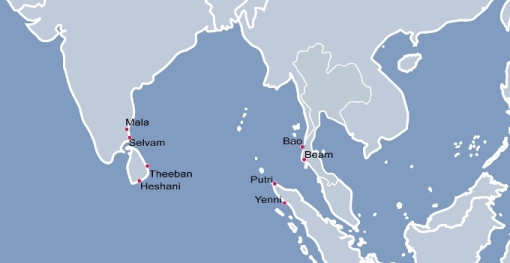
Without Bruce’s involvement, Children of Tsunami would have turned out to be very different. He was our Supervising Producer for the entire effort, advising and guiding our national film production teams tracking the progress of Tsunami survivor families in India, Indonesia, Sri Lanka and Thailand for one year afer the Asian Tsunami.

As Bruce recalled, the four teams came with different backgrounds, skill levels and film-making traditions of their own – ranging from television news and current affairs to development film-making, the type usually commissioned by UN agencies. Bringing them to be ‘on the same page’ was no easy task.

Film-makers are not particularly known for their patience or people-skills. Many I know have a ‘just-get-on-with-it-never-mind-the-niceties’ attitude. Bruce is one of the most patient persons I know: he would spend days and weeks relating to our production teams – usually by email or phone – gently nudging them in certain directions.

For sure, there’s no one right way to make a film. But there are some tried and tested principles in good story telling, which is what Bruce excels in. And which he willingly shares with others.

The year-long, 4-country and 8-location Children of Tsunami project was the biggest logistical operation TVE Asia Pacific has mounted in its 11 years of existence. (We’re in no great hurry to top that one!). Our production teams – operating from Bangkok, Colombo, Ubud (Indonesia) and Chennai – related to our regional production team based in two cities: Colombo, where TVEAP office is currently anchored, and Sydney, where Bruce lives.

We only came together face to face just once, in Bangkok, early on in the process. That meeting agreed on styles and formats, and also helped build the human relationships.

The rest of the time it was all through communications technologies. As you can imagine, lots of tapes moved around, as did many Gigabytes of video over the web. (DHL should have become a sponsor – they had lots of business from us!)

children-of-tsunami-locations.jpg

As I explained in my talk, Children of Tsunami was not just a film project. We published a monthly video report online on each of the eight families we were tracking, plus maintained a dedicated website with growing volumes of text, images and links. The monthly videos were edited and post-produced in the countries of filming, by our production teams themselves. It was distributed film-making, even if everyone worked to a common format.

With all that frenzy now behind us, the products of Children of Tsunami continue to be distributed, showcased and discussed at film festivals and conferences like OUR Media.

As I said yesterday to my predominantly academic audience: we’ve got a story telling and journalistic practice, and we now need a theory for it.

Related links:

Children of Tsunami: Documenting Asia’s longest year

Children of Tsunami revisited two years later