Joey R B Lozano: The legacy continues…at Silverdocs

I met Joey R B Lozano only once, but he left a deep impression.

A small-made man with passionate zeal and tons of energy, he was every inch an activist-journalist-campaigner. We had invited him to a regional workshop of factual video producing and distributing partners from across Asia that we held in Singapore in November 2002.

We hadn’t worked with Joey earlier. He came recommended by our international partner Witness, which uses video-based advocacy and activism for promoting and safeguarding human rights worldwide.

Joey R B Lozano Joey R B Lozano Joey R B Lozano

Joey used his personal video camera to assert indigenous land rights, and to investigate corruption and environmental degradation in his native Philippines. Joey was an independent human rights activist and also one of the country’s leading investigative reporters.

He freelanced for the Philippine Daily Inquirer, covering Indigenous peoples’ rights and the environment, considered the two most dangerous beats in the Philippines. But years earlier, he had moved out of the capital Manila, and committed his life and career to stories and issues at the grassroots that many of his city-based colleagues had no time or patience in covering on an on-going basis.

Trained as a print journalist, Joey mastered new media and technologies whose potential he quickly realised. He moved into television and video media with ease, and later became an active blogger.

Joey’s TV investigations began in 1986, when he helped ABC’s 20/20 to uncover the “Tasaday hoax”, a highly successful fraud to pass off local tribespeople as a newly discovered Stone Age culture.

He soon embarked on his own investigations and started digging into illegal logging, gold mining and land-grabbing. In turn, his exposes quickly earned him repeated assassination and abduction attempts, in a country that is one of the more dangerous places to practice journalism.

When he came to Singapore, Joey had recently ‘starred’ in a major Canadian documentary titled Seeing is Believing: Human Rights, Handicams and The News, which looked at how committed, passionate individuals were using new communication technologies to change the world.
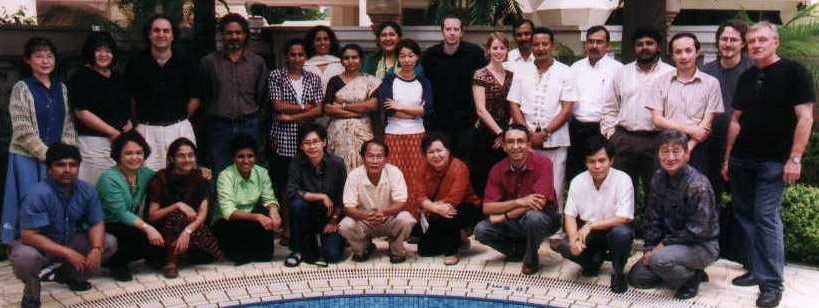
participants-at-tveap-partner-workshop-singapore-nov-2002.jpg

Photo of Singapore TVEAP workshop participants: Joey Lozano is 6th from left on the frontmost row

Follow Seeing is Believing storyboard on the film’s website

We screened the film, made by Katerina Cizek and Peter Wintonick, and heard first hand from Joey on what his struggles entailed. The film followed Joey as he delivers a new “Witness” donated video camera to Nakamata, a coalition of Indigenous groups in Central Bukidnon. Together, Nakamata and Joey begin documenting a dangerous land claims struggle, and it doesn’t take long for tragedy to unfold in front of the camera.

Watching the film and then listening to Joey — and his Witness colleague Sam Gregory — describe the on-going struggle, was one highlight of our week-long workshop. Some of us saw in Joey the activist-campaigner that we wanted to be, but were too scared or too polite to really become.

Not everyone shared that view. The cynicism — sometimes bordering on disdain — of a fellow Filipino from Metro Manila was palpable. No wonder Joey moved away from the city.

We at TVE Asia Pacific were extremely keen to distribute Seeing is Believing, for it held such a powerful and relevant message for our region, but it was not to be. Our enquiries showed that like most documentaries, it was tied up in too many copyrights restrictions and commercial distribution deals.

Following the Singapore workshop, I did keep a watchful eye on what Joey Lozano was up to. The film’s website provided occasional updates, and sometimes blog posts from Joey himself.

Our paths never crossed again. Almost three years after our single encounter came the news that Joey had passed away. It wasn’t the assorted goons who hated his guts that finally got him. His own body turned against him.

His tribute on the film’s website started as follows:

Joey Lozano defied the odds. For three decades, he survived dangerous missions to defend human rights using his video camera, in the Philippines, a country that ranks high, year after year, for most journalists killed. Joey went into hiding numerous times, and he dodged two assassination attempts. Once, bullets whizzed past his ear as he made his escape on motorbike.
But Joey couldn’t beat the odds of cancer. He died in his sleep on September 16, 2005 – at home and surrounded by his family.

Joey R B Lozano - image courtesy Seeing is Believing

The spirit and legacy of Joey R B Lozano live on. He inspired a large number of journalists and activists to stand up for what is right and just — and to be smart about it in using modern information and communication technologies, or ICTs.

Joey and other Witness activists were pioneers in different parts of the world who turned handicams away from weddings and birthday parties to capture less cheerful sights and sounds the world must see — and then act on. They were at it years before mobile phone cameras, YouTube and user-generated content in the mainstream media.

And now, Witness has established an award at the Silverdocs film festival. The WITNESS Award in Memory of Joey R.B. Lozano will be awarded to the qualifying SILVERDOCS filmmaker of a feature-length film who has produced a well-crafted and compelling documentary about a human rights violation or social justice issue. The winning filmmaker will also have a thoughtful, creative, and feasible outreach plan to use their film as a tool to raise awareness of the human rights or social justice issue explored in the film with a goal to bring about change.

The inaugural award was announced on June 17 — and has been won by “The Devil Came on Horseback” by Annie Sundberg and Ricki Stern.

Joey was a Witness partner and board member. He co-produced many films and collaborated on others that helped raise awareness about threats to indigenous people’s rights in the Philippines from corporations, and the complicity of the government in the abuses. Witness was founded in 1991 by musician peter Gabriel and the Lawyer’s Committee for Human Rights to put new technologies into the hands of local activists around the world.

Joey R B Lozano with his handycam

Read International Wildlife May 1999: Why Joey Lozano Is A Marked Man – investigative reporter works for the environment

Read about and watch Rule of the Gun in Sugarland

Asia Mediasaurus Summit 2007 now on in Kuala Lumpur?

As the Asia Media Summit 2007 started this morning at Hotel Nikko in Kuala Lumpur Malaysia, I had to kick myself hard to make sure it was not a bad dream concocted by my often over-active imagination.

The first plenary session was on ‘Era of participatory media: Rethinking mass media’. It was a response to what many of us had urged the organisers, Asia Pacific Institute for Broadcasting Development (AIBD), to do this time around: take a closer look at how the citizens’ media are evolving and impacting mainstream media.

The session had three speakers — the Director General of Deutsche Welle (DW) of Germany, Director General (international planning) of NHK Japan, and an Editor Emeritus (no less!) from The Toronto Star newspaper in Canada. (The fourth speaker, Director General of Al Jazeera Network, didn’t show up – is it because he no longer holds that job after a recent shake-up of the network’s top management? See: Pro-US coup at Al Jazeera?)

Image courtesy AIBD

The panel was chaired by Jennifer Lewis, who edits Singapore Straits Times Online, Mobile and Print offering — better known by its abbreviation STOMP. She was the only interesting speaker and, tellingly, the only speaker who had any direct experience with the new media or participatory media.

Age has something to do with it, I guess. I’m 41 years old, and I don’t consider myself a digital native. I didn’t grow up with computers and mobile phones like my 11-year-old daughter is now doing. For all my interest in the new media, I remain a digital immigrant trying to find my way in the digital world.

For sure, DW, NHK and The Toronto Star are venerable media institutions that have long served the public interest. No argument there. But why were their chiefs pontificating on the limitations of new media — especially blogs — while there was not a single new media practitioner on the panel (not counting Jennifer, who as moderator didn’t get to share her own experience)?

We sat there hearing from the worthies of the old media that bloggers have limitations of outreach, legitimacy and credibility. They grudgingly acknowledged the existence and some advantages the new media have over their own (old and tired?) media. But all of them failed to say anything new or interesting.

Some, like the emeritus Canadian editor, in fact could not understand why there was no business model in blogs. (Yes, we know it stumps the commercialised media to see so many of us working for no gains or perks of any kind!). He then ventured to make sweeping generalisations about all new media by trying to make a tenuous link between new media platforms and their use by terrorist groups. That was so off the mark that does not warrant a response. The moral is: Elderly editors must stick to what they know best.

During question time, a few audience members tried to point out the complementarity of the old and new media, but by then the tone had already been set: this is going to be yet another gathering of the now rapidly endangered mediasaurus – about whom I have talked about in this previous post.

AMS 2007’s first session showed us well and clear the great divide between the old media and new media. The panel failed miserably and completely to find any bridge across the two. It was doomed from the start because there was no representative of the new media on it.

Asia’s largest gathering of media managers and policy makers has got off to an inauspicious start.

I don’t want to spend three days of my time if this is going to be Asia Mediasaurus Summit.

Source: http://www.indcjournal.com/archives/ariaillg2.jpg

Promote AirDiversity, Asian broadcasters urged

Protect and promote AirDiversity!

Just like bio-diversity and cultural diversity, we need to value and support diversity on the airwaves. Not just government or corporate voices, but the fullest range of citizen and community voices must also be included in that diversity.

That was my call to a group of Asian broadcasters gathered in Kuala Lumpur, Malaysia, for a workshop on ‘Connecting Communities through Community Broadcasting and ICTs’ in the run-up to Asia Media Summit that opens on May 29.

I was speaking during the second session on ‘ICTs – Bringing Added Value to Community Radio’. ICT stands for information and communication technologies. As I reminded my fellow participants, radio broadcasting itself is very much an ICT – it is a more established form of ICT along with the telephone and television. Newer ICTs include computers, Internet, mobile phones and other hand-held data processing devices such as i-pods and PDAs.

For more details, see these blog posts:

The ‘rural romance’ lives on in the ICT age: Urban poor need not apply

Communities are not what they used to be…so let’s get real!

By the way, I think I have just made up that term – AirDiversity. I asked Google, which can’t track down any previous use…

Read post-delivery text of my remarks to the workshop:
ams-2007-connecting-people-via-icts-ng-remarks.pdf

Broadcasters: can you ‘future-proof’ your viewers?

I have just arrived in Kuala Lumpur, the Malaysian capital, to participate in and speak at Asia Media Summit 2007.

It’s Asia’s largest annual gathering of broadcast media’s movers and shakers — for the next few days, TV and radio network CEOs and managers will hobnob with programme producers, researchers and a few, carefully invited media activists. They will discuss many issues of common concern – from media freedom and copyrights to keeping up with new technologies.

TVE Asia Pacific is once again co-sponsoring the Summit, which is one of the most important events of our calendar. Among the development issues to be addressed in plenary sessions or pre-summit workshops are ICTs, community radio and effective communication of HIV/AIDS.

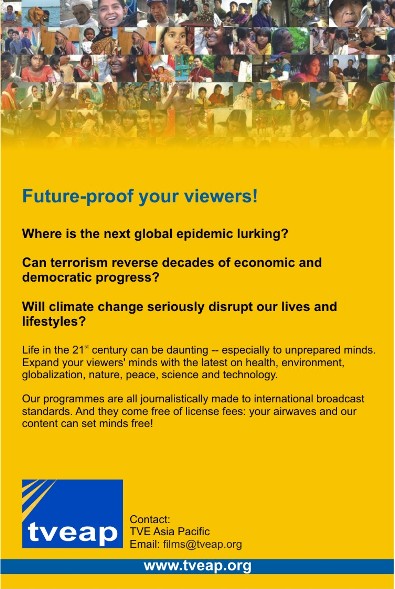
Here’s our promo advert for the event:

futureproof-your-viewers-tveap.jpg

TVE Asia Pacific to co-sponsor Asia Media Summit 2007

I will be reporting from AMS 2007 for the next few days.

Outsourcing with a heart: Cambodia’s success story

Today, 16 May 2007, was observed worldwide as World Information Society Day – it marks the establishment of the International Telecommunications Union (ITU) in 1865 and used to be called the World Telecommunication Day.

The UN-sponsored day was dedicated this year to making available the benefits of the digital revolution to young people everywhere. As the ITU noted in its media release:

The World Summit on the Information Society (WSIS) recognized the young as the future workforce and the earliest adopters of ICT, and called for their empowerment as key contributors to building an inclusive Information Society. World leaders stated their commitment at the Summit in Tunis to actively engage youth in innovative ICT-based development programmes and widen opportunities for them.

Yesterday I wrote about a TV service in Pasadena, California, outsourcing some of its reporting work to journalists in India.

Outsourcing is a worldwide trend, fuelled by the rolling out of Internet access and encouraged – at least in part – by the lower salaries that equally skilled persons still command in the less developed parts of the world. So much has been written and spoken about outsourcing in the IT industry, which has created multi-million dollar businesses in recipient countries such as India.

The outsourcing industry employs tens of thousands of young women and men in developing countries, especially in Asia, which receive the outsourced work. Most of them are from urban backgrounds with English-speaking ability and reasonable levels of education.

But this business-driven process can also benefit young people who haven’t had such advantages in life.

digits4change.jpg

A story in TVE Asia Pacific’s Digits4Change series illustrates this potential. It came from Cambodia, and we called it Compassionate Data.

digits4change-tv-series-cambodia.jpg

We went to Cambodia in late 2005 to find out how business process outsourcing (BPO) is benefiting one of the poorest countries in the world.

Emerging from decades of conflict, Cambodians are now trying to find their place in the global village. But lacking in English and computer skills, many find their opportunities limited.

Digital Divide Data is a non-profit organisation run like a business. Started in 2001, they outsource data processing work from the west.

As the world goes digital, thousands of old, paper-based documents need to be digitised. These tasks take time, effort and quality control. Digital Divide Data (DDD) provides this value added service.

Among its clients are universities, companies and organisations in North America.

But what’s special about DDD is their staff. They employ young men and women from disadvantaged backgrounds – orphans, those with disabilities, or from very poor, rural backgrounds. A few have been trafficked for the sex trade.

Sith Sophary Nhev, DDD’s then Cambodia manager told us: “Many companies outsource this kind of service to international clients by using educated and skillful people, but DDD use disadvantaged people who have low skill and low education but we still provide like a good service, quality, time turnaround and a competitive price for the clients.”

Young people come to DDD with a basic education and virtually no skills. The company trains them in computers and English. In fact, all staff are required to continue their education. The company provides scholarships – and pays them an above average salary.

In the hard-nosed ICT industry that’s usually driven by financial bottomlines, DDD has demonstrated that it is indeed possible to do well and do good at the same time. They are a social enterprise, a growing trend worldwide.

digits4change-compassionate-data.jpg

[

]

Watch the full story on TVEAP’s YouTube Channel

Digits4Change TV series website

Digital Divide Data website

Feeding Oliver Twists of the world…and delivering UN logos with it!

“Please, Sir: I want some more!”

These simple yet evocative words were etched into our memories by Charles Dickens, who created the story of Oliver Twist (1838), the poor orphan struggling – and suffering – in 19th century England.

Dickens mocks the hypocrisies of the time by surrounding the novel’s serious themes with sarcasm and dark humour. The novel may have been inspired by the story of Robert Blincoe, an orphan whose account of his hardships as a child laborer in a cotton mill was widely read in the 1830s.

Image courtesy Wikipedia

The world has seen unprecedented creation of wealth since those dark and miserable days 180 years ago. But sadly, there still are hundreds of millions of children who share young Oliver plight — or worse: many go to bed entirely hungry in a world that does not have an overall shortage of food anymore.

Fighting Hunger 2007

Today, 13 May, thousands of people in different parts of the world will walk wherever they can as part of a global campaign in support of ending hunger – one lingering great shame of our time.


Fight Hunger: Walk the World
is a global fundraising and awareness event that takes place every year in all times zones with one sole purpose – to call for an end to child hunger.

Fighting hunger website tells us:

Hunger is more than having an empty stomach. Hunger means not getting the necessary daily nutrition to lead a fully active, productive and healthy life.

Hunger affects more than 800 million people around the world. A child dies every 5 seconds because he or she is hungry.

This year, the organisers – led by the UN World Food Programme – had a viral video contest. It asked anyone, anywhere to do a short video promoting the event – and the issue of hunger – and upload. Some interesting videos have been received — even if some are blatantly in-your-face propaganda for the UN WFP.

That’s my big, long-lasting complaint about the UN family of agencies addressing and tackling the world’s ills. After a while, they allow their worthy issues to be eclipsed by their own self-promotion, public relations and spin. I wrote last month about how the entire MDG campaign has been subsumed by needless volumes of spin.

If only the World Food Programme and its sister agencies can resist their temptation to see every campaign, issue and programme as a logo-delivery mechanism, they will do a whole lot more good.

For that reason, while I will privately walk and think of those in hunger today, I will not contribute any money to the bloated bureaucracy of the United Nations World Food Programme. I would also ask that they go before a mirror today just before they step out to go walking with the world — and sincerely ask: do you see part of the problem or part of the solution?

Thank you, WFP, for delivering food to tens of millions of people worldwide who would not otherwise be fed, or fed adequately. But try and deliver a little less of your image and your logo, if you can. (We saw so much of this happen in the days and weeks that followed the Asian Tsunami disaster, and it was simply disgusting.)

Both hunger and hypocricy thrive nearly two centuries after Dickens and Oliver Twist. We must walk today to end not just one, but both!

Happy walking, everyone.

Watch the winning and commended videos in Fighting Hunger online video contest

Read UN WFP fact sheet about hunger worldwide

Mediasaurus — and the rise of bloggers

Earlier this month, I referred to science fiction writer Michael Crichton’s 1993 Wired article titled ‘Mediasaurus’ — in which he talked about how television as we know it (or knew it, at the time) was doomed.

I’ve just come across this cartoon, which I can’t resist sharing.

Cartoonists are the social philosophers of our time. And no one else achieves a better economy of words.

Source: http://www.indcjournal.com/archives/ariaillg2.jpg

Banned in the USA, Al Jazeera now online at YouTube

“The world’s first English language news channel to have its headquarters in the Middle East; covering the world, bridging cultures and setting the news agenda.”

That’s the marketing line of Al Jazeera International (AJI), launched on 15 November 2006.

It’s been slowly building up an audience, which it now claims to be around 90 million households.

But not in the United States of America: it was shut out of most American homes because cable companies have refused to carry their signal.

Elsewhere, commerce – not politics – was at play: some cable operators and hotels, already locked into various deals with the established global news channels of BBC World and CNN International, weren’t easily carrying AJI either.

Undeterred, AJI started this week to post some of their content on YouTube.

al-jazeera.jpg

Well, things are getting more interesting now!

When AJI started less than six months ago, I wrote an op ed published on Both Media Helping Media (UK) and MediaChannel.org (USA). I argued that to make a real difference, AJI needs to not only analyse and present the news differently, but also gather news more ethically in the developing countries of the global South.

BBC World and CNN International have an appalling track record of doing this. “They epitomise a disturbing belief in international news and current affairs journalism: the end justifies the means.”

I added: If products of child labour and blood diamonds are no longer internationally acceptable, neither should the world tolerate moving images whose origins are ethically suspect.”

I ended my essay: We will be watching. And not just what’s shown on AJI, but how those pictures get there.”>

Well, it’s now become easier to follow AJI. I still keep an open mind about their English channel, even if it shows every sign of aping the BBC and CNN. Already we need to look hard to find a real difference.

Let’s give them one year to prove if they mean what they say — or not.

Read my full essay on Media Helping Media, with some reader comments

Read the version that appeared on MediaChannel.org

50? In South African terms, you’re probably dead!

“How many of you are over 50?” asked Christina Scott, South African journalist and broadcaster.

Half a dozen hands went up.

“Come on, now – be honest,” Christina urged. One more hand joined.

“In South African terms, chances are that you’re already dead,” she declared.

Christina was talking about stark realities of living and dying in today’s South Africa, which is one of the highest HIV infection rates in the world.

We were at a session on ‘Life and Death in 2020: How will science respond?’ during the Fifth World Conference of Science Journalists, currently underway in Melbourne.

christina-scott.jpg Christina Scott - image courtesy IPS

Christina then asked how many in her audience were aged between 30 and 35. This time, four hands shot up.

“If you were in South Africa, you’re probably infected with HIV, and don’t know it yet — and go around giving it to others,” she told them.

After getting her audience shocked and hooked, Christina talked about how HIV is cutting across social hierarchies and colour barriers in her country.

Many intervention strategies to contain HIV have been based on the premise that when people know more, they are more likely to change risky behaviour. “We now see that greater wealth or higher levels of access to information alone do not change people’s behaviour. In fact, the middle classes lull themselves into thinking that HIV is a poor people’s disease, when it’s not,” she said.

In other words, it’s not a linear process and is much nuanced.

Christina was doubtful if Internet, PCs and online communications could make much headway in reaching out a majority of South Africans. It’s not just a lack of connectivity and computers, but a more basic absence of electricity in many areas.

To her, old fashioned radio was still the most cost-effective way to reach more people quickly.

One new ICT that has taken sub-Saharan African by storm is mobile phones. “They are everywhere, and people are using them for all sorts of things — including sexual transactions.”

She was cautiously optimistic about prospects for combating HIV. “AIDS is like a war: it’s very nasty, and causes a lot of damage. But as in war, it also spurs innovation and responses,” she said.

An AIDS vaccine is not the answer, as the virus keeps mutating and in any case distributing the vaccine to all those who need it will be a huge challenge.

Her personal wish: her daughter of 15 to get through college without contracting HIV.

Note: Christina works as Africa consultant for the Science and Development Network.

And now, Al Jazeera get on You Tube

YouTube seems to be everywhere!

Last week in Sydney and this week in Melbourne, journalists and media researchers can’t talk enough about You Tube — though not everyone is equally enthusiastic about the online video sharing platform.

This just in, from MediaChannel.org:

Al Jazeera English goes You Tube

The Doha-based broadcaster Al Jazeera (English) will launch a YouTube branded Channel, the company said today. YouTube users worldwide will have the ability to comment on Al Jazeera English clips, rate them, recommend them to friends and post their own video responses to communicate with other viewers.

Content will include segments from shows such as ‘Frost over the World’, ‘Everywoman’, ‘Inside Iraq’, ‘Inside Story’, ‘Listening Post’, ‘Riz Khan’, ‘One-on-One’, ‘The Fabulous Picture Show’, ‘Witness’ and ‘48′. Al Jazeera English is also planning to release some exclusive web-only programming, starting with ‘Poltical Bytes’, a global conversation hosted by UN correspondent Mark Seddon which will ask the YouTube community to carry on the conversation and add video contributions. The broadcaster said it will provide new content to the site by adding at least 10-15 new clips each week.

Nigel Parsons, Managing Director of Al Jazeera English said: “We believe that YouTube is a perfect platform to reach out to our audience and to give wide and easy access to new viewers around the world. We have significantly built on our distribution since launch and now reach well in access of 90 million cable and satellite households worldwide. With YouTube’s community of millions of online users this is set to dramatically increase.”