John Pilger: Being a journalist is a privilege

Towards the end of our week’s stay in Sydney for OUR Media 6 Conference, the organisers gifted us copies of The Australian Photojournalist, which is the journal of the Australian Photojournalists’ Association.

The June 2006 issue I received is a handsome volume and makes fascinating reading. On the inside front cover, I came across these words by John Pilger, the courageous and outspoken Australian journalist and film-maker hailing from Sydney.

John Pilger

“The best journalism is about looking behind facades and pretensions. It is never accepting the status quo; it is always questioning and remaining sceptical of the pronouncements and actions of those in authority, especially authority that is not accountable.

“The best journalism is following the dictum, wry but true: Never believe anything until it is officially denied. It is seeing the world from ground up, where ordinary people are, not from the top down, where the powerful reside. In many respects, the best journalists are the agents of ordinary people, not of those who preside over them.

“By looking at the world this way, from the standpoint of humanity not its would-be controllers, journalists will find themselves closer to the truth about all manner of things than they will ever be, following the manuals of establishment thinking.

“And by journalists, I mean photographers, too. The finest photographers produce images that ought to achieve mor than a gut reaction but help us make sense of events, great and small.

“Speaking personally, being a journalist is a privilege.”

Indeed. And few people bear that title with greater responsibility and passion than John Pilger.

I had the privilege of listening to John Pilger early on in my career, during one of the first international media conferences I attended in Sweden in the late 1980s. Of the three dozen speakers who spoke there, the only ones who have withstood the gradual erosion of memory are Pilger and Norwegian academic Johan Galtung.

Years later, I read Pilger’s book The New Rulers of the World — which was also the title of 2002 documentary film he wrote, produced and presented on the consequences of globalisation, taking Indonesia as the primary example of the serious problems with the new globalization.

And thank heavens, he shows no signs of slowing down — or mellowing.

The War on Democracy is John Pilger’s first major film for the cinema. Set in Latin America and the US, it explores the historic and current relationship of Washington with countries such as Venezuela, Bolivia and Chile. Two years in the making, The War on Democracy is due to be released in cinemas in the UK on 15 June 2007.

He has produced more than 55 TV documentaries. Links to two of his more recent ones available online:

Breaking the Silence: Truth and Justice in the War on Terror (2004) on Google Video (51 mins)

Stealing a Nation (2004) on Google Video

Noam Chomsky on John Pilger

Images courtesy www.johnpilger.com

Say MDG and smile, will ya?

There we go again!

I have just done another post on Millennium Development Goals (MDGs), pleading that the core issues they promote be given due prominence than simple brand promotion for MDGs and their promoters-cum-custodians (the UN).

For my readers outside the charmed development circles, MDGs are an international blueprint for human development, with eight major goals to be achieved by 2015. These goals are the means of implementing the Millennium Declaration — to which 189 governments committed at the UN Millennium Summit held in 2000.

One way to ensure the governments will keep their promise is to turn media spotlight on them. Journalists and media managers have a key role to play in this process.

With this in mind, our friends at the Asia Pacific Institute for Broadcasting Development (AIBD) have launched the Asia Pacific MDG Media Awards to ‘recognise and honour the best media reporting on the MDGs’. They have the backing of two UN agencies (UNDP and UNESCAP) and the Asian Development Bank. The deadline for applications is 15 April 2007.


See TVE Asia Pacific news item on Asia Pacific MDG Media Awards

All this is well and good — except that the rules of the award scheme are a bit self-limiting. There’s one that I’ve only just noticed: “Reference to the MDGs (whether one or all MDG Goals) in your content is mandatory.”

This places wrong emphasis on MDG branding when it should be on the actual issues. MDGs are not another slogan for spin doctors at UN agencies to play around with for a few years until the next development fad comes along.

MDGs are about human dignity and social justice to the half of humanity that currently lives in poverty, squalor and deprivation. It is these real world people who lose their babies to preventable childhood diseases; drop out of school because they cannot afford to stay on; die needlessly in their millions during pregnancy or childbirth; or go to bed hungry every night.

In that bigger scheme of things, it doesn’t really matter whether justice is delivered through strategies, programmes and projects labelled ABC, XYZ, MDG or something else.

Besides, MDGs are a means to an end. The process is important, but branding is not, on that journey.

Half way along the way — to the agreed target of 2015 — an informed and motivated media can help countries and development players to remain focused.

By all means, reward good journalistic coverage of development and social justice issues underscored by the MDGs. But please, let’s not turn this into another round of simple publicity and self-promotion for UN agencies.

Related:

MDG Asia Pacific website

AIBD documents on Asia Pacific MDG Media Awards

Michael Crichton, Mediasaurus and end of broadcasting

I just wrote a post on digital pioneer and futurist Mark Pesce’s views on the end of broadcasting and the mass media as we know it.

Television broadcasting is probably a dinosaur facing extinction, but let’s remember a bit of pre-history here: dinosaurs didn’t die off in an instant. No time lord zapped them with some mighty extincter machine. Their decline and eventual extinction was, it is believed, a slow and gradual process.

So it will be with broadcasting. Even if their distribution and revenue models are now undermined and will soon be obsolete, conventional broadcasting (as we know it) will continue to operate and try to compete, at least for a few years. And in the less developed countries with emerging economies, that process will take longer.

Which means we still have to engage TV broadcasters even as their Empires of Eyeball slowly crumble.

And let’s not write off those Empires just yet. I still remember an article in the early days of Wired magazine: appearing in Sep-Oct 1993 issue, it was titled Mediasaurus , and written by the well known science fiction author (and medical doctor) Michael Crichton (of Jurassic Park and ER fame).

Michael Crichton, courtesy Michael Crichton website

He started the article as:
I am the author of a novel about dinosaurs, a novel about US-Japanese trade relations, and a forthcoming novel about sexual harassment – what some people have called my dinosaur trilogy. But I want to focus on another dinosaur, one that may be on the road to extinction. I am referring to the American media. And I use the term extinction literally. To my mind, it is likely that what we now understand as the mass media will be gone within ten years. Vanished, without a trace.

And he ended:
So I hope that this era of polarized, junk-food journalism will soon come to an end. For too long the media have accepted the immortal advice of Yogi Berra, who said: “When you come to a fork in the road, take it.” But business as usual no longer serves the audience. And although technology will soon precipitate enormous changes in the media, we face a more immediate problem: a period of major social change. We are going to need a sensitive, informed, and responsive media to accomplish those changes. And that’s the way it is.

I just re-read the full article, and Crichton’s analysis is even more valid today than when it was written over a dozen years ago. But it’s also true that the broadcast industry – and conventional media as a whole – have changed and adapted.

No doubt that Mediasaurus still has an expiry date, but it’s not easy trying to guess exactly when the last of their kind drops dead.

Read the full article on Wired Online

Blogging turns 10 – Happy Birthday to Us!

“Check this out. Amazing!”

Four simple words. Yet they sparked what snowballed into a revolution of sorts on the web.

Those were the very first words to be written on the first blog.

Blogging turned 10 on 1 April 2007.

Created by the US web guru Dave Winer, Scripting News is regarded as the first modern blog, though the term “weblog” was not used in the early days.

Having first gone online on 1 April 1997, Scripting News is still going strong and is credited with helping popularise RSS and podcasting, too.

Winer himself actually calls info.cern.ch, built by Tim Berners-Lee, the first weblog because it “pointed to all the new sites as they came online”.

According to his blog (what else?), Winer, 51, pioneered the development of weblogs, syndication (RSS), podcasting, outlining, and web content management software. He is a former contributing editor at Wired Magazine, my own favourite guide to the often bewildering but fascinating digital world.

Latest figures indicate an estimated 70 million blogs in existence, with around 1.5m posts being written every day.

According to Technorati, which monitors and aggregates blogs, some 120,000 new weblogs being created worldwide each day – that’s about 1.4 blogs every second.

Oh, and what did Dave Winer want checked out? It was just a list of websites he had visited that day.


Read The Guardian (UK) article on 10 years of blogging.

What’s in a name: My media, your media or OUR Media?

We’ve just finished the first day of OUR Media 6 conference in Sydney. A great deal was presented and discussed by over 150 participants from more than 30 countries. It will take a while to navigate through this mass of information, perspectives and opinions.

One thing we talked about was how to describe the kind of media that is emerging or consolidating in many countries outside the formal power structures and corporate/governmental controls.

Several names are being tossed up:
Community media?
Alternative media?
Tactical media?
Citizen media?
Social movement media?
People’s media?

Whatever label we apply, these media face formidable challenges. John D.H. Downing, Professor of International Communication and Founding Director, Global Media Research Center Southern Illinois University, USA, started off the conference with a wide-ranging, insightful discussion of the key challenges.

His talk was full of ‘nuggets’ of practical wisdom, the kind that some academics never seem to produce or peddle:

Small is not always beautiful.

Community is not necessarily lovely.

Aha! I’m glad these statements were said upfront, because there’s a tendency to romanticise both at gatherings like this.

We’re off to a good start. Watch this space.

A foot in both graves? OURMedia, here I come!

I’ve just arrived in Sydney, Australia, to participate in, and speak at, OURMedia/NUESTROSMedios 6 Conference, 9-13 April 2007.

There are over 130 presentations planned over the 5 days from representatives from over 85 international and Australian organizations and over 35 countries. I’ll be talking about ‘Communicating Under Duress: The Children of Tsunami experience’ on April 10 afternoon.

ourmedia-vi-banner.jpg

According to the conference website:

OURMedia / NUESTROS Medios is an international network and forum founded in 2001 by a group of engaged academics interested in advancing the democratic potential of community, alternative and ‘citizens’ media. Recognising that the intellectual and policy frameworks for citizens’ media are often out of touch with the on-the-ground reality, the purpose of OURMedia is to connect scholars, practitioners, activists and policy-makers towards defined outcomes. OURMedia is now a network of over 500 people from 50 countries and has generated an extensive body of practical and theoretical knowledge primarily in English and Spanish. It constitues a unique space of dialogue between academics and practitioners, advocates and artists working in community, alternative and citizens’ media.

Past OURMedia conferences have been organized in the United States (2001), Spain (2002), Colombia (2003), Brazil (2004) and India (2005). These conferences have consisted of scholarly and academic presentations, media activism initiatives, policy workshops, community cultural development roundtable debates, new media labs, research-led forums and engagements by local media producers.

I’m not an academic, although in my media and communication work I often work with researchers and academics, always asking them to say things in simpler words. I speak and write in very practical, pragmatic terms — not in academese. I sometimes wonder how it goes down with academic colleagues who typically utter four jargon terms out of every ten. But somehow, I must be doing a few things right because I often get invited back!

Which reminds me what John Naughton, British columnist on new media and academic said about the double-life of a journalist-cum-academic (or the other way round):

When I was an undergraduate I became heavily involved in student politics and in the process got to know some newspaper editors who asked me to write articles for them. So I did — and to my astonishment they sent money in return. Figuring that this was a great racket I continued to do it. One of my famous fellow-countrymen, Conor Cruise O’Brien has also been an academic and a journalist all his life. He describes it as “having a foot in both graves”. I try and keep the two sides of my life separate. My journalistic mates think I must be a good academic on the grounds that I’m not much of a journalist, while my academic colleagues think I must be a good journalist (on the grounds that…). They’re both wrong.

John wrote A Brief History of the Future: The origins of the Internet. He writes a weekly column about the Internet in the business section of The Observer newspaper in the UK.

Wanted – Human face of climate change!

Now that scientists have spoken, loud and clear, things are beginning to happen on climate change — and not a moment too soon.

Venture capitalists, policy wonks, technology geeks, security analysts and social activists are all joining the conversation — thanks largely to the media’s increased coverage of the issue.

The threat of climate change is being taken seriously. The past few weeks have seen evidence of this. For example:

The latest report from the Inter-governmental Panel on Climate Change, released on April 6, said greenhouse gas emissions are at least partly responsible for the warmer climate, which will pose a host of environmental and health challenges, ranging from more diseases to floods and droughts.

– In March 2007, an international panel of scientists presented the United Nations with a sweeping, detailed plan to combat climate change, warning that failure would produce a turbulent 21st century of weather extremes, spreading drought and disease, expanding oceans and displacing coastal populations.

And for the first time ever, the U.N. Security Council will discuss potential threats to international security from climate change.

These conversations will be richer and more meaningful if the ordinary people — who are most at direct risk from climate change’s multiple impacts — were heard in the corridors of power, money and deal-making.

We in the media must see beyond the important scientific projections, policy debates and UN talks — we must look for the human faces, voices and dimensions of climate change.

That’s the point I made in a recent essay published on TVE Asia Pacific website a few weeks ago. Here’s an extract:

A healthy mix of rational thinking and emotional appeal will stand a better chance of moving people to kick their addition to oil.

Allowing real people to tell their own personal experiences can also be very effective. I realised this five years ago, when we commissioned the first-ever documentary on climate change and the South Pacific, made by a native Pacific islander. Voices from the Waves, directed and produced by Bernadette Masianini of Fiji, was narrated by two teenagers growing up on two islands, each facing an uncertain future.

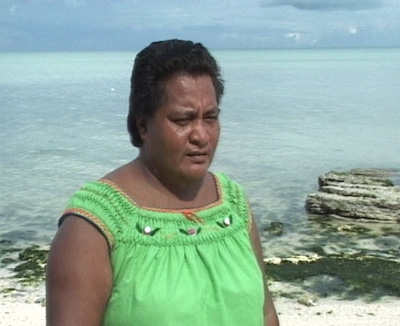
At one point we meet Mrs Saipolua, an ordinary woman who lives on the island of Kiribati, where no place is higher than a few feet above the sea. She is distressed having had to move her home twice in a past decade due to the receding shoreline.
For Kiribati’s 82,000 inhabitants, climate change is not theory; it’s already lashing on their beaches.

“Our house used to be in that spot,” Mrs Saipolua points to a place that’s now permanently submerged. “This is where we relocated to the second time.”

mrs-saipolua.jpg

She points to several tombstones that are on the verge of being washed away. “Even the final resting places of our loved ones are not spared…..The sea action had cracked the gravestones.”

I’ve covered climate change for years as a science writer. But it was Mrs Saipolua who made me realise the impact climate change is having on millions of ordinary people who have never heard that term.

Related links:

Pacific ‘Voices from the Waves’ on climate change

Read the full essay, Changing Climate and Moving Images on TVEAP website

Watch a video clip from Voices from the Waves on TVEAP’s YouTube Channel:

Video and DVD copies of Voices from the Waves can be ordered from TVE Asia Pacific’s online e-shop.

UN Climate Change Impact Report: Poor Will Suffer Most

The BBC as a Fossil Fool?

The BBC is running a Climate Season once again. Like many arms of the media, they have jumped the climate change bandwagon.

And that’s a good thing.

BBC World’s blurb reads:
As part of BBC World’s extensive coverage of one of the key challenges facing humanity, the Climate Watch season throughout April will feature a host of special documentaries and factual programmes plus news and
business reports from its global correspondents.

This is only to be applauded. But it wasn’t too ago that the BBC – with other sections of the mainstream media – was still insisting on “balancing” its coverage of climate change.

Even a couple of years ago, the BBC appeared to be incapable of running an item on the subject without inviting a skeptic to comment on it.

Of course, the BBC is entitled to change its mind like everyone else. (As a certain Boutros Boutros-Gali once famously remarked, only fools don’t change their mind.)

George Monbiot wrote a column in The Guardian (UK) on 27 April 2004 commenting on this. It was titled: “Beware the Fossil Fools: The Dismissal of Climate Change by Journalistic Nincompoops is a Danger to us All”.

Here’s an extract from that article, published less than 1,000 days ago:

Picture a situation in which most of the media, despite the overwhelming weight of medical opinion, refused to accept that there was a connection between smoking and lung cancer. Imagine that every time new evidence emerged, they asked someone with no medical qualifications to write a piece dismissing the evidence and claiming that there was no consensus on the issue.

Imagine that the BBC, in the interests of “debate”, wheeled out one of the tiny number of scientists who says that smoking and cancer aren’t linked, or that giving up isn’t worth the trouble, every time the issue of cancer was raised.

Imagine that, as a result, next to nothing was done about the problem, to the delight of the tobacco industry and the detriment of millions of smokers. We would surely describe the newspapers and the BBC as grossly irresponsible.

Now stop imagining it, and take a look at what’s happening. The issue is not smoking, but climate change. The scientific consensus is just as robust, the misreporting just as widespread, the consequences even graver.

Monbiot ended the article by asking:

But isn’t it time that the BBC stopped behaving like the public relations arm of the fossil fuel lobby?

How times have changed! But hey, better late than never…

Related:

Monbiot.com
World’s richest environmental prize goes to the BBC

Long live MediaChannel.org!

I have never peddled a fund raising appeal through my blog…until now.

Earlier today, I received my daily email from MediaChannel.org, a website that critiques the media — ‘As the media watch the world, we watch the media’

According to their website: MediaChannel is concerned with the political, cultural and social impacts of the media, large and small. MediaChannel exists to provide information and diverse perspectives and inspire debate, collaboration, action and citizen engagement.

And like many of us who mix media and social activism, they are facing a crisis. Today’s email said:

After seven years and a new website redesign, MediaChannel.org may have to cease operations because of a financial emergency. As most of you have already noticed, we have started to run advertising on the website in an effort to deal with our funding challenge.

To put it bluntly, the future of MediaChannel is in question. Please consider making a tax deductible donation online through PayPal or send a check made out to: The Global Center, 575 8th Avenue, Suite 2200, New York, New York, 10018.

MediaChannel is headed by Danny Schechter, the Emmy-award winning TV journalist and film-maker.

I met Danny in the Fall of 1995, when I spent a few weeks in New York on a fellowship to study the United Nations. Danny was one of the more colourful people we met (besides lots of men in suits from the UN, only a few of whom I can now recall by name). Danny introduced himself as a (TV) ‘network refugee’ — and gave a workshop on television journalism in defence of the public interest and human rights that had a lasting influence on myself.

Besides running MediaChannel.org, Danny writes the well-informed, incisive NewsDissector blog

Since then, we’ve been in contact occasionally. And here’s my declaration of interest: MediaChannel.org has published my media related op ed essays, though I never get paid and never expect any payment.

As Walter Cronkite says: “MediaChannel is undoubtedly worth taking part in. So many leading groups and individuals around the whole world have come together.”

And MediaChannel.org is undoubtedly worth supporting.

Read my last op ed on MediaChannel:
Ethical news-gathering: Al Jazeer’s biggest challenge