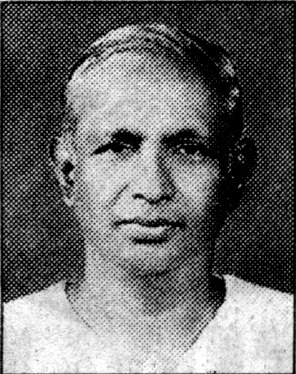
Tambiaiah SabaratnamI seem to be writing a few fond farewells to fellow travellers every year, becoming an obituarist of sorts in that process. I don’t go to funerals if I can help it (they’re too depressing), and instead I withdraw to a corner to write my memories. Some are published; others are privately circulated.
I’ve just published such a tribute on veteran Lankan journalist T (Tambiaiah) Sabaratnam, who died on March 5 aged 79. He was a senior colleague when I entered the world of journalism in the late 1980s. He retired (sort of) in 1997, but remained active in the world of media to the very end.
He was an outstanding journalistic story-teller. As I wrote in the tribute: “He was a pathfinder and leading light in Sri Lankan science journalism for over a generation. Throughout his long association with the English and Tamil press, he advocated the pursuit of public science: tax-payer funded scientific research for the benefit of the people and economy.”
Here’s another excerpt, more personalised:
“He was a source of inspiration and encouragement to me during my early years in science journalism. Our paths crossed often in the late 1980s and early 1990s when he and I covered many of the same scientific events. He was approachable and helpful, but I could never bring myself to call him ‘Saba’. When I knew him, he had already been in journalism for longer than I’d been alive. To me, he was always ‘Mr Sabaratnam’.
“He reached out despite our generational, media house and other divides. He was genuinely interested in my progress as a science journalist, and offered me advice on both style and substance. Occasionally, he also cautioned about on various ‘pitfalls’ in the local scientific scene — personal rivalries, exaggerated claims or oversized egos.”
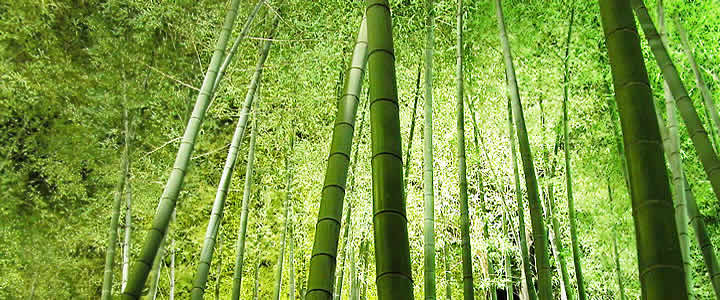
“The bamboo that bends is stronger than the oak that resists,” says a Japanese Proverb.
In these times of climate change, we all need to bear this in mind. It’s not how we resist the battering, but how we pick up again after repeated onslaughts.
Bamboo is an amazingly versatile plant (actually, a grass) with many uses in Asian cultures. We use it for buildings, furniture, outdoor infrastructure, artistic decor and even eat parts of it.
Beyond these utility functions, the bamboo holds a philosophical lesson that the ancient Japanese and Chinese knew very well: its flexibility is its strength. It can bend and move with the wind or water or other element, rather than being rigid, unyielding and ultimately vulnerable to an unexpected jolt and sideways shift.
Resilience was discussed and interpreted in a number of ways at the conference. But participants broadly agreed that it is the ability of any individual or community or system to absorb external shocks, bounce back and transform or continue to grow.
Such bouncing back, in some climate related situations, could be to alternatives rather than to the original condition. For example, if poorly built structures are damaged in a disaster or extreme weather condition, the recovery could – and should – be to build back better.
Indeed, the bamboo metaphor is widely used in various fields from business management to self-help counseling. See these interesting links for further insights:
What does Livelihood Resilience mean to them?
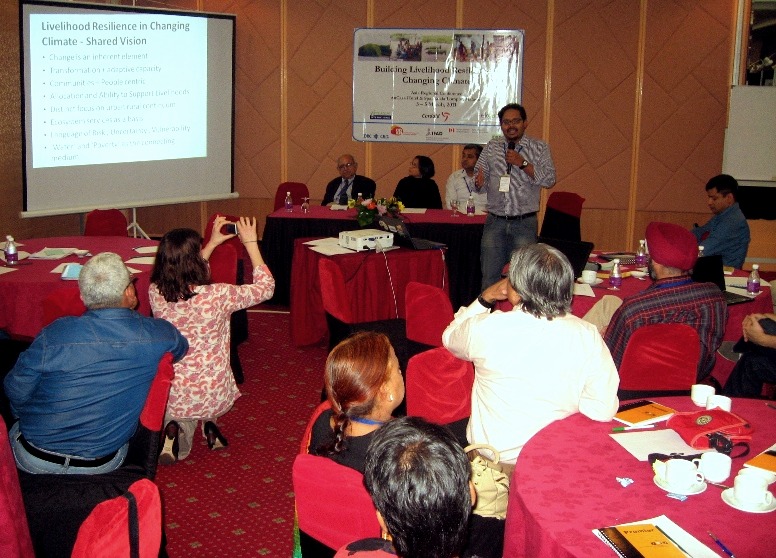
I am at Resilience 2011: Asia Regional Conference on Building Livelihood Resilience in Changing Climate, being held in Kuala Lumpur, Malaysia, from 3 – 5 March 2011. It is jointly organised by Wetlands International-South Asia (WISA), International Development Research Center (IDRC), The Climate and Development Knowledge Network (CDKN), Cordaid and ekgaon technologies
The conference has attracted three dozen researchers, practitioners and policy makers from across the Asia Pacific region, and from different ‘domains’: Disaster Risk Reduction (DRR) and disaster management; Ecosystem services and conservation; and livelihoods and socio-economic development.
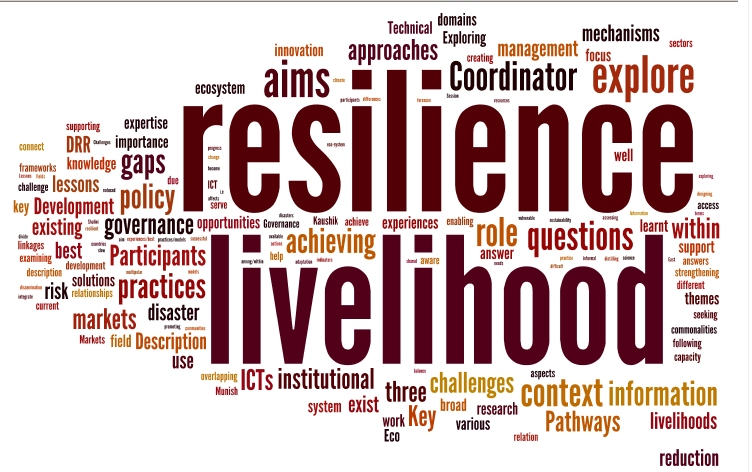
I like hobnob with researchers and activists from whom I learn much. As a science and development communicator, I sit through their often very technical discussions and find ways of relating them to the bigger realities. For a start, I created a word map of the keywords being used in the conference. That gives an idea of concerns at a glance.
I then tried to make sense of the conference introduction note, published on the event website. It looks and reads like the work of a committee, and not the easiest to read and absorb unless one is deep immersed in these areas. Since most of us aren’t, I spent an hour or two rewriting it in my own language. Here it is — my version of what Resilience 2011 conference is trying to accomplish:
Building Livelihood Resilience in Changing Climate Asia Regional Conference
Kuala Lumpur, Malaysia, 3 – 5 March 2011
A layman’s interpretation of the vision, scope and aims of the conference
Asia, home to over 60 per cent of all human beings, is the largest and most diverse geographical region in the world. It is also a region of sharp contrasts and disparities in economic and social development.
Some Asian economies have been growing faster than any other on the planet, and even the global recession has not slowed them down too much. This growth has helped push tens of millions of people out of poverty during the past three decades. Yet, Asia still has the largest number of people living in poverty and food insecurity.
In some respects, gains have been lost. For example, the UN Millennium Development Goals Report for 2010 revealed that the proportion of undernourished Asians has increased recently to levels last seen during the 1990s. Two thirds of the world’s undernourished people live in Asia. At the same time, the natural resources on which food supplies depend – land, water and biodiversity – are degrading rapidly. Food shortages and water scarcities are already being experienced, or anticipated, in many countries.
Growing number and intensity of disasters adds further pressures. According to the international disaster database EM DAT, Asia accounted for nearly half (46 per cent) of the all water related disasters in the world, and 90 per cent of all affected people during 1980 to 2006. During this period, disasters in Asia caused a total of US$ 8 billion worth of economic damage. These disasters impacted disproportionately on the poor and vulnerable sections of society.
Climate change impacts will make this situation worse for everyone, and especially for the poor who already have limited options and ability to adjust to rapid changes. It is now clear that all efforts aimed at reducing poverty and protecting the socially vulnerable groups need to factor in the additional pressures created by changing climate.
To cope with these challenges, we need better understand how livelihoods are threatened, and what strategies can be adopted to improve resilience especially at the grassroots. Researchers and practitioners in natural resource management and poverty reduction are now focusing more and more on the nexus between resources, climate changes and livelihoods.
New ways of looking at the inter-linked challenges have emerged:
• Humanitarian aid workers active on disasters now focus on disaster risk reduction, expanding the scope of risk management to include preparedness and risk reduction.
• Development practitioners working on poverty reduction emphasize on increasing access to various capitals to help address disaster risk and poverty.
• A ‘systems approach’ is being used to look at poverty in broader terms of well-being of people and ecosystem services of Nature.
In addition, researchers and activists emphasize the value of freedoms for participation, economic facilities, social opportunities, transparency guarantees, protective security and ecological security. It is only by ensuring these freedoms that the poor will have a meaningful chance to assert their rights and make their own choices in what they do, and how they do it.
The slowly but steadily warming planet challenges everyone to rethink their conceptual frameworks, and redefine or reconfigure how they work. If there is one thing certain about these uncertain and turbulent times, it is business-as-usual won’t do!
What do we seek to achieve?
Each sector has accumulated a knowledge base, set of best practices and lessons learnt exist within individual domains. Each sector’s theories, approaches and actions within various domains differ on how to make livelihoods more resilient, especially in the often harsh realities of the developing world.
They are all necessary, but not sufficient. Taken individually, no single approach or solution can help make everybody’s livelihoods resilient from the multitude of pressures and impacts. Yet, what one strand cannot withstand on its own, a bundle of strands very likely can: bringing different areas of research, advocacy and practice is the way forward to ensuring better resilience at the grassroots.
This is easier said than done. Both researchers and practitioners have long worked in their own silos or compartments, with occasional nods at each other’s work and periodic exchanges. From this, we need to evolve more integrated framework that brings in the ecologists, disaster managers, social scientists and everyone else who share an interest in making lives better at the grassroots and at the bottom of the income pyramid.
The Kuala Lumpur conference attempts to address this formidable challenge. It will provide a common platform to practitioners and researchers from various ‘domains’ related to livelihoods to work out a shared vision on livelihoods resilience by seeking answers to these questions:
• What are the existing challenges to achieving livelihood resilience?
• What are the gaps in existing livelihood frameworks in relation to disaster, climate change adaptation and conservation in addressing livelihood resilience?
• What are the challenges in scaling up pilot models of Livelihood Resilience?
• How does social adaptation occur in resilience building?
The conference brings together researchers and practitioners from three fields: Disaster Risk Reduction (DRR) and disaster management community; Ecosystem services and conservation community; and the livelihoods and socio-economic development community. Although their work overlap part of the time, they don’t converge too often.
I will blog on different aspects of the conference, trying to connect the dots, and relating the micro to the macro as I often do in my own work communicating development.
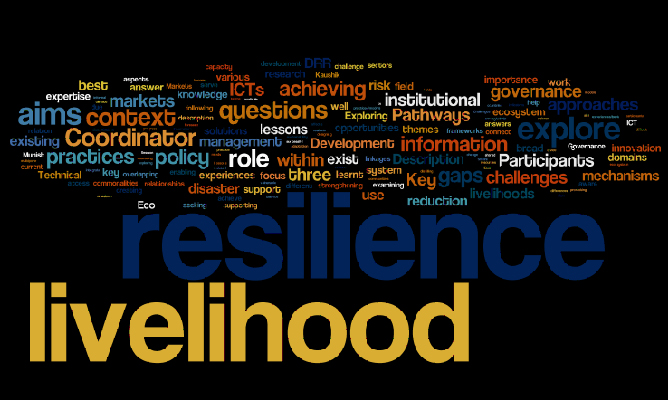
There are many issues, topics and discussions under the broad theme of protecting Asian livelihoods from climate change impacts. For a start, I used Wordle to build a word map, displaying proportionate use of keywords in the conference sessions. The above and below are the word clouds it generated (same words, displayed in different modes).
The conference is organised jointly by Wetlands International-South Asia (WISA), International Development Research Center (IDRC), The Climate and Development Knowledge Network (CDKN), Cordaid and ekgaon technologies of India.
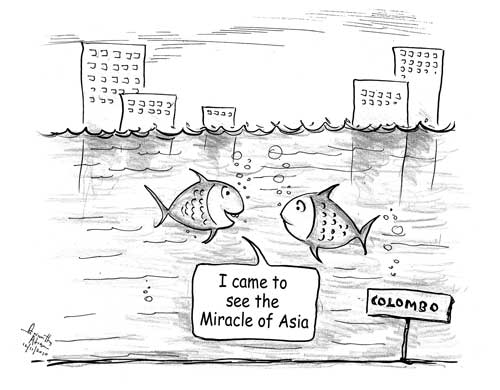
Cartoon in Daily Mirror, Sri Lanka, on 12 November 2010
Why do movie audiences in this part of the world cheer every time they see alien invaders blow up the White House? For a long time I thought it had something to do with anti-American sentiments; then I heard that many US audiences react the same way. Perhaps some among us get a kick out of seeing overbearing governments in trouble?
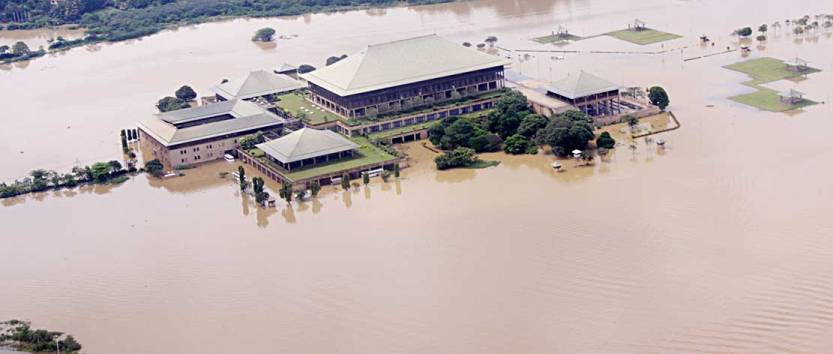
That might explain the gleeful tone with which the Colombo media reported the Sri Lankan Parliament being flooded after torrential rains in mid-November. Newspapers and television channels repeatedly showed images of the Parliamentary complex – built three decades ago on a marshland – completely marooned. The hapless people’s representatives were ferried across the expanse by the military, to take part in a brief session to extend Emergency Regulations. The symbolism was inescapable.
When the trapped rainwater engulfed many areas in and around Colombo, thousands of affected people groaned, but no one was really surprised. By now Sri Lankans know this is almost an annual routine. As I sat knee-deep in my own flooded office, I had a strong sense of déjà vu.
This is the opening of an op ed essay I’ve just written for Himal Southasian magazine, whose March issue carries a cover story on disasters in South Asia.
My essay, titled Drowning in media indifference, takes a personalised look at how the Lankan media have covered different disasters in the past two decades.
“Once again, the mainstream media in Sri Lanka has proven itself irrelevant in reporting and responding to catastrophic flooding,” says the intro — and that pretty much sums it up.
Sri Lankan Parliament flooded after torrential rains in mid-November 2010. The complex, built on a marshland, was completely marooned.
I recall how, back in 1992-93, the then media (fewer in number, with broadcasting still a state monopoly) provided saturation coverage for a major flood in the capital Colombo while under-reporting an even worse flood in the provinces a few months later.
“Fast forward to the present – and how little things have changed! During the past three months, as the fury of the formidable little girl (La Niña, the global weather anomaly) played havoc on the island, I have been struck by the similarly lop-sided coverage in the country’s mainstream print and broadcast media. Urban flooding once again received ample front-page coverage and ‘breaking news’ treatment. Everyone, from cartoonists and editorialists to talk-show hosts and radio DJs, ranted about what was taking place. Yet the much worse flooding, once again in the north, east and centre of the country, received proportionately much less attention. There were a few honourable exceptions, but by and large the 1992-93 disparity was repeated wholesale.”
I have been both an insider and outsider in this issue. I consider myself to be part of the extended mass media community in Sri Lanka for over two decades: I have worked for newspapers, magazines, radio and TV stations. At the same time, I retain the ability – and independence – to steps back and take a more critical and objective look at the media industry and community.
My interest in how disasters are covered and communicated go back to the time when my own house was flooded in mid 1992. I have since researched and commented extensively on this issue, and co-edited the 2007 book Communicating Disasters: An Asia Pacific Resource Book (TVEAP/UNDP).
In this latest essay, I reiterate an argument I’ve been making for sometime: “Media researchers have long accused the Western and globalised news media of having an implicit ‘hierarchy’ of death and destruction, in terms of how they report disasters in developing countries. But Sri Lanka’s own media’s indifference is equally appalling – the story of a quarter-million displaced people languishing in squalid conditions for weeks on end did not constitute front-page news. A starlet entering hospital after a domestic brawl excites news editors more than thousands of flood-affected provincial people starving while waiting for relief.”
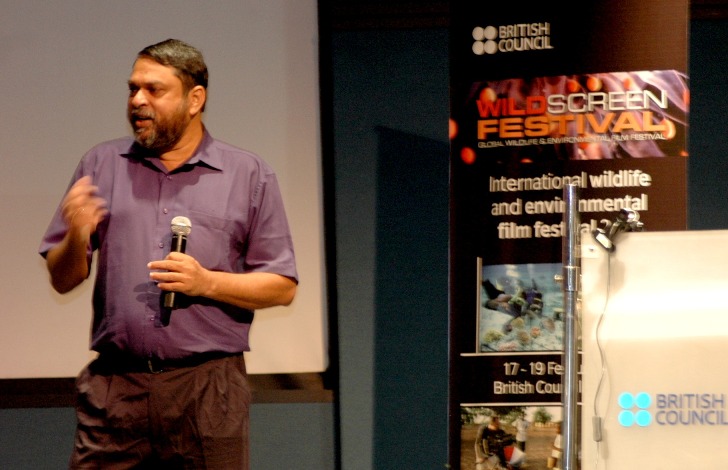
Taya Diaz conducts film making master class during Wildscreen 2011 in Colombo
“Taya Diaz has the shortest name in Sri Lanka but is a big man with a personality to match and a bushy black beard. Apart from being an excellent guide with good knowledge of all aspects of Sri Lankan Wildlife, he’s also a writer and film maker and is excellent company.”
That’s how a bird-watching website once described Taya Diaz, Sri Lankan conservationist turned wildlife film maker.
During the past two decades, Taya has collaborated in making over 20 full-length international wildlife documentaries, all showcasing Sri Lanka’s rich biological diversity and ecosystems. He has been a scientific investigator, presenter, narrator or Sinhalese scriptwriter.
One of his earliest involvements in international film making was with The Temple Troop. Made in 1997, for the BBC and Discovery Channel, it documented a year in the life of a troop of monkeys living in Sri Lanka’s ancient city of Polonnaruwa. These monkeys have been the subject of a long-running study by the Smithsonian Institution’s Primate Biology Program.
Trained as a scientist, Taya has worked in a number of field based conservation projects including the Smithsonian study of monkeys. But it’s as a wildlife and natural history that he now makes a name both in Sri Lanka and overseas.
The Urban Elephant (2000, for PBS/National Geographic), and The Last Tusker (2000, for BBC/Discovery) are two other productions that used Taya’s ground knowledge and scientific expertise. He has provided local liaison for broadcasters such as New Zealand TV, Canal+, Discovery channel, and BBC1.
Taya Diaz: Enough stories to last a lifetime!For all these reasons, Taya was a natural choice when TVE Asia Pacific was asked to recommend a Sri Lankan film maker to present a master class when the Wildscreen traveling film festival held in Colombo from 17 to 19 February 2011. His master class, titled “Untold Stories of Sri Lanka”, looked at Sri Lanka’s as yet largely untapped potential for authentic, factual stories related to wildlife, natural history and the environment.
He explained the premise for his master class: “Sri Lanka is a pot of plenty in every aspect — the opportunities for a documentary filmmaker are astounding. But sadly, what most audiences see on the airwaves is very standard and boringly similar, touching on the same topics year in and year out.”
Taya feels that documentary films and TV programmes are also essential for educating Sri Lankans about their own natural heritage. Sri Lanka has an impressively high number of plant and animal species for its relatively small land area — which makes it one of the most biologically diverse countries in the world.
“Sri Lankan naturalists, wildlife experts and environmentalists should collaborate more closely with film makers and/or broadcasters to make more local films aimed at local audiences,” he said during a panel discussion I moderated on February 17. “This is essential for raising awareness on environment and sustainable development issues as Sri Lanka pursues rapid economic development after the war.”
Time is ticking away...but crises also mean opportunities
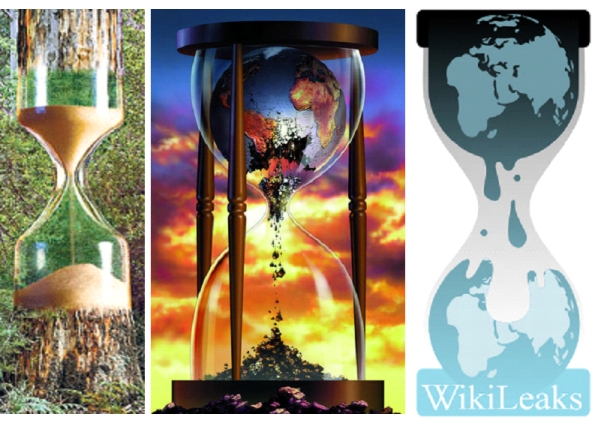
I like to think and speak in metaphors, especially visual metaphors. Sometimes I coin or design new ones. This illustration is the latest example.
Individual elements in this came from very different sources (thanks to them all). I just mixed them together to make two points during a talk I just gave at the Colombo University.
We live in a crisis-ridden world where we have to cope with multiple emergencies unfolding at the same time, impacting us on different fronts. This illustration captures three of them: crisis in biodiversity, man-made climate change, and the new reality of living in a rapidly WikiLeakable world — what I called the Global Glass House.
We don’t get to choose the timing, severity or duration of any challenge. But we do have some choice over how we respond: we can despair and grumble (blaming the Gods or karma if we believe in those); we can become really alarmist (a la Chicken Little); or we can be measured and smart in how we deal with the seemingly overwhelming situations.
Speaking at the Leaders in Environmental Advocacy Forum (LEAF) on Preserving the Past, Securing the Future on 22 January 2011 at the University of Colombo, I advocated this last option. I also pulled together a number of ideas mentioned on this blog over the past four years.
LEAF was a two-day summit held in Colombo, Sri Lanka, hosted by members of the Elon University’s Periclean Scholar Class of 2011, in partnership with the University of Colombo, the United States Embassy in Colombo, the National Science Foundation of Sri Lanka and Rainforest Rescue International.
In fact, some challenges of living on a warming planet are comparable to coping with a WikiLeakable world: both demand quick adaptation to a new reality. In both cases, governments and society have to change mindset and practices on the go — business as usual is no longer an option. Denialism, or demonising the messenger, won’t take us forward. We need more measured, sometimes even pragmatic responses.
In that process, all-or-nothing is not a viable approach. Waiting for full knowledge and understanding is not feasible either. As I once described it, responding to the planet’s climate and other ecological crisis with partial scientific understanding is akin to many pages of our planet’s ‘operations manual’ being still completely blank — and yet we have to manage the planet to the best of our knowledge, intuition and common sense.
Many of the same principles apply to living in the modern networked info society, where no secrets can be kept that way for too long. The sooner we come to terms with this new reality and adapt, the better.
I’m delighted to see others are addressing these parallels. In my talk, I mentioned a recent essay titled Could climate science become open source? by Brendan Barrett and Sulayman K. Sowe, published earlier this month on the UN University’s Our World 2.0 website.
In their perceptive piece, the authors ask whether climate science would benefit by being more firmly grounded in the principles of openness, perhaps along the lines of the free and open source software communities and open content movements. “The concept of openness behind free and open source software describes a mode of creative knowledge production and sharing in which individuals and communities freely generate and adapt or remix resources (content or software) without licensing restrictions.”
They add: “Proposing a move to a new model of climate science in no way suggests that climate change is not a real and present threat or that we cannot rely on the integrity of our contemporary climate science institutions and scientists. Rather, the argument here is that learning from the way free and open source software projects and communities work may be an important way forward in engendering more effective global, national and local responses to climate change.”
I have always worn multiple ‘hats’, and dabbled in multiple pursuits rather than follow narrow paths of enquiry. I see myself continuing to oscillate between the ‘geeks’ and greens, and where possible, bridging their worlds. It’s really encouraging to see some others straddling the two spheres.
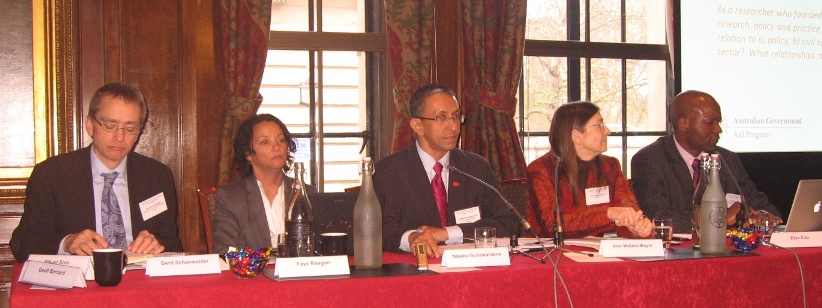
L to R - Gerd Shonwalder (IDRC Canada), Faye Reagon (HSRC South Africa), Nalaka Gunawardene, Ann Waters-Bayer (ETC Netherlands) & Eliya Zulu (AIDP, Kenya)
What needs to be done to improve connections between researchers and the media?
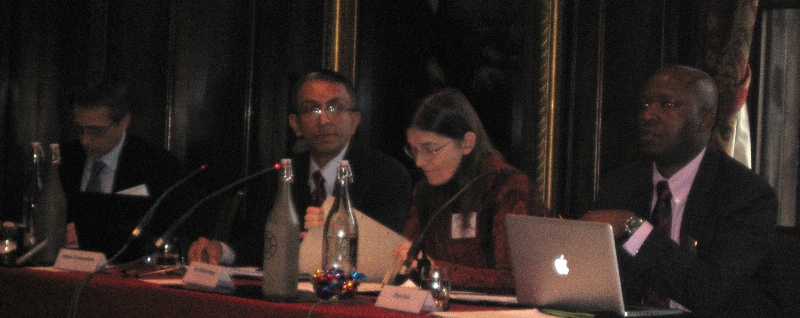
The workshop, organised by the UK Department for International Development (DFID) and the Australian Government Aid Programme (AusAid), brought together close to 100 research managers, science communicators and development donors from all regions of the world.
As always, I spoke from a practitioner’s perspective. Our panel was asked to discuss ‘different ways of making the links between research, policy and practice’. Each panel member was allowed 5 – 6 minutes of speaking time, with no PowerPoint or other visual aids.
I started off by flagging two fairly self-evident yet important points:
• Media is a PLURAL – there is no single recipe that works for all media because it is such a diverse sector!
• Media is only a SUB-SET of a wider process of communicating for social change.
Within this, there is always room for improvement! As a science journalist, I am a ‘critical cheerleader’ of researchers and their institutes. From that point of view, there are 3 elements that we need more of.
I call them A, B and C.
• A is for Access: Today, 24/7 news cycles dominate the media landscape. That means, more often than not, journalists need quick and easy access to researchers, and rapid (or ‘live’) responses to breaking stories. Ideally, journalists want to talk to the researchers themselves, and not PR people or administrators within research institutes or universities.
• B is for Bridges: To enable good access, we need strong and reliable links between researchers and the media. That can take many forms. They may be physical or virtual – including events, online platforms, and other activities. I see them as ‘Intersections’ where research, media and policy communities come together. These help share information, but also nurture trust –- that precious and rare virtue!
• C is for Credibility: We’ve already heard how critical this element is to all our work as researchers and journalists. Credibility is something hard to earn, easy to lose. We can’t buy it – but good, long-term investments in people can help consolidate it.
I argued that these A, B and C can certainly help improve connections between researchers and the media, and ultimately, with the wider public.
Ray Wijewardene on the set of 'Sri Lanka 2048' TV show, June 2008: Cautiously optimistic about the future...The small farmers, buffaloes and earthworms all over the world lost a true friend and spokesman this week when Lankan scientist Ray Wijewardene passed away.
Ray packed multiple interests and pursuits into his 86 years of life – including engineering, building and flying light aircraft, and Olympic-level competitive sailing. But he was happiest being a farmer and mechanic, and had strong opinions on the subject. He was vocal about misguided priorities in tropical farming his native Sri Lanka – and across the developing world.
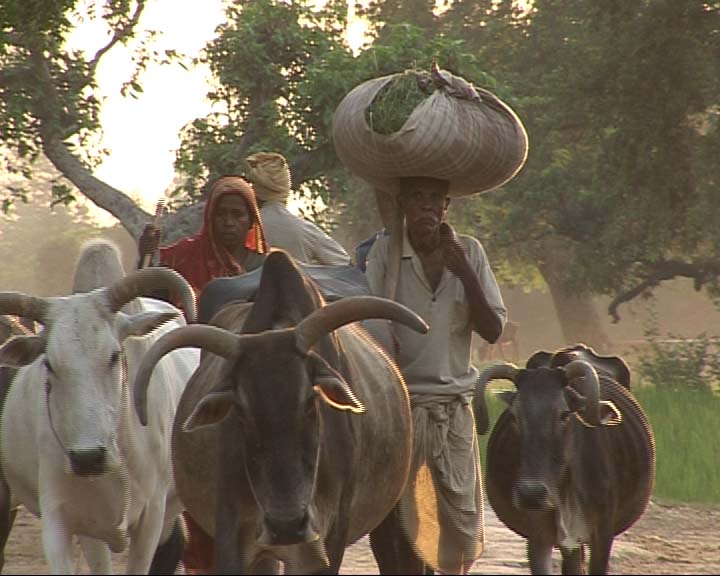
He was especially passionate when speaking about small farmers in the developing world, with whom he worked many years of his international career as an expert on tropical farming systems.
Educated at Cambridge and Harvard universities, and with impeccable technical credentials, he was no stranger to the ways of academia. But he remained a sceptic about the efficacy and benefits of agricultural research — on which hundreds of millions of development funding is invested every year.
The main problem with agricultural research, he used to say, is that those who engaged in such studies and experimentation didn’t have to rely on farming for their sustenance. There was not enough self interest. In contrast, the small farmer had to eke out a meagre existence from whatever land, water and seeds or livestock she had. In her case — and a majority of small farmers around the world today are indeed women — it’s a stark choice of innovate or perish.
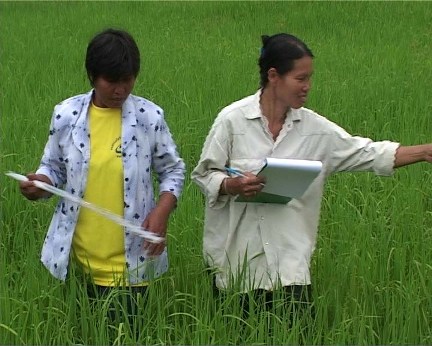
Thai researchers and farmers looking for field solutions (from Living Labs TV series)The heroic efforts of small farmers were rarely recognised by the rest of humanity who consume their produce — and the farmers themselves are too busy planting crops or raising animals to speak on their own behalf. This is where Ray Wijewardene came in: with his education, exposure and talent, he made an outstanding spokesman for small farmers all over the tropics.
In the 1960s, as the inventor and promoter of the world’s first two-wheeled (Land Master) tractor, Ray travelled all over Asia, Africa and Latin America working with tropical farmers.
For half a century, Ray has championed the lot of the small farmer at national, regional and global levels with UN agencies, academic and research groups, corporate sector and governments. But in later years, he questioned the wisdom of trying to mechanise tropical farming, and considered that phase of his career a ‘big mistake’. He dedicated the rest of his life to researching and promoting ecologically sustainable agriculture, on which he co-wrote an authoritative book in 1984.
Ray had the rare ability to ask piercing questions without antagonizing his audiences. He was an activist in the true sense of the word, but one whose opinions were well informed and grounded in reality, not rhetoric.
This comes through very powerfully in an extensive media interview I did with Ray in 1995, which I released online this week as a tribute to Ray — who has been my mentor and friend for almost 25 years.
At the outset, Ray points out where the Green Revolutionists went astray: “All along in the Green Revolution, its promoters focused on maximizing yields through massive inputs. But they forgot that what the farmer wants is to maximize profits, not necessarily yields!”
We then talked about the particular challenges faced in tropical farming, and the mismatch of temperate farming systems promoted widely in the tropics where climatic and soil conditions are different. One of Ray’s main concerns was agriculture’s profligate use of water – more for weed control than to meet the strict biological needs of crop plants themselves!
Ray, a grandmaster in summing up complex technical issues in colourful terms, said at the time: “Water is rapidly becoming the most expensive herbicide in the world — and freshwater is increasingly scarce!” [A decade later, I would go on to script and executive produce a global TV series called Living Labs on just this issue: how to grow more food with less water, or get more crop per drop.]
Ray wasn’t fundamentally opposed to external, chemical inputs to boost soil fertility but he advocated a mix of natural and synthetic options. In our interview, he asked: “We have multinational companies supporting — directly or indirectly — the extensive use of chemical fertilizers. But who supports cow-dung? Who extols the virtues of the humble earthworm?”
He then added: “For us in Asia, these elements are far more important. Indians have recognized this, but we still haven’t. As long as our agricultural scientists are trained in the western mould of high external input agriculture, this (mindset) won’t change. Cow-dung and earthworms won’t stand a chance – until some western academic suddenly ‘re-discovers’ them…“
It was Indian science writer and environmentalist Anil Agarwal who asked me, sometime in mid 1995, to interview Ray for Down to Earth, the science and environmental fortnightly magazine published by his Centre for Science and Environment. As Anil told me, “In Ray, you have not only one of the topmost agricultural experts in the developing world but one of its most original thinkers.”
By this time, I’d known Ray for almost a decade, and been exposed to several of his multiple facets. But each encounter with Ray was enriching for me, so I immediately seized the opportunity. The usually media-shy Ray already knew of and respected Anil, which helped.
Down to Earth is part of Anil Agarwal's legacyThe interview was audio taped over two long sessions, and I remember spending many hours transcribing it. I had to check some references with Ray, who cooperated wonderfully. I’ve been trained to observe the word limit set by editors, but in this instance, I sent in the full length Q&A, for it was so interesting. Down to Earth issue for 31 October 1995 carried a compact version, skillfully distilling the essence of that long exchange between Ray and myself — one of the most memorable interviews among hundreds I’ve done during 25 years of work in print and broadcast media.
How I wish the exchange was also preserved on audio tape! Indeed, it’s a small miracle that the original transcript survived for 15 years. The soft copy was lost in a hard drive crash of 1998, but fortunately I’d taken a full print-out. I’m grateful to a former colleague, Buddhini Ekanayake, for retyping the entire interview in mid 2008 when I considered releasing it in the wake of the global food crisis. That somehow didn’t work out, but the soft copy was ready at hand for me to rush to the editor of Groundviews on the day of Ray’s funeral. All I added was a new, 500-word introduction which tried to sum up the Ray Wijewardene phenomenon.

 Open Minds!