And now, Al Jazeera get on You Tube

YouTube seems to be everywhere!

Last week in Sydney and this week in Melbourne, journalists and media researchers can’t talk enough about You Tube — though not everyone is equally enthusiastic about the online video sharing platform.

This just in, from MediaChannel.org:

Al Jazeera English goes You Tube

The Doha-based broadcaster Al Jazeera (English) will launch a YouTube branded Channel, the company said today. YouTube users worldwide will have the ability to comment on Al Jazeera English clips, rate them, recommend them to friends and post their own video responses to communicate with other viewers.

Content will include segments from shows such as ‘Frost over the World’, ‘Everywoman’, ‘Inside Iraq’, ‘Inside Story’, ‘Listening Post’, ‘Riz Khan’, ‘One-on-One’, ‘The Fabulous Picture Show’, ‘Witness’ and ‘48′. Al Jazeera English is also planning to release some exclusive web-only programming, starting with ‘Poltical Bytes’, a global conversation hosted by UN correspondent Mark Seddon which will ask the YouTube community to carry on the conversation and add video contributions. The broadcaster said it will provide new content to the site by adding at least 10-15 new clips each week.

Nigel Parsons, Managing Director of Al Jazeera English said: “We believe that YouTube is a perfect platform to reach out to our audience and to give wide and easy access to new viewers around the world. We have significantly built on our distribution since launch and now reach well in access of 90 million cable and satellite households worldwide. With YouTube’s community of millions of online users this is set to dramatically increase.”

SOS: Save Our Spectrum for media freedom

I’m strongly committed to promoting media freedom, but have never been the placard-carrying, slogan-shouting type. Street activism is necessary — but not sufficient.

I’ve been more interested in studying trends and conditions, trying to anticipate what the next big threats, challenges and opportunities are, and how best we can respond to them.

For years, I’ve been writing and talking about the need for proper spectrum management as a pre-condition for media freedom and media pluralism. Last week, I once again spoke about these core issues at OUR Media 6 Conference in Sydney.

I’ve just adapted my Sydney panel remarks into an op ed essay, just published by the UK-anchored media website, Media Helping Media.

Here are the first few paras:

On May 3, the annual World Press Freedom Day will once again be observed worldwide, focusing public attention on a multitude of threats to freedom of expression through the mass media.

But amidst the extremely relevant and necessary slogans, we are unlikely to hear this one: Hands off our spectrum!

Yet saving our spectrum is critical for ensuring media freedom.

The electro-magnetic spectrum has been called the ‘invisible wealth of nations’ — conventional broadcasting relies on the fair, equitable and sound management of this common property resource.

And as economic and cultural practices move more and more into the digital realm, the spectrum’s value is only set to increase.

But few people -– even within the media profession and industry -– appreciate our dependence on this finite resource. Out of sight does seem to push it out of most people’s minds.

Therein lurks a danger: what we don’t see and value can be quietly taken away, without many of us realizing it.

Read full article and leave your comments

Added on April 18: MediaChannel.org anchored in the US has also just re-published the article. Read their version here

Added on April 19: Free Press.Net has also reproduced the article.

Added on April 20: FreePress.Net in the US reproduces the essay

Added on April 21: Bytes4All South Asian ICT wevsite reproduces my essay

Added on April 21: Reclaim the Media website also publishes the article
Thanks to everyone who considered it worth amplifying to their audiences — we need to spread the word! – Nalaka

John Pilger: Being a journalist is a privilege

Towards the end of our week’s stay in Sydney for OUR Media 6 Conference, the organisers gifted us copies of The Australian Photojournalist, which is the journal of the Australian Photojournalists’ Association.

The June 2006 issue I received is a handsome volume and makes fascinating reading. On the inside front cover, I came across these words by John Pilger, the courageous and outspoken Australian journalist and film-maker hailing from Sydney.

John Pilger

“The best journalism is about looking behind facades and pretensions. It is never accepting the status quo; it is always questioning and remaining sceptical of the pronouncements and actions of those in authority, especially authority that is not accountable.

“The best journalism is following the dictum, wry but true: Never believe anything until it is officially denied. It is seeing the world from ground up, where ordinary people are, not from the top down, where the powerful reside. In many respects, the best journalists are the agents of ordinary people, not of those who preside over them.

“By looking at the world this way, from the standpoint of humanity not its would-be controllers, journalists will find themselves closer to the truth about all manner of things than they will ever be, following the manuals of establishment thinking.

“And by journalists, I mean photographers, too. The finest photographers produce images that ought to achieve mor than a gut reaction but help us make sense of events, great and small.

“Speaking personally, being a journalist is a privilege.”

Indeed. And few people bear that title with greater responsibility and passion than John Pilger.

I had the privilege of listening to John Pilger early on in my career, during one of the first international media conferences I attended in Sweden in the late 1980s. Of the three dozen speakers who spoke there, the only ones who have withstood the gradual erosion of memory are Pilger and Norwegian academic Johan Galtung.

Years later, I read Pilger’s book The New Rulers of the World — which was also the title of 2002 documentary film he wrote, produced and presented on the consequences of globalisation, taking Indonesia as the primary example of the serious problems with the new globalization.

And thank heavens, he shows no signs of slowing down — or mellowing.

The War on Democracy is John Pilger’s first major film for the cinema. Set in Latin America and the US, it explores the historic and current relationship of Washington with countries such as Venezuela, Bolivia and Chile. Two years in the making, The War on Democracy is due to be released in cinemas in the UK on 15 June 2007.

He has produced more than 55 TV documentaries. Links to two of his more recent ones available online:

Breaking the Silence: Truth and Justice in the War on Terror (2004) on Google Video (51 mins)

Stealing a Nation (2004) on Google Video

Noam Chomsky on John Pilger

Images courtesy www.johnpilger.com

Say MDG and smile, will ya?

There we go again!

I have just done another post on Millennium Development Goals (MDGs), pleading that the core issues they promote be given due prominence than simple brand promotion for MDGs and their promoters-cum-custodians (the UN).

For my readers outside the charmed development circles, MDGs are an international blueprint for human development, with eight major goals to be achieved by 2015. These goals are the means of implementing the Millennium Declaration — to which 189 governments committed at the UN Millennium Summit held in 2000.

One way to ensure the governments will keep their promise is to turn media spotlight on them. Journalists and media managers have a key role to play in this process.

With this in mind, our friends at the Asia Pacific Institute for Broadcasting Development (AIBD) have launched the Asia Pacific MDG Media Awards to ‘recognise and honour the best media reporting on the MDGs’. They have the backing of two UN agencies (UNDP and UNESCAP) and the Asian Development Bank. The deadline for applications is 15 April 2007.


See TVE Asia Pacific news item on Asia Pacific MDG Media Awards

All this is well and good — except that the rules of the award scheme are a bit self-limiting. There’s one that I’ve only just noticed: “Reference to the MDGs (whether one or all MDG Goals) in your content is mandatory.”

This places wrong emphasis on MDG branding when it should be on the actual issues. MDGs are not another slogan for spin doctors at UN agencies to play around with for a few years until the next development fad comes along.

MDGs are about human dignity and social justice to the half of humanity that currently lives in poverty, squalor and deprivation. It is these real world people who lose their babies to preventable childhood diseases; drop out of school because they cannot afford to stay on; die needlessly in their millions during pregnancy or childbirth; or go to bed hungry every night.

In that bigger scheme of things, it doesn’t really matter whether justice is delivered through strategies, programmes and projects labelled ABC, XYZ, MDG or something else.

Besides, MDGs are a means to an end. The process is important, but branding is not, on that journey.

Half way along the way — to the agreed target of 2015 — an informed and motivated media can help countries and development players to remain focused.

By all means, reward good journalistic coverage of development and social justice issues underscored by the MDGs. But please, let’s not turn this into another round of simple publicity and self-promotion for UN agencies.

Related:

MDG Asia Pacific website

AIBD documents on Asia Pacific MDG Media Awards

Michael Crichton, Mediasaurus and end of broadcasting

I just wrote a post on digital pioneer and futurist Mark Pesce’s views on the end of broadcasting and the mass media as we know it.

Television broadcasting is probably a dinosaur facing extinction, but let’s remember a bit of pre-history here: dinosaurs didn’t die off in an instant. No time lord zapped them with some mighty extincter machine. Their decline and eventual extinction was, it is believed, a slow and gradual process.

So it will be with broadcasting. Even if their distribution and revenue models are now undermined and will soon be obsolete, conventional broadcasting (as we know it) will continue to operate and try to compete, at least for a few years. And in the less developed countries with emerging economies, that process will take longer.

Which means we still have to engage TV broadcasters even as their Empires of Eyeball slowly crumble.

And let’s not write off those Empires just yet. I still remember an article in the early days of Wired magazine: appearing in Sep-Oct 1993 issue, it was titled Mediasaurus , and written by the well known science fiction author (and medical doctor) Michael Crichton (of Jurassic Park and ER fame).

Michael Crichton, courtesy Michael Crichton website

He started the article as:
I am the author of a novel about dinosaurs, a novel about US-Japanese trade relations, and a forthcoming novel about sexual harassment – what some people have called my dinosaur trilogy. But I want to focus on another dinosaur, one that may be on the road to extinction. I am referring to the American media. And I use the term extinction literally. To my mind, it is likely that what we now understand as the mass media will be gone within ten years. Vanished, without a trace.

And he ended:
So I hope that this era of polarized, junk-food journalism will soon come to an end. For too long the media have accepted the immortal advice of Yogi Berra, who said: “When you come to a fork in the road, take it.” But business as usual no longer serves the audience. And although technology will soon precipitate enormous changes in the media, we face a more immediate problem: a period of major social change. We are going to need a sensitive, informed, and responsive media to accomplish those changes. And that’s the way it is.

I just re-read the full article, and Crichton’s analysis is even more valid today than when it was written over a dozen years ago. But it’s also true that the broadcast industry – and conventional media as a whole – have changed and adapted.

No doubt that Mediasaurus still has an expiry date, but it’s not easy trying to guess exactly when the last of their kind drops dead.

Read the full article on Wired Online

Mark Pesce: In the company of a hypermind

Oops – I didn’t immediately realise that I was sharing a panel with a digerati – a highly accomplished pioneer and visionary of the digital world. And did he get us to think outside the idiot box!

His name is Mark Pesce. He is one of the early pioneers in Virtual Reality.
The co-inventor of VRML, he is the author of five books and numerous papers on the future of technology. Now based on Sydney, Australia, he is a writer, researcher and teacher.

Mark Pesce, courtesy Wikipedia

During the OUR Media 6 panel discussing how to safeguard community interests in the era of digital broadcasting, he was emphatic that broadcasting as we know it is doomed.

“The mass mind is not going to last. The sooner broadcasters recognise this, the better,” he said.

The broadcast model of one-way, point-to-multipoint, passive distribution of content is endangered by the digital revolution. The age of hyperdistribution has already dawned, and that is going to wipe out conventional distribution models sooner than later.

Hyperdistribution is audience-driven distribution of films and television programmes. The economics of production and distribution of media have changed radically – can film-makers adapt to the new rules? This is the question that Mark posed in talk given at the Sydney International Film Festival in Jube 2006 – listen to audio recording of his talk.

The near future of content distribution is in Internet-enabled, user-driven and often mobile devices. Already, two billion people – almost a third of humanity – walks around with mobile phones. These will provide new pathways to peddle new types of content to more audiences than ever before.

The film-making and TV-producing communities need to wake up to these new realities, Mark said.

His blog, Hyperpeople, is full of fascinating insights and extrapolations. Here’s one short extract:
Television producers are about to learn the same lessons that film studios and the recording industry learned before them: what the audience wants, it gets. Take your clips off of YouTube, and watch as someone else – quite illegally – creates another hyperdistribution system for them. Attack that system, and watch as it fades into invisibility. Those attacks will force it to evolve into ever-more-undetectable forms. That’s the lesson of music-sharing site Napster, and the lesson of torrent-sharing site Supernova. When you attack the hyperdistribution system, you always make the problem worse.

In May 2005, he wrote in an article titled Piracy is good? How Battlestar Galactica killed broadcast TV:
Television broadcasters owe their existence to the absence of substantially effective competition. When you’re dealing with real-world materials that are in naturally short supply – whether diamonds, oil, or broadcasting spectrum — a cartel can maintain and enforce its oligopoly. But when you’re working with media, which exist today as digital ephemera, bits that can be copied and reproduced endlessly at nearly zero cost, broadcast oligopolies are susceptible to a form of “digital arbitrage,” which can hollow-out their empires in an afternoon. Hyperdistribution techniques are more efficient than broadcast networks for television program distribution.

Read my other post on the OUR Media Forum on the community use of digital spectrum

Mark Pesce website

Mark Pesce blog, Hyperpeople

Let’s resolve analog anomalies before going fully digital…

At the last minute, I was invited to join a forum on Community use of digital spectrum at OUR Media 6 Conference here in Sydney.

I agreed because I have written and spoken for years about how we in developing Asia are blissfully ignorant about the gross misuse and abuse of our electro-magnetic spectrum by its custodians – our governments.

I was the odd one out on this panel, as all others were from Australia -– I don’t even live in a country that has set a timeframe for transition from analog to digital spectrum in broadcasting.

Only a few countries in Asia have as yet announced a timeframe for this -– Japan, Korea and Malaysia among them. Some have not even thought of this issue – they are dealing with more basic concerns in broadcast regulation and policy formulation. Yet I found this discussion instructive: sooner or later, all countries will have to go through this transition. It certainly helps to know the issues you are debating and grappling with.

Cartoon Stock

An extract from my remarks:

We should address fundamental reforms in broadcast policy, law and regulation before embarking on the high-cost, tedious and slow process of moving the entire production and distribution process to digital. We who haven’t derived and shared the full benefits of analog broadcasting must get our fundamentals right before going digital.

And therein lies the challenge for all of us who want to safeguard media freedom and promote the freedom of expression and cultural production. In my view, many activists in our region are not paying enough attention to how the electro-magnetic spectrum has been mismanaged and abused by various governments. Activist attention has been held by the more tangible, physical threats to media freedom: issues such as censorship, media ownership and political economy of the media.

All these are worthwhile and necessary — but not sufficient on their own.

During discussion, I also made the points:

The spectrum has been called the ‘invisible wealth of nations’. As economic and cultural practices move more and more into the digital realm, we’re going to increasingly feel the value of this common property resource. All our gains in the physical world would be undermined if we find the spectrum has been irretrievably allocated to a handful of privileged users ignoring the public interest. We need to wake up to this reality.

Perhaps it’s just as well we in developing Asia don’t have tight timeframes to switch from analog to digital spectrum use. We’ve got a good deal of cleaning up and streamlining to do in the analog realm.

This window will be open only for a few years. If we don’t act, we run the risk of making an equal mess in the digital spectrum, only far worse.

In terms of action, I suggest three simple yet important steps:

For us in the developing countries – or emerging economies – in Asia, I suggest three actions:
• Look forward to the transition from analog to digital spectrum
• Look sideways to see how we’re currently doing in the analog domain
• Look back to reflect on the mistakes we’ve made along the way (and learn)

Read the cleaned up text of my panel remarks plus responses
om6-forum-on-digital-spectrum-nalaka-remarks.pdf

Wikipedia on Open Spectrum

Copyright, copyleft and film-makers in the digital age

In my post on 1 April, Have you made your million dollars yet?, I wrote:

Many development film-makers like to decry our society’s obsession with money, consumerism and greed. Some would make films that passionately promote sharing ideas and resources at community level, and advocate common property resources over private ownership.

But when it comes to rights of their own film/s, these very film-makers would become extremely possessive: they want to restrict it in every conceivable way.

This came up during a session at the OUR Media 6 conference in Sydney yesterday.

Andrew Lowenthal, from EngageMedia in Australia, talked on ‘Online video for social action’ and presented what his non-profit organisation is doing.

As their website says:
EngageMedia is a website and a network for distributing social justice and environmental video from South East Asia, Australia and the Pacific. It is a space for critical documentary, fiction, artistic and experimental works that challenge the one-way communication model of the mainstream media.

Andrew said they currently host around 120 videos online, all offered for free public access at the moment. They are keen to add more titles to this collection, to build an online, engaged community of film makers and film viewers.

But as we discussed, many film makers aren’t yet ready or willing to give their films to be placed online.

“Some of them freak out at the very mention of being placed online. They ask how their copyright can be safeguarded, and how they can make money,” Andrew noted.

Fred Noronha, who has campaigned for a long time for Indian documentary makers to open up and share their films, agreed. “Many film-makers are apprehensive. They aren’t broadcasting, or webcasting their productions. They just show it at a few film festivals. Many films don’t go out to the wider public.”

At TVE Asia Pacific, we come across this all the time. As a non-commercial, non-exclusive distributor, we ask film-makers to share distribution rights while copyright stays firmly with them. Even then, many are not convinced.

Of course, each creative professional is entitled to the full returns of their investment of time, effort and creativity. But let’s not forget: many films, especially those on development issues (which covers health, education, environment, ICT, science in development and human rights, among others), are made with development funding or philanthropic grants. Which means the production costs are largely or entirely paid for.

Yet when such films are made, their creators would rather hang on to them than let them go. Copyright is one concern they cite. ‘Returns on investment’ is another. (Hmmm…if a film has been paid for by public/donor funds, returns to whom?)

Creative Commons offers a good way forward, and we had a presentation from CC Australia on this during the session. More about that later.

Go to:
Engage Media
Creative Commons

Moving images moving heart first, mind next

“Film is a lousy medium to communicate information. It works best at the emotional level.”

Bruce Moir, one of Australia’s seniormost film professionals made this remark soon after I had presented TVE Asia Pacific’s Children of Tsunami experience to OUR Media 6 conference in Sydney last afternoon.

After more than 35 years in documentary and feature film production for both cinematic and broadcast industries, in different parts of the English speaking world, Bruce knows a thing or two about moving people with moving images.

I was delighted and privileged to have Bruce join my presentation. He’d come at my invitation to the conference happening in his city.

“We’ve got to remember that film appeals to people’s hearts more than their minds,” Bruce explained. “The way to people’s heads is through their hearts, from the chest upwards — and not the other way round.”

I hope this was an ‘Aha!’ moment to at least some in our audience. I’ve personally heard Bruce say this before, but it bears repetition – because many film professionals tend to overlook this. Especially those who are trying to ‘communicate messages’.

Even a few weeks ago, I quoted him in a review as saying: “Our fundamental job is to tell a story – one that holds an audience’s interest and moves their heart, regardless of language, cultural context or subject….I have always believed that film achieves its optimal impact by aiming to ‘get at the audience’s head via their heart’ rather than the other way around.”

Bruce Moir

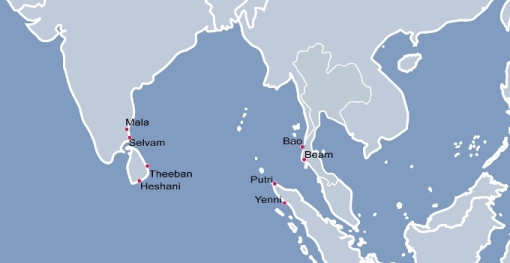
Without Bruce’s involvement, Children of Tsunami would have turned out to be very different. He was our Supervising Producer for the entire effort, advising and guiding our national film production teams tracking the progress of Tsunami survivor families in India, Indonesia, Sri Lanka and Thailand for one year afer the Asian Tsunami.

As Bruce recalled, the four teams came with different backgrounds, skill levels and film-making traditions of their own – ranging from television news and current affairs to development film-making, the type usually commissioned by UN agencies. Bringing them to be ‘on the same page’ was no easy task.

Film-makers are not particularly known for their patience or people-skills. Many I know have a ‘just-get-on-with-it-never-mind-the-niceties’ attitude. Bruce is one of the most patient persons I know: he would spend days and weeks relating to our production teams – usually by email or phone – gently nudging them in certain directions.

For sure, there’s no one right way to make a film. But there are some tried and tested principles in good story telling, which is what Bruce excels in. And which he willingly shares with others.

The year-long, 4-country and 8-location Children of Tsunami project was the biggest logistical operation TVE Asia Pacific has mounted in its 11 years of existence. (We’re in no great hurry to top that one!). Our production teams – operating from Bangkok, Colombo, Ubud (Indonesia) and Chennai – related to our regional production team based in two cities: Colombo, where TVEAP office is currently anchored, and Sydney, where Bruce lives.

We only came together face to face just once, in Bangkok, early on in the process. That meeting agreed on styles and formats, and also helped build the human relationships.

The rest of the time it was all through communications technologies. As you can imagine, lots of tapes moved around, as did many Gigabytes of video over the web. (DHL should have become a sponsor – they had lots of business from us!)

children-of-tsunami-locations.jpg

As I explained in my talk, Children of Tsunami was not just a film project. We published a monthly video report online on each of the eight families we were tracking, plus maintained a dedicated website with growing volumes of text, images and links. The monthly videos were edited and post-produced in the countries of filming, by our production teams themselves. It was distributed film-making, even if everyone worked to a common format.

With all that frenzy now behind us, the products of Children of Tsunami continue to be distributed, showcased and discussed at film festivals and conferences like OUR Media.

As I said yesterday to my predominantly academic audience: we’ve got a story telling and journalistic practice, and we now need a theory for it.

Related links:

Children of Tsunami: Documenting Asia’s longest year

Children of Tsunami revisited two years later

The BBC as a Fossil Fool?

The BBC is running a Climate Season once again. Like many arms of the media, they have jumped the climate change bandwagon.

And that’s a good thing.

BBC World’s blurb reads:
As part of BBC World’s extensive coverage of one of the key challenges facing humanity, the Climate Watch season throughout April will feature a host of special documentaries and factual programmes plus news and
business reports from its global correspondents.

This is only to be applauded. But it wasn’t too ago that the BBC – with other sections of the mainstream media – was still insisting on “balancing” its coverage of climate change.

Even a couple of years ago, the BBC appeared to be incapable of running an item on the subject without inviting a skeptic to comment on it.

Of course, the BBC is entitled to change its mind like everyone else. (As a certain Boutros Boutros-Gali once famously remarked, only fools don’t change their mind.)

George Monbiot wrote a column in The Guardian (UK) on 27 April 2004 commenting on this. It was titled: “Beware the Fossil Fools: The Dismissal of Climate Change by Journalistic Nincompoops is a Danger to us All”.

Here’s an extract from that article, published less than 1,000 days ago:

Picture a situation in which most of the media, despite the overwhelming weight of medical opinion, refused to accept that there was a connection between smoking and lung cancer. Imagine that every time new evidence emerged, they asked someone with no medical qualifications to write a piece dismissing the evidence and claiming that there was no consensus on the issue.

Imagine that the BBC, in the interests of “debate”, wheeled out one of the tiny number of scientists who says that smoking and cancer aren’t linked, or that giving up isn’t worth the trouble, every time the issue of cancer was raised.

Imagine that, as a result, next to nothing was done about the problem, to the delight of the tobacco industry and the detriment of millions of smokers. We would surely describe the newspapers and the BBC as grossly irresponsible.

Now stop imagining it, and take a look at what’s happening. The issue is not smoking, but climate change. The scientific consensus is just as robust, the misreporting just as widespread, the consequences even graver.

Monbiot ended the article by asking:

But isn’t it time that the BBC stopped behaving like the public relations arm of the fossil fuel lobby?

How times have changed! But hey, better late than never…

Related:

Monbiot.com
World’s richest environmental prize goes to the BBC