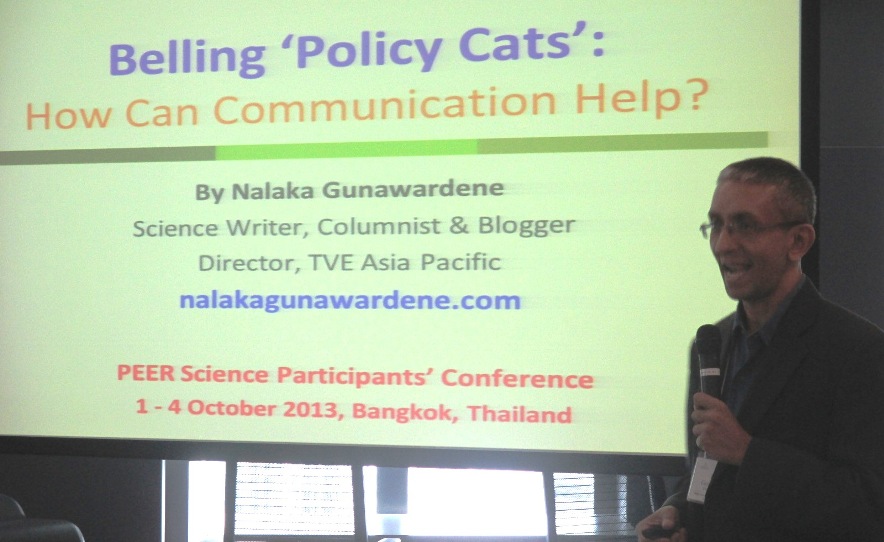
Nalaka Gunawardene speaks at PEER Science Conference 2013 in Bangkok, 3 Oct 2013
How to ‘Bell’ the policy ‘cats’?
This question is often asked by researchers and activists who would like to influence various public policies. Everyone is looking for strategies and engagement methods.
The truth is, there is no one sure-fire way — it’s highly situation specific. Policy makers come in many forms and types, and gaining their attention depends on many variables such as a country’s political system, governance processes, level of bureaucracy and also timing.
Perfecting the finest ‘bells’ and coming across the most amiable and receptive ‘cats’ is an ideal rarely achieved. The rest of the time we have to improvise — and hope for the best.
Good research, credible analysis and their sound communication certainly increase chances of policy engagement and eventual influence.
How Can Communications Help in this process? This was the aspect I explored briefly in a presentation to the PEER Science Participants’ Conference 2013 held in Bangkok, Thailand, from 1 to 4 Oct 2013.
It brought together over 40 principal investigators and other senior researchers from over a dozen Asian countries who are participating in Partnerships for Enhanced Engagement in Research (PEER) Science program. PEER Science is a grant program implemented by the (US) National Academies of Science on behalf of the U.S. Agency for International Development (USAID) and in cooperation with the National Science Foundation (NSF).
I flagged some key findings of a global study by SciDev.Net (where I am an honorary trustee) which looked at the different contextual settings within which policymakers, the private sector, NGOs, media organisations and the research community operate to better understand how to mainstream more science and technology evidence for development and poverty reduction purposes.
I like show and tell. To illustrate many formats and approaches available, I shared some of my work with LIRNEasia and IWMI, two internationally active research organisations for which I have produced several short videos (through TVE Asia Pacific) communicating their research findings and policy recommendations.
I don’t believe in ghosts and spirits, but I’m interested in how such notions shape people’s behaviour. As literacy and education levels rise, I notice how old demons are being replaced by new, more potent ones.
With modernisation, fewer Lankans uncritically accept Maha Sona, Mohinee and Riri Yaka that dominated the psychological landscape for generations. In their place, a new set of modern-day demons have emerged.
These ‘demons’ come in many shapes and forms. They include various half truths, misconceptions, fallacies, myths and conspiracy theories. Playing on an insular and insecure national psyche, these elements seem to have multiplied…
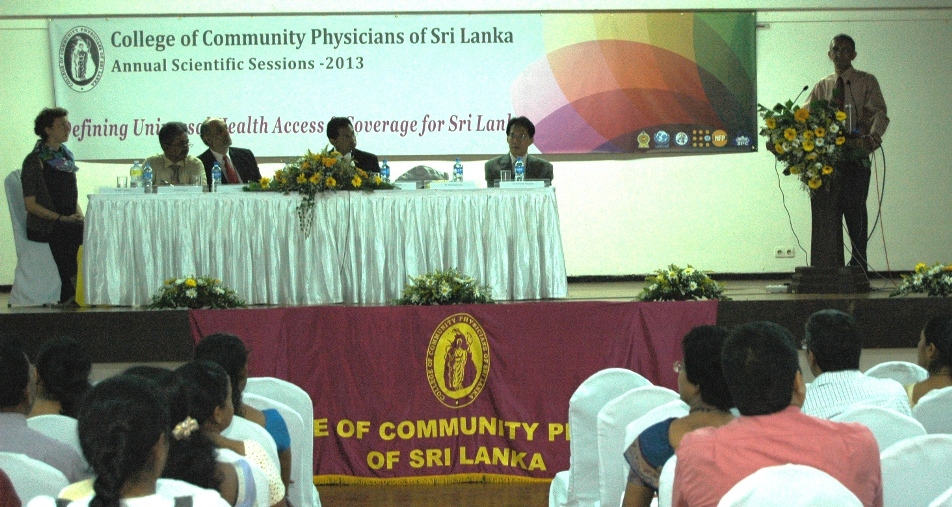
In this week’s Ravaya column (in Sinhala), I explore the nexus between public perceptions and public health – a topic I discussed in a recent talk to the College of Community Physicians Sri Lanka held in Colombo on 23 – 24 September 2013.
Nalaka Gunawardene speaks at Annual Scientific Sessions of College of Community Physicians Sri Lanka, 24 Sep 2013 Colombo – Photo by Janaka Sri Jayalath


 Open Minds!