October 8 is the International Day for Disaster Reduction. The United Nations system observes the day ‘to raise the profile of disaster risk reduction, and encourage every citizen and government to take part in building more resilient communities and nations’.
Disaster risk reduction (abbreviated as DRR) is the common term for many and varied techniques that focus on preventing or minimising the effects of disasters. DRR measures either seek to reduce the likelihood of a disaster occurring, or strengthen the people’s ability to respond to it.
DRR is not just another lofty piece of developmentspeak. Unlike many other development measures that are full of cold statistics and/or hot air, this one directly (and quietly) saves lives, jobs and properties.
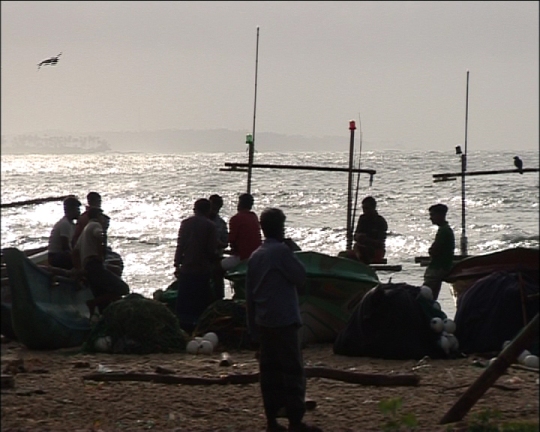
And it gives people peace of mind – we can’t put a value on that. That was the point I made in a blog post written in December 2007, on the third anniversary of the Indian Ocean Tsunami. Taking the personal example of J A Malani, an ordinary Sri Lankan woman living in Hambantota, on the island’s southern coast, I talked about how she has found peace of mind from a DRR initiative.
Recently, IDRC’s inhouse series ‘Research that Matters’ has published an article about the project. Titled “For Easy Sleep Along the Shore: Making Hazard Warnings More Effective” its blurb reads: “In Sri Lanka, a grassroots pilot study combines advanced communication technologies with local volunteer networks to alert coastal villages to danger coming from the sea.”
TVE Asia Pacific also made a short video film in late 2007. Called The Long Last Mile, it can be viewed on YouTube in two parts:
The Long Last Mile, part 1 of 2:
The Long Last Mile, part 2 of 2:
The recent IDRC article ends with this para: “A related challenge concerns the shortness of any society’s attention span. In the absence of frequent crises and alerts, how can a nation — or even a village — sustain the continuing levels of preparedness essential to ensure that, when the next big wave comes rolling in and the sirens sound, its people will have the motivation and the capacity to act? The follow-up project seeks to address this worry by preparing the hotels and villages to respond to different types of hazards, rather than only to the relatively rare tsunamis.”
I asked this question when addressing a group of television journalists and film-makers from the Asia Pacific last week. I was making introductory remarks to an Asia Pacific Workshop and Open Film Screening on ‘Changing Climate and Moving Pictures‘ held on 3 – 4 October 2008 in Tokyo, Japan. It was organised by TVE Japan in collaboration with TVE Asia Pacific, and supported by the Japan Fund for Global Environment.
I acknowledged that climate change was not just another environmental issue or even the latest planetary scare. “This time we’re in deep trouble – and still finding out how deep,” I said.
Climate change has brought into sharp focus the crisis in:
• how we grow economically;
• how we share natural resources and energy; and
• how we relate to each other in different parts of the world.
In that sense, I noted, climate change is acting like a prism — helping to split our worldly experience into individual issues, concerns and problems that combine to create it. Just like an ordinary prism splits sunlight into the seven colours (of the rainbow) that it’s made of.
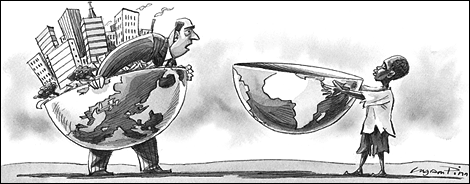
“Climate shows up the enormous development disparities within our individual societies and also between them. When this happens, we realise that climate is not just a scientific or environmental problem, but one that also has social, political, security, ethical and human rights dimensions,” I added.
Climate change in an uneven world
I then outlined some parallels between the current climate crisis and the HIV/AIDS pandemic that emerged some 25 years ago.
Consider these similarities:
• When HIV was first detected, it was considered a medical issue affecting specific sections of society.
• It took years for the wider societal, development and human rights aspects of HIV to be understood and then accepted.
• Some countries and cultures wasted precious years in HIV denial; a few are still in this mode.
• It took overwhelming impact evidence and mounting pressure from affected persons for states and international community to respond.
• Then…everybody jumped the bandwagon and HIV became a fundable, profitable enterprise.
And it’s not just NGOs who are riding the HIV gravy train. The United Nations programme for AIDS, or UNAIDS, created by the UN system in response to the global crisis, has evolved into a behemoth whose efficacy and relevance are now being widely questioned.
UNAIDS “is obsolete and an obstacle to improving healthcare in developing countries” claims Roger England, an international health expert. Writing in the British Medical Journal in May 2008, England pointed out that HIV causes 3.7 per cent of mortality and kills fewer people than pneumonia or diabetes, yet it received 25 per cent of all international healthcare aid and a big chunk of domestic expenditure. This has resulted in wasting vast sums of funding on esoteric disciplines instead of beefing up public health capacity. Despite this criticism, UNAIDS is calling for huge increases in its funding — from its current US$9 billion to US$54 billion by 2015.
All this makes me wonder: is climate the new HIV of our times? This is the question I raised in Tokyo.
I added: “If so, I sincerely hope it does not evolve in the same manner that HIV crisis did. There are worrying signs that the drive towards a low carbon economy is being exploited by various groups – including some in civil society – for self gain.”
Certain development agencies and ‘think tanks’ are clearly exploiting climate change to make money. Suddenly, everybody is ‘climate-proofing’ their activities — meaning they are talking about climate change no matter what they do, whether it is teacher training or micro-credit.
In the run up to the Bali climate conference in late 2007, I wrote a blog post titled ‘Beware of bad weather friends’ about a London-based NGO engaging in some media training on climate issues, but deriving its legitimacy from a dubious survey. This post apparently irked the party concerned a great deal.
In Tokyo, a workshop participant confirmed that this was already happening in his country.
“Every crisis today is being turned into a business opportunity – and not just by the corporate sector,” said Pradip Saha, associate director of the Centre for Science and Environment in India.
He added: “Consultancy companies and some NGOs have realised there is big money to be made in climate related areas like carbon offsets and the Clean Development Mechanism. They are already riding the climate bandwagon!”.
My regular readers know the disdain with which I hold the so-called public broadcasters in my part of the world. In developing Asia, which lacks sufficient checks and balances to ensure independence of state broadcasters, the only thing ‘public’ about such channels is that they are often a drain on public money collected through taxes. Their service and loyalties are entirely to whichever political party, coalition or military dictator heading the government in office. A few months ago, I described Burmese TV as a good example.
I was delighted, therefore, to visit the headquarters of Japan’s sole public broadcaster NHK this week and find out how exceptional they are in being a public broadcaster that really cares for its funding and viewing public.
Nippon Hōsō Kyōkai has always identified itself to its audiences by the English pronunciation of its initials, NHK. Started as a radio service in 1926, it added television in 1953. Today, NHK runs two terrestrial TV channels, three satellite channels and three radio services – and has started offering more content online and for mobile devices as well. It also has international offerings in TV, radio and web through NHK World.
This massive broadcast operation is financed primarily by a license fee (called ‘receiving fee’ in Japan) paid by each Japanese household that owns a television set. Its TV channels don’t carry any advertising, although the corporation exploits its massive archive and often repurposes its products for commercial gain.
As NHK’s website says, “This (license) system enables the Corporation to maintain independence from any governmental and private organisation, and ensures that the opinions of viewers and listeners are assigned top priority.”
NHK’s license fee system is not unanimously endorsed by the Japanese public, and I later found out that growing numbers of households are declining to pay what currently works out to around US$30 per month (or a dollar a day). This debate has been sustained for several years, with public calls for administrative reform at NHK.
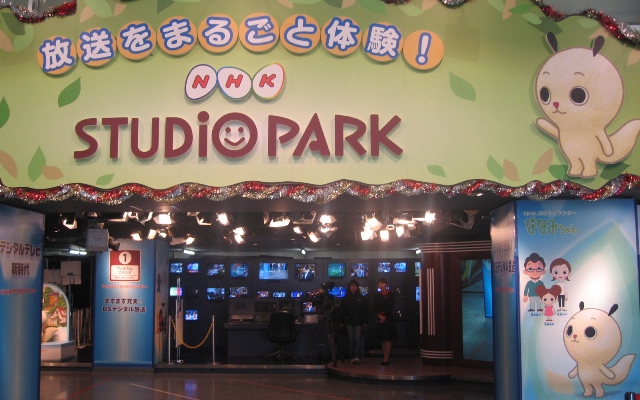
NHK Studio Park entrance
But NHK’s eagerness to engage the public is clearly evident, even to a visitor like myself who spent only an afternoon at NHK’s Studio Park in Shibuya. This is where the corporation’s production facilities are opened to the public every week day from 10 am to 5.30 pm.
NHK Studio Park is a living exhibit – the corporation’s executives and technical staff carry on with their real work amidst (mostly Japanese public) visitors who get to see how TV content is made. Part of the attraction is a museum of TV 55 years of TV broadcasting in Japan.
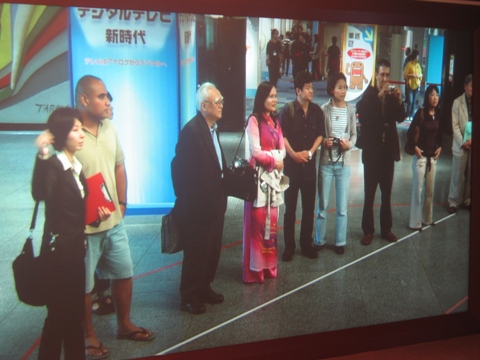
Welcome to NHK: You're in our bigger picture!
Every visitor is welcomed by being captured by a TV camera with the image being projected live on to a giant screen at the reception. The camera zoomed in on each one in our tour party of ten – and gave us our 10 seconds of fame!
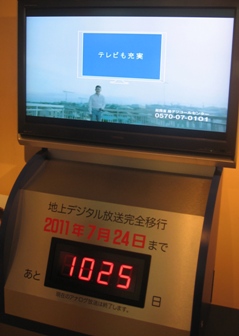
From then on, it offers various displays and interactive opportunities to find out how TV broadcasting has evolved, where it is today – and glimpses of where it is headed. NHK has been an industry leader in technological innovation. It launched digital satellite TV broadcasting in December 2000 and introduced digital terrestrial broadcasts in December 2003. The core technology is Hi-Vision (HDTV), which delivers clear, vivid pictures and CD-quality sound. More than 90% of the programming on NHK is now produced and aired in Hi-Vision.Japan's countdown to analog switch-off
Studio Park makes good use of corridor space for varied displays of photos and archival videos on memorable moments in Japanese and world broadcasting history. Highlights of NHK’s most enduring productions in news, current affairs, culture programming and sports are also shared.
Some of NHK’s cultural and entertainment programmes have been exported successfully to other parts of Asia, offering some counterbalance to the western TV content. One that I recognised was Oshin, a serial drama of 297 episodes made in the early 1980s that has since been aired in close to 60 countries.
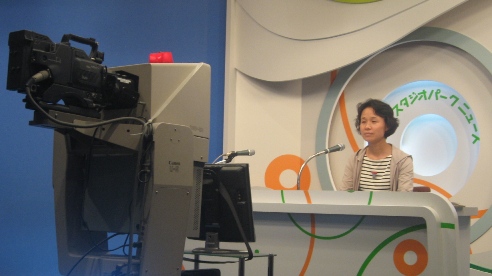
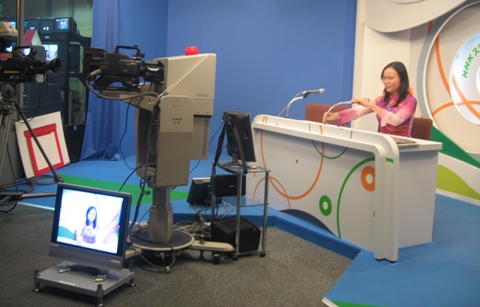
One of Studio Park’s star attractions offers to make a star of any visitor for a few minutes. It’s a newscasting studio where the visitor may sit and face the live camera and read a few lines suggested by the teleprompter – the device that enables news readers to look at their audience while sticking to a flowing text. The teleprompter text is available in Japanese and several other Asian languages.
Hu Jincao of China faces NHK cameraPham Thuy Trang from Vietnam reads NHK news
Two members of our tour party took this news challenge (photos above), and being broadcast professionals, they performed admirably! While it was fun and games for us who are familiar with the medium’s inner working, I can imagine the educational and public relations value of this for people who only consume what television delivers every day and night.
We were also treated to a screening of what was called the world’s first 3D television without special glasses. It was a breathtaking film of about 10 minutes showing underwater scenes. In the dimly lit theatre, the screen felt more like a fish tank – the 3D effect was very real. Not being a techie, I don’t know how to verify the claim of this being a world first, but when this catches on, watching television will never be the same again…
As visitors move in and out of these interesting offerings, it was another day at work for NHK’s staff who carried on with their real productions in studios we passed by. We were allowed to photograph everything except across the viewing glass inside a studio when a recording was underway (lest the camera flashlights disturb it). The freedom to explore and experience, helped by the eternally courteous tour guides, was refreshing.
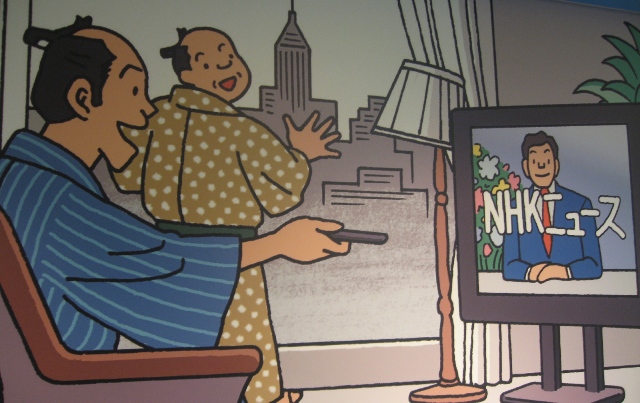
Well, at least NHK seems to know who their masters are – the paying public. And as this image in one exhibit shows, NHK is aware of that little gadget in every viewer’s hand that can instantly nullify all the irinvestment, technology and creativity. If wielded for long enough by sufficient numbers, this can put mighty broadcasters out of business.
It’s a message that Asia’s other broadcasters – public and private – would do well to remember.
NHK knows who its bosses are...
Note: My visit to Tokyo did not involve NHK funding in any manner. I was the guest of our partner TVE Japan, who paid for our admission tickets to enter NHK Studio Park.


 Open Minds!