Caught between mines and starvation

Today, April 4, is being observed worldwide as Mine Action Day.

The UN General Assembly declared the International Day for Mine Awareness and Assistance in Mine Action, which was first observed in 2006.

Mine Action says on its website:“Landmines and explosive remnants of war continue to kill or injure as many as 15,000 people a year. The overwhelming majority are civilians who trigger these devices years or even decades after a conflict ends. In some countries, such as Afghanistan, the majority of victims are under the age of 18.

Some progress has been made. Mine action programmes and the anti-personnel mine-ban treaty or “Ottawa Convention,” have contributed to a reduction in the annual number of casualties from an estimated 26,000 10 years ago to between 15,000 and 20,000 today.

But not nearly enough. I remember a short video film I watched during my first visit to Cambodia in mid 1996. After 30 years of civil war, Cambodia was left with a deadly legacy of between 4 and 6 million landmines – nobody knows quite how many. And progress has been slow to detect, deactivate and remove these millions of death-traps lying all around in this one of the poorest countries in Asia.

Our friends at the Women’s Media Centre of Cambodia, a media advocacy group run by women, showed me a campaign video they had made advocating mine action. Used for screenings at key UN meetings in Geneva and New York, it showed the plight of poor Cambodians, especially women and children, who have no choice but to live and work with landmine hazards.

Sorry, a decade later I can’t recall the title of this film. A Google search didn’t bring up any links either. But there was a sequence that I remember well.

In rural Cambodia, some women spoke their mind about the many hazards that surround them, small arms and landmines being just two of them.

What’s our choice here, one woman asked. “Everytime we step out of our homes and go to the fields, we can get blown up by a landmine. Yet if we stay at home, we will starve to death.”

She’s not alone. Millions of people – women, children and men – across the global South face this reality everyday. The men in suits in Geneva and New York, who issue lofty statements on mine action from the safety of their glasshouses, need to be aware of this stark choice.

Note: Women’s Media Centre in Cambodia does some good work. At the time we worked with them, they were running an FM radio station, producing lots of videos, and training Cambodian women to use media to support development and personal advancement.

Changing climate and moving images

Climate change is suddenly popping out of everywhere. Media outlets that couldn’t discern climate from weather not too long ago are covering the politics, technology, economics — and sometimes, science — of climate change.

We have to thank Al Gore and his Oscar-award winning film, An Inconvenient Truth, for helping climate change to reach that tipping point. For sure, it has been building up for years, but it took moving images to really push it up the agenda.

While the political stature of its ‘star’ — and now, the Oscar – takes this film to a league of its own, it’s not the only global documentary about this important topic. In recent years, a number of factual and make-belief films have been made with climate change as their principal theme.

No wonder Hollywood is attracted to this subject – it offers the ultimate planetary disaster, even if it unfolds slowly over decades. That’s not a major constraint in the land of make-belief: in The Day After Tomorrow (2004), director Roland Emmerich just accelerated natural climatic processes to happen within weeks – with dramatic results for his story (and box office).

It may be convenient to take such liberties with the truth in fiction, but delivering factual and credible content involves bigger challenges. That requires balancing facts, opinions and interpretations while engaging today’s easily distracted audiences. The task becomes harder when the subject is as technical as climate change.

I recently wrote a review of two major climate change documentaries, both released last year: An Inconvenient Truth, and The Great Warming.

Read the full review on TVE Asia Pacific website

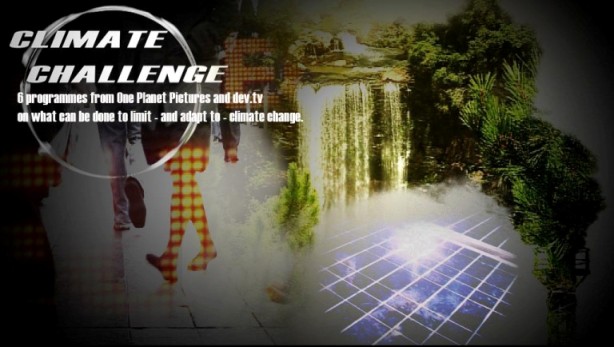
One Planet’s Climate Challenge on BBC World

Climate Challenge is a new, weekly, 6-part series coproduced by our Geneva-based partner
dev.tv and UK partner, One Planet Pictures. It begins broadcasting on BBC World from Wednesday, 4 April 2007.

The series goes local and global to find here-and-now answers to climate change. It makes the point: in the fight against global warming, developed and developing countries must work hand-in-hand to find viable solutions for all.

climate-challenge.jpg

Here’s the blurb from One Planet Pictures website:

So it’s official. Even President Bush in his latest State of the Union Report has acknowledged that global warming is happening. The scientists of the UN’s Intergovernmental Panel on Climate Change say that only swingeing cuts in the release of greenhouse gases can save our planet from becoming a Venusian hothouse.

But how can that be achieved when even the modest Kyoto targets are not being met by most rich countries? And when the world’s most populous countries are expanding their energy requirements at an unprecedented rate? What can be done to head off a catastrophe?

In Climate Challenge, One Planet Pictures’ film-makers focus on some of the most promising approaches to turning down the global thermostat. Climate Challenge goes local and global in search for solutions that won’t put a break on economic growth

The series will be distributed by TVE Asia Pacific after its initial run on BBC World.

For broadcast times, see dev.tv website or checkout BBC World programme schedule

BBC World is the commercially-operated international broadcasting arm of the BBC.

The ‘Children of Brundtland’, 20 years on

On 30 March 2007, I was part of a South Asian Workshop to pre-test a pilot e-module on Science Journalism. Held at the University of Hyderabad, India, it brought together a small group sharing a passion for science journalism and science communication. It was organised by SciDev.Net with support from UNESCO.

I used my remarks to pay tribute to an important and lasting influence on my own career as a development communicator: Our Common Future, report of the Brundtland Commission that came out exactly 20 years ago. The anniversary was marked by a few organisations like IIED, but I felt it deserved better observance.


Here’s an extract from my remarks:

Within a few months of my entering active journalism, something happened globally that left a deep impression on me -– and as I later found out, on many others like myself in different parts of the world. In March 1987, the World Commission on Environment and Development –- chaired by the then Norwegian Prime Minister Gro Harlem Brundtland -– published its final report. Titled Our Common Future, it was the first of its kind to draw broad links between environmental, social and economic concerns and it made international policy recommendations accordingly. It prompted the UN to convene the Earth Summit in Rio de Janeiro in 1992.

The Report didn’t invent the concept or term sustainable development, but it certainly helped popularise it. The Commission’s work helped the environmental movement to evolve from the tree-hugging, whale-saving, cuddly animal level to a higher and multi-faceted level of environmental management.

And it inspired a generation of young journalists, educators and activists worldwide. I count myself among them –- in that sense, we are all Children of Brundtland.

IIED London takes stock of 20 years after Brundtland Commission Report

Capturing Asia’s Wild…Life

To paraphrase Woody Allen, 90 per cent of success in life has to do with just showing up.

That’s one reason why I travel extensively in Asia and beyond. The other reasons are networking, meeting interesting people and being inspired by them.

Last month I was at two international film festivals. I’ve already posted several items from the DC Environmental Film Festival. On my way to Washington DC, I stopped over in Singapore to catch the first day of the inaugural Wildlife Asia film festival, held from March 13 to 17.


The festival organisers asked me to speak on a panel on the indie (independent film-making) scene in Asia. I used that opportunity to take stock of TVE Asia Pacific productions, which rely largely on freelance TV and film professionals across Asia. We have a policy of engaging locally-based, native talent wherever we film.

But we are not into wildlife. So I had to clarify where we fit in:

For a moment, I was wondering whether I’m at the wrong film festival -– because we don’t cover any wildlife!

But what we do cover, with great interest and passion, is wild…life –- we chronicle life itself going ‘wild’ in different parts of Asia Pacific. Disasters, conflicts, pandemics, migration and desertification -– these are a few among many topics, themes and subjects in the television and video films that TVE Asia Pacific produces and distributes.

I continued:

Everywhere in the media we hear of Asia rising –- economies, cultures and people are all on the move. Indeed, things are happening at a mind-boggling pace. But not everyone is part of this frenzy. Many people -– and societies -– are being left behind. We are interested in both those who run ahead as well as those who get left behind….and we try to find out why.

That’s the small challenge we have set for ourselves. ‘We’ are Television for Education Asia Pacific -– trading as TVE Asia Pacific –- a small media foundation trying to tell this big story of our times. We are driven by a strong belief that what is happening in the world’s largest and most populous region has far-reaching impacts not just on our region, but on the entire planet.

Read the full text of my panel remarks on TVEAP website.

Cricket on TV: Fatal attraction?

Productivity in South Asia can’t be all that high these days. A good part of our 1.5 billion combined population stays up late into the night, watching live TV broadcasts of cricket matches of the ICC World Cup.

Because the championship is hosted in the West Indies, time differences mean that each match would begin in the evening and continue into the early hours of our mornings.

Lots of people turn up at work with bleary eyes.

But that’s nothing compared to the many tears shed, sighs heaved and fists raised when South Asia’s cricket playing nations — Bangladesh, India, Pakistan and Sri Lanka – lose a match.

The two cricket giants and rivals – India and Pakistan – both had shocking exits in the first round itself. This inspired much anguish, despair and anger. It also wrecked business plans of many South Asian TV networks, which had paid millions of dollars for the rights to broadcast World Cup cricket matches. Now they fear they cannot recover their investment.

Flying from Colombo to Hyderabad for an academic meeting, I read the latest (2 April 2007) issue of the Indian newsmagazine Outlook, which offered a good analysis of what went wrong for India in the World Cup. It’s one among many, many post mortems in the media.

Outlook Editor Vinod Mehta, one of India’s seniormost and outspoken journalists, writes a short piece in this issue, headlined ‘Fatal Attractions’.

In his typical style, he starts:
I told-you-so journalism can be both exasperating and juvenile. Thus, I get no pleasure in reminding you that four weeks before our determined fifteen left for the Caribbean, I had lamented: “Am I the only one turned off by Indian cricket? I’d much rather relax watching an old film than see our boys wield the willow. The occasional fluke victory is all we can hope for. The team looks pedestrian and, frequently, pathetic.

Then he gets more serious, saying we must ask ourselves if the media and the marketers are doing us a favour by injecting such hyper-nationalism ‘as they collectively raise unrealistic hopes of India’s conquests’.

He concludes:

“The martial music, the thumping of chests, the shouts of “India, India”, the painting of the national colours on faces, the patriotic exhortations of politicos suggests that the Cup is already in the bag; the winning is just a formality. When we experience not just defeat but a sound thrashing, the Indian cricket fan, who has been duped by slick promos and to some extent his own credulity, finds reality intolerable. If, instead, expectations were kept at a reasonable level we would not undergo such a tremendous feeling of being let down. We could cope with the disappointment.

“No other team in the World Cup, not even the Aussies and the Proteas, play under so much pressure, most of it induced by greedy advertisers hoping to exploit the passion for the game. I believe this exploitation has gone on long enough. The market must stop playing with the emotions of a nation. Meanwhile, we should remember we have just lost a game of cricket. We are not finished as a nation.”

Read the full commentary in Outlook Online

Arthur Clarke looking for signs of life in Colombo…

I have finally found my legitimate claim for being unique: I don’t follow cricket.

Yes, you heard me right. Despite being born and raised in Sri Lanka, and still being based there about half of my time, I have never been a great fan of cricket. I must be the only one in my office who gets a decent night’s sleep these days. Practically everyone stays up till the wee hours of the morning watching live TV broadcasts of the ICC World Cup cricket matches taking place literally on the other side of the globe: the West Indies.

There’s now a very close nexus between television and cricket. Live broadcasts beam instantly into our living rooms the action on a cricket field anywhere on the planet. In fact, thanks to the zoom-ins, slow-motion instant replays and other techniques, those who watch a cricket match on the small screen can share the action even better than the few thousand who witness it physically at the stadium. (And the screens are no longer very small: across cricket-crazy South Asia, sales have soared for plasma screens of increasingly large – if not mostrous – sizes.)

The man who made all this possible is slightly bemused — but not one bit affected — by all this frenzy. Sir Arthur C Clarke, science fiction author, futurist and inventor of the communications satellite, sits in his living room, pondering the near and far future of humanity that he helped transform into a Global Village.

That’s the only other person in the whole of Colombo that I know who isn’t infected by the current World Cup fever. (See my other post today for views of a rare Indian who doesn’t follow cricket and instead prefers to watch old movies.)

Writing a foreword to the UNDP’s Human Development Report in 2003, Sir Arthur noted: “Today, television rules how Sri Lankans work, dine and socialise. And when an important cricket match is being broadcast live, I have to look hard to find any signs of life on the streets of Colombo.”

We might opt out of following the cricket, making ourselves rather dull conversationalists these days, but if we dare to utter even a word against this de facto religion of South Asians, dire consequences are sure to follow.

A decade ago, Sir Arthur had a first hand experience to prove this. In a wide-ranging media interview, he told a visiting Reuters correspondent that he shared some people’s skepticism that cricket was the slowest form of animal life, because it takes so long. (A Test match can take as many as five full days, and still end without a clear result!).

Having mis-heard Sir Arthur, the Reuters man filed his story saying Arthur C Clarke calls cricket the `lowest form of life’.

That was enough to stir up a mini storm. It couldn’t have come at a worse time — Sri Lanka had just won the 1996 cricket World Cup and the country was still euphoric. For weeks, Sir Arthur had to cope with irate Sri Lankan cricket fans — as he told a visiting American journalist from The Philadelphia Inquirer, ‘I had a lot of explaining to do’.

Moral of the story:
1. Be always careful when talking to journalists.
2. Keep your criticism of cricket strictly to yourself.

Human Development Report Foreword by Sir Arthur C. Clarke: Communications for Goodness’ Sake

Read my later post: Arthur Clarke’s climate friendly advice: Don’t commute; communicate!

More memories of Theeban…

On March 17, I wrote about introducing our Children of Tsunami documentary at the DC Environmental Film Festival, and and how I dedicated the screening to Theeban – the Sri Lankan boy who survived the Asian Tsunami, but was killed in the island nation’s political violence on 3 March 2007.

My personal tribute to Theeban has been widely circulated online. Edited versions have appeared on MediaHelpingMedia (UK) and Asia Media from University of California Los Angeles (USA).

It appears that my tribute has moved many readers. I’ve heard from several by email – encouragingly, all supportive and sympathetic. Among those who wrote was young journalist Chathuri Dissanayake, who worked as a researcher for Video Image, the Sri Lankan production company we (TVE Asia Pacific) engaged to film Theeban’s unfolding story for most of 2005.

With her permission, I want to share her recollections and views:

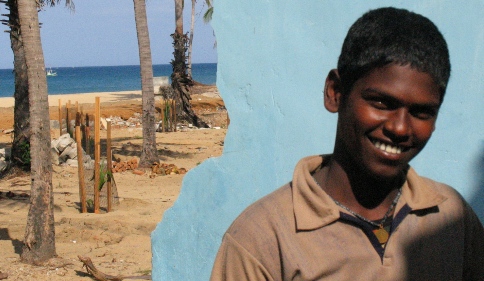
It’s a very nice piece about Theeban. It captures what we had grown to love in the boy. The picture you have of him taken on I think our first visit brings back a lot of memories.

theeban.jpg

When he was abducted (in late 2006), I always thought at least he is alive, now I’m still trying to come to terms with the fact that he is no more. The best memory I have of him is his wide smile. The pictures you have chosen bears ample testimony as to how beautiful that is. Even though he couldn’t communicate with us coz of the language barrier his smile and eyes were so expressive. When I first met him at the camp what struck me most was his unspoilt innocence. I wish I had taken a bit more trouble to help him out after the filming ended.

Theeban gave life to harsh realities of the conflict in the country that I have lived all my life with. Before meeting Theeban and visiting his village, I only knew what media told me of the east but Theeban brought it closer to me. Earlier, when ever I heard of the violence in the north or the east, it was just news to me as it was to many living in the “right side of the country”. But the Children of Tsunami project opened up the other side of the story, and as a young journalist, I gained a lot of experience.

To me, Theeban was real and he represented many youngsters in the area. His scattered dreams and hopes were real and it is a tragedy that help doesn’t reach them. Nothing substantial was done to help him and many others like him to rebuild their lives. Theeban was too young for any sort of vocational training that was available, and he didn’t have the right qualifications. My dilemma of what would happen to Theeban and many like him whose futures were washed away in the Tsunami grew as all the options of vocational training I checked out for Theeban turned out that applicants needed at least (GCE) Ordinary Level. Theeban was forced to leave school and it looked as if it never struck to any authority that someone needs to look after the youths like Theeban.

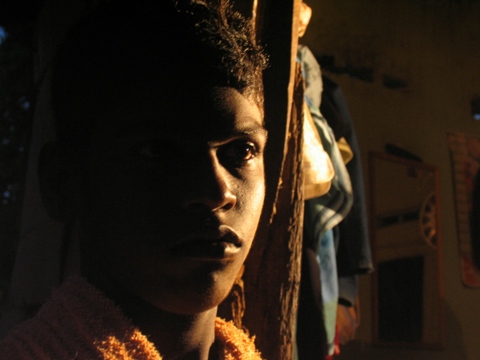
theeban-photocredit-video-imagetveap.jpg

To me Theeban, like many others was another victim of forces that he had no control over. It was not his fault that a tidal wave destroyed his family but he paid for it dearly, gave up his education and took the responsibilities of the bread winner of the family on to his shoulders. When the Tsunami struck he was still hopeful he wanted to earn money and take care of his brothers. He missed his mother dearly but found a bit of comfort in his grandma. But the violence that sprang up in the area had no mercy on him. Theeban’s story ended in tragedy coz the forces that were against him were too strong for him to fight back. The hope I saw in his eyes still haunts me. But I take comfort in knowing that at least he tried to fight back. No matter what his shy smile and shining eyes will remain with me.

That is how I remember Theban best. A youth who managed to smile and have a hope for the future in spite of the trauma that he went through when many grown up men around him gave up on life.

Have you made your million dollars yet?

Money, money, money!

Many development film-makers like to decry our society’s obsession with money, consumerism and greed. Some would make films that passionately promote sharing ideas and resources at community level, and advocate common property resources over private ownership.

But when it comes to rights of their own film/s, these very film-makers would become extremely possessive: they want to restrict it in every conceivable way.

They feel justified in such sentiment and action: after all, they have invested a great deal of time, effort, creativity and hard-won resoures to make their films. They must now seek a ‘return on investment’ like everyone else (it’s a material world!). Film-makers too have families to feed.

No argument on that last one. But it would be interesting to find out how many – or how few – development films deliver any appreciable ‘returns on investment’ to their makers. Certainly in developing Asia, development film-makers will be seriously endangered species if they had to rely on license fees or royalties for their survival.
https://i0.wp.com/www.hcn.org/allimages/1996/oct28/graphics/961028.001.gif
After a dozen years of extensive networking with environment, wildlife and development film-makers across Asia Pacific, I have yet to come across a single film-maker who made his or her million dollars from a film.

Yet, many continue to cling on to the traditional notion of copyright in film, perhaps hoping that sooner or later, that cherished million bucks would come calling.

And in the meantime, they continue to approach every known funding source – and many unknown and unlikely ones – for supporting their next film. At TVE Asia Pacific, we receive our fair share of these requests every month – and we are not even a funding source for independent films! These requests are accompanied by impressive CVs or filmographies, listing past films produced.

Produced, yes. But how many are circulating? How many have been seen outside film festival circuits, or beyond a one-off broadcast (or two)? How many films are available for educational, advocacy, training or activist purposes at affordable cost of duplication and dispatch?

The answer is depressing: precious few.

Because our film-makers are waiting for their million dollar deal or sale, and won’t let go of their creations. Even if many have been made using development donor (i.e. public) funding, these films are not in the public domain.

That, to me, is incongruent with the lofty ideals that many development films proclaim: sharing ideas and resources at community level, and advocating common property resources.

We have to walk our talk, or we risk joining the already burgeoning ranks of hypocrites in our societies.

The time has come for documentary film-makers, especially those covering development topics, to take a fresh look at copyright. That doesn’t mean abandoning all our rights to be known and acknowledged as creators of our films.

For a start, I strongly recommend an interesting and insightful essay, “Shoot, Share and Create: Looking beyond copyright makes sense in film“, written by a young Indian lawyer-activist specialising in intellectual property. Lawrence Liang is a Bangalore-based lawyer who works at the Alternative Law Forum. I had the opportunity of meeting the dynamic and articulate Lawrence at the Asia Commons meeting in Bangkok in June 2005 – he’s certainly a man to watch in this rapidly evolving field of managing our digital commons and how to safeguard the public interest in the bewildering era of digital media.
Lawrence Liang

Here’s how he starts his essay, which he wrote as an open letter addressed to Indian documentary filmmakers:

When I was in law school, I had great aspirations of wanting to be a filmmaker, and an FTII-type (Film and TV Institute of India, a prominent school for film-making) friend told me the best place to start was to watch a lot of foreign films and documentaries. So I did that rather dutifully and spent many hours when I should have been reading corporate law, watching documentaries.

My fondest memory of my placement in Mumbai with a law firm was when we took off to the Tata Institute of Social Sciences (TISS) and watched Anjali Monteiro and K P Jayashankar’s film on the Yerawada prison in Pune.

I gave up on the idea of becoming a filmmaker after we finally did do a documentary on law school. But by then the bug had bitten and I had fallen in love with cinema and the documentary form as well. I think watching documentaries has also made me a better lawyer than I would have been if I read Ramiaya on the Indian Companies Act. So if I have written this rather longish argument about why documentary filmmakers should start thinking about open content licenses, it is with a sense of repaying a debt.

Read the full essay at Alternative Law Forum website

Read my own call for recognising poverty as a copyright free zone