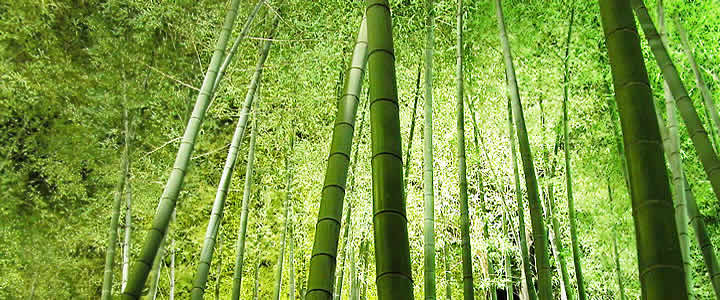
“The bamboo that bends is stronger than the oak that resists,” says a Japanese Proverb.
In these times of climate change, we all need to bear this in mind. It’s not how we resist the battering, but how we pick up again after repeated onslaughts.
Bamboo is an amazingly versatile plant (actually, a grass) with many uses in Asian cultures. We use it for buildings, furniture, outdoor infrastructure, artistic decor and even eat parts of it.
Beyond these utility functions, the bamboo holds a philosophical lesson that the ancient Japanese and Chinese knew very well: its flexibility is its strength. It can bend and move with the wind or water or other element, rather than being rigid, unyielding and ultimately vulnerable to an unexpected jolt and sideways shift.
Resilience was discussed and interpreted in a number of ways at the conference. But participants broadly agreed that it is the ability of any individual or community or system to absorb external shocks, bounce back and transform or continue to grow.
Such bouncing back, in some climate related situations, could be to alternatives rather than to the original condition. For example, if poorly built structures are damaged in a disaster or extreme weather condition, the recovery could – and should – be to build back better.
Indeed, the bamboo metaphor is widely used in various fields from business management to self-help counseling. See these interesting links for further insights:
What does Livelihood Resilience mean to them?
I am at Resilience 2011: Asia Regional Conference on Building Livelihood Resilience in Changing Climate, being held in Kuala Lumpur, Malaysia, from 3 – 5 March 2011. It is jointly organised by Wetlands International-South Asia (WISA), International Development Research Center (IDRC), The Climate and Development Knowledge Network (CDKN), Cordaid and ekgaon technologies
The conference has attracted three dozen researchers, practitioners and policy makers from across the Asia Pacific region, and from different ‘domains’: Disaster Risk Reduction (DRR) and disaster management; Ecosystem services and conservation; and livelihoods and socio-economic development.
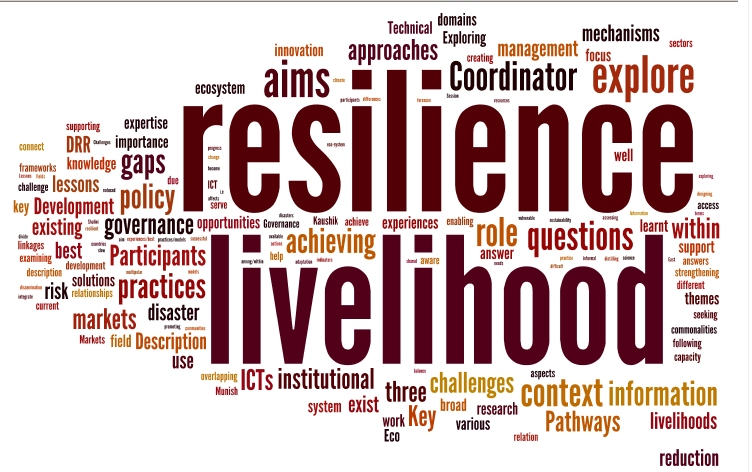
I like hobnob with researchers and activists from whom I learn much. As a science and development communicator, I sit through their often very technical discussions and find ways of relating them to the bigger realities. For a start, I created a word map of the keywords being used in the conference. That gives an idea of concerns at a glance.
I then tried to make sense of the conference introduction note, published on the event website. It looks and reads like the work of a committee, and not the easiest to read and absorb unless one is deep immersed in these areas. Since most of us aren’t, I spent an hour or two rewriting it in my own language. Here it is — my version of what Resilience 2011 conference is trying to accomplish:
Building Livelihood Resilience in Changing Climate Asia Regional Conference
Kuala Lumpur, Malaysia, 3 – 5 March 2011
A layman’s interpretation of the vision, scope and aims of the conference
Asia, home to over 60 per cent of all human beings, is the largest and most diverse geographical region in the world. It is also a region of sharp contrasts and disparities in economic and social development.
Some Asian economies have been growing faster than any other on the planet, and even the global recession has not slowed them down too much. This growth has helped push tens of millions of people out of poverty during the past three decades. Yet, Asia still has the largest number of people living in poverty and food insecurity.
In some respects, gains have been lost. For example, the UN Millennium Development Goals Report for 2010 revealed that the proportion of undernourished Asians has increased recently to levels last seen during the 1990s. Two thirds of the world’s undernourished people live in Asia. At the same time, the natural resources on which food supplies depend – land, water and biodiversity – are degrading rapidly. Food shortages and water scarcities are already being experienced, or anticipated, in many countries.
Growing number and intensity of disasters adds further pressures. According to the international disaster database EM DAT, Asia accounted for nearly half (46 per cent) of the all water related disasters in the world, and 90 per cent of all affected people during 1980 to 2006. During this period, disasters in Asia caused a total of US$ 8 billion worth of economic damage. These disasters impacted disproportionately on the poor and vulnerable sections of society.
Climate change impacts will make this situation worse for everyone, and especially for the poor who already have limited options and ability to adjust to rapid changes. It is now clear that all efforts aimed at reducing poverty and protecting the socially vulnerable groups need to factor in the additional pressures created by changing climate.
To cope with these challenges, we need better understand how livelihoods are threatened, and what strategies can be adopted to improve resilience especially at the grassroots. Researchers and practitioners in natural resource management and poverty reduction are now focusing more and more on the nexus between resources, climate changes and livelihoods.
New ways of looking at the inter-linked challenges have emerged:
• Humanitarian aid workers active on disasters now focus on disaster risk reduction, expanding the scope of risk management to include preparedness and risk reduction.
• Development practitioners working on poverty reduction emphasize on increasing access to various capitals to help address disaster risk and poverty.
• A ‘systems approach’ is being used to look at poverty in broader terms of well-being of people and ecosystem services of Nature.
In addition, researchers and activists emphasize the value of freedoms for participation, economic facilities, social opportunities, transparency guarantees, protective security and ecological security. It is only by ensuring these freedoms that the poor will have a meaningful chance to assert their rights and make their own choices in what they do, and how they do it.
The slowly but steadily warming planet challenges everyone to rethink their conceptual frameworks, and redefine or reconfigure how they work. If there is one thing certain about these uncertain and turbulent times, it is business-as-usual won’t do!
What do we seek to achieve?
Each sector has accumulated a knowledge base, set of best practices and lessons learnt exist within individual domains. Each sector’s theories, approaches and actions within various domains differ on how to make livelihoods more resilient, especially in the often harsh realities of the developing world.
They are all necessary, but not sufficient. Taken individually, no single approach or solution can help make everybody’s livelihoods resilient from the multitude of pressures and impacts. Yet, what one strand cannot withstand on its own, a bundle of strands very likely can: bringing different areas of research, advocacy and practice is the way forward to ensuring better resilience at the grassroots.
This is easier said than done. Both researchers and practitioners have long worked in their own silos or compartments, with occasional nods at each other’s work and periodic exchanges. From this, we need to evolve more integrated framework that brings in the ecologists, disaster managers, social scientists and everyone else who share an interest in making lives better at the grassroots and at the bottom of the income pyramid.
The Kuala Lumpur conference attempts to address this formidable challenge. It will provide a common platform to practitioners and researchers from various ‘domains’ related to livelihoods to work out a shared vision on livelihoods resilience by seeking answers to these questions:
• What are the existing challenges to achieving livelihood resilience?
• What are the gaps in existing livelihood frameworks in relation to disaster, climate change adaptation and conservation in addressing livelihood resilience?
• What are the challenges in scaling up pilot models of Livelihood Resilience?
• How does social adaptation occur in resilience building?
The conference brings together researchers and practitioners from three fields: Disaster Risk Reduction (DRR) and disaster management community; Ecosystem services and conservation community; and the livelihoods and socio-economic development community. Although their work overlap part of the time, they don’t converge too often.
I will blog on different aspects of the conference, trying to connect the dots, and relating the micro to the macro as I often do in my own work communicating development.
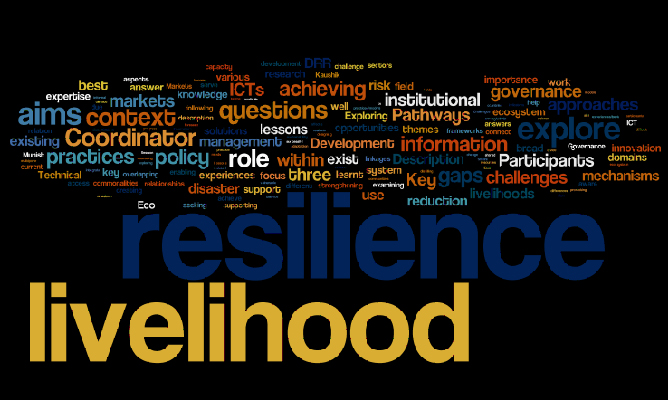
There are many issues, topics and discussions under the broad theme of protecting Asian livelihoods from climate change impacts. For a start, I used Wordle to build a word map, displaying proportionate use of keywords in the conference sessions. The above and below are the word clouds it generated (same words, displayed in different modes).
The conference is organised jointly by Wetlands International-South Asia (WISA), International Development Research Center (IDRC), The Climate and Development Knowledge Network (CDKN), Cordaid and ekgaon technologies of India.
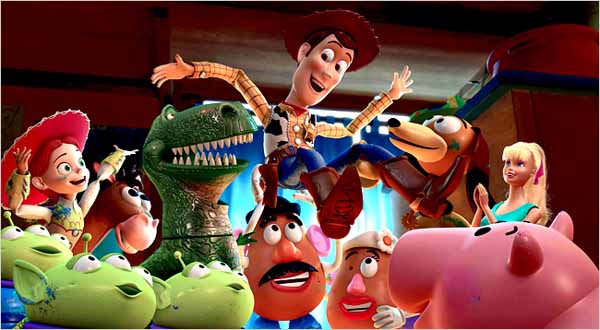
Toy Story 3: Reaching out to the child in all of us? Photo courtesy - Pixar Animation Studios/Walt Disney PicturesWhy did a 3D CGI comedy-adventure film on the abandoned toys of a upper teenager become the highest grossing feature film in the US, and also worldwide, during 2010? What does it say about our common psyche when Toy Story 3, a variation on an already twice-tested theme, earned more than a billion dollars — making it one of the top five money earners of all time?
Psycho-analysts can debate that for years to come. Toy Story series must tug on some deep emotions in many of us, for the third film was not only highly popular, but also received near universal critical acclaim.
Writing in The New York Times, movie critic A. O. Scott noted: “This film—this whole three-part, 15-year epic—about the adventures of a bunch of silly plastic junk turns out also to be a long, melancholy meditation on loss, impermanence and that noble, stubborn, foolish thing called love.”
Wiz Quiz this week, appearing just two days after the Oscar Awards ceremony, started off with a few questions based on some films that received nominations for the best film of 2010 (officially called the Best Picture Award). At the time we compiled the quiz, the winners were not yet announced. But we probed the 10-movie nominations list deeper to see connections not immediately apparent.
We then roam the world of ancient and modern cultures, hopping from Hindu mythology to modern day Japanese cartoons. In between, we take a look at the Suez Canal that was recently in the news, and salute Ronald Reagan.
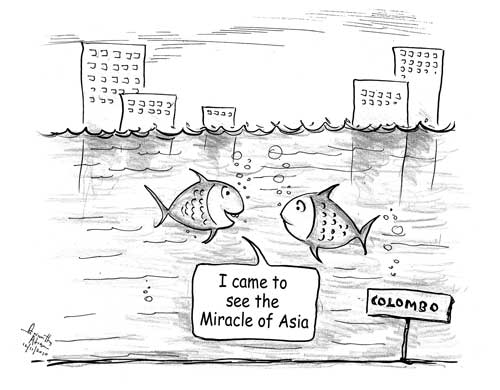
Cartoon in Daily Mirror, Sri Lanka, on 12 November 2010
Why do movie audiences in this part of the world cheer every time they see alien invaders blow up the White House? For a long time I thought it had something to do with anti-American sentiments; then I heard that many US audiences react the same way. Perhaps some among us get a kick out of seeing overbearing governments in trouble?
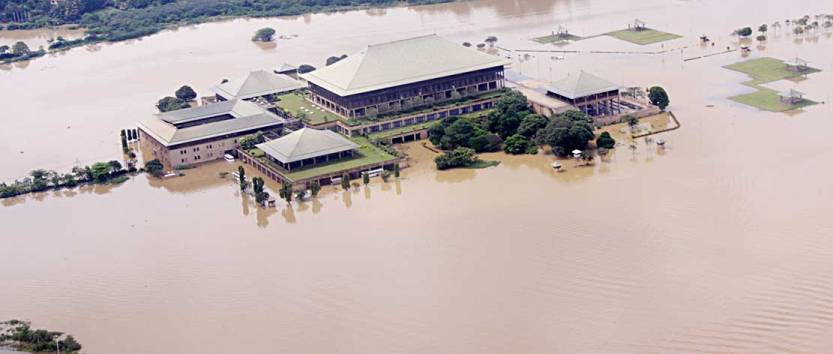
That might explain the gleeful tone with which the Colombo media reported the Sri Lankan Parliament being flooded after torrential rains in mid-November. Newspapers and television channels repeatedly showed images of the Parliamentary complex – built three decades ago on a marshland – completely marooned. The hapless people’s representatives were ferried across the expanse by the military, to take part in a brief session to extend Emergency Regulations. The symbolism was inescapable.
When the trapped rainwater engulfed many areas in and around Colombo, thousands of affected people groaned, but no one was really surprised. By now Sri Lankans know this is almost an annual routine. As I sat knee-deep in my own flooded office, I had a strong sense of déjà vu.
This is the opening of an op ed essay I’ve just written for Himal Southasian magazine, whose March issue carries a cover story on disasters in South Asia.
My essay, titled Drowning in media indifference, takes a personalised look at how the Lankan media have covered different disasters in the past two decades.
“Once again, the mainstream media in Sri Lanka has proven itself irrelevant in reporting and responding to catastrophic flooding,” says the intro — and that pretty much sums it up.
Sri Lankan Parliament flooded after torrential rains in mid-November 2010. The complex, built on a marshland, was completely marooned.
I recall how, back in 1992-93, the then media (fewer in number, with broadcasting still a state monopoly) provided saturation coverage for a major flood in the capital Colombo while under-reporting an even worse flood in the provinces a few months later.
“Fast forward to the present – and how little things have changed! During the past three months, as the fury of the formidable little girl (La Niña, the global weather anomaly) played havoc on the island, I have been struck by the similarly lop-sided coverage in the country’s mainstream print and broadcast media. Urban flooding once again received ample front-page coverage and ‘breaking news’ treatment. Everyone, from cartoonists and editorialists to talk-show hosts and radio DJs, ranted about what was taking place. Yet the much worse flooding, once again in the north, east and centre of the country, received proportionately much less attention. There were a few honourable exceptions, but by and large the 1992-93 disparity was repeated wholesale.”
I have been both an insider and outsider in this issue. I consider myself to be part of the extended mass media community in Sri Lanka for over two decades: I have worked for newspapers, magazines, radio and TV stations. At the same time, I retain the ability – and independence – to steps back and take a more critical and objective look at the media industry and community.
My interest in how disasters are covered and communicated go back to the time when my own house was flooded in mid 1992. I have since researched and commented extensively on this issue, and co-edited the 2007 book Communicating Disasters: An Asia Pacific Resource Book (TVEAP/UNDP).
In this latest essay, I reiterate an argument I’ve been making for sometime: “Media researchers have long accused the Western and globalised news media of having an implicit ‘hierarchy’ of death and destruction, in terms of how they report disasters in developing countries. But Sri Lanka’s own media’s indifference is equally appalling – the story of a quarter-million displaced people languishing in squalid conditions for weeks on end did not constitute front-page news. A starlet entering hospital after a domestic brawl excites news editors more than thousands of flood-affected provincial people starving while waiting for relief.”
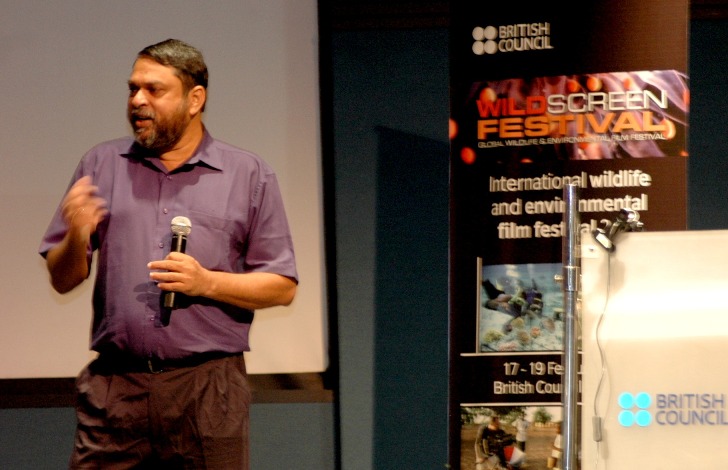
Taya Diaz conducts film making master class during Wildscreen 2011 in Colombo
“Taya Diaz has the shortest name in Sri Lanka but is a big man with a personality to match and a bushy black beard. Apart from being an excellent guide with good knowledge of all aspects of Sri Lankan Wildlife, he’s also a writer and film maker and is excellent company.”
That’s how a bird-watching website once described Taya Diaz, Sri Lankan conservationist turned wildlife film maker.
During the past two decades, Taya has collaborated in making over 20 full-length international wildlife documentaries, all showcasing Sri Lanka’s rich biological diversity and ecosystems. He has been a scientific investigator, presenter, narrator or Sinhalese scriptwriter.
One of his earliest involvements in international film making was with The Temple Troop. Made in 1997, for the BBC and Discovery Channel, it documented a year in the life of a troop of monkeys living in Sri Lanka’s ancient city of Polonnaruwa. These monkeys have been the subject of a long-running study by the Smithsonian Institution’s Primate Biology Program.
Trained as a scientist, Taya has worked in a number of field based conservation projects including the Smithsonian study of monkeys. But it’s as a wildlife and natural history that he now makes a name both in Sri Lanka and overseas.
The Urban Elephant (2000, for PBS/National Geographic), and The Last Tusker (2000, for BBC/Discovery) are two other productions that used Taya’s ground knowledge and scientific expertise. He has provided local liaison for broadcasters such as New Zealand TV, Canal+, Discovery channel, and BBC1.
Taya Diaz: Enough stories to last a lifetime!For all these reasons, Taya was a natural choice when TVE Asia Pacific was asked to recommend a Sri Lankan film maker to present a master class when the Wildscreen traveling film festival held in Colombo from 17 to 19 February 2011. His master class, titled “Untold Stories of Sri Lanka”, looked at Sri Lanka’s as yet largely untapped potential for authentic, factual stories related to wildlife, natural history and the environment.
He explained the premise for his master class: “Sri Lanka is a pot of plenty in every aspect — the opportunities for a documentary filmmaker are astounding. But sadly, what most audiences see on the airwaves is very standard and boringly similar, touching on the same topics year in and year out.”
Taya feels that documentary films and TV programmes are also essential for educating Sri Lankans about their own natural heritage. Sri Lanka has an impressively high number of plant and animal species for its relatively small land area — which makes it one of the most biologically diverse countries in the world.
“Sri Lankan naturalists, wildlife experts and environmentalists should collaborate more closely with film makers and/or broadcasters to make more local films aimed at local audiences,” he said during a panel discussion I moderated on February 17. “This is essential for raising awareness on environment and sustainable development issues as Sri Lanka pursues rapid economic development after the war.”
1,100 million fools following 11 flannelled fools...for six weeks!“Eleven flannelled fools chasing a red ball, with eleven thousand fools cheering them.”
A few decades later, he might well have said 1,100 million fools cheering. Probably that many people will watch or otherwise follow the The ICC Cricket World Cup 2011, currently underway in the world’s most ardent cricketing region: South Asia!
In terms of television audiences and media-linked sponsorship money, the ICC Cricket World Cup is the world’s third largest sporting event: only the FIFA Football World Cup and the Summer Olympics are bigger than this event.
Not everyone is equally enthusiastic about cricket. Those in non-playing countries must wonder just what the cricket frenzy is all about. But frenzy time it is, right now, in much of South Asia. The ICC Cricket World Cup 2011 started on 19 February 2011, and will continue until 2 April 2011.
What's your score, mate?This is the world’s leading men’s one day international (ODI) cricket tournament, organized by the sport’s governing body, the International Cricket Council (ICC). National teams of 14 countries are participating in this tournament, being hosted jointly by Bangladesh, India and Sri Lanka.
I’m not a cricket fan myself, but living in South Asia, it is impossible to avoid catching at least bits and pieces of cricket fever. But cricket is not just a game of players and matches, but a whole cultural and social phenomenon, especially in South Asia. If the English invented cricket, the one-time British colonies have vastly globalised it.
So try your wider cricketing knowledge with this week’s quiz…and see what your score is!
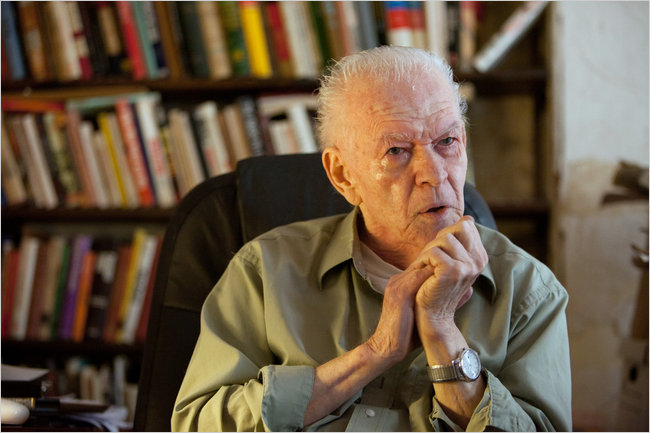
Is this man, now 82 years old, giving the world’s assorted dictators their worst nightmares?
This is Dr Gene Sharp, a Professor Emeritus of political science at the University of Massachusetts Dartmouth in the US, he is widely known for his extensive writings on nonviolent struggle, which have influenced numerous anti-government resistance movements around the world. He is now credited with the strategy behind the recent toppling of the Egyptian government of Hosni Mubarak.
The New York Times on 17 Feb 2011 profiled him with the title: “Shy U.S. Intellectual Created Playbook Used in a Revolution”. The article noted: “Few Americans have heard of Mr Sharp. But for decades, his practical writings on nonviolent revolution — most notably “From Dictatorship to Democracy,” a 93-page guide to toppling autocrats, available for download in 24 languages — have inspired dissidents around the world, including in Burma, Bosnia, Estonia and Zimbabwe, and now Tunisia and Egypt.”
“Gene Sharp is the world’s foremost expert on non-violent revolution. His work has been translated into more than 30 languages, his books slipped across borders and hidden from secret policemen all over the world,” says Ruaridh Arrow, Director of the upcoming documentary titled ‘Gene Sharp – How to Start a Revolution’.
In 2009 Arrow, a producer with Sky News in the UK, began filming a documentary following the impact of Sharp’s work from his Boston house, across four continents and eventually to Tahrir square in Cairo, “where I slept alongside protesters who read his work by torchlight in the shadow of tanks”.
Extract: “Gene Sharp is no Che Guevara but he may have had more influence than any other political theorist of his generation. His central message is that the power of dictatorships comes from the willing obedience of the people they govern – and that if the people can develop techniques of withholding their consent, a regime will crumble.”
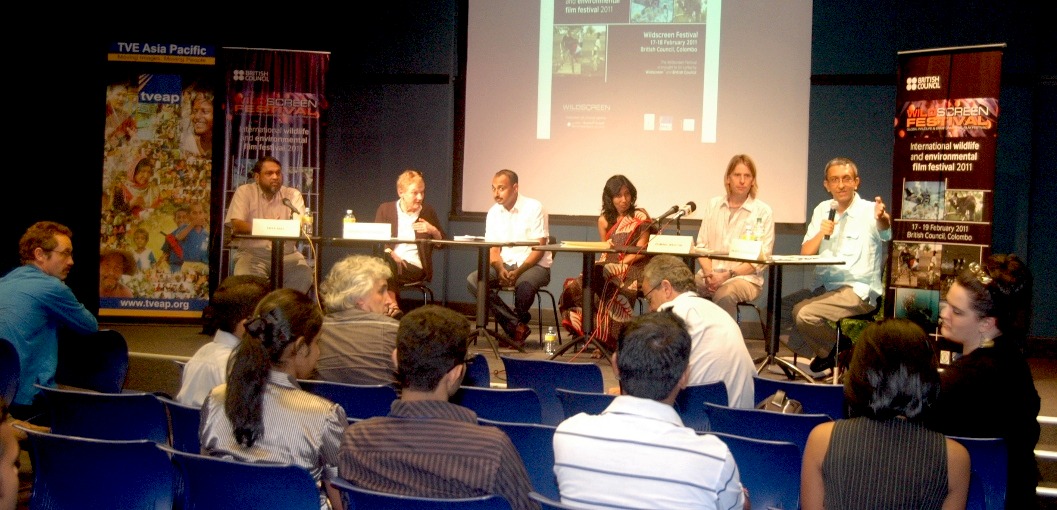
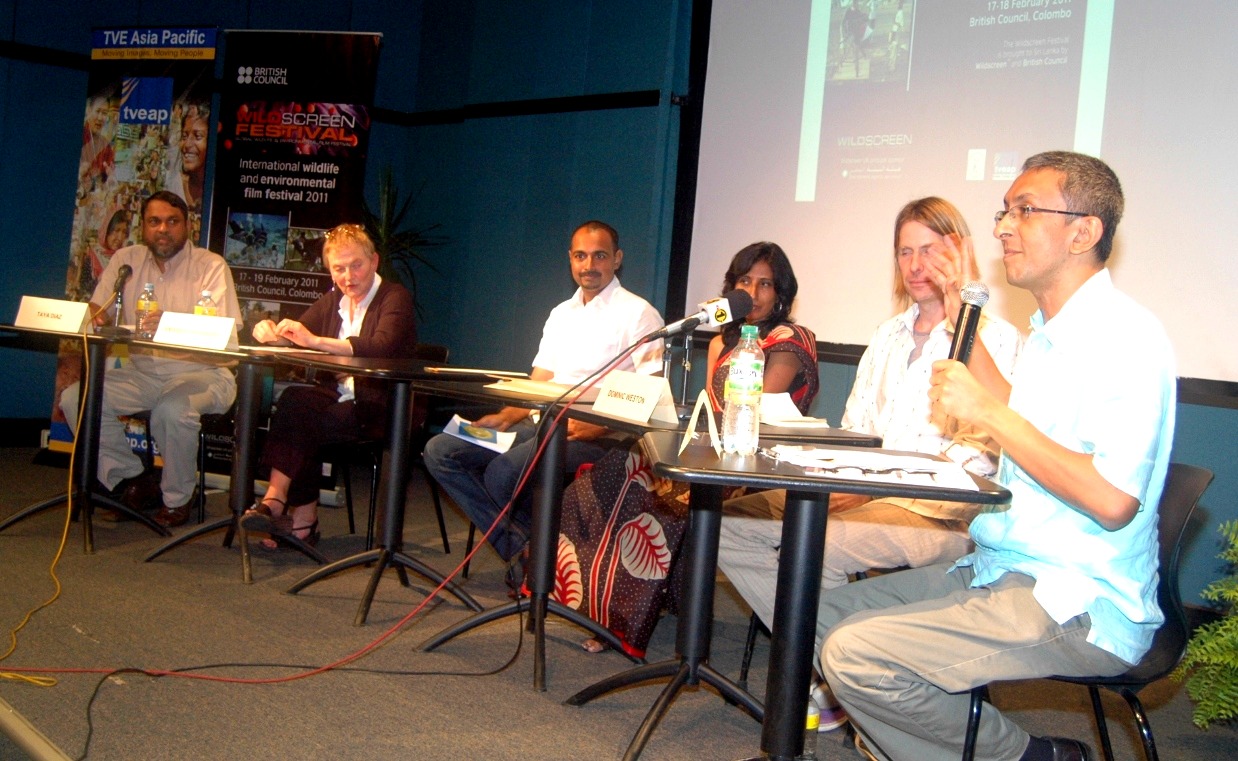
Wildscreen 2011 Colombo Panel: From L to R - Taya Diaz, Amanda Theunissen, Delon Weerasinghe, Anoma Rajakaruna, Dominic Weston and Nalaka Gunawardene
Is there an elite or ‘charmed’ circle of wildlife and natural history film makers in the world? If so, how does a new film maker break into this circle?
This is the question I posed to a group of visiting British film makers and their Sri Lankan counterparts during a panel discussion I moderated at the British Council Colombo on February 17 evening.
The panel, organised around the topic ‘Differences and mutual challenges in Asian, American and European productions/film making’, was part of the Wildscreen traveling film festival held hosted in Colombo, Sri Lanka, from 17 to 19 February 2011.
Amanda Theunissen, who has worked with the BBC Natural History Unit and National Geographic Television, gave a straight answer: yes, there is such a charmed circle.
And although she didn’t say it in so many words, it was clear from our overall discussions that the circle is jealously guarded, and it’s not easy for any newcomer to break into it. And the entry barrier becomes harder if the film maker is from the global South.
I opened the panel recalling the opening sentence of Our Common Future, the 1987 Report by the World Commission on Environment and Development: “The Earth is one but the world is not”. I said: “A similar disparity exists in wildlife and natural history film making. We are all covering the same planet Earth in all its splendour and diversity. But on this planet there are many different worlds of film making.”
I asked my five panelists — Amanda Theunissen and Dominic Weston from the UK, and Delon Weerasinghe, Anoma Rajakaruna, and Taya Diaz from Sri Lanka — to address three key challenges faced by all wildlife and natural history film makers everywhere: the art of effective story telling; fund raising to make films; and ensuring wide distribution of the films made.
The panel discussion was lively, wide-ranging and engaged the audience which comprised mostly aspiring film makers or film students. I didn’t want our discussion to scare any of them away from a career in environment and wildlife film making. But at the same time, we wanted to acknowledge the practical realities — and disparities — that exist within and across countries in this respect.
I’ve now written up a summary of the panel discussion for TVE Asia Pacific news. Its heading comes from a provocative question I asked during the panel: does wildlife film making operate on almost Darwinian rules?
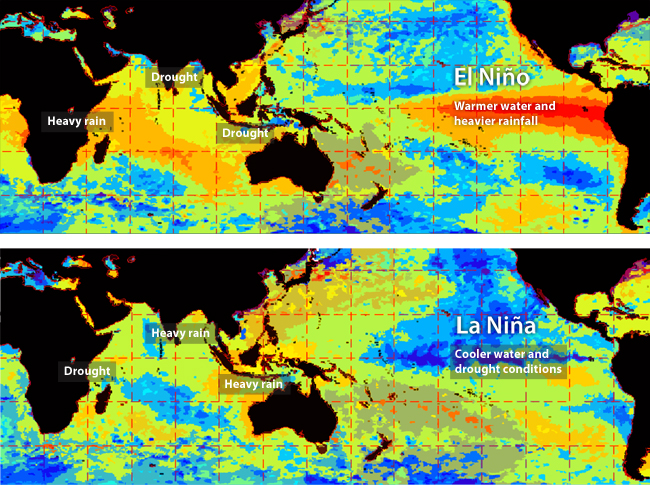
The current spell of heavy rainfall and resulting floods is being blamed on a phenomenon called La Niña. It involves both the ocean and atmosphere.
La Niña occurs when surface temperatures get cooler than normal (by 3 to 5 degrees Centigrade) in the western Pacific Ocean. During a La Niña, the cold water that pools near the coast of South America surges westwards across the mighty Pacific, the largest ocean in the world. This flow causes a greater build up of warmer water along the eastern coast of Australia and in the South East Asia region. The contrast in sea surface temperatures across the Pacific, as well as the contrast in air pressure, produces more rainfall.
La Niña is the Spanish term for “the girl child”. In that literal sense, the current weather extremes might be called the fury of a very formidable young lady! And it’s not the first time she has unleashed such havoc on us. This week in my quiz column, I started off with some questions on freaky weather, and then moved on to other topics.
Other ladies figure in the quiz: from Nobel Prize winning Marie Curie to Harry Potter creator J K Rowling. And we ask about the lady school teacher who died in the Challenger space shuttle disaster in February 1986.



 Open Minds!