The ‘Rural Romance’ lives on in the ICT Age: Urban poor need not apply

Poor rice farmers running up laptops in paddy fields.

Fishermen navigating their ramshackle vessels using satellite-guided global positioning systems (GPS).

A wide-eyed girl child seated in front of a computer screen, looking completely awe-struck.

A saffron-robed Buddhist monk gleefully chatting away on a mobile phone.

Do these images sound a bit familiar to you? That’s because you keep seeing them on magazine covers, posters and various other items produced and distributed to show how modern-day communication gadgets are making a difference in the majority world.

The majority world is where a majority of people live in poverty or hover close to it.

Some influential members of the development community – which includes aid giving nations, UN agencies, researchers and assorted charities working on humanitarian and development issues – now try to fix poverty with gadgets. Or, to use the proper term, unleash information and communication technologies (ICTs) to help combat poverty.

Photo courtesy SciAm Image courtesy Panos Image courtesy Panos

ICT is a basket term that includes the well established services like radio, television and fixed phones as well as newer technologies such as computers, Internet and mobile phones.

Can ICTs help developing countries overcome the current income, social and other disparities? In an editorial written for the Global Knowledge Partnership (GKP) three years ago, I answered this question as a conditional ‘yes’ — with the caution that ICTs are not a panacea that can fix deep-rooted ills.

Read my full essay in GKP Partners Newsletter (My essay is the last one, so keep scrolling down, down, down.)

I said:
ICTs cannot turn bad development into good development; they can only make good development, better. However, when used strategically and as part of a wider development process, ICTs can offer substantial value addition.

But that presumes there is a rigorous assessment of the needs and rational investment of the limited resources. What happens when experts and activists act on their perceptions and prejudices, and not on evidence?

The development community’s obsession with everything rural is one key factor creating such distortions. Sharad Shankardass, Spokesperson for the United Nations Human Settlements Programme (UN-HABITAT), once described this as the development community’s ‘rural romance’.

In 2003 – 2004, Sharad joined us at TVE Asia Pacific in running two regional workshops for training Asian TV journalists in covering sustainability related issues. As the UN agency that chronicles humanity’s urbanization, his agency has all the facts and figures to draw evidence-based conclusions.

The amiable and articulate Sharad summed it up well: more than half the world’s population – including significant numbers of its poor – now live in cities or semi-urban areas. Yet, most members of the development community continue to think of poverty and under-development as an exclusively rural phenomenon.

In other words, they are hooked on a romanticised notion of the rural poor and cannot see (or choose to ignore) a more multi-faceted reality.

Image courtesy UN HABITAT Image courtesy TVE Asia Pacific

Here’s the blurb for State of the World’s Cities 2006/2007 report, published by UN-HABITAT:
“It is generally assumed that urban populations are healthier, more literate and more prosperous than rural populations. However, UN-HABITAT’s State of the World’s Cities Report 2006/7 has broken new ground by showing that the urban poor suffer from an urban penalty: Slum dwellers in developing countries are as badly off if not worse off than their rural relatives.”

Read State of the World’s Cities 2006/2007 online, as pdf chapters

This kind of evidence is being ignored by researchers, activists and UN officials who have fallen (or sleep-walked) into a ‘rural romance trap’. To them, the unmet needs of millions of urban poor are not a concern, or at least not a priority.

In their strange logic, it’s not just a low income level and deprivation of basic human amenities that qualify someone for support under various poverty reduction efforts. That person must also live in an idyllic village, away from major signs of civilization, and preferably in a mud hut surrounded by starving children and emaciated cattle.

That’s picture perfect poverty for you. Urban poor, living in the shadow of highrise buildings and skytrains, rather spoil this pristine image!

Last week while visiting Kuala Lumpur, Malaysia, for Asia Media Summit 2007, I had two separate encounters related to this rural romance.

First was a pre-summit workshop on Connecting Communities through Community Broadcasting and ICTs that brought together some 25 – 30 participants, mostly activists and researchers. In my remarks to the workshop (where I spoke and chaired a session), I urged everyone not to romanticize either communities or broadcasting.

“Communities in need are no longer rural and idyllic as some of you might imagine,” I cautioned. “And broadcasting isn’t what it used to be either. Things have moved on. So must we.”

During question time, a communications advisor from UNESCO New Delhi took me to task for saying this. “We are working with 45 years of solid experience behind us,” she reminded me and everyone else. “You can’t just dismiss this body of work.”

She seemed affected by my questioning the strong or exclusive focus that community radio promoters have on rural areas and rural poor in particular.

I didn’t want to split hairs on this when bigger issues were at stake. I just said that what had worked in the first century of radio will not work in that same form in the medium’s second century that we have now entered. New thinking based on a century’s experience was needed.

Why are organizations like UNESCO so resistant to change and new thinking? Why do they go around spreading development myths that actually do more harm than good?

Read my 2004 essay that exposes the UNESCO-sponsored myth of ‘community radio’ in my native Sri Lanka

And they are not alone. Other UN agencies and development practitioners still plan and deliver development aid and support based on a reality that prevailed in the 1980s or earlier.

My Malaysian friend Chong Sheau Ching, whom I met last week after two years, told me a recent experience that corroborates it.

Chong Sheau Ching, photo courtesy IDRC e-homemakers

Sheau Ching is a remarkable woman. She combines many roles – social entrepreneur, columnist and single mom among them. She is a leading voice in Southeast Asia for using modern ICTs to help women – especially single moms — to find work that they can do from home yet earn decent incomes.

She is founder and head of e-homemakers, a non-profit organisation that networks over 13,000 Malaysian women who are home workers, home-based entrepreneurs and home-makers. These women live and work in cities or towns, and now take advantage of Malaysia’s well-developed telecommunications infrastructure.

Sheau Ching was an invited speaker at Asia Telecentre Forum held in the Malaysian capital on 6 – 8 February 2007. In her presentation, she had spoken about the ICT needs and uses of urban women, including the poor women living in cities. She had questioned why the tele-centre movement was focusing almost entirely on rural areas.

Guess what? The organisers didn’t like such outspokenness at all – she had been reprimanded in public during the rest of the session as well as ‘scolded’ in private after it ended. So much for plurality of views!

Sheau Ching is full of such stories, even if some of them make us feel outraged at the stupidity of people or institutions involved.

Here’s another one, recounting an experience at the World Summit on the Information Society in Tunis, Tunisia in November 2005:

At WSIS Tunis, I gave a short presentation to a small group of bankers from developing countries on using low cost ICT4D innovations for urban poor women to generate income. One politely said to me as he handed out dinner invitations, “We are interested in big projects for youth and the rural people.” I was the only woman in the group, the only one from the civil society, and needless to say, the only one who was not invited to the fancy dinner in a five-star hotel in North Tunis.
Read her full essay, Unsexy and voiceless!!

Next time when UN agencies and other bleeding-heart do-gooders turn on their rhetoric about busting poverty, ask a simple question: Are they fighting poverty no matter where it exists, or is it only poverty in rural, idyllic settings where they like to visit and take photographs?

Like those images I mentioned at the beginning.

Read IDRC profile on Chong Sheau Ching

Public funds, private rights: Big mismatch in Development film making

After over a decade of extensive networking with environment, wildlife and development film-makers across the Asia Pacific, I have yet to come across a single film-maker who had a ‘sufficient’ budget to make their films or TV programmes.

All the film-makers I know — and that’s several dozen — wish they had a bigger budget to do a better film. At an individual professional’s level, that’s perfectly fine. But collectively, there just isn’t enough money to go around.

And to make matters worse, the number of film-makers keeps growing faster than how available funds expand. In fact, in real terms, the volume of funding to make development films has been shrinking. That’s another story.

In most parts of developing Asia, broadcasters don’t invest much — or any — funds in productions of development films. So independent film-makers, and sometimes even producers within TV stations, have to raise that money from elsewhere.

They turn to development donors, UN agencies, philanthropic foundations, corporate sponsors and even private individuals. They have to beg, borrow – but hopefully, not steal – to create content that is of public interest and educational value.

It’s a constant struggle, but when we get things right, the social benefits can be high.

But there’s one aspect in this whole endeavour that has not received sufficient attention for too long: what happens to the copyrights of such creations?

Development donors manage funds that have originally come from tax payers in industrialised countries — in other words, public funds. When public funds are invested in creating what are meant to be public goods, such goods must remain available and accessible without restriction.

But that’s where things often go wrong.

Public (donor) funds are used to finance the production of development films, yet neither their funders nor commissioners clarify the rights situation to ensure the widest possible public access to the film/s. An individual film-maker or production company takes advantage of this lack of clarity to appropriate the sole copyright, and starts restricting public access to the film/s by locking into exclusive arrangements.

The very purpose of investing public/donor funds in the film’s production is thus defeated.

I have seen this scenario repeat dozens of times across Asia and elsewhere. Usually it involves development donor officials or UN agencies whose media knowledge is rather limited, and whose commitment to the public domain is not always sincere.

It is a contradiction to have full control of copyrights vested in private individuals when films or TV programmes have been fully funded using public funds. To the best of my understand of the public interest, that is just not right.

This is why I keep raising it at every available opportunity. At Asia Media Summit in Kuala Lumpur yesterday, I touched on this in my speech during the panel on ‘mobilising airwaves against poverty’. I said:

522445368_8a10a4f2fa.jpg

I call upon development donors to insist that all development films and other media products they finance -– with tax-payer money – will have no copyright restrictions attached.

I hope the UN agencies will also take note. Perhaps inadvertently, they often get locked into exclusive rights arrangements with single production companies or broadcasters. This should be avoided.

I am proud to announce that all international TV content produced by TVE Asia Pacific is available to broadcast, civil society and educational users anywhere in the world without any license fees or copyright restrictions. We do practise what we preach.

And let us all consider alternative approaches to managing intellectual property — such as the Creative Commons framework now gaining acceptance.

In my virew, there are at least four possible options for handling the rights of a publicly-funded film or other media product:

1. Keep the rights entirely unrestricted (copyleft), allowing unlimited commercial and non-commercial uses of the work.

2. Share the rights equally between the film-maker and the party commissioning (and financing) the film, so that both parties may pursue distribution and promotion in ways they think fit, keeping each other informed if need be, but not having to seek each other’s permission for it.

3. Reserving all rights in the party commissioning (and financing) the film, leaving none of it to the film-maker.

4. Conceding all rights to the film-maker, allowing him/her the full discretion and choice on how rights are managed (or restricted). This is as good as sending the film into a ‘black hole’ from which it may never emerge again.

We don’t advocate option 3, because we respect the right of creative professionals to be acknowledged for their work, and to share the intellectual property (many UN agencies do this, and we don’t think that is healthy or warranted).

We have been applying option 2 in all content we commission from TVE Asia Pacific, and are now actively considering option 1 as well. This is because all our films are made using public (donor), foundation or corporate funds given to us in trust. That must be reflected in the rights regime we apply on the products.

And we never allow ourselves to get locked into a single broadcaster’s copyrights regime.

This is clearly a debate that must gain momentum.

Investing public funds to create privately-held copyrights is just not right.

Photo courtesy Justine Chew, GKPS

Feeding Oliver Twists of the world…and delivering UN logos with it!

“Please, Sir: I want some more!”

These simple yet evocative words were etched into our memories by Charles Dickens, who created the story of Oliver Twist (1838), the poor orphan struggling – and suffering – in 19th century England.

Dickens mocks the hypocrisies of the time by surrounding the novel’s serious themes with sarcasm and dark humour. The novel may have been inspired by the story of Robert Blincoe, an orphan whose account of his hardships as a child laborer in a cotton mill was widely read in the 1830s.

Image courtesy Wikipedia

The world has seen unprecedented creation of wealth since those dark and miserable days 180 years ago. But sadly, there still are hundreds of millions of children who share young Oliver plight — or worse: many go to bed entirely hungry in a world that does not have an overall shortage of food anymore.

Fighting Hunger 2007

Today, 13 May, thousands of people in different parts of the world will walk wherever they can as part of a global campaign in support of ending hunger – one lingering great shame of our time.


Fight Hunger: Walk the World
is a global fundraising and awareness event that takes place every year in all times zones with one sole purpose – to call for an end to child hunger.

Fighting hunger website tells us:

Hunger is more than having an empty stomach. Hunger means not getting the necessary daily nutrition to lead a fully active, productive and healthy life.

Hunger affects more than 800 million people around the world. A child dies every 5 seconds because he or she is hungry.

This year, the organisers – led by the UN World Food Programme – had a viral video contest. It asked anyone, anywhere to do a short video promoting the event – and the issue of hunger – and upload. Some interesting videos have been received — even if some are blatantly in-your-face propaganda for the UN WFP.

That’s my big, long-lasting complaint about the UN family of agencies addressing and tackling the world’s ills. After a while, they allow their worthy issues to be eclipsed by their own self-promotion, public relations and spin. I wrote last month about how the entire MDG campaign has been subsumed by needless volumes of spin.

If only the World Food Programme and its sister agencies can resist their temptation to see every campaign, issue and programme as a logo-delivery mechanism, they will do a whole lot more good.

For that reason, while I will privately walk and think of those in hunger today, I will not contribute any money to the bloated bureaucracy of the United Nations World Food Programme. I would also ask that they go before a mirror today just before they step out to go walking with the world — and sincerely ask: do you see part of the problem or part of the solution?

Thank you, WFP, for delivering food to tens of millions of people worldwide who would not otherwise be fed, or fed adequately. But try and deliver a little less of your image and your logo, if you can. (We saw so much of this happen in the days and weeks that followed the Asian Tsunami disaster, and it was simply disgusting.)

Both hunger and hypocricy thrive nearly two centuries after Dickens and Oliver Twist. We must walk today to end not just one, but both!

Happy walking, everyone.

Watch the winning and commended videos in Fighting Hunger online video contest

Read UN WFP fact sheet about hunger worldwide

Press freedom in the digital age: Seeing beyond our noses and tummies

See later post on 3 May 2008: Who is afraid of Citizen Journalists?

On 3 May 2007, we mark another World Press Freedom Day.

This day is meant to ‘raise awareness of the importance of freedom of the press and to remind governments of their duty to respect and uphold the right to freedom of expression enshrined under Article 19 of the Universal Declaration of Human Rights.’

Read more about the Day on the Wikipedia and World Association of Newspapers. (Ah yes, that cartel of governments called UNESCO also puts up a show every year to mark this day, but it’s no better than the mafia bosses coming together to pontificate about the rule of law and justice for all. So let’s completely ignore the irrelevant UN behemoth and its meaningless hot air.)

The essay I wrote two weeks ago about saving our (electro-magnetic) spectrum to safeguard media freedom and media pluralism has been widely reproduced on the web.

That’s precisely the kind of insidious, hidden dangers to media freedom that don’t receive sufficient attention at many events to mark World Press Freedom Day.

I found this out the hard way when the Editors Guild of Sri Lanka invited me to address their observance of the 2001 World Press Freedom Day in Colombo. In the audience were over 250 Sri Lankan journalists and editors, and my topic was global trends and challenges to press freedom.

I decided to talk about ICTs – information and communication technologies – and how they were impacting the profession and industry of journalism. I recalled how technologies like mobile phones and satellite television had completely revolutionised the nature of news gathering and dissemination during the 1990s. The Internet was once again turning the whole media world upside down, I said: sooner rather than later, the impact of these developments would be felt in little Sri Lanka.

I argued that by being well informed and prepared, we could adapt better to the new challenges posed by the Internet, and we will be able to seize the many opportunities the new medium offers to consolidate press freedom. I mentioned some examples from the Asia Pacific and elsewhere how social activists, indigenous people and political groups – including separatist organisations – are using the power of the Internet to disseminate information and opinions at a low cost to a worldwide audience, and how states and their censors were increasingly unable to control such flows across political borders.

Unfortunately, a section of the audience felt very strongly that I was talking ‘pie in the sky’ when journalists in Sri Lanka were grappling with much more urgent issues of survival – such as low salaries, poor working conditions, and threats of physical harm or even death in the line of duty.

I was told — firmly — not to talk about computers and Internet when some media organisations did not even provide sufficient seating or (book) library facilities for their journalists. “Internet is good for pampered western journalists. We have survival issues,” one ardent critic said.

Now, it’s far more interesting to talk to a room full of disagreeing people. I took these comments in that spirit.

In the ensuing discussion, I readily agreed that all immediate factors mentioned by my detractors were indeed major concerns. My point, simply, was that we could not afford to ignore the bigger trends and processes that shape our industry and redefine how we reach our audiences.

Cartoon courtesy WAN

Just as terrestrial television broadcasters had to adjust and reorient themselves when faced with challenges from satellite television in the 1990s, the entire media sector – print and broadcast – has to come to terms with the Internet and World Wide Web.

I added: It doesn’t do any good to bury our head in the sand and wish it to go away. The much better option, as Sir Arthur Clarke has suggested, is ‘cautious engagement of the new media, so that we can exploit the inevitable’

Exploiting the inevitable is precisely the pragmatic approach we need. The globalisation of economics, media and information is taking place regardless of our individual opinions and reactions. By positioning ourselves for cautious engagement and to take advantage of tools and opportunities ushered in by the digital age, we can promote both media freedom and media pluralism.

Three years later, I expanded these ideas into a semi-academic paper (that is, as academic as I can ever get!) presented to the Annual Conference of the Asian Media Information and Communication Centre (AMIC) held in Bangkok, Thailand, in July 2004. I titled it: Media Pluralism in the Digital Age: Seize the Moment

It was later published in AMIC’s quarterly journal, Media Asia. Here’s how I ended my paper:

Newer ICTs can strengthen the outreach, quality and inclusiveness of the mass media. The true potential of this change can only be tapped when all stake-holders of the media play their part. A particular challenge to the ICT4D community is advocating the policy and legislative reform agenda that will enable this process.

There is an interesting post script to my experience with the Sri Lankan media on World Press Freedom Day 2001 quoted at the beginning.
During the past three years, more journalists, producers and their gatekeepers have begun using the Internet as a tool, information resource or alternative medium for expression. The initial apprehensions that some professionals harboured about this new medium have been replaced with growing enthusiasm and a recognition of its utility.

The vindication of my initially disputed seminar remarks came sooner than I expected. My most vehement critic that day was a fire-breathing young reporter then working for a Sinhala newspaper. Less than a year later, this avowed sceptic of the Internet launched his own website to disseminate news and commentary on social, political and economic issues that he felt he could not freely cover in the mainstream print outlets. The fact that his initiative did not last more than a few issues is another matter; clearly, he has been converted.

He would be happy to hear that I have been among regular visitors to his website.

Related: Media Freedom Internet Cookbook

Media Helping Media website

Can journalists save the planet?

earth-at-night-off-website.jpg

Earth’s city lights at night: this is one of my favourite images. Without a single word, it says so much about resource and energy use disparities on our planet.

It also reminds us of the biggest challenge we face: to better manage our affairs so that life — and lights — are not snuffed out.

“The Earth is one, but the world is not.”

These perceptive words opened the final report of the World Commission on Environment and Development (WCED), published 20 years ago this month.

Titled Our Common Future, it was the outcome of over 900 days of worldwide consultations and deliberations by experts, activists, government officials, industrialists and a cross section of ordinary people from all walks of life.

As I wrote in an earlier blog post, that report made a deep impression on myself just when I was getting started in journalism.

Two decades on, there’s much unfinished business. In an editorial just published by the Science and Development Network (SciDev.Net), I take a closer look at the role of journalists in pursuit of that elusive goal of sustainable development.

Here’s a short excerpt:

But environmental journalists can, at best, only weave part of the multi-faceted tapestry of sustainable development. Grasping the bigger picture, and communicating it well, requires the active participation of the entire media industry — from reporters, producers and feature writers to editors, managers and media owners.

Climate change — rapidly emerging as today’s charismatic mega-issue — could provide the means for unifying media and communication industries for this purpose.

Already, there is recognition of climate change’s far-reaching impacts. Echoing the United Kingdom’s Stern Review on the economics of climate change, the UN’s Intergovernmental Panel on Climate Change is pushing for climate change to be ‘rebranded’ as a development, rather than an environmental, problem.

In this scenario, we urgently need more good journalism that covers sustainable development as an integral part of mainstream human affairs.

Read the full editorial on SciDev.Net

Note:
The composite image of Earth at night was created by NASA with data from the Defense Meteorological Satellite Program (DMSP) Operational Linescan System (OLS). Originally designed to view clouds by moonlight, the OLS is also used to map the locations of permanent lights on the Earth’s surface.

Say MDG and smile, will ya?

There we go again!

I have just done another post on Millennium Development Goals (MDGs), pleading that the core issues they promote be given due prominence than simple brand promotion for MDGs and their promoters-cum-custodians (the UN).

For my readers outside the charmed development circles, MDGs are an international blueprint for human development, with eight major goals to be achieved by 2015. These goals are the means of implementing the Millennium Declaration — to which 189 governments committed at the UN Millennium Summit held in 2000.

One way to ensure the governments will keep their promise is to turn media spotlight on them. Journalists and media managers have a key role to play in this process.

With this in mind, our friends at the Asia Pacific Institute for Broadcasting Development (AIBD) have launched the Asia Pacific MDG Media Awards to ‘recognise and honour the best media reporting on the MDGs’. They have the backing of two UN agencies (UNDP and UNESCAP) and the Asian Development Bank. The deadline for applications is 15 April 2007.


See TVE Asia Pacific news item on Asia Pacific MDG Media Awards

All this is well and good — except that the rules of the award scheme are a bit self-limiting. There’s one that I’ve only just noticed: “Reference to the MDGs (whether one or all MDG Goals) in your content is mandatory.”

This places wrong emphasis on MDG branding when it should be on the actual issues. MDGs are not another slogan for spin doctors at UN agencies to play around with for a few years until the next development fad comes along.

MDGs are about human dignity and social justice to the half of humanity that currently lives in poverty, squalor and deprivation. It is these real world people who lose their babies to preventable childhood diseases; drop out of school because they cannot afford to stay on; die needlessly in their millions during pregnancy or childbirth; or go to bed hungry every night.

In that bigger scheme of things, it doesn’t really matter whether justice is delivered through strategies, programmes and projects labelled ABC, XYZ, MDG or something else.

Besides, MDGs are a means to an end. The process is important, but branding is not, on that journey.

Half way along the way — to the agreed target of 2015 — an informed and motivated media can help countries and development players to remain focused.

By all means, reward good journalistic coverage of development and social justice issues underscored by the MDGs. But please, let’s not turn this into another round of simple publicity and self-promotion for UN agencies.

Related:

MDG Asia Pacific website

AIBD documents on Asia Pacific MDG Media Awards

MDG: A message from our spin doctors?

References to the Millennium Development Goals (MDGs) are popping out of every UN document, speech and communication product these days. Each agency and official seem to be keen to outdo all others in living and swearing by this new ‘development mantra’ of our times.

MDGs are an international blueprint for human development, with eight major goals to be achieved by 2015. These goals are the means of implementing the Millennium Declaration — to which 189 governments committed at the UN Millennium Summit held in 2000.

But important as they are, the MDGs are only a means to an end, even if an extremely worthwhile one. If we lose sight of that, we risk allowing the MDG ‘dog’ to wag the development ‘dog’.

Alfonso Gumucio Dagron

Speaking at OUR Media 6 conference in Sydney this week, Alfonso Gumucio-Dagron, Managing Director – Programmes of the Communication for Social Change Consortium, cautioned about development agencies engaging in too much spin or public relations, and too little real communication.

Alfonso, a widely experienced and highly respected practitioner and thinker in development communication, lamented how institutional publicity is taking a much higher priority than communication as a social process that gives a voice to the communities and players involved.

Ah, finally a dev-com heavyweight echoes what I’ve been saying for some time! At every UN and media platform I could access in the past couple of years, I’ve stressed that catalysing wide ranging public discussion and debate on the MDGs’ core issues is far more important than simply enhancing ‘brand recognition’ for MDGs themselves. (That’s useful too, but as part of a wider process.)

On the eve of the MDG+5 Summit at UN Headquarters in September 2005, I wrote in an editorial published by SciDev.Net:

Today’s MDG promoters need to revisit some of the more successful development efforts of the past few decades — such as promoting universal human rights, eradicating smallpox, popularising oral rehydration salts, and wiping out Southern debt — and study the role good communication played in each.

Those in the UN system, in particular, have to find more creative ways of getting the MDG message across. In my view, MDG ‘branding’ is not what is important; it is the core set of issues that MDGs embody that need mass attention and aggressive promotion.

We should also invoke the memory of past visionary leaders who navigated the treacherous inter-governmental minefields to talk truth to power. One was James Grant, former executive director of the UN children’s agency, turned UNICEF into a formidable global brand.

One of Grant’s enduring remarks concerned the silent emergency of several thousand children (and adults) dying everyday from preventable diarrhoeal diseases. It was, he pointed out repeatedly, as if several jumbo jets full of children were crashing everyday — and nobody took any notice.

That metaphor might lack political correctness in the post-11 September era. But the message was loud and clear. Grants’ one time deputy at UNICEF, Tarzie Vittachi, was another master at summing up complex development issues in memorable ways. When he was head of information at the UN population agency, the former newspaper editor used to remind everyone: ‘Governments don’t have babies; people do.’

Read my full editorial in SciDev.Net in September 2005: Simpler words are needed to get MDG message across

Related links:

MDGs: Mind the development gap, Asia Pacific told

The Communication Initiative: Strategic Thinkin: Mind the Communication Gap

Wanted – Human face of climate change!

Now that scientists have spoken, loud and clear, things are beginning to happen on climate change — and not a moment too soon.

Venture capitalists, policy wonks, technology geeks, security analysts and social activists are all joining the conversation — thanks largely to the media’s increased coverage of the issue.

The threat of climate change is being taken seriously. The past few weeks have seen evidence of this. For example:

The latest report from the Inter-governmental Panel on Climate Change, released on April 6, said greenhouse gas emissions are at least partly responsible for the warmer climate, which will pose a host of environmental and health challenges, ranging from more diseases to floods and droughts.

– In March 2007, an international panel of scientists presented the United Nations with a sweeping, detailed plan to combat climate change, warning that failure would produce a turbulent 21st century of weather extremes, spreading drought and disease, expanding oceans and displacing coastal populations.

And for the first time ever, the U.N. Security Council will discuss potential threats to international security from climate change.

These conversations will be richer and more meaningful if the ordinary people — who are most at direct risk from climate change’s multiple impacts — were heard in the corridors of power, money and deal-making.

We in the media must see beyond the important scientific projections, policy debates and UN talks — we must look for the human faces, voices and dimensions of climate change.

That’s the point I made in a recent essay published on TVE Asia Pacific website a few weeks ago. Here’s an extract:

A healthy mix of rational thinking and emotional appeal will stand a better chance of moving people to kick their addition to oil.

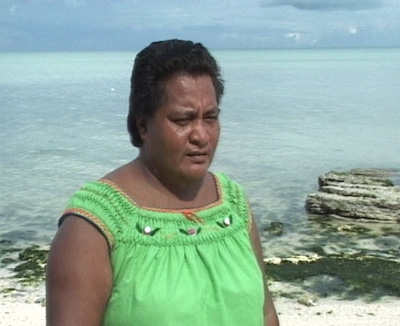
Allowing real people to tell their own personal experiences can also be very effective. I realised this five years ago, when we commissioned the first-ever documentary on climate change and the South Pacific, made by a native Pacific islander. Voices from the Waves, directed and produced by Bernadette Masianini of Fiji, was narrated by two teenagers growing up on two islands, each facing an uncertain future.

At one point we meet Mrs Saipolua, an ordinary woman who lives on the island of Kiribati, where no place is higher than a few feet above the sea. She is distressed having had to move her home twice in a past decade due to the receding shoreline.
For Kiribati’s 82,000 inhabitants, climate change is not theory; it’s already lashing on their beaches.

“Our house used to be in that spot,” Mrs Saipolua points to a place that’s now permanently submerged. “This is where we relocated to the second time.”

mrs-saipolua.jpg

She points to several tombstones that are on the verge of being washed away. “Even the final resting places of our loved ones are not spared…..The sea action had cracked the gravestones.”

I’ve covered climate change for years as a science writer. But it was Mrs Saipolua who made me realise the impact climate change is having on millions of ordinary people who have never heard that term.

Related links:

Pacific ‘Voices from the Waves’ on climate change

Read the full essay, Changing Climate and Moving Images on TVEAP website

Watch a video clip from Voices from the Waves on TVEAP’s YouTube Channel:

Video and DVD copies of Voices from the Waves can be ordered from TVE Asia Pacific’s online e-shop.

UN Climate Change Impact Report: Poor Will Suffer Most

The ‘Children of Brundtland’, 20 years on

On 30 March 2007, I was part of a South Asian Workshop to pre-test a pilot e-module on Science Journalism. Held at the University of Hyderabad, India, it brought together a small group sharing a passion for science journalism and science communication. It was organised by SciDev.Net with support from UNESCO.

I used my remarks to pay tribute to an important and lasting influence on my own career as a development communicator: Our Common Future, report of the Brundtland Commission that came out exactly 20 years ago. The anniversary was marked by a few organisations like IIED, but I felt it deserved better observance.


Here’s an extract from my remarks:

Within a few months of my entering active journalism, something happened globally that left a deep impression on me -– and as I later found out, on many others like myself in different parts of the world. In March 1987, the World Commission on Environment and Development –- chaired by the then Norwegian Prime Minister Gro Harlem Brundtland -– published its final report. Titled Our Common Future, it was the first of its kind to draw broad links between environmental, social and economic concerns and it made international policy recommendations accordingly. It prompted the UN to convene the Earth Summit in Rio de Janeiro in 1992.

The Report didn’t invent the concept or term sustainable development, but it certainly helped popularise it. The Commission’s work helped the environmental movement to evolve from the tree-hugging, whale-saving, cuddly animal level to a higher and multi-faceted level of environmental management.

And it inspired a generation of young journalists, educators and activists worldwide. I count myself among them –- in that sense, we are all Children of Brundtland.

IIED London takes stock of 20 years after Brundtland Commission Report

Living Labs searching for solutions

Today, March 22, is World Water Day. TVE Asia Pacific’s latest TV series, Living Labs, was released in Colombo and Washington DC last week in time for this day of significance in the development calendar.

The series — filmed in nine countries in Africa, Asia, Europe and Latin America last year — looks at how researchers, farmers and local communities in different parts of the world are trying to grow more food with less water.

This year’s theme for World Water Day is ‘Coping with Water Scarcity’, which resonates fully with the content of Living Labs.

Between 70 and 90 per cent of all freshwater drawn in the developing world is used for growing crops. But this has to change fast: with water scarcity emerging as a global concern, agriculture cannot afford to remain so hooked on water.

Today’s crowded world needs to produce more food using both less water and land. This calls for smarter, thriftier methods of increasing water’s productivity in agriculture. And it must be achieved without damaging the environment, or threatening people’s food security, health and jobs.

Living Labs looks profiles a major global effort looking for solutions through action research: the CGIAR Challenge Program on Water and Food (CPWF).

Read TVEAP news item on Living Labs

See all 8 short films in Living Labs series on TVEAP’s channel at YouTube.