“HIV is our virus; go find one of your own!”

“HIV is our virus; go find one of your own!”

Well, the nice lady on the phone didn’t actually say that. But that message was heard loud and clear.

And she is one at the forefront of fighting HIV/AIDS in my native Sri Lanka. My organisation had gone with an offer of help, in our own small way, to augment their good fight. But for reasons best known to her, she chose to brush us off.

It happens in the context of the 8th International Conference on AIDS in Asia and the Pacific, or ICAAP8. The year’s most important regional event on HIV is scheduled to be held in Colombo, Sri Lanka, from 19 to 23 August 2007. Several hundred members of our region’s HIV community — from activists and researchers to development aid officials and persons living with HIV — are expected to turn up.

HIV virus

TVE Asia Pacific has been involved in communicating about HIV for a few years. One highlight was when, at the invitation of the International AIDS Society and the Thai Ministry of Public Health, we organised the 2004 AIDS Film Festival in Bangkok. That was part of the XV International AIDS Conference.

We also distribute across Asia some outstanding factual films on HIV/AIDS produced in different parts of the world. Among them is the highly acclaimed Scenarios from Africa.

With these and other credentials, we had hoped that we could share our experience in using audio-visual media for communicating the HIV message in all its nuances and complexity.

Earlier this year, we responded to a call for skills building activities appearing on the Conference website. We didn’t know anyone involved, but we submitted a proposal to the website, outlining our offer to conduct a ‘Skills Building Workshop on Strategic use of moving images for HIV/AIDS Advocacy’. We didn’t ask for any money – our offer was to do it entirely at our cost. We planned to involve some Asian communicators who are regional leaders in this area.

A few weeks later we had a phone and email exchange with a Sri Lankan member of the secretariat
about our proposal. We don’t know this lady at all, but relating to her was not a pleasant experience. In fact, she was very dismissive and almost rude. She found fault with us for submitting our proposal late, when in fact we’d done so well within deadline!

We felt rebuffed and put off by her attitude. Although she said she was going to get back to us, it never happened. Evidently, our offer had touched on somebody’s raw nerve.

We still don’t know what irked this lady — it’s possible that my outspoken public views on HIV/AIDS in Sri Lanka may have been taken personally by a small mind. This is the problem with some people: they take evidence-based criticism personally.

Whatever was responsible, we won’t be at ICAAP8. Our friends who are part of the media team at the conference belatedly tried to involve us. But by then, our spirits were shattered.

A missed opportunity. And there’s some irony that while the Thai Ministry of Health invited us to run an entire film festival in their capital, the Sri Lankan Health Ministry (organisers of ICAAP8) would actually keep us out of this event!

Such are the politics of HIV, which I’m only just beginning to understand. And I thought we needed to unite against the common, invisible enemy…

Read my other blog posts on HIV:

HIV: Stigma a bigger killer than the virus?

Three Amigos: Funny condoms with a serious mission

Beware of Vatican condoms!

50? In South African terms, you’re probably dead!

Ratomate’s best cup of tea

A girl named Nan-nan

Baby 81: The Asian Tsunami’s big ‘non-story’

When many journalists chase the same unfolding story, it’s common for them to acquire the ‘herd mentality’. This ‘media pack’ can sometimes lose sense of direction, perspective — and even the truth.

A good example is the story of a Sri Lankan baby who grabbed world media attention for a few days as a “celebrated” Tsunami orphan.

The four-month-old boy, Abhilash Jeyarajah, was picked up by a neighbor who found him under a pile of garbage soon after giant waves lashed Kalmunai on 26 December 2004. The man handed over the child to the Kalmunai hospital. The parents, who also survived the waves, later found their child.

That should have been the happy ending for that family — but it was not to be.

Newspapers, television and news agencies reported how squabbling broke out among several couples over “Baby 81” — as he was dubbed by hospital authorities in Kalmunai, going by the admission number. As many as nine couples who lost their infants in the tsunami all claimed he was theirs — or so the story was spread by the news-hungry media who had descended on tsunami-hit Sri Lanka in their hundreds.

Photo courtesy Reuters

Even the usually cautious New York Times carried the story, referring to him as a “celebrated orphan”.

The story assumed a momentum of its own. One leading American TV network invited the baby and his parents to visit the US to be their studio guests and tell their ‘story’.

It was only many weeks later that the truth began to emerge.

Police denied nine couples had claimed him as their own. Kalmunai hospital authorities confirmed that only one couple had come forward to claim the baby. The man who handed over the child to hospital told police that he had known the child was that of his neighbors — there was no dispute about the parentage.

“Because it had a miraculous escape, a lot of people showed interest in the child, but they never said they were the parents,” chief inspector W. C. Wijetilleka was quoted as saying. “Only one couple claimed the child. No one else has come forward to make a legal claim.”

“As far as the police and the courts are concerned, only one couple is claiming the child,” inspector Wijetilleka said. “We have reported the facts to court and the judge ordered the hospital to release the child to the parents.”

The story was fuelled by the hospital’s initial reluctance to release the boy until he was well enough. The couple then petitioned the court, which ordered on 12 January 2005 that the baby be given to them. DNA tests, presented to court on 14 February 2005 confirmed their claim as biological parents.


Read Lanka Business Online account of what happened: Baby 81 – the story with nine or more lies

Read Reuters AlertNet guest blogger Glenda Cooper’s recent update on the Baby 81 saga

This non-story was discussed during the Asian regional brainstorming on Communicating Disasters that TVE Asia Pacific and UNDP organised in Bangkok, Thailand, in December 2006.

“The young couple was at the centre of endless media coverage for several weeks,” Asoka Dias, Station Director of MTV/MBC Network, Sri Lanka, told our meeting.

He added: “This created public impression that they also received a great deal of money and other help, which was not the case. They have had to relocate to a new neighbourhood, and are struggling to lead normal lives.”

Read the meeting report of Communicating Disasters

Lions and community radio: part of Sri Lanka’s mythical lore

Even well-meaning, usually balanced media organisations can occasionally slip, and fall for traps that damage their credibility.

I have always had the highest regard for Inter Press Service (IPS), the news agency of the majority world that presents the Southern voice and perspective. In the early days of my career, I shared an office with IPS bureau in Colombo, and still count many good friends who work or report for IPS from different parts of Asia.

Imagine my dismay and surprise, then, when this news story was carried by IPS earlier today:

MEDIA-SRI LANKA:
Building Ethnic Harmony With Community Radio

KOTHMALE, Jun 4 (IPS) – In this tea-growing hill country, about 150 km from Colombo, a state-run community radio station is creating harmony among the country’s Sinhalese, Tamil and Muslim ethnic groups by broadcasting from the villages and opening up the airwaves to people’s participation.

”People all over Sri Lanka are talking about peace, but this community radio has been doing it from the beginning,” P. Pavitheran, an announcer at the Kothmale Community Radio (KCR) told IPS.

“We don’t have any community divisions here,” added the Tamil broadcaster who also speaks fluent Sinhalese and switches smoothly between the two languages on air. “All my (assisting) staff are Sinhalese, but we’re all working together as a team.”

KCR on FM band was set up by the government-owned Sri Lanka Broadcasting Corporation (SLBC) in 1989 with 3 hours of transmission three days a week. Today, it broadcasts 12.5 hours a day on weekdays and 8 hours on weekends in both Sinhalese and Tamil. It covers a modest 20-km radius that includes 60 villages and 3 rural towns and reaches a population of 200,000. Read the full story here

IPS

This is one of those feel-good stories that news agencies like to publish once in a while, so that it counter the mainly negative stories that they carry as mirrors of society.

But in this instance, IPS has – perhaps inadvertently – peddled a pervasive myth that has been fabricated and distributed by UNESCO for over two decades about there being community radio stations in Sri Lanka.

I have lived and worked in Sri Lanka all my life, and never once come across a community radio station. In fact, this is a rare instance where successive governments for the past 20 years stand united: all have stubbornly refused to license any community radio.

There has never been, and there isn’t, any community radio in Sri Lanka in the sense the rest of the world understands that term. The fully state-owned and government-controlled Sri Lanka Broadcasting Corporation (SLBC) has several rural transmissions which masquerade as community radio, hoodwinking gullible development donors and naive foreign journalists.

As I have written in many places over the years, local communities have no control over content or management of the station. And no political content is allowed in the programming — try criticising the government in office and the jackboot of the Big Bad Babus of SLBC will come down with thunderous effect!

Let me quote from one of my published articles:

“SLBC broadcasts from all corners of the country, including stations located in remote areas. The channel involves local people in programme production, and it maintains a strongly agrarian audience. But listeners have no say in running the stations – these are managed by a tight bureaucracy in the capital Colombo, whose rigid guidelines control content: strictly no politics, and nothing remotely against the government in office.

“But, although touted as such, SLBC is not community radio, which is supposed to promote access, public participation in production and decision-making and listener-financing – where each listener contributes a small amount towards the running of the radio station.”

Read full article in Panos Features: Radio in Sri Lanka suffers as Colombo bosses call the shots

See also: Sri Lankan government’s broadcast stranglehold in UCLA’s AsiaMedia

Despite all this, if someone still insists that there is community radio in Sri Lanka, I can argue that by the same token, lions roam free in Sri Lanka’s remaining jungles. After all, the Sinhalese have a folk lore suggesting they descend from a lion.

Both prospects are equally fantastic. At least there are a couple of lions in the zoo.

Individuals are free to believe in fabrications coming out of that Paris-based myth factory called UNESCO. But responsible news organisations like IPS need to fact-check their stories lest they legitimise these dubious claims that contribute to suppressing genuine media freedom and media pluralism in Sri Lanka.

Press freedom in the digital age: Seeing beyond our noses and tummies

See later post on 3 May 2008: Who is afraid of Citizen Journalists?

On 3 May 2007, we mark another World Press Freedom Day.

This day is meant to ‘raise awareness of the importance of freedom of the press and to remind governments of their duty to respect and uphold the right to freedom of expression enshrined under Article 19 of the Universal Declaration of Human Rights.’

Read more about the Day on the Wikipedia and World Association of Newspapers. (Ah yes, that cartel of governments called UNESCO also puts up a show every year to mark this day, but it’s no better than the mafia bosses coming together to pontificate about the rule of law and justice for all. So let’s completely ignore the irrelevant UN behemoth and its meaningless hot air.)

The essay I wrote two weeks ago about saving our (electro-magnetic) spectrum to safeguard media freedom and media pluralism has been widely reproduced on the web.

That’s precisely the kind of insidious, hidden dangers to media freedom that don’t receive sufficient attention at many events to mark World Press Freedom Day.

I found this out the hard way when the Editors Guild of Sri Lanka invited me to address their observance of the 2001 World Press Freedom Day in Colombo. In the audience were over 250 Sri Lankan journalists and editors, and my topic was global trends and challenges to press freedom.

I decided to talk about ICTs – information and communication technologies – and how they were impacting the profession and industry of journalism. I recalled how technologies like mobile phones and satellite television had completely revolutionised the nature of news gathering and dissemination during the 1990s. The Internet was once again turning the whole media world upside down, I said: sooner rather than later, the impact of these developments would be felt in little Sri Lanka.

I argued that by being well informed and prepared, we could adapt better to the new challenges posed by the Internet, and we will be able to seize the many opportunities the new medium offers to consolidate press freedom. I mentioned some examples from the Asia Pacific and elsewhere how social activists, indigenous people and political groups – including separatist organisations – are using the power of the Internet to disseminate information and opinions at a low cost to a worldwide audience, and how states and their censors were increasingly unable to control such flows across political borders.

Unfortunately, a section of the audience felt very strongly that I was talking ‘pie in the sky’ when journalists in Sri Lanka were grappling with much more urgent issues of survival – such as low salaries, poor working conditions, and threats of physical harm or even death in the line of duty.

I was told — firmly — not to talk about computers and Internet when some media organisations did not even provide sufficient seating or (book) library facilities for their journalists. “Internet is good for pampered western journalists. We have survival issues,” one ardent critic said.

Now, it’s far more interesting to talk to a room full of disagreeing people. I took these comments in that spirit.

In the ensuing discussion, I readily agreed that all immediate factors mentioned by my detractors were indeed major concerns. My point, simply, was that we could not afford to ignore the bigger trends and processes that shape our industry and redefine how we reach our audiences.

Cartoon courtesy WAN

Just as terrestrial television broadcasters had to adjust and reorient themselves when faced with challenges from satellite television in the 1990s, the entire media sector – print and broadcast – has to come to terms with the Internet and World Wide Web.

I added: It doesn’t do any good to bury our head in the sand and wish it to go away. The much better option, as Sir Arthur Clarke has suggested, is ‘cautious engagement of the new media, so that we can exploit the inevitable’

Exploiting the inevitable is precisely the pragmatic approach we need. The globalisation of economics, media and information is taking place regardless of our individual opinions and reactions. By positioning ourselves for cautious engagement and to take advantage of tools and opportunities ushered in by the digital age, we can promote both media freedom and media pluralism.

Three years later, I expanded these ideas into a semi-academic paper (that is, as academic as I can ever get!) presented to the Annual Conference of the Asian Media Information and Communication Centre (AMIC) held in Bangkok, Thailand, in July 2004. I titled it: Media Pluralism in the Digital Age: Seize the Moment

It was later published in AMIC’s quarterly journal, Media Asia. Here’s how I ended my paper:

Newer ICTs can strengthen the outreach, quality and inclusiveness of the mass media. The true potential of this change can only be tapped when all stake-holders of the media play their part. A particular challenge to the ICT4D community is advocating the policy and legislative reform agenda that will enable this process.

There is an interesting post script to my experience with the Sri Lankan media on World Press Freedom Day 2001 quoted at the beginning.

During the past three years, more journalists, producers and their gatekeepers have begun using the Internet as a tool, information resource or alternative medium for expression. The initial apprehensions that some professionals harboured about this new medium have been replaced with growing enthusiasm and a recognition of its utility.

The vindication of my initially disputed seminar remarks came sooner than I expected. My most vehement critic that day was a fire-breathing young reporter then working for a Sinhala newspaper. Less than a year later, this avowed sceptic of the Internet launched his own website to disseminate news and commentary on social, political and economic issues that he felt he could not freely cover in the mainstream print outlets. The fact that his initiative did not last more than a few issues is another matter; clearly, he has been converted.

He would be happy to hear that I have been among regular visitors to his website.

Related: Media Freedom Internet Cookbook

Media Helping Media website

Arthur Clarke looking for signs of life in Colombo…

I have finally found my legitimate claim for being unique: I don’t follow cricket.

Yes, you heard me right. Despite being born and raised in Sri Lanka, and still being based there about half of my time, I have never been a great fan of cricket. I must be the only one in my office who gets a decent night’s sleep these days. Practically everyone stays up till the wee hours of the morning watching live TV broadcasts of the ICC World Cup cricket matches taking place literally on the other side of the globe: the West Indies.

There’s now a very close nexus between television and cricket. Live broadcasts beam instantly into our living rooms the action on a cricket field anywhere on the planet. In fact, thanks to the zoom-ins, slow-motion instant replays and other techniques, those who watch a cricket match on the small screen can share the action even better than the few thousand who witness it physically at the stadium. (And the screens are no longer very small: across cricket-crazy South Asia, sales have soared for plasma screens of increasingly large – if not mostrous – sizes.)

The man who made all this possible is slightly bemused — but not one bit affected — by all this frenzy. Sir Arthur C Clarke, science fiction author, futurist and inventor of the communications satellite, sits in his living room, pondering the near and far future of humanity that he helped transform into a Global Village.

That’s the only other person in the whole of Colombo that I know who isn’t infected by the current World Cup fever. (See my other post today for views of a rare Indian who doesn’t follow cricket and instead prefers to watch old movies.)

Writing a foreword to the UNDP’s Human Development Report in 2003, Sir Arthur noted: “Today, television rules how Sri Lankans work, dine and socialise. And when an important cricket match is being broadcast live, I have to look hard to find any signs of life on the streets of Colombo.”

We might opt out of following the cricket, making ourselves rather dull conversationalists these days, but if we dare to utter even a word against this de facto religion of South Asians, dire consequences are sure to follow.

A decade ago, Sir Arthur had a first hand experience to prove this. In a wide-ranging media interview, he told a visiting Reuters correspondent that he shared some people’s skepticism that cricket was the slowest form of animal life, because it takes so long. (A Test match can take as many as five full days, and still end without a clear result!).

Having mis-heard Sir Arthur, the Reuters man filed his story saying Arthur C Clarke calls cricket the `lowest form of life’.

That was enough to stir up a mini storm. It couldn’t have come at a worse time — Sri Lanka had just won the 1996 cricket World Cup and the country was still euphoric. For weeks, Sir Arthur had to cope with irate Sri Lankan cricket fans — as he told a visiting American journalist from The Philadelphia Inquirer, ‘I had a lot of explaining to do’.

Moral of the story:
1. Be always careful when talking to journalists.
2. Keep your criticism of cricket strictly to yourself.

Human Development Report Foreword by Sir Arthur C. Clarke: Communications for Goodness’ Sake

Read my later post: Arthur Clarke’s climate friendly advice: Don’t commute; communicate!

More memories of Theeban…

On March 17, I wrote about introducing our Children of Tsunami documentary at the DC Environmental Film Festival, and and how I dedicated the screening to Theeban – the Sri Lankan boy who survived the Asian Tsunami, but was killed in the island nation’s political violence on 3 March 2007.

My personal tribute to Theeban has been widely circulated online. Edited versions have appeared on MediaHelpingMedia (UK) and Asia Media from University of California Los Angeles (USA).

It appears that my tribute has moved many readers. I’ve heard from several by email – encouragingly, all supportive and sympathetic. Among those who wrote was young journalist Chathuri Dissanayake, who worked as a researcher for Video Image, the Sri Lankan production company we (TVE Asia Pacific) engaged to film Theeban’s unfolding story for most of 2005.

With her permission, I want to share her recollections and views:

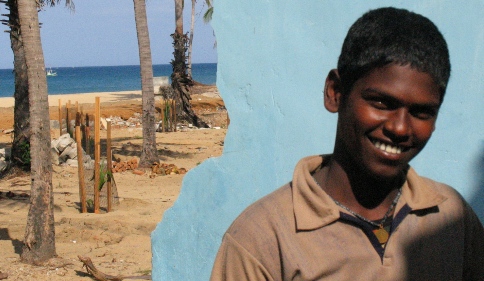
It’s a very nice piece about Theeban. It captures what we had grown to love in the boy. The picture you have of him taken on I think our first visit brings back a lot of memories.

theeban.jpg

When he was abducted (in late 2006), I always thought at least he is alive, now I’m still trying to come to terms with the fact that he is no more. The best memory I have of him is his wide smile. The pictures you have chosen bears ample testimony as to how beautiful that is. Even though he couldn’t communicate with us coz of the language barrier his smile and eyes were so expressive. When I first met him at the camp what struck me most was his unspoilt innocence. I wish I had taken a bit more trouble to help him out after the filming ended.

Theeban gave life to harsh realities of the conflict in the country that I have lived all my life with. Before meeting Theeban and visiting his village, I only knew what media told me of the east but Theeban brought it closer to me. Earlier, when ever I heard of the violence in the north or the east, it was just news to me as it was to many living in the “right side of the country”. But the Children of Tsunami project opened up the other side of the story, and as a young journalist, I gained a lot of experience.

To me, Theeban was real and he represented many youngsters in the area. His scattered dreams and hopes were real and it is a tragedy that help doesn’t reach them. Nothing substantial was done to help him and many others like him to rebuild their lives. Theeban was too young for any sort of vocational training that was available, and he didn’t have the right qualifications. My dilemma of what would happen to Theeban and many like him whose futures were washed away in the Tsunami grew as all the options of vocational training I checked out for Theeban turned out that applicants needed at least (GCE) Ordinary Level. Theeban was forced to leave school and it looked as if it never struck to any authority that someone needs to look after the youths like Theeban.

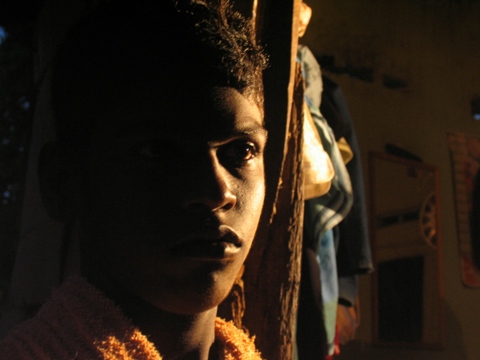
theeban-photocredit-video-imagetveap.jpg

To me Theeban, like many others was another victim of forces that he had no control over. It was not his fault that a tidal wave destroyed his family but he paid for it dearly, gave up his education and took the responsibilities of the bread winner of the family on to his shoulders. When the Tsunami struck he was still hopeful he wanted to earn money and take care of his brothers. He missed his mother dearly but found a bit of comfort in his grandma. But the violence that sprang up in the area had no mercy on him. Theeban’s story ended in tragedy coz the forces that were against him were too strong for him to fight back. The hope I saw in his eyes still haunts me. But I take comfort in knowing that at least he tried to fight back. No matter what his shy smile and shining eyes will remain with me.

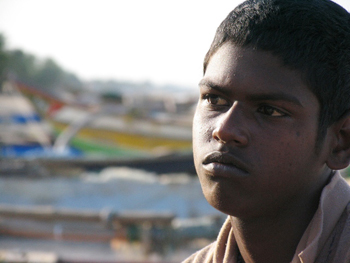
That is how I remember Theban best. A youth who managed to smile and have a hope for the future in spite of the trauma that he went through when many grown up men around him gave up on life.

Remembering Thillainayagam Theeban (1990 – 2007)

Thillainayagam Theeban (1990 – 2007)
Since we started Children of Tsunami media project in early 2005, as a citizen media response to the Indian Ocean Tsunami, I have introduced it to dozens of audiences of many and varied kinds in different parts of the world. But presenting our documentary, Children of Tsunami: The Journey Continues to the 15th DC Environmental Film Festival at the World Bank headquarters yesterday (16 March 2007) was perhaps the most difficult of all.

No, this was not a cynical audience – far from it, they turned out to be a very appreciative one, as I describe in my other post. But this was the first public introduction I had to make after we lost Theeban, the Sri Lankan boy who was one of eight children whose recovery story we tracked and filmed for much of 2005.

Theeban was murdered by unidentified gunmen who stormed into his ‘temporary’ tsunami shelter on 3 March 2007. The death is linked to spiralling political violence that is once again sweeping across Sri Lanka.

When the shocking news reached us three days later, our Sri Lankan camera team at Video Image and we at TVE Asia Pacific just couldn’t believe it. We were all in tears, and some of us were also angry. Theeban, who survived the killer waves 26 months ago (but lost his mom and kid brother in the disaster) suffered many indignities in displacement. And now, he is gone. 

It’s now two weeks since Theeban was killed, but I still can’t speak about it without a lump in my throat.

That’s why I was nervous in introducing the film yesterday at the festival: I knew I was just seconds away from being stuck for words, and overcome with emotion.

My friends in the audience later said I had managed reasonably well. This is what I said as I ended my brief introduction:

“We ran out of funds to sustain our monthly filming beyond end 2005. By then we found that our film crews and we ourselves had become attached to our participating families, and especially the children who worked so closely with our film crews. We remain interested in their personal progress, even if we can no longer publish their stories.

Earlier this month, we received the devastatingly sad news that the Sri Lankan boy we filmed has been murdered –- by unidentified gunmen, right at the ‘temporary’ camp in Eastern Sri Lanka.

Thillainayagam Theeban survived the killer Tsunami waves and endured 26 months of extreme hardship in displacement — only to be swept away by the wave of political violence currently sweeping Sri Lanka.

We still don’t know who killed Theeban, and for what reasons. He was abducted by an armed group a few months ago, from whom he escaped earlier this year. It is believed that Theeban was killed as a punishment — and as a warning to all others.

He was 16 years at the time of his death. We don’t know if his killers would ever face justice.

I want to dedicate this screening to Theeban — and thousands of young people like him who are still languishing in temporary shelters, struggling to rebuild their futures.”

After the screening, there was some sympathy and empathy in the audience about Theeban. But on the whole this particular development didn’t inspire too many questions or remarks. The predominantly American audience seemed more intrigued by our journalistic documentation of how evangelical Christian groups rushed to tsunami-struck Asia, offering relief support coupled with religious conversion. (Find out more about this by watching the film online.)

Ah well, everyone takes away something different from a film like Children of Tsunami. It has so many facets and elements mixed together.

We set out asking lots of questions, and found only a few answers. We still have lots of questions in search of answers…and new ones emerging.

Thillainayagam Theeban (1990 – 2007)

TVE Asia Pacific official statement on Theeban’s death

My personal tribute to Theeban, published by MediaHelpingMedia, UK

My tribute to Theeban, published by UCLA Asia Media