Remembering Saneeya Hussain

20 April 2007: It’s exactly two years ago that Saneeya Hussain left us.

Saneeya was a journalist who took a special interest in environment and human rights issues. All her working life, she campaigned tirelessly for a cleaner, safer and more equitable society for everyone — not just in her native Pakistan, but everywhere.

Ironically, it was the urban nightmare that we have collectively created that finally snatched her away at the prime of her career. She was 51.

saneeya-hussain.jpg

I first met Saneeya when we both worked for the same global organisation – IUCN, The World Conservation Union. She headed IUCN Pakistan’s Communication Division while I started a similar division for IUCN in Sri Lanka in the early 1990s. In fact, the trails she and her team had blazed in Pakistan was a model and inspiration for us.

In 1998, Saneeya moved to Cape Town in South Africa to work with the World Commission on Dams, an independent group of experts that had a tough mandate: consult widely to resolve the controversial issues associated with large dams. When the Commission held its South Asia consultations in Colombo, Sri Lanka, Saneeya approached us at TVE Asia Pacific to handle all the media relations.

It was while working in Cape Town that Saneeya met Luis Ferraz, a Brazilian geographer, whom she married later.
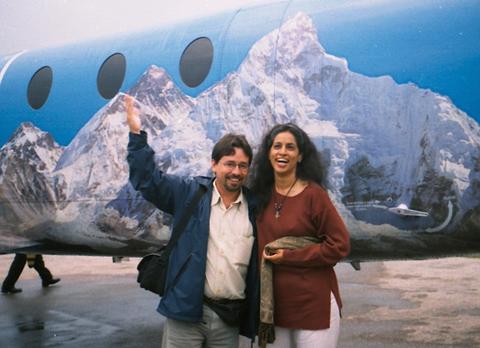
saneeya-and-luis-taking-an-everest-flight.jpg

In 2002, Saneeya became the Executive Director of Panos South Asia, a regional media organisation with its headquarters in Kathmandu, Nepal. As a Board member of Panos, I worked closely with Saneeya in a number of projects and activities.

Although everyone at Panos and in Kathmandu liked her, Saneeya’s stay there was cut short by what her successor at Panos, A S Panneerselvan, called her Siamese twin: asthma.

It was asthma that forced Saneeya to leave Nepal – and the Panos director’s job – as she just couldn’t cope with Kathmandu’s polluted air. As a fellow asthmatic, I fully empathised with her. She moved to Sao Paulo, where she set up what was to be her final home.

What happened in April 2005 has been written and discussed widely by Saneeya’s far-flung network of friends in the past two years. I can only reproduce the last few paras of a tribute I wrote in May 2005, which was privately circulated at the time:

When Saneeya suffered an acute attack of asthma in Sao Paulo on April 7, her husband Luis rushed her to hospital in his car. It was rush hour at 6.30 in the evening, and it took him 20 minutes to drive to the hospital only 2 kilometres away. Saneeya — who had walked to the car — stopped breathing five minutes into the journey. Luis drove as fast as the traffic would allow him, but as it turned out, not nearly fast enough.

Her brain suffered too much damage due to oxygen deprivation, and she never recovered.

As Luis was to remark later, it was not asthma but the traffic that killed Saneeya.

Similar tragic scenarios unfold on South Asia’s mean streets every day. Heart and stroke patients fail to reach help in time. Ambulences and fire engines, with their sirens blaring, only manage to proceed at a snail’s pace. It’s not uncommon for expectant mothers in labour to give birth on their way to hospitals. Then there is the slow, insidious poisoning that goes on 24/7.

So let us be forewarned. If the air pollution doesn’t get us, the traffic jams will. And if we survive both, our road accidents will wait for us. It’s only a matter of time.

Not one but several serial killers are out there.

And we unleashed them all.

beena-sarwar-left-and-saneeya-hussain-photo-courtesy-b-sarwar.jpg

Our mutual friend Beena Sarwar (in the photo above, with Saneeya) has made a 14-minute documentary called Celebrating Saneeya. It was screened at the 5th Karachi International Film Festival in December 2005.

See also my essay ‘Grappling with Asia’s Tsunami of the Air’ (December 2006).

All photos from Saneeya Yahoo Group that links her friends around the world.

The ‘Children of Brundtland’, 20 years on

On 30 March 2007, I was part of a South Asian Workshop to pre-test a pilot e-module on Science Journalism. Held at the University of Hyderabad, India, it brought together a small group sharing a passion for science journalism and science communication. It was organised by SciDev.Net with support from UNESCO.

I used my remarks to pay tribute to an important and lasting influence on my own career as a development communicator: Our Common Future, report of the Brundtland Commission that came out exactly 20 years ago. The anniversary was marked by a few organisations like IIED, but I felt it deserved better observance.


Here’s an extract from my remarks:

Within a few months of my entering active journalism, something happened globally that left a deep impression on me -– and as I later found out, on many others like myself in different parts of the world. In March 1987, the World Commission on Environment and Development –- chaired by the then Norwegian Prime Minister Gro Harlem Brundtland -– published its final report. Titled Our Common Future, it was the first of its kind to draw broad links between environmental, social and economic concerns and it made international policy recommendations accordingly. It prompted the UN to convene the Earth Summit in Rio de Janeiro in 1992.

The Report didn’t invent the concept or term sustainable development, but it certainly helped popularise it. The Commission’s work helped the environmental movement to evolve from the tree-hugging, whale-saving, cuddly animal level to a higher and multi-faceted level of environmental management.

And it inspired a generation of young journalists, educators and activists worldwide. I count myself among them –- in that sense, we are all Children of Brundtland.

IIED London takes stock of 20 years after Brundtland Commission Report

Arthur Clarke looking for signs of life in Colombo…

I have finally found my legitimate claim for being unique: I don’t follow cricket.

Yes, you heard me right. Despite being born and raised in Sri Lanka, and still being based there about half of my time, I have never been a great fan of cricket. I must be the only one in my office who gets a decent night’s sleep these days. Practically everyone stays up till the wee hours of the morning watching live TV broadcasts of the ICC World Cup cricket matches taking place literally on the other side of the globe: the West Indies.

There’s now a very close nexus between television and cricket. Live broadcasts beam instantly into our living rooms the action on a cricket field anywhere on the planet. In fact, thanks to the zoom-ins, slow-motion instant replays and other techniques, those who watch a cricket match on the small screen can share the action even better than the few thousand who witness it physically at the stadium. (And the screens are no longer very small: across cricket-crazy South Asia, sales have soared for plasma screens of increasingly large – if not mostrous – sizes.)

The man who made all this possible is slightly bemused — but not one bit affected — by all this frenzy. Sir Arthur C Clarke, science fiction author, futurist and inventor of the communications satellite, sits in his living room, pondering the near and far future of humanity that he helped transform into a Global Village.

That’s the only other person in the whole of Colombo that I know who isn’t infected by the current World Cup fever. (See my other post today for views of a rare Indian who doesn’t follow cricket and instead prefers to watch old movies.)

Writing a foreword to the UNDP’s Human Development Report in 2003, Sir Arthur noted: “Today, television rules how Sri Lankans work, dine and socialise. And when an important cricket match is being broadcast live, I have to look hard to find any signs of life on the streets of Colombo.”

We might opt out of following the cricket, making ourselves rather dull conversationalists these days, but if we dare to utter even a word against this de facto religion of South Asians, dire consequences are sure to follow.

A decade ago, Sir Arthur had a first hand experience to prove this. In a wide-ranging media interview, he told a visiting Reuters correspondent that he shared some people’s skepticism that cricket was the slowest form of animal life, because it takes so long. (A Test match can take as many as five full days, and still end without a clear result!).

Having mis-heard Sir Arthur, the Reuters man filed his story saying Arthur C Clarke calls cricket the `lowest form of life’.

That was enough to stir up a mini storm. It couldn’t have come at a worse time — Sri Lanka had just won the 1996 cricket World Cup and the country was still euphoric. For weeks, Sir Arthur had to cope with irate Sri Lankan cricket fans — as he told a visiting American journalist from The Philadelphia Inquirer, ‘I had a lot of explaining to do’.

Moral of the story:
1. Be always careful when talking to journalists.
2. Keep your criticism of cricket strictly to yourself.

Human Development Report Foreword by Sir Arthur C. Clarke: Communications for Goodness’ Sake

Read my later post: Arthur Clarke’s climate friendly advice: Don’t commute; communicate!