Nepal’s Aankhijhyal is 500 — and counting!

Aankhijhyal is a Nepali word. It means window.

Aankhijhyal is today also a ‘brand name’ in Nepal. It’s Nepal’s most popular TV magazine programme on environment and social development, which recently produced its 500th edition.

Aankhijhyal logo NEFEJ logo

The half-hour programme has been produced regularly since May 1994. Now in its 13th year, it is one of developing Asia’s longest running television shows.

The landmark 500th edition was broadcast on 27 February 2007. In this special programme, its producers, the Nepal Forum of Environmental Journalists (NEFEJ), looked back at the interesting and challenging times they have chronicled and investigated.

And last night in Kathmandu, the Nepali capital, I sat down with a team of friends from NEFEJ to belatedly celebrate the occasion.

A dozen journalists, producers and film-makers joined us. We chatted away well into the night. There was no longer any worries about curfews and army check-points.

“We don’t often get together like this as one big group,” said Rabindra Pandey, head of Audio-Visual at NEFEJ. “Most of the time, we are too busy to socialise. We are chasing deadlines, or stories, or sponsors!”

There is much to cheer, both at micro and macro levels.

Sustaining a half-hour show on television is no mean feat in any part of the world, especially in a low income country like Nepal. Broadcasters here don’t put any money in programmes like Aankhijhyal . In fact, NEFEJ not only produces the show entirely at its own cost, but also pays for airtime on Nepal Television to get it out to the public! That’s the broadcast reality that many of our western colleagues are often unable to understand.

And the general feeling right now in Nepal is upbeat. After Nepal’s own People Power revolution of April 2006, people are hopeful that their ‘second chance in democracy’ can actually work better. While the streets of Nepal are as dusty and chaotic as ever, I can see far more tourists and far fewer soldiers on the roads now than on previous visits in recent years.

NEFEJ is a non-profit collective of journalists committed to communicating sustainable development issues. Foundecd 20 years ago, it has a much better record of democracy than Nepal itself: every year, office-bearers are democractically elected by its over 100 members. There is regular ‘change of guard’ at the top.

NEFEJ is also one of the oldest and strongest parters for us at TVE Asia Pacific.

Aankhijhyal is the organisation’s ‘crown jewel’. It’s the centrepiece of NEFEJ’s Audio Visual Department, and has been widely acclaimed for its investigative approach to sustainable development and social justice issues.

From land reform and agrochemical misuse to the conservation of heritage sites, and from the trafficking of women and children to HIV, Aankhijhyal has been covering a broad range of issues, concerns and controversies in the public interest. While remaining apolitical, the programme has also reflected the human, social and environmental costs of Nepal’s violent insurgency and pro-democracy struggle in recent years.

Filming Aankhijhyal - image courtesy NEFEJ

“Since its inception in 1993, we have come a long way and Aankhijhyal has managed to create awareness among the Nepalis on the issues related to environment and development,” says Rabindra. “Aankhijhyal still remains one of the most popular video magazines on Nepal Television.”

Aankhijhyal’s passing 500 editions is all the more significant because it has been sustained without a break by this non-profit cooperative of journalists. Whether or not external funding was available, NEFEJ has continued producing the programme – often using its own savings from other, better-funded projects.

And it was clear to me last night that they have no intention of resting on their laurels.

“There’s so much happening in Nepal today. We are living in a period of rapid change. We feel one half-hour show a week is not enough to capture the unfolding stories,” said NEFEJ’s current President, Sahaj Man Shrestha, himself a former CEO of a private TV channel in Nepal.

Image courtesy NEFEJ

Read TVE Asia Pacific news item: Nepal’s premier TV magazine Aankhijhyal is 500 (27 Feb 2007)

NEFEJ Aankhijhyal online archives

More about NEFEJ Audio-Visual Department

Read Indian magazine Down to Earth on Aankhijhyal

All images courtesy NEFEJ

Remembering Saneeya Hussain

20 April 2007: It’s exactly two years ago that Saneeya Hussain left us.

Saneeya was a journalist who took a special interest in environment and human rights issues. All her working life, she campaigned tirelessly for a cleaner, safer and more equitable society for everyone — not just in her native Pakistan, but everywhere.

Ironically, it was the urban nightmare that we have collectively created that finally snatched her away at the prime of her career. She was 51.

saneeya-hussain.jpg

I first met Saneeya when we both worked for the same global organisation – IUCN, The World Conservation Union. She headed IUCN Pakistan’s Communication Division while I started a similar division for IUCN in Sri Lanka in the early 1990s. In fact, the trails she and her team had blazed in Pakistan was a model and inspiration for us.

In 1998, Saneeya moved to Cape Town in South Africa to work with the World Commission on Dams, an independent group of experts that had a tough mandate: consult widely to resolve the controversial issues associated with large dams. When the Commission held its South Asia consultations in Colombo, Sri Lanka, Saneeya approached us at TVE Asia Pacific to handle all the media relations.

It was while working in Cape Town that Saneeya met Luis Ferraz, a Brazilian geographer, whom she married later.

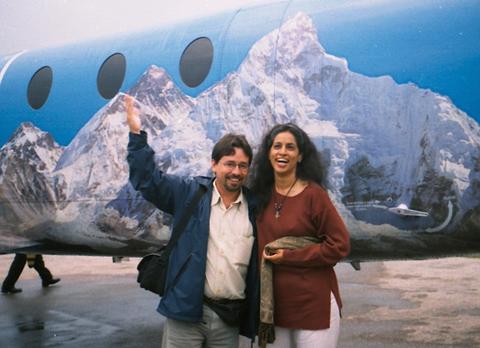
saneeya-and-luis-taking-an-everest-flight.jpg

In 2002, Saneeya became the Executive Director of Panos South Asia, a regional media organisation with its headquarters in Kathmandu, Nepal. As a Board member of Panos, I worked closely with Saneeya in a number of projects and activities.

Although everyone at Panos and in Kathmandu liked her, Saneeya’s stay there was cut short by what her successor at Panos, A S Panneerselvan, called her Siamese twin: asthma.

It was asthma that forced Saneeya to leave Nepal – and the Panos director’s job – as she just couldn’t cope with Kathmandu’s polluted air. As a fellow asthmatic, I fully empathised with her. She moved to Sao Paulo, where she set up what was to be her final home.

What happened in April 2005 has been written and discussed widely by Saneeya’s far-flung network of friends in the past two years. I can only reproduce the last few paras of a tribute I wrote in May 2005, which was privately circulated at the time:

When Saneeya suffered an acute attack of asthma in Sao Paulo on April 7, her husband Luis rushed her to hospital in his car. It was rush hour at 6.30 in the evening, and it took him 20 minutes to drive to the hospital only 2 kilometres away. Saneeya — who had walked to the car — stopped breathing five minutes into the journey. Luis drove as fast as the traffic would allow him, but as it turned out, not nearly fast enough.

Her brain suffered too much damage due to oxygen deprivation, and she never recovered.

As Luis was to remark later, it was not asthma but the traffic that killed Saneeya.

Similar tragic scenarios unfold on South Asia’s mean streets every day. Heart and stroke patients fail to reach help in time. Ambulences and fire engines, with their sirens blaring, only manage to proceed at a snail’s pace. It’s not uncommon for expectant mothers in labour to give birth on their way to hospitals. Then there is the slow, insidious poisoning that goes on 24/7.

So let us be forewarned. If the air pollution doesn’t get us, the traffic jams will. And if we survive both, our road accidents will wait for us. It’s only a matter of time.

Not one but several serial killers are out there.

And we unleashed them all.

beena-sarwar-left-and-saneeya-hussain-photo-courtesy-b-sarwar.jpg

Our mutual friend Beena Sarwar (in the photo above, with Saneeya) has made a 14-minute documentary called Celebrating Saneeya. It was screened at the 5th Karachi International Film Festival in December 2005.

See also my essay ‘Grappling with Asia’s Tsunami of the Air’ (December 2006).

All photos from Saneeya Yahoo Group that links her friends around the world.

Ratomate’s best cup of tea

In another post earlier today, I quoted a doctor turned film-maker in India saying people affected by HIV are dying more from the social stigma attached to the disease than by the disease itself.

Social stigma is a wide-spread problem that confronts people living with HIV in all parts of the world.

But occasionally, we hear some good news: how community has overcome its prejudices and accepted those infected with HIV with affection and care. Usually, it happens after going through the knee-jerk reactions.

It would be very worthwhile for some research to be done on how and when community attitude changes: what are the triggers? what is the tipping point?

Five years ago, we had first hand experience of this through a film that we at TVE Asia Pacific commissioned under our Truth Talking documentary series.

The film, titled Love for a Longer Life (26 mins, 2002) was directed by leading Nepali documentary film-maker Dhurba Basnet.
dhurba-basnet.jpg

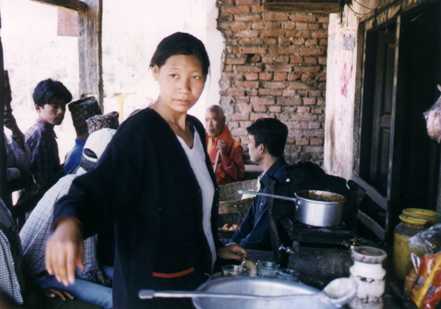
The best cup of tea in the Ratomate village, in central Nepal, is made by a woman called Laxmi Lama. She works in a tea shop owned by her father. “People tell me my father does not know how to make good tea,” she says. “They want me to make tea. The men like their tea strong. When I give my customers strong tea they say one cup is enough for the whole day.”

This is nothing unusual – except that Laxmi is living with HIV. A few years ago, no one in her village would have come near her, let along clamour for a cup of tea she makes.

Born into a very poor family, Laxmi was sold off to a Bombay brothel at the age of 14, and worked as a commercial sex worker for nearly three years before returning to Nepal. She married a man from her village and had settled down to a peaceful routine when a health worker tested her blood and found her positive for HIV. That changed everything dramatically: her husband fled, never to return, and everybody shunned her. The pregnant woman sought refuge in her parents’ house.

That was the fate of most Nepalis living with HIV – abandoned by friends, ostracised by community and left to their own devices. But thanks to the perseverance of a few courageous people – many HIV positive themselves – community attitudes have changed slowly, and have come almost full circle: being reassured that HIV does not spread through casual physical contact, they have accepted her back into their fold.

lakshmi-lama.JPG The moment of truth is when she makes Ratomate’s favourite cups of tea with her bare hands, and men and women flock to taste it. Such a major transformation of community attitudes captured in such a simple, elegant sequence.

Laxmi’s neighbour Kumari Shrestha sums it all up: “We have to give her love. If we do that, she will live longer.”

It would be wonderful if we can discern how and when this change happens. So that it can be induced in thousands of other villages and communites where persons living with HIV are currently battling the virus within, and stigma without.

View a clip from the film here.
Order the film from TVEAP e-shop