Can media tame the global ‘alms bazaar’?

The Asian Tsunami of December 2004 inspired dozens of cartoons in newspapers and websites all over the world. To me, this was one of the most heart rending Tsunami cartoons.

Without a single word, it said so much about the humanitarian sector’s conduct and priorities. It showed how Asia’s massive disaster drained much needed support from other unfolding emergencies in the world.

This week in Geneva – arguably the humanitarian capital of the world – a leading Swiss journalist once again raised the crucial issue: how best can humanitarian agencies respond to multiple crises without everyone ending up in a needless frenzy?

Edward Girardet, who specialises in in media, humanitarian aid and conflict issues, was speaking at a media workshop on tracking climate change that his non-profit organisation, Media21, organised this week in conjunction with the Global Platform on Disaster Risk Reduction in Geneva (5 – 7 June 2007).

The platform, organised by the UN International Strategy for Disaster Reduction (UN-ISDR), brought together several hundred disaster managers, researchers and activists for three days of discussion and debate on key issues and challenges they face.

Ed was outspoken in his critique of the humanitarian sector (which, someone suggested during the week, is the largest unregulated industry in the world).

“Much of the emergency response to the Indian Ocean tsunami in late 2004 was not required, but hundreds of organizations still insisted on being seen, often at the cost of rechanneling humanitarian resources from vital operations elsewhere in the world, bringing some to virtual collapse, notably in Africa.”

Writing an op ed piece in the Christian Science Monitor this week, Ed has expanded on his views. He says:

“What this amounts to is a blatant abuse of public confidence. As one International Committee of the Red Cross representative admitted, if the donating public knew how often personal egos or vested interests call the shots, they might prove less forthcoming in their support.”

Edward Girardet, Swiss journalist

Here is how he ends his essay:

Humanitarianism, however, should not “belong” to any one group. What the international aid industry urgently needs is more hard-nosed and independent reporting.

Current initiatives such as IRIN, the UN’s humanitarian news service, and the World Disaster Report of the International Red Cross are excellent in many ways but widely perceived as beholden to their organizations.

Another question is whether one can expect real criticism of the international aid industry if such ventures are themselves cofunded by governments.

The best solution would be the creation of a viable media watchdog capable of reporting the real causes behind humanitarian predicaments, including how the international community responds.

Most mainstream news organizations are unlikely to cover the global aid business on a consistent basis.

On the other hand, a pooling of media, corporate, and foundation support for a specialized reporting entity could prove to be the answer. Any other approach that does not guarantee complete independence would be a waste of time and money.

Read his full op ed in Christian Science Monitor online (8 June 2007 issue).

Read the full report of TVE Asia Pacific’s Roundable meeting on Communicating Disasters, held in Bangkok, December 2006

Sex and the warming planet: a tip for climate reporters

I had no idea that the nice lady seated next to me was described by her publisher as ‘America’s hottest sex therapist’.

Nor had I linked sex with climate change — though, come to think of it, both have something ‘hot’ in common.

Psychologist, journalist and sex therapist Dr Judy Kuriansky came out with practical advice on how we journalists can cover climate change in more interesting ways. And she made a lot of sense.

“You have to make the climate story appeal to the average reader or viewer,” the Professor of Clinical Psychology at Columbia University Teacher’s College, USA, told us participants at a global media workshop on understanding and reporting climate change in Geneva this week.

In some ways, attracting audience attention is comparable to getting a new date, she suggested.

Dr Judy Kuriansky

“If you want to attract a man or woman’s attention, what do you do? You can go for a walk in the park…and take a child or dog with you. It doesn’t have to be your child or your dog, as long as you have one. That makes it a lot easier for you to start a conversation with an attractive stranger.”

Likewise in covering climate change. Bring out the children or animals. These always help audiences to relate to otherwise dull or dreary stories.

People across cultural and educational divides share a love and concern for children and animals. And how climate change is going to impact our children is something that most sensible adults would pay attention to.

Some communicators are already heeding this advice. The Great Warming, a compelling, Canadian-made documentary released in 2006 and narrated by actors Alanis Morissette and Keanu Reeves, reveals how a changing climate is affecting the lives of people everywhere. Using breathtaking visuals filmed in eight countries on three continents, this production ‘taps into the growing groundswell of public interest in this topic to present an emotional, accurate picture of our children’s planet’.

‘Our children’s planet’ – a simple yet powerful phrase that never fails to move sensible and sensitive people. As I wrote in a recent review, it’s precisely that kind of appeal to our hearts and emotions that many climate change (and indeed, environmental) documentaries lack.

But who else could have linked all this to the art and science of dating? Dr Judy knows a thing or two about this subject, having written The Complete Idiot’s Guide to Dating, now in its 3rd edition.

Dr Judy he was in Geneva representing the NGO Committee on Mental Health, a US-based charity, which ran a session during the Global Platform on Disaster Risk Reduction in Geneva (5 – 7 June 2007).

Her group ran a session on mental health needs of disaster affected people — an aspect largely neglected by the UN and humanitarian organisations that respond to disasters.

Experts warned this week that climate change is set to increase both the intensity and frequency of disasters. This will mean more people than ever will be affected physically, pshychologically, economically and other ways.

Chatting to her later, I discovered Dr Judy and I had more things in common than an interest in, well, climate change.

For one thing, in the aftermath of the Asian Tsunami of December 2004, she had visited Sri Lanka with a team of psychologists to provide much-needed help to survivors to overcome their trauma. Unlike many relief agencies that stayed within the ‘comfort zones’ close to the capital Colombo, her team went all the way to Batticaloa on the east coast, a good 12 hour car journey away.

I also discovered that she and I had both been speakers at the 59th Annual NGO Conference organised by the UN Department of Public Information in New York in September 2006.

And we are both associated with Light Millennium, a non-profit group in New York dedicated to culture and peace. We have a mutual friend in its founder, Bircan Unver.

Here’s a bio note on Dr Judy from one of her websites:

Dr.Kuriansky is a world renowned radio advice host, clinical psychologist and certified sex therapist, popular lecturer, newspaper columnist, TV reporter and commentator and author of many books on relationships. She is a pioneer of radio call-in advice, and more recently of Internet advice. An adjunct professor at the Clinical Psychology Program at Columbia University Teachers College and at the Department of Psychiatry at Columbia Medical Center, she is also visiting professor of Peking University Health Science Center in Beijing. She is a frequent commentator on TV on various news issues, particularly on CNN, and columnist for the New York Daily News, Singapore Straits Times and South China Morning Post.

Community Broadcasting: A way forward in Asia

In an earlier post, I wrote about what I presented to the workshop on community broadcasting and ICTs during Asia Media Summit 2007 in Kuala Lumpur, Malaysia, last week.

The workshop on ‘Connecting Communities through Community Broadcasting and ICTs’ gave us a chance to clarify key issues and concerns, and to agree on a common understanding for future action.

On behalf of our workshop, dynamic young Manisha Aryal, broadcast activist from Nepal who currently works for InterNews in Pakistan, presented our recommendations to the Summit plenary.

manisha-aryal-at-asia-media-summit-2007.jpg

Here, for the record, are the recommendations. I don’t hold my breath on this, but it’s good to synthesize a long and hard day’s work — over nine hours of talking! — into a few short paras.

Connecting Communities Though Community Radios and ICT

Recognizing the importance of community media in economic, political and social development, in promoting good governance practices, and in empowering marginalized groups and communities in participating fully in society in urban, rural as well as remote areas; and

Understanding the importance of encouraging community media initiatives that are owned and managed by communities and with material produced predominantly by, for and about communities,

We, the participants at the workshop on Connecting Communities through Community Radios and ICTs at Asia Media Summit 2007:
• Advocate for the recognition of community radio and other community media as a distinct tier of legislation and regulation, alongside public service and commercial broadcasting, thus, contributing to the promotion of “air diversity”
• Advocate for the recognition of community media practitioners as valuable, professionally competent resources who can be involved in both peer training and training of other media professionals
• Organize awareness building and sensitization programs on community radio and other ICTs’ potential in development for legislators and community broadcasters
• Invite community media practitioners and include the topic of community broadcasting prominently in regional and global meetings (for example: a plenary session on community media at AMS 2008, World Electronic Media Forum later this year, etc.)
• Organize training and mentoring sessions for Community Broadcasting practitioners with special recognition of the role of younger generations on how community radio can capitalize on the development in the ICT sector, on new ways of addressing financial and organizational sustainability, etc.
• Include Community Media practitioners in the documentation and sharing of local and indigenous knowledge, as well as other discussions on global themes (for example the discussions on GM, MDGs, etc.)
• Look for ways to ground community media initiatives to initiatives in other sectors (health, agriculture, education, etc.)
• Facilitate partnerships between efforts to promote community broadcasting and efforts to promote newer ICTs among communities such as Community Multimedia Centers, etc.
• Recognize community broadcasting stations as an effective entry point to take ICTs to the grassroots both in rural as well as urban settings.
• Document and disseminate best-practices and learnings in community broadcasting

Photo courtesy Manori Wijesekera, TVEAP

Communities are not what they used to be…so let’s get real!

I like busting myths when I see them. That’s probably the result of my training as a journalist to be evidence-based, open-minded and always ask probing questions.

This makes me popular in some circles and very unwelcome in others!

I took a few shots at persistent development myths while speaking last week to a group of Asian broadcasters gathered in Kuala Lumpur, Malaysia, for a workshop on ‘Connecting Communities through Community Broadcasting and ICTs’ in the run-up to Asia Media Summit 2007.

I was speaking during a session on ‘ICTs – Bringing Added Value to Community Radio’. ICT stands for information and communication technologies.

The first myth I exposed was what I call the development community’s ‘rural romance’ — almost exclusive obsession with the rural poor to the exclusion of similar, or even more compelling, needs of the urban poor. I have already devoted an entire blog post to this topic, so won’t repeat it here.

The next myth I tackled was the popular notion of ‘communities’.

I told my audience of researchers, activists and broadcasters: Communities are not just rural and unspoilt as some of you might imagine.

Here’s the relevant excerpt from my remarks:

What does ‘community’ meant to many card-carrying members of the development community? For starters:
• To begin with, people must be remote and rural, and in a geographically confined location.
• They are invariably poor, under-developed and living on the edges of survival.
• If they also have unique cultural artefacts or performances, that would offer convenient photographic or videographic opportunities to the development workers travelling from the city bearing gifts.

You get the idea. Now I ask you to get real.

Yes, such idyllic, hapless and romanticised communities probably exist in some endangered form in a few locations. But in most parts of the Real World (at least in Asia), communities -– both urban and rural -– are undergoing rapid transformation:
• People are on the move in search of jobs and opportunities.
• Technologies are on the move — especially mobile phones that no development agency put their money on!
• People are discerning and demanding, not blissfully ignorant or willing to settle for any offering from the outside!

These may seriously shatter some of your visions of an idyllic and ideal community, but these are essentially positive changes.

And communities no longer need to be defined merely by geographic proximity.

Newer ICTs now allow individuals scattered over larger areas to be connected via the airwaves or the web. This enables the creation and sustaining of:
• communities of practice;
• communities of shared interest/need;
• single issue agitation such as rallying around for constitutional reform, or repeal of an unfriendly law; and
• clamouring for political or democratic reforms.

So please move away from your narrow understanding of communities. Members of any of the above kinds of communities can benefit from community broadcasting.

I added that broadcasting itself isn’t what it used to be. The days of centrally manufactured content being imposed upon a hapless audience are now over.

Interactivity and user-generated content are IN.

Pompous, know-all anchors and presenters are OUT.

My plea to all my colleagues was: Things have moved on in the media world. So must we!

Read full text of my remarks to the workshop (cleaned up after delivery)
ams-2007-connecting-people-via-icts-ng-remarks.pdf

Read my op ed on Media: Step-child of WSIS? published by OneWorld in Nov 2003

Asian broadcasters: Make poverty a copyrights free zone!

Today was the second day at Asia Media Summit 2007 in the Malaysian capital of Kuala Lumpur. Among the topics taken up today were gender, poverty reduction and climate change — all discussed from the perspective of broadcasters.

I was part of the plenary session on ‘Mobilising airwaves against poverty’ held this morning. Among the other speakers were Walter Fust, director general of Swiss Development and Cooperation agency (SDC) and Stephen King, Director of BBC World Service Trust.

As speakers, we were asked to address these among other questions: How can we generate in media real interest in development issues such as poverty? How can we secure more airtime in educating and bringing about better ways to fight poverty? How can media put the poorest of the poor at the center of attention?

panel-on-mobilising-airwaves-against-poverty-at-ams-2007.jpg

In my remarks, I called for an on-air/off-air combined ‘assault’ on poverty, ignorance, corruption and other scourges of our time. Powerful as they are, broadcasts alone cannot accomplish this massive task, I pointed out.

Here’s an extract from my remarks:

We all know the power of moving images. Used strategically, moving images can move people to change lifestyles, attitudes and behaviour.

Indeed, the right kind of information -– whether about microcredit, contraception, home gardening or immunisation — can vastly improve the quality of life, and even save lives that are needlessly lost.

But this is not something that one-off or even repeat broadcasts alone can accomplish. We need a mix of broadcast and narrowcast approaches.

Communicating for social change is a slow, incremental process that involves learning, understanding, participation and sharing.

At TVE Asia Pacific, we work equally with broadcast, educational and civil society users of moving images. Our experience for over a decade shows that narrowcast work can reinforce and build on the initial broadcast outreach.

But that’s easier said than done. Every year, excellent TV programmes are made on different development topics. Public and private funds are spent in making these programmes, which draw in the creativity and hard work of committed professionals. Many TV channels willingly broadcast these programmes. After a few transmissions, these end up in broadcast archives. A few are adapted for multimedia use. That’s the nature of this industry.

Yet, as I pointed out, most of these programmes have a longer shelf-life. They can be extremely useful in education, awareness raising, advocacy and training. But unfortunately, copyrights restrictions are often too tight for that to happen. Even when the film-makers and producers themselves are keen for their creations to be used beyond broadcasts, the copyright restrictions stand in the way.

I said: “Broadcasters need to let go of development related TV content after initial broadcasts. They must also allow educational and civil society users greater access to vast visual archives, gathered from all over the world.”

I then repeated a proposal I first made last year, which I have since presented at the UN Headquarters and other forums: make poverty a ‘copyrights free zone’.

The idea is to have broadcasters and other electronic publishers release copyrights on TV, video and online content relating to poverty and development issues -– at least until (MDG target year of) 2015.

Read my original essay on poverty as a copyrights free zone, published in June 2006

There was a mixed reaction from the predominantly broadcast audience. I knew it wasn’t going to be an easy sell: this industry is so closely tied to copyrights and licensing in not just commercial but also emotional terms. Letting go of these rights, even in a limited way for a highly worthy cause, is a quantum leap for broadcast managers raised on strict rights regimes.

More about the reaction in a later post.

Meanwhile, here’s the full text of my remarks:

nalaka-gunawardene-speech-to-ams-2007-final.pdf

Photo courtesy Manori Wijesekera, TVEAP

Has Al Jazeera left the building?

Where is Wadah Khanfar?

This is the question that everyone kept asking as Asia Media Summit 2007 started off with what turned out to be a feeble and lop-sided panel on participatory media.

Khanfar, listed on the programme as Director General of the Al Jazeera Network, had confirmed participation and a seat was kept reserved for him on stage even as the opening panel kicked off.

The amiable moderator, Jennifer Lewis from Singapore, kept on asking for Khanfar to please come on stage. He never did.

The seat assigned for him remained empty all through the inaugural session. Some speculated if that was due to the recent reshuffle at Al Jazeera, which some interpreted as a pro-US coup in what until recently was regarded as the world’s most outspoken broadcast media network from the majority world.

I myself have been a cautious cheer-leader for Al Jazeera International. For example, on 18 April 2007, I wrote about AJI placing its content on YouTube to enable US-based viewers to watch the channel that was blocked out of many US cable networks.

AJI has been on the air for only six months, so we must reserve judgement on its performance for a while longer.

Many of us media-watchers were optimistic and hopeful that AJI would offer a much-needed counter to the blatantly one-sided and self-righteous coverage of the dominant international news channels, BBC World and CNN International.

AJI set out with a lofty agenda, saying it wants to ‘balance the information flow from South to North, providing accurate, impartial and objective news for a global audience from a grass roots level, giving voice to different perspectives from under-reported regions around the world.’

It also wanted to revolutionise English language TV in the same way it turned Arabic TV upside down, ending the monopoly of the airwaves by state broadcasters and governments.

Writing an op ed within days of AJI starting its broadcasts on 15 November 2006, I reacted to these stated ideals as follows:

“Noble ideals, indeed — and we fervently hope it succeeds, but unless it’s very careful and thoughtful, AJI runs the risk of falling into the same cultural and commercial traps that its two rivals are completely mired in.

“While CNN can’t get out of its US-centric analysis even in its international broadcasts, the BBC news team is more like a hopelessly mixed up teenager: one moment they are deeply British or at least western European; the next moment they are more passionate about Africa than Africans themselves.

“Desperately seeking legitimacy and acceptance in wide and varied circles, these two global channels have sometimes traded in their journalistic integrity for privileged access, exclusives or – dare we say it? – to be embedded.

“They have increasingly come to epitomise a disturbing trend in international news and current affairs journalism: the end justifies the means.”


Read my full essay in Media Helping Media (UK)

al-jazeera.jpg

I argued in my essay that the end does not justify the means of gathering news.

“If products of child labour and blood diamonds are no longer internationally acceptable, neither should the world tolerate moving images whose origins are ethically suspect.

So that’s the real challenge to Al Jazeera: to usher in real change, it needs to transform not just how television news is presented and analysed, but also how it is gathered.”

We have been watching — whenever we can catch it, that is — how AJI is covering the complex and nuanced world we live in. So far, the impressions are not encouraging. We have to look long and hard to tell the difference between BBC World, CNN International and AJI.

We will keep watching, and give the new kid on the block a bit more time to prove itself.

And we look at not just what’s shown on AJI, but how those pictures get there.

Read earlier post: Banned in the USA, Al Jazeera now on YouTube

Saved by the ‘soaps’ – Asia Media Summit picks up momentum

Asia Media Summit 2007’s first day — which started with old media mandarins dismissing new media — ended on a good note, thanks to an interesting, focused session on soap operas and reality TV shows.

Is reality TV a transient fad? With media convergence and lowered barriers to mass media, what new forms and formats of programming and delivery will emerge? These were some questions posed to three panelists drawn from the India, South Africa and the UK.

The most interesting presentation, for me, came from India: Yvonne MacPherson, Project Director of BBC World Service Trust (India) — the BBC’s charitable arm — spoke about their work in India using entertainment TV formats to communicate socially relevant messages.

She shared highlights of BBC-WST’s experiences in using the long-format drama serials and reality based dramas on Indian television.

These are part of what BBC-WST website calls ‘one of the world’s biggest mass media projects to achieve HIV and AIDS awareness and prevention’.

HIV positive detective Jasoos Vijay - courtesy BBC WST Jasoos Vijay transformed Indian attitudes about HIV Haath se Haath Milaa music video wins top India TV awards

First broadcast in July 2002, ‘Jasoos Vijay’ (which means Detective Vijay) is a long-running detective serial on India television. It features Vijay — who is living with HIV — and has messaging about HIV and AIDS awareness and prevention woven in to the plot and dialogue. It not only provided basic facts and figures, but also debunked popular misconceptions about HIV.

After four years on the air, the series entered the Top Ten among Indian TV programmes in August 2006. According the industry-wide TAM audience figures, it then drew a weekly audience reach of almost 16 million viewers.

The series is filmed entirely on location. It is made in Hindi and dubbed into seven other languages. The detective serial is broadcast on peak viewing time on Sunday evening on India’s Doordarshan National channel.

“Long format drama series is the best way to attract a countrywide mass audience,” MacPherson said. “Reality show format, on the other hand, better suits urban and semi-urban audiences.”

In the latter category is BBC-WST’s celebrity and reality programme on HIV awareness, ‘Haath se Haath Milaa’, which means ‘Let’s Join Hands’. It is aimed at younger viewers in urban areas.

Both series were delivered in partnership with India’s national broadcaster, Doordarshan and the Indian National Aids Control Organisation (NACO). Whatever services that were mentioned in the programmes — whether on voluntary HIV testing or anti retroviral drugs — the creators ensured that it was already available through the official healthcare system.

Key to the success of these media initiatives was substantial volumes of research and pre-testing, MacPherson said.

Studies have highlighted how television plays such a significant role in the lifestyle and family choices in India.

She disclosed that BBC-WST is now planning to apply the same entertainment format to another social issue in India: the wide-spread practice of aborting girls after the sex of an unborn child is found out from tests.

“There have been various TV advertisements appealing viewers to love girls, but that doesn’t seem to work — because they don’t address why girls and women are devalued in society.”

Vasanthi Rao, Director of India’s Centre for Media Studies (CMS), was less enthusiastic about reality shows on Indian television. “They don’t really capture reality. It’s more a moderated reality.”

She asked about the kind of budgets that BBC-WST worked with in India, a question that Yvonne MacPherson chose to ignore. This was interesting by itself, given how BBC-WST is increasingly seen as competing for scarce development communication funds with national and local organisations in the very developing countries that it seeks to serve.

In recent years, the BBC-WST has raised millions of pounds and dollars worth grants which come from overseas aid budgets of the UK government and from charitable foundations such as the Bill and Melinda Gates Foundation. Notwithstanding the high degree of professionalism and creativity the Trust has brought into all its media projects in India and elsewhere, questions need to be asked on its cost-benefits ratio — and whether it distorts the market for others.

Jacky Sutton, a communications advisor with Unesco in Afghanistan, noted how soap operas can complement the media’s news agenda. “Media is not all about confronting politicians or exposing corruption. It is also about giving people the right information and more choices in their daily lives.”

She noted how UN-sponsored development films on worthy issues are just that – worthy. “They are not particularly interesting — I have made a few myself!”. She agreed that entertainment formats are the most suitable to engage the mass audience.

Dali Mpofu, Group CEO of South African Broadcasting Corporation, offered very sound advice to the so-called public service broadcasters or PSBs (a misnomer that I no longer believe in). In his own words: “The biggest mistake that PSBs is to compete with the (commercial) mainstream, trying to be more like them. Instead, we should do very well what we are mandated to do. It is the duty of PSBs to push the envelope.”

He described how SABC has taken risks: some paid off, others didn’t. That’s all part of the game.

If only other ‘public’ broadcasters of the world were as enterprising.

Broadcasters: can you ‘future-proof’ your viewers?

I have just arrived in Kuala Lumpur, the Malaysian capital, to participate in and speak at Asia Media Summit 2007.

It’s Asia’s largest annual gathering of broadcast media’s movers and shakers — for the next few days, TV and radio network CEOs and managers will hobnob with programme producers, researchers and a few, carefully invited media activists. They will discuss many issues of common concern – from media freedom and copyrights to keeping up with new technologies.

TVE Asia Pacific is once again co-sponsoring the Summit, which is one of the most important events of our calendar. Among the development issues to be addressed in plenary sessions or pre-summit workshops are ICTs, community radio and effective communication of HIV/AIDS.

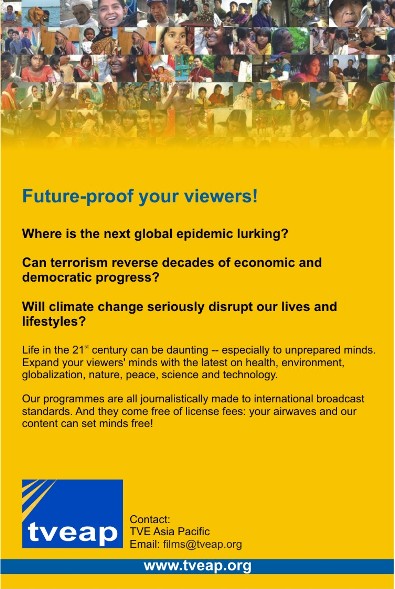
Here’s our promo advert for the event:

futureproof-your-viewers-tveap.jpg

TVE Asia Pacific to co-sponsor Asia Media Summit 2007

I will be reporting from AMS 2007 for the next few days.

Feeding Oliver Twists of the world…and delivering UN logos with it!

“Please, Sir: I want some more!”

These simple yet evocative words were etched into our memories by Charles Dickens, who created the story of Oliver Twist (1838), the poor orphan struggling – and suffering – in 19th century England.

Dickens mocks the hypocrisies of the time by surrounding the novel’s serious themes with sarcasm and dark humour. The novel may have been inspired by the story of Robert Blincoe, an orphan whose account of his hardships as a child laborer in a cotton mill was widely read in the 1830s.

Image courtesy Wikipedia

The world has seen unprecedented creation of wealth since those dark and miserable days 180 years ago. But sadly, there still are hundreds of millions of children who share young Oliver plight — or worse: many go to bed entirely hungry in a world that does not have an overall shortage of food anymore.

Fighting Hunger 2007

Today, 13 May, thousands of people in different parts of the world will walk wherever they can as part of a global campaign in support of ending hunger – one lingering great shame of our time.


Fight Hunger: Walk the World
is a global fundraising and awareness event that takes place every year in all times zones with one sole purpose – to call for an end to child hunger.

Fighting hunger website tells us:

Hunger is more than having an empty stomach. Hunger means not getting the necessary daily nutrition to lead a fully active, productive and healthy life.

Hunger affects more than 800 million people around the world. A child dies every 5 seconds because he or she is hungry.

This year, the organisers – led by the UN World Food Programme – had a viral video contest. It asked anyone, anywhere to do a short video promoting the event – and the issue of hunger – and upload. Some interesting videos have been received — even if some are blatantly in-your-face propaganda for the UN WFP.

That’s my big, long-lasting complaint about the UN family of agencies addressing and tackling the world’s ills. After a while, they allow their worthy issues to be eclipsed by their own self-promotion, public relations and spin. I wrote last month about how the entire MDG campaign has been subsumed by needless volumes of spin.

If only the World Food Programme and its sister agencies can resist their temptation to see every campaign, issue and programme as a logo-delivery mechanism, they will do a whole lot more good.

For that reason, while I will privately walk and think of those in hunger today, I will not contribute any money to the bloated bureaucracy of the United Nations World Food Programme. I would also ask that they go before a mirror today just before they step out to go walking with the world — and sincerely ask: do you see part of the problem or part of the solution?

Thank you, WFP, for delivering food to tens of millions of people worldwide who would not otherwise be fed, or fed adequately. But try and deliver a little less of your image and your logo, if you can. (We saw so much of this happen in the days and weeks that followed the Asian Tsunami disaster, and it was simply disgusting.)

Both hunger and hypocricy thrive nearly two centuries after Dickens and Oliver Twist. We must walk today to end not just one, but both!

Happy walking, everyone.

Watch the winning and commended videos in Fighting Hunger online video contest

Read UN WFP fact sheet about hunger worldwide

Can you make a one minute film for a better planet?

One minute – or 60 seconds – is a lot of time on the air. Our friends in radio and TV broadcasting know this well.

And with shrinking attention spans, many news items on TV are now being packaged for a minute, or not much longer.

Now, Friends of the Earth (together with FilmMinute) are challenging us all to come up with very short films that are one minute long — and still pack a message that benefits our planet.

Image courtesy FoE UK

Their challenge: make a film of exactly 60 seconds which explores how we look after our planet and use it like there is a tomorrow.

Here are the key rules of the game:

60 seconds – no more, no less.
Ideally broadcast quality.
Consider audience – Internet, TV, phones, etc.
Contributors must be the sole author(s).
You can submit more than one film.
No unlicenced use of copyrighted material.
No rude, unlawful or discriminatory material.
No promotion of products or services.
Some prizes are only open to UK residents.
All green one-minute films can be entered, regardless of previous screenings and awards.

Deadline is 20 August 2007. That should give us plenty of minutes to come up with some really compelling one minute films.

Image courtesy FoE

Helpful links:

Making your greenfilm


How to submit your film (via YouTube!)

Competition rules and regulations in detail

Awards and prizes
FilmMinute – the international one minute film festival: make every second count