Rajiv Kafle: A ‘Portrait of Commitment’ against HIV

Photo by Shahidul Alam, Drik/Majority World

It was good to see Rajiv Kafle again — even if only in this photograph, where he is the grown up surrounded by children. This was taken by my friend Shahidul Alam, whose latest photo exhibition, Portraits of Commitment, I’ve just seen.

I immediately recognised Rajiv because he was a key character in a documentary film we at TVE Asia Pacific commissioned five years ago, in 2002. Love for a Longer Life, directed by Nepali film-maker Dhurba Basnet, was part of a package of Truth Talking films that probed how Asia Pacific societies were coping with rapid change or crises.

At that time, there were 50,000 Nepalis living with HIV. But Rajiv was the very first among them to publicly announce that he had HIV — it created ripples in the conservative Nepali society.

He is a former injecting drug user who contracted HIV through unsafe needles.

“I injected drugs for two years. I got infected with HIV when I used a contaminated syringe belonging to one of my friends. He was HIV positive and I used his syringe without sterilising it properly,” Rajiv described his case history on our film.

After coming to terms with his own HIV status, Rajiv turned activist. For the past few years, he has been a crusader to educate Nepalese youth to prevent them from contracting HIV through ignorance. He gives talks at schools and colleges about his experiences of living with HIV.

It has not been easy: his revelation shook the conservative Nepali society, where most people are still reluctant to talk about HIV, associating it directly with illicit sex.

“Stigma, discrimination — then death.” That’s the bleak future that many HIV positive people in Nepal face according to Rajiv. “There is a great deal of stigma and discrimination against HIV/AIDS sufferers. Because there is so much negative publicity, an HIV-positive person finds it difficult to reveal his condition. He will have heard only about stigma, discrimination and death.”

“If we create a favourable environment, people will definitely come out and let others know,” he says, adding: “It took me a couple of years before I was able to publicly announce that I was HIV positive.”

Change was happening even five years ago when the camera crew from Nepal Forum of Environmental Journalists (NEFEJ) followed him across Kathmandul Valley as he gave talks at schools and other public places.

“Now I see a change. Lots of young people understand the problem and are getting involved. The media and public are now more interested in this subject and they want to interact with people who have been through this.”

film-maker-dhurba-basnet.jpg

It wasn’t easy to produce Love for a Longer Life. As Dhurba Basnet (photo, above) reported at the time: “The major problem we faced during shooting, however, was that it was very difficult to get people living with HIV to talk naturally on camera. We had to first win their trust. This we achieved by behaving with them as normally as possible.”

After some shooting had been completed, Rajiv Kafle fell ill. “Since he was a major character in the film we had to wait a whole month while he recovered.”

Read more about Truth Talking films from across Asia Pacific

Shahidul Alam’s blog post on Portraits of Commitment photo exhibition featuring individuals making a difference in South Asia’s battle against HIV

Read my earlier blog post on HIV in Nepal: Ratomate’s best cup of tea (29 March 2007)

Rajiv Kafle photo by Shahidul Alam, Drik/Majority World

HIV/AIDS as a growth industry?

The 8th International Conference on AIDS in Asia and the Pacific, or ICAAP8, is currently being held in my home city Colombo, Sri Lanka, and runs from 19 to 23 August 2007.

As I wrote earlier, some of us who have a track record of communicating on HIV/AIDS have been excluded from this conference by the arrogance of its organisers. And having just read the biography of Sri Lanka’s best known HIV/AIDS activist, I now understand why.

Good books help us experience a range of emotions. A Life in the Round: Desamanya Kamalika, The Girl from Giruwa Pattuwa by Hilary Abeyaratne (WHT Publications, Colombo, 2006) made me outraged and deeply ashamed of the kind of sick society I live in.

Here are some depressing ‘lowlights’ from the book:
* Some medical professionals and para-medics simply refused to treat one of their own kind who was accidentally infected with HIV (fearing infection from casual contact!).
* A leading government hospital carelessly stocked and peddled blood contaminated with HIV. When discovered, it was quickly covered up, and the official investigation was suppressed.
* Some NGOs and charities have turned HIV activism into a self-serving, lucrative industry. There are fierce ‘turf wars’ to claim persons living with HIV as their institutional ‘property’.
* The public health system mandated to care for those living with HIV reinforces stigma and discrimination against such persons.

Image courtesy YouandAIDS Image courtesy YouandAIDS

That’s just for starters. The book packs more shocking details on mass-scale ignorance about basic facts, bureaucratic apathy and a nation in staunch denial about the human immunodeficiency virus.

And we understand why the merchants of misery detested Dr Mrs Kamalika Abeyaratne, who stood up and spoke out for the rights of those living with HIV in Sri Lanka.

She was an extraordinary Sri Lankan woman and a dedicated physician, and the book is her life’s story told by her family and friends. As the cover blurb says: “This is a sad but inspiring account of the joys, sorrows, achievements and disappointments in an all-too-brief but beautiful life, cut short by tragedy and a courageous battle with HIV.”

In 1994, Dr Kamalika was involved in a serious road accident while heading to a rural location where she was to conduct a free medical clinic. While being treated at a government hospital, she was administered HIV-contaminated blood. Media investigations later revealed how intravenous drug users had routinely sold their blood to this hospital, which had few checks in place. This created a major scandal in the public health system — ironically, the very system that she had served for many years.

Dr Kamalika (Kami to her friends) was one of the very few Sri Lankans who openly acknowledged their HIV status. She paid a dear price for this admission: she was shunned and maligned by many members of her own medical community. Undaunted, she spent the last few years of life as an activist campaigning for the rights of persons living with HIV. She waged an almost lone battle for access to anti retroviral (ARV) treatment.

As Sonam Yangchen Rana of UNDP’s Regional HIV and Devlopment Programme has noted: “As a champion for the rights of people living with HIV/AIDS, she had become an icon for PLWHA in the region. Spreading awareness about issues surrounding the epidemic had become the mission of her life. She campaigned vigorously against stigma and discrimination faced by people living with HIV/AIDS and exemplified that PLWHA can lead productive and meaningful lives. productive and meaningful lives.”

And here’s a revealing extract from her biography:
“Paediatrician turned activist, here is the story of Kami’s involvement in the HIV/AIDS campaign. A story that suggests rather wryly that it is not only about People Living with HIV/AIDS (PLWHA), but also about those who have been called People Living off HIV/AIDS (PLOHA). Kami’s own statement on this issue was that the known number of both groups was about the same, with some of the latter, representing some non-governmental organisations (NGOs) or other, living in five-star hotels, driving around in Toyota Land Cruisers, and using up sixty percent of their resources on ‘administrative costs’.”

So now we know why some organisers of ICAAP8 were so defensive and protective of ‘their’ virus: after all, it is their horn of plenty that they cannot share with anyone else. These PLOHA are the mandarins of HIV/AIDS, Incorporated.

On a personal note, I always admired Dr Kamalika but never got to meet her. Our paths almost crossed once in July 2000, when I had helped Panos South Asia to organise a media gatekeepers’ meeting on HIV which she addressed. But the night before, I was struck down by influenza, and didn’t get to participate in what had been a stimulating meeting.

Read Dr Kamalika Abeyaratne: A Profile of Courage, written by my friend Manori Wijesekera in 2003:
dr-kamalika-abeyratne-by-manori-wijesekera.pdf

Read InterPress Service profile on Dr Kamalika Abeyaratne

The Sunday Times (Sri Lanka) review of Kamalika Abeyaratne biography (March 2007)

Read The Sunday Times (Sri Lanka) tribute to Dr Kamalika Abeyaratne, 19 June 2005

Read journalistic coverage of ICAAP8 by Inter Press Service:
IPS Terraviva

Making fun of HIV: Welcome to the Scenarios from Africa

General Assembly of Diseases: In the city of Contaminobo, assorted germs in an emergency session. Tuberculosis, Polio, Hepatitis and others are all angry and afraid because their favourite target – humans – are fighting back. Enter ‘His Royal Heinous, Overlord AIDS’. Hope at last! When he attacks the immune system of humans, other germs can still have a chance…The humans are so careless, that it’s easy for AIDS to quickly spread from one to many. But wait a minute – somebody has been listening into all their talk. Which means the secret of defending humans from HIV and his cronies is out.

Iron Will: Moussah is a young man with a healthy, or bubbling, interest in girls. His male friends advise him to be play it safe — carefree sex can easily expose him to HIV, for which there is no cure. They talk about condoms, and another strategy that is an alternative to using the rubber latex. But Moussah doesn’t quite understand the expression ‘iron will’. He interprets it differently, and gets custom made iron underpants made — much to the amusement of his friends, who remind him the most important sex organ is…the brain!

Just Once: A man returns from the field and feels like making love to his wife. She is living with HIV and insists that he uses a condom — but they’ve run out of stocks. So he cycles far and wide in search of condoms – where is a rubber when you need one? Finally he succeeds and rushes home, only to find that his wife did have one last, unused condom with her. So why didn’t you tell me, he asks in exasperation. Her answer is revealing….

Intrigued? There’s a lot more where they came from.

These three stories are part of Scenarios from Africa — a highly successful and popular pan-African initiative to use moving images to get young people talking and acting on HIV/AIDS. The decade-long project has been carried out with and for young people, with community mobilisation, education and media elements.

Integral to this communication effort are television drama vignettes about different scenarios involving HIV in everyday life.

Some are very funny while others are very moving. They cover many dimensions of the HIV epidemic, from preventing the virus spreading to taking care of persons living with HIV. Underlying themes include safe sex, removing social stigma from the epidemic and dispelling misconceptions about how HIV spreads or does not spread.

The project was started in 1997 and is coordinated by the non-profit Global Dialogues Trust. It gave African children and young adults an exciting opportunity to educate themselves and others about HIV/AIDS by inviting them to participate with internationally acclaimed directors in the production of these short films.

The films are based on ideas thought up by young people in a series of contests. So far, over 105,000 young people from 37 African countries have taken part in these contests. Over 1,000 local and international partner organisations have been involved in organising the contests and selecting the winning ideas.

The films range in duration from just under 2 minutes to almost 15 minutes. They were produced by top fiction film-makers and animation specialists in Africa.

All stories use African actors, locations and situations – and employ different story telling tactics.

Scenarios from Africa is a multi-media communication project that has been widely acclaimed by practitioners, activists and scholars worldwide. The films are supported by a user’s guide and online discussion points that help teachers, trainers and activists to make the best use of these stories in their work.

The films are all distributed on a non-commercial basis across Africa and beyond, for broadcast and narrowcast use. The Scenarios films have been broadcast on locally-based television stations in almost every country in sub-Saharan Africa. The films are also collected on compilation DVDs and video cassettes for use by organisations and schools. Some 60,000 copies of the films (DVDs and video cassettes) of the films have been distributed to date.

The films are now available in a wide and growing range of African and European languages, and are reaching tens of millions of people.

Says Daniel Enger of the Global Dialogues Trust: “Although the films were originally produced for the sub-Saharan African cultural context, we have been pleased to learn over the years that the films have proven useful as awareness-raising tools in many countries of the Asia Pacific area. Indeed, most of the HIV-related topics raised in the Scenarios from Africa collections have universal relevance, making the films useful discussion starters across the globe.”

TVE Asia Pacific has recently taken on the task of distributing all Scenarios films across the Asia Pacific region. As with all other films in its catalogue, TVEAP will distribute Scenarios on a non-exclusive, non-commercial basis to broadcast, civil society and educational. We have been promoting the Scenarios films since we screened them to packed houses during the 2004 AIDS Film Festival in Bangkok

Meanwhile, the 5th Scenarios contest will be held from 1 December 2007 to 15 March 2008. Please contact for more information.

Watch Scenarios films on the official website (RealPlayer required)

Scenarios from Africa now available from TVE Asia Pacific

All images used in this post are courtesy Global Dialogues Trust.

Read my other blog posts on HIV:
HIV: Stigma a bigger killer than the virus?
Three Amigos: Funny condoms with a serious mission
Beware of Vatican condoms!
50? In South African terms, you’re probably dead!
Ratomate’s best cup of tea
A girl named Nan-nan

“HIV is our virus; go find one of your own!”

“HIV is our virus; go find one of your own!”

Well, the nice lady on the phone didn’t actually say that. But that message was heard loud and clear.

And she is one at the forefront of fighting HIV/AIDS in my native Sri Lanka. My organisation had gone with an offer of help, in our own small way, to augment their good fight. But for reasons best known to her, she chose to brush us off.

It happens in the context of the 8th International Conference on AIDS in Asia and the Pacific, or ICAAP8. The year’s most important regional event on HIV is scheduled to be held in Colombo, Sri Lanka, from 19 to 23 August 2007. Several hundred members of our region’s HIV community — from activists and researchers to development aid officials and persons living with HIV — are expected to turn up.

HIV virus

TVE Asia Pacific has been involved in communicating about HIV for a few years. One highlight was when, at the invitation of the International AIDS Society and the Thai Ministry of Public Health, we organised the 2004 AIDS Film Festival in Bangkok. That was part of the XV International AIDS Conference.

We also distribute across Asia some outstanding factual films on HIV/AIDS produced in different parts of the world. Among them is the highly acclaimed Scenarios from Africa.

With these and other credentials, we had hoped that we could share our experience in using audio-visual media for communicating the HIV message in all its nuances and complexity.

Earlier this year, we responded to a call for skills building activities appearing on the Conference website. We didn’t know anyone involved, but we submitted a proposal to the website, outlining our offer to conduct a ‘Skills Building Workshop on Strategic use of moving images for HIV/AIDS Advocacy’. We didn’t ask for any money – our offer was to do it entirely at our cost. We planned to involve some Asian communicators who are regional leaders in this area.

A few weeks later we had a phone and email exchange with a Sri Lankan member of the secretariat
about our proposal. We don’t know this lady at all, but relating to her was not a pleasant experience. In fact, she was very dismissive and almost rude. She found fault with us for submitting our proposal late, when in fact we’d done so well within deadline!

We felt rebuffed and put off by her attitude. Although she said she was going to get back to us, it never happened. Evidently, our offer had touched on somebody’s raw nerve.

We still don’t know what irked this lady — it’s possible that my outspoken public views on HIV/AIDS in Sri Lanka may have been taken personally by a small mind. This is the problem with some people: they take evidence-based criticism personally.

Whatever was responsible, we won’t be at ICAAP8. Our friends who are part of the media team at the conference belatedly tried to involve us. But by then, our spirits were shattered.

A missed opportunity. And there’s some irony that while the Thai Ministry of Health invited us to run an entire film festival in their capital, the Sri Lankan Health Ministry (organisers of ICAAP8) would actually keep us out of this event!

Such are the politics of HIV, which I’m only just beginning to understand. And I thought we needed to unite against the common, invisible enemy…

Read my other blog posts on HIV:

HIV: Stigma a bigger killer than the virus?

Three Amigos: Funny condoms with a serious mission

Beware of Vatican condoms!

50? In South African terms, you’re probably dead!

Ratomate’s best cup of tea

A girl named Nan-nan

A Silent Emergency: More television sets than toilets!

Read a later blog post: Faecal Attraction: There’s no such thing as a convenient flush…

It was September 2004. My daughter Dhara, eight years at the time (or ‘eight plus’ as she insisted on saying), had a complaint.

The toilets in her school were not clean enough. She was finding it squeamish to use them. So she was doing her best to avoid going to the loo: she’d drink less, and try to ‘hold back’ until she could rush home.

Like many sheltered middle class kids, she was still coming to terms with the wider world outside her home. And she attends a well endowed private school where, I am told, toilets are cleaned regularly by janitors engaged by the school.

Now we cut to eleven-year-old Susheela, a girl growing up in neighbouring India. I’ve never met her in person, but this sentence summed up her tragic story:
“I was always first in the class. I am very much interested in studies. I want to become a lawyer. But my mother stopped me from going to school after Class V as the middle school I was attending, 5 km from my house, had no toilet. Can someone help me?”

This was the opening of an article on water and sanitation written by Indian journalist Dr Asha Krishnakumar and published in the news magazine Frontline (part of The Hindu group) at the end of 2003. It was titled: A Silent Emergency.

dr-asha-krishnakumar.jpg Image courtesy WSSCC

It was several months later that I actually read Asha’s article. By coincidence, my daughter was having her own ‘toilet issue’ at the time — and the contrast was striking.

Asha’s article continued:
Susheela’s anguish is shared by a large number of girls in India who drop out of school for what sounds like an absurd reason: want of a toilet in school. “Sanitation is closely linked to female literacy in India,” says a United Nations Children’s Fund (UNICEF) study. According to V. Balakrishnan, convener of the Tamil Nadu Primary Schools Improvement Campaign, the lack of proper toilet facilities in schools has a definite and significant bearing on the drop-out rate of girls, particularly around the time they reach Class VIII. In 2000, barely 10 per cent of Tamil Nadu’s 40,000 government schools had usable toilets; the figure is much lower for the country as a whole.

I’d been covering development issues in the media for over 15 years, but this stark reality had not occurred to me. In some developing countries, girls face a greater struggle in enrolling in school and staying on. There are cultural, social and economic factors working against educating girls.

And as Asha’s article revealed, there are other, less known factors adding to this burden.

I shouldn’t have been surprised. Indian census data had revealed in 2001 that, some parts of the country had more television sets than toilets.

Asha’s was one of three dozen excellent media articles on water and sanitation that I read that month as a judge in an international award scheme to recognise the best media reporting on the issue. Organised by the Water Supply and Sanitation Collaborative Council (WSSCC), it was meant to to encourage broader media coverage of water supply, sanitation and hygiene (WASH) issues in the developing world.

The initiative, first launched in 2002, is open to journalists from developing countries, who write or broadcast original investigative reports on WASH issues. The Collaborative Council seeks to use the WASH Media Awards as part of the broader goals of fostering sustainable relations with journalists in developing nations, and increasing media coverage of WASH issues.

WASH has recently announced the next media awards, covering print and broadcast media coverage from 1 July 2007 to 30 April 2008. This time around, it also involves the Stockholm International Water Institute (SIWI).

Winning entries will be presented at the World Water Week in Stockholm , Sweden in August 2008. Deadline for the submission of entries is on or before May 15, 2008. Read the announcement

In 2004, the recipient of the first WASH Media Award was Nadia El-Awady from Egypt for her outstanding article “The Nile and its People”. It illustrated the impacts of industrial pollution, sewage and solid waste management on people’s health and dignity along the River Nile.

We evaluated a large number of high quality entries and decided to give special recognition and Certificates of Appreciation to several other journalists. Asha was one of them.

A few months later, it was my privilege to meet Asha in person at a workshop on media and sustainable development that TVE Asia Pacific organised as part of the Education for a Sustainable Future conference in Ahmedabad, India, in January 2005. The photo shows Asha addressing our workshop while Darryl D’Monte, fellow judge in WASH media awards looks on.

l-to-r-darryl-dmonte-asha-krishnakumar-and-nadia-el-awady.jpg

By another coincidence, the lady on the right is Nadia El-Awady who was overall winner of the WASH media award. At the time she was the Health and Science Page Editor of IslamOnline.net. She has since been promoted.

Either the world is smaller than we think, or our networks are larger than we imagine.

But I will always be grateful to Asha for opening my eyes on a silent emergency. One that I have since explained to my daughter. She no longer complains.

Read the WASH press release on 2004 media award winners

Read the publication on WASH Media Awards 2004

Read WASH media guide on The Biggest Scandal of the last 50 Years

Photos by Janaka Sri Jayalath, TVE Asia Pacific

Sex and the warming planet: a tip for climate reporters

I had no idea that the nice lady seated next to me was described by her publisher as ‘America’s hottest sex therapist’.

Nor had I linked sex with climate change — though, come to think of it, both have something ‘hot’ in common.

Psychologist, journalist and sex therapist Dr Judy Kuriansky came out with practical advice on how we journalists can cover climate change in more interesting ways. And she made a lot of sense.

“You have to make the climate story appeal to the average reader or viewer,” the Professor of Clinical Psychology at Columbia University Teacher’s College, USA, told us participants at a global media workshop on understanding and reporting climate change in Geneva this week.

In some ways, attracting audience attention is comparable to getting a new date, she suggested.

Dr Judy Kuriansky

“If you want to attract a man or woman’s attention, what do you do? You can go for a walk in the park…and take a child or dog with you. It doesn’t have to be your child or your dog, as long as you have one. That makes it a lot easier for you to start a conversation with an attractive stranger.”

Likewise in covering climate change. Bring out the children or animals. These always help audiences to relate to otherwise dull or dreary stories.

People across cultural and educational divides share a love and concern for children and animals. And how climate change is going to impact our children is something that most sensible adults would pay attention to.

Some communicators are already heeding this advice. The Great Warming, a compelling, Canadian-made documentary released in 2006 and narrated by actors Alanis Morissette and Keanu Reeves, reveals how a changing climate is affecting the lives of people everywhere. Using breathtaking visuals filmed in eight countries on three continents, this production ‘taps into the growing groundswell of public interest in this topic to present an emotional, accurate picture of our children’s planet’.

‘Our children’s planet’ – a simple yet powerful phrase that never fails to move sensible and sensitive people. As I wrote in a recent review, it’s precisely that kind of appeal to our hearts and emotions that many climate change (and indeed, environmental) documentaries lack.

But who else could have linked all this to the art and science of dating? Dr Judy knows a thing or two about this subject, having written The Complete Idiot’s Guide to Dating, now in its 3rd edition.

Dr Judy he was in Geneva representing the NGO Committee on Mental Health, a US-based charity, which ran a session during the Global Platform on Disaster Risk Reduction in Geneva (5 – 7 June 2007).

Her group ran a session on mental health needs of disaster affected people — an aspect largely neglected by the UN and humanitarian organisations that respond to disasters.

Experts warned this week that climate change is set to increase both the intensity and frequency of disasters. This will mean more people than ever will be affected physically, pshychologically, economically and other ways.

Chatting to her later, I discovered Dr Judy and I had more things in common than an interest in, well, climate change.

For one thing, in the aftermath of the Asian Tsunami of December 2004, she had visited Sri Lanka with a team of psychologists to provide much-needed help to survivors to overcome their trauma. Unlike many relief agencies that stayed within the ‘comfort zones’ close to the capital Colombo, her team went all the way to Batticaloa on the east coast, a good 12 hour car journey away.

I also discovered that she and I had both been speakers at the 59th Annual NGO Conference organised by the UN Department of Public Information in New York in September 2006.

And we are both associated with Light Millennium, a non-profit group in New York dedicated to culture and peace. We have a mutual friend in its founder, Bircan Unver.

Here’s a bio note on Dr Judy from one of her websites:

Dr.Kuriansky is a world renowned radio advice host, clinical psychologist and certified sex therapist, popular lecturer, newspaper columnist, TV reporter and commentator and author of many books on relationships. She is a pioneer of radio call-in advice, and more recently of Internet advice. An adjunct professor at the Clinical Psychology Program at Columbia University Teachers College and at the Department of Psychiatry at Columbia Medical Center, she is also visiting professor of Peking University Health Science Center in Beijing. She is a frequent commentator on TV on various news issues, particularly on CNN, and columnist for the New York Daily News, Singapore Straits Times and South China Morning Post.

50? In South African terms, you’re probably dead!

“How many of you are over 50?” asked Christina Scott, South African journalist and broadcaster.

Half a dozen hands went up.

“Come on, now – be honest,” Christina urged. One more hand joined.

“In South African terms, chances are that you’re already dead,” she declared.

Christina was talking about stark realities of living and dying in today’s South Africa, which is one of the highest HIV infection rates in the world.

We were at a session on ‘Life and Death in 2020: How will science respond?’ during the Fifth World Conference of Science Journalists, currently underway in Melbourne.

christina-scott.jpg Christina Scott - image courtesy IPS

Christina then asked how many in her audience were aged between 30 and 35. This time, four hands shot up.

“If you were in South Africa, you’re probably infected with HIV, and don’t know it yet — and go around giving it to others,” she told them.

After getting her audience shocked and hooked, Christina talked about how HIV is cutting across social hierarchies and colour barriers in her country.

Many intervention strategies to contain HIV have been based on the premise that when people know more, they are more likely to change risky behaviour. “We now see that greater wealth or higher levels of access to information alone do not change people’s behaviour. In fact, the middle classes lull themselves into thinking that HIV is a poor people’s disease, when it’s not,” she said.

In other words, it’s not a linear process and is much nuanced.

Christina was doubtful if Internet, PCs and online communications could make much headway in reaching out a majority of South Africans. It’s not just a lack of connectivity and computers, but a more basic absence of electricity in many areas.

To her, old fashioned radio was still the most cost-effective way to reach more people quickly.

One new ICT that has taken sub-Saharan African by storm is mobile phones. “They are everywhere, and people are using them for all sorts of things — including sexual transactions.”

She was cautiously optimistic about prospects for combating HIV. “AIDS is like a war: it’s very nasty, and causes a lot of damage. But as in war, it also spurs innovation and responses,” she said.

An AIDS vaccine is not the answer, as the virus keeps mutating and in any case distributing the vaccine to all those who need it will be a huge challenge.

Her personal wish: her daughter of 15 to get through college without contracting HIV.

Note: Christina works as Africa consultant for the Science and Development Network.

The ‘Children of Brundtland’, 20 years on

On 30 March 2007, I was part of a South Asian Workshop to pre-test a pilot e-module on Science Journalism. Held at the University of Hyderabad, India, it brought together a small group sharing a passion for science journalism and science communication. It was organised by SciDev.Net with support from UNESCO.

I used my remarks to pay tribute to an important and lasting influence on my own career as a development communicator: Our Common Future, report of the Brundtland Commission that came out exactly 20 years ago. The anniversary was marked by a few organisations like IIED, but I felt it deserved better observance.


Here’s an extract from my remarks:

Within a few months of my entering active journalism, something happened globally that left a deep impression on me -– and as I later found out, on many others like myself in different parts of the world. In March 1987, the World Commission on Environment and Development –- chaired by the then Norwegian Prime Minister Gro Harlem Brundtland -– published its final report. Titled Our Common Future, it was the first of its kind to draw broad links between environmental, social and economic concerns and it made international policy recommendations accordingly. It prompted the UN to convene the Earth Summit in Rio de Janeiro in 1992.

The Report didn’t invent the concept or term sustainable development, but it certainly helped popularise it. The Commission’s work helped the environmental movement to evolve from the tree-hugging, whale-saving, cuddly animal level to a higher and multi-faceted level of environmental management.

And it inspired a generation of young journalists, educators and activists worldwide. I count myself among them –- in that sense, we are all Children of Brundtland.

IIED London takes stock of 20 years after Brundtland Commission Report

Ratomate’s best cup of tea

In another post earlier today, I quoted a doctor turned film-maker in India saying people affected by HIV are dying more from the social stigma attached to the disease than by the disease itself.

Social stigma is a wide-spread problem that confronts people living with HIV in all parts of the world.

But occasionally, we hear some good news: how community has overcome its prejudices and accepted those infected with HIV with affection and care. Usually, it happens after going through the knee-jerk reactions.

It would be very worthwhile for some research to be done on how and when community attitude changes: what are the triggers? what is the tipping point?

Five years ago, we had first hand experience of this through a film that we at TVE Asia Pacific commissioned under our Truth Talking documentary series.

The film, titled Love for a Longer Life (26 mins, 2002) was directed by leading Nepali documentary film-maker Dhurba Basnet.
dhurba-basnet.jpg

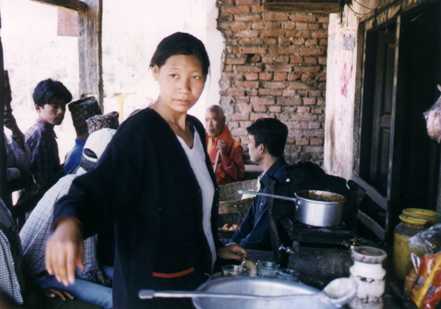
The best cup of tea in the Ratomate village, in central Nepal, is made by a woman called Laxmi Lama. She works in a tea shop owned by her father. “People tell me my father does not know how to make good tea,” she says. “They want me to make tea. The men like their tea strong. When I give my customers strong tea they say one cup is enough for the whole day.”

This is nothing unusual – except that Laxmi is living with HIV. A few years ago, no one in her village would have come near her, let along clamour for a cup of tea she makes.

Born into a very poor family, Laxmi was sold off to a Bombay brothel at the age of 14, and worked as a commercial sex worker for nearly three years before returning to Nepal. She married a man from her village and had settled down to a peaceful routine when a health worker tested her blood and found her positive for HIV. That changed everything dramatically: her husband fled, never to return, and everybody shunned her. The pregnant woman sought refuge in her parents’ house.

That was the fate of most Nepalis living with HIV – abandoned by friends, ostracised by community and left to their own devices. But thanks to the perseverance of a few courageous people – many HIV positive themselves – community attitudes have changed slowly, and have come almost full circle: being reassured that HIV does not spread through casual physical contact, they have accepted her back into their fold.

lakshmi-lama.JPG The moment of truth is when she makes Ratomate’s favourite cups of tea with her bare hands, and men and women flock to taste it. Such a major transformation of community attitudes captured in such a simple, elegant sequence.

Laxmi’s neighbour Kumari Shrestha sums it all up: “We have to give her love. If we do that, she will live longer.”

It would be wonderful if we can discern how and when this change happens. So that it can be induced in thousands of other villages and communites where persons living with HIV are currently battling the virus within, and stigma without.

View a clip from the film here.
Order the film from TVEAP e-shop