Asia Mediasaurus Summit 2007 now on in Kuala Lumpur?

As the Asia Media Summit 2007 started this morning at Hotel Nikko in Kuala Lumpur Malaysia, I had to kick myself hard to make sure it was not a bad dream concocted by my often over-active imagination.

The first plenary session was on ‘Era of participatory media: Rethinking mass media’. It was a response to what many of us had urged the organisers, Asia Pacific Institute for Broadcasting Development (AIBD), to do this time around: take a closer look at how the citizens’ media are evolving and impacting mainstream media.

The session had three speakers — the Director General of Deutsche Welle (DW) of Germany, Director General (international planning) of NHK Japan, and an Editor Emeritus (no less!) from The Toronto Star newspaper in Canada. (The fourth speaker, Director General of Al Jazeera Network, didn’t show up – is it because he no longer holds that job after a recent shake-up of the network’s top management? See: Pro-US coup at Al Jazeera?)

Image courtesy AIBD

The panel was chaired by Jennifer Lewis, who edits Singapore Straits Times Online, Mobile and Print offering — better known by its abbreviation STOMP. She was the only interesting speaker and, tellingly, the only speaker who had any direct experience with the new media or participatory media.

Age has something to do with it, I guess. I’m 41 years old, and I don’t consider myself a digital native. I didn’t grow up with computers and mobile phones like my 11-year-old daughter is now doing. For all my interest in the new media, I remain a digital immigrant trying to find my way in the digital world.

For sure, DW, NHK and The Toronto Star are venerable media institutions that have long served the public interest. No argument there. But why were their chiefs pontificating on the limitations of new media — especially blogs — while there was not a single new media practitioner on the panel (not counting Jennifer, who as moderator didn’t get to share her own experience)?

We sat there hearing from the worthies of the old media that bloggers have limitations of outreach, legitimacy and credibility. They grudgingly acknowledged the existence and some advantages the new media have over their own (old and tired?) media. But all of them failed to say anything new or interesting.

Some, like the emeritus Canadian editor, in fact could not understand why there was no business model in blogs. (Yes, we know it stumps the commercialised media to see so many of us working for no gains or perks of any kind!). He then ventured to make sweeping generalisations about all new media by trying to make a tenuous link between new media platforms and their use by terrorist groups. That was so off the mark that does not warrant a response. The moral is: Elderly editors must stick to what they know best.

During question time, a few audience members tried to point out the complementarity of the old and new media, but by then the tone had already been set: this is going to be yet another gathering of the now rapidly endangered mediasaurus – about whom I have talked about in this previous post.

AMS 2007’s first session showed us well and clear the great divide between the old media and new media. The panel failed miserably and completely to find any bridge across the two. It was doomed from the start because there was no representative of the new media on it.

Asia’s largest gathering of media managers and policy makers has got off to an inauspicious start.

I don’t want to spend three days of my time if this is going to be Asia Mediasaurus Summit.

Source: http://www.indcjournal.com/archives/ariaillg2.jpg

Promote AirDiversity, Asian broadcasters urged

Protect and promote AirDiversity!

Just like bio-diversity and cultural diversity, we need to value and support diversity on the airwaves. Not just government or corporate voices, but the fullest range of citizen and community voices must also be included in that diversity.

That was my call to a group of Asian broadcasters gathered in Kuala Lumpur, Malaysia, for a workshop on ‘Connecting Communities through Community Broadcasting and ICTs’ in the run-up to Asia Media Summit that opens on May 29.

I was speaking during the second session on ‘ICTs – Bringing Added Value to Community Radio’. ICT stands for information and communication technologies. As I reminded my fellow participants, radio broadcasting itself is very much an ICT – it is a more established form of ICT along with the telephone and television. Newer ICTs include computers, Internet, mobile phones and other hand-held data processing devices such as i-pods and PDAs.

For more details, see these blog posts:

The ‘rural romance’ lives on in the ICT age: Urban poor need not apply

Communities are not what they used to be…so let’s get real!

By the way, I think I have just made up that term – AirDiversity. I asked Google, which can’t track down any previous use…

Read post-delivery text of my remarks to the workshop:
ams-2007-connecting-people-via-icts-ng-remarks.pdf

Broadcasters: can you ‘future-proof’ your viewers?

I have just arrived in Kuala Lumpur, the Malaysian capital, to participate in and speak at Asia Media Summit 2007.

It’s Asia’s largest annual gathering of broadcast media’s movers and shakers — for the next few days, TV and radio network CEOs and managers will hobnob with programme producers, researchers and a few, carefully invited media activists. They will discuss many issues of common concern – from media freedom and copyrights to keeping up with new technologies.

TVE Asia Pacific is once again co-sponsoring the Summit, which is one of the most important events of our calendar. Among the development issues to be addressed in plenary sessions or pre-summit workshops are ICTs, community radio and effective communication of HIV/AIDS.

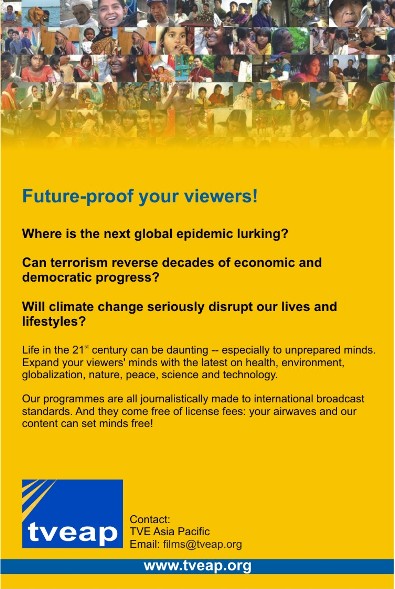
Here’s our promo advert for the event:

futureproof-your-viewers-tveap.jpg

TVE Asia Pacific to co-sponsor Asia Media Summit 2007

I will be reporting from AMS 2007 for the next few days.

Radio Sagarmatha: Kathmandu’s Beacon of hope on 102.4 MHz turns 10

Today, 23 May 2007 is a very special day for broadcasting in South Asia.

Radio Sagarmatha, the first independent community broadcasting station in South Asia, completes 10 years on the air today. It’s certainly a moment to reflect and rejoice for all of us concerned with broadcasting and the public interest in Asia.

Image courtesy Radio Sagarmatha

Here’s how the station introduces itself on its website:
Broadcasting daily from the center of the Kathmandu Valley on FM 102.4 MHz from 5 am to 11 pm, the pioneering radio station has earned a name as a free, independent and highly credible radio station in keeping with its objectives of producing a cadre of professional journalists, addressing the information needs of audiences, stimulating awareness and participation in public issues, and facilitating democratization and pluralism.

The Sagarmatha story is of particular interest to me personally.

Firstly, many involved in founding and running this station are good Nepali friends whose resolve and professionalism I salute on this 10th birthday.

Secondly, this radio station exposed to the whole world a persistent myth that was fabricated and distributed globally by Unesco and its local cronies: that community radio has been thriving in Sri Lanka from the early 1980s. I’ve lived all my life in Sri Lanka, and I’ve spent the past 20 years working in the media, but I have yet to find a single community radio station there — simply because no government has allowed any to be set up! I’ve been writing about this for years, but I’m a lone voice against Unesco’s well-funded ‘myth factory’ working overtime! Read my Panos Feature: Radio suffers as Colombo bosses callthe shots (October 2003).

But enough of that old hat. Today is Sagarmatha’s Day! Happy birthday to the courageous public radio station and everyone involved, past and present.

Recently, supporting the radio station’s nomination for an international media award (to be announced soon), I wrote a brief account about Sagarmatha. It has not been published until now, so here it is, with minor edits:

Kathmandu’s Silent Revolution

Almost a decade ago, a silent revolution started in the Nepali capital of Kathmandu. One day in May 1997, a senior official of the Ministry of Communications handed over a piece of paper to Raghu Mainali, representing a group of Nepali journalists and civil society organisations. It was the broadcast license permitting the first-ever citizen-owned, non-commercial, public interest radio broadcasting station anywhere in South Asia. Soon afterwards, Radio Sagarmatha (RS) was on the air, using the FM frequency 102.4 MHz.

The airwaves will never be the same again in the world’s most populous sub-region, where governments had a strict monopoly over broadcasting for decades.

The broadcast license did not come easily: it was under consideration for over four years, and entailed considerable lobbying by Nepali journalists and civil society groups. At the forefront in this quest was the Nepal Forum of Environmental Journalists (NEFEJ), a non-governmental organisation and a collective of journalists strongly committed to sustainable development, human rights and media freedom.

The senior and highly respected Nepali journalist Bharat Koirala provided advice and leadership for setting up RS, which was cited when he was awarded the Ramon Magsaysay Award — ‘Asia’s Nobel Prize’ — in 2002.

Read a brief history of Radio Sagarmatha on its website

As a long-standing partner of NEFEJ, we have had the opportunity to observe the evolution of RS from humble beginnings to what it is today. Remarkably, NEFEJ colleagues had laid the groundwork for the radio station in anticipation of the license: the hardware, manpower and institutional framework were ready to go on the air soon after official sanction. Beginning with an initial two hours of broadcasts, RS gradually increased its transmissions, providing a mix of music, news and current affairs, sports and cultural entertainment to the Kathmandu city and valley — home to nearly 2 million people. While broadcasting primarily in Nepali, it also carries programming in minority languages and English. In recent years, RS has also rebroadcast selected programmes from BBC World Service Nepali transmissions.

Image courtesy BBC Online Image courtesy Radio Sagarmatha

RS blazed a new trail in broadcasting in Nepal, and in its wake a large number of commercial FM stations and other community broadcasting stations have been set up. The Kathmandu valley’s hills are alive with a cacophony of voices, offering the people a greater choice than ever before. Across Nepal, RS has inspired a plethora of community-owned, community-based radio stations, who are enjoying different degrees of success. RS has also trained a significant number of radio professionals – from announcers and producers to technicians – some of who have moved on to employment with other channels. This commitment to capacity building continues.

In today’s multi-channel environment, RS retains its strong commitment to the public interest, good journalism and high production values. Among others, the following distinguishes this station:

• RS increases people’s participation in debating important day-to-day issues that directly affect their lives and jobs. Roaming producers talk to not just city dwellers but to people living in the most remote areas of Kathmandu.

• RS serves as a people’s forum to examine the merits and demerits of various development policies, efforts and approaches in Nepal, undertaken by government, development donors, civil society and others.

• RS has played its part to bridge Nepal’s digital divide. Suchana Prabidhi dot com (meaning ‘Information technology dot com’) is a popular programme that browses the Internet live on radio, connecting the unconnected radio listeners with information available online.

• In spite of being supported by a large number of development donors, including some UN agencies, RS has maintained its editorial independence, without allowing itself to become a propaganda outlet for any entity.

But it was in Nepal’s recent pro-democracy struggles that Radio Sagarmatha’s commitment to the public interest was truly tested and reaffirmed. The station joined human rights activists, progressive journalists and civil society groups in the mass movement for political reform, including the restoration of parliamentary democracy suspended by the King’s autocratic rule. The regime – seeking complete control over Nepalis’ access to information and independent opinions – imposed a blanket ban on private broadcasters carrying news. Soldiers were posted inside and around Radio Sagarmatha for eight days. Even after they withdrew, the spectre of absolute monarchy hung over all media for months.

Read BBC Online story: The Muzzling of Nepalese Radio (22 April 2005)

Read IPS story: Nepal plunged into the Dark Ages, cry dissidents

Soldier outside Radio Sagarmatha station - bad old days, now gone

That seige continued for much of 2005. On 27 November 2005, I was with some NEFEJ colleagues at a regional media workshop in Siem Reap, Cambodia, when the disturbing news reached us that RS had been forced off the air after police raided the station, seized its transmission equipment and arrested five journalists and technicians. The incident had happened while RS was relaying BBC Nepali Service live from London.

Fortunately, the judiciary intervened. Two days later, responding to a massive outcry from within and outside Nepal, the Supreme Court ordered the authorities to allow RS to continue its transmissions. The station started broadcasting news and current affairs again, and other stations soon found their courage.

The next few months leading to April 2006 were crucial for all associated with the pro-democracy movement. During this period, amidst various pressures, threats and obstacles, the managers and journalists at RS played a pivotal role in ensuring the free flow of information and plurality of views in Nepal. When broadcasting news was banned, RS resorted to innovative ways of getting information across while getting around the jack-boot of bureaucracy.

One method: singing the day’s news — as there was no restriction on broadcasting musical content!

The unwavering resolve of RS, other independent media and pro-democracy activists led to the restoration of parliamentary democracy in April 2006 and the subsequent marginalization of the monarchy. Now the pioneering radio station is working hard to ensure that Nepalis would make better use of their ‘second chance’ in democracy in less than two decades.

As Radio Sagarmatha now enters its second decade, there is much unfinished business: Nepal is one of the most impoverished countries in the world, held back by a decade of civil war. A free, independent and responsible media – epitomized by Radio Sagarmatha – will be essential for Nepal to break from the past and usher in a new era of peace, prosperity and equality.

Listen to Radio Sagarmatha Online

World Association of Community Broadcasters (AMARC) Asia Pacific website

Saving the Planet, one tiny step at a time

A youth theatre group that tours the Philippines, engaging small groups on history, culture and development.

A public radio station that takes up development issues through on air reporting and discussions in Nepal’s Kathmandu valley.

A project that brings together Thai school children and farmers to study and understand farmland biodiversity.

These are among the winning projects that have just been selected to be featured in TVE Asia Pacific’s new regional TV series, Saving the Planet.

Six projects or activities – each addressing an aspect of education for sustainable development (ESD) – have been chosen from worldwide public nominations.

saving-the-planet-logo.jpg

Click here for full list of competition winners.

Read TVEAP news story announcing the winners.

I was part of the International selection panel that sifted through dozens of public nominations from all over the world. Reading these was an inspiring experience. In a world that is full of doom and gloom type of news, there still are individuals, groups and communities who are doing their bit to live within our planet’s means….that’s what sustainable development is all about.

The joint statement by the selection panel noted: “The selection panel was impressed by the breadth and scope of nominated activities, which indicates that all across developing Asia, there is an upsurge of concern and commitment to living within the planet’s resources.”

Read the full statement by selection panel

I have always held that governments or scientists can’t save the planet – people can. In the final analysis, all the inter-governmental babble and scientific research are means to an end. Unless people change their attitudes and lifestyles, all that governments or science can do is to buy us more time — which will run out sooner or later.

In Saving the Planet, we are going to showcase some Asian communities and groups who are not just walking the talk themselves, but showing others how to do it as well.

The new TV series will go into production by July, and will be released next year. Watch this space.

Gasp! Asthma on the rise – and we made it all possible

Gasp!

This morning, I woke up at 4.30 in the morning struggling to breathe. It’s another attack of asthma.

My lungs don’t know – and won’t care – that yesterday, 1 May, was World Asthma Day. All my long-suffering lungs need is some fresh air.

But in the increasingly polluted — and right now, incredibly humid — Greater Colombo, I’m not likely to find it any time soon.

World Asthma Day is designed to increase awareness of asthma as a global health problem. Those who live with Asthma, and suffer on a daily or weekly basis, know what it’s all about.

I’m among the lucker ones. My asthma is well under control most of the time, but an inhalor is never far away. In fact, asthma is my personal indicator of how clean or polluted the air is in places I visit on my frequent travels.

I’ve had bad attacks in Beijing and Kathmandu. No surprises there. But at least in the latter city, which I’ll be revisiting soon, my lungs feel that the air quality has been getting better.

So there is some good news, even if we have to look hard and dig deep for it. That’s part of the job for us journalists — and in this instance, I readily declare my self interest: I want to breathe more easily!

Last year, TVE Asia Pacific conducted a regional media training workshop on covering air quality issues in Asia. That was part of the Better Air Quality 2006 event, a large gathering of everyone concerned with cleaner air issues. It was held in Yogyakarta, Indonesia, in mid December 2006. Read TVE Asia Pacific website coverage of BAQ 2006 and the media training workshop.

Political, scientific and industry leaders made lofty statements about the value of clean air. Rachmat Witoelar, Indonesia’s environment minister, said clean air was more important for Asians than even rice, the staple food for most Asians.

Inspired by the week-long event, I wrote an op ed essay that month titled ‘Grappling with Asia’s Tsunami of the Air’. It has appeared online at several websites.

Images courtesy TVE Asia Pacific

In that essay, I argued:

In the wake of the Asian Tsunami, some development and humanitarian groups used the phrase ‘silent tsunami’ to describe slowly unfolding emergencies that rarely attract much media coverage or global compassion. UN Secretary General Kofi Annan made frequent, passionate references to the ‘daily tsunami of poverty, hunger, disease and environmental degradation.’

It’s easy to call Asia’s air pollution induced sickness and death another silent tsunami. Except that there is nothing silent about it: the lung-corroding, heart-threatening, cancer-causing and blood-poisoning pollutants are released with a thunderous roar from the region’s cars, trucks, buses, motorcycles and other motorised vehicles. Anyone who has stood in a busy intersection in an Asian megacity knows exactly what I mean.

For the want of a phrase, we might call this Asia’s ‘tsunami of the air’.

And this tsunami is very much of our own making — let’s acknowledge that we are all part of the problem, some more than others. It makes us culpable for what India’s Centre for Science and Environment (CSE) once termed ‘slow murder’ by dirty air.

Read the full essay on One World South Asia

Related:

TVEAP News: Rising Asia chokes, but continues its quest for cleaner air

Clean Air Initiative for Asian Cities

Images courtesy TVE Asia Pacific

Press freedom in the digital age: Seeing beyond our noses and tummies

See later post on 3 May 2008: Who is afraid of Citizen Journalists?

On 3 May 2007, we mark another World Press Freedom Day.

This day is meant to ‘raise awareness of the importance of freedom of the press and to remind governments of their duty to respect and uphold the right to freedom of expression enshrined under Article 19 of the Universal Declaration of Human Rights.’

Read more about the Day on the Wikipedia and World Association of Newspapers. (Ah yes, that cartel of governments called UNESCO also puts up a show every year to mark this day, but it’s no better than the mafia bosses coming together to pontificate about the rule of law and justice for all. So let’s completely ignore the irrelevant UN behemoth and its meaningless hot air.)

The essay I wrote two weeks ago about saving our (electro-magnetic) spectrum to safeguard media freedom and media pluralism has been widely reproduced on the web.

That’s precisely the kind of insidious, hidden dangers to media freedom that don’t receive sufficient attention at many events to mark World Press Freedom Day.

I found this out the hard way when the Editors Guild of Sri Lanka invited me to address their observance of the 2001 World Press Freedom Day in Colombo. In the audience were over 250 Sri Lankan journalists and editors, and my topic was global trends and challenges to press freedom.

I decided to talk about ICTs – information and communication technologies – and how they were impacting the profession and industry of journalism. I recalled how technologies like mobile phones and satellite television had completely revolutionised the nature of news gathering and dissemination during the 1990s. The Internet was once again turning the whole media world upside down, I said: sooner rather than later, the impact of these developments would be felt in little Sri Lanka.

I argued that by being well informed and prepared, we could adapt better to the new challenges posed by the Internet, and we will be able to seize the many opportunities the new medium offers to consolidate press freedom. I mentioned some examples from the Asia Pacific and elsewhere how social activists, indigenous people and political groups – including separatist organisations – are using the power of the Internet to disseminate information and opinions at a low cost to a worldwide audience, and how states and their censors were increasingly unable to control such flows across political borders.

Unfortunately, a section of the audience felt very strongly that I was talking ‘pie in the sky’ when journalists in Sri Lanka were grappling with much more urgent issues of survival – such as low salaries, poor working conditions, and threats of physical harm or even death in the line of duty.

I was told — firmly — not to talk about computers and Internet when some media organisations did not even provide sufficient seating or (book) library facilities for their journalists. “Internet is good for pampered western journalists. We have survival issues,” one ardent critic said.

Now, it’s far more interesting to talk to a room full of disagreeing people. I took these comments in that spirit.

In the ensuing discussion, I readily agreed that all immediate factors mentioned by my detractors were indeed major concerns. My point, simply, was that we could not afford to ignore the bigger trends and processes that shape our industry and redefine how we reach our audiences.

Cartoon courtesy WAN

Just as terrestrial television broadcasters had to adjust and reorient themselves when faced with challenges from satellite television in the 1990s, the entire media sector – print and broadcast – has to come to terms with the Internet and World Wide Web.

I added: It doesn’t do any good to bury our head in the sand and wish it to go away. The much better option, as Sir Arthur Clarke has suggested, is ‘cautious engagement of the new media, so that we can exploit the inevitable’

Exploiting the inevitable is precisely the pragmatic approach we need. The globalisation of economics, media and information is taking place regardless of our individual opinions and reactions. By positioning ourselves for cautious engagement and to take advantage of tools and opportunities ushered in by the digital age, we can promote both media freedom and media pluralism.

Three years later, I expanded these ideas into a semi-academic paper (that is, as academic as I can ever get!) presented to the Annual Conference of the Asian Media Information and Communication Centre (AMIC) held in Bangkok, Thailand, in July 2004. I titled it: Media Pluralism in the Digital Age: Seize the Moment

It was later published in AMIC’s quarterly journal, Media Asia. Here’s how I ended my paper:

Newer ICTs can strengthen the outreach, quality and inclusiveness of the mass media. The true potential of this change can only be tapped when all stake-holders of the media play their part. A particular challenge to the ICT4D community is advocating the policy and legislative reform agenda that will enable this process.

There is an interesting post script to my experience with the Sri Lankan media on World Press Freedom Day 2001 quoted at the beginning.

During the past three years, more journalists, producers and their gatekeepers have begun using the Internet as a tool, information resource or alternative medium for expression. The initial apprehensions that some professionals harboured about this new medium have been replaced with growing enthusiasm and a recognition of its utility.

The vindication of my initially disputed seminar remarks came sooner than I expected. My most vehement critic that day was a fire-breathing young reporter then working for a Sinhala newspaper. Less than a year later, this avowed sceptic of the Internet launched his own website to disseminate news and commentary on social, political and economic issues that he felt he could not freely cover in the mainstream print outlets. The fact that his initiative did not last more than a few issues is another matter; clearly, he has been converted.

He would be happy to hear that I have been among regular visitors to his website.

Related: Media Freedom Internet Cookbook

Media Helping Media website

Beware of ‘Vatican condoms’ – and global warming

See also my 19 July 2007 post: Three Amigos: Funny Condoms on a serious mission

You never know where the next piece of helpful advice can come from.

Here at the Fifth World Conference of Science Journalists, currently underway in Melbourne, we were told to be careful in using Vatican condoms: they have holes in them!

It’s a joke, of course, but the implications of increasing human numbers is no laughing matter. And neither is global warming and resulting climate change — one major topic of discussion at the conference.

Professor Roger V Short, FRS, from the University of Melbourne made a passionate plea for controlling our numbers: “We are the global warmers. And we hold the key to containing and reducing it.”

He was speaking at session on ‘Life and death in 2020: how will science respond?’

Human population has increased at an unprecedented rate. When he was born, the world had a total of 2 billion people, the elderly academic said. Now, the estimate is around 6.7 billion.

By 2050, according to the United Nations, it is set to reach 9 billion. And that with all efforts at family planning.

The United States and Australia are the biggest emitters of greenhouse gases that cause global warming. Yet, Australia is the only developed country that is encouraging its people to increase the birthrate.

Are we out of our minds, Professor Short wondered.

The message was loud and clear: unless we seriously contain our numbers, we — and our planet — are doomed.

Prof Short recalled how he’d spent a inspiring week with Thailand’s Senator Michai Viravaidya – known as ‘Mr Condom’ in Thailand for his unashamed and long-standing promoting of condom use — to both reduce population growth and to contain the spread of HIV.

john-rennie2.jpg roger-v-short.jpg

Wide use of condoms, and globally adopting a one-child-per-family policy, can give us a chance to arrest run-away global warming, Prof Short suggested.

The world is urgently in need of many more Mr Condoms, it seems.

To illustrate his point, Prof Short took out a T-Shirt saying ‘Stop Global Warming: Use Condoms!‘ and presented it to John Rennie, editor of the Scientific American, who was chairing the session.

The good sport that Rennie was, he immediately donned it.

Read what Christine Scott said about HIV and South Africa during the same session

See also my 19 July 2007 post: Three Amigos: Funny Condoms on a serious mission

Let’s resolve analog anomalies before going fully digital…

At the last minute, I was invited to join a forum on Community use of digital spectrum at OUR Media 6 Conference here in Sydney.

I agreed because I have written and spoken for years about how we in developing Asia are blissfully ignorant about the gross misuse and abuse of our electro-magnetic spectrum by its custodians – our governments.

I was the odd one out on this panel, as all others were from Australia -– I don’t even live in a country that has set a timeframe for transition from analog to digital spectrum in broadcasting.

Only a few countries in Asia have as yet announced a timeframe for this -– Japan, Korea and Malaysia among them. Some have not even thought of this issue – they are dealing with more basic concerns in broadcast regulation and policy formulation. Yet I found this discussion instructive: sooner or later, all countries will have to go through this transition. It certainly helps to know the issues you are debating and grappling with.

Cartoon Stock

An extract from my remarks:

We should address fundamental reforms in broadcast policy, law and regulation before embarking on the high-cost, tedious and slow process of moving the entire production and distribution process to digital. We who haven’t derived and shared the full benefits of analog broadcasting must get our fundamentals right before going digital.

And therein lies the challenge for all of us who want to safeguard media freedom and promote the freedom of expression and cultural production. In my view, many activists in our region are not paying enough attention to how the electro-magnetic spectrum has been mismanaged and abused by various governments. Activist attention has been held by the more tangible, physical threats to media freedom: issues such as censorship, media ownership and political economy of the media.

All these are worthwhile and necessary — but not sufficient on their own.

During discussion, I also made the points:

The spectrum has been called the ‘invisible wealth of nations’. As economic and cultural practices move more and more into the digital realm, we’re going to increasingly feel the value of this common property resource. All our gains in the physical world would be undermined if we find the spectrum has been irretrievably allocated to a handful of privileged users ignoring the public interest. We need to wake up to this reality.

Perhaps it’s just as well we in developing Asia don’t have tight timeframes to switch from analog to digital spectrum use. We’ve got a good deal of cleaning up and streamlining to do in the analog realm.

This window will be open only for a few years. If we don’t act, we run the risk of making an equal mess in the digital spectrum, only far worse.

In terms of action, I suggest three simple yet important steps:

For us in the developing countries – or emerging economies – in Asia, I suggest three actions:
• Look forward to the transition from analog to digital spectrum
• Look sideways to see how we’re currently doing in the analog domain
• Look back to reflect on the mistakes we’ve made along the way (and learn)

Read the cleaned up text of my panel remarks plus responses
om6-forum-on-digital-spectrum-nalaka-remarks.pdf

Wikipedia on Open Spectrum

Moving images moving heart first, mind next

“Film is a lousy medium to communicate information. It works best at the emotional level.”

Bruce Moir, one of Australia’s seniormost film professionals made this remark soon after I had presented TVE Asia Pacific’s Children of Tsunami experience to OUR Media 6 conference in Sydney last afternoon.

After more than 35 years in documentary and feature film production for both cinematic and broadcast industries, in different parts of the English speaking world, Bruce knows a thing or two about moving people with moving images.

I was delighted and privileged to have Bruce join my presentation. He’d come at my invitation to the conference happening in his city.

“We’ve got to remember that film appeals to people’s hearts more than their minds,” Bruce explained. “The way to people’s heads is through their hearts, from the chest upwards — and not the other way round.”

I hope this was an ‘Aha!’ moment to at least some in our audience. I’ve personally heard Bruce say this before, but it bears repetition – because many film professionals tend to overlook this. Especially those who are trying to ‘communicate messages’.

Even a few weeks ago, I quoted him in a review as saying: “Our fundamental job is to tell a story – one that holds an audience’s interest and moves their heart, regardless of language, cultural context or subject….I have always believed that film achieves its optimal impact by aiming to ‘get at the audience’s head via their heart’ rather than the other way around.”

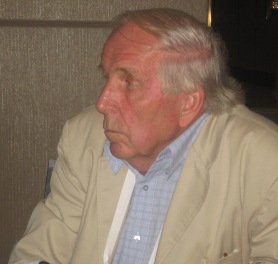
Bruce Moir

Without Bruce’s involvement, Children of Tsunami would have turned out to be very different. He was our Supervising Producer for the entire effort, advising and guiding our national film production teams tracking the progress of Tsunami survivor families in India, Indonesia, Sri Lanka and Thailand for one year afer the Asian Tsunami.

As Bruce recalled, the four teams came with different backgrounds, skill levels and film-making traditions of their own – ranging from television news and current affairs to development film-making, the type usually commissioned by UN agencies. Bringing them to be ‘on the same page’ was no easy task.

Film-makers are not particularly known for their patience or people-skills. Many I know have a ‘just-get-on-with-it-never-mind-the-niceties’ attitude. Bruce is one of the most patient persons I know: he would spend days and weeks relating to our production teams – usually by email or phone – gently nudging them in certain directions.

For sure, there’s no one right way to make a film. But there are some tried and tested principles in good story telling, which is what Bruce excels in. And which he willingly shares with others.

The year-long, 4-country and 8-location Children of Tsunami project was the biggest logistical operation TVE Asia Pacific has mounted in its 11 years of existence. (We’re in no great hurry to top that one!). Our production teams – operating from Bangkok, Colombo, Ubud (Indonesia) and Chennai – related to our regional production team based in two cities: Colombo, where TVEAP office is currently anchored, and Sydney, where Bruce lives.

We only came together face to face just once, in Bangkok, early on in the process. That meeting agreed on styles and formats, and also helped build the human relationships.

The rest of the time it was all through communications technologies. As you can imagine, lots of tapes moved around, as did many Gigabytes of video over the web. (DHL should have become a sponsor – they had lots of business from us!)

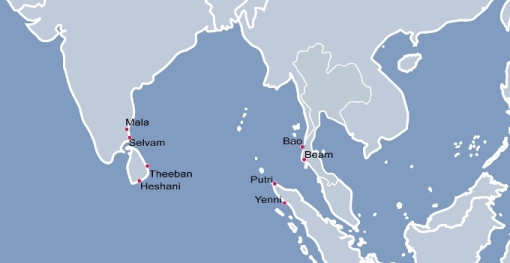
children-of-tsunami-locations.jpg

As I explained in my talk, Children of Tsunami was not just a film project. We published a monthly video report online on each of the eight families we were tracking, plus maintained a dedicated website with growing volumes of text, images and links. The monthly videos were edited and post-produced in the countries of filming, by our production teams themselves. It was distributed film-making, even if everyone worked to a common format.

With all that frenzy now behind us, the products of Children of Tsunami continue to be distributed, showcased and discussed at film festivals and conferences like OUR Media.

As I said yesterday to my predominantly academic audience: we’ve got a story telling and journalistic practice, and we now need a theory for it.

Related links:

Children of Tsunami: Documenting Asia’s longest year

Children of Tsunami revisited two years later