Global Green Awards for Creativity in Sustainability 2010
China’s emergence as a major automobile market has led to high levels of air pollution in the cities. It has also caused an increase in the country’s carbon dioxide emissions that warm the planet.
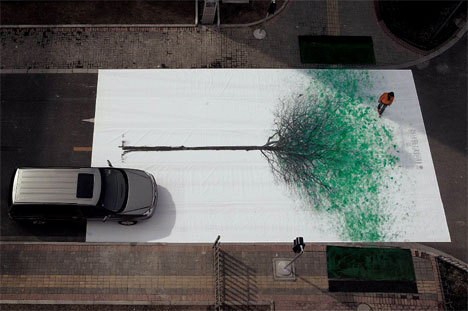
Now, an innovative outdoor campaign, called green pedestrian crossing, is urging Chinese people to walk more and drive less.
This campaign targeted young Chinese people who chose to drive over walking. The campaign involved the creation of an outdoor poster advertisement on pedestrian crossings across 7 thoroughfares in Shanghai.
The Green Awards, presented from the UK, culminated on December 2 with a glittering, ‘green carpet’ event at the Natural History Museum in London. The awards ceremony announced winners for all 16 categories and the 2010 Grand Prix. I was one of the international judges for this year’s awards.
The Green Awards Grand Prix is given to the overall winner which is judged the best amongst all the entries. It is meant to recognise a campaign which, in the opinion of the expert judging panel, best exemplified an outstanding environmental message, and had the greatest capacity to raise public awareness.
Judges were impressed by the creativity shown by the campaign and the simple and effective use of local knowledge. Moreover, the results of the campaign supported the judges’ decision. The campaign reached an estimated 3.9 million people and increased general public awareness about environmental awareness by 86%.
Poddala Jayantha's mother and father receiving award from Kanak Mani dixit (extreme R)
Two persons stood out among the several hundred people gathered at Sri Lanka National Integrity Awards ceremony on December 9 evening in Colombo. Dressed in off-white, the elderly couple looked dignified yet slightly bewildered by the pace of events at Colombo’s top conventions venue.
But when their moment arrived, the parents of investigative journalist Poddala Jayantha rose to the occasion: they accepted the Global Integrity Award presented to him by the anti-corruption watchdog Transparency International (TI).
Jayantha could not turn up in person because his is under threat and fled Sri Lanka for safety. In June 2009, he was abducted by unidentified persons and assaulted. The attack, one among many on journalists in Sri Lanka, left him permanently disabled in his legs. That’s the high price he had to pay for systematically exposing corruption and irregularities in government and corporate sector in Sri Lanka.
TI, which created this award to recognise the courage and determination of individuals and organisations fighting corruption around the world, commended Jayantha for his “dedication to exposing injustice in Sri Lanka”.
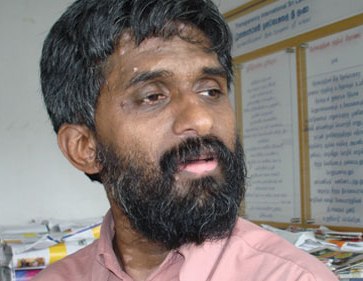
Poddala Jayantha“I am happy that I could fight against corruption and campaign for press freedom while working for the state media,” he told BBC Sinhala after the awards announcement. “But yes I had to leave the country as a result.”
I’ve long admired Poddala’s courage and meticulous research, and have been amazed that he managed to do so much while working in a state-owned media establishment like Lake House, where he was employed after leaving the independent Ravaya newspaper. Of course he was the exception to the rule, but what a refreshing exception that was — reminding us that even amidst all those sacred cows that state media journalists must tiptoe around, they can still serve the public interest if they want to…
Of course, there were also stories that he never got to write. In November 2008, I wrote about one such example in an essay commenting on the Lankan media’s shameful conduct in relation to our own Ponzi scheme and local Madoff called Sakvithi.
From aspiration to reality...looking for honest people who stand their ground
Sri Lanka’s National Integrity Award ceremony 2010 was held at BMICH, Colombo, on 9 December evening. This marked the culmination of weeks of work in reviewing nominations and verifying information. I was part of the three-member independent award committee that chose the winners.
The occasion was both solemn and quietly inspiring. It was telling that the winner of this year’s award has been dead for nine years – killed for being honest and forthright in his work.
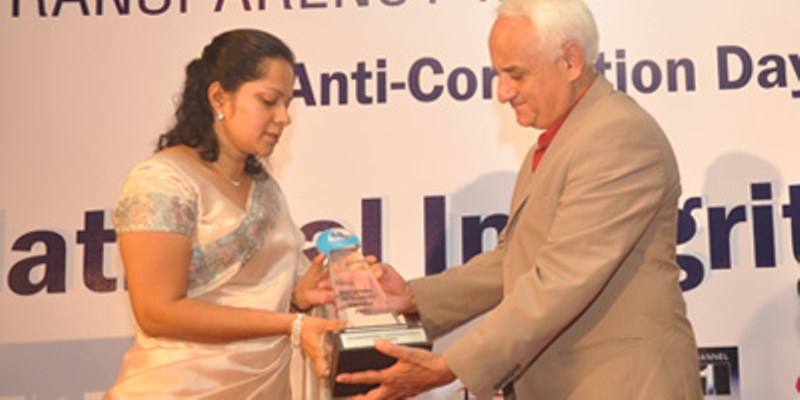
The late Sujith Prasanna Perera, a former Assistant Superintendent of Customs, paid the price with his life standing up against corruption and promoting integrity in his own department. It was a moving moment when the wife accepted the award from my Nepali friend Kanak Mani Dixit, who was chief guest.
The audience stood up and observed two minutes silence as a mark of respect. Some people who never knew the winner in person were in tears.
Angela Perera, wife of late Sujith Prasanna Perera, receives the award from Kanak Dixit
A Maulavi (Muslim priest) from Kinniya in the Eastern Province, M Y Hathiyathullah won recognition with a Special Mention for his active involvement in anti-corruption activities.
“Having studied this year’s nominations, we feel that more work needs to done to enhance the public understanding of corruption. This cancer is not limited to isolated acts of bribery or influence peddling or subverting the rules. Indeed, these are merely the tip of the iceberg — and there are many other ways in which corruption and mal-governance erode our entire social fabric. When people can better recognise the many ugly heads and tentacles of corruption, we hope it would motivate more public-spirited individuals to counter them.
“In our view, the various legal, regulatory and other structural arrangements are all necessary – but not sufficient – to combat corruption. Corruption is deep rooted in human greed. The temptations and opportunities for corruption are greater today than ever before. Faced with these stark realities, we must find the bulwark of resistance in our individual and collective values.
“In the end, the journey to a cleaner, honest and more equitable society begins with each one of us – the man or woman in the mirror. Each one of us is corruptible. At the same time, each one of us also has the potential to counter corruption. In this era of mobile phones and WikiLeaks, the opportunities are only limited by our courage and imagination. No act is too small or too insignificant. And silently looking away is not an option.
“I would like to end by quoting the Malaysian social activist Anwar Fazal, whose words sum up what the National Integrity Award is all about. Begin quote ‘In a world that is increasingly violent, wasteful and manipulative, every effort at developing islands of integrity, wells of hope and sparks of action must be welcomed, multiplied and linked…’ End quote”
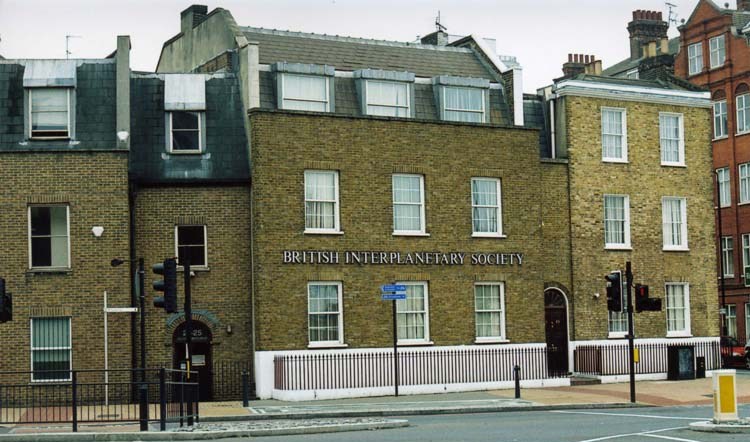
Humanity’s journey to the stars began here…Photo by Greg Fewer
I seem to have a knack for visiting the UK just when Nature decides to remind the hapless islanders who is really in charge. Last April it was the Icelandic volcano Eyjaffjalljokull coughing up. Last week it was sub-zero temperatures and freezing winds coming all the way, with love, from Siberia…
But London’s spirits are not so easily dampened by ash or snow (but they all groaned when their bid for FIFA World Cup 2018 lost to Russia’s). A highlight of my week’s stay was a visit to the British Interplanetary Society (BIS) headquarters on South Lambeth Road.
BIS, founded in 1933 by Phil E Cleator, is the oldest organisation in the world whose aim is exclusively to support and promote astronautics and space exploration. It was originally set up not only to promote and raise the public profile of astronautics, but also to undertake practical experiments in rocketry. But the pioneering British ‘space cadets’ soon discovered that Britain’s the Explosives Act of 1875 prevented any private testing of liquid-fuel rockets.
Undaunted, they continued with their thought experiments, discussions and public advocacy. Perhaps it was just as well that they didn’t get into the messy (and potentially hazardous) business of rocketry. For over 75 years, they have been preparing humanity’s engagement with the realm and challenges of space. Unlike its American and German counterparts, the BIS never became absorbed into the rocket or space industries that developed after the Space Age began in 1957.
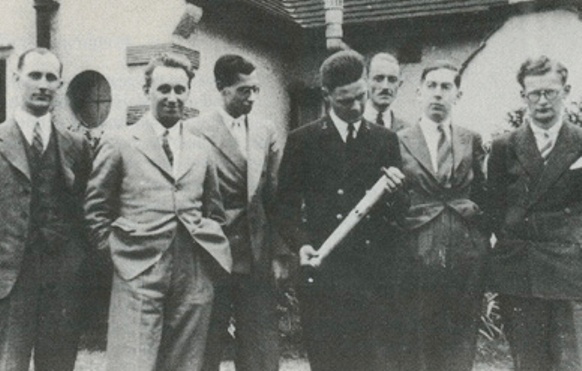
Arthur C. Clarke (far right) and other members of the British Interplanetary Society had a visit from rocket pioneer Robert Truax (holding the rocket model) in 1938
I have always admired the BIS for their pioneering role in popularising space travel, and having ha the audacity to dream of it and in public too. So I was delighted to be invited to the BIS annual Christmas get-together on the evening of December 1. This year, they celebrated the life and times of their founder member and two-time chairman, Arthur C Clarke.
Mark Stewart, the energetic librarian and archivist at BIS, heard I was visiting London and invited me to join their members-only event. Mark is currently looking after one of the finest collections on astronautics on this side of the Atlantic. Some records and documents at the BIS Library go back to the 1930s.
It was good to finally visit ‘ground zero’ of where it all began — nothing less than humanity’s long (and eventual) journey to the stars, hatched by a group of starry-eyed youth as an entirely private, citizen initiative. It took another 20 years — and considerable battering of London by Germany’s V2 rockets — for the British government to take it seriously.
I spent the afternoon chatting with Mark and Colin Philip, a BIS Fellow. Joining us later was Mark’s teenage son Alex, a next-gen space cadet already volunteering at the society. They gave me the guided tour — only a few months ago, I heard, a certain N. Armstrong had been similarly shown around. The society is certainly proud of its history and Sir Arthur’s photos, books, papers and posters are prominently displayed.
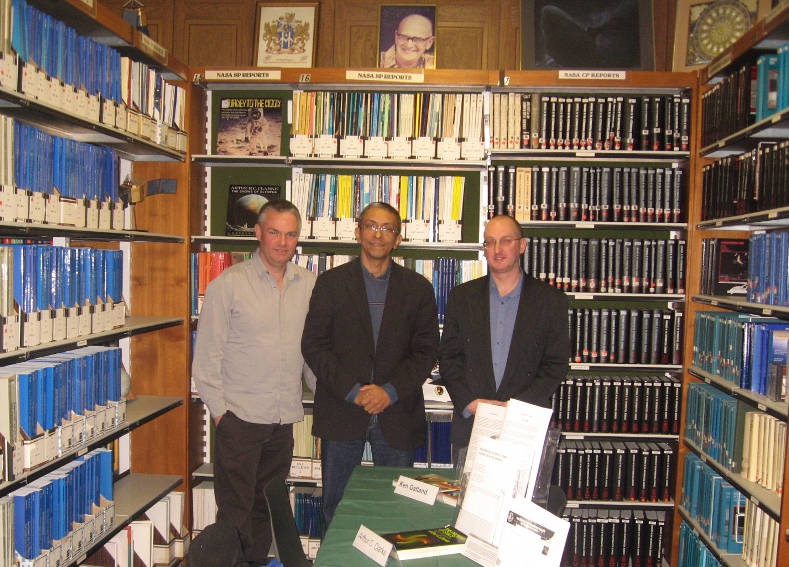
L to R – Colin Philip, Naaka Gunawardene, Mark Stewart, BIS Library 1 Dec 2010
The evening gathering was attended by 40 – 50 members, who were treated to an illustrated talk by Mat Irvine, British TV personality who has worked on many science and science fiction shows over the years, gave an illustrated talk about his friend Arthur. (Confession: I was so engrossed in his talk that I forgot to take any photos of him making it!)
I was familiar with much of the ground that Mat covered, but there were occasional revelations. For example, I didn’t know that circa 1995, Mat and (Sir Arthur’s brother) Fred Clarke had worked with the Isle of Man Post Office to issue some stamps bearing Sir Arthur’s visage and other iconic images associated with him, e.g. the monolith from 2001, comsats, etc. Alas, the plans didn’t work out, but Mat still has the designs and is hopeful that the British Post Office might consider it for the author’s birth centenary in 2017. Of course, some lobbying will be needed…but there’s plenty of time for that.
Like all non-profits these days, the BIS is struggling financially. It also faces the challenge of recruiting younger members – the average age of the Christmas gathering seemed to be 55 or 60. They have fascinating stories to tell (among them: the inside story how Apollo 13 was saved), but forward transmission requires more new blood.
The Council, I heard, is working on repositioning the society for the Facebook generation, and I wish them every success. ‘Imagination to reality’ is their motto, and they have seen a good deal of day-dreaming of the pioneering space cadets come true.
Nalala Gunawardene (L) with Mark Stewart at BIS Library
 The China Environmental Protection Foundation, in association with DDB China Group (a marketing communications company), has won the Grand Prix at the 2010 Global Green Awards for Creativity in Sustainability.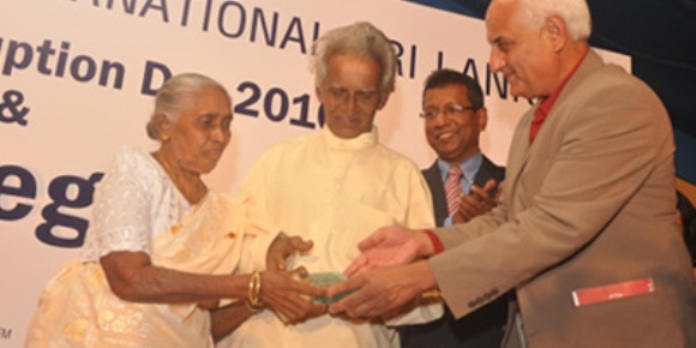

 Open Minds!