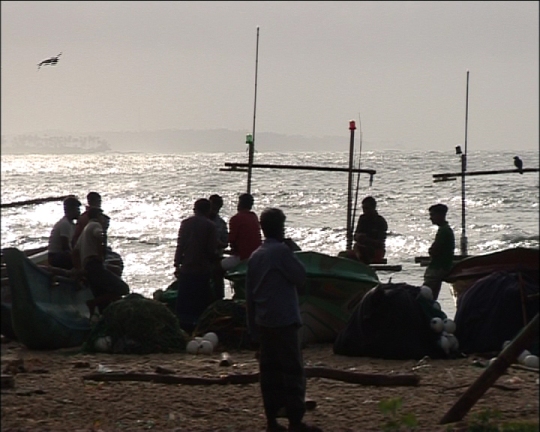
Sleeping easy along the shore: Going the Last Mile with hazard warnings

creating-disaster-resilience-everywhere.jpg

October 8 is the International Day for Disaster Reduction. The United Nations system observes the day ‘to raise the profile of disaster risk reduction, and encourage every citizen and government to take part in building more resilient communities and nations’.

Disaster risk reduction (abbreviated as DRR) is the common term for many and varied techniques that focus on preventing or minimising the effects of disasters. DRR measures either seek to reduce the likelihood of a disaster occurring, or strengthen the people’s ability to respond to it.

DRR is not just another lofty piece of developmentspeak. Unlike many other development measures that are full of cold statistics and/or hot air, this one directly (and quietly) saves lives, jobs and properties.

And it gives people peace of mind – we can’t put a value on that. That was the point I made in a blog post written in December 2007, on the third anniversary of the Indian Ocean Tsunami. Taking the personal example of J A Malani, an ordinary Sri Lankan woman living in Hambantota, on the island’s southern coast, I talked about how she has found peace of mind from a DRR initiative.

‘Evaluating Last Mile Hazard Information Dissemination Project’ (HazInfo project for short) was an action research project by LIRNEasia to find out how communication technology and training can be used to safeguard grassroots communities from disasters. It involved Sarvodaya, Sri Lanka’s largest development organisation, and several other partners including my own TVE Asia Pacific. It was supported by International Development Research Center (IDRC) of Canada.

Recently, IDRC’s inhouse series ‘Research that Matters’ has published an article about the project. Titled “For Easy Sleep Along the Shore: Making Hazard Warnings More Effective” its blurb reads: “In Sri Lanka, a grassroots pilot study combines advanced communication technologies with local volunteer networks to alert coastal villages to danger coming from the sea.”

The article has adapted a lot of the information and quotes I originally compiled for a project introductory note in April 2006.

The outcome of the project’s first phase, which ended in mid 2007, is well documented. My own reflective essay on this project is included as a chapter in our book Communicating Disasters: An Asia Pacific Resource Book, published by TVE Asia Pacific and UNDP in December 2007.

TVE Asia Pacific also made a short video film in late 2007. Called The Long Last Mile , it can be viewed on YouTube in two parts:

The Long Last Mile, part 1 of 2:

The Long Last Mile, part 2 of 2:

The recent IDRC article ends with this para: “A related challenge concerns the shortness of any society’s attention span. In the absence of frequent crises and alerts, how can a nation — or even a village — sustain the continuing levels of preparedness essential to ensure that, when the next big wave comes rolling in and the sirens sound, its people will have the motivation and the capacity to act? The follow-up project seeks to address this worry by preparing the hotels and villages to respond to different types of hazards, rather than only to the relatively rare tsunamis.”

Watch this space.

Download pdf of IDRC’s Research That Matters profile on Last Mile Hazard Warning Project

Mobile phones in Sri Lanka: Everyman’s new trousers?

Mobile phones - social leveller in Sri Lanka

Mobile Phones in Sri Lanka: Everyman’s new trousers?

This is the title of my latest op ed essay, published this week on Groundviews, the leading citizen journalism website in Sri Lanka.

In this, I try to place in a social and cultural context a series of discriminatory laws, regulations and taxes that my native Sri Lanka has introduced – or threatened – in the past few months all aimed at mobile phones, and only mobiles.

This, despite the fact that the proliferation of mobiles has brought telecom services within reach of millions of Sri Lankans in the past decade, helping raise the country’s overall tele-density (mobiles+fixed phones) to 54 telephones per 100 population. With over 11 million SIMs issued, mobiles today outnumber fixed phones by three to one.

In my essay, I cite specific examples, and ask the crucial questions:

Why is this already licensed and regulated technology often targeted for ‘special treatment’ by different arms of government?

Where is this wide-spread suspicion and hostility towards mobiles coming from?

I argue that it is rear-guard action by the traditional elite and bureaucracy who’d rather not allow such digital empowerment to spread. And this has historical parallels.

Here’s the crux of it:

“There is a numerically small (but influential) privileged class that resents information and communication access becoming universal. They might talk glibly in public on using ICTs for social development or poverty reduction. But back inside the corridors of power, they make policies and regulations to undermine the very utility of these tools. This is no accident.

“The mobile phone is the biggest social leveller in Sri Lankan society since the trouser became ubiquitous (initially for men, and belatedly for women). Our elders can probably recall various arguments heard 30 or 40 years ago on who should be allowed to wear the western garb: it was okay for the educated and/or wealthy mahattayas, but not for the rest. Absurd and hilarious as these debates might seem today, they were taken very seriously at the time.

“Make no mistake: the mobile is the trouser of our times –- and thus becomes the lightning rod for class tensions, petty jealousies and accumulated frustrations of an elite that sees the last vestiges of control slipping away.

Read the full essay on Groundviews

Relevant to this discussion is a short film that TVE Asia Pacific produced for LIRNEasia in late 2007, summarising the findings of the latter’s large sample survey on tele-use at the bottom of the pyramid in five emerging markets (which included Sri Lanka).

TVEAP News, Nov 2007: Film highlights telephone revolution in Asia’s emerging markets

Watch the film online:

Teleuse@BOP – Part 1 of 2

Teleuse@BOP – Part 2 of 2

Photo courtesy TVE Asia Pacific

Telecom Without Tears: Book Review

My review of the book, ICT Infrastructure in Emerging Asia: Policy and Regulatory Roadblocks, was printed in Financial Times on Sunday, Sri Lanka, on 18 May 2008.

The book, co-edited by Rohan Samarajiva (in photo, below) and Ayesha Zainudeen, is published jointly by Sage Books and Canada’s IDRC. It is based largely on the work of my friends and colleagues at LIRNEasia.

Although the book showcases recent telecom and ICT reform experiences in five economies in South and Southeast Asia (Bangladesh, India, Indonesia, Nepal and Sri Lanka), my review takes a closer look at the Sri Lankan situation partly because I live and work there, and because the review was intended more at a Sri Lankan readership.

Here’s my opening:

“In the early 1990s, I had to wait for nearly six years for my first (fixed) telephone – I refused to pay bribes or use ‘connections’ to bypass thousands of others on the notorious waiting list. Earlier this year, when I bought an extra mobile phone SIM from Dialog GSM, it took six hours for the company to connect it. I found that a bit too long.

“How things have changed! Connectivity without (social) connections, and practically off-the-shelf, is now possible in most parts of Sri Lanka. Telecommunications is the fastest growing sector in the economy, recording 47 per cent growth in 2007 (and 58 per cent in 2006). The country’s tele-density (number of telephones per 100 persons) jumped to 54 in 2007, from 36 at the end of 2006 -– thanks largely to the phenomenal spread of mobile phones, which now outnumber fixed phones by three to one.”

One quick – albeit a bit unfortunate – way to introduce this book is that it apparently scared some sections of Sri Lanka’s state bureaucracy. When copies arrived from the Indian publisher earlier this year, they were held up at Customs for over three months for no logical or coherent reason. The editors speculated whether it had something to do with one chapter (among 13) looking at telephone use in war-ravaged Jaffna during the ceasefire (which lasted from 2002 to 2008), but this was neither confirmed nor denied.

In my review, I make the point: “It was a stark reminder, if any were needed, of the turbulent settings and often paranoid times in which telecom liberalisation has been taking place in many parts of emerging Asia.”

And I return to the larger political reality in my conclusion, as follows:
“Now that the ICT genie has been set loose, it’s impossible to push it back into the dusty lamp of the monopolist past, even under that much-abused bogey of ‘national security’ (or its new, freshly squeezed version, ‘war against terror’). Despite this, the officialdom and its ultra-nationalist cohorts don’t give up easily. While this book was in ‘state custody’, Sri Lankans experienced the first government-sanctioned blocking of mobile phone SMS – ironically on the day marking 60 years of political independence.

Photo below shows several contributing authors at the book’s launch in Chennai in December 2007


Read the review online

Download the review as a pdf document (47kb)
telecom-without-tears-by-nalaka-gunawardene-may-2008

Read or download the book electronically from IDRC website