Communities are not what they used to be…so let’s get real!

I like busting myths when I see them. That’s probably the result of my training as a journalist to be evidence-based, open-minded and always ask probing questions.

This makes me popular in some circles and very unwelcome in others!

I took a few shots at persistent development myths while speaking last week to a group of Asian broadcasters gathered in Kuala Lumpur, Malaysia, for a workshop on ‘Connecting Communities through Community Broadcasting and ICTs’ in the run-up to Asia Media Summit 2007.

I was speaking during a session on ‘ICTs – Bringing Added Value to Community Radio’. ICT stands for information and communication technologies.

The first myth I exposed was what I call the development community’s ‘rural romance’ — almost exclusive obsession with the rural poor to the exclusion of similar, or even more compelling, needs of the urban poor. I have already devoted an entire blog post to this topic, so won’t repeat it here.

The next myth I tackled was the popular notion of ‘communities’.

I told my audience of researchers, activists and broadcasters: Communities are not just rural and unspoilt as some of you might imagine.

Here’s the relevant excerpt from my remarks:

What does ‘community’ meant to many card-carrying members of the development community? For starters:
• To begin with, people must be remote and rural, and in a geographically confined location.
• They are invariably poor, under-developed and living on the edges of survival.
• If they also have unique cultural artefacts or performances, that would offer convenient photographic or videographic opportunities to the development workers travelling from the city bearing gifts.

You get the idea. Now I ask you to get real.

Yes, such idyllic, hapless and romanticised communities probably exist in some endangered form in a few locations. But in most parts of the Real World (at least in Asia), communities -– both urban and rural -– are undergoing rapid transformation:
• People are on the move in search of jobs and opportunities.
• Technologies are on the move — especially mobile phones that no development agency put their money on!
• People are discerning and demanding, not blissfully ignorant or willing to settle for any offering from the outside!

These may seriously shatter some of your visions of an idyllic and ideal community, but these are essentially positive changes.

And communities no longer need to be defined merely by geographic proximity.

Newer ICTs now allow individuals scattered over larger areas to be connected via the airwaves or the web. This enables the creation and sustaining of:
• communities of practice;
• communities of shared interest/need;
• single issue agitation such as rallying around for constitutional reform, or repeal of an unfriendly law; and
• clamouring for political or democratic reforms.

So please move away from your narrow understanding of communities. Members of any of the above kinds of communities can benefit from community broadcasting.

I added that broadcasting itself isn’t what it used to be. The days of centrally manufactured content being imposed upon a hapless audience are now over.

Interactivity and user-generated content are IN.

Pompous, know-all anchors and presenters are OUT.

My plea to all my colleagues was: Things have moved on in the media world. So must we!

Read full text of my remarks to the workshop (cleaned up after delivery)
ams-2007-connecting-people-via-icts-ng-remarks.pdf

Read my op ed on Media: Step-child of WSIS? published by OneWorld in Nov 2003

The ‘Rural Romance’ lives on in the ICT Age: Urban poor need not apply

Poor rice farmers running up laptops in paddy fields.

Fishermen navigating their ramshackle vessels using satellite-guided global positioning systems (GPS).

A wide-eyed girl child seated in front of a computer screen, looking completely awe-struck.

A saffron-robed Buddhist monk gleefully chatting away on a mobile phone.

Do these images sound a bit familiar to you? That’s because you keep seeing them on magazine covers, posters and various other items produced and distributed to show how modern-day communication gadgets are making a difference in the majority world.

The majority world is where a majority of people live in poverty or hover close to it.

Some influential members of the development community – which includes aid giving nations, UN agencies, researchers and assorted charities working on humanitarian and development issues – now try to fix poverty with gadgets. Or, to use the proper term, unleash information and communication technologies (ICTs) to help combat poverty.

Photo courtesy SciAm Image courtesy Panos Image courtesy Panos

ICT is a basket term that includes the well established services like radio, television and fixed phones as well as newer technologies such as computers, Internet and mobile phones.

Can ICTs help developing countries overcome the current income, social and other disparities? In an editorial written for the Global Knowledge Partnership (GKP) three years ago, I answered this question as a conditional ‘yes’ — with the caution that ICTs are not a panacea that can fix deep-rooted ills.

Read my full essay in GKP Partners Newsletter (My essay is the last one, so keep scrolling down, down, down.)

I said:
ICTs cannot turn bad development into good development; they can only make good development, better. However, when used strategically and as part of a wider development process, ICTs can offer substantial value addition.

But that presumes there is a rigorous assessment of the needs and rational investment of the limited resources. What happens when experts and activists act on their perceptions and prejudices, and not on evidence?

The development community’s obsession with everything rural is one key factor creating such distortions. Sharad Shankardass, Spokesperson for the United Nations Human Settlements Programme (UN-HABITAT), once described this as the development community’s ‘rural romance’.

In 2003 – 2004, Sharad joined us at TVE Asia Pacific in running two regional workshops for training Asian TV journalists in covering sustainability related issues. As the UN agency that chronicles humanity’s urbanization, his agency has all the facts and figures to draw evidence-based conclusions.

The amiable and articulate Sharad summed it up well: more than half the world’s population – including significant numbers of its poor – now live in cities or semi-urban areas. Yet, most members of the development community continue to think of poverty and under-development as an exclusively rural phenomenon.

In other words, they are hooked on a romanticised notion of the rural poor and cannot see (or choose to ignore) a more multi-faceted reality.

Image courtesy UN HABITAT Image courtesy TVE Asia Pacific

Here’s the blurb for State of the World’s Cities 2006/2007 report, published by UN-HABITAT:
“It is generally assumed that urban populations are healthier, more literate and more prosperous than rural populations. However, UN-HABITAT’s State of the World’s Cities Report 2006/7 has broken new ground by showing that the urban poor suffer from an urban penalty: Slum dwellers in developing countries are as badly off if not worse off than their rural relatives.”

Read State of the World’s Cities 2006/2007 online, as pdf chapters

This kind of evidence is being ignored by researchers, activists and UN officials who have fallen (or sleep-walked) into a ‘rural romance trap’. To them, the unmet needs of millions of urban poor are not a concern, or at least not a priority.

In their strange logic, it’s not just a low income level and deprivation of basic human amenities that qualify someone for support under various poverty reduction efforts. That person must also live in an idyllic village, away from major signs of civilization, and preferably in a mud hut surrounded by starving children and emaciated cattle.

That’s picture perfect poverty for you. Urban poor, living in the shadow of highrise buildings and skytrains, rather spoil this pristine image!

Last week while visiting Kuala Lumpur, Malaysia, for Asia Media Summit 2007, I had two separate encounters related to this rural romance.

First was a pre-summit workshop on Connecting Communities through Community Broadcasting and ICTs that brought together some 25 – 30 participants, mostly activists and researchers. In my remarks to the workshop (where I spoke and chaired a session), I urged everyone not to romanticize either communities or broadcasting.

“Communities in need are no longer rural and idyllic as some of you might imagine,” I cautioned. “And broadcasting isn’t what it used to be either. Things have moved on. So must we.”

During question time, a communications advisor from UNESCO New Delhi took me to task for saying this. “We are working with 45 years of solid experience behind us,” she reminded me and everyone else. “You can’t just dismiss this body of work.”

She seemed affected by my questioning the strong or exclusive focus that community radio promoters have on rural areas and rural poor in particular.

I didn’t want to split hairs on this when bigger issues were at stake. I just said that what had worked in the first century of radio will not work in that same form in the medium’s second century that we have now entered. New thinking based on a century’s experience was needed.

Why are organizations like UNESCO so resistant to change and new thinking? Why do they go around spreading development myths that actually do more harm than good?

Read my 2004 essay that exposes the UNESCO-sponsored myth of ‘community radio’ in my native Sri Lanka

And they are not alone. Other UN agencies and development practitioners still plan and deliver development aid and support based on a reality that prevailed in the 1980s or earlier.

My Malaysian friend Chong Sheau Ching, whom I met last week after two years, told me a recent experience that corroborates it.

Chong Sheau Ching, photo courtesy IDRC e-homemakers

Sheau Ching is a remarkable woman. She combines many roles – social entrepreneur, columnist and single mom among them. She is a leading voice in Southeast Asia for using modern ICTs to help women – especially single moms — to find work that they can do from home yet earn decent incomes.

She is founder and head of e-homemakers, a non-profit organisation that networks over 13,000 Malaysian women who are home workers, home-based entrepreneurs and home-makers. These women live and work in cities or towns, and now take advantage of Malaysia’s well-developed telecommunications infrastructure.

Sheau Ching was an invited speaker at Asia Telecentre Forum held in the Malaysian capital on 6 – 8 February 2007. In her presentation, she had spoken about the ICT needs and uses of urban women, including the poor women living in cities. She had questioned why the tele-centre movement was focusing almost entirely on rural areas.

Guess what? The organisers didn’t like such outspokenness at all – she had been reprimanded in public during the rest of the session as well as ‘scolded’ in private after it ended. So much for plurality of views!

Sheau Ching is full of such stories, even if some of them make us feel outraged at the stupidity of people or institutions involved.

Here’s another one, recounting an experience at the World Summit on the Information Society in Tunis, Tunisia in November 2005:

At WSIS Tunis, I gave a short presentation to a small group of bankers from developing countries on using low cost ICT4D innovations for urban poor women to generate income. One politely said to me as he handed out dinner invitations, “We are interested in big projects for youth and the rural people.” I was the only woman in the group, the only one from the civil society, and needless to say, the only one who was not invited to the fancy dinner in a five-star hotel in North Tunis.
Read her full essay, Unsexy and voiceless!!

Next time when UN agencies and other bleeding-heart do-gooders turn on their rhetoric about busting poverty, ask a simple question: Are they fighting poverty no matter where it exists, or is it only poverty in rural, idyllic settings where they like to visit and take photographs?

Like those images I mentioned at the beginning.

Read IDRC profile on Chong Sheau Ching

Public funds, private rights: Big mismatch in Development film making

After over a decade of extensive networking with environment, wildlife and development film-makers across the Asia Pacific, I have yet to come across a single film-maker who had a ‘sufficient’ budget to make their films or TV programmes.

All the film-makers I know — and that’s several dozen — wish they had a bigger budget to do a better film. At an individual professional’s level, that’s perfectly fine. But collectively, there just isn’t enough money to go around.

And to make matters worse, the number of film-makers keeps growing faster than how available funds expand. In fact, in real terms, the volume of funding to make development films has been shrinking. That’s another story.

In most parts of developing Asia, broadcasters don’t invest much — or any — funds in productions of development films. So independent film-makers, and sometimes even producers within TV stations, have to raise that money from elsewhere.

They turn to development donors, UN agencies, philanthropic foundations, corporate sponsors and even private individuals. They have to beg, borrow – but hopefully, not steal – to create content that is of public interest and educational value.

It’s a constant struggle, but when we get things right, the social benefits can be high.

But there’s one aspect in this whole endeavour that has not received sufficient attention for too long: what happens to the copyrights of such creations?

Development donors manage funds that have originally come from tax payers in industrialised countries — in other words, public funds. When public funds are invested in creating what are meant to be public goods, such goods must remain available and accessible without restriction.

But that’s where things often go wrong.

Public (donor) funds are used to finance the production of development films, yet neither their funders nor commissioners clarify the rights situation to ensure the widest possible public access to the film/s. An individual film-maker or production company takes advantage of this lack of clarity to appropriate the sole copyright, and starts restricting public access to the film/s by locking into exclusive arrangements.

The very purpose of investing public/donor funds in the film’s production is thus defeated.

I have seen this scenario repeat dozens of times across Asia and elsewhere. Usually it involves development donor officials or UN agencies whose media knowledge is rather limited, and whose commitment to the public domain is not always sincere.

It is a contradiction to have full control of copyrights vested in private individuals when films or TV programmes have been fully funded using public funds. To the best of my understand of the public interest, that is just not right.

This is why I keep raising it at every available opportunity. At Asia Media Summit in Kuala Lumpur yesterday, I touched on this in my speech during the panel on ‘mobilising airwaves against poverty’. I said:

522445368_8a10a4f2fa.jpg

I call upon development donors to insist that all development films and other media products they finance -– with tax-payer money – will have no copyright restrictions attached.

I hope the UN agencies will also take note. Perhaps inadvertently, they often get locked into exclusive rights arrangements with single production companies or broadcasters. This should be avoided.

I am proud to announce that all international TV content produced by TVE Asia Pacific is available to broadcast, civil society and educational users anywhere in the world without any license fees or copyright restrictions. We do practise what we preach.

And let us all consider alternative approaches to managing intellectual property — such as the Creative Commons framework now gaining acceptance.

In my virew, there are at least four possible options for handling the rights of a publicly-funded film or other media product:

1. Keep the rights entirely unrestricted (copyleft), allowing unlimited commercial and non-commercial uses of the work.

2. Share the rights equally between the film-maker and the party commissioning (and financing) the film, so that both parties may pursue distribution and promotion in ways they think fit, keeping each other informed if need be, but not having to seek each other’s permission for it.

3. Reserving all rights in the party commissioning (and financing) the film, leaving none of it to the film-maker.

4. Conceding all rights to the film-maker, allowing him/her the full discretion and choice on how rights are managed (or restricted). This is as good as sending the film into a ‘black hole’ from which it may never emerge again.

We don’t advocate option 3, because we respect the right of creative professionals to be acknowledged for their work, and to share the intellectual property (many UN agencies do this, and we don’t think that is healthy or warranted).

We have been applying option 2 in all content we commission from TVE Asia Pacific, and are now actively considering option 1 as well. This is because all our films are made using public (donor), foundation or corporate funds given to us in trust. That must be reflected in the rights regime we apply on the products.

And we never allow ourselves to get locked into a single broadcaster’s copyrights regime.

This is clearly a debate that must gain momentum.

Investing public funds to create privately-held copyrights is just not right.

Photo courtesy Justine Chew, GKPS

Asian broadcasters: Make poverty a copyrights free zone!

Today was the second day at Asia Media Summit 2007 in the Malaysian capital of Kuala Lumpur. Among the topics taken up today were gender, poverty reduction and climate change — all discussed from the perspective of broadcasters.

I was part of the plenary session on ‘Mobilising airwaves against poverty’ held this morning. Among the other speakers were Walter Fust, director general of Swiss Development and Cooperation agency (SDC) and Stephen King, Director of BBC World Service Trust.

As speakers, we were asked to address these among other questions: How can we generate in media real interest in development issues such as poverty? How can we secure more airtime in educating and bringing about better ways to fight poverty? How can media put the poorest of the poor at the center of attention?

panel-on-mobilising-airwaves-against-poverty-at-ams-2007.jpg

In my remarks, I called for an on-air/off-air combined ‘assault’ on poverty, ignorance, corruption and other scourges of our time. Powerful as they are, broadcasts alone cannot accomplish this massive task, I pointed out.

Here’s an extract from my remarks:

We all know the power of moving images. Used strategically, moving images can move people to change lifestyles, attitudes and behaviour.

Indeed, the right kind of information -– whether about microcredit, contraception, home gardening or immunisation — can vastly improve the quality of life, and even save lives that are needlessly lost.

But this is not something that one-off or even repeat broadcasts alone can accomplish. We need a mix of broadcast and narrowcast approaches.

Communicating for social change is a slow, incremental process that involves learning, understanding, participation and sharing.

At TVE Asia Pacific, we work equally with broadcast, educational and civil society users of moving images. Our experience for over a decade shows that narrowcast work can reinforce and build on the initial broadcast outreach.

But that’s easier said than done. Every year, excellent TV programmes are made on different development topics. Public and private funds are spent in making these programmes, which draw in the creativity and hard work of committed professionals. Many TV channels willingly broadcast these programmes. After a few transmissions, these end up in broadcast archives. A few are adapted for multimedia use. That’s the nature of this industry.

Yet, as I pointed out, most of these programmes have a longer shelf-life. They can be extremely useful in education, awareness raising, advocacy and training. But unfortunately, copyrights restrictions are often too tight for that to happen. Even when the film-makers and producers themselves are keen for their creations to be used beyond broadcasts, the copyright restrictions stand in the way.

I said: “Broadcasters need to let go of development related TV content after initial broadcasts. They must also allow educational and civil society users greater access to vast visual archives, gathered from all over the world.”

I then repeated a proposal I first made last year, which I have since presented at the UN Headquarters and other forums: make poverty a ‘copyrights free zone’.

The idea is to have broadcasters and other electronic publishers release copyrights on TV, video and online content relating to poverty and development issues -– at least until (MDG target year of) 2015.

Read my original essay on poverty as a copyrights free zone, published in June 2006

There was a mixed reaction from the predominantly broadcast audience. I knew it wasn’t going to be an easy sell: this industry is so closely tied to copyrights and licensing in not just commercial but also emotional terms. Letting go of these rights, even in a limited way for a highly worthy cause, is a quantum leap for broadcast managers raised on strict rights regimes.

More about the reaction in a later post.

Meanwhile, here’s the full text of my remarks:

nalaka-gunawardene-speech-to-ams-2007-final.pdf

Photo courtesy Manori Wijesekera, TVEAP

Has Al Jazeera left the building?

Where is Wadah Khanfar?

This is the question that everyone kept asking as Asia Media Summit 2007 started off with what turned out to be a feeble and lop-sided panel on participatory media.

Khanfar, listed on the programme as Director General of the Al Jazeera Network, had confirmed participation and a seat was kept reserved for him on stage even as the opening panel kicked off.

The amiable moderator, Jennifer Lewis from Singapore, kept on asking for Khanfar to please come on stage. He never did.

The seat assigned for him remained empty all through the inaugural session. Some speculated if that was due to the recent reshuffle at Al Jazeera, which some interpreted as a pro-US coup in what until recently was regarded as the world’s most outspoken broadcast media network from the majority world.

I myself have been a cautious cheer-leader for Al Jazeera International. For example, on 18 April 2007, I wrote about AJI placing its content on YouTube to enable US-based viewers to watch the channel that was blocked out of many US cable networks.

AJI has been on the air for only six months, so we must reserve judgement on its performance for a while longer.

Many of us media-watchers were optimistic and hopeful that AJI would offer a much-needed counter to the blatantly one-sided and self-righteous coverage of the dominant international news channels, BBC World and CNN International.

AJI set out with a lofty agenda, saying it wants to ‘balance the information flow from South to North, providing accurate, impartial and objective news for a global audience from a grass roots level, giving voice to different perspectives from under-reported regions around the world.’

It also wanted to revolutionise English language TV in the same way it turned Arabic TV upside down, ending the monopoly of the airwaves by state broadcasters and governments.

Writing an op ed within days of AJI starting its broadcasts on 15 November 2006, I reacted to these stated ideals as follows:

“Noble ideals, indeed — and we fervently hope it succeeds, but unless it’s very careful and thoughtful, AJI runs the risk of falling into the same cultural and commercial traps that its two rivals are completely mired in.

“While CNN can’t get out of its US-centric analysis even in its international broadcasts, the BBC news team is more like a hopelessly mixed up teenager: one moment they are deeply British or at least western European; the next moment they are more passionate about Africa than Africans themselves.

“Desperately seeking legitimacy and acceptance in wide and varied circles, these two global channels have sometimes traded in their journalistic integrity for privileged access, exclusives or – dare we say it? – to be embedded.

“They have increasingly come to epitomise a disturbing trend in international news and current affairs journalism: the end justifies the means.”


Read my full essay in Media Helping Media (UK)

al-jazeera.jpg

I argued in my essay that the end does not justify the means of gathering news.

“If products of child labour and blood diamonds are no longer internationally acceptable, neither should the world tolerate moving images whose origins are ethically suspect.

So that’s the real challenge to Al Jazeera: to usher in real change, it needs to transform not just how television news is presented and analysed, but also how it is gathered.”

We have been watching — whenever we can catch it, that is — how AJI is covering the complex and nuanced world we live in. So far, the impressions are not encouraging. We have to look long and hard to tell the difference between BBC World, CNN International and AJI.

We will keep watching, and give the new kid on the block a bit more time to prove itself.

And we look at not just what’s shown on AJI, but how those pictures get there.

Read earlier post: Banned in the USA, Al Jazeera now on YouTube

Saved by the ‘soaps’ – Asia Media Summit picks up momentum

Asia Media Summit 2007’s first day — which started with old media mandarins dismissing new media — ended on a good note, thanks to an interesting, focused session on soap operas and reality TV shows.

Is reality TV a transient fad? With media convergence and lowered barriers to mass media, what new forms and formats of programming and delivery will emerge? These were some questions posed to three panelists drawn from the India, South Africa and the UK.

The most interesting presentation, for me, came from India: Yvonne MacPherson, Project Director of BBC World Service Trust (India) — the BBC’s charitable arm — spoke about their work in India using entertainment TV formats to communicate socially relevant messages.

She shared highlights of BBC-WST’s experiences in using the long-format drama serials and reality based dramas on Indian television.

These are part of what BBC-WST website calls ‘one of the world’s biggest mass media projects to achieve HIV and AIDS awareness and prevention’.

HIV positive detective Jasoos Vijay - courtesy BBC WST Jasoos Vijay transformed Indian attitudes about HIV Haath se Haath Milaa music video wins top India TV awards

First broadcast in July 2002, ‘Jasoos Vijay’ (which means Detective Vijay) is a long-running detective serial on India television. It features Vijay — who is living with HIV — and has messaging about HIV and AIDS awareness and prevention woven in to the plot and dialogue. It not only provided basic facts and figures, but also debunked popular misconceptions about HIV.

After four years on the air, the series entered the Top Ten among Indian TV programmes in August 2006. According the industry-wide TAM audience figures, it then drew a weekly audience reach of almost 16 million viewers.

The series is filmed entirely on location. It is made in Hindi and dubbed into seven other languages. The detective serial is broadcast on peak viewing time on Sunday evening on India’s Doordarshan National channel.

“Long format drama series is the best way to attract a countrywide mass audience,” MacPherson said. “Reality show format, on the other hand, better suits urban and semi-urban audiences.”

In the latter category is BBC-WST’s celebrity and reality programme on HIV awareness, ‘Haath se Haath Milaa’, which means ‘Let’s Join Hands’. It is aimed at younger viewers in urban areas.

Both series were delivered in partnership with India’s national broadcaster, Doordarshan and the Indian National Aids Control Organisation (NACO). Whatever services that were mentioned in the programmes — whether on voluntary HIV testing or anti retroviral drugs — the creators ensured that it was already available through the official healthcare system.

Key to the success of these media initiatives was substantial volumes of research and pre-testing, MacPherson said.

Studies have highlighted how television plays such a significant role in the lifestyle and family choices in India.

She disclosed that BBC-WST is now planning to apply the same entertainment format to another social issue in India: the wide-spread practice of aborting girls after the sex of an unborn child is found out from tests.

“There have been various TV advertisements appealing viewers to love girls, but that doesn’t seem to work — because they don’t address why girls and women are devalued in society.”

Vasanthi Rao, Director of India’s Centre for Media Studies (CMS), was less enthusiastic about reality shows on Indian television. “They don’t really capture reality. It’s more a moderated reality.”

She asked about the kind of budgets that BBC-WST worked with in India, a question that Yvonne MacPherson chose to ignore. This was interesting by itself, given how BBC-WST is increasingly seen as competing for scarce development communication funds with national and local organisations in the very developing countries that it seeks to serve.

In recent years, the BBC-WST has raised millions of pounds and dollars worth grants which come from overseas aid budgets of the UK government and from charitable foundations such as the Bill and Melinda Gates Foundation. Notwithstanding the high degree of professionalism and creativity the Trust has brought into all its media projects in India and elsewhere, questions need to be asked on its cost-benefits ratio — and whether it distorts the market for others.

Jacky Sutton, a communications advisor with Unesco in Afghanistan, noted how soap operas can complement the media’s news agenda. “Media is not all about confronting politicians or exposing corruption. It is also about giving people the right information and more choices in their daily lives.”

She noted how UN-sponsored development films on worthy issues are just that – worthy. “They are not particularly interesting — I have made a few myself!”. She agreed that entertainment formats are the most suitable to engage the mass audience.

Dali Mpofu, Group CEO of South African Broadcasting Corporation, offered very sound advice to the so-called public service broadcasters or PSBs (a misnomer that I no longer believe in). In his own words: “The biggest mistake that PSBs is to compete with the (commercial) mainstream, trying to be more like them. Instead, we should do very well what we are mandated to do. It is the duty of PSBs to push the envelope.”

He described how SABC has taken risks: some paid off, others didn’t. That’s all part of the game.

If only other ‘public’ broadcasters of the world were as enterprising.

Asia Mediasaurus Summit 2007 now on in Kuala Lumpur?

As the Asia Media Summit 2007 started this morning at Hotel Nikko in Kuala Lumpur Malaysia, I had to kick myself hard to make sure it was not a bad dream concocted by my often over-active imagination.

The first plenary session was on ‘Era of participatory media: Rethinking mass media’. It was a response to what many of us had urged the organisers, Asia Pacific Institute for Broadcasting Development (AIBD), to do this time around: take a closer look at how the citizens’ media are evolving and impacting mainstream media.

The session had three speakers — the Director General of Deutsche Welle (DW) of Germany, Director General (international planning) of NHK Japan, and an Editor Emeritus (no less!) from The Toronto Star newspaper in Canada. (The fourth speaker, Director General of Al Jazeera Network, didn’t show up – is it because he no longer holds that job after a recent shake-up of the network’s top management? See: Pro-US coup at Al Jazeera?)

Image courtesy AIBD

The panel was chaired by Jennifer Lewis, who edits Singapore Straits Times Online, Mobile and Print offering — better known by its abbreviation STOMP. She was the only interesting speaker and, tellingly, the only speaker who had any direct experience with the new media or participatory media.

Age has something to do with it, I guess. I’m 41 years old, and I don’t consider myself a digital native. I didn’t grow up with computers and mobile phones like my 11-year-old daughter is now doing. For all my interest in the new media, I remain a digital immigrant trying to find my way in the digital world.

For sure, DW, NHK and The Toronto Star are venerable media institutions that have long served the public interest. No argument there. But why were their chiefs pontificating on the limitations of new media — especially blogs — while there was not a single new media practitioner on the panel (not counting Jennifer, who as moderator didn’t get to share her own experience)?

We sat there hearing from the worthies of the old media that bloggers have limitations of outreach, legitimacy and credibility. They grudgingly acknowledged the existence and some advantages the new media have over their own (old and tired?) media. But all of them failed to say anything new or interesting.

Some, like the emeritus Canadian editor, in fact could not understand why there was no business model in blogs. (Yes, we know it stumps the commercialised media to see so many of us working for no gains or perks of any kind!). He then ventured to make sweeping generalisations about all new media by trying to make a tenuous link between new media platforms and their use by terrorist groups. That was so off the mark that does not warrant a response. The moral is: Elderly editors must stick to what they know best.

During question time, a few audience members tried to point out the complementarity of the old and new media, but by then the tone had already been set: this is going to be yet another gathering of the now rapidly endangered mediasaurus – about whom I have talked about in this previous post.

AMS 2007’s first session showed us well and clear the great divide between the old media and new media. The panel failed miserably and completely to find any bridge across the two. It was doomed from the start because there was no representative of the new media on it.

Asia’s largest gathering of media managers and policy makers has got off to an inauspicious start.

I don’t want to spend three days of my time if this is going to be Asia Mediasaurus Summit.

Source: http://www.indcjournal.com/archives/ariaillg2.jpg

Promote AirDiversity, Asian broadcasters urged

Protect and promote AirDiversity!

Just like bio-diversity and cultural diversity, we need to value and support diversity on the airwaves. Not just government or corporate voices, but the fullest range of citizen and community voices must also be included in that diversity.

That was my call to a group of Asian broadcasters gathered in Kuala Lumpur, Malaysia, for a workshop on ‘Connecting Communities through Community Broadcasting and ICTs’ in the run-up to Asia Media Summit that opens on May 29.

I was speaking during the second session on ‘ICTs – Bringing Added Value to Community Radio’. ICT stands for information and communication technologies. As I reminded my fellow participants, radio broadcasting itself is very much an ICT – it is a more established form of ICT along with the telephone and television. Newer ICTs include computers, Internet, mobile phones and other hand-held data processing devices such as i-pods and PDAs.

For more details, see these blog posts:

The ‘rural romance’ lives on in the ICT age: Urban poor need not apply

Communities are not what they used to be…so let’s get real!

By the way, I think I have just made up that term – AirDiversity. I asked Google, which can’t track down any previous use…

Read post-delivery text of my remarks to the workshop:
ams-2007-connecting-people-via-icts-ng-remarks.pdf

Broadcasters: can you ‘future-proof’ your viewers?

I have just arrived in Kuala Lumpur, the Malaysian capital, to participate in and speak at Asia Media Summit 2007.

It’s Asia’s largest annual gathering of broadcast media’s movers and shakers — for the next few days, TV and radio network CEOs and managers will hobnob with programme producers, researchers and a few, carefully invited media activists. They will discuss many issues of common concern – from media freedom and copyrights to keeping up with new technologies.

TVE Asia Pacific is once again co-sponsoring the Summit, which is one of the most important events of our calendar. Among the development issues to be addressed in plenary sessions or pre-summit workshops are ICTs, community radio and effective communication of HIV/AIDS.

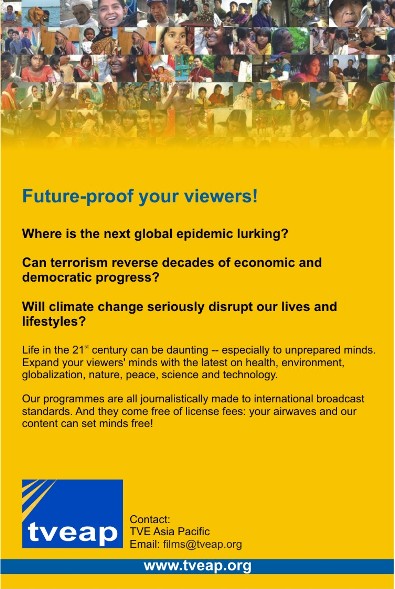
Here’s our promo advert for the event:

futureproof-your-viewers-tveap.jpg

TVE Asia Pacific to co-sponsor Asia Media Summit 2007

I will be reporting from AMS 2007 for the next few days.

Radio Sagarmatha: Kathmandu’s Beacon of hope on 102.4 MHz turns 10

Today, 23 May 2007 is a very special day for broadcasting in South Asia.

Radio Sagarmatha, the first independent community broadcasting station in South Asia, completes 10 years on the air today. It’s certainly a moment to reflect and rejoice for all of us concerned with broadcasting and the public interest in Asia.

Image courtesy Radio Sagarmatha

Here’s how the station introduces itself on its website:
Broadcasting daily from the center of the Kathmandu Valley on FM 102.4 MHz from 5 am to 11 pm, the pioneering radio station has earned a name as a free, independent and highly credible radio station in keeping with its objectives of producing a cadre of professional journalists, addressing the information needs of audiences, stimulating awareness and participation in public issues, and facilitating democratization and pluralism.

The Sagarmatha story is of particular interest to me personally.

Firstly, many involved in founding and running this station are good Nepali friends whose resolve and professionalism I salute on this 10th birthday.

Secondly, this radio station exposed to the whole world a persistent myth that was fabricated and distributed globally by Unesco and its local cronies: that community radio has been thriving in Sri Lanka from the early 1980s. I’ve lived all my life in Sri Lanka, and I’ve spent the past 20 years working in the media, but I have yet to find a single community radio station there — simply because no government has allowed any to be set up! I’ve been writing about this for years, but I’m a lone voice against Unesco’s well-funded ‘myth factory’ working overtime! Read my Panos Feature: Radio suffers as Colombo bosses callthe shots (October 2003).

But enough of that old hat. Today is Sagarmatha’s Day! Happy birthday to the courageous public radio station and everyone involved, past and present.

Recently, supporting the radio station’s nomination for an international media award (to be announced soon), I wrote a brief account about Sagarmatha. It has not been published until now, so here it is, with minor edits:

Kathmandu’s Silent Revolution

Almost a decade ago, a silent revolution started in the Nepali capital of Kathmandu. One day in May 1997, a senior official of the Ministry of Communications handed over a piece of paper to Raghu Mainali, representing a group of Nepali journalists and civil society organisations. It was the broadcast license permitting the first-ever citizen-owned, non-commercial, public interest radio broadcasting station anywhere in South Asia. Soon afterwards, Radio Sagarmatha (RS) was on the air, using the FM frequency 102.4 MHz.

The airwaves will never be the same again in the world’s most populous sub-region, where governments had a strict monopoly over broadcasting for decades.

The broadcast license did not come easily: it was under consideration for over four years, and entailed considerable lobbying by Nepali journalists and civil society groups. At the forefront in this quest was the Nepal Forum of Environmental Journalists (NEFEJ), a non-governmental organisation and a collective of journalists strongly committed to sustainable development, human rights and media freedom.

The senior and highly respected Nepali journalist Bharat Koirala provided advice and leadership for setting up RS, which was cited when he was awarded the Ramon Magsaysay Award — ‘Asia’s Nobel Prize’ — in 2002.

Read a brief history of Radio Sagarmatha on its website

As a long-standing partner of NEFEJ, we have had the opportunity to observe the evolution of RS from humble beginnings to what it is today. Remarkably, NEFEJ colleagues had laid the groundwork for the radio station in anticipation of the license: the hardware, manpower and institutional framework were ready to go on the air soon after official sanction. Beginning with an initial two hours of broadcasts, RS gradually increased its transmissions, providing a mix of music, news and current affairs, sports and cultural entertainment to the Kathmandu city and valley — home to nearly 2 million people. While broadcasting primarily in Nepali, it also carries programming in minority languages and English. In recent years, RS has also rebroadcast selected programmes from BBC World Service Nepali transmissions.

Image courtesy BBC Online Image courtesy Radio Sagarmatha

RS blazed a new trail in broadcasting in Nepal, and in its wake a large number of commercial FM stations and other community broadcasting stations have been set up. The Kathmandu valley’s hills are alive with a cacophony of voices, offering the people a greater choice than ever before. Across Nepal, RS has inspired a plethora of community-owned, community-based radio stations, who are enjoying different degrees of success. RS has also trained a significant number of radio professionals – from announcers and producers to technicians – some of who have moved on to employment with other channels. This commitment to capacity building continues.

In today’s multi-channel environment, RS retains its strong commitment to the public interest, good journalism and high production values. Among others, the following distinguishes this station:

• RS increases people’s participation in debating important day-to-day issues that directly affect their lives and jobs. Roaming producers talk to not just city dwellers but to people living in the most remote areas of Kathmandu.

• RS serves as a people’s forum to examine the merits and demerits of various development policies, efforts and approaches in Nepal, undertaken by government, development donors, civil society and others.

• RS has played its part to bridge Nepal’s digital divide. Suchana Prabidhi dot com (meaning ‘Information technology dot com’) is a popular programme that browses the Internet live on radio, connecting the unconnected radio listeners with information available online.

• In spite of being supported by a large number of development donors, including some UN agencies, RS has maintained its editorial independence, without allowing itself to become a propaganda outlet for any entity.

But it was in Nepal’s recent pro-democracy struggles that Radio Sagarmatha’s commitment to the public interest was truly tested and reaffirmed. The station joined human rights activists, progressive journalists and civil society groups in the mass movement for political reform, including the restoration of parliamentary democracy suspended by the King’s autocratic rule. The regime – seeking complete control over Nepalis’ access to information and independent opinions – imposed a blanket ban on private broadcasters carrying news. Soldiers were posted inside and around Radio Sagarmatha for eight days. Even after they withdrew, the spectre of absolute monarchy hung over all media for months.

Read BBC Online story: The Muzzling of Nepalese Radio (22 April 2005)

Read IPS story: Nepal plunged into the Dark Ages, cry dissidents

Soldier outside Radio Sagarmatha station - bad old days, now gone

That seige continued for much of 2005. On 27 November 2005, I was with some NEFEJ colleagues at a regional media workshop in Siem Reap, Cambodia, when the disturbing news reached us that RS had been forced off the air after police raided the station, seized its transmission equipment and arrested five journalists and technicians. The incident had happened while RS was relaying BBC Nepali Service live from London.

Fortunately, the judiciary intervened. Two days later, responding to a massive outcry from within and outside Nepal, the Supreme Court ordered the authorities to allow RS to continue its transmissions. The station started broadcasting news and current affairs again, and other stations soon found their courage.

The next few months leading to April 2006 were crucial for all associated with the pro-democracy movement. During this period, amidst various pressures, threats and obstacles, the managers and journalists at RS played a pivotal role in ensuring the free flow of information and plurality of views in Nepal. When broadcasting news was banned, RS resorted to innovative ways of getting information across while getting around the jack-boot of bureaucracy.

One method: singing the day’s news — as there was no restriction on broadcasting musical content!

The unwavering resolve of RS, other independent media and pro-democracy activists led to the restoration of parliamentary democracy in April 2006 and the subsequent marginalization of the monarchy. Now the pioneering radio station is working hard to ensure that Nepalis would make better use of their ‘second chance’ in democracy in less than two decades.

As Radio Sagarmatha now enters its second decade, there is much unfinished business: Nepal is one of the most impoverished countries in the world, held back by a decade of civil war. A free, independent and responsible media – epitomized by Radio Sagarmatha – will be essential for Nepal to break from the past and usher in a new era of peace, prosperity and equality.

Listen to Radio Sagarmatha Online

World Association of Community Broadcasters (AMARC) Asia Pacific website