Has Al Jazeera left the building?

Where is Wadah Khanfar?

This is the question that everyone kept asking as Asia Media Summit 2007 started off with what turned out to be a feeble and lop-sided panel on participatory media.

Khanfar, listed on the programme as Director General of the Al Jazeera Network, had confirmed participation and a seat was kept reserved for him on stage even as the opening panel kicked off.

The amiable moderator, Jennifer Lewis from Singapore, kept on asking for Khanfar to please come on stage. He never did.

The seat assigned for him remained empty all through the inaugural session. Some speculated if that was due to the recent reshuffle at Al Jazeera, which some interpreted as a pro-US coup in what until recently was regarded as the world’s most outspoken broadcast media network from the majority world.

I myself have been a cautious cheer-leader for Al Jazeera International. For example, on 18 April 2007, I wrote about AJI placing its content on YouTube to enable US-based viewers to watch the channel that was blocked out of many US cable networks.

AJI has been on the air for only six months, so we must reserve judgement on its performance for a while longer.

Many of us media-watchers were optimistic and hopeful that AJI would offer a much-needed counter to the blatantly one-sided and self-righteous coverage of the dominant international news channels, BBC World and CNN International.

AJI set out with a lofty agenda, saying it wants to ‘balance the information flow from South to North, providing accurate, impartial and objective news for a global audience from a grass roots level, giving voice to different perspectives from under-reported regions around the world.’

It also wanted to revolutionise English language TV in the same way it turned Arabic TV upside down, ending the monopoly of the airwaves by state broadcasters and governments.

Writing an op ed within days of AJI starting its broadcasts on 15 November 2006, I reacted to these stated ideals as follows:

“Noble ideals, indeed — and we fervently hope it succeeds, but unless it’s very careful and thoughtful, AJI runs the risk of falling into the same cultural and commercial traps that its two rivals are completely mired in.

“While CNN can’t get out of its US-centric analysis even in its international broadcasts, the BBC news team is more like a hopelessly mixed up teenager: one moment they are deeply British or at least western European; the next moment they are more passionate about Africa than Africans themselves.

“Desperately seeking legitimacy and acceptance in wide and varied circles, these two global channels have sometimes traded in their journalistic integrity for privileged access, exclusives or – dare we say it? – to be embedded.

“They have increasingly come to epitomise a disturbing trend in international news and current affairs journalism: the end justifies the means.”


Read my full essay in Media Helping Media (UK)

al-jazeera.jpg

I argued in my essay that the end does not justify the means of gathering news.

“If products of child labour and blood diamonds are no longer internationally acceptable, neither should the world tolerate moving images whose origins are ethically suspect.

So that’s the real challenge to Al Jazeera: to usher in real change, it needs to transform not just how television news is presented and analysed, but also how it is gathered.”

We have been watching — whenever we can catch it, that is — how AJI is covering the complex and nuanced world we live in. So far, the impressions are not encouraging. We have to look long and hard to tell the difference between BBC World, CNN International and AJI.

We will keep watching, and give the new kid on the block a bit more time to prove itself.

And we look at not just what’s shown on AJI, but how those pictures get there.

Read earlier post: Banned in the USA, Al Jazeera now on YouTube

Saved by the ‘soaps’ – Asia Media Summit picks up momentum

Asia Media Summit 2007’s first day — which started with old media mandarins dismissing new media — ended on a good note, thanks to an interesting, focused session on soap operas and reality TV shows.

Is reality TV a transient fad? With media convergence and lowered barriers to mass media, what new forms and formats of programming and delivery will emerge? These were some questions posed to three panelists drawn from the India, South Africa and the UK.

The most interesting presentation, for me, came from India: Yvonne MacPherson, Project Director of BBC World Service Trust (India) — the BBC’s charitable arm — spoke about their work in India using entertainment TV formats to communicate socially relevant messages.

She shared highlights of BBC-WST’s experiences in using the long-format drama serials and reality based dramas on Indian television.

These are part of what BBC-WST website calls ‘one of the world’s biggest mass media projects to achieve HIV and AIDS awareness and prevention’.

HIV positive detective Jasoos Vijay - courtesy BBC WST Jasoos Vijay transformed Indian attitudes about HIV Haath se Haath Milaa music video wins top India TV awards

First broadcast in July 2002, ‘Jasoos Vijay’ (which means Detective Vijay) is a long-running detective serial on India television. It features Vijay — who is living with HIV — and has messaging about HIV and AIDS awareness and prevention woven in to the plot and dialogue. It not only provided basic facts and figures, but also debunked popular misconceptions about HIV.

After four years on the air, the series entered the Top Ten among Indian TV programmes in August 2006. According the industry-wide TAM audience figures, it then drew a weekly audience reach of almost 16 million viewers.

The series is filmed entirely on location. It is made in Hindi and dubbed into seven other languages. The detective serial is broadcast on peak viewing time on Sunday evening on India’s Doordarshan National channel.

“Long format drama series is the best way to attract a countrywide mass audience,” MacPherson said. “Reality show format, on the other hand, better suits urban and semi-urban audiences.”

In the latter category is BBC-WST’s celebrity and reality programme on HIV awareness, ‘Haath se Haath Milaa’, which means ‘Let’s Join Hands’. It is aimed at younger viewers in urban areas.

Both series were delivered in partnership with India’s national broadcaster, Doordarshan and the Indian National Aids Control Organisation (NACO). Whatever services that were mentioned in the programmes — whether on voluntary HIV testing or anti retroviral drugs — the creators ensured that it was already available through the official healthcare system.

Key to the success of these media initiatives was substantial volumes of research and pre-testing, MacPherson said.

Studies have highlighted how television plays such a significant role in the lifestyle and family choices in India.

She disclosed that BBC-WST is now planning to apply the same entertainment format to another social issue in India: the wide-spread practice of aborting girls after the sex of an unborn child is found out from tests.

“There have been various TV advertisements appealing viewers to love girls, but that doesn’t seem to work — because they don’t address why girls and women are devalued in society.”

Vasanthi Rao, Director of India’s Centre for Media Studies (CMS), was less enthusiastic about reality shows on Indian television. “They don’t really capture reality. It’s more a moderated reality.”

She asked about the kind of budgets that BBC-WST worked with in India, a question that Yvonne MacPherson chose to ignore. This was interesting by itself, given how BBC-WST is increasingly seen as competing for scarce development communication funds with national and local organisations in the very developing countries that it seeks to serve.

In recent years, the BBC-WST has raised millions of pounds and dollars worth grants which come from overseas aid budgets of the UK government and from charitable foundations such as the Bill and Melinda Gates Foundation. Notwithstanding the high degree of professionalism and creativity the Trust has brought into all its media projects in India and elsewhere, questions need to be asked on its cost-benefits ratio — and whether it distorts the market for others.

Jacky Sutton, a communications advisor with Unesco in Afghanistan, noted how soap operas can complement the media’s news agenda. “Media is not all about confronting politicians or exposing corruption. It is also about giving people the right information and more choices in their daily lives.”

She noted how UN-sponsored development films on worthy issues are just that – worthy. “They are not particularly interesting — I have made a few myself!”. She agreed that entertainment formats are the most suitable to engage the mass audience.

Dali Mpofu, Group CEO of South African Broadcasting Corporation, offered very sound advice to the so-called public service broadcasters or PSBs (a misnomer that I no longer believe in). In his own words: “The biggest mistake that PSBs is to compete with the (commercial) mainstream, trying to be more like them. Instead, we should do very well what we are mandated to do. It is the duty of PSBs to push the envelope.”

He described how SABC has taken risks: some paid off, others didn’t. That’s all part of the game.

If only other ‘public’ broadcasters of the world were as enterprising.

Asia Mediasaurus Summit 2007 now on in Kuala Lumpur?

As the Asia Media Summit 2007 started this morning at Hotel Nikko in Kuala Lumpur Malaysia, I had to kick myself hard to make sure it was not a bad dream concocted by my often over-active imagination.

The first plenary session was on ‘Era of participatory media: Rethinking mass media’. It was a response to what many of us had urged the organisers, Asia Pacific Institute for Broadcasting Development (AIBD), to do this time around: take a closer look at how the citizens’ media are evolving and impacting mainstream media.

The session had three speakers — the Director General of Deutsche Welle (DW) of Germany, Director General (international planning) of NHK Japan, and an Editor Emeritus (no less!) from The Toronto Star newspaper in Canada. (The fourth speaker, Director General of Al Jazeera Network, didn’t show up – is it because he no longer holds that job after a recent shake-up of the network’s top management? See: Pro-US coup at Al Jazeera?)

Image courtesy AIBD

The panel was chaired by Jennifer Lewis, who edits Singapore Straits Times Online, Mobile and Print offering — better known by its abbreviation STOMP. She was the only interesting speaker and, tellingly, the only speaker who had any direct experience with the new media or participatory media.

Age has something to do with it, I guess. I’m 41 years old, and I don’t consider myself a digital native. I didn’t grow up with computers and mobile phones like my 11-year-old daughter is now doing. For all my interest in the new media, I remain a digital immigrant trying to find my way in the digital world.

For sure, DW, NHK and The Toronto Star are venerable media institutions that have long served the public interest. No argument there. But why were their chiefs pontificating on the limitations of new media — especially blogs — while there was not a single new media practitioner on the panel (not counting Jennifer, who as moderator didn’t get to share her own experience)?

We sat there hearing from the worthies of the old media that bloggers have limitations of outreach, legitimacy and credibility. They grudgingly acknowledged the existence and some advantages the new media have over their own (old and tired?) media. But all of them failed to say anything new or interesting.

Some, like the emeritus Canadian editor, in fact could not understand why there was no business model in blogs. (Yes, we know it stumps the commercialised media to see so many of us working for no gains or perks of any kind!). He then ventured to make sweeping generalisations about all new media by trying to make a tenuous link between new media platforms and their use by terrorist groups. That was so off the mark that does not warrant a response. The moral is: Elderly editors must stick to what they know best.

During question time, a few audience members tried to point out the complementarity of the old and new media, but by then the tone had already been set: this is going to be yet another gathering of the now rapidly endangered mediasaurus – about whom I have talked about in this previous post.

AMS 2007’s first session showed us well and clear the great divide between the old media and new media. The panel failed miserably and completely to find any bridge across the two. It was doomed from the start because there was no representative of the new media on it.

Asia’s largest gathering of media managers and policy makers has got off to an inauspicious start.

I don’t want to spend three days of my time if this is going to be Asia Mediasaurus Summit.

Source: http://www.indcjournal.com/archives/ariaillg2.jpg

Broadcasters: can you ‘future-proof’ your viewers?

I have just arrived in Kuala Lumpur, the Malaysian capital, to participate in and speak at Asia Media Summit 2007.

It’s Asia’s largest annual gathering of broadcast media’s movers and shakers — for the next few days, TV and radio network CEOs and managers will hobnob with programme producers, researchers and a few, carefully invited media activists. They will discuss many issues of common concern – from media freedom and copyrights to keeping up with new technologies.

TVE Asia Pacific is once again co-sponsoring the Summit, which is one of the most important events of our calendar. Among the development issues to be addressed in plenary sessions or pre-summit workshops are ICTs, community radio and effective communication of HIV/AIDS.

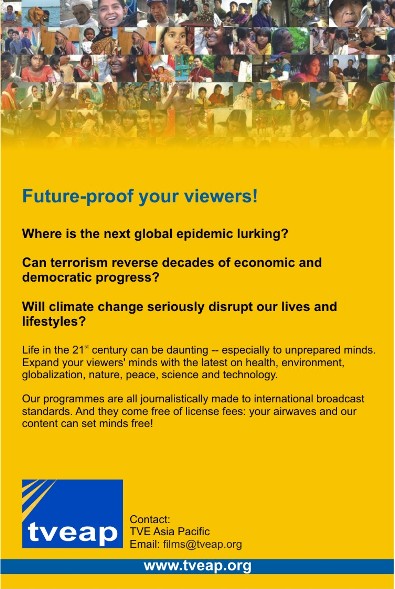
Here’s our promo advert for the event:

futureproof-your-viewers-tveap.jpg

TVE Asia Pacific to co-sponsor Asia Media Summit 2007

I will be reporting from AMS 2007 for the next few days.

Saving the Planet, one tiny step at a time

A youth theatre group that tours the Philippines, engaging small groups on history, culture and development.

A public radio station that takes up development issues through on air reporting and discussions in Nepal’s Kathmandu valley.

A project that brings together Thai school children and farmers to study and understand farmland biodiversity.

These are among the winning projects that have just been selected to be featured in TVE Asia Pacific’s new regional TV series, Saving the Planet.

Six projects or activities – each addressing an aspect of education for sustainable development (ESD) – have been chosen from worldwide public nominations.

saving-the-planet-logo.jpg

Click here for full list of competition winners.

Read TVEAP news story announcing the winners.

I was part of the International selection panel that sifted through dozens of public nominations from all over the world. Reading these was an inspiring experience. In a world that is full of doom and gloom type of news, there still are individuals, groups and communities who are doing their bit to live within our planet’s means….that’s what sustainable development is all about.

The joint statement by the selection panel noted: “The selection panel was impressed by the breadth and scope of nominated activities, which indicates that all across developing Asia, there is an upsurge of concern and commitment to living within the planet’s resources.”

Read the full statement by selection panel

I have always held that governments or scientists can’t save the planet – people can. In the final analysis, all the inter-governmental babble and scientific research are means to an end. Unless people change their attitudes and lifestyles, all that governments or science can do is to buy us more time — which will run out sooner or later.

In Saving the Planet, we are going to showcase some Asian communities and groups who are not just walking the talk themselves, but showing others how to do it as well.

The new TV series will go into production by July, and will be released next year. Watch this space.

Outsourcing journalism: From eye witness to i-witness?

Outsourcing has arrived…in broadcast journalism.

Good reporting, we thought, has everything to do with being there, observing and then sharing the information, impressions and opinions. But some editors and publishers disagree.

Just caught this news in the Los Angeles Times, 11 May 2007:

Local news reporting outsourced to India
A news site hires two to cover Pasadena from afar. That helps a shoestring budget go further.

By Alex Pham, Times Staff Writer
May 11, 2007

When is local journalism not really local? When it’s about Pasadena and written by someone in India.

James Macpherson, editor and publisher of the Pasadena Now website, hired two reporters last weekend to cover the Pasadena City Council. One lives in Mumbai and will be paid $12,000 a year. The other will work in Bangalore for $7,200.

The council broadcasts its meetings on the Web. From nearly 9,000 miles away, the outsourced journalists plan to watch, then write their stories while their boss sleeps — India is 12.5 hours ahead of Pacific Standard Time.

“A lot of the routine stuff we do can be done by really talented people in another time zone at much lower wages,” said Macpherson, 51, who used to run a clothing business with manufacturing help from Vietnam and India.

Read the full story

Wait till other media managers get to hear this.

And I can already imagine how our media intellectuals in South Asia will tear this apart.

Read Rediff India coverage of this story

When will the next David Attenborough show up?

David Attenborough has done more to bring Nature and wildlife to the world’s television audiences than anybody else in the past half century.

Growing up in teh 1980s, I watched his pioneering series Life on Earth (1979) and The Living Planet. These series redefined how natural history documentaries were made, and inspired a whole new generation of film-makers and nature lovers.

Sir David Attenborough

Attenborough went on to make several more trail-blazing series, such as The Trials of Life (1990), The Life of Birds (1998) and The Life of Mammals (2002).

He has also produced a large number of stand-alone documentaries, and narrated an astonishing number of films and series, including the multi-award-winning Blue Planet (2001) and Planet Earth (2006).

Image courtesy Wikipedia Image courtesy Wikipedia Image courtesy Wikipedia

I have always been grateful for his inspiration. But Sir David earned my eternal respect when I read in his biography how he had given up British broadcasting’s most coveted post so he could concentrate on what he did best: making natural history films. From 1969 to 1972, he was BBC Television’s Director of Programmes (making him responsible overall for both BBC1 and BBC2), but turned down the offer to become Director General of the BBC. In 1972, he resigned his post and returned to programme making.

I recently came across the following news item, which reminds us that like all creatures big and small in the great Circle of Life that Sir David has so avidly told us about, he too is mortal. At 81, it’s time for the world to look for the next David Attenborough.

This item is from the latest newsletter of Film-makers for Conservation, a network organisation where my company, TVE Asia Pacific, has recently become a member.

New reality TV show to discover the next Attenborough

Join wildlife filmmaking finalist Bryan Grayson as he talks about his journey from engineer to wildlife film maker and discusses his hopes of being the next David Attenborough

David Attenborough, David Bellamy and Steve Irwin. All great men who have brought the wonder of nature to our front rooms. They have worked in some of the worlds most amazing and dangerous locations to show us the beauty, innocence and sometimes savagery of the animal kingdom.

Imagine filming rhinos in Africa, whales in the South Pacific or being within an arms reach of gorillas in the rainforest. Well now a unique new television project will follow six contestants as they embark on a demanding training course at the award-winning Shamwari Game Reserve in South Africa, where they will learn the essential skills and realities of creating a natural history documentary.

Thousands of people entered Animal Planet’s search for amateur film-makers to take part in a once-in-a-lifetime intensive filmmaking course with experts Andrew Barron and Lyndal Davies. The entrants, from across the globe, were filtered down to a final six and Bryon Grayson is the only UK finalist.

But exactly how do you cope with filming a charging herd of wildebeest, learn to track an elusive leopard and deal with stroppy presenters!? Here with the answers is the UK’s contestant, Bryan Grayson. He joins us to share some of his tricks of the trade and offers his advice to all other budding filmmakers.

Bryan Grayson joins us online at http://www.webchats.tv/webchat.php?ID=372 to discuss his hopes for being Animal Planet’s Unearthed wildlife filmmaker after taking part in this remarkable series.

Do you think you have what it takes to be a wildlife filmmaker? Enter here for your chance to appear in series two of UNEARTHED

Watch Unearthed promo video on Google Video

TVE Asia Pacific joins Film-makers for Conservation

Is UK’s Channel 4 the latest ‘Fossil Fool’?

Even as climate change gathers momentum as a worldwide concern, more media organisations are ending up with egg on their face about their coverage of the issue.

Last month, I quoted British environmentalist George Monbiot about the BBC’s appalling track record on this: see ‘The BBC as a Fossil Fool’, 7 April 2007.

And now, UK’s Channel Four can make its own claims to be a Fossil Fool.

The Independent on 8 May 2007 reported that the makers of a Channel 4 documentary which claimed that global warming is a swindle have been accused of fabricating data by one of the scientists who participated in the film.

The Great Global Warming Swindle was broadcast on 8 March and has been criticised by leading scientists for errors, distortions and misrepresentations.

Image courtesy Channel 4

The article reads:

The film has also been referred to the UK regulatory watchdog OFCOM which is considering a complaint from 37 senior scientists that the programme breached the broadcasting code on the misrepresentation of views and facts.

Now even a climate sceptic whose dissenting views were used by the film-makers to bolster their claims about the “lies” and “swindles” of global warming has accused the documentary of promulgating falsehoods.

Eigil Friis-Christensen, director of the Danish National Space Centre, has issued a statement accusing the film-makers of fabricating data based on his work looking at the links between solar activity and global temperatures.

The scientists who have written to Ofcom include Sir John Houghton, the former chief executive of the Met Office, Lord May of Oxford, a former government chief scientist and past-president of the Royal Society, and Professor Chris Rapley, director of the British Antarctic Survey in Cambridge. In a letter to Mr Durkin they call for changes to the programme before the DVD version is released, even though DVDs are not covered by the Ofcom Broadcasting Code.

“So serious and fundamental are the misrepresentations that the distribution of the DVD without their removal amounts to nothing more than an exercise in misleading the public,” they say.

Image courtesy the film's website

Commenting on the documentary on 13 March 2007, George Monbiot wrote in The Guardian:

The problem with The Great Global Warming Swindle…is that to make its case it relies not on future visionaries, but on people whose findings have already been proved wrong. The implications could not be graver. Just as the government launches its climate change bill and Gordon Brown and David Cameron start jostling to establish their green credentials, thousands have been misled into believing there is no problem to address.

The film’s main contention is that the current increase in global temperatures is caused not by rising greenhouse gases, but by changes in the activity of the sun. It is built around the discovery in 1991 by the Danish atmospheric physicist Dr Eigil Friis-Christensen that recent temperature variations on Earth are in “strikingly good agreement” with the length of the cycle of sunspots. Unfortunately, he found nothing of the kind.

Read full commentary by George Monbiot in The Guardian 13 March 2007

Read the full article by Steve Connor in The Independent online on 8 May 2007

The Great Global Warming Swindle website

Profile of film’s director, Martin Durkin

Nepal’s Aankhijhyal is 500 — and counting!

Aankhijhyal is a Nepali word. It means window.

Aankhijhyal is today also a ‘brand name’ in Nepal. It’s Nepal’s most popular TV magazine programme on environment and social development, which recently produced its 500th edition.

Aankhijhyal logo NEFEJ logo

The half-hour programme has been produced regularly since May 1994. Now in its 13th year, it is one of developing Asia’s longest running television shows.

The landmark 500th edition was broadcast on 27 February 2007. In this special programme, its producers, the Nepal Forum of Environmental Journalists (NEFEJ), looked back at the interesting and challenging times they have chronicled and investigated.

And last night in Kathmandu, the Nepali capital, I sat down with a team of friends from NEFEJ to belatedly celebrate the occasion.

A dozen journalists, producers and film-makers joined us. We chatted away well into the night. There was no longer any worries about curfews and army check-points.

“We don’t often get together like this as one big group,” said Rabindra Pandey, head of Audio-Visual at NEFEJ. “Most of the time, we are too busy to socialise. We are chasing deadlines, or stories, or sponsors!”

There is much to cheer, both at micro and macro levels.

Sustaining a half-hour show on television is no mean feat in any part of the world, especially in a low income country like Nepal. Broadcasters here don’t put any money in programmes like Aankhijhyal . In fact, NEFEJ not only produces the show entirely at its own cost, but also pays for airtime on Nepal Television to get it out to the public! That’s the broadcast reality that many of our western colleagues are often unable to understand.

And the general feeling right now in Nepal is upbeat. After Nepal’s own People Power revolution of April 2006, people are hopeful that their ‘second chance in democracy’ can actually work better. While the streets of Nepal are as dusty and chaotic as ever, I can see far more tourists and far fewer soldiers on the roads now than on previous visits in recent years.

NEFEJ is a non-profit collective of journalists committed to communicating sustainable development issues. Foundecd 20 years ago, it has a much better record of democracy than Nepal itself: every year, office-bearers are democractically elected by its over 100 members. There is regular ‘change of guard’ at the top.

NEFEJ is also one of the oldest and strongest parters for us at TVE Asia Pacific.

Aankhijhyal is the organisation’s ‘crown jewel’. It’s the centrepiece of NEFEJ’s Audio Visual Department, and has been widely acclaimed for its investigative approach to sustainable development and social justice issues.

From land reform and agrochemical misuse to the conservation of heritage sites, and from the trafficking of women and children to HIV, Aankhijhyal has been covering a broad range of issues, concerns and controversies in the public interest. While remaining apolitical, the programme has also reflected the human, social and environmental costs of Nepal’s violent insurgency and pro-democracy struggle in recent years.

Filming Aankhijhyal - image courtesy NEFEJ

“Since its inception in 1993, we have come a long way and Aankhijhyal has managed to create awareness among the Nepalis on the issues related to environment and development,” says Rabindra. “Aankhijhyal still remains one of the most popular video magazines on Nepal Television.”

Aankhijhyal’s passing 500 editions is all the more significant because it has been sustained without a break by this non-profit cooperative of journalists. Whether or not external funding was available, NEFEJ has continued producing the programme – often using its own savings from other, better-funded projects.

And it was clear to me last night that they have no intention of resting on their laurels.

“There’s so much happening in Nepal today. We are living in a period of rapid change. We feel one half-hour show a week is not enough to capture the unfolding stories,” said NEFEJ’s current President, Sahaj Man Shrestha, himself a former CEO of a private TV channel in Nepal.

Image courtesy NEFEJ

Read TVE Asia Pacific news item: Nepal’s premier TV magazine Aankhijhyal is 500 (27 Feb 2007)

NEFEJ Aankhijhyal online archives

More about NEFEJ Audio-Visual Department

Read Indian magazine Down to Earth on Aankhijhyal

All images courtesy NEFEJ

Breaking News from Onion News Network: They know it all!

Some journalists and media organisations never allow the truth to get in the way of a good story.

Now, as broadcast television trades more substance for style, on-screen graphics is everything. Unless a news story is supported with gimmicky, flashy graphics, the networks seem to think, it won’t be news anymore.

This ONION TV News Parody shows how getting the graphics right is more important to TV networks than getting the meaning right. The story keeps shifting but the anchor remains authoritative — without knowing what the news is all about.


Breaking News: Something Happening In Haiti

According to their self introduction: The Onion News Network (ONN) has set the standard for globe-encompassing 24-hour television news since it was founded in December, 1892. The network boasts channels in 171 languages and can be viewed in 4.2 billion households in 811 countries. Now get the only news you need on the web and from our esteemed media partners.

Onion News Network Promo

Earlier post: Jib-Jab Video: What we call the news