Enriching South Asian airwaves: Ujala TV is one year and counting…

Some of us dream about doing great things. Other agitate for reform. A few among us just go ahead and do it.

This story is about one such group, and its inspirational leader, who took on the formidable challenge of setting up an educational television channel for South Asia.

Just thinking about it can scare away most people. Home to over 1.5 billion people, including the largest concentration of poor anywhere in the world, South Asia is in a region full of disparities, divisions and desperation. It is not only the most militarised region in the world, but also one of the most highly bureaucratised (the British invented bureaucracy and we in South Asia perfected it!). Starting a new venture of any kind is fraught with endless permissions and paperwork.

None of this deterred Rashid Latif from launching Ujala TV in mid 2006 as a free, 24-hour satellite television channel dedicated to education and information with focus on South Asia.

Ujala TV Ujala TV Ujala TV

Ujala TV is wholly owned and operated by a non-profit entity called the People’s Education Network (PEN) that Rashid founded.

As the channel’s website says: ”A refreshing new television alternative, Ujala does not belong to any nation – it belongs to South Asia. Showcasing both local and international programs our goal is to help ease the barriers placed between us and within our own minds.”

Ujala TV’s test transmissions started on 2 July 2006 from Dubai, where Latif assembled his small team of hard-working professionals at the Dubai Media City. This was a smart move: not to be anchored in any single country in South Asia itself when broadcasting to the region.
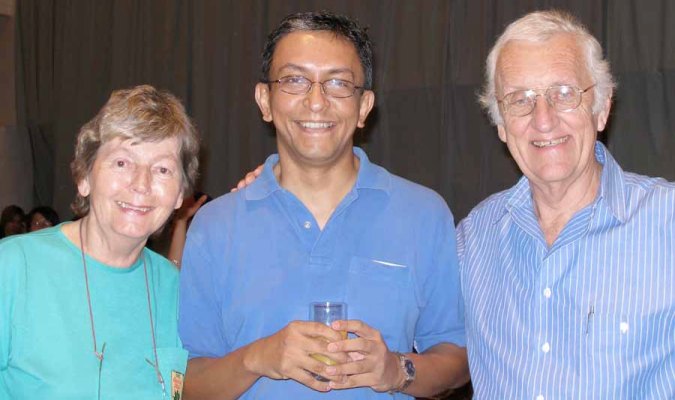
l-to-r-rashid-nalaka-sohail.jpg

Photo shows (L to R) Rashid Latif, Nalaka Gunawardene and Sohail Khan in Dubai, May 2006

As Sohail Khan, Director Operations of Ujala TV, recalled recently: “I still cherish the excitement when I was at Samacom (the Uplink Earth Station at Dubai) at around 2 am Dubai Time to press the button to air Ujala for the very first time at 00:00 GMT on 2 July 2007 (4 am Dubai Time) to start the Test Transmission.”

They had worked long and hard to get to that point. A few weeks earlier, in mid May 2006, I stopped over in Dubai specifically to meet Rashid and his team who were busy preparing to launch. At that time, they were working out of their office for 16 – 18 hours a day, every day, and sleeping a few hours at the office itself.

This was no multi-million dollar start up channel. The entire operation was being financed by Rashid Latif from personal funds. Although the channel’s aims were entirely in the public interest, he declined to seek funding from development donors or philanthropic foundations.

A Pakistan-born Canadian citizen, Rashid worked in the Pakistan government as a senior broadcast manager before heading west to work in the corporate sector. He started Ujala TV after formal retirement.

“I started working on ‘Ujala’ project (at the age of 75) when most of my contemporaries had either played their innings or were about to pack up and leave for the pavilion,” Rashid said in a recent letter.

Until this letter, I had no idea that Rashid was 75. He has the energy and drive of someone in his late 50s or early 60s!

Sohail looks back on the first year: “During this first year, we came across many difficulties, including, changing laws in India and Pakistan for Landing Rights with huge financial requirements, and increase in running costs due to change in different rentals here in Dubai. These problems, however, do not have any effect on our determination, and we are still trying to eliminate the darkness from our part of the world, and to spread Ujala.

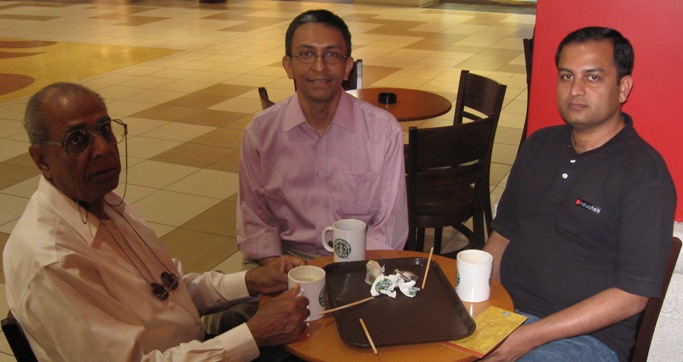
nalaka-with-rashid-latif.jpg

The new channel still struggles to establish its brand identity and distribution networks — it’s not easy to compete with big corporations with their deep pockets.

But a modest start has been made. Now we need to sustain the momentum.

Meanwhile, Rashid is looking for a dynamic South Asian national to take over from him, so that he can fully retire. Now that’s going to be a tall order.

Declaration of interests:
1. I am on the honorary Board of Governors of People’s Education Network along with over a dozen academics, journalists and film-makers who share Rashid’s ideal for a South Asian public interest TV channel.
2. TVE Asia Pacific has supplied many development films to Ujala TV over the past few months.

Read Aman Malik’s article in Himal Southasian on Channel Southasia

All Online Data Lost after Internet Crash…

This report has just come in, from my favourite news source, Onion News Network….enjoy!

I wonder what I would do if all my blog posts were suddenly lost….irrevocably? Agh — perish the thought!

And this reliable news report confirms something I’ve suspected all along — when it comes to e-commerce, Nigeria’s is the southern economy that is best developed: I receive evidence of that in my email practically everyday…

‘Toxic Trail’ continues its trail across Asia

mongkon-tianponkrang.jpg mongkon-tianponkrang-of-tef.jpg
Meet Mongkon (Mong) Tianponkrang.

He is a Programme Coordinator with the Thai Education Foundation (TEF), a non-profit organisation working to improve education in Thailand at all levels, especially using non-formal methods.

I met Mong earlier this month during our regional workshop on communication capacity building under TVE Asia Pacific‘s Saving the Planet project.

TEF’s School and Community Farmland Biodiversity Conservation project is one of six stories that was chosen from among dozens of public nominations to be featured in the Asian regional TV series we are working on, titled Saving the Planet.

Saving the Planet will feature remarkable initiatives from South and Southeast Asia by educational, civil society and community groups engaged in Education for Sustainable Development (ESD).

Mong was a live wire during our 5-day workshop in Khao Lak, Thailand. We encouraged everyone to share experiences in communicating with their respective audiences, using whatever communication methods and means (media or non-media).

At one point, Mong started describing how he and his team have been using a video film called Toxic Trail that takes a critical look at the use of pesticides in crop cultivation in Thailand and neighbouring countries.

He described how they’d found the film’s Thai version very useful in their work with farmers, housewives and other community members.

This was a fine coincidence: he didn’t know until then that we at TVE Asia Pacific had been involved in versioning Toxic Trails, originally produced in English, into half a dozen Asian languages including Thai. That was back in 2002.

Toxic Trail is a two part documentary that was produced in early 2001, directed by a long-time friend and colleague Janet Boston (who today heads the Thomson Foundation, which has a 40-year track record in training journalists in the developing world). It was first broadcast on BBC World in April 2001.


Image courtesy Community IPM website

It followed Russell Dilts, an expert working with the United Nations Food and Agriculture Organisation (FAO) as he investigated the pesticide industry in South East Asia. The trail begins in Thailand, moving to Cambodia and ending in Indonesia. The main focus, however, is on Cambodia, where Dilts uncovers major problems in the misuse of pesticides.

Dilts makes stark and horrifying findings: the mass use of pesticides is progressively destroying delicate local ecosystems, as well as causing many health problems to farmers and their families involved. Eventually, everybody is affected by consuming agricultural produce with high levels of pesticide residues.

Read TVEAP website feature on Toxic Trail (Aug 2002).

Read key issues raised by Toxic Trail films

Image courtesy Toxic Trail website

Interesting things happened following the release of Toxic Trail in 2001. First, the FAO came under intense pressure from pesticide companies for having supported an investigative film that probed the reality of product stewardship that these companies claimed existed.

Stated simply, Product Stewardship is when companies take the responsibility for their products. It includes the monitoring of the distribution of products with regard to choice of outlet and method of sale. Toxic Trail questioned how this concept was being practised in developing countries such as Thailand and Cambodia.

Clearly, the companies didn’t like what was disclosed with tangible, visual evidence. In the weeks that followed the film’s release, and its high profile broadcast on BBC World, at least three heads rolled at FAO’s Integrated Pest Management (IPM) programme for Asia.

But by then the genie was out of the bottle. The BBC broadcast may have been watched by a handful of officials, diplomats and businessmen who walk the corridors of power. But a much larger Asian audience was reached by our versioning the films into Bahasa Indonesia, Hindi, Khmer, Mandarin, Sinhala and Thai — which, between them, are spoken by close to two billion people. These versions have been broadcast and narrowcast through numerous outlets ever since.

And as Mong reminded us earlier this month, the films are still in good use, several years after their production and versioning.

One clear lesson: it’s not just enough to produce a good TV film. How much it is seen and used depends on the amount of promotion, local adaptation and subsidised or free distribution that goes with it.

In the case of Toxic Trail, there was a network of promoters for IPM and sustainable agriculture who picked it up and ran with it — and continue to spread the word.

Meanwhile, we should be releasing more such ‘genies’ out of their bottles…

Visit Community IPM website

Look up more online resources on integrated pest management

Photos of Mongkon Tianponkrang by Indika Wanniarachchi of TVEAP
Other images courtesy Toxic Trail website

Pay-back time for film-makers: Go back to your locations!

“These days it’s simply not good enough to use the old response… “If people know about it they’ll care for it and do something”. Wrong. They’ll just go on being conned that it’s all perfect out there, with endless jungles, immaculate Masai Maras, and untouched oceans. What planet are they on about?”

These words come from Richard Brock, one of the world’s leading and most senior natural history film makers.

If you haven’t heard his name, chances are that you know at least some of his many creations: he worked in the BBC Natural History Unit producing, among others, the highly successful Life on Earth and Living Planet series presented by David Attenborough.

Image courtesy The Brock Initiative Image courtesy Brock Initiative

The BBC Natural History Unit (NHU) is a department of the BBC dedicated to making TV and radio programmes with a natural history or wildlife theme, especially nature documentaries. It celebrates 50 years in 2007.

Richard Brock worked with them for 35 of those 50 years. He left them a few years ago, according to his own website, ”concerned by the lack of willingness to address the real current state of the environment”.

He then started his own independent production company, Living Planet Productions, which has made over 100 films on a wide range of environmental topics, shown all over the world. As his archive of films and footage mounted up, Richard felt that there was something more, better, that could be done with this resource.

“We’ve been celebrating nature by bringing its wonders to the TV screen all over the world. Now that world is changing, faster and faster, and nature needs help. Films can do that, at a local level, be it with decision-makers in the government or in the village,” he says.

He adds: “When you consider the miles of footage and thousands of programs sitting in vaults out there unused, it seems tragic that the very wonders they celebrate are dwindling, often because no one tells the locals and tries to help. That is why I believe its Payback Time for the wildlife television.”

Thus the Brock Initiative was born. To quote from their website:
“He decided to set up the Brock Initiative, to use his archive of footage, and to ask others to do the same, to create new programs, not made for a general TV audience, but made for those who are really connected to the situation in hand: local communities, decision makers, even that one fisherman who uses dynamite fishing over that one coral reef. Its about reaching those who have a direct impact; reaching those who can make the difference.”

As he emphatically says: “Showing the truth on some minority channel is not the answer. Showing it where it counts, is.”

Image courtesy The Brock Initiative

I hope those development donors and corporate sponsors, who try to outdo each other in supporting programming going out on BBC World (an elite minority channel in most markets) hear people like Richard Brock — long-time BBC insiders who know what they are talking about.

Those who make documentaries on wildlife, natural history or environment (and wild-life of humans) are trapped in their industry’s many contradictions. They go on location filming to the far corners of the planet, capturing ecosystems, species and natural phenomena. Yet for a long time, many have avoided talking about or featuring the one species that has the biggest impact on Nature: Homo sapiens (that’s us!).

Whole series of wildlife documentaries have been made, by leading broadcasters and production houses of the east and west, without once showing a human being or human activity in them. Almost as if humans would ‘contaminate’ pristine Nature!

In recent years, more film-makers have broken ranks and started acknowledging the human footprint on the planet and its environment. But a good many documentaries are still made with ‘pure’ wildlife content, with not a thought spared on the wild-life of our species.

Richard Brock is one who has refused to follow the flock. And he has also punctured the highly inflated claims — promoted by BBC Worlds of this planet — that broadcast television can fix the world’s problems.

As we have found out here in Asia, it’s a judicious combination of broadcast and narrowcast that can work – and we still need the participation of teachers, activists and trainers to get people to think and act differently.

At their best, broadcasts can only flag an issue or concern to a large number of people. For attitudes and behaviour to change, that needs to be followed up by narrowcast engagement at small group levels.

Taking films to the grassroots need not be expensive, says Brock. In fact it can be done inexpensively.

These are not programmes for broadcast to western audiences demanding BIG productions – you are often showing films to people who have never even seen TV. The effort comes in showing the right thing, to the right people, in the right way, and not about expensive effects, top quality cameras or cutting edge effects.”

Using donated archive footage cuts costs dramatically. New footage, important for putting a film in a local context, can be taken on small miniDV cameras and editing can be done on any home computer. In this way, it becomes feasible to put together a film even for a very small, but crucial audience.

The Brock Initiative, started and funded by donations from its founder, has projects in Kenya, Madagascar, Tanzania, the UK and Indonesia.

Read more about the Indonesia project

They also offer wildlife and nature footage free to those who want to use moving images to make a difference.

Read Richard Brock’s formula for making films that make a difference!

As our species’ wild-life pushes our living planet closer to peril, we need many more Richard Brocks to try and reverse disturbing trends at the edges of survival — almost all of them in the global South.

It’s pay-back time, film-makers!

Related blog posts:
End this callous waste – open up broadcast archives for combating poverty and ignorance

Lawyers who locked up the butterfly tree

Anita Roddick, Angkor Wat and the Development Pill

Contact The Brock Initiative

The Three Amigos: Funny Condoms with a serious mission

For some reason, my blog post with the highest number of daily hits for the past few days has been what I wrote in mid April: ‘Beware of Vatican Condoms – and global warming’.

I’m not sure if the interest is really in condoms, the Vatican or global warming, but since we must be demand-driven, here’s a new condom story! It concerns the three funniest condoms I’ve met.

Image courtesy Three Amigos website

They are called The Three Amigos – they are three differently shaped and coloured condoms, each with distinctive personality. They go places — certainly more than your average condom — to airports, forests, football games, recording studios, even television talk shows!

They are funny, amiable and out to have a good time. Occasionally they are also fallible and gullible — just like many humans are.

And like many of us, they grapple with hard choices in life – for example, between caution and temptation, or between right and wrong.

So far there are 20 adventures of The Three Amigos — each no longer than a minute: in those precious few seconds, a compact story is told with stunning effect. Talk about packing a punch.

Wherever they go, and whatever they do, the three friends have one mission: to remind us of many ways in which we can help stop the spread of HIV/AIDS.

The Three Amigos is a series of twenty Public Service Announcements (PSAs) in the form of short comedic sketches, featuring three animated, talking condoms. Some 80 volunteers in Canada, India and South Africa have created this ground-breaking behaviour modification programme to stop the spread of HIV/AIDS.

It is a multi-award winning series that has been endorsed by Bishop Desmond Tutu of South Africa, who believes these PSAs are a powerful communicating tool to encourage people to change their behaviour.
Read Desmond Tutu letter here
See testimonials from all over.

The Three Amigos The Three Amigos The Three Amigos The Three Amigos

The Three Amigos is a north-south joint production. Its producers are Brent Quinn of South Africa and Firdaus Kharas of Canada. They are jointly responsible for the project and its contents.

Firdaus Kharas, who was also the Director of the series, is Ottawa-based and specializes in the creation of television programmes, feature films and animation. Most of the productions are international in creation and on international themes such as children’s rights.

We met Firdaus in person when TVE Asia Pacific organised the International AIDS Film Festival 2004 in Bangkok, as part of the XV International AIDS Conference held in the Thai capital.

We screened The Three Amigos every day, always to a packed house. Amidst the often depressing, long-format documentaries dealing with the death and misery unleashed by HIV (very much part of the HIV story), the animated cartoons livened up the audience — and showed that discussing HIV on television can be funny yet serious at the same time.

Producer Firdaus Kharas at TVEAP's AIDS Film Festival 2004 Producers Brent Quinn (L) and Firdaus Kharas

Earlier this month, July 2007, I showed a dozen of The Three Amigos PSAs as part of my presentation on ‘Who is afraid of Moving Images?’ at the regional communication capacity building workshop under our Saving the Planet project, held in Khao Lak, Thailand.

Our participants, all engaged in non-formal education through civil society organisations from South and Southeast Asia, had interesting things to say about The Three Amigos. In conservative Philippines that extends the Vatican’s dictates, for example, our friends can’t go very far — and it was uncertain if they could go on the air at all.

In conservative yet secular India, some of it could get on broadcast television – but not the more explicit ones. Clearly, making fun of sex, sexuality and sexual habits is a very delicate task, and such humour does not always travel across cultures.

In Thailand itself, The Three Amigos will have no problems of media and public acceptance. After all, condom use has been popularised by the well known Senator Mechai Viravaidya, better known as Mr Condom.

Read what Senator (Mr Condom) Viravaidya and actor Richard Gere said at our AIDS Film Festival 2004 in Bangkok.

As Asia grapples with an increasing incidence of HIV, countries will have to make some hard choices on confronting the epidemic. One choice is how to make the best use of tried and tested, existing public educational materials like The Three Amigos, all too willing to traverse Asia spreading their message: use condoms to stop AIDS.

Watch The Three Amigos online at their website

How to order tapes of The Three Amigos

PS: The website is careful to stress this:
“These PSA’s should be used as one component only in a comprehensive HIV/AIDS prevention programme. The PSA’s will not be appropriate in all settings and in all cultures and careful evalualtion of the appropriateness of each PSA should be made.”

The lawyers who locked up the Butterfly Tree

nalaka-with-neil-and-brenda-curry-at-jwf-2005-awards-night-aug-2005.jpg
This photo was taken in August 2005 in Toyama, Japan, which is some 200km east of Tokyo. The occasion was during the Japan Wildlife Film Festival, held in Toyama every other summer since 1993.

I am seen with Brenda and Neil Curry, my film-maker friends from South Africa. That was a memorable night for Neil, whose remarkable film, The Elephant, the Emperor and the Butterfly Tree, won the festival’s highest award.

The 50-min film captures the delicate relationship between the elephant, the Emperor Moth and the Mopane Tree (scientific name: Colophospermum mopane). It was produced by Oxford Scientific Films for BBC Natural World, bringing together the creative talents of Neil Curry, Alastair and Mark MacEwen, and Sean Morris.

Here’s the full official synopsis of the film:
Mopane woodland has been symbolic of African bush for centuries but its ecology is often misunderstood. Its importance to the fragile ecosystem is paramount. In this programme we show the delicate relationship between the elephant, the emperor moth and the incredible mopane tree. We also show the vital impact this ecosystem has on a local family who depend upon the delicious harvest of mopane worms to supplement their diet, and the precious resources the mopane tree provides in order to survive in the mopane woodland of Botswana.

Foreign delegates, staff and volunteers of JWF2005 Neil Curry accepting the Best of JWF2005 award on behalf of his team

I was in Toyama as a guest speaker, talking about TVE Asia Pacific‘s Children of Tsunami media project, which was then in progress.

Brenda and Neil, originally from the UK, now live in wine country off Cape Town. Neil is the quintessential natural history film-maker: meticulous in his approach to a story, passionate in what he covers, and with tons of patience.

Most natural history film-makers go for animal subjects. It’s much harder to do an interesting film about a plant or tree that stays in one place and does not have an annual breeding cycle like animals.

That’s just one of many reasons why The Elephant, the Emperor and the Butterfly Tree is outstanding. It tells a complex story of an ecosystem that is inter-dependent and in balance.

The film, made in 2004, also won the top award at WildScreen (Bristol, UK), considered to be the oscar awards in wildlife and natural history film-making.

A stand of Mopane laden with seed pods - image courtesy Africa Hunter Image courtesy Tourism Botswana

Now here’s the rest of the story, which is not as upbeat. Neil spent many months in Botswana filming this story, and wanted to take the finished film back to the communities where it was shot. The wildlife parks and schools in the area, he knew, could make good use of the film to educate the local kids, adults and visitors.

What would be simpler than that? Get a VHS or DVD copy and pass it on to them, right?

Wrong. When I met Neil in the summer of 2005, it was more than 18 months since the film was made. For much of that time, he had been trying to obtain permission from the BBC to share a non-broadcast copy of his film with the people in Botswana. His request was passed from person to person, and from division to division, with no clear decision made, and no permission granted.

The BBC had invested funds in making the film, and had a legal right to decide how and where it was to be used. Focused on ‘revenue optimisation’ and ‘returns on investment’, its bean-counters could not care less whether the film-maker wished to share his creation with the local people whose reality he had captured.

This is not an isolated incident. In fact, it is alarmingly wide-spread: every year, excellent environmental documentaries and development films are produced, most of them using public funds (who pays the BBC license fee? The British public!). Yet these films are locked up in complex copyrights that prevent them from being used by anyone outside broadcast circles.

As I said in my recent speech to Asia Media Summit 2007:
Even where the film-makers or producers themselves are keen for their creations to be used beyond broadcasts, the copyright policies stand in the way. In large broadcast organisations, it is lawyers and accountants –- not journalists or producers -– who now seem to decide on what kind of content is produced, and how it is distributed under what restrictions.

I don’t know if Neil Curry ever cleared the rights to screen the film to small groups of people in Botswana or elsewhere in Africa. But I think of this every time BBC World cries its heart out for the poor and suffering in Africa.

This is one global broadcaster that does not put its money where its mouth is.

In fact, the BBC’s accountants must be laughing all the way to their bank.

Read my related posts: End this callous waste: Open up broadcast archives for combating poverty and ignorance!

Public funds, private rights: Big mismatch in development film-making

27 July 2007 – Neil Curry responds to my views on optimum duration of natural history documentaries

End this callous waste…open up broadcast archives for combating poverty and ignorance!

Image courtesy Boeing

This is the new Boeing 787 aircraft that was unveiled a few days ago — described as more fuel-efficient, and therefore more climate friendly. Not to mention being a more comfortable plane to fly on.

Now just imagine if one of these new aircraft were to be used for a single return flight — let’s say Singapore to London and back — and then relegating it to a hanger for the rest of its lifetime!

What a callous waste that would be. Now who would do that, and will that be tolerated?

Yet something like this happens in the moving images industry quite frequently….and not too many seem to be bothered.

Every year, many new TV films and documentaries are produced with considerable investment of time, effort and money. After one or few broadcasts, they are confined to broadcast archives. Trapped in copyright restrictions, they languish there even though they can be a vital resource for teachers, students, civil society groups and trainers worldwide.

To me, this is as much a criminal waste as throwing away a Jumbo jet after a single journey.

In fact, I’ve been writing and talking about it whenever I can. Here’s an extract from my speech to Asia Media Summit 2007 held in late May 2007 in Kuala Lumpur:

Every year, excellent TV programmes are made on different development topics. Public and private funds are spent in making these programmes, which draw in the creativity and hard work of committed professionals.

Many channels broadcast these programmes. They are typically aired a few times and then end up in the archives. Few may be exploited for their multimedia potential.

Yet many of these programmes have a longer shelf-life – and outside the broadcast sphere. They can be extremely useful in education, awareness raising, advocacy and training.

Alas, copyrights restrictions are often too tight for that to happen. Even where the film-makers or producers themselves are keen for their creations to be used beyond broadcasts, the copyright policies stand in the way. In large broadcast organisations, it is lawyers and accountants –- not journalists or producers -– who now seem to decide on what kind of content is produced, and how it is distributed under what restrictions.

Read the full text of my speech here

copy-of-copy-of-ams-ad2-low-res.jpg copy-of-copy-of-ams-ad2-low-res.jpg

This is why we at TVE Asia Pacific have been calling for poverty and development to be recognised as a copyrights-free zone. So that the crushing (and completely meaningless) grip of copyrights can be loosened up.

I first made this proposal in mid 2006, in an op ed essay published online at MediaChannel.org. I then reiterated it at the UN Headquarters in New York in September 2006, when addressing the 59th annual UN NGO Conference.

The idea has been well received in education and civil society circles. But predictably enough, the broadcast community itself has been less enthusiastic.

We just have to keep on at it.

Can media tame the global ‘alms bazaar’?

The Asian Tsunami of December 2004 inspired dozens of cartoons in newspapers and websites all over the world. To me, this was one of the most heart rending Tsunami cartoons.

Without a single word, it said so much about the humanitarian sector’s conduct and priorities. It showed how Asia’s massive disaster drained much needed support from other unfolding emergencies in the world.

This week in Geneva – arguably the humanitarian capital of the world – a leading Swiss journalist once again raised the crucial issue: how best can humanitarian agencies respond to multiple crises without everyone ending up in a needless frenzy?

Edward Girardet, who specialises in in media, humanitarian aid and conflict issues, was speaking at a media workshop on tracking climate change that his non-profit organisation, Media21, organised this week in conjunction with the Global Platform on Disaster Risk Reduction in Geneva (5 – 7 June 2007).

The platform, organised by the UN International Strategy for Disaster Reduction (UN-ISDR), brought together several hundred disaster managers, researchers and activists for three days of discussion and debate on key issues and challenges they face.

Ed was outspoken in his critique of the humanitarian sector (which, someone suggested during the week, is the largest unregulated industry in the world).

“Much of the emergency response to the Indian Ocean tsunami in late 2004 was not required, but hundreds of organizations still insisted on being seen, often at the cost of rechanneling humanitarian resources from vital operations elsewhere in the world, bringing some to virtual collapse, notably in Africa.”

Writing an op ed piece in the Christian Science Monitor this week, Ed has expanded on his views. He says:

“What this amounts to is a blatant abuse of public confidence. As one International Committee of the Red Cross representative admitted, if the donating public knew how often personal egos or vested interests call the shots, they might prove less forthcoming in their support.”

Edward Girardet, Swiss journalist

Here is how he ends his essay:

Humanitarianism, however, should not “belong” to any one group. What the international aid industry urgently needs is more hard-nosed and independent reporting.

Current initiatives such as IRIN, the UN’s humanitarian news service, and the World Disaster Report of the International Red Cross are excellent in many ways but widely perceived as beholden to their organizations.

Another question is whether one can expect real criticism of the international aid industry if such ventures are themselves cofunded by governments.

The best solution would be the creation of a viable media watchdog capable of reporting the real causes behind humanitarian predicaments, including how the international community responds.

Most mainstream news organizations are unlikely to cover the global aid business on a consistent basis.

On the other hand, a pooling of media, corporate, and foundation support for a specialized reporting entity could prove to be the answer. Any other approach that does not guarantee complete independence would be a waste of time and money.

Read his full op ed in Christian Science Monitor online (8 June 2007 issue).

Read the full report of TVE Asia Pacific’s Roundable meeting on Communicating Disasters, held in Bangkok, December 2006

Public funds, private rights: Big mismatch in Development film making

After over a decade of extensive networking with environment, wildlife and development film-makers across the Asia Pacific, I have yet to come across a single film-maker who had a ‘sufficient’ budget to make their films or TV programmes.

All the film-makers I know — and that’s several dozen — wish they had a bigger budget to do a better film. At an individual professional’s level, that’s perfectly fine. But collectively, there just isn’t enough money to go around.

And to make matters worse, the number of film-makers keeps growing faster than how available funds expand. In fact, in real terms, the volume of funding to make development films has been shrinking. That’s another story.

In most parts of developing Asia, broadcasters don’t invest much — or any — funds in productions of development films. So independent film-makers, and sometimes even producers within TV stations, have to raise that money from elsewhere.

They turn to development donors, UN agencies, philanthropic foundations, corporate sponsors and even private individuals. They have to beg, borrow – but hopefully, not steal – to create content that is of public interest and educational value.

It’s a constant struggle, but when we get things right, the social benefits can be high.

But there’s one aspect in this whole endeavour that has not received sufficient attention for too long: what happens to the copyrights of such creations?

Development donors manage funds that have originally come from tax payers in industrialised countries — in other words, public funds. When public funds are invested in creating what are meant to be public goods, such goods must remain available and accessible without restriction.

But that’s where things often go wrong.

Public (donor) funds are used to finance the production of development films, yet neither their funders nor commissioners clarify the rights situation to ensure the widest possible public access to the film/s. An individual film-maker or production company takes advantage of this lack of clarity to appropriate the sole copyright, and starts restricting public access to the film/s by locking into exclusive arrangements.

The very purpose of investing public/donor funds in the film’s production is thus defeated.

I have seen this scenario repeat dozens of times across Asia and elsewhere. Usually it involves development donor officials or UN agencies whose media knowledge is rather limited, and whose commitment to the public domain is not always sincere.

It is a contradiction to have full control of copyrights vested in private individuals when films or TV programmes have been fully funded using public funds. To the best of my understand of the public interest, that is just not right.

This is why I keep raising it at every available opportunity. At Asia Media Summit in Kuala Lumpur yesterday, I touched on this in my speech during the panel on ‘mobilising airwaves against poverty’. I said:

522445368_8a10a4f2fa.jpg

I call upon development donors to insist that all development films and other media products they finance -– with tax-payer money – will have no copyright restrictions attached.

I hope the UN agencies will also take note. Perhaps inadvertently, they often get locked into exclusive rights arrangements with single production companies or broadcasters. This should be avoided.

I am proud to announce that all international TV content produced by TVE Asia Pacific is available to broadcast, civil society and educational users anywhere in the world without any license fees or copyright restrictions. We do practise what we preach.

And let us all consider alternative approaches to managing intellectual property — such as the Creative Commons framework now gaining acceptance.

In my virew, there are at least four possible options for handling the rights of a publicly-funded film or other media product:

1. Keep the rights entirely unrestricted (copyleft), allowing unlimited commercial and non-commercial uses of the work.

2. Share the rights equally between the film-maker and the party commissioning (and financing) the film, so that both parties may pursue distribution and promotion in ways they think fit, keeping each other informed if need be, but not having to seek each other’s permission for it.

3. Reserving all rights in the party commissioning (and financing) the film, leaving none of it to the film-maker.

4. Conceding all rights to the film-maker, allowing him/her the full discretion and choice on how rights are managed (or restricted). This is as good as sending the film into a ‘black hole’ from which it may never emerge again.

We don’t advocate option 3, because we respect the right of creative professionals to be acknowledged for their work, and to share the intellectual property (many UN agencies do this, and we don’t think that is healthy or warranted).

We have been applying option 2 in all content we commission from TVE Asia Pacific, and are now actively considering option 1 as well. This is because all our films are made using public (donor), foundation or corporate funds given to us in trust. That must be reflected in the rights regime we apply on the products.

And we never allow ourselves to get locked into a single broadcaster’s copyrights regime.

This is clearly a debate that must gain momentum.

Investing public funds to create privately-held copyrights is just not right.

Photo courtesy Justine Chew, GKPS

Asian broadcasters: Make poverty a copyrights free zone!

Today was the second day at Asia Media Summit 2007 in the Malaysian capital of Kuala Lumpur. Among the topics taken up today were gender, poverty reduction and climate change — all discussed from the perspective of broadcasters.

I was part of the plenary session on ‘Mobilising airwaves against poverty’ held this morning. Among the other speakers were Walter Fust, director general of Swiss Development and Cooperation agency (SDC) and Stephen King, Director of BBC World Service Trust.

As speakers, we were asked to address these among other questions: How can we generate in media real interest in development issues such as poverty? How can we secure more airtime in educating and bringing about better ways to fight poverty? How can media put the poorest of the poor at the center of attention?

panel-on-mobilising-airwaves-against-poverty-at-ams-2007.jpg

In my remarks, I called for an on-air/off-air combined ‘assault’ on poverty, ignorance, corruption and other scourges of our time. Powerful as they are, broadcasts alone cannot accomplish this massive task, I pointed out.

Here’s an extract from my remarks:

We all know the power of moving images. Used strategically, moving images can move people to change lifestyles, attitudes and behaviour.

Indeed, the right kind of information -– whether about microcredit, contraception, home gardening or immunisation — can vastly improve the quality of life, and even save lives that are needlessly lost.

But this is not something that one-off or even repeat broadcasts alone can accomplish. We need a mix of broadcast and narrowcast approaches.

Communicating for social change is a slow, incremental process that involves learning, understanding, participation and sharing.

At TVE Asia Pacific, we work equally with broadcast, educational and civil society users of moving images. Our experience for over a decade shows that narrowcast work can reinforce and build on the initial broadcast outreach.

But that’s easier said than done. Every year, excellent TV programmes are made on different development topics. Public and private funds are spent in making these programmes, which draw in the creativity and hard work of committed professionals. Many TV channels willingly broadcast these programmes. After a few transmissions, these end up in broadcast archives. A few are adapted for multimedia use. That’s the nature of this industry.

Yet, as I pointed out, most of these programmes have a longer shelf-life. They can be extremely useful in education, awareness raising, advocacy and training. But unfortunately, copyrights restrictions are often too tight for that to happen. Even when the film-makers and producers themselves are keen for their creations to be used beyond broadcasts, the copyright restrictions stand in the way.

I said: “Broadcasters need to let go of development related TV content after initial broadcasts. They must also allow educational and civil society users greater access to vast visual archives, gathered from all over the world.”

I then repeated a proposal I first made last year, which I have since presented at the UN Headquarters and other forums: make poverty a ‘copyrights free zone’.

The idea is to have broadcasters and other electronic publishers release copyrights on TV, video and online content relating to poverty and development issues -– at least until (MDG target year of) 2015.

Read my original essay on poverty as a copyrights free zone, published in June 2006

There was a mixed reaction from the predominantly broadcast audience. I knew it wasn’t going to be an easy sell: this industry is so closely tied to copyrights and licensing in not just commercial but also emotional terms. Letting go of these rights, even in a limited way for a highly worthy cause, is a quantum leap for broadcast managers raised on strict rights regimes.

More about the reaction in a later post.

Meanwhile, here’s the full text of my remarks:

nalaka-gunawardene-speech-to-ams-2007-final.pdf

Photo courtesy Manori Wijesekera, TVEAP