Broadcasters: can you ‘future-proof’ your viewers?

I have just arrived in Kuala Lumpur, the Malaysian capital, to participate in and speak at Asia Media Summit 2007.

It’s Asia’s largest annual gathering of broadcast media’s movers and shakers — for the next few days, TV and radio network CEOs and managers will hobnob with programme producers, researchers and a few, carefully invited media activists. They will discuss many issues of common concern – from media freedom and copyrights to keeping up with new technologies.

TVE Asia Pacific is once again co-sponsoring the Summit, which is one of the most important events of our calendar. Among the development issues to be addressed in plenary sessions or pre-summit workshops are ICTs, community radio and effective communication of HIV/AIDS.

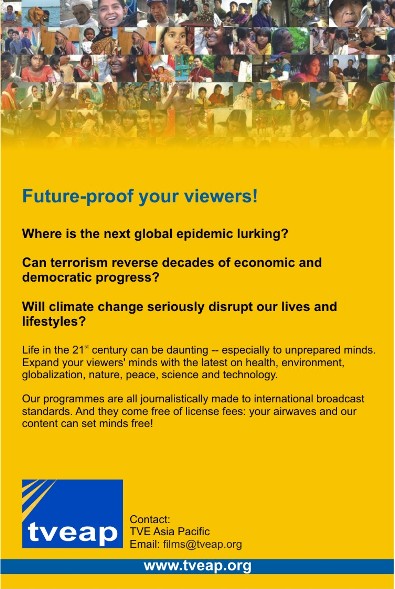
Here’s our promo advert for the event:

futureproof-your-viewers-tveap.jpg

TVE Asia Pacific to co-sponsor Asia Media Summit 2007

I will be reporting from AMS 2007 for the next few days.

Radio Sagarmatha: Kathmandu’s Beacon of hope on 102.4 MHz turns 10

Today, 23 May 2007 is a very special day for broadcasting in South Asia.

Radio Sagarmatha, the first independent community broadcasting station in South Asia, completes 10 years on the air today. It’s certainly a moment to reflect and rejoice for all of us concerned with broadcasting and the public interest in Asia.

Image courtesy Radio Sagarmatha

Here’s how the station introduces itself on its website:
Broadcasting daily from the center of the Kathmandu Valley on FM 102.4 MHz from 5 am to 11 pm, the pioneering radio station has earned a name as a free, independent and highly credible radio station in keeping with its objectives of producing a cadre of professional journalists, addressing the information needs of audiences, stimulating awareness and participation in public issues, and facilitating democratization and pluralism.

The Sagarmatha story is of particular interest to me personally.

Firstly, many involved in founding and running this station are good Nepali friends whose resolve and professionalism I salute on this 10th birthday.

Secondly, this radio station exposed to the whole world a persistent myth that was fabricated and distributed globally by Unesco and its local cronies: that community radio has been thriving in Sri Lanka from the early 1980s. I’ve lived all my life in Sri Lanka, and I’ve spent the past 20 years working in the media, but I have yet to find a single community radio station there — simply because no government has allowed any to be set up! I’ve been writing about this for years, but I’m a lone voice against Unesco’s well-funded ‘myth factory’ working overtime! Read my Panos Feature: Radio suffers as Colombo bosses callthe shots (October 2003).

But enough of that old hat. Today is Sagarmatha’s Day! Happy birthday to the courageous public radio station and everyone involved, past and present.

Recently, supporting the radio station’s nomination for an international media award (to be announced soon), I wrote a brief account about Sagarmatha. It has not been published until now, so here it is, with minor edits:

Kathmandu’s Silent Revolution

Almost a decade ago, a silent revolution started in the Nepali capital of Kathmandu. One day in May 1997, a senior official of the Ministry of Communications handed over a piece of paper to Raghu Mainali, representing a group of Nepali journalists and civil society organisations. It was the broadcast license permitting the first-ever citizen-owned, non-commercial, public interest radio broadcasting station anywhere in South Asia. Soon afterwards, Radio Sagarmatha (RS) was on the air, using the FM frequency 102.4 MHz.

The airwaves will never be the same again in the world’s most populous sub-region, where governments had a strict monopoly over broadcasting for decades.

The broadcast license did not come easily: it was under consideration for over four years, and entailed considerable lobbying by Nepali journalists and civil society groups. At the forefront in this quest was the Nepal Forum of Environmental Journalists (NEFEJ), a non-governmental organisation and a collective of journalists strongly committed to sustainable development, human rights and media freedom.

The senior and highly respected Nepali journalist Bharat Koirala provided advice and leadership for setting up RS, which was cited when he was awarded the Ramon Magsaysay Award — ‘Asia’s Nobel Prize’ — in 2002.

Read a brief history of Radio Sagarmatha on its website

As a long-standing partner of NEFEJ, we have had the opportunity to observe the evolution of RS from humble beginnings to what it is today. Remarkably, NEFEJ colleagues had laid the groundwork for the radio station in anticipation of the license: the hardware, manpower and institutional framework were ready to go on the air soon after official sanction. Beginning with an initial two hours of broadcasts, RS gradually increased its transmissions, providing a mix of music, news and current affairs, sports and cultural entertainment to the Kathmandu city and valley — home to nearly 2 million people. While broadcasting primarily in Nepali, it also carries programming in minority languages and English. In recent years, RS has also rebroadcast selected programmes from BBC World Service Nepali transmissions.

Image courtesy BBC Online Image courtesy Radio Sagarmatha

RS blazed a new trail in broadcasting in Nepal, and in its wake a large number of commercial FM stations and other community broadcasting stations have been set up. The Kathmandu valley’s hills are alive with a cacophony of voices, offering the people a greater choice than ever before. Across Nepal, RS has inspired a plethora of community-owned, community-based radio stations, who are enjoying different degrees of success. RS has also trained a significant number of radio professionals – from announcers and producers to technicians – some of who have moved on to employment with other channels. This commitment to capacity building continues.

In today’s multi-channel environment, RS retains its strong commitment to the public interest, good journalism and high production values. Among others, the following distinguishes this station:

• RS increases people’s participation in debating important day-to-day issues that directly affect their lives and jobs. Roaming producers talk to not just city dwellers but to people living in the most remote areas of Kathmandu.

• RS serves as a people’s forum to examine the merits and demerits of various development policies, efforts and approaches in Nepal, undertaken by government, development donors, civil society and others.

• RS has played its part to bridge Nepal’s digital divide. Suchana Prabidhi dot com (meaning ‘Information technology dot com’) is a popular programme that browses the Internet live on radio, connecting the unconnected radio listeners with information available online.

• In spite of being supported by a large number of development donors, including some UN agencies, RS has maintained its editorial independence, without allowing itself to become a propaganda outlet for any entity.

But it was in Nepal’s recent pro-democracy struggles that Radio Sagarmatha’s commitment to the public interest was truly tested and reaffirmed. The station joined human rights activists, progressive journalists and civil society groups in the mass movement for political reform, including the restoration of parliamentary democracy suspended by the King’s autocratic rule. The regime – seeking complete control over Nepalis’ access to information and independent opinions – imposed a blanket ban on private broadcasters carrying news. Soldiers were posted inside and around Radio Sagarmatha for eight days. Even after they withdrew, the spectre of absolute monarchy hung over all media for months.

Read BBC Online story: The Muzzling of Nepalese Radio (22 April 2005)

Read IPS story: Nepal plunged into the Dark Ages, cry dissidents

Soldier outside Radio Sagarmatha station - bad old days, now gone

That seige continued for much of 2005. On 27 November 2005, I was with some NEFEJ colleagues at a regional media workshop in Siem Reap, Cambodia, when the disturbing news reached us that RS had been forced off the air after police raided the station, seized its transmission equipment and arrested five journalists and technicians. The incident had happened while RS was relaying BBC Nepali Service live from London.

Fortunately, the judiciary intervened. Two days later, responding to a massive outcry from within and outside Nepal, the Supreme Court ordered the authorities to allow RS to continue its transmissions. The station started broadcasting news and current affairs again, and other stations soon found their courage.

The next few months leading to April 2006 were crucial for all associated with the pro-democracy movement. During this period, amidst various pressures, threats and obstacles, the managers and journalists at RS played a pivotal role in ensuring the free flow of information and plurality of views in Nepal. When broadcasting news was banned, RS resorted to innovative ways of getting information across while getting around the jack-boot of bureaucracy.

One method: singing the day’s news — as there was no restriction on broadcasting musical content!

The unwavering resolve of RS, other independent media and pro-democracy activists led to the restoration of parliamentary democracy in April 2006 and the subsequent marginalization of the monarchy. Now the pioneering radio station is working hard to ensure that Nepalis would make better use of their ‘second chance’ in democracy in less than two decades.

As Radio Sagarmatha now enters its second decade, there is much unfinished business: Nepal is one of the most impoverished countries in the world, held back by a decade of civil war. A free, independent and responsible media – epitomized by Radio Sagarmatha – will be essential for Nepal to break from the past and usher in a new era of peace, prosperity and equality.

Listen to Radio Sagarmatha Online

World Association of Community Broadcasters (AMARC) Asia Pacific website
Outsourcing with a heart: Cambodia’s success story

Today, 16 May 2007, was observed worldwide as World Information Society Day – it marks the establishment of the International Telecommunications Union (ITU) in 1865 and used to be called the World Telecommunication Day.

The UN-sponsored day was dedicated this year to making available the benefits of the digital revolution to young people everywhere. As the ITU noted in its media release:

The World Summit on the Information Society (WSIS) recognized the young as the future workforce and the earliest adopters of ICT, and called for their empowerment as key contributors to building an inclusive Information Society. World leaders stated their commitment at the Summit in Tunis to actively engage youth in innovative ICT-based development programmes and widen opportunities for them.

Yesterday I wrote about a TV service in Pasadena, California, outsourcing some of its reporting work to journalists in India.

Outsourcing is a worldwide trend, fuelled by the rolling out of Internet access and encouraged – at least in part – by the lower salaries that equally skilled persons still command in the less developed parts of the world. So much has been written and spoken about outsourcing in the IT industry, which has created multi-million dollar businesses in recipient countries such as India.

The outsourcing industry employs tens of thousands of young women and men in developing countries, especially in Asia, which receive the outsourced work. Most of them are from urban backgrounds with English-speaking ability and reasonable levels of education.

But this business-driven process can also benefit young people who haven’t had such advantages in life.

digits4change.jpg

A story in TVE Asia Pacific’s Digits4Change series illustrates this potential. It came from Cambodia, and we called it Compassionate Data.

digits4change-tv-series-cambodia.jpg

We went to Cambodia in late 2005 to find out how business process outsourcing (BPO) is benefiting one of the poorest countries in the world.

Emerging from decades of conflict, Cambodians are now trying to find their place in the global village. But lacking in English and computer skills, many find their opportunities limited.

Digital Divide Data is a non-profit organisation run like a business. Started in 2001, they outsource data processing work from the west.

As the world goes digital, thousands of old, paper-based documents need to be digitised. These tasks take time, effort and quality control. Digital Divide Data (DDD) provides this value added service.

Among its clients are universities, companies and organisations in North America.

But what’s special about DDD is their staff. They employ young men and women from disadvantaged backgrounds – orphans, those with disabilities, or from very poor, rural backgrounds. A few have been trafficked for the sex trade.

Sith Sophary Nhev, DDD’s then Cambodia manager told us: “Many companies outsource this kind of service to international clients by using educated and skillful people, but DDD use disadvantaged people who have low skill and low education but we still provide like a good service, quality, time turnaround and a competitive price for the clients.”

Young people come to DDD with a basic education and virtually no skills. The company trains them in computers and English. In fact, all staff are required to continue their education. The company provides scholarships – and pays them an above average salary.

In the hard-nosed ICT industry that’s usually driven by financial bottomlines, DDD has demonstrated that it is indeed possible to do well and do good at the same time. They are a social enterprise, a growing trend worldwide.

digits4change-compassionate-data.jpg

[

]

Watch the full story on TVEAP’s YouTube Channel

Digits4Change TV series website

Digital Divide Data website

Outsourcing journalism: From eye witness to i-witness?

Outsourcing has arrived…in broadcast journalism.

Good reporting, we thought, has everything to do with being there, observing and then sharing the information, impressions and opinions. But some editors and publishers disagree.

Just caught this news in the Los Angeles Times, 11 May 2007:

Local news reporting outsourced to India
A news site hires two to cover Pasadena from afar. That helps a shoestring budget go further.

By Alex Pham, Times Staff Writer
May 11, 2007

When is local journalism not really local? When it’s about Pasadena and written by someone in India.

James Macpherson, editor and publisher of the Pasadena Now website, hired two reporters last weekend to cover the Pasadena City Council. One lives in Mumbai and will be paid $12,000 a year. The other will work in Bangalore for $7,200.

The council broadcasts its meetings on the Web. From nearly 9,000 miles away, the outsourced journalists plan to watch, then write their stories while their boss sleeps — India is 12.5 hours ahead of Pacific Standard Time.

“A lot of the routine stuff we do can be done by really talented people in another time zone at much lower wages,” said Macpherson, 51, who used to run a clothing business with manufacturing help from Vietnam and India.

Read the full story

Wait till other media managers get to hear this.

And I can already imagine how our media intellectuals in South Asia will tear this apart.

Read Rediff India coverage of this story

Press freedom in the digital age: Seeing beyond our noses and tummies

See later post on 3 May 2008: Who is afraid of Citizen Journalists?

On 3 May 2007, we mark another World Press Freedom Day.

This day is meant to ‘raise awareness of the importance of freedom of the press and to remind governments of their duty to respect and uphold the right to freedom of expression enshrined under Article 19 of the Universal Declaration of Human Rights.’

Read more about the Day on the Wikipedia and World Association of Newspapers. (Ah yes, that cartel of governments called UNESCO also puts up a show every year to mark this day, but it’s no better than the mafia bosses coming together to pontificate about the rule of law and justice for all. So let’s completely ignore the irrelevant UN behemoth and its meaningless hot air.)

The essay I wrote two weeks ago about saving our (electro-magnetic) spectrum to safeguard media freedom and media pluralism has been widely reproduced on the web.

That’s precisely the kind of insidious, hidden dangers to media freedom that don’t receive sufficient attention at many events to mark World Press Freedom Day.

I found this out the hard way when the Editors Guild of Sri Lanka invited me to address their observance of the 2001 World Press Freedom Day in Colombo. In the audience were over 250 Sri Lankan journalists and editors, and my topic was global trends and challenges to press freedom.

I decided to talk about ICTs – information and communication technologies – and how they were impacting the profession and industry of journalism. I recalled how technologies like mobile phones and satellite television had completely revolutionised the nature of news gathering and dissemination during the 1990s. The Internet was once again turning the whole media world upside down, I said: sooner rather than later, the impact of these developments would be felt in little Sri Lanka.

I argued that by being well informed and prepared, we could adapt better to the new challenges posed by the Internet, and we will be able to seize the many opportunities the new medium offers to consolidate press freedom. I mentioned some examples from the Asia Pacific and elsewhere how social activists, indigenous people and political groups – including separatist organisations – are using the power of the Internet to disseminate information and opinions at a low cost to a worldwide audience, and how states and their censors were increasingly unable to control such flows across political borders.

Unfortunately, a section of the audience felt very strongly that I was talking ‘pie in the sky’ when journalists in Sri Lanka were grappling with much more urgent issues of survival – such as low salaries, poor working conditions, and threats of physical harm or even death in the line of duty.

I was told — firmly — not to talk about computers and Internet when some media organisations did not even provide sufficient seating or (book) library facilities for their journalists. “Internet is good for pampered western journalists. We have survival issues,” one ardent critic said.

Now, it’s far more interesting to talk to a room full of disagreeing people. I took these comments in that spirit.

In the ensuing discussion, I readily agreed that all immediate factors mentioned by my detractors were indeed major concerns. My point, simply, was that we could not afford to ignore the bigger trends and processes that shape our industry and redefine how we reach our audiences.

Cartoon courtesy WAN

Just as terrestrial television broadcasters had to adjust and reorient themselves when faced with challenges from satellite television in the 1990s, the entire media sector – print and broadcast – has to come to terms with the Internet and World Wide Web.

I added: It doesn’t do any good to bury our head in the sand and wish it to go away. The much better option, as Sir Arthur Clarke has suggested, is ‘cautious engagement of the new media, so that we can exploit the inevitable’

Exploiting the inevitable is precisely the pragmatic approach we need. The globalisation of economics, media and information is taking place regardless of our individual opinions and reactions. By positioning ourselves for cautious engagement and to take advantage of tools and opportunities ushered in by the digital age, we can promote both media freedom and media pluralism.

Three years later, I expanded these ideas into a semi-academic paper (that is, as academic as I can ever get!) presented to the Annual Conference of the Asian Media Information and Communication Centre (AMIC) held in Bangkok, Thailand, in July 2004. I titled it: Media Pluralism in the Digital Age: Seize the Moment

It was later published in AMIC’s quarterly journal, Media Asia. Here’s how I ended my paper:

Newer ICTs can strengthen the outreach, quality and inclusiveness of the mass media. The true potential of this change can only be tapped when all stake-holders of the media play their part. A particular challenge to the ICT4D community is advocating the policy and legislative reform agenda that will enable this process.

There is an interesting post script to my experience with the Sri Lankan media on World Press Freedom Day 2001 quoted at the beginning.

During the past three years, more journalists, producers and their gatekeepers have begun using the Internet as a tool, information resource or alternative medium for expression. The initial apprehensions that some professionals harboured about this new medium have been replaced with growing enthusiasm and a recognition of its utility.

The vindication of my initially disputed seminar remarks came sooner than I expected. My most vehement critic that day was a fire-breathing young reporter then working for a Sinhala newspaper. Less than a year later, this avowed sceptic of the Internet launched his own website to disseminate news and commentary on social, political and economic issues that he felt he could not freely cover in the mainstream print outlets. The fact that his initiative did not last more than a few issues is another matter; clearly, he has been converted.

He would be happy to hear that I have been among regular visitors to his website.

Related: Media Freedom Internet Cookbook

Media Helping Media website

Mediasaurus — and the rise of bloggers

Earlier this month, I referred to science fiction writer Michael Crichton’s 1993 Wired article titled ‘Mediasaurus’ — in which he talked about how television as we know it (or knew it, at the time) was doomed.

I’ve just come across this cartoon, which I can’t resist sharing.

Cartoonists are the social philosophers of our time. And no one else achieves a better economy of words.

Source: http://www.indcjournal.com/archives/ariaillg2.jpg

50? In South African terms, you’re probably dead!

“How many of you are over 50?” asked Christina Scott, South African journalist and broadcaster.

Half a dozen hands went up.

“Come on, now – be honest,” Christina urged. One more hand joined.

“In South African terms, chances are that you’re already dead,” she declared.

Christina was talking about stark realities of living and dying in today’s South Africa, which is one of the highest HIV infection rates in the world.

We were at a session on ‘Life and Death in 2020: How will science respond?’ during the Fifth World Conference of Science Journalists, currently underway in Melbourne.

christina-scott.jpg Christina Scott - image courtesy IPS

Christina then asked how many in her audience were aged between 30 and 35. This time, four hands shot up.

“If you were in South Africa, you’re probably infected with HIV, and don’t know it yet — and go around giving it to others,” she told them.

After getting her audience shocked and hooked, Christina talked about how HIV is cutting across social hierarchies and colour barriers in her country.

Many intervention strategies to contain HIV have been based on the premise that when people know more, they are more likely to change risky behaviour. “We now see that greater wealth or higher levels of access to information alone do not change people’s behaviour. In fact, the middle classes lull themselves into thinking that HIV is a poor people’s disease, when it’s not,” she said.

In other words, it’s not a linear process and is much nuanced.

Christina was doubtful if Internet, PCs and online communications could make much headway in reaching out a majority of South Africans. It’s not just a lack of connectivity and computers, but a more basic absence of electricity in many areas.

To her, old fashioned radio was still the most cost-effective way to reach more people quickly.

One new ICT that has taken sub-Saharan African by storm is mobile phones. “They are everywhere, and people are using them for all sorts of things — including sexual transactions.”

She was cautiously optimistic about prospects for combating HIV. “AIDS is like a war: it’s very nasty, and causes a lot of damage. But as in war, it also spurs innovation and responses,” she said.

An AIDS vaccine is not the answer, as the virus keeps mutating and in any case distributing the vaccine to all those who need it will be a huge challenge.

Her personal wish: her daughter of 15 to get through college without contracting HIV.

Note: Christina works as Africa consultant for the Science and Development Network.

SOS: Save Our Spectrum for media freedom

I’m strongly committed to promoting media freedom, but have never been the placard-carrying, slogan-shouting type. Street activism is necessary — but not sufficient.

I’ve been more interested in studying trends and conditions, trying to anticipate what the next big threats, challenges and opportunities are, and how best we can respond to them.

For years, I’ve been writing and talking about the need for proper spectrum management as a pre-condition for media freedom and media pluralism. Last week, I once again spoke about these core issues at OUR Media 6 Conference in Sydney.

I’ve just adapted my Sydney panel remarks into an op ed essay, just published by the UK-anchored media website, Media Helping Media.

Here are the first few paras:

On May 3, the annual World Press Freedom Day will once again be observed worldwide, focusing public attention on a multitude of threats to freedom of expression through the mass media.

But amidst the extremely relevant and necessary slogans, we are unlikely to hear this one: Hands off our spectrum!

Yet saving our spectrum is critical for ensuring media freedom.

The electro-magnetic spectrum has been called the ‘invisible wealth of nations’ — conventional broadcasting relies on the fair, equitable and sound management of this common property resource.

And as economic and cultural practices move more and more into the digital realm, the spectrum’s value is only set to increase.

But few people -– even within the media profession and industry -– appreciate our dependence on this finite resource. Out of sight does seem to push it out of most people’s minds.

Therein lurks a danger: what we don’t see and value can be quietly taken away, without many of us realizing it.

Read full article and leave your comments

Added on April 18: MediaChannel.org anchored in the US has also just re-published the article. Read their version here

Added on April 19: Free Press.Net has also reproduced the article.

Added on April 20: FreePress.Net in the US reproduces the essay

Added on April 21: Bytes4All South Asian ICT wevsite reproduces my essay

Added on April 21: Reclaim the Media website also publishes the article
Thanks to everyone who considered it worth amplifying to their audiences — we need to spread the word! – Nalaka

Michael Crichton, Mediasaurus and end of broadcasting

I just wrote a post on digital pioneer and futurist Mark Pesce’s views on the end of broadcasting and the mass media as we know it.

Television broadcasting is probably a dinosaur facing extinction, but let’s remember a bit of pre-history here: dinosaurs didn’t die off in an instant. No time lord zapped them with some mighty extincter machine. Their decline and eventual extinction was, it is believed, a slow and gradual process.

So it will be with broadcasting. Even if their distribution and revenue models are now undermined and will soon be obsolete, conventional broadcasting (as we know it) will continue to operate and try to compete, at least for a few years. And in the less developed countries with emerging economies, that process will take longer.

Which means we still have to engage TV broadcasters even as their Empires of Eyeball slowly crumble.

And let’s not write off those Empires just yet. I still remember an article in the early days of Wired magazine: appearing in Sep-Oct 1993 issue, it was titled Mediasaurus , and written by the well known science fiction author (and medical doctor) Michael Crichton (of Jurassic Park and ER fame).

Michael Crichton, courtesy Michael Crichton website

He started the article as:
I am the author of a novel about dinosaurs, a novel about US-Japanese trade relations, and a forthcoming novel about sexual harassment – what some people have called my dinosaur trilogy. But I want to focus on another dinosaur, one that may be on the road to extinction. I am referring to the American media. And I use the term extinction literally. To my mind, it is likely that what we now understand as the mass media will be gone within ten years. Vanished, without a trace.

And he ended:
So I hope that this era of polarized, junk-food journalism will soon come to an end. For too long the media have accepted the immortal advice of Yogi Berra, who said: “When you come to a fork in the road, take it.” But business as usual no longer serves the audience. And although technology will soon precipitate enormous changes in the media, we face a more immediate problem: a period of major social change. We are going to need a sensitive, informed, and responsive media to accomplish those changes. And that’s the way it is.

I just re-read the full article, and Crichton’s analysis is even more valid today than when it was written over a dozen years ago. But it’s also true that the broadcast industry – and conventional media as a whole – have changed and adapted.

No doubt that Mediasaurus still has an expiry date, but it’s not easy trying to guess exactly when the last of their kind drops dead.

Read the full article on Wired Online

Mark Pesce: In the company of a hypermind

Oops – I didn’t immediately realise that I was sharing a panel with a digerati – a highly accomplished pioneer and visionary of the digital world. And did he get us to think outside the idiot box!

His name is Mark Pesce. He is one of the early pioneers in Virtual Reality.
The co-inventor of VRML, he is the author of five books and numerous papers on the future of technology. Now based on Sydney, Australia, he is a writer, researcher and teacher.

Mark Pesce, courtesy Wikipedia

During the OUR Media 6 panel discussing how to safeguard community interests in the era of digital broadcasting, he was emphatic that broadcasting as we know it is doomed.

“The mass mind is not going to last. The sooner broadcasters recognise this, the better,” he said.

The broadcast model of one-way, point-to-multipoint, passive distribution of content is endangered by the digital revolution. The age of hyperdistribution has already dawned, and that is going to wipe out conventional distribution models sooner than later.

Hyperdistribution is audience-driven distribution of films and television programmes. The economics of production and distribution of media have changed radically – can film-makers adapt to the new rules? This is the question that Mark posed in talk given at the Sydney International Film Festival in Jube 2006 – listen to audio recording of his talk.

The near future of content distribution is in Internet-enabled, user-driven and often mobile devices. Already, two billion people – almost a third of humanity – walks around with mobile phones. These will provide new pathways to peddle new types of content to more audiences than ever before.

The film-making and TV-producing communities need to wake up to these new realities, Mark said.

His blog, Hyperpeople, is full of fascinating insights and extrapolations. Here’s one short extract:
Television producers are about to learn the same lessons that film studios and the recording industry learned before them: what the audience wants, it gets. Take your clips off of YouTube, and watch as someone else – quite illegally – creates another hyperdistribution system for them. Attack that system, and watch as it fades into invisibility. Those attacks will force it to evolve into ever-more-undetectable forms. That’s the lesson of music-sharing site Napster, and the lesson of torrent-sharing site Supernova. When you attack the hyperdistribution system, you always make the problem worse.

In May 2005, he wrote in an article titled Piracy is good? How Battlestar Galactica killed broadcast TV:
Television broadcasters owe their existence to the absence of substantially effective competition. When you’re dealing with real-world materials that are in naturally short supply – whether diamonds, oil, or broadcasting spectrum — a cartel can maintain and enforce its oligopoly. But when you’re working with media, which exist today as digital ephemera, bits that can be copied and reproduced endlessly at nearly zero cost, broadcast oligopolies are susceptible to a form of “digital arbitrage,” which can hollow-out their empires in an afternoon. Hyperdistribution techniques are more efficient than broadcast networks for television program distribution.

Read my other post on the OUR Media Forum on the community use of digital spectrum

Mark Pesce website

Mark Pesce blog, Hyperpeople