Anita Roddick, Angkor Wat and ‘development pill’

Dame Anita Roddick would have been proud of her mastery of Khmer.

There she was on a large screen, speaking in fluent Khmer, watched by over a thousand Cambodians women, children and men.

Time: One evening in December 2005
Place: A village temple close to the historic city of Siem Reap, Cambodia

There we were, practically in the shadow of the massive Angkor Wat temple complex, and trying to reach out to rural Cambodians on practical ways to live more sustainable lives.

anita-roddick.jpg cambodian-audience.jpg

The event was an evening of variety entertainment laced with some information and education. Colleagues at Action IEC, our Cambodian partner, knew exactly how to get this mix right. Amidst songs, drama, comedy and live competitions, they screened Hands On video films versioned into Khmer.

As the loudspeakers boomed and (Hands On host) Anita Roddick appeared on screen speaking in a strange tongue, I watched the audience closely. They were spell-bound: especially the children belied a sense of wonder.

But sustaining their attention is a big challenge. That evening’s 4-hr programme was the result of over a dozen Cambodian colleagues planning and working for days. It was part of the public outreach activity for Hands On films that we versioned into Khmer under a 4-country, Asian project called Localising Hands On in Asia.

The young and not-so-young in our audience that evening were there mainly for the fun and games. Rolling out Anita and Hands On was a clever ploy by Kosal, Cedric and other Cambodian colleagues. Call it ‘sugar-coating’ the development pill.

Oh yes, we also had the Khmer versioned programmes broadcast on Cambodia’s most popular TV channel (CTN). That engaged a different kind of audience. A passive broadcast can never really produce the kind of audience engagement we saw that evening.

In our efforts to engage Asia’s eyeballs and minds, we’ve made modest progress by proceeding parallely on broadcast and narrowcast fronts — but there is a great deal of unfinished business.

For details, visit Localising Hands On in Asia website

Added on 11 Sep 2007: Anita Roddick:We shall always remember you

Digits4Change: Do ICTs make a difference?

When it comes to bridging the Digital Divide, there’s so much hype, rhetoric and confusion. For many in the UN system, it’s just another development issue to be bandied about at endless meetings and conferences, and to be reflected upon from 30,000 feet above the ground where they find themselves most of the time.

Yet, at the ground level, individuals and communities are adapting various ICTs to meet their practical needs and solve real world problems. I sometimes feel that whatever bridging of the Digital Divide will happen in spite of, and not because of, the UN agencies and other development players debating issues to exhaustion.

In 2005-2006, we at TVE Asia Pacific documented some of these efforts in different parts of Asia. We looked at a variety of technologies solving a range of problems. This became Digits4Change.

digits4change.jpg

Here’s our series intrdocution:

There are more poor people in the Asia Pacific than in all other regions combined. At the same time, some Asian countries have achieved the most advanced economies in the world. Their prosperity is partly due to how they have developed or adopted information and communication technologies — or ICTs.

How can the developing countries of Asia use these digital tools to help generate wealth, create more jobs and improve living conditions of people? Governments, private sector, civil society and researchers have been trying out various approaches for years. The World Summit on the Information Society (WSIS) in 2003 – 2005 took stock of what has been accomplished, and what remains to be done.

TVE Asia Pacific – a regional leader in using audio-visual media to cover development issues – embarked on documenting examples where ICTs have made a change in people’s lives in the world’s largest region. We investigated stories on distance learning, business process outsourcing, tele-health and rural connectivity.

The result is a new video series: Digits4Change.

Watch Digits4Change stories on TVEAP’s channel on YouTube

Read my views on the newly launched UN Global Alliance on ICTs for Development , published on SciDev.Net

Caught between mines and starvation

Today, April 4, is being observed worldwide as Mine Action Day.

The UN General Assembly declared the International Day for Mine Awareness and Assistance in Mine Action, which was first observed in 2006.

Mine Action says on its website:“Landmines and explosive remnants of war continue to kill or injure as many as 15,000 people a year. The overwhelming majority are civilians who trigger these devices years or even decades after a conflict ends. In some countries, such as Afghanistan, the majority of victims are under the age of 18.

Some progress has been made. Mine action programmes and the anti-personnel mine-ban treaty or “Ottawa Convention,” have contributed to a reduction in the annual number of casualties from an estimated 26,000 10 years ago to between 15,000 and 20,000 today.

But not nearly enough. I remember a short video film I watched during my first visit to Cambodia in mid 1996. After 30 years of civil war, Cambodia was left with a deadly legacy of between 4 and 6 million landmines – nobody knows quite how many. And progress has been slow to detect, deactivate and remove these millions of death-traps lying all around in this one of the poorest countries in Asia.

Our friends at the Women’s Media Centre of Cambodia, a media advocacy group run by women, showed me a campaign video they had made advocating mine action. Used for screenings at key UN meetings in Geneva and New York, it showed the plight of poor Cambodians, especially women and children, who have no choice but to live and work with landmine hazards.

Sorry, a decade later I can’t recall the title of this film. A Google search didn’t bring up any links either. But there was a sequence that I remember well.

In rural Cambodia, some women spoke their mind about the many hazards that surround them, small arms and landmines being just two of them.

What’s our choice here, one woman asked. “Everytime we step out of our homes and go to the fields, we can get blown up by a landmine. Yet if we stay at home, we will starve to death.”

She’s not alone. Millions of people – women, children and men – across the global South face this reality everyday. The men in suits in Geneva and New York, who issue lofty statements on mine action from the safety of their glasshouses, need to be aware of this stark choice.

Note: Women’s Media Centre in Cambodia does some good work. At the time we worked with them, they were running an FM radio station, producing lots of videos, and training Cambodian women to use media to support development and personal advancement.

Have you made your million dollars yet?

Money, money, money!

Many development film-makers like to decry our society’s obsession with money, consumerism and greed. Some would make films that passionately promote sharing ideas and resources at community level, and advocate common property resources over private ownership.

But when it comes to rights of their own film/s, these very film-makers would become extremely possessive: they want to restrict it in every conceivable way.

They feel justified in such sentiment and action: after all, they have invested a great deal of time, effort, creativity and hard-won resoures to make their films. They must now seek a ‘return on investment’ like everyone else (it’s a material world!). Film-makers too have families to feed.

No argument on that last one. But it would be interesting to find out how many – or how few – development films deliver any appreciable ‘returns on investment’ to their makers. Certainly in developing Asia, development film-makers will be seriously endangered species if they had to rely on license fees or royalties for their survival.
https://i0.wp.com/www.hcn.org/allimages/1996/oct28/graphics/961028.001.gif
After a dozen years of extensive networking with environment, wildlife and development film-makers across Asia Pacific, I have yet to come across a single film-maker who made his or her million dollars from a film.

Yet, many continue to cling on to the traditional notion of copyright in film, perhaps hoping that sooner or later, that cherished million bucks would come calling.

And in the meantime, they continue to approach every known funding source – and many unknown and unlikely ones – for supporting their next film. At TVE Asia Pacific, we receive our fair share of these requests every month – and we are not even a funding source for independent films! These requests are accompanied by impressive CVs or filmographies, listing past films produced.

Produced, yes. But how many are circulating? How many have been seen outside film festival circuits, or beyond a one-off broadcast (or two)? How many films are available for educational, advocacy, training or activist purposes at affordable cost of duplication and dispatch?

The answer is depressing: precious few.

Because our film-makers are waiting for their million dollar deal or sale, and won’t let go of their creations. Even if many have been made using development donor (i.e. public) funding, these films are not in the public domain.

That, to me, is incongruent with the lofty ideals that many development films proclaim: sharing ideas and resources at community level, and advocating common property resources.

We have to walk our talk, or we risk joining the already burgeoning ranks of hypocrites in our societies.

The time has come for documentary film-makers, especially those covering development topics, to take a fresh look at copyright. That doesn’t mean abandoning all our rights to be known and acknowledged as creators of our films.

For a start, I strongly recommend an interesting and insightful essay, “Shoot, Share and Create: Looking beyond copyright makes sense in film“, written by a young Indian lawyer-activist specialising in intellectual property. Lawrence Liang is a Bangalore-based lawyer who works at the Alternative Law Forum. I had the opportunity of meeting the dynamic and articulate Lawrence at the Asia Commons meeting in Bangkok in June 2005 – he’s certainly a man to watch in this rapidly evolving field of managing our digital commons and how to safeguard the public interest in the bewildering era of digital media.
Lawrence Liang

Here’s how he starts his essay, which he wrote as an open letter addressed to Indian documentary filmmakers:

When I was in law school, I had great aspirations of wanting to be a filmmaker, and an FTII-type (Film and TV Institute of India, a prominent school for film-making) friend told me the best place to start was to watch a lot of foreign films and documentaries. So I did that rather dutifully and spent many hours when I should have been reading corporate law, watching documentaries.

My fondest memory of my placement in Mumbai with a law firm was when we took off to the Tata Institute of Social Sciences (TISS) and watched Anjali Monteiro and K P Jayashankar’s film on the Yerawada prison in Pune.

I gave up on the idea of becoming a filmmaker after we finally did do a documentary on law school. But by then the bug had bitten and I had fallen in love with cinema and the documentary form as well. I think watching documentaries has also made me a better lawyer than I would have been if I read Ramiaya on the Indian Companies Act. So if I have written this rather longish argument about why documentary filmmakers should start thinking about open content licenses, it is with a sense of repaying a debt.

Read the full essay at Alternative Law Forum website

Read my own call for recognising poverty as a copyright free zone

Ratomate’s best cup of tea

In another post earlier today, I quoted a doctor turned film-maker in India saying people affected by HIV are dying more from the social stigma attached to the disease than by the disease itself.

Social stigma is a wide-spread problem that confronts people living with HIV in all parts of the world.

But occasionally, we hear some good news: how community has overcome its prejudices and accepted those infected with HIV with affection and care. Usually, it happens after going through the knee-jerk reactions.

It would be very worthwhile for some research to be done on how and when community attitude changes: what are the triggers? what is the tipping point?

Five years ago, we had first hand experience of this through a film that we at TVE Asia Pacific commissioned under our Truth Talking documentary series.

The film, titled Love for a Longer Life (26 mins, 2002) was directed by leading Nepali documentary film-maker Dhurba Basnet.
dhurba-basnet.jpg

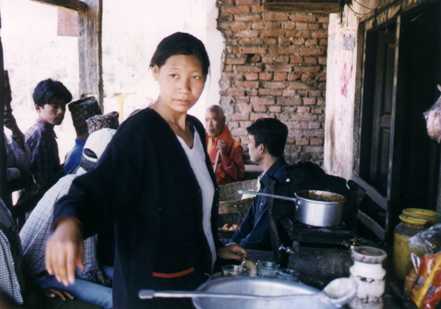
The best cup of tea in the Ratomate village, in central Nepal, is made by a woman called Laxmi Lama. She works in a tea shop owned by her father. “People tell me my father does not know how to make good tea,” she says. “They want me to make tea. The men like their tea strong. When I give my customers strong tea they say one cup is enough for the whole day.”

This is nothing unusual – except that Laxmi is living with HIV. A few years ago, no one in her village would have come near her, let along clamour for a cup of tea she makes.

Born into a very poor family, Laxmi was sold off to a Bombay brothel at the age of 14, and worked as a commercial sex worker for nearly three years before returning to Nepal. She married a man from her village and had settled down to a peaceful routine when a health worker tested her blood and found her positive for HIV. That changed everything dramatically: her husband fled, never to return, and everybody shunned her. The pregnant woman sought refuge in her parents’ house.

That was the fate of most Nepalis living with HIV – abandoned by friends, ostracised by community and left to their own devices. But thanks to the perseverance of a few courageous people – many HIV positive themselves – community attitudes have changed slowly, and have come almost full circle: being reassured that HIV does not spread through casual physical contact, they have accepted her back into their fold.

lakshmi-lama.JPG The moment of truth is when she makes Ratomate’s favourite cups of tea with her bare hands, and men and women flock to taste it. Such a major transformation of community attitudes captured in such a simple, elegant sequence.

Laxmi’s neighbour Kumari Shrestha sums it all up: “We have to give her love. If we do that, she will live longer.”

It would be wonderful if we can discern how and when this change happens. So that it can be induced in thousands of other villages and communites where persons living with HIV are currently battling the virus within, and stigma without.

View a clip from the film here.
Order the film from TVEAP e-shop

HIV: Stigma a bigger killer than the virus?

A doctor turned film-maker in India says people affected by HIV are dying more from the social stigma attached to the disease than by the disease itself.

Dr Jorge Guillermo Caravotta’s AIDS documentary Second Life was released recently. Goa-based journalist Fred Noronha’s story about this film has appeared on several websites.


An extract from the article:

India has 5.1 million HIV positive people, second only to South Africa. However, the stigma and discrimination associated with this disease are the real enemies, said Mumbai-based Caravotta, an Italian doctor of Argentine origin.

“My source of inspiration was Kamal, the first PLHA (person living with HIV/AIDS) to be my colleague,” he said.

Kamal discovered her HIV/AIDS status six months into marriage. After her husband’s death and daughter’s birth, she completed her medical studies to “live for positive people like her”, says Caravotta’s film.

“I never thought of making a documentary film about HIV/AIDS before. But after listening to her during a trip to Delhi, I found in her story a lot of courage to empower PLHAs,” Caravotta told IANS.

“India acted as an alarm clock for my film-making creativity, boosting my potential,” he added. “I would like the message of the documentary film spread all over this country with the same velocity as the virus.”

Read full article here: Doctor’s AIDS Documentary Focus on Stigma and Discrimination

Living Labs searching for solutions

Today, March 22, is World Water Day. TVE Asia Pacific’s latest TV series, Living Labs, was released in Colombo and Washington DC last week in time for this day of significance in the development calendar.

The series — filmed in nine countries in Africa, Asia, Europe and Latin America last year — looks at how researchers, farmers and local communities in different parts of the world are trying to grow more food with less water.

This year’s theme for World Water Day is ‘Coping with Water Scarcity’, which resonates fully with the content of Living Labs.

Between 70 and 90 per cent of all freshwater drawn in the developing world is used for growing crops. But this has to change fast: with water scarcity emerging as a global concern, agriculture cannot afford to remain so hooked on water.

Today’s crowded world needs to produce more food using both less water and land. This calls for smarter, thriftier methods of increasing water’s productivity in agriculture. And it must be achieved without damaging the environment, or threatening people’s food security, health and jobs.

Living Labs looks profiles a major global effort looking for solutions through action research: the CGIAR Challenge Program on Water and Food (CPWF).

Read TVEAP news item on Living Labs

See all 8 short films in Living Labs series on TVEAP’s channel at YouTube.

A girl named Nan Nan…

Nan Nan is a young girl living in Guo Zhuang Village, in China’s Anhui province. Her parents died of AIDS sometime ago, and she now lives with an older sister — and HIV.

After her parents’ death, the two girls were shunned by relatives and left to live without adult care. “Little Flower,” Nan Nan’s teenage sister, is about to get married. She vows not to tell the groom about her sibling’s disease.

Nan Nan is one China’s estimated 75,000 (and growing) AIDS orphans. She is one of several children whose depressing story is captured in a documentary film, The Blood of the Yingzhou District (China/USA, 40 mins, 2006).

I watched this film last afternoon at the Woodrow Wilson Centre in Washington DC as part of the DC Environmental Film Festival. For me, it was one of the highlights of the festival. After all, this film won the Oscar award for Best Documentary, Short Subjects (while Al Gore’s An Inconvenient Truth won the Oscar for best documentary feature).

Notwithstanding the giggly woman moderator provided by the host institution, and even in the absence of any representative from the film’s producers – China AIDS Media Project — the audience managed to have fairly good discussion with a representative from Family Health International who was panelist to discuss the issue of AIDS orphans.

Accoring to FHI, some 15 million children worldwide have lost one or both parents to HIV/AIDS — and the numbers continue to grow as the pandemic consumes men and women of child-bearing age.

But the millions and billions don’t make much sense to most people. It’s hard to visualise more than a few thousand, let alone millions. This is something that UN agencies – all claiming to be serving the poor and disadvantaged – often forget: they dabble in the abstract, theoretical and statistical matters far removed from real people, real issues.

In that sense, films like The Blood of the Yingzhou District take us close to the unfolding human tragedies behind big numbers.
BLOOD OF THE YINGZHOU DISTRICT

This is just what we tried to do in our own Children of Tsunami media project, in which producing a documentary film was one of many outputs across different media platforms and formats.

A question was asked how the film has been received in China. The giggly moderator informed us that it is allowed to be screened in China, which is encouraging. But the Chinese response to the film has been mixed, as can be expected. See this interesting exchange online.

What impressed me the most was the film’s subtle yet powerful use of soundtrack – a good mix of music, natural sounds and spoken voices. Some featured children did seem a bit like acting at times, but that didn’t detract the film’s value too much, at least for me.

Truly a moving image creation that moves people!

See trailer on YouTube.

Attacking the Messenger…again!

The Pakistani police attack on the popular, independent TV network Geo TV made international news during the weekend. Here in Washington DC, I read a half-page news features in the Washington Post, and was dismayed by this attack by law-enforcers on a reputed media organisation that operates within the law.

Geo TV, Pakistan

The Washington Post item read:

The Lahore protests on Saturday followed a clash in Islamabad on Friday in which police fired rubber bullets into crowds, detained key opposition leaders and stormed the offices of Geo TV, Pakistan’s most popular independent network.

The government has generally defended its reaction to the protests as the only way to maintain law and order. But Musharraf apologized for the raid on Geo TV in an interview with the station and indicated that the action had been executed without his approval. Prime Minister Shaukat Aziz also visited Geo TV’s studios Saturday to express his regret, and the government fired 15 officers involved in the raid.

But Hamid Mir, the station’s bureau chief in Islamabad, said that was insufficient.

“They wanted to destroy this newsroom,” Mir said Saturday afternoon, his words punctuated by frequent coughs, the result, he said, of inhaling large amounts of tear gas Friday. “They were trying to send a message to the whole media by attacking Geo TV.”

The station was broadcasting live images of the protest Friday afternoon when it was attacked. Journalists filming from the roof reported that police fired rubber bullets and tear gas in an attempt to knock out their cameras. Video footage of the raid showed police smashing in windows and doors inside the building. Broken glass lined the lobby floors Saturday.

Mir said he was encouraged that the media did not appear to be giving in to what he described as government intimidation tactics. “This is the first time the media is showing a lot of resistance,” he said.

There we go again….South Asian governments never seem to learn! We have good friends at Geo TV, and are relieved to hear from them that they are unharmed and that they continue to broadcast. Our thoughts and solidarity are with them, in the weeks and months ahead, when they stand for the public’s right to know and for the freedom of expression.

Remembering Thillainayagam Theeban (1990 – 2007)

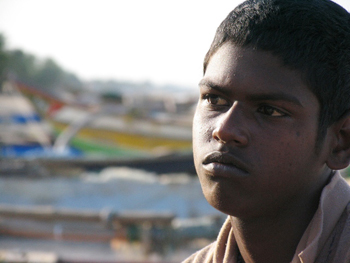
Thillainayagam Theeban (1990 – 2007)
Since we started Children of Tsunami media project in early 2005, as a citizen media response to the Indian Ocean Tsunami, I have introduced it to dozens of audiences of many and varied kinds in different parts of the world. But presenting our documentary, Children of Tsunami: The Journey Continues to the 15th DC Environmental Film Festival at the World Bank headquarters yesterday (16 March 2007) was perhaps the most difficult of all.

No, this was not a cynical audience – far from it, they turned out to be a very appreciative one, as I describe in my other post. But this was the first public introduction I had to make after we lost Theeban, the Sri Lankan boy who was one of eight children whose recovery story we tracked and filmed for much of 2005.

Theeban was murdered by unidentified gunmen who stormed into his ‘temporary’ tsunami shelter on 3 March 2007. The death is linked to spiralling political violence that is once again sweeping across Sri Lanka.

When the shocking news reached us three days later, our Sri Lankan camera team at Video Image and we at TVE Asia Pacific just couldn’t believe it. We were all in tears, and some of us were also angry. Theeban, who survived the killer waves 26 months ago (but lost his mom and kid brother in the disaster) suffered many indignities in displacement. And now, he is gone. 

It’s now two weeks since Theeban was killed, but I still can’t speak about it without a lump in my throat.

That’s why I was nervous in introducing the film yesterday at the festival: I knew I was just seconds away from being stuck for words, and overcome with emotion.

My friends in the audience later said I had managed reasonably well. This is what I said as I ended my brief introduction:

“We ran out of funds to sustain our monthly filming beyond end 2005. By then we found that our film crews and we ourselves had become attached to our participating families, and especially the children who worked so closely with our film crews. We remain interested in their personal progress, even if we can no longer publish their stories.

Earlier this month, we received the devastatingly sad news that the Sri Lankan boy we filmed has been murdered –- by unidentified gunmen, right at the ‘temporary’ camp in Eastern Sri Lanka.

Thillainayagam Theeban survived the killer Tsunami waves and endured 26 months of extreme hardship in displacement — only to be swept away by the wave of political violence currently sweeping Sri Lanka.

We still don’t know who killed Theeban, and for what reasons. He was abducted by an armed group a few months ago, from whom he escaped earlier this year. It is believed that Theeban was killed as a punishment — and as a warning to all others.

He was 16 years at the time of his death. We don’t know if his killers would ever face justice.

I want to dedicate this screening to Theeban — and thousands of young people like him who are still languishing in temporary shelters, struggling to rebuild their futures.”

After the screening, there was some sympathy and empathy in the audience about Theeban. But on the whole this particular development didn’t inspire too many questions or remarks. The predominantly American audience seemed more intrigued by our journalistic documentation of how evangelical Christian groups rushed to tsunami-struck Asia, offering relief support coupled with religious conversion. (Find out more about this by watching the film online.)

Ah well, everyone takes away something different from a film like Children of Tsunami. It has so many facets and elements mixed together.

We set out asking lots of questions, and found only a few answers. We still have lots of questions in search of answers…and new ones emerging.

Thillainayagam Theeban (1990 – 2007)

TVE Asia Pacific official statement on Theeban’s death

My personal tribute to Theeban, published by MediaHelpingMedia, UK

My tribute to Theeban, published by UCLA Asia Media