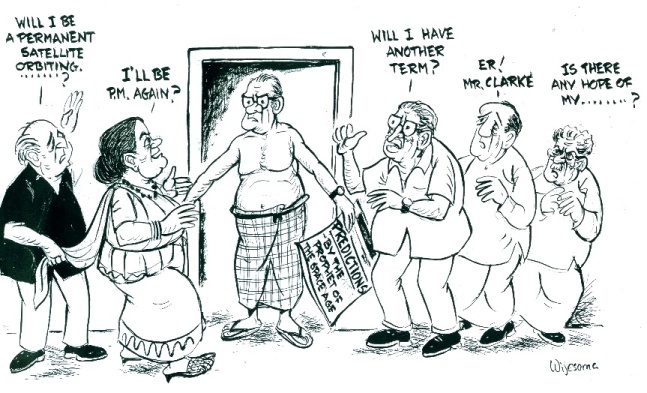
Space prophet mobbed by anxious politicians: Cartoon by W R Wijesoma in The Observer (Sri Lanka)
This cartoon is nearly as old as myself! It was drawn by Sri Lanka’s leading political cartoonist W R Wijesoma and appeared in The Observer newspaper of Colombo sometime in the late 1960s (I haven’t been able to ascertain the exact date).
It shows science fiction writer (later Sir) Arthur C Clarke, already settled down in Ceylon (later Sri Lanka) and ‘Serendipitised’ enough to sport the native attire of sarong, being mobbed by the island’s leading politicians — all of them now departed — each wanting to know what he can foresee or foretell about their personal political futures.
Sir Arthur, whose 91st birth anniversary falls today, took pains to explain that science fiction writers like himself were not soothsayers with powers to predict the future. He was fond of quoting fellow SF writer Ray Bradbury’s famous saying: “People ask me to predict the future, when all I want to do is prevent it.”
But that kind of reason never deterred politicians of every colour and hue, who are always anxious to know just when they can get elected – or return – to high office and all the trappings of power that go with it.
To mark the birth anniversary – the first since his death in March 2008 – I have just published an op ed essay, titled Sir Arthur C Clarke: A life-long public intellectual, on Groundviews website. In this essay I explore, briefly, some of his life-long pursuits for more rational discussion and debate in public policy. I also wonder how and why he lost his struggle against Sri Lankans’ obsession with astrology.
Here’s an excerpt:
But even half a century of Arthur C Clarke could not shake Sri Lankans off their deep obsession with astrology — the unscientific belief that human destinies are somehow shaped and controlled by celestial bodies millions of kilometres away. A life-long astronomy enthusiast, he repeatedly invited astrologers to rationally explain the basis of their calculations and predictions. This challenge was craftily avoided by astrologers who continue to exercise much influence over politics, public policy, business and everyday life in Sri Lanka.
Despite his broad-mindedness, Clarke couldn’t understand how so many highly educated Sri Lankans practised astrology with a faith bordering on the religious (another topic on which he held strong views). Ironically, even the government-run technical institute named after him used astrologically chosen ‘auspicious times’ for commissioning its new buildings. In later years, Clarke would only say, jokingly: “I don’t believe in astrology; but then, I’m a Sagittarius — and we’re very sceptical.”
On a personal note, I’m truly privileged to have known and worked with both Sir Arthur Clarke and his cartoonist W R Wijesoma (who was my senior colleague at The Island newspaper which he joined at its inception in 1981). I know how much Sir Arthur liked this cartoon, the original of which he obtained from Wijesoma and preserved among dozens of other souvenirs and mementos.
Alas, Wijesoma left us in January 2006 — or he might just have drawn another brilliant cartoon to send off Sir Arthur on his final journey. In fact, a worthy follower of Wijesoma’s cartoon tradition did just that earlier this year – see this blog post of mine from March 2008: Arthur C Clarke autographing all the way to the Great Beyond….?
Alexandr Solzhenitsyn: image courtesy New York Times
“For a country to have a great writer … is like having a second government. That’s why no régime has ever loved great writers, only minor ones.”
The great Russian writer Aleksandr Solzhenitsyn, who died 3 August 2008 aged 89, made this remark 40 years ago, in The First Circle(written in the early 1960s, and first published in the West in 1968).
The mighty man, who stood up to one of the most tyrannical states in history – and outlived it by almost 20 years – was buried this week at the Donskoy Monastery, Moscow, as he had wished. That was a far more dignified and respectable departure than what the late, unlamented Soviet Union received when it disintegrated in 1989-90.
From the time his death was reported, post-Soviet Russia, and the rest of the reading and caring world, stood in solemn, grateful silence in awe of the living legend that Solzhenitsyn had become in his own life time. As a small-time writer of no consequence, I join them in my own personal salute.
As every writer – major and minor – who has ever heeded his or her conscience knows, standing up to governments is an extremely hazardous business, especially in a world where might often emerges as right, at least in the short term. In the twenty first century, governments may adopt more subtle methods of suppressing dissent, but their final effect is no less sinister than those brutal ones that Soviet Union followed at the height of the Cold War in the 1950s and 1960s.
I must admit here and now that I haven’t read any of Solzhenitsyn’s celebrated works. But that doesn’t diminish my admiration for him as one of the world’s best known writer-dissidents. Any man who stands up to Big Bad Governments defies all odds, and a man who employs only ideas and words in such a struggle is a greater hero in my mind than anyone else.
A high school teacher of mine, who was a great fan of Solzhenitsyn, once told us: “Never underestimate the power of well written and sincere words.” That was in the mid 1980s, when the writer was living in exile in the United States and the Soviet Union still seemed unshakable. But subsequent events have proved how prophetic those words were.
In a sense, many of us will never quite discover the true Solzhenitsyn. Unless we learn Russian at this stage in life, we can only read Solzhenitsyn through English translations — and as I have discovered this week by browsing widely online for writing by and about him, the quality of these translations vary considerably.
“During all the years until 1961, not only was I convinced that I should never see a single line of mine in print in my lifetime, but, also, I scarcely dared allow any of my close acquaintances to read anything I had written because I feared that this would become known. Finally, at the age of 42, this secret authorship began to wear me down. The most difficult thing of all to bear was that I could not get my works judged by people with literary training. In 1961, after the 22nd Congress of the U.S.S.R. Communist Party and Tvardovsky’s speech at this, I decided to emerge and to offer One Day in the Life of Ivan Denisovich.
“Such an emergence seemed, then, to me, and not without reason, to be very risky because it might lead to the loss of my manuscripts, and to my own destruction. But, on that occasion, things turned out successfully, and after protracted efforts, A.T. Tvardovsky was able to print my novel one year later. The printing of my work was, however, stopped almost immediately and the authorities stopped both my plays and (in 1964) the novel, The First Circle, which, in 1965, was seized together with my papers from the past years. During these months it seemed to me that I had committed an unpardonable mistake by revealing my work prematurely and that because of this I should not be able to carry it to a conclusion.”
Thus, the 1960s was the turning point when hitherto obscure Solzhenitsyn burst into the literary landscape of his native country, and his uncompromising stand against the suffering of his people brought him worldwide attention.
Solzhenitsyn’s open letter to the Fourth Soviet Writers’ Congress, on 16 May 1967, was particularly outspoken and expressive of his views of the social responsibility of writers and artistes: “Literature that is not the breath of contemporary society, that dares not transmit the pains and fears of that society, that does not warn in time against threatening moral and social dangers — such literature does not deserve the name of literature; it is only a façade. Such literature loses the confidence of its own people, and its published works are used as wastepaper instead of being read.”
By then under siege by the entire might of the USSR, and having only his formidable guts and wits as his defence, he already had a strong sense of destiny. In the same open letter, he added: “I am of course confident that I will fulfill my tasks as a writer in all circumstances — from my grave even more successfully and more irrefutably than in my lifetime. No one can bar the road to truth, and to advance its cause I am prepared to accept even death. But may it be that repeated lessons will finally teach us not to stop the writer’s pen during his lifetime? At no time has this ennobled our history.”
Solzhenitsyn’s global stature in the world of letters was reaffirmed in 1970 when he was awarded the Nobel Prize in Literature. But he could not receive the prize personally in Stockholm – he was afraid he would not be allowed back into the Soviet Union. He finally collected his prize only at the 1974 Nobel ceremony after he had been deported from the Soviet Union.
In his Nobel Prize Lecture (delivered to the Swedish Academy but never actually given as a lecture), I came across these words which epitomise the man and his views: “Woe to that nation whose literature is disturbed by the intervention of power. Because that is not just a violation against ‘freedom of print’, it is the closing down of the heart of the nation, a slashing to pieces of its memory. The nation ceases to be mindful of itself, it is deprived of its spiritual unity, and despite a supposedly common language, compatriots suddenly cease to understand one another. Silent generations grow old and die without ever having talked about themselves, either to each other or to their descendants. When writers such as Achmatova and Zamjatin – interred alive throughout their lives – are condemned to create in silence until they die, never hearing the echo of their written words, then that is not only their personal tragedy, but a sorrow to the whole nation, a danger to the whole nation.”
Solzhenitsyn’s writing is studded with such gems that I’ve resolved to discover even if belatedly. After all, I’m now at the exact age (42) when he finally decided to start publishing his work — a monumental personal decision that has left its mark on history.
For now, my favourite Solzhenitsyn quote is one that resonates so well with my own current turmoils in life: “If one is forever cautious, can one remain a human being?”


 Open Minds!