Money is not an issue: ‘No budget’ films have their own festival

After over a decade working in television and film, most of that time commissioning new content from independent producers or creating content ourselves, I have yet to come across a film-maker who had enough budget.

We’re are all used to getting by with less than ideal budgets.

Some more than others, though: there are low budget films, and then there are ‘no budget’ films.

A few idealists among us still believe money is not an issue in cultural expression.

They now have their own festival, unashamedly for just that kind of films: No Budget VideoFilmfestival, Heilbronn / Weimar & Tour 2007
No budget video film festival

Their self-intro reads:

In 2007 the „Geld spielt keine Rolle“ (“money is not an issue””it’s only money”) VideoFilmfestival will start a series of events during an independent art-, film- and musicfestival in Heilbronn. From the 8th to 10th of June 2007 it will be in Heilbronn, and thereafter will be ample opportunity to screen the films in Weimar (at the Lichthaus Kino in summer 2007), Magdeburg, London and other cities. The previous festival was carried by the faculty of media of the Bauhaus- University Weimar and took place in Weimar in May 2006.

Filmmakers characterized by creativity and idealism get the opportunity to present their films to a wide audience.
For the audience this promises good films which possibly fall through the cracks of commerce.

Remember: deadline for entries is 1 May 2007.

The festival is being organised by a group of German film enthusiasists calling themselves the film sharing community.

Under the topic GELD SPIELT KEINE ROLLE (Money is no issue) the film sharing community wants to provide a platform for productions of moderate means achieving remarkable outputs and meaningful films on a shoestring.

May their tribe increase!

Michael Crichton, Mediasaurus and end of broadcasting

I just wrote a post on digital pioneer and futurist Mark Pesce’s views on the end of broadcasting and the mass media as we know it.

Television broadcasting is probably a dinosaur facing extinction, but let’s remember a bit of pre-history here: dinosaurs didn’t die off in an instant. No time lord zapped them with some mighty extincter machine. Their decline and eventual extinction was, it is believed, a slow and gradual process.

So it will be with broadcasting. Even if their distribution and revenue models are now undermined and will soon be obsolete, conventional broadcasting (as we know it) will continue to operate and try to compete, at least for a few years. And in the less developed countries with emerging economies, that process will take longer.

Which means we still have to engage TV broadcasters even as their Empires of Eyeball slowly crumble.

And let’s not write off those Empires just yet. I still remember an article in the early days of Wired magazine: appearing in Sep-Oct 1993 issue, it was titled Mediasaurus , and written by the well known science fiction author (and medical doctor) Michael Crichton (of Jurassic Park and ER fame).

Michael Crichton, courtesy Michael Crichton website

He started the article as:
I am the author of a novel about dinosaurs, a novel about US-Japanese trade relations, and a forthcoming novel about sexual harassment – what some people have called my dinosaur trilogy. But I want to focus on another dinosaur, one that may be on the road to extinction. I am referring to the American media. And I use the term extinction literally. To my mind, it is likely that what we now understand as the mass media will be gone within ten years. Vanished, without a trace.

And he ended:
So I hope that this era of polarized, junk-food journalism will soon come to an end. For too long the media have accepted the immortal advice of Yogi Berra, who said: “When you come to a fork in the road, take it.” But business as usual no longer serves the audience. And although technology will soon precipitate enormous changes in the media, we face a more immediate problem: a period of major social change. We are going to need a sensitive, informed, and responsive media to accomplish those changes. And that’s the way it is.

I just re-read the full article, and Crichton’s analysis is even more valid today than when it was written over a dozen years ago. But it’s also true that the broadcast industry – and conventional media as a whole – have changed and adapted.

No doubt that Mediasaurus still has an expiry date, but it’s not easy trying to guess exactly when the last of their kind drops dead.

Read the full article on Wired Online

Mark Pesce: In the company of a hypermind

Oops – I didn’t immediately realise that I was sharing a panel with a digerati – a highly accomplished pioneer and visionary of the digital world. And did he get us to think outside the idiot box!

His name is Mark Pesce. He is one of the early pioneers in Virtual Reality.
The co-inventor of VRML, he is the author of five books and numerous papers on the future of technology. Now based on Sydney, Australia, he is a writer, researcher and teacher.

Mark Pesce, courtesy Wikipedia

During the OUR Media 6 panel discussing how to safeguard community interests in the era of digital broadcasting, he was emphatic that broadcasting as we know it is doomed.

“The mass mind is not going to last. The sooner broadcasters recognise this, the better,” he said.

The broadcast model of one-way, point-to-multipoint, passive distribution of content is endangered by the digital revolution. The age of hyperdistribution has already dawned, and that is going to wipe out conventional distribution models sooner than later.

Hyperdistribution is audience-driven distribution of films and television programmes. The economics of production and distribution of media have changed radically – can film-makers adapt to the new rules? This is the question that Mark posed in talk given at the Sydney International Film Festival in Jube 2006 – listen to audio recording of his talk.

The near future of content distribution is in Internet-enabled, user-driven and often mobile devices. Already, two billion people – almost a third of humanity – walks around with mobile phones. These will provide new pathways to peddle new types of content to more audiences than ever before.

The film-making and TV-producing communities need to wake up to these new realities, Mark said.

His blog, Hyperpeople, is full of fascinating insights and extrapolations. Here’s one short extract:
Television producers are about to learn the same lessons that film studios and the recording industry learned before them: what the audience wants, it gets. Take your clips off of YouTube, and watch as someone else – quite illegally – creates another hyperdistribution system for them. Attack that system, and watch as it fades into invisibility. Those attacks will force it to evolve into ever-more-undetectable forms. That’s the lesson of music-sharing site Napster, and the lesson of torrent-sharing site Supernova. When you attack the hyperdistribution system, you always make the problem worse.

In May 2005, he wrote in an article titled Piracy is good? How Battlestar Galactica killed broadcast TV:
Television broadcasters owe their existence to the absence of substantially effective competition. When you’re dealing with real-world materials that are in naturally short supply – whether diamonds, oil, or broadcasting spectrum — a cartel can maintain and enforce its oligopoly. But when you’re working with media, which exist today as digital ephemera, bits that can be copied and reproduced endlessly at nearly zero cost, broadcast oligopolies are susceptible to a form of “digital arbitrage,” which can hollow-out their empires in an afternoon. Hyperdistribution techniques are more efficient than broadcast networks for television program distribution.

Read my other post on the OUR Media Forum on the community use of digital spectrum

Mark Pesce website

Mark Pesce blog, Hyperpeople

Blogging turns 10 – Happy Birthday to Us!

“Check this out. Amazing!”

Four simple words. Yet they sparked what snowballed into a revolution of sorts on the web.

Those were the very first words to be written on the first blog.

Blogging turned 10 on 1 April 2007.

Created by the US web guru Dave Winer, Scripting News is regarded as the first modern blog, though the term “weblog” was not used in the early days.

Having first gone online on 1 April 1997, Scripting News is still going strong and is credited with helping popularise RSS and podcasting, too.

Winer himself actually calls info.cern.ch, built by Tim Berners-Lee, the first weblog because it “pointed to all the new sites as they came online”.

According to his blog (what else?), Winer, 51, pioneered the development of weblogs, syndication (RSS), podcasting, outlining, and web content management software. He is a former contributing editor at Wired Magazine, my own favourite guide to the often bewildering but fascinating digital world.

Latest figures indicate an estimated 70 million blogs in existence, with around 1.5m posts being written every day.

According to Technorati, which monitors and aggregates blogs, some 120,000 new weblogs being created worldwide each day – that’s about 1.4 blogs every second.

Oh, and what did Dave Winer want checked out? It was just a list of websites he had visited that day.


Read The Guardian (UK) article on 10 years of blogging.

Let’s resolve analog anomalies before going fully digital…

At the last minute, I was invited to join a forum on Community use of digital spectrum at OUR Media 6 Conference here in Sydney.

I agreed because I have written and spoken for years about how we in developing Asia are blissfully ignorant about the gross misuse and abuse of our electro-magnetic spectrum by its custodians – our governments.

I was the odd one out on this panel, as all others were from Australia -– I don’t even live in a country that has set a timeframe for transition from analog to digital spectrum in broadcasting.

Only a few countries in Asia have as yet announced a timeframe for this -– Japan, Korea and Malaysia among them. Some have not even thought of this issue – they are dealing with more basic concerns in broadcast regulation and policy formulation. Yet I found this discussion instructive: sooner or later, all countries will have to go through this transition. It certainly helps to know the issues you are debating and grappling with.

Cartoon Stock

An extract from my remarks:

We should address fundamental reforms in broadcast policy, law and regulation before embarking on the high-cost, tedious and slow process of moving the entire production and distribution process to digital. We who haven’t derived and shared the full benefits of analog broadcasting must get our fundamentals right before going digital.

And therein lies the challenge for all of us who want to safeguard media freedom and promote the freedom of expression and cultural production. In my view, many activists in our region are not paying enough attention to how the electro-magnetic spectrum has been mismanaged and abused by various governments. Activist attention has been held by the more tangible, physical threats to media freedom: issues such as censorship, media ownership and political economy of the media.

All these are worthwhile and necessary — but not sufficient on their own.

During discussion, I also made the points:

The spectrum has been called the ‘invisible wealth of nations’. As economic and cultural practices move more and more into the digital realm, we’re going to increasingly feel the value of this common property resource. All our gains in the physical world would be undermined if we find the spectrum has been irretrievably allocated to a handful of privileged users ignoring the public interest. We need to wake up to this reality.

Perhaps it’s just as well we in developing Asia don’t have tight timeframes to switch from analog to digital spectrum use. We’ve got a good deal of cleaning up and streamlining to do in the analog realm.

This window will be open only for a few years. If we don’t act, we run the risk of making an equal mess in the digital spectrum, only far worse.

In terms of action, I suggest three simple yet important steps:

For us in the developing countries – or emerging economies – in Asia, I suggest three actions:
• Look forward to the transition from analog to digital spectrum
• Look sideways to see how we’re currently doing in the analog domain
• Look back to reflect on the mistakes we’ve made along the way (and learn)

Read the cleaned up text of my panel remarks plus responses
om6-forum-on-digital-spectrum-nalaka-remarks.pdf

Wikipedia on Open Spectrum

A foot in both graves? OURMedia, here I come!

I’ve just arrived in Sydney, Australia, to participate in, and speak at, OURMedia/NUESTROSMedios 6 Conference, 9-13 April 2007.

There are over 130 presentations planned over the 5 days from representatives from over 85 international and Australian organizations and over 35 countries. I’ll be talking about ‘Communicating Under Duress: The Children of Tsunami experience’ on April 10 afternoon.

ourmedia-vi-banner.jpg

According to the conference website:

OURMedia / NUESTROS Medios is an international network and forum founded in 2001 by a group of engaged academics interested in advancing the democratic potential of community, alternative and ‘citizens’ media. Recognising that the intellectual and policy frameworks for citizens’ media are often out of touch with the on-the-ground reality, the purpose of OURMedia is to connect scholars, practitioners, activists and policy-makers towards defined outcomes. OURMedia is now a network of over 500 people from 50 countries and has generated an extensive body of practical and theoretical knowledge primarily in English and Spanish. It constitues a unique space of dialogue between academics and practitioners, advocates and artists working in community, alternative and citizens’ media.

Past OURMedia conferences have been organized in the United States (2001), Spain (2002), Colombia (2003), Brazil (2004) and India (2005). These conferences have consisted of scholarly and academic presentations, media activism initiatives, policy workshops, community cultural development roundtable debates, new media labs, research-led forums and engagements by local media producers.

I’m not an academic, although in my media and communication work I often work with researchers and academics, always asking them to say things in simpler words. I speak and write in very practical, pragmatic terms — not in academese. I sometimes wonder how it goes down with academic colleagues who typically utter four jargon terms out of every ten. But somehow, I must be doing a few things right because I often get invited back!

Which reminds me what John Naughton, British columnist on new media and academic said about the double-life of a journalist-cum-academic (or the other way round):

When I was an undergraduate I became heavily involved in student politics and in the process got to know some newspaper editors who asked me to write articles for them. So I did — and to my astonishment they sent money in return. Figuring that this was a great racket I continued to do it. One of my famous fellow-countrymen, Conor Cruise O’Brien has also been an academic and a journalist all his life. He describes it as “having a foot in both graves”. I try and keep the two sides of my life separate. My journalistic mates think I must be a good academic on the grounds that I’m not much of a journalist, while my academic colleagues think I must be a good journalist (on the grounds that…). They’re both wrong.

John wrote A Brief History of the Future: The origins of the Internet. He writes a weekly column about the Internet in the business section of The Observer newspaper in the UK.

Long live MediaChannel.org!

I have never peddled a fund raising appeal through my blog…until now.

Earlier today, I received my daily email from MediaChannel.org, a website that critiques the media — ‘As the media watch the world, we watch the media’

According to their website: MediaChannel is concerned with the political, cultural and social impacts of the media, large and small. MediaChannel exists to provide information and diverse perspectives and inspire debate, collaboration, action and citizen engagement.

And like many of us who mix media and social activism, they are facing a crisis. Today’s email said:

After seven years and a new website redesign, MediaChannel.org may have to cease operations because of a financial emergency. As most of you have already noticed, we have started to run advertising on the website in an effort to deal with our funding challenge.

To put it bluntly, the future of MediaChannel is in question. Please consider making a tax deductible donation online through PayPal or send a check made out to: The Global Center, 575 8th Avenue, Suite 2200, New York, New York, 10018.

MediaChannel is headed by Danny Schechter, the Emmy-award winning TV journalist and film-maker.

I met Danny in the Fall of 1995, when I spent a few weeks in New York on a fellowship to study the United Nations. Danny was one of the more colourful people we met (besides lots of men in suits from the UN, only a few of whom I can now recall by name). Danny introduced himself as a (TV) ‘network refugee’ — and gave a workshop on television journalism in defence of the public interest and human rights that had a lasting influence on myself.

Besides running MediaChannel.org, Danny writes the well-informed, incisive NewsDissector blog

Since then, we’ve been in contact occasionally. And here’s my declaration of interest: MediaChannel.org has published my media related op ed essays, though I never get paid and never expect any payment.

As Walter Cronkite says: “MediaChannel is undoubtedly worth taking part in. So many leading groups and individuals around the whole world have come together.”

And MediaChannel.org is undoubtedly worth supporting.

Read my last op ed on MediaChannel:
Ethical news-gathering: Al Jazeer’s biggest challenge

Digits4Change: Do ICTs make a difference?

When it comes to bridging the Digital Divide, there’s so much hype, rhetoric and confusion. For many in the UN system, it’s just another development issue to be bandied about at endless meetings and conferences, and to be reflected upon from 30,000 feet above the ground where they find themselves most of the time.

Yet, at the ground level, individuals and communities are adapting various ICTs to meet their practical needs and solve real world problems. I sometimes feel that whatever bridging of the Digital Divide will happen in spite of, and not because of, the UN agencies and other development players debating issues to exhaustion.

In 2005-2006, we at TVE Asia Pacific documented some of these efforts in different parts of Asia. We looked at a variety of technologies solving a range of problems. This became Digits4Change.

digits4change.jpg

Here’s our series intrdocution:

There are more poor people in the Asia Pacific than in all other regions combined. At the same time, some Asian countries have achieved the most advanced economies in the world. Their prosperity is partly due to how they have developed or adopted information and communication technologies — or ICTs.

How can the developing countries of Asia use these digital tools to help generate wealth, create more jobs and improve living conditions of people? Governments, private sector, civil society and researchers have been trying out various approaches for years. The World Summit on the Information Society (WSIS) in 2003 – 2005 took stock of what has been accomplished, and what remains to be done.

TVE Asia Pacific – a regional leader in using audio-visual media to cover development issues – embarked on documenting examples where ICTs have made a change in people’s lives in the world’s largest region. We investigated stories on distance learning, business process outsourcing, tele-health and rural connectivity.

The result is a new video series: Digits4Change.

Watch Digits4Change stories on TVEAP’s channel on YouTube

Read my views on the newly launched UN Global Alliance on ICTs for Development , published on SciDev.Net

Have you made your million dollars yet?

Money, money, money!

Many development film-makers like to decry our society’s obsession with money, consumerism and greed. Some would make films that passionately promote sharing ideas and resources at community level, and advocate common property resources over private ownership.

But when it comes to rights of their own film/s, these very film-makers would become extremely possessive: they want to restrict it in every conceivable way.

They feel justified in such sentiment and action: after all, they have invested a great deal of time, effort, creativity and hard-won resoures to make their films. They must now seek a ‘return on investment’ like everyone else (it’s a material world!). Film-makers too have families to feed.

No argument on that last one. But it would be interesting to find out how many – or how few – development films deliver any appreciable ‘returns on investment’ to their makers. Certainly in developing Asia, development film-makers will be seriously endangered species if they had to rely on license fees or royalties for their survival.
https://i0.wp.com/www.hcn.org/allimages/1996/oct28/graphics/961028.001.gif
After a dozen years of extensive networking with environment, wildlife and development film-makers across Asia Pacific, I have yet to come across a single film-maker who made his or her million dollars from a film.

Yet, many continue to cling on to the traditional notion of copyright in film, perhaps hoping that sooner or later, that cherished million bucks would come calling.

And in the meantime, they continue to approach every known funding source – and many unknown and unlikely ones – for supporting their next film. At TVE Asia Pacific, we receive our fair share of these requests every month – and we are not even a funding source for independent films! These requests are accompanied by impressive CVs or filmographies, listing past films produced.

Produced, yes. But how many are circulating? How many have been seen outside film festival circuits, or beyond a one-off broadcast (or two)? How many films are available for educational, advocacy, training or activist purposes at affordable cost of duplication and dispatch?

The answer is depressing: precious few.

Because our film-makers are waiting for their million dollar deal or sale, and won’t let go of their creations. Even if many have been made using development donor (i.e. public) funding, these films are not in the public domain.

That, to me, is incongruent with the lofty ideals that many development films proclaim: sharing ideas and resources at community level, and advocating common property resources.

We have to walk our talk, or we risk joining the already burgeoning ranks of hypocrites in our societies.

The time has come for documentary film-makers, especially those covering development topics, to take a fresh look at copyright. That doesn’t mean abandoning all our rights to be known and acknowledged as creators of our films.

For a start, I strongly recommend an interesting and insightful essay, “Shoot, Share and Create: Looking beyond copyright makes sense in film“, written by a young Indian lawyer-activist specialising in intellectual property. Lawrence Liang is a Bangalore-based lawyer who works at the Alternative Law Forum. I had the opportunity of meeting the dynamic and articulate Lawrence at the Asia Commons meeting in Bangkok in June 2005 – he’s certainly a man to watch in this rapidly evolving field of managing our digital commons and how to safeguard the public interest in the bewildering era of digital media.
Lawrence Liang

Here’s how he starts his essay, which he wrote as an open letter addressed to Indian documentary filmmakers:

When I was in law school, I had great aspirations of wanting to be a filmmaker, and an FTII-type (Film and TV Institute of India, a prominent school for film-making) friend told me the best place to start was to watch a lot of foreign films and documentaries. So I did that rather dutifully and spent many hours when I should have been reading corporate law, watching documentaries.

My fondest memory of my placement in Mumbai with a law firm was when we took off to the Tata Institute of Social Sciences (TISS) and watched Anjali Monteiro and K P Jayashankar’s film on the Yerawada prison in Pune.

I gave up on the idea of becoming a filmmaker after we finally did do a documentary on law school. But by then the bug had bitten and I had fallen in love with cinema and the documentary form as well. I think watching documentaries has also made me a better lawyer than I would have been if I read Ramiaya on the Indian Companies Act. So if I have written this rather longish argument about why documentary filmmakers should start thinking about open content licenses, it is with a sense of repaying a debt.

Read the full essay at Alternative Law Forum website

Read my own call for recognising poverty as a copyright free zone

You got films on YouTube?

Earlier this year, we at TVE Asia Pacific decided to place all our short video films on YouTube.

We are always willing to try out new ways of reaching out to the various – and increasingly fragmented – publics. Any new media format or platform that comes into the public domain is to be explored and exploited to peddle our content.

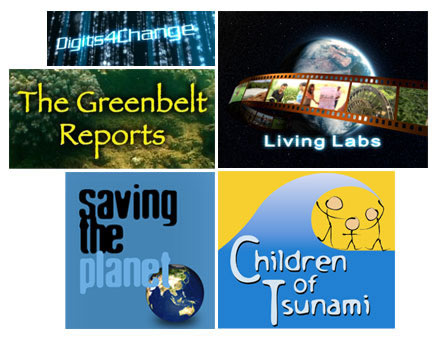
With this in mind, we launched the TVEAPFilms channel on YouTube in February 2007. We have so far placed three distinctive TV series on this channel:

Digits4Change, which explores how information and communications technologies (ICTs) are changing lives and livelihoods across Asia (6 x 5 min stories)

The Greenbelt Reports, where we revisited tsunami-affected countries in South and Southeast Asia, investigating how communities co-exist with coastal greenbelts of coral reefs, mangroves and sand dunes (12 x 5 min stories)

Living Labs, our latest series which was released this month, which profiles global action research efforts to grow more food with less water (8 x 5 min stories)

Since then, attending film festivals in Singapore and Washington DC, I realised that many documentary film-makers aren’t yet convinced about this new outlet.

‘You got your films on YouTube?’ one film-maker asked me somewhat incredulously. ‘How can you be sure someone will not download and manipulate it?’

Well, we can’t be sure. But that doesn’t prevent us from engaging this new platform. We’re willing to take these risks.

Another colleague asked: ‘But isn’t that a place for all those ameteurs?’ Perhaps. But in this digital age, the division between so-called amateurs and professionals is blurring.

Some film-makers have started placing trailers for their longer films on YouTube. Since we produce a fair number of short, self-contained films — all of which come under the YouTube’s upper limit of 10 mins — we are able to place our entire films online.

And unlike broadcast television and even passive webcasts, YouTube allows our online viewers to comment on films, and if they feel so moved, even to rank them.

At TVE Asia Pacific, we want our moving images to move people…so they join the conversation. In that sense, YouTube is a good platform to be on, and a good community to be part of.

Do visit TVEAPFilms channel on YouTube. Tell us what you think – whatever you think.