Gasp! Asthma on the rise – and we made it all possible

Gasp!

This morning, I woke up at 4.30 in the morning struggling to breathe. It’s another attack of asthma.

My lungs don’t know – and won’t care – that yesterday, 1 May, was World Asthma Day. All my long-suffering lungs need is some fresh air.

But in the increasingly polluted — and right now, incredibly humid — Greater Colombo, I’m not likely to find it any time soon.

World Asthma Day is designed to increase awareness of asthma as a global health problem. Those who live with Asthma, and suffer on a daily or weekly basis, know what it’s all about.

I’m among the lucker ones. My asthma is well under control most of the time, but an inhalor is never far away. In fact, asthma is my personal indicator of how clean or polluted the air is in places I visit on my frequent travels.

I’ve had bad attacks in Beijing and Kathmandu. No surprises there. But at least in the latter city, which I’ll be revisiting soon, my lungs feel that the air quality has been getting better.

So there is some good news, even if we have to look hard and dig deep for it. That’s part of the job for us journalists — and in this instance, I readily declare my self interest: I want to breathe more easily!

Last year, TVE Asia Pacific conducted a regional media training workshop on covering air quality issues in Asia. That was part of the Better Air Quality 2006 event, a large gathering of everyone concerned with cleaner air issues. It was held in Yogyakarta, Indonesia, in mid December 2006. Read TVE Asia Pacific website coverage of BAQ 2006 and the media training workshop.

Political, scientific and industry leaders made lofty statements about the value of clean air. Rachmat Witoelar, Indonesia’s environment minister, said clean air was more important for Asians than even rice, the staple food for most Asians.

Inspired by the week-long event, I wrote an op ed essay that month titled ‘Grappling with Asia’s Tsunami of the Air’. It has appeared online at several websites.

Images courtesy TVE Asia Pacific

In that essay, I argued:

In the wake of the Asian Tsunami, some development and humanitarian groups used the phrase ‘silent tsunami’ to describe slowly unfolding emergencies that rarely attract much media coverage or global compassion. UN Secretary General Kofi Annan made frequent, passionate references to the ‘daily tsunami of poverty, hunger, disease and environmental degradation.’

It’s easy to call Asia’s air pollution induced sickness and death another silent tsunami. Except that there is nothing silent about it: the lung-corroding, heart-threatening, cancer-causing and blood-poisoning pollutants are released with a thunderous roar from the region’s cars, trucks, buses, motorcycles and other motorised vehicles. Anyone who has stood in a busy intersection in an Asian megacity knows exactly what I mean.

For the want of a phrase, we might call this Asia’s ‘tsunami of the air’.

And this tsunami is very much of our own making — let’s acknowledge that we are all part of the problem, some more than others. It makes us culpable for what India’s Centre for Science and Environment (CSE) once termed ‘slow murder’ by dirty air.

Read the full essay on One World South Asia

Related:

TVEAP News: Rising Asia chokes, but continues its quest for cleaner air

Clean Air Initiative for Asian Cities

Images courtesy TVE Asia Pacific

Remembering Saneeya Hussain

20 April 2007: It’s exactly two years ago that Saneeya Hussain left us.

Saneeya was a journalist who took a special interest in environment and human rights issues. All her working life, she campaigned tirelessly for a cleaner, safer and more equitable society for everyone — not just in her native Pakistan, but everywhere.

Ironically, it was the urban nightmare that we have collectively created that finally snatched her away at the prime of her career. She was 51.

saneeya-hussain.jpg

I first met Saneeya when we both worked for the same global organisation – IUCN, The World Conservation Union. She headed IUCN Pakistan’s Communication Division while I started a similar division for IUCN in Sri Lanka in the early 1990s. In fact, the trails she and her team had blazed in Pakistan was a model and inspiration for us.

In 1998, Saneeya moved to Cape Town in South Africa to work with the World Commission on Dams, an independent group of experts that had a tough mandate: consult widely to resolve the controversial issues associated with large dams. When the Commission held its South Asia consultations in Colombo, Sri Lanka, Saneeya approached us at TVE Asia Pacific to handle all the media relations.

It was while working in Cape Town that Saneeya met Luis Ferraz, a Brazilian geographer, whom she married later.

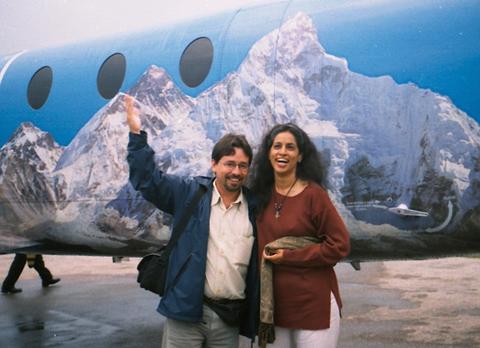
saneeya-and-luis-taking-an-everest-flight.jpg

In 2002, Saneeya became the Executive Director of Panos South Asia, a regional media organisation with its headquarters in Kathmandu, Nepal. As a Board member of Panos, I worked closely with Saneeya in a number of projects and activities.

Although everyone at Panos and in Kathmandu liked her, Saneeya’s stay there was cut short by what her successor at Panos, A S Panneerselvan, called her Siamese twin: asthma.

It was asthma that forced Saneeya to leave Nepal – and the Panos director’s job – as she just couldn’t cope with Kathmandu’s polluted air. As a fellow asthmatic, I fully empathised with her. She moved to Sao Paulo, where she set up what was to be her final home.

What happened in April 2005 has been written and discussed widely by Saneeya’s far-flung network of friends in the past two years. I can only reproduce the last few paras of a tribute I wrote in May 2005, which was privately circulated at the time:

When Saneeya suffered an acute attack of asthma in Sao Paulo on April 7, her husband Luis rushed her to hospital in his car. It was rush hour at 6.30 in the evening, and it took him 20 minutes to drive to the hospital only 2 kilometres away. Saneeya — who had walked to the car — stopped breathing five minutes into the journey. Luis drove as fast as the traffic would allow him, but as it turned out, not nearly fast enough.

Her brain suffered too much damage due to oxygen deprivation, and she never recovered.

As Luis was to remark later, it was not asthma but the traffic that killed Saneeya.

Similar tragic scenarios unfold on South Asia’s mean streets every day. Heart and stroke patients fail to reach help in time. Ambulences and fire engines, with their sirens blaring, only manage to proceed at a snail’s pace. It’s not uncommon for expectant mothers in labour to give birth on their way to hospitals. Then there is the slow, insidious poisoning that goes on 24/7.

So let us be forewarned. If the air pollution doesn’t get us, the traffic jams will. And if we survive both, our road accidents will wait for us. It’s only a matter of time.

Not one but several serial killers are out there.

And we unleashed them all.

beena-sarwar-left-and-saneeya-hussain-photo-courtesy-b-sarwar.jpg

Our mutual friend Beena Sarwar (in the photo above, with Saneeya) has made a 14-minute documentary called Celebrating Saneeya. It was screened at the 5th Karachi International Film Festival in December 2005.

See also my essay ‘Grappling with Asia’s Tsunami of the Air’ (December 2006).

All photos from Saneeya Yahoo Group that links her friends around the world.